
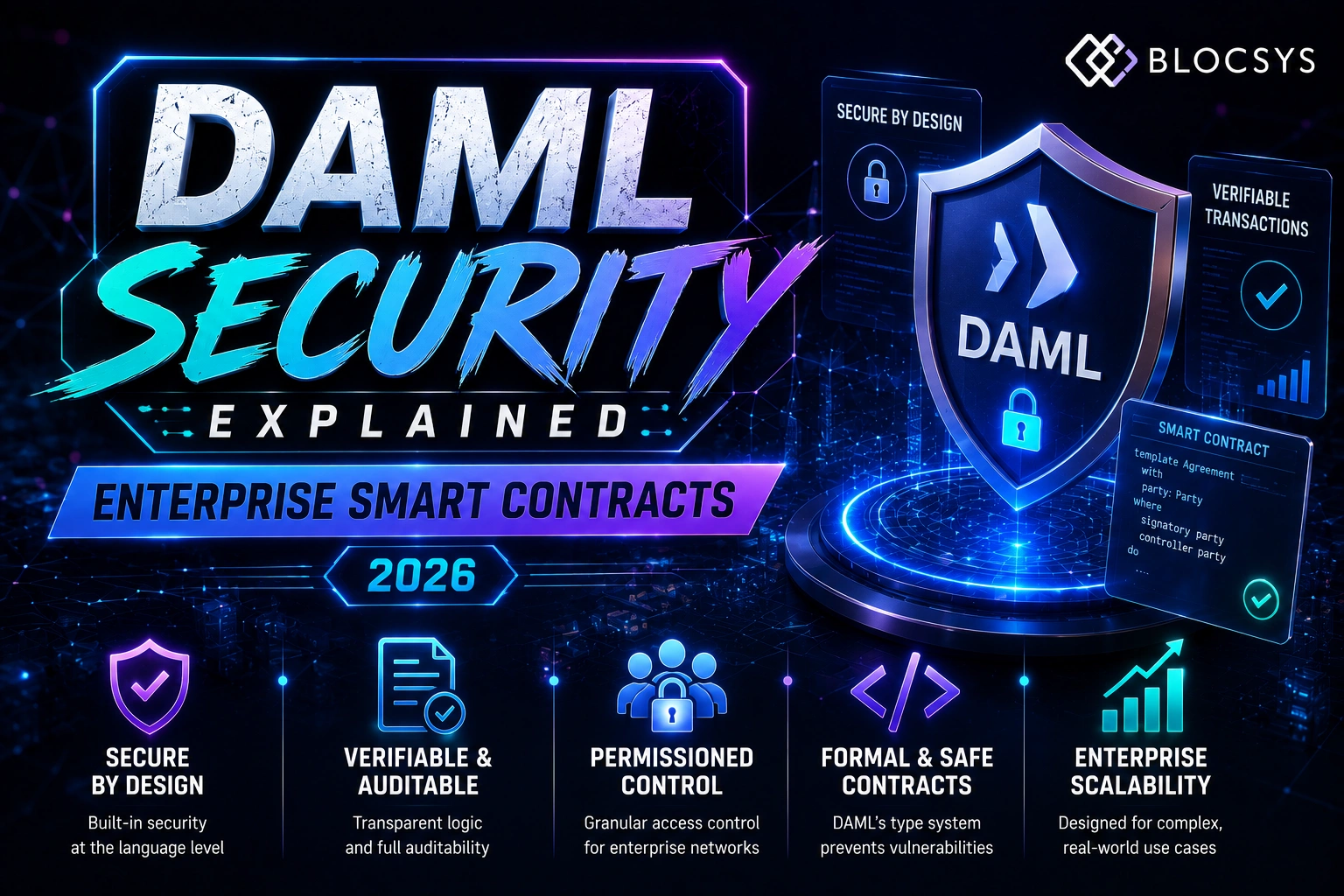
Most enterprise blockchain risk doesn’t come from cryptography failing. It comes from using platforms built for public transparency in environments that require controlled disclosure, explicit authority, and defensible audit trails. That’s why DAML security matters. It changes the problem from “how do we patch smart contract risk?” to “how do we remove avoidable risk from the design in the first place?”
For CTOs, enterprise architects, CISOs, and digital asset leaders, that distinction is practical, not academic. If you’re evaluating permissioned infrastructure for regulated finance, tokenization, or multi-party workflow automation, the primary question isn’t whether smart contracts are powerful. It’s whether the security model matches enterprise obligations around privacy, governance, and operational control. Firms exploring enterprise blockchain development company services from Blocsys usually hit that exact decision point early. Teams also underestimate adjacent engineering risk, especially when architecture choices compound over time. This is one reason the broader discussion around technical debt for non-technical founders remains relevant even in enterprise blockchain programmes.
A useful starting point is understanding what DAML is designed to do differently from public-chain tooling. If you need a foundation before going deeper into security, this overview of what the DAML language is and how it powers Canton is the right pre-read.
Table of Contents
- Introduction Why Standard Blockchain Security Fails the Enterprise
- DAML Permissioned Smart Contracts vs Public Smart Contracts
- The Architectural Pillars of DAML Security
- How Canton Network Amplifies DAML Security and Privacy
- Achieving Enterprise Governance and Regulatory Compliance with DAML
- Enterprise Use Cases DAML Security in Action
- Build and Scale With Blocsys Your DAML and Canton Development Partner
- Frequently Asked Questions About DAML Security
Introduction Why Standard Blockchain Security Fails the Enterprise
Security on public blockchains is often treated as a matter of better audits, better monitoring, and better incident response. Enterprises need something stricter. They need a platform where the default operating model already reflects segregation of duties, confidential workflows, and constrained execution.
That’s where the usual blockchain narrative breaks down. Public smart contract systems were built for open participation and broad verification. Regulated institutions operate under very different assumptions. They need to know who can act, who can see what, how obligations are enforced, and how data exposure is limited without undermining process integrity.
The mismatch is architectural
A public chain gives you a transparent shared state. That’s useful for open ecosystems. It’s a poor fit for proprietary deal terms, internal approval logic, and sensitive counterparty relationships.
DAML takes the opposite route. It’s designed for permissioned smart contracts where rights, obligations, and visibility are explicitly modelled. That means enterprise blockchain security isn’t bolted on with after-the-fact controls. It starts in the contract model itself.
Public-chain security often asks, “How do we detect harmful behaviour?” Enterprise security asks, “Why was that behaviour even possible?”
Why this matters to leadership teams
Technical leaders usually aren’t worried about whether a smart contract can execute. They’re worried about whether it can execute safely inside a business process that includes compliance teams, auditors, external counterparties, and internal control owners.
In DAML-based systems, security is tied to workflow design. The contract doesn’t just store state. It encodes who is authorised to create, approve, observe, and settle actions. That’s a much closer fit for banks, capital markets infrastructure, tokenization platforms, and enterprise consortia than the public-chain model of universal visibility.
For executive teams, the core point is simple:
- Risk containment: Fewer exposed functions and less unnecessary visibility.
- Operational clarity: Rights and obligations are machine-enforced.
- Compliance alignment: Privacy and auditability can coexist more naturally than they do on transparent ledgers.
DAML Permissioned Smart Contracts vs Public Smart Contracts
Public smart contracts expose more than code. In enterprise settings, they often expose workflow intent, counterparty relationships, and timing patterns that become security and compliance problems before any exploit occurs. DAML starts from a different security assumption. Only the parties with a legitimate role in the transaction should see and act on it.
That is the dividing line. It is less about syntax and more about whether the execution model fits regulated, confidential business processes. For teams assessing platform choices, this comparison of DAML vs Solidity for enterprise blockchain is useful because the main architectural question is who can observe, who can exercise rights, and what the platform reveals by default.
Public smart contracts optimize for shared state
Public-chain systems are built for open verification across a broad network. That design has clear strengths. It supports censorship resistance, public auditability, and composability across unknown participants.
Those same properties create enterprise risk.
If a workflow includes negotiated pricing, restricted asset allocations, internal approval chains, or pending trade activity, broad visibility is not a neutral feature. It can disclose information that should never leave the authorised participant set. Even if payload data is partially obscured, metadata and execution flow can still reveal commercially sensitive behavior.
| Model | Default visibility | Primary trust assumption | Enterprise security fit |
|---|---|---|---|
| Public smart contracts | Broad transparency | Open participation | Limited for confidential regulated workflows |
| DAML permissioned smart contracts | Need-to-know access | Identified participants with explicit rights | Strong for controlled multi-party processes |
DAML permissioned contracts optimize for controlled execution
DAML treats privacy and authorization as part of the contract model itself. A contract can specify who must authorize an action, who may observe it, and which parties are entitled to exercise specific choices. That removes a common source of enterprise security failure. Sensitive workflows do not depend on every participant seeing everything and then relying on off-chain policy to contain the fallout.
Many enterprise incidents are design failures, not just coding failures. A public contract may be technically correct and still create unacceptable exposure by making state transitions, participant relationships, or transaction timing visible too broadly. DAML reduces that class of risk by limiting disclosure at the platform level.
For leadership teams, the practical effect shows up in three areas:
- Information exposure is constrained: Non-participants do not automatically gain visibility into deal terms, approvals, or operational flows.
- Control design is easier to enforce: Business roles map more directly to contract rights and required authorizations.
- Compliance review gets simpler: Teams can prove what each party was permitted to see and do, rather than retrofitting privacy around a transparent base layer.
A useful test is straightforward. If publishing a workflow to a public blockchain would create a confidentiality review, insider-risk concern, or regulatory escalation, the architecture is probably wrong for that use case.
Application-layer access controls do not fully solve this. If the underlying ledger assumes open interaction and broad observability, the security team still inherits that exposure model. DAML changes the model itself. That is why it is a better fit for private credit, tokenized real-world assets, trade finance, post-trade processing, and other multi-party workflows where unauthorized visibility is a business risk in its own right.
The Architectural Pillars of DAML Security
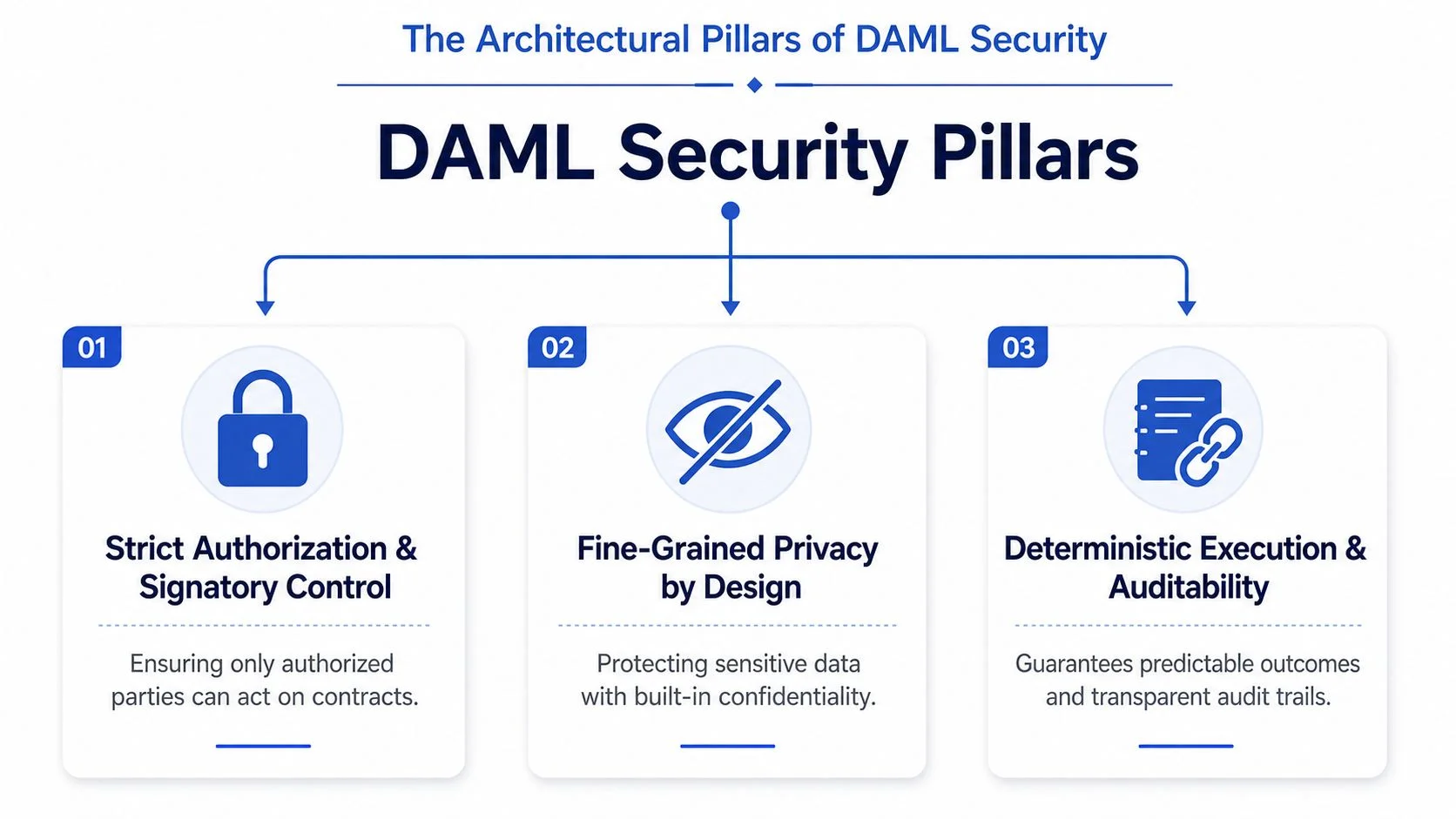
The strongest reason enterprises adopt DAML isn’t that it merely reduces common smart contract mistakes. It’s that the architecture removes some categories of failure from the attack surface altogether, while making the remaining risks more specific and governable.
For implementation teams, the practical side of this becomes clearer when you review an actual DAML smart contract development guide covering architecture and workflow choices.
Strict authorization changes the threat model
In DAML, authorisation is not an afterthought. Contracts define signatories, controllers, and observers explicitly. The runtime then enforces those permissions automatically.
Many public-chain exploits come from contracts having too much freedom, too many callable paths, or too much dependence on developer discipline. In DAML, the model is narrower by design. That sharply limits what code can do and who can make it do it.
A useful way to think about it is this: enterprise risk falls when a system prevents unauthorised action structurally, not just procedurally.
Privacy is built into the workflow
DAML security is also shaped by selective disclosure. Parties only see the contract data relevant to their role in the transaction. That’s a better fit for enterprise processes where separate actors must collaborate without revealing everything to everyone.
In practical terms, this supports workflows such as:
- Syndicated lending: Each party can act on shared obligations without broad data exposure.
- Trading approvals: Approval logic can remain private to the entitled participants.
- Tokenization operations: Issuers, custodians, and investors can interact without flattening all information into a public record.
The security gain here isn’t secrecy for its own sake. It’s reducing the amount of sensitive data each participant ever receives.
Determinism removes one class of risk and exposes another
DAML eliminates entire categories of vulnerabilities prevalent in Solidity-based smart contracts, specifically removing reentrancy attacks, integer overflows, and unprotected self-destruct calls from the attack surface because the runtime enforces authorisation rules automatically and the type system prevents most arithmetic and type errors at compile time. The same deterministic model also means DAML contracts cannot call external oracles during execution, so data must be submitted as transaction input by authorised parties before execution begins (Scaudit Studio on Daml smart contract vulnerabilities).
That last point is a real trade-off. You gain determinism, but you lose the convenience of pulling external state mid-execution. For enterprise teams, that pushes security design upstream into data ingestion, attestation, and workflow governance.
OpenZeppelin’s research adds an important nuance. In DAML, the major bug classes shift. Their work identifies four critical bug classes: conservation violations, arithmetic faults from unguarded division, temporal assumption errors, and non-deterministic ordering at application boundaries. They built three tools to address these issues: daml-lint, daml-props, and daml-verify, using static analysis, property-based testing, and formal verification with the Z3 prover (OpenZeppelin on smart contract security for institutional finance on Canton).
That is what mature DAML security work looks like. You don’t stop at “DAML is safer than Solidity.” You test the failure modes that remain.
| Security layer | What DAML changes | What teams still need to review |
|---|---|---|
| Runtime controls | Enforced authorisation | Incorrect business permissions in templates |
| Type system | Prevents many arithmetic and type issues at compile time | Unsafe business assumptions such as division logic |
| Deterministic execution | Removes reentrancy-style behaviour and external call complexity | Input quality, time assumptions, and ordering at boundaries |
| Tooling | Supports static analysis, property testing, and formal verification | Discipline in using those tools before release |
How Canton Network Amplifies DAML Security and Privacy
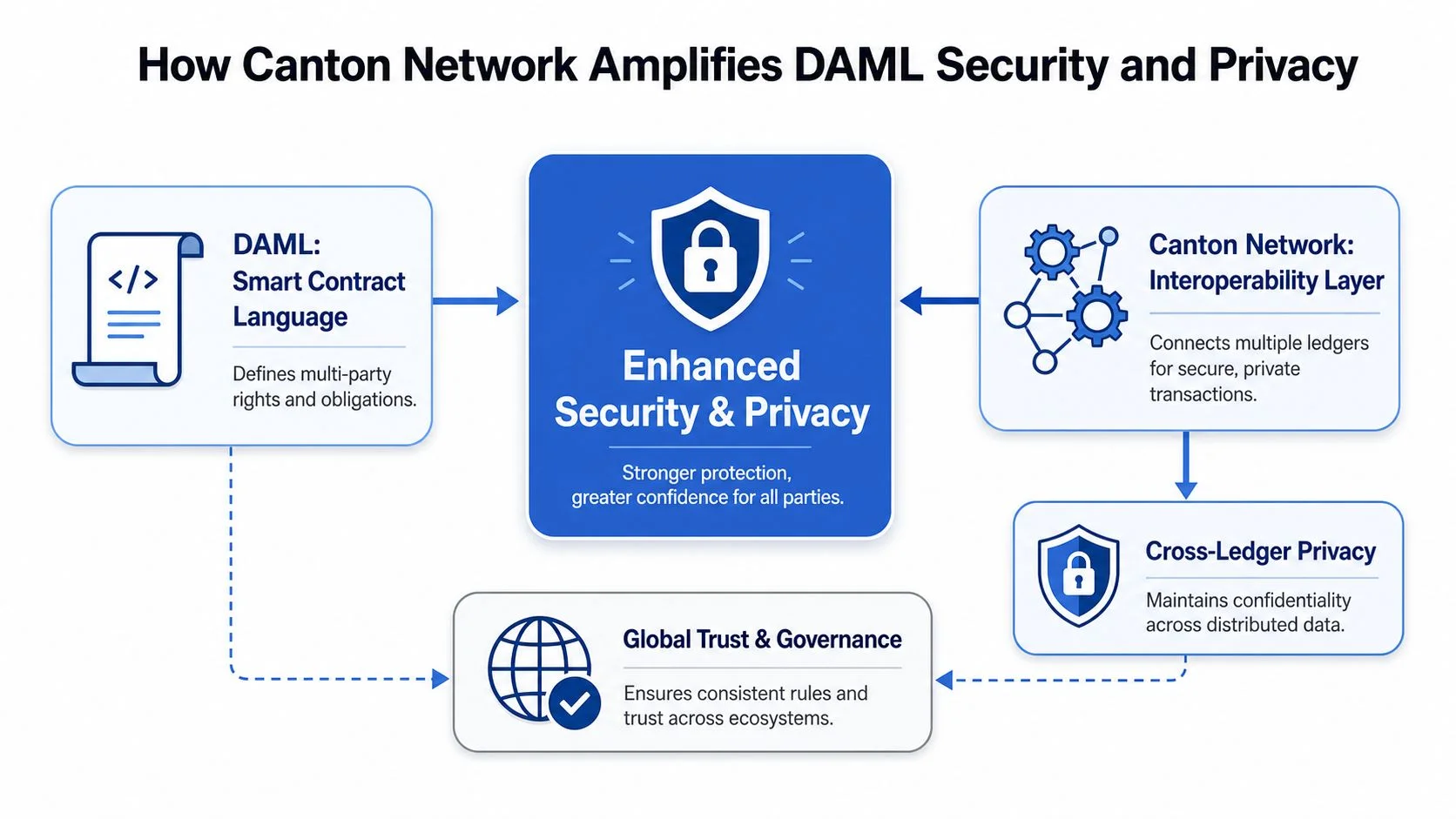
Canton matters because enterprise risk does not stop at contract correctness. It extends to who sees what, which parties can coordinate, and whether one institution’s workflow can interact with another’s without exposing internal state. DAML defines the business logic. Canton provides the trust boundary and synchronization model that lets separate domains transact without reverting to a single shared data pool.
For teams assessing multi-party digital asset platforms, this overview of why financial institutions are adopting DAML and Canton Network for digital assets gives useful context on why large programs rarely stay inside one ledger boundary.
DAML defines the workflow. Canton contains the disclosure.
That division of responsibility is what changes the security model.
DAML encodes rights, obligations, and required approvals in the contract itself. Canton then ensures those contracts can operate across organizational boundaries without broadcasting the full transaction history or business context to every participant. In practice, that removes a common enterprise failure mode. Firms no longer have to choose between interoperability and confidentiality.
This matters in regulated markets where multiple legal entities participate in one process but are not allowed, or not willing, to disclose their full position, pricing logic, or client activity to every counterparty. A public-chain pattern of global replication creates risk by default. Canton replaces that with selective sharing tied to the parties that need the data.
For architecture teams, the operational benefits are concrete:
- Partners coordinate without full ledger visibility
- Cross-domain transactions retain domain-level policy controls
- Sensitive contract state stays limited to entitled participants
- Interoperability does not require copying confidential data into every connected system
The security gain is not just “more privacy.” It is the removal of entire exposure paths. Broad transaction replication, unnecessary data disclosure, and shared-state visibility across unrelated participants are designed out of the model.
That is a different control posture from traditional integration estates, where confidentiality often depends on middleware filters, data-masking rules, and bilateral trust assumptions that become harder to defend as the network grows.
Canton also changes the compliance conversation. In jurisdictions such as the EU, UAE, and India, institutions often need to prove both controlled data access and controlled cross-entity processing. A network architecture that restricts disclosure at the protocol level is easier to justify to risk, audit, and legal teams than one that exposes data widely and relies on downstream controls to contain it.
The trade-off is architectural discipline. Privacy on Canton does not remove the need for good domain design, clear participant boundaries, or careful authority modeling. If entitlements are modeled poorly, the platform will enforce the wrong policy very effectively. But that is still a better enterprise position than trying to retrofit confidentiality onto infrastructure that was never designed for selective disclosure.
Achieving Enterprise Governance and Regulatory Compliance with DAML
DAML gives governance teams something most blockchain stacks do not. Controls become enforceable system behavior instead of policy intent. That matters in regulated environments, where risk committees, auditors, and supervisors need proof that approvals, restrictions, and obligations were applied correctly at transaction time.
The main compliance benefit is not generic transparency. It is the ability to encode who can act, who must approve, what evidence is produced, and which parties can inspect the result. In practice, that reduces reliance on manual reconciliations, fragmented workflow tools, and after-the-fact exception reviews. For teams designing regulated platforms, compliance-ready audit trails with cryptographic evidence belongs in the core architecture, because the quality of the audit record is determined by the transaction model itself.
Governance becomes part of the execution model
Traditional enterprise governance often sits outside the business process. Policy documents define approval thresholds. Middleware checks try to enforce them. Operations teams clean up breaks later.
DAML changes that operating model by putting control logic into the contract lifecycle.
That has direct implications for enterprise oversight:
- Approval chains are explicit: Required signatories and authorisers are defined in the workflow, not inferred from side systems.
- Segregation of duties is enforceable: One role can initiate, another can approve, and a third can observe, with the platform enforcing those boundaries.
- Evidence is generated as work happens: Audit support comes from recorded contract actions and authorisation paths, not from stitching together logs across systems.
- Policy drift is easier to detect: If the contract model and the intended control model diverge, the gap is visible in code and testable before production release.
The trade-off is straightforward. DAML does not excuse weak governance design. If role models, authority boundaries, or supervisory access patterns are defined poorly, the platform will enforce those mistakes consistently. From an enterprise risk perspective, that is still preferable to environments where controls are informal, duplicated across tools, and hard to verify.
Compliance work shifts from remediation to design
DAML aligns well with core compliance objectives such as data minimisation, controlled disclosure, and traceable approvals. That does not mean legal and regulatory review becomes trivial. It means the hard questions move earlier, into architecture and policy design.
The EU is a clear example. Selective disclosure supports GDPR principles because firms can limit personal and commercially sensitive data to participants with a defined need to know. But privacy law still requires decisions about retention periods, subject access handling, lawful basis, and erasure constraints where records must be preserved. Teams working through those issues should pair platform design with legal interpretation, not assume privacy-preserving infrastructure settles the matter on its own. GoSafe’s GDPR compliance guide is a useful reference point for framing those obligations.
The same pattern shows up in the UAE and India, although the supervisory priorities differ. In the UAE, regulated financial and digital asset environments often require clear operational accountability, provable approval authority, and defensible cross-entity data handling. In India, organisations also have to consider how privacy controls, auditability, and regulator visibility will be interpreted under sector-specific expectations, especially where tokenized assets or multi-party financial workflows are involved.
A practical compliance review usually comes down to four design questions:
| Compliance concern | What DAML improves by design | What the enterprise still has to decide |
|---|---|---|
| Data access control | Limits disclosure to authorised participants in the workflow | Which supervisors, auditors, or regulators need defined access paths |
| Audit evidence | Records contract actions, approvals, and lifecycle events in a structured way | How evidence is exported, retained, and presented for local regulatory review |
| Governance enforcement | Encodes rights, obligations, and approval logic directly in the application model | How legal policy maps to roles, permissions, and exception handling |
| Privacy obligations | Supports data minimisation and controlled processing between parties | How retention, deletion requests, and statutory recordkeeping are reconciled |
Teams that succeed with DAML usually avoid two common mistakes. One is assuming privacy-by-design automatically satisfies every regulator. The other is overcorrecting by exposing far more data than the business process or supervisory model requires.
The better approach is narrower and more defensible. Define the legal accountability model first. Then map it to contract roles, approval logic, observer rights, retention rules, and evidence outputs that can stand up in audit and supervision.
Enterprise Use Cases DAML Security in Action
DAML earns its place when the cost of getting permissions wrong is high. The strongest enterprise use cases are the ones where the platform removes whole categories of exposure by design, especially over-disclosure, reconciliation drift, and ambiguous control ownership between parties.
Digital asset tokenization with controlled visibility
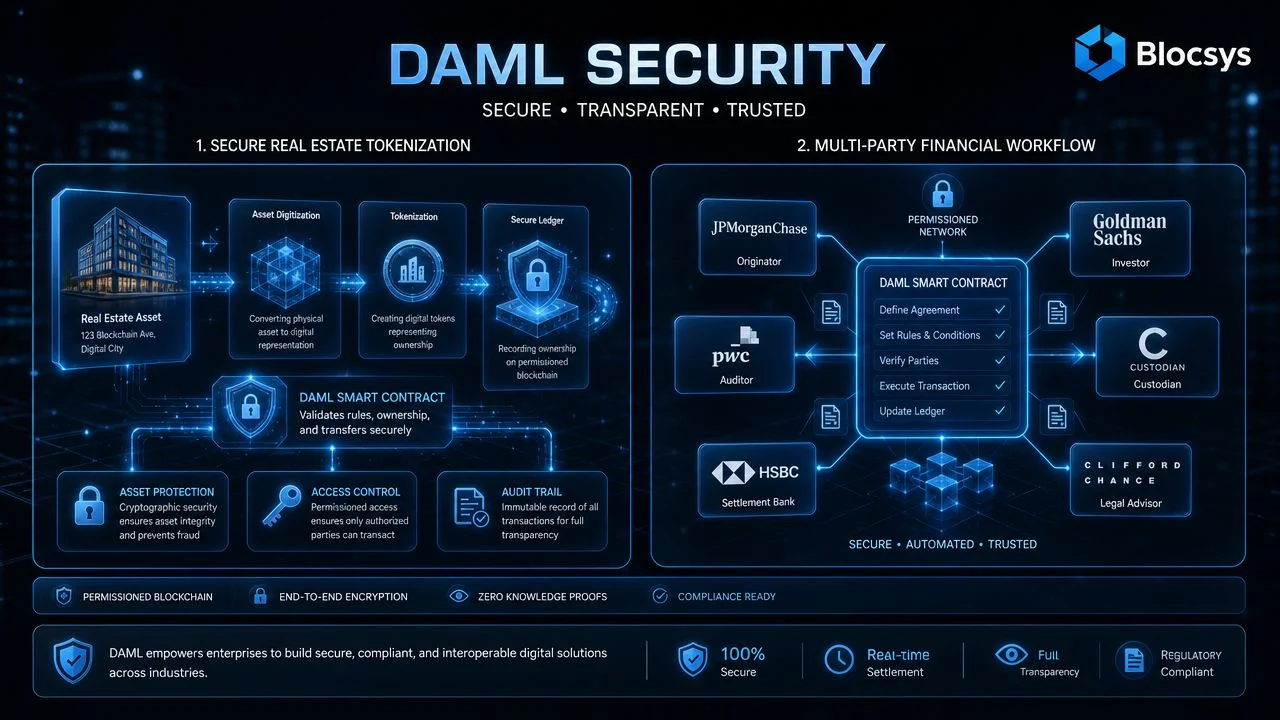
Tokenization programmes usually fail security review for predictable reasons. Sensitive deal terms are exposed too broadly, transfer controls sit outside the asset model, or compliance checks rely on off-ledger operations that can be skipped under pressure.
DAML addresses those failure points at the contract layer. Issuance rights, holding restrictions, approval paths, and lifecycle events can be encoded directly into the asset workflow, so the operating model does not depend on every participant implementing the same controls in separate systems. That matters in real estate, fund interests, private credit, sukuk-aligned structures in the UAE, and other private market assets where confidentiality and policy enforcement carry legal weight.
In practice, the pattern usually includes:
- Issuer-scoped authority: Only defined parties can create, amend, suspend, or retire an asset position.
- Need-to-know disclosure: Investors, servicers, custodians, and auditors see the portion of the workflow relevant to their role.
- Transfer enforcement in the workflow: Eligibility, approvals, and settlement conditions are checked before ownership changes, not after.
- Stronger audit posture: Contract state and lifecycle actions produce a cleaner evidence trail for internal control, external audit, and regulator review.
That design choice has direct compliance value. EU teams still need to handle retention, lawful processing, and downstream data handling outside the ledger, which is why a resource like GoSafe’s GDPR compliance guide is useful alongside contract design. The ledger can minimise disclosure. It does not replace data governance obligations in connected systems.
Multi-party financial workflows without reconciliation drag
The second class of use case is multi-party finance. Trade finance, collateral operations, syndicated lending, and post-trade approval chains all break down in the same place: each institution maintains its own record, then spends time and control effort proving alignment after the fact.
DAML changes that operating model by having parties act against shared contract state with explicit rights and obligations. The security benefit is concrete. Fewer copies of business-critical data move between organisations. Fewer manual hand-offs exist for attackers, insiders, or simple process failure to exploit. Fewer exceptions need to be patched with emails, spreadsheets, and local workarounds that never pass architectural review.
That does not mean every integration risk disappears. Firms still need to secure identity, external data ingestion, signing infrastructure, and operational access. OpenZeppelin-style review discipline remains relevant here, especially around privilege boundaries, approval logic, upgrade assumptions, and dependency risk. The difference is architectural scope. On a permissioned DAML workflow, the contract model can remove entire categories of public-chain exposure such as unrestricted state visibility and uncontrolled participant execution.
The operational gains are often easiest to see in control failures that stop happening:
- Reconciliation breaks stop driving false exceptions across counterparties
- Approval logic stays attached to the business object instead of being split across systems
- Process drift becomes easier to detect because the authorised path is explicit
- Fraud opportunities shrink when side-channel coordination is no longer part of routine execution
This short video gives a helpful visual view of the workflow implications:
The practical lesson is simple. DAML works well when teams model the legal commitment, decision rights, and visibility rules as first-class parts of the workflow. It works poorly when an organisation lifts a fragmented off-ledger process into a smart contract environment and expects the platform to fix bad operating design on its own.
Build and Scale With Blocsys Your DAML and Canton Development Partner
The difficult part of DAML adoption isn’t understanding the headline. It’s carrying the model into production without weakening it through shortcuts in workflow design, identity boundaries, integration patterns, or governance assumptions.
That’s especially true once systems expand across business units, counterparties, and operational domains. The same scaling pressure appears in other engineering fields. This perspective on managing growing systems with IoT and simulation is relevant because the core lesson carries over cleanly: complexity creates risk unless you model it before it compounds.
What a production DAML programme actually needs
Most enterprise programmes need the same set of capabilities:
- Contract modelling discipline: Rights, controllers, and visibility rules must match legal and operational reality.
- Security validation: Teams should use DAML-specific review methods, including static analysis, property-based testing, and formal reasoning where appropriate.
- Integration design: Oracle-free execution means external data handling must be governed carefully before submission.
- Operational architecture: Privacy and audit access have to survive across environments, counterparties, and support processes.
One delivery option in that space is Blocsys Technologies, which works on blockchain, AI, and enterprise software systems, including DAML and Canton-aligned builds for fintech and digital asset platforms. For buyers assessing implementation partners, the right criterion isn’t brand language. It’s whether the team can preserve the security model all the way from contract design to operational rollout.
Frequently Asked Questions About DAML Security
Below are concise answers to the questions technical leadership teams usually ask once they move from curiosity to evaluation.
| Question | Answer |
|---|---|
| What is DAML security? | DAML security is the combination of strict authorisation, selective disclosure, deterministic execution, and contract-level rights modelling used to reduce enterprise risk in multi-party workflows. It is designed for permissioned environments where participants need strong control over who can act and who can see data. |
| What are permissioned smart contracts? | Permissioned smart contracts run in environments where participants are identified and access is controlled. Instead of exposing all activity publicly, the system limits execution and visibility to authorised parties, which is far better suited to regulated finance and enterprise collaborations. |
| How does DAML improve enterprise blockchain security? | DAML improves security by constraining what contracts can do, enforcing authorisation automatically, and reducing unnecessary data exposure. It also supports a deterministic execution model, which helps enterprises reason about outcomes more clearly than public-chain architectures built for open interaction. |
| Does DAML eliminate any smart contract vulnerabilities? | Yes. DAML removes entire categories of vulnerabilities common in Solidity environments, including reentrancy attacks, integer overflows, and unprotected self-destruct behaviour, because of its runtime enforcement and type-driven design, as covered earlier in the article. |
| Is DAML security the same as Canton Network security? | No. DAML defines the contract logic and participant rights. Canton extends those guarantees across interoperating domains and preserves need-to-know privacy during cross-domain workflows. They work together, but they solve different parts of the security architecture. |
| Why do financial institutions use DAML? | Financial institutions use DAML because it aligns better with confidential, regulated, multi-party operations than public smart contract platforms do. It supports controlled disclosure, explicit approvals, and stronger governance patterns for workflows such as tokenization, settlement, and structured financial operations. |
| How does Canton secure smart contracts in practice? | Canton helps by preserving privacy and authorisation boundaries when separate parties or domains interact. Instead of forcing all participants onto one fully visible ledger, it enables collaboration while keeping sensitive process logic and data visible only to the entitled parties. |
| Can DAML reduce operational risk as well as cyber risk? | Yes. DAML can reduce operational risk by making business obligations executable and by reducing reconciliation overhead across parties. When participants rely on a shared process model instead of fragmented records, manual exception handling and process drift become easier to control. |
| Does DAML support regulatory compliance? | It supports compliance-oriented design by aligning with data minimisation, structured approvals, and auditable workflows. That said, enterprises still need jurisdiction-specific legal review, especially where regulators have not fully clarified how privacy-preserving ledger models should satisfy supervisory access requirements. |
| What is the main trade-off in DAML’s security model? | The biggest trade-off is that deterministic execution limits direct access to external data during contract execution. That improves predictability, but it shifts responsibility to secure data submission, validation, and governance before transactions are executed. |
| What tools help secure DAML applications? | OpenZeppelin has highlighted DAML-specific tools including daml-lint, daml-props, and daml-verify. Together, these support static analysis, property-based testing, and formal verification, which is useful when teams need stronger assurance for high-value financial workflows. |
| How can Blocsys help with DAML and Canton solutions? | Blocsys can support organisations that need DAML development, Canton-aligned architecture, enterprise blockchain implementation, and secure digital asset platform delivery. The main value is practical implementation support across modelling, engineering, and rollout rather than abstract strategy alone. |
If your team is evaluating DAML security, permissioned smart contracts, or Canton-based digital asset infrastructure, Blocsys Technologies can help you assess the fit, define the right architecture, and plan delivery with implementation realities in mind. For early budgeting or platform planning, the software development cost estimator is a useful next step before moving into technical scoping.
