
Are you a CTO, founder, or enterprise leader struggling with document fraud, slow verification processes, and rising compliance costs? You’re not alone. In today’s digital economy, trust is the most valuable currency, yet traditional document handling methods are failing us. This guide is for decision-makers in global markets like the USA, UK, UAE, and Europe who need a secure, efficient, and scalable solution. We will break down exactly how a blockchain document verification platform works, its core features, benefits, and implementation costs, providing a clear roadmap for building digital trust infrastructure that delivers a powerful competitive edge.
Table of Contents
- Why Is Blockchain the Future of Document Verification?
- Building Your Platform With Essential Enterprise Features
- How Blockchain Document Verification Works: A Technical Breakdown
- Forecasting Platform Development Costs and ROI in 2026
- Exploring Real-World Industry Use Cases
- How Blocsys Accelerates Your Platform Development
- Frequently Asked Questions
- What is a blockchain document verification platform?
- How does blockchain document verification work?
- What features should a document verification platform include?
- How much does blockchain document verification platform development cost in 2026?
- What factors affect blockchain platform development costs?
- Which industries benefit from blockchain document verification?
- How are documents secured using blockchain technology?
- Can blockchain integrate with existing enterprise systems?
- What compliance standards can blockchain document verification support?
- Why should businesses choose Blocsys for blockchain document verification platform development?
Why Is Blockchain the Future of Document Verification?
Imagine a digital notary that’s on duty 24/7, is accessible from anywhere in the world, and can’t be bribed or tampered with. That’s the core promise of a blockchain document verification platform. In a business environment where document fraud costs companies and governments billions each year, traditional verification methods just don’t cut it anymore. Manual checks and centralized databases are slow, expensive, and wide open to sophisticated tampering.
The development of a blockchain document verification platform directly tackles these weaknesses. By creating an unchangeable, cryptographic proof of a document’s existence and its state at a precise moment, the technology sets a new gold standard for digital trust. It shifts verification from a system based on trusting a single entity to one built on pure cryptographic certainty.

This change isn’t just a technical upgrade; it’s a strategic one. For enterprises in the USA, UK, UAE, Singapore, Germany, and Switzerland, this translates into real-world advantages:
- Enhanced Security: Forgery becomes nearly impossible when a document’s unique digital “fingerprint” is locked onto a tamper-proof ledger.
- Operational Efficiency: Verification processes that used to take days or even weeks can now be completed instantly and automatically.
- Strengthened Compliance: A permanent, unchangeable audit trail gives regulators absolute proof of a document’s history and authenticity.
Leading organisations like Blocsys are at the forefront of these solutions, helping businesses build the infrastructure for this new era of digital integrity. Understanding the fundamentals of what is digital proof of document integrity is the first step toward using this powerful technology for a serious competitive edge. Ultimately, this system provides the bedrock of trust in an increasingly digital and decentralized world.
Building Your Platform With Essential Enterprise Features
When you’re building a blockchain document verification platform, making the leap from a basic concept to an enterprise-grade solution demands a laser focus on core features. These aren’t just lines on a technical spec sheet; they are the fundamental pillars of trust, efficiency, and scalability that deliver real business value to CTOs and product managers in competitive global markets like the USA, Germany, and the UAE.
A truly successful platform isn’t just about storing data on a blockchain. Its value hinges on a set of non-negotiable, interconnected features that guarantee security, seamless integration, and the ability to scale.
Foundational Security and Integrity
At its very core, the platform must guarantee the integrity of every document. This all starts with cryptographic hashing, which typically uses proven algorithms like SHA-256. This process generates a unique, tamper-evident digital fingerprint for each document, but it does so without ever exposing the document’s sensitive contents, ensuring total privacy.
This unique hash is then anchored to the blockchain, creating a permanent and immutable audit trail. Every single action—from verification and timestamping to digital signatures—is recorded in a way that can never be altered. For sectors like finance and healthcare, this provides an unbreakable chain of custody that is absolutely essential for regulatory compliance and gives auditors definitive proof.
Automation and Seamless Integration
To deliver genuine enterprise value, the platform has to move beyond manual checks and embrace automation. This is where smart contracts come into play. Think of them as self-executing business logic that lives on the blockchain, automatically enforcing predefined rules for document validation. For example, a smart contract could instantly confirm whether a digital certificate was issued by a verified university before a certain date, completely eliminating the need for human intervention.
Beyond that, an API-first design is non-negotiable. A robust suite of APIs is what allows the blockchain’s trust layer to communicate with existing enterprise systems like ERPs, CRMs, and document management solutions. This allows a logistics company, for instance, to integrate blockchain-verified bills of lading directly into its supply chain software, triggering automated payments and slashing costly disputes.
For an enterprise platform, the goal is not just to verify a document but to embed automated trust directly into core business processes. A well-designed API layer is the bridge that connects blockchain’s integrity to tangible ROI.
Finally, managing user identity securely is paramount. Decentralized Identifiers (DIDs) represent an advanced approach that puts users in control of their own identity information. This not only enhances privacy but is also fast becoming a key requirement for meeting stringent data protection regulations like GDPR. For a deeper dive into scaling blockchain transactions efficiently, explore our guide on Merkle Batching for handling thousands of proofs.
How Blockchain Document Verification Works: A Technical Breakdown
So, how does a simple digital file transform into a cryptographically secure, verifiable asset? Whether you’re a business leader or a technical architect, understanding the workflow is key. Let’s walk through the journey of a document—like a university degree or a supply chain invoice—as it moves through the system.
The entire process is built to create irrefutable proof of a document’s authenticity and integrity. Crucially, it does this without ever exposing the document’s contents to the public blockchain, ensuring total privacy.
1. Document Hashing
It all starts on the user’s device, right inside their browser or application. Before a document is even sent anywhere, the platform’s software generates a unique digital fingerprint of the file. This is done using a cryptographic hash function like SHA-256. This hash is a fixed-length string of characters that is entirely unique to that specific file. If you were to change even a single comma in the document, it would produce a completely different hash.
2. Metadata Canonicalization
Next, the system gathers and standardizes important metadata connected to the document. This might include details like the issuer’s identity, the document type, and the date it was issued. This process of metadata canonicalization ensures all information is structured in a consistent, machine-readable format. This consistency is vital for enabling automated verification and maintaining a clear audit trail.
3. Blockchain Anchoring
With the document’s hash and metadata ready, the platform bundles this information into a transaction. This transaction is then sent out to the blockchain network. Once the network validators confirm it, the transaction is permanently recorded—or anchored—into a block. This step creates an immutable, time-stamped record, proving the document existed in a specific state at a precise moment in time.
This infographic shows how these fundamental steps form the basis of a full-scale enterprise system.
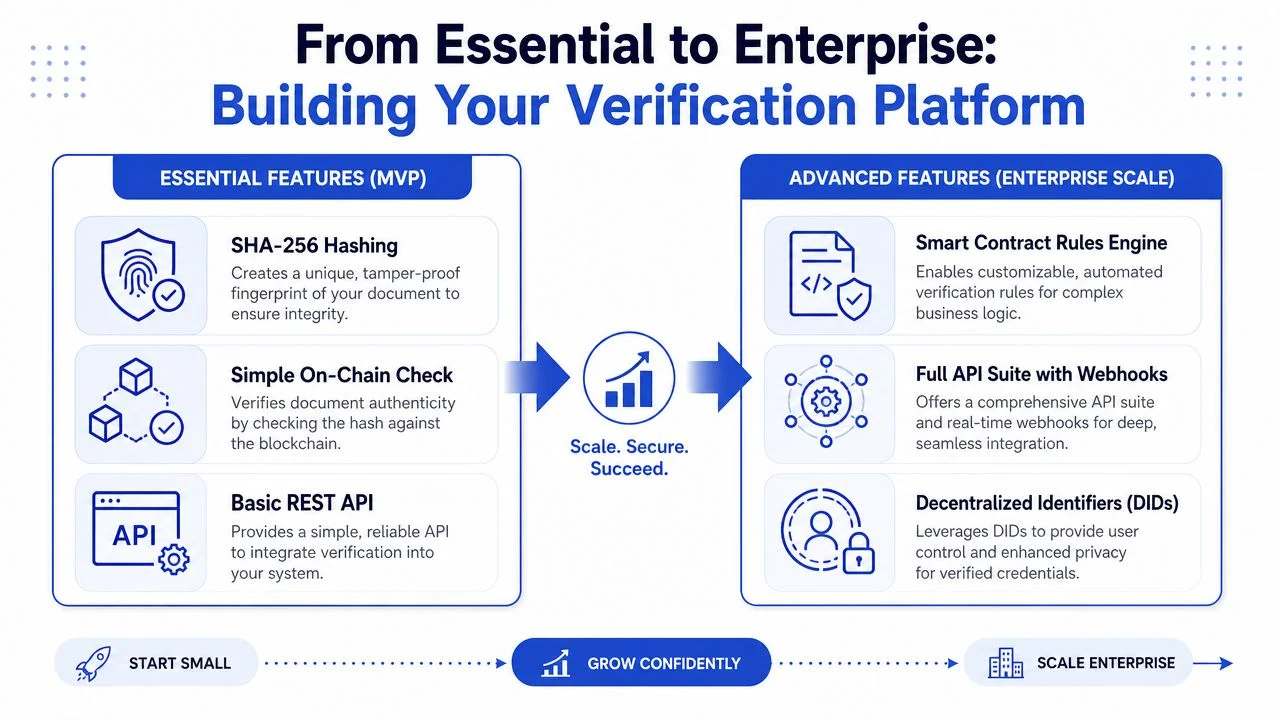
As the visual makes clear, an MVP might focus on core integrity, but a true enterprise platform builds upon this foundation with sophisticated logic and deep integration capabilities.
4. Cryptographic Verification
The final step is where the magic happens. To verify a document, a person simply uploads their copy to the verification portal. The system instantly repeats the hashing process (Step 1) on this new version of the document. It then compares the newly generated hash to the original one anchored on the blockchain. If the two hashes match, the document is 100% authentic and untampered. If they don’t, it has been altered. The process is instant, fully automated, and requires no human intermediary. In fact, the combination of AI and blockchain can create even more robust, tamper-proof systems.
While the core technology is certainly impressive, what really matters to decision-makers are the tangible business outcomes. For businesses operating in competitive global markets like the UK, USA, and UAE, adopting a blockchain document verification platform isn’t just a technical upgrade—it’s a direct path to gaining a strategic edge. It delivers concrete improvements in security, efficiency, and perhaps most importantly, trust.
The ever-present threat of document fraud and identity theft makes secure verification systems a critical business need. As detailed in MY CYBER GUARD’s identity theft guide, the risks are substantial, and blockchain offers a uniquely powerful defense.
Fortified Security and Unshakeable Trust
The most immediate and profound benefit is a massive leap in security. When a document’s unique cryptographic fingerprint, or hash, is recorded on an immutable blockchain, it becomes virtually impossible to forge. Any attempt to alter a verified document would create a mismatch, making tampering instantly obvious. This provides a level of security that traditional paper or centralized digital systems simply can’t match.
This creates a powerful ripple effect, building unprecedented trust between all parties. When banks, partners, and customers are certain that documents are cryptographically guaranteed to be authentic, business moves faster. Relationships strengthen, and friction melts away. Imagine a logistics firm in Dubai securing a bill of lading on the blockchain. Every stakeholder in that supply chain—from the exporter in Germany to the importer in Singapore—is now looking at the exact same, unalterable document. The costly disputes and delays caused by document fraud are eliminated.
Driving Efficiency and Reducing Costs
A blockchain verification platform also automates what are often slow, cumbersome manual processes. This frees up your team from the tedious, error-prone work of human verification, allowing them to focus on higher-value activities that actually grow the business. This automation translates directly into significant cost reductions. You can cut out the need for third-party notary services, expensive courier fees, and the administrative bloat that comes with manual document handling. The return on investment becomes clear very quickly.
For instance, a financial institution can completely overhaul its Know Your Customer (KYC) process. Instead of taking days to manually verify identity documents, a blockchain-based platform can confirm their authenticity in seconds. This dramatically improves the customer onboarding experience while simultaneously lowering compliance costs.
This powerful combination of stronger security, greater efficiency, and lower costs makes Blockchain Document Verification Platform development a compelling strategic move for any forward-thinking organization. It effectively transforms documents from a potential liability into secure, trustworthy digital assets.
Forecasting Platform Development Costs and ROI in 2026
Understanding the financial commitment is a critical first step when planning your Blockchain Document Verification Platform. The final price tag isn’t a single number; it’s a spectrum shaped entirely by your specific technical and business goals. Accurately forecasting these costs means digging into the key factors that define the project’s scope and complexity.
Likewise, calculating the Return on Investment (ROI) is about much more than just cost savings. It’s about measuring the value of enhanced security, smoother operations, and the massive boost to brand trust—all invaluable assets in competitive markets across the USA, UK, UAE, and Europe.
Key Factors Influencing Development Costs
Several core decisions will directly influence the budget for your document authentication platform. Each choice represents a trade-off between features, security, and cost.
- Choice of Blockchain: Using a public blockchain like Ethereum gives you incredible decentralization and security, but you might face higher transaction costs and slower speeds. On the other hand, a private or permissioned blockchain offers greater control, speed, and privacy at a potentially lower operational cost, making it a go-to for many enterprises.
- Smart Contract Complexity: A platform with straightforward verification logic will naturally be more affordable. Things get more complex—and costly—when you need multi-step smart contracts to automate sophisticated business rules, like those for escrow services or time-locked document releases.
- API Integrations: A basic API for verification is pretty standard. However, true automation and efficiency are unlocked through deep integrations with your existing enterprise systems like ERP, CRM, or HRMS, which will add to the development timeline and budget.
- User Interface (UI) and User Experience (UX) Design: A simple, functional interface for an internal tool is one thing. A polished, brand-aligned, and intuitive public portal designed for thousands of external users is another, and it will require a more significant investment in design.
Understanding the Return on Investment
For any enterprise, the ROI from a blockchain document verification platform is multifaceted. The technology doesn’t just deliver measurable financial wins; it also shields the business from significant risks.
Industry analysis shows this technology can lead to a 73% reduction in document verification costs compared to old-school methods. Furthermore, its decentralized nature can deliver a 67% reduction in storage costs, enable 58% faster data recovery, and lower overall operational costs by 45%. Businesses deploying these systems can often achieve a full ROI in just 14–18 months.
Building a solid business case starts with a clear financial model. For a detailed breakdown of what goes into a project budget, our guide on blockchain development cost estimation explained factors models and budgeting is an excellent starting point. For a more customized figure, we encourage businesses to use a specialized Software Development Cost Estimator to get an estimate that aligns with their unique project goals.
Exploring Real-World Industry Use Cases
The real value of a Blockchain Document Verification Platform becomes clear when you move past theory and look at how it solves practical, high-stakes problems. Its ability to create a single, unchangeable source of truth is reshaping how organizations across the globe—from education in the UK to finance in Dubai and logistics in Singapore—manage their most critical information.
These aren’t just futuristic concepts; they are tangible solutions delivering measurable results today. The technology’s impact is most obvious when you examine specific industry applications.
Education and Professional Credentials
Academic institutions and professional bodies are in a constant battle against certificate fraud. A blockchain-based solution offers a simple yet incredibly powerful defense.
- The Problem: Fake diplomas and counterfeit professional licenses devalue legitimate qualifications. This poses huge risks, especially in critical fields like healthcare where an unqualified practitioner can cause immense harm.
- The Blockchain Solution: Instead of paper certificates, universities and licensing bodies issue digital credentials with cryptographic proofs anchored to the blockchain. This creates a tamper-proof, instantly verifiable record for every single credential issued.
- The Outcome: Employers can now verify a candidate’s qualifications in seconds, not weeks, and with absolute certainty. This protects the institution’s reputation and, more importantly, ensures only genuinely qualified professionals enter the workforce.

Finance and Insurance
The financial services sector operates under intense regulatory scrutiny. For these firms, blockchain is a way to streamline compliance and secure high-value agreements.
Think about a financial institution in Germany. It can use a blockchain platform to manage Know Your Customer (KYC) and Anti-Money Laundering (AML) checks. Once a customer’s identity documents are verified and hashed, that proof can be securely and privately reused across different services, drastically cutting down onboarding times and costs.
This same principle applies to loan agreements and insurance policies. By recording the final, signed contract on the blockchain, both the provider and the customer have irrefutable proof of the agreed-upon terms. This eliminates disputes down the line and prevents any chance of unauthorized alterations.
Government and Legal Sectors
For governments and legal firms, the integrity of a document is everything. Blockchain provides a new foundation for digital trust in public services and legal proceedings. From digital IDs and land titles to notarized contracts and court evidence, anchoring these records on-chain guarantees their origin and protects them from being tampered with.
Robust verification is also critical for sectors like non-profits, where ensuring safety and trust is paramount. Understanding the requirements for background checks for nonprofits underscores just how vital secure credential management has become.
As these examples show, the applications are extensive. For a deeper analysis, you can learn more about blockchain document verification for healthcare, legal, and government records and see how it secures the most sensitive information.
How Blocsys Accelerates Your Platform Development
Building a Blockchain Document Verification Platform requires more than just code; it demands a partner with deep enterprise engineering experience and a strategic understanding of your business needs. At Blocsys, we translate your vision for digital trust into a secure, scalable, and production-ready platform that drives real-world value.
We specialize in guiding enterprises, startups, and public sector organizations in competitive markets like the USA, Europe, and the UAE through the complexities of decentralized technology. Our consultative, end-to-end approach means we architect complete solutions. We’ll help you navigate critical decisions, from choosing the right blockchain and designing resilient smart contracts to ensuring seamless API integration with your existing enterprise systems. Our team is adept at creating platforms that meet stringent compliance standards like GDPR while delivering a clear, measurable ROI.
By combining proven development methodologies with extensive experience in enterprise blockchain, AI, and secure software engineering, we help you overcome technical hurdles and accelerate your time-to-market.
We empower CTOs, founders, and digital transformation leaders to build with confidence. Whether you need a full development team or want to Hire Blockchain Developers to augment your existing staff, Blocsys provides the specialized expertise to ensure your project’s success. Ready to build the future of digital trust? Contact Blocsys today to discuss your project with our blockchain experts.
Frequently Asked Questions
What is a blockchain document verification platform?
A blockchain document verification platform is a decentralized digital system that uses cryptographic hashing and distributed ledger technology to create a permanent, time-stamped, and unchangeable record of a document’s integrity. It allows organizations to instantly prove the authenticity of credentials, certificates, or contracts without relying on a central intermediary, significantly reducing fraud and operational overhead.
How does blockchain document verification work?
The process is both secure and straightforward. First, a unique cryptographic hash (a digital fingerprint) of the document is generated. This hash is then recorded on the blockchain, creating an immutable, time-stamped proof. To verify the document later, one simply re-hashes it. If the new hash matches the one on the blockchain, the document is proven to be 100% authentic and untampered.
What features should a document verification platform include?
An enterprise-grade platform must include immutable audit trails for compliance, robust cryptographic hashing (e.g., SHA-256), smart contract integration for automating business logic, and a comprehensive set of APIs for seamless integration with existing enterprise systems (ERP, CRM). Advanced features like decentralized identifiers (DIDs) for user-controlled identity are also becoming crucial for privacy and regulatory compliance.
How much does blockchain document verification platform development cost in 2026?
The cost of developing a blockchain document verification platform in 2026 varies based on complexity. A Minimum Viable Product (MVP) with core features typically ranges from $25,000 to $40,000. A full-scale enterprise platform with custom smart contracts, extensive API integrations, and a polished UI/UX can range from $70,000 to over $150,000. For a precise quote, use our Software Development Cost Estimator.
What factors affect blockchain platform development costs?
Key cost drivers include the choice of blockchain (public vs. private), the complexity of smart contract logic, the number and depth of API integrations with existing enterprise software, the level of UI/UX design sophistication, and ongoing security maintenance and compliance requirements. Each factor adds to the development scope and overall project budget.
Which industries benefit from blockchain document verification?
Any industry where document authenticity and trust are paramount benefits significantly. This includes finance (KYC/AML), education (academic credentials), healthcare (patient records), supply chain (provenance tracking), government (digital IDs, land titles), legal (notarized contracts, evidence), and HR (employment verification). The technology provides a universal layer of trust for critical information.
How are documents secured using blockchain technology?
Security is multi-layered. First, the original document never leaves the user’s control or gets stored on the blockchain, preserving privacy. Only its cryptographic hash is recorded. Second, the blockchain’s decentralized and immutable nature means this hash cannot be altered or deleted. This combination ensures that the proof of authenticity is tamper-proof and permanent.
Can blockchain integrate with existing enterprise systems?
Yes, absolutely. A well-architected blockchain document verification platform is designed with an API-first approach. This allows for seamless integration with existing Enterprise Resource Planning (ERP), Customer Relationship Management (CRM), Human Resource Management Systems (HRMS), and other legacy software. This integration is key to automating workflows and unlocking the full efficiency benefits of the technology.
What compliance standards can blockchain document verification support?
Blockchain’s immutable audit trail provides a powerful tool for compliance. It can help organizations meet standards like GDPR and CCPA by enabling privacy-preserving verification (DIDs), and its unchangeable record-keeping supports financial regulations (like AML and KYC) and legal evidence standards. The transparent, time-stamped log is invaluable for auditors and regulators.
Why should businesses choose Blocsys for blockchain document verification platform development?
Blocsys combines deep expertise in enterprise blockchain, AI, and secure software engineering. We don’t just build platforms; we architect scalable, compliant, and production-ready solutions tailored to your business goals. With a proven track record of delivering for clients in competitive global markets like the USA, UK, and UAE, we focus on helping you achieve a rapid ROI and a sustainable competitive advantage.
