
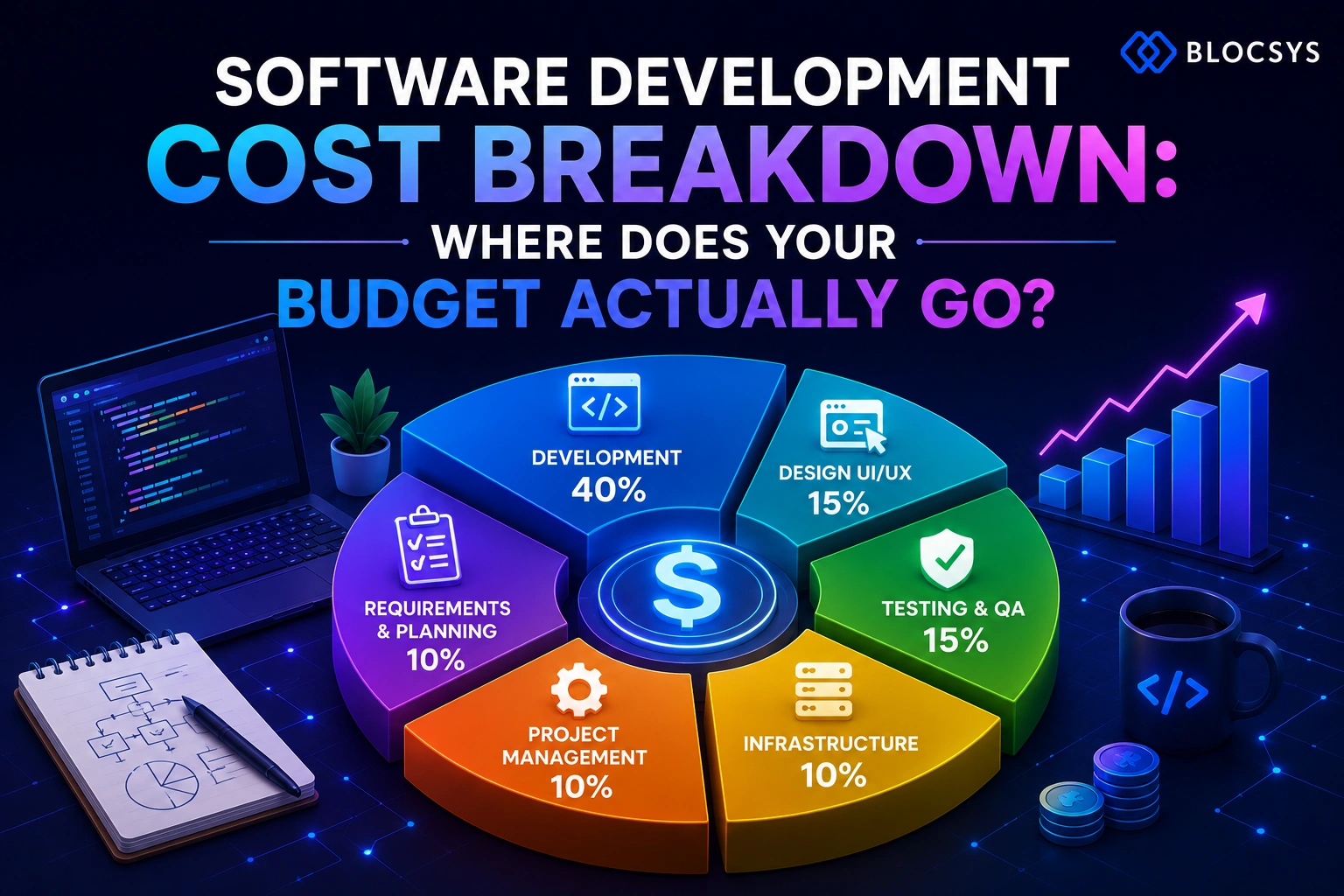
Software Development Cost Breakdown: Where Does Your Budget Actually Go?
Ask any founder who just opened a software proposal, and they’ll tell you the same thing: the final number rarely matches what they expected going in. That’s exactly why a clear software development cost breakdown matters so much. It shows you precisely where your money goes—planning, design, engineering, infrastructure, testing, and everything in between. Whether you’re building a SaaS platform, an AI-driven tool, or a blockchain application, understanding this breakdown helps you budget smarter and avoid unpleasant surprises later. Before you request another quote, it’s worth running your idea through Blocsys’ software development cost estimator, which gives you a realistic starting point grounded in real project data. Let’s break down where the budget actually goes.
What Is a Software Development Cost Breakdown?
A software development cost breakdown is a detailed map of every expense tied to building your product. It separates one big number into individual line items: discovery, design, frontend, backend, APIs, infrastructure, QA, and maintenance. Think of it as an itemized receipt rather than a vague quote. Without one, you’re essentially budgeting blind. With one, you can see exactly which phase eats the most resources and negotiate accordingly.
Enterprises and startups use this breakdown differently, but the goal stays the same. Founders want to know how far their seed funding stretches. CTOs want to justify spend to their board. Either way, a proper software project cost breakdown turns guesswork into a plan you can actually defend.
Why Understanding Your Software Budget Matters
Here’s why this matters more than most teams realize: software projects fail financially far more often than they fail technically. Poor software development budgeting leads to scope creep, rushed QA, and half-finished features. Consequently, teams end up shipping late and over budget, which damages trust with stakeholders and investors alike.
In fifteen years of scoping enterprise software, I’ve never seen a project blow its budget because of one big mistake—it’s always death by a thousand undocumented assumptions.
Additionally, understanding your budget upfront gives you negotiating power. When you know that backend development typically consumes 25-30% of a project, you can push back on vendors who quote it disproportionately high. That knowledge is leverage, plain and simple.
Project Discovery and Planning Costs
Every solid software development cost breakdown starts with discovery. This phase covers requirements gathering, technical architecture, wireframing, and risk assessment. Typically, it accounts for 5-10% of total project cost. Skipping it feels like saving money, but it almost never is.
Rushed planning is short. It’s also expensive later.
For enterprise clients, discovery often includes compliance mapping and stakeholder workshops across departments. For startups, it’s leaner—usually a few weeks of scoping with a technical architect. Either way, this phase determines whether your software development cost estimation later on is even accurate.
![Software development cost breakdown — [Flow diagram showing the software development cost breakdown process: Discovery & Planning → UI/UX Design → Frontend & Backend Development → API & Database Architecture → QA & Testing → Deployment → Maintenance]](https://s3.blocsys.com/blocsys/blog-images/1785024133741-d3b09b16a7e8e2f1.webp)
UI/UX Design Costs
Design isn’t decoration—it’s functional architecture for how users interact with your product. UI/UX typically represents 10-15% of your budget, covering user research, wireframes, prototypes, and design systems. Enterprise applications with complex dashboards or multi-role permissions naturally cost more here.
Moreover, good design reduces downstream development costs. A well-tested prototype catches usability issues before engineers write a single line of code. That’s far cheaper than rebuilding a feature after launch because users couldn’t figure out how to use it.
Frontend Development Costs
Frontend development usually accounts for 20-25% of your total software development cost. This covers everything users touch directly: responsive layouts, interactive components, accessibility, and performance optimization across devices.
Complexity drives cost here more than almost any other factor. A simple marketing site costs a fraction of what a real-time trading dashboard or AI-powered analytics interface demands. Furthermore, frameworks matter—React, Vue, and Angular each carry different talent costs depending on your region.
Backend Development Costs
Backend work is where the real engineering muscle goes, typically consuming 25-30% of your budget. This includes server logic, authentication, third-party integrations, and business rule implementation. It’s the invisible engine that keeps everything else running.
Enterprise systems with complex workflows, multi-tenant architecture, or high transaction volumes push this percentage even higher. Consequently, businesses building fintech or SaaS platforms should expect backend costs to dominate their software project cost breakdown.
Database and API Development Costs
Database architecture and API development often get underestimated. Together, they typically represent 10-15% of the budget, but poor planning here creates expensive technical debt. Choosing between SQL and NoSQL, designing for scale, and building secure RESTful or GraphQL APIs all require senior-level expertise.
Integration with third-party services—payment gateways, CRMs, analytics tools—adds further cost. Each integration needs testing, error handling, and documentation. Therefore, businesses connecting multiple external systems should budget extra time for this layer specifically.
AI and Blockchain Integration Costs
AI and blockchain features have become standard requests, not exotic add-ons. AI integration costs vary widely based on whether you’re using pre-built APIs or training custom models. A chatbot powered by an existing LLM costs far less than a custom recommendation engine trained on proprietary data.
Blockchain integration follows a similar pattern. Smart contract development, security audits, and consensus mechanism selection all add complexity. Businesses exploring tokenized assets or decentralized platforms should work with specialists—AI development services and blockchain development company partners who understand both the technical and regulatory landscape.
For enterprises building digital asset platforms specifically, teams like hire blockchain developers specialists can significantly reduce trial-and-error costs. Similarly, if AI is central to your roadmap, working with dedicated hire AI developers teams shortens your path to production.
![Software development cost breakdown — [Flow diagram showing AI and blockchain integration workflow: Use Case Definition → Model or Smart Contract Selection → Development and Training → Security Audit → Integration Testing → Production Deployment]](https://s3.blocsys.com/blocsys/blog-images/1785024134029-5ecc2c2fff97b4a6.webp)
Cloud Infrastructure and DevOps Costs
Cloud infrastructure isn’t a one-time cost—it’s ongoing. AWS, Azure, and Google Cloud pricing scales with usage, so a small SaaS product might spend a few hundred dollars monthly while an enterprise platform spends tens of thousands.
DevOps practices, including CI/CD pipelines, containerization, and automated monitoring, typically add 8-12% to your development budget. However, this investment pays off through faster deployments and fewer production incidents. Skipping DevOps early almost always costs more later.
QA and Testing Costs
Testing is where corners get cut most often, and it’s the costliest mistake teams make. QA typically requires 15-20% of your budget across manual testing, automated test suites, performance testing, and user acceptance testing.
Enterprise software with regulatory requirements needs even more rigorous testing—think financial platforms or healthcare applications. Skimping here doesn’t save money. It just delays the expense until after launch, when fixes cost significantly more.
Cybersecurity and Compliance Costs
Security can’t be an afterthought, especially for fintech, healthcare, or blockchain applications. Cybersecurity work includes penetration testing, encryption implementation, and secure authentication—typically 5-10% of total cost, though regulated industries push this higher.
Compliance adds another layer entirely. GDPR in Europe, HIPAA in the US, and various financial regulations across the UAE and Singapore each demand specific architectural decisions. Consequently, businesses operating across multiple jurisdictions should budget compliance costs early, not as an afterthought.
Deployment and Maintenance Costs
Deployment itself is relatively quick, but maintenance is a long-term commitment. Industry estimates suggest maintenance costs 15-20% of the original development cost annually. This covers bug fixes, security patches, feature updates, and performance monitoring.
Here’s the thing: many businesses budget for launch but forget about year two. That’s a mistake. Software isn’t a one-time purchase—it’s an ongoing relationship between your product and your users’ evolving needs.
Hidden Software Development Costs
Every experienced software development company has watched a client get blindsided by costs nobody mentioned upfront. Third-party licensing fees, unexpected scalability upgrades, data migration complexity, and technical debt from previous vendors all fall into this category.
These hidden costs can distort your entire software development cost breakdown if you don’t plan for them. Change requests mid-project are another common culprit—each one ripples through design, development, and testing simultaneously.
- Third-party API and licensing fees that scale with usage
- Data migration from legacy systems
- Post-launch scalability upgrades
- Change requests and scope adjustments
- Training and documentation for internal teams
Cost Optimization Strategies for Smarter Software Development Budgeting
You don’t need to sacrifice quality to control costs. Prioritizing an MVP approach, for instance, lets you validate ideas before committing to full-scale development. Additionally, choosing modular architecture makes future updates cheaper because you’re not rebuilding entire systems for small changes.
Agile sprints with regular budget checkpoints also help. Rather than discovering a problem after six months, you catch cost overruns after two weeks. That’s a meaningful difference for any CFO watching burn rate closely.
The teams that control costs best aren’t the ones who cut corners—they’re the ones who track spend weekly instead of quarterly.
![Software development cost breakdown — [Flow diagram showing software cost optimization workflow: Requirement Prioritization → MVP Scoping → Agile Sprint Planning → Continuous Budget Tracking → Post-Launch Cost Review]](https://s3.blocsys.com/blocsys/blog-images/1785024133847-66b015a00126e38a.webp)
Fixed Price vs Time & Material vs Dedicated Team Pricing
Choosing the right software development pricing model shapes your entire budgeting strategy. Each model fits different project types, and picking the wrong one creates friction later.
| Pricing Model | Best For | Budget Predictability |
|---|---|---|
| Fixed Price | Well-defined, smaller projects | High |
| Time & Material | Evolving requirements, MVPs | Moderate |
| Dedicated Team | Long-term, enterprise-scale products | Flexible |
Fixed price works well when scope is locked. Time and material suits projects that evolve based on user feedback. Dedicated teams make sense for enterprises building long-term platforms who need continuous, in-house-style engineering capacity without the overhead of hiring.
Building an Accurate Software Development Cost Breakdown for Your Project
So how do you actually build your own software development cost breakdown before talking to vendors? Start by defining scope clearly, then map each phase—design, development, testing, deployment—against realistic percentage allocations.
Rather than guessing, use a data-backed tool. That’s precisely why teams turn to the Blocsys software development cost estimator early in planning. It factors in project complexity, tech stack, and integrations like AI or blockchain, giving you a benchmark before you ever request formal quotes.
Why Choose Blocsys for Software Development Cost Estimation
Blocsys has spent years delivering enterprise software, AI integrations, and blockchain platforms across the US, UK, Europe, UAE, and Singapore. We know how project costs behave in the real world because we’ve built the systems ourselves.
Our approach centers on transparent project planning and accurate software development cost estimation from day one. Whether you need a digital asset platform, an enterprise blockchain solution, or a scalable SaaS product, we break down costs honestly rather than hiding fees in vague line items. That’s how businesses avoid budget shocks and maximize ROI.
Frequently Asked Questions
Here are direct answers to the questions we hear most often about software development cost breakdown.
What is a software development cost breakdown?
A software development cost breakdown is a detailed itemization of every expense involved in building software, including planning, design, frontend and backend development, APIs, infrastructure, testing, and maintenance. Instead of one lump sum, it separates costs by phase and function.
This transparency lets founders, CTOs, and procurement teams see exactly where money goes and identify which areas offer room for optimization without cutting essential quality.
Why is understanding a software development budget important?
Understanding your budget prevents scope creep, missed deadlines, and mid-project financial stress. When you know how funds are allocated across development phases, you can make informed trade-offs rather than reactive cuts.
It also builds credibility with investors and stakeholders, who expect founders to justify spend with specifics rather than rough estimates.
What factors have the biggest impact on software development costs?
Project complexity, feature scope, integrations like AI or blockchain, compliance requirements, and team location all significantly affect cost. Enterprise platforms with multi-role access and regulatory needs cost considerably more than simple applications.
Technology stack choices and third-party dependencies also influence pricing, since some frameworks and services carry higher licensing or talent costs than others.
How much of the budget should be allocated to planning and design?
Typically, discovery and planning consume 5-10% of the total budget, while UI/UX design accounts for another 10-15%. Combined, that’s roughly a quarter of your total spend before a single feature gets built.
Underfunding this stage often leads to costly rework later, so it’s rarely wise to compress it just to save upfront cash.
Why do software development costs vary between companies?
Costs vary based on team location, experience level, technology specialization, and pricing model. A vendor in North America or Western Europe typically charges more per hour than teams in other regions, though quality and communication also factor in.
Additionally, companies with deep AI or blockchain expertise often price specialized work higher because it demands scarcer technical skills.
What are the hidden costs of software development projects?
Hidden costs include third-party licensing fees, data migration from legacy systems, unplanned scalability upgrades, change requests, and post-launch training. These rarely appear in initial quotes but show up during execution.
Working with a transparent vendor who flags these possibilities upfront helps you budget realistically instead of getting blindsided mid-project.
How can businesses reduce software development costs without compromising quality?
Start with an MVP to validate core assumptions before building every feature. Choose modular architecture so future updates don’t require full rebuilds, and use agile sprints with regular budget checkpoints to catch overruns early.
Reusing proven components and APIs instead of building everything from scratch also reduces both cost and development time significantly.
Which pricing model is best for custom software development?
It depends on your project’s certainty level. Fixed price suits well-defined, smaller projects with locked scope. Time and material fits projects likely to evolve based on user feedback or market testing.
Dedicated teams work best for enterprises building long-term platforms that need ongoing engineering capacity, similar to an in-house team without the hiring overhead.
How can a software development cost estimator improve project planning?
A cost estimator gives you a data-backed benchmark before you approach vendors, factoring in complexity, tech stack, and integrations like AI or blockchain. This prevents you from either underbudgeting or overpaying based on guesswork.
It also speeds up vendor negotiations since you enter conversations with realistic expectations rather than vague assumptions about pricing.
How can Blocsys help businesses estimate and optimize software development costs?
Blocsys combines enterprise development experience with transparent, phase-by-phase cost estimation. We help founders and CTOs map realistic budgets using our software development cost estimator, then guide project architecture to avoid unnecessary spend.
From AI integration to blockchain platforms, our team designs scalable solutions while keeping cost transparency central to every engagement.
Conclusion: Turn Your Budget Guesswork Into a Plan
A clear software development cost breakdown isn’t just a nice-to-have document—it’s the difference between a project that stays on track and one that quietly bleeds money. From discovery through maintenance, every phase carries weight, and understanding that weight lets you plan with confidence instead of anxiety.
Whether you’re a startup founder scoping your first MVP or an enterprise CIO planning digital transformation across multiple regions, getting your software development cost estimation right from the start saves you time, stress, and budget down the line. Ready to see exactly where your project’s money should go? Try the Blocsys software development cost estimator today, and let’s build your project’s budget the right way—together.
Ready to move beyond theory and build an intelligent platform that delivers real-world value? Blocsys Technologies specialises in engineering enterprise-grade AI and blockchain solutions for the fintech, Web3, and digital asset sectors. Connect with our experts today to discuss your vision and chart a clear path from concept to a secure, scalable reality.
