
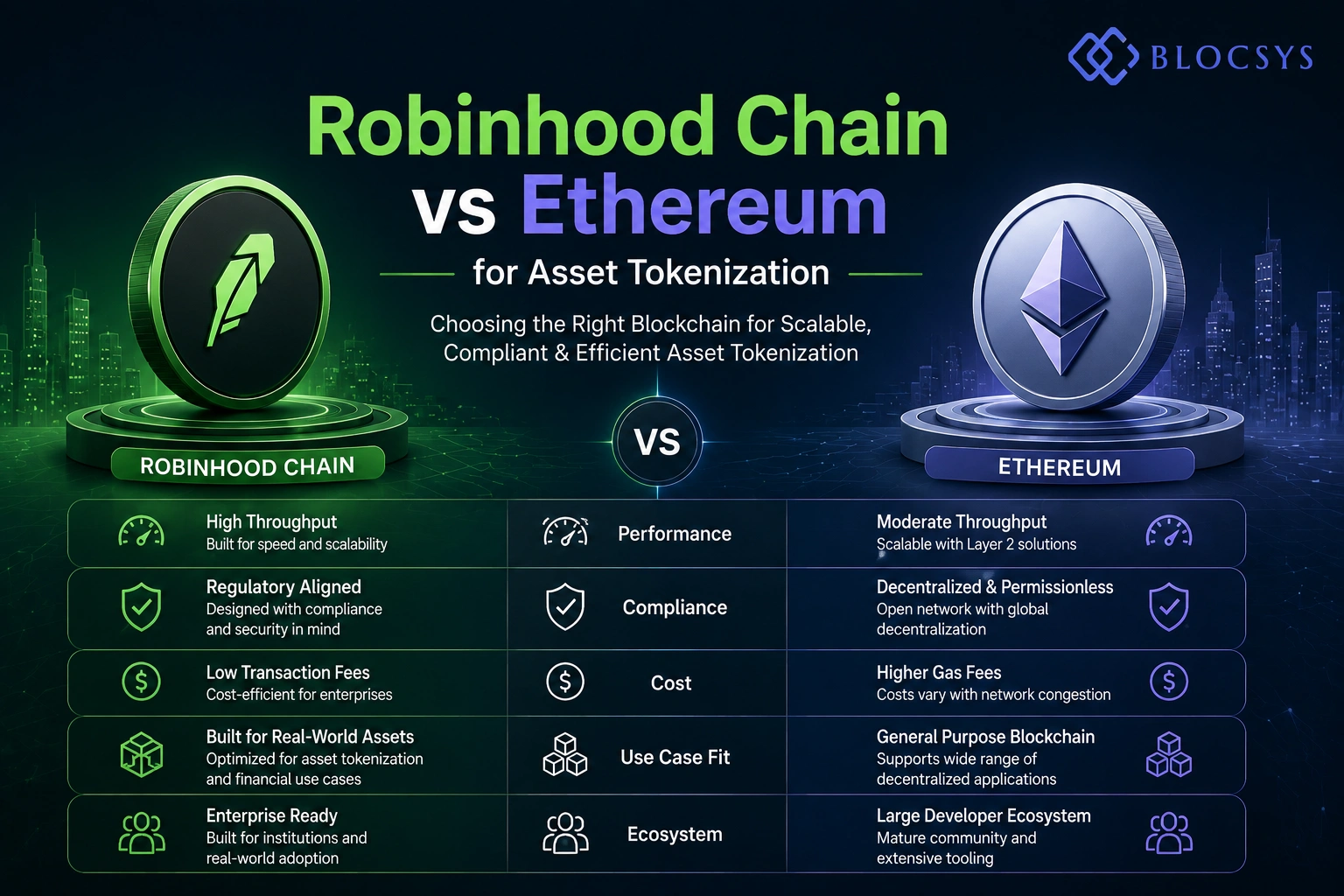
Robinhood Chain’s first-week numbers make the question impossible to dodge. It pulled in nearly $250 million in tracked liquidity, but the tokenized real-world asset slice was still only about $12.8 million, or roughly 4.1% of activity by later reporting, while Ethereum kept its position as the more credible settlement layer for institutional tokenization. For banks, fintechs, asset managers, and regulators, Robinhood Chain vs Ethereum isn’t a branding contest, it’s a decision about execution speed, compliance posture, and where long-term tokenization belongs.
If you’re evaluating tokenized stocks, private credit, funds, or other digital securities, the right choice depends on whether you need a fast app-specific trading environment or a neutral infrastructure layer with deeper institutional gravity. For enterprises designing tokenization platforms, the answer isn’t universal, and the trade-off matters more than the marketing. For firms building production systems, Blocsys Technologies is one of the teams focused on enterprise blockchain, tokenization platforms, and smart contract workflows.
Table of Contents
- The Tokenization Market State in 2026
- Architecture and Infrastructure Compared
- Tokenization Performance and Real-World Asset Adoption
- Compliance and Regulatory Alignment
- Choosing the Right Chain for Your Tokenization Strategy
- Building Enterprise Tokenization with Blocsys
The Tokenization Market State in 2026
Robinhood Chain opened with launch metrics that can distort judgment. In its first week, the network accumulated nearly $250 million in tracked liquidity, including about $70 million bridged in ETH and $178 million in USDG, while daily active users rose from roughly 33,000 to 194,000 and daily revenue from about $4,000 to $39,000 Token Terminal. That is real traction, but it does not answer the tokenization question on its own.
Robinhood Chain’s early traction versus tokenization depth
By July 20, the chain had processed about 130 million transactions and generated roughly $1.94 million in gross fee revenue, yet only around 10% was shared with Arbitrum and less than 1% went to Ethereum for data availability and security Token Terminal. That structure matters. It shows that tokenization activity can scale quickly on an L2, while the base-layer economics captured by Ethereum remain small.
The usage mix is more revealing than the headline volume. Within two weeks of launch, Robinhood Chain reached roughly $312 million in TVL, nearly 800,000 lifetime active addresses, and 3.6 million transactions in a single day, while DEX volume hit about $838 million in 24 hours Crypto.news. Tokenized RWAs, by contrast, remained only about $12.8 million, or roughly 4.1% of activity Crypto.news. For a practical framework on issuance, custody, and transfer design, see this guide to tokenizing real-world assets on modern infrastructure.
Practical rule: do not confuse a fast-growing venue with a deep tokenization stack. A chain can attract users before it proves that regulated assets are the primary driver behind that activity.
Why Ethereum still anchors institutional settlement
Ethereum’s value in tokenization is not just throughput, it is settlement credibility. Robinhood Chain is a permissionless, Ethereum-compatible Layer 2 built to bring traditional markets, crypto, and real-world assets onto one network, and Robinhood’s support docs state that transaction fees are paid in ETH rather than a native chain token Robinhood support. Robinhood Chain’s tokenization economics are still tied to Ethereum settlement, even when the user-facing activity happens on the L2.
That dependency matters for institutions. Ethereum remains the more neutral settlement layer, with a broader credibility profile for long-horizon financial infrastructure. Tokenization is not only about trading velocity. It is about whether a ledger can support issuance, ownership logic, transfer restrictions, and cross-jurisdiction compliance without locking the market into a single app operator’s policy choices.
The market gap is straightforward. Robinhood Chain is currently stronger at capturing speculative and app-native activity, while Ethereum remains the safer default for institutions that need a chain to outlive any single product cycle. For teams mapping asset lifecycle, that difference is the starting point, not the conclusion.
Architecture and Infrastructure Compared
Robinhood Chain’s appeal starts with speed, but the architecture behind that speed is what matters for tokenization. Launch reporting describes it as built on Arbitrum Orbit, with EVM compatibility, Ethereum settlement, and roughly 100-millisecond block times Galaxy. Ethereum mainnet produces blocks about every 12 seconds, so the block-production layer alone points to a large latency gap in Robinhood Chain’s favor Robinhood docs. For teams evaluating modular deployments, modular blockchain architecture for scalable networks is a useful framework for understanding why sequencing, settlement, and execution can be separated without treating them as the same control point.
What Robinhood Chain’s Layer 2 design changes
For tokenized stocks, money-market style products, or real-world assets that need fast quote updates, the faster block cadence matters. It can improve quote freshness, order-book responsiveness, and the feel of near-instant execution. That does not make the chain a better settlement venue by default, but it does make the user experience closer to a modern trading system than a slower base layer.
Robinhood Chain also uses first-come, first-served sequencing rather than fee-priority ordering Robinhood docs. Inclusion therefore depends on sequencer arrival time instead of gas bidding. For tokenization workflows, that reduces the value of paying more to get ahead in line, while increasing the importance of sequencer policy and application-layer rules.
Why Ethereum’s base-layer neutrality still matters
Ethereum’s main advantage is architectural neutrality. It does not ask the market to trust one product stack for issuance, custody integrations, and long-lived settlement. A tokenization platform built on Ethereum can fit more easily into institutional custody, interoperability, and governance assumptions because the base layer is not optimized around a single distribution channel.
That distinction matters most when legal teams, compliance teams, and counterparties need a ledger that can survive product changes without changing the settlement model with it.
Architecture takeaway: Robinhood Chain can make tokenized trading feel faster. Ethereum can make the same asset class feel more institutionally durable.
The fee model adds another layer of dependence. Robinhood Chain’s support docs say fees are paid in ETH, and reporting notes that it has no native protocol token Robinhood support Galaxy. That simplifies the user-facing economics, but it also keeps the chain’s tokenization stack tied to Ethereum for settlement economics and network assumptions.
For enterprise tokenization, that coupling is a design choice, not a neutral fact. Robinhood Chain gives application teams tighter control and lower-latency execution. Ethereum gives institutions a base layer that is easier to defend in boardrooms, more familiar to integrators, and less exposed to a single operator’s sequencing rules.
Tokenization Performance and Real-World Asset Adoption
The adoption profile is more restrained than the launch narrative suggests. Robinhood Chain’s early activity was broad, but the tokenized RWA segment remained a small part of on-chain usage. Early reporting tied about $12.8 million of tokenized RWAs to the chain, including roughly $10.68 million in tokenized stocks and about $410,000 in Treasuries. That mix supports the core point in this analysis of Robinhood Chain and real-world asset tokenization, the chain is getting attention first as a trading venue, not yet as a deep institutional RWA settlement layer.
Current Usage Mix Distribution
Reporting on the launch period said the chain reached about $312 million in TVL, nearly 800,000 lifetime active addresses, and 3.6 million transactions in a single day, with DEX volume around $838 million in 24 hours Crypto.news. Independent coverage from industry analysts and market data providers described the same pattern in less promotional terms, strong trading throughput, but limited evidence that tokenized RWAs were driving the network’s center of gravity.
A separate market readout put active RWA value at about $70 million, or around 4% of activity, while memecoins and stablecoins accounted for most usage. That matters because volume and RWA depth are not the same thing. High transaction counts can reflect speculation, market making, or retail experimentation without proving that the chain has become a primary venue for regulated asset issuance or transfer.
Robinhood Chain vs Ethereum here is a question of what kind of adoption matters more. Robinhood Chain shows faster short-term trading momentum. Ethereum shows deeper credibility for long-duration tokenization, where the asset needs to survive market cycles, custody changes, and product redesigns.
| Metric | Robinhood Chain | Ethereum |
|---|---|---|
| Launch model | Ethereum Layer 2 built with Arbitrum technology | Base layer settlement network |
| Tokenization focus | Designed for tokenized real-world assets | Established settlement layer for institutional tokenization |
| Early usage mix | Broad, but RWAs were only about 4.1% of activity Crypto.news | More mature institutional tokenization footprint |
| Market behaviour | Strong trading activity, including memecoins and stablecoins | More neutral environment for long-duration asset programmes |
| Settlement dependence | Depends on Ethereum settlement | Native settlement layer |
| Fee asset | ETH | ETH |
What the metrics imply for institutions
The main risk for tokenization teams is reading activity as depth. A network can attract users quickly and still have shallow real-world asset penetration. For institutions, that means Robinhood Chain may be useful for launch speed and retail distribution, while Ethereum remains the more defensible choice for assets that need predictable settlement over time.
Ethereum still looks stronger for tokenized ETFs, money-market funds, corporate bonds, and similar instruments where continuity matters more than promotional momentum. The relevant question is not whether Robinhood Chain can host tokenized assets. It can. The question is whether its current usage shows that regulated assets are the primary source of network value.
Institutional lens: if the most visible activity is speculative rather than asset-centric, treat tokenization claims as early-stage product positioning, not proof of a durable market structure shift.
For builders evaluating real-world asset platforms, the distinction is practical. A chain can be technically viable and commercially active, yet still be a weak fit for long-term issuance, transfer governance, and institutional custody design. That is the difference between a trading venue and a settlement system. The same caution applies when teams compare control and observability against compliance tooling such as the Vanta features and pricing breakdown, because operational maturity and tokenization depth are related, but not interchangeable.
Compliance and Regulatory Alignment
Compliance is where many tokenization projects either become investable or get stuck in pilot mode. Robinhood Chain’s posture is different from Ethereum’s because it is explicitly app-specific and includes transaction monitoring, while Ethereum remains a neutral public settlement layer that doesn’t build the same policy assumptions into the base infrastructure. For regulated firms, that changes how the legal, custody, and transaction-control stack gets assembled.
How each chain fits regulated tokenization
For Europe, the most relevant reference points are MiCA, the DLT Pilot Regime, and local securities frameworks. For the UK, it’s FCA digital asset alignment and tokenised equity treatment. For the US, it’s the question of SEC-compliant tokenization and whether the structure maps cleanly to securities law and custody obligations. The chain alone doesn’t solve any of that.
Robinhood Chain’s app-specific model can reduce operational friction for controlled workflows, especially where monitoring and policy enforcement are built into the stack. Ethereum’s neutral architecture makes it easier to justify as a public settlement layer when the goal is to preserve interoperability and avoid over-reliance on a single operator. That neutrality is often what institutional counsel wants when the asset needs to travel across partners, custodians, and jurisdictions.
A useful practical reference point for compliance teams is Vanta’s features and pricing breakdown, because it shows how structured control monitoring gets discussed in adjacent enterprise contexts. The point isn’t that a compliance SaaS tool solves tokenization, it’s that institutions already expect auditable controls, repeatability, and clear evidence trails before they approve production systems.
Operational controls that matter to compliance teams
Tokenization projects usually fail on workflow, not on blockchain theory. The important issues are custody segregation, KYC and AML integration, transfer restrictions, corporate action handling, and whether the smart contract layer reflects the legal wrapper correctly. If the token says one thing and the legal instrument says another, the structure becomes hard to defend.
Robinhood Chain’s architecture may feel more convenient for policy enforcement because the platform owns more of the user journey. Ethereum can be more workable where the institution wants a settlement layer that sits below multiple service providers rather than inside one vertically integrated product. That difference becomes especially important for cross-border structures involving private credit, unlisted equity, or commodity-linked tokens.
Blocsys’s FCA compliance equity tokenisation guidance for the UK sits in the middle of this discussion for a reason. UK and European deployments rarely fail because the chain is wrong, they fail because the operating model isn’t aligned with the regulatory wrapper.
Choosing the Right Chain for Your Tokenization Strategy
The cleanest way to choose between Robinhood Chain and Ethereum is to start with the asset, not the chain. If the business objective is high-frequency execution around tokenized stocks, internal platform liquidity, or app-specific trading flows, Robinhood Chain has a clear advantage in user experience and sequencing control. If the objective is long-term settlement, multi-party interoperability, and institutional credibility, Ethereum is the more conservative choice.
A practical decision framework
Use Robinhood Chain when these conditions are true.
- You need low-latency execution: The roughly 100-millisecond block cadence supports quote freshness and responsive trading Galaxy.
- You control the user experience: App-specific tokenization works best when the platform already owns the distribution layer.
- You’re optimising for trading behaviour: Robinhood Chain’s early traction shows strong momentum in activity, even if RWAs remain a small part of it Crypto.news.
Use Ethereum when these conditions are true.
- You need settlement neutrality: Ethereum is harder to frame as a proprietary venue and easier to position as common infrastructure.
- You expect cross-platform integration: Institutional tokenization often depends on wallet support, custody partners, and broader ecosystem compatibility.
- You’re building for duration, not hype: The market still treats Ethereum as the more established home for durable tokenization infrastructure.
Where the trade-offs usually land
The decision is rarely one chain versus the other in a pure form. Many institutional deployments will end up hybrid, with one layer handling distribution or trading logic and another handling settlement assumptions and interoperability. That’s especially true where the business wants to keep compliance controls tight without closing off future connectivity.
Decision rule: if speed is your main value proposition, Robinhood Chain deserves a serious look. If defensibility is your main value proposition, Ethereum is still the safer anchor.
For product teams, a useful next step is to separate front-end trading design from legal settlement design. Once those are decoupled, the chain choice becomes much clearer, and the platform architecture stops pretending that every tokenization problem has one universal answer.
Building Enterprise Tokenization with Blocsys
The next stage of tokenization will reward teams that can ship compliant infrastructure rather than just concept decks. Over the next 12 to 24 months, the likely winners will be the organisations that can combine asset structuring, smart contract logic, transfer controls, and integration with custody and reporting systems into one operating model. That’s where implementation discipline matters more than chain ideology.
How implementation should be sequenced
A sensible enterprise roadmap starts with the asset wrapper, not the smart contract. The legal rights, transfer permissions, and custody model need to be fixed before the code is finalised. Then the contract layer can enforce the workflow rather than improvising it.
A practical rollout usually looks like this.
- Define the asset class carefully. Tokenized equities, private credit, funds, and commodity-linked products all carry different compliance and transfer constraints.
- Map legal and operational controls. The token logic has to match custody, issuer permissions, and investor eligibility rules.
- Choose the chain based on the actual workflow. If the product depends on app-native speed, Robinhood Chain is relevant. If it depends on settlement neutrality and integration breadth, Ethereum is usually the better anchor.
- Add monitoring and reporting from day one. The platform has to produce records that compliance and audit teams can work with, not just dashboards for traders.
Blocsys’s enterprise tokenized equity platform guide is relevant here because the technical problem is rarely just token issuance. It’s the end-to-end system around the asset, including smart contract development, compliance logic, and platform operations.
What the next 12 to 24 months could change
Robinhood Chain will probably keep pushing hard on distribution, liquidity, and app-level tokenization use cases. Ethereum is still more likely to remain the default settlement and interoperability layer for institutions that want a broader public-infrastructure posture. The market may not converge on one winner, because different asset classes have different infrastructure needs.
Blocsys Technologies fits into that environment as an implementation partner for teams that need production-ready tokenization, blockchain software development, and enterprise blockchain consulting. The useful role is not to pick a favourite chain, but to build the right architecture for the asset, the jurisdiction, and the operating model.
If you’re a bank, fintech, asset manager, or digital asset provider planning a tokenization programme, Blocsys can help turn the chain decision into a deployable system rather than a slide deck. Visit Blocsys Technologies to discuss Robinhood Chain development, Ethereum development, or a hybrid tokenization architecture that fits your compliance and market-access needs.
Choosing the Right Blockchain for Tokenization in GIFT City
GIFT City is becoming an important environment for businesses exploring regulated digital assets and tokenization, making blockchain infrastructure an important consideration. When evaluating networks such as Robinhood Chain and Ethereum, businesses should consider factors such as scalability, transaction efficiency, interoperability, security, and suitability for institutional tokenization use cases. The right blockchain infrastructure can help tokenization platforms operating in GIFT City support secure asset issuance and efficient digital asset management.
Frequently Asked Questions
What is the difference between Robinhood Chain and Ethereum for tokenization?
Robinhood Chain is an Ethereum-compatible Layer 2 designed for lower-latency, application-focused financial activity, while Ethereum is the base-layer blockchain commonly used as a neutral settlement and interoperability foundation. For tokenization, Robinhood Chain can be attractive for fast trading and app-specific workflows, whereas Ethereum can be better suited to assets that require broad institutional integration, long-term settlement, and ecosystem neutrality.
Is Robinhood Chain better than Ethereum for tokenization?
Robinhood Chain is not universally better than Ethereum for tokenization because the appropriate blockchain depends on the asset, trading model, compliance requirements, and settlement needs. Robinhood Chain can be advantageous when low-latency execution, controlled sequencing, and an application-specific user experience are priorities, while Ethereum may be the stronger choice when institutional interoperability, settlement neutrality, custody compatibility, and long-term infrastructure durability are more important.
Why is Ethereum still important for institutional tokenization?
Ethereum remains important for institutional tokenization because it provides a widely recognised public settlement layer with a large ecosystem of wallets, custody providers, developers, protocols, and infrastructure services. Its neutrality can also make it easier for institutions to design tokenized assets that can interact with multiple service providers rather than depending on the policies of a single application or distribution platform.
What are the advantages of Robinhood Chain for tokenized assets?
The main advantages of Robinhood Chain for tokenized assets are fast block production, Ethereum compatibility, application-focused infrastructure, and support for responsive trading experiences. Its Layer 2 architecture can make tokenized stocks and other digital assets feel closer to conventional high-speed trading environments, although speed alone does not establish institutional-grade settlement, liquidity, custody, or regulatory readiness.
Is Ethereum suitable for corporate bond tokenization?
Yes, Ethereum can support corporate bond tokenization by providing infrastructure for token issuance, ownership records, smart contracts, transfers, and integration with broader digital-asset infrastructure. Corporate bond platforms can use Ethereum-based architectures for programmable lifecycle events such as coupon payments and redemption, while additional legal, custody, compliance, and settlement layers are required to make the tokenized bond suitable for institutional use.
How fast is Robinhood Chain compared with Ethereum?
Robinhood Chain has a much faster block-production cadence than Ethereum mainnet, with launch reporting describing roughly 100-millisecond block times compared with Ethereum’s approximately 12-second block interval. This difference can improve responsiveness for applications such as tokenized trading, but block speed should be evaluated alongside finality, sequencing, settlement architecture, security, liquidity, and institutional requirements rather than treated as the only performance metric.
Can Robinhood Chain and Ethereum be used together for tokenization?
Yes, Robinhood Chain and Ethereum can be used together in a hybrid tokenization architecture. Robinhood Chain can handle application-level execution, trading, or distribution while Ethereum can provide settlement, security, or broader interoperability assumptions. This approach allows enterprises to separate high-speed user-facing workflows from long-term settlement and connectivity requirements instead of forcing every function onto a single blockchain.
What blockchain is best for real-world asset tokenization?
There is no single blockchain that is best for every real-world asset tokenization project. The appropriate network depends on the asset class, investor restrictions, custody model, compliance requirements, transfer rules, liquidity needs, settlement design, interoperability requirements, and jurisdiction. Ethereum can be a strong foundation for institutional RWA tokenization, while specialised Layer 2 or permissioned networks can be appropriate when speed, privacy, or application-level control is more important.
How does compliance differ between Robinhood Chain and Ethereum?
Compliance does not come automatically from choosing either Robinhood Chain or Ethereum because regulatory obligations depend on the tokenized asset, issuer, investors, service providers, and jurisdiction. Robinhood Chain can provide more application-level control over certain workflows, while Ethereum provides a more neutral public infrastructure layer. In both cases, tokenization platforms still require KYC/AML, transfer restrictions, custody controls, transaction monitoring, investor eligibility rules, and appropriate legal structures.
Should enterprises choose Robinhood Chain or Ethereum for a tokenization platform?
Enterprises should choose Robinhood Chain when the platform prioritises low-latency execution, app-specific distribution, and controlled trading workflows, while Ethereum is generally more suitable when the priority is settlement neutrality, broad interoperability, institutional ecosystem support, and long-term infrastructure durability. The decision should begin with the asset and operating model rather than the blockchain, with hybrid architectures considered when both requirements are important.
How much does it cost to build a tokenization platform on Robinhood Chain or Ethereum?
The cost of building a tokenization platform on Robinhood Chain or Ethereum depends on the asset type, smart contract complexity, wallet infrastructure, custody, KYC/AML controls, transfer restrictions, trading functionality, oracle integrations, compliance requirements, blockchain integrations, security testing, and settlement architecture. A basic token issuance platform can cost significantly less than an institutional system supporting tokenized securities, secondary trading, custody, multi-jurisdiction compliance, and automated asset lifecycle management.
