
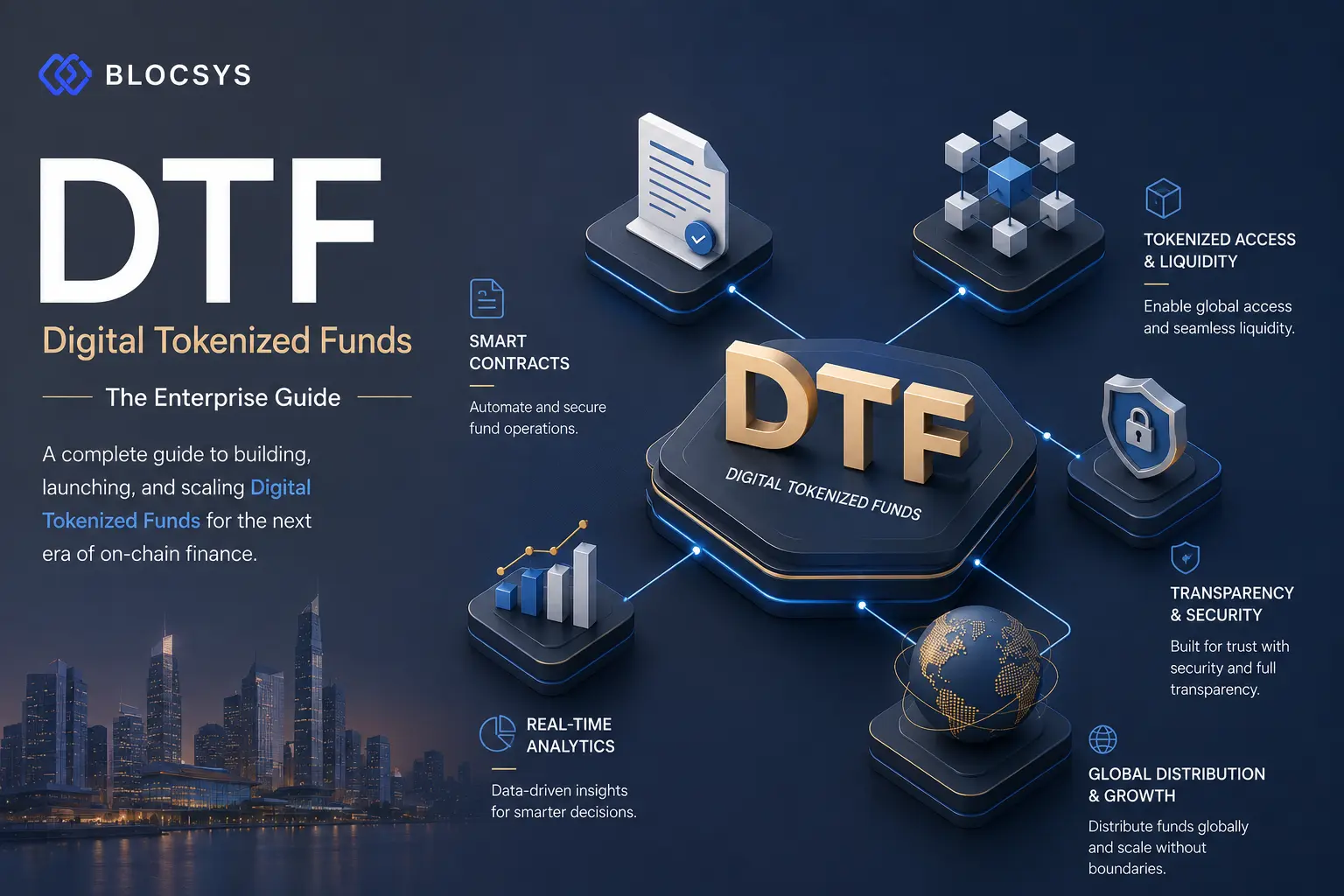
DTF for Digital Tokenized Funds: Enterprise Guide for Financial Institutions
Institutional finance is quietly rebuilding its plumbing. Decentralized traded funds are at the center of that shift, giving asset managers a way to issue, trade, and settle fund shares directly on blockchain rails. If you’re a CTO, CIO, or fund manager trying to understand where digital tokenized funds fit into your roadmap, you’re in the right place. We’ll walk through what DTFs actually are, why banks and wealth managers are adopting them, and how a platform like Decentralized Traded Funds (DTF) Platform — AI-Powered On-Chain Asset Management turns theory into a working institutional product. For a broader look at how Blocsys approaches enterprise-grade infrastructure, visit our homepage anytime.
What Are Digital Tokenized Funds?
Digital tokenized funds represent fund shares as blockchain-based tokens instead of traditional book-entry records. Each token corresponds to a claim on underlying assets. Those assets might be equities, bonds, real estate, or commodities.
Here’s why this matters: tokenization compresses settlement time from days to minutes. It also opens fund access to a wider range of investors without rebuilding your entire back office.
Unlike a standard mutual fund wrapper, a tokenized fund lives on a shared ledger. That ledger updates ownership records automatically whenever a trade executes. Consequently, reconciliation errors that plague legacy fund administration drop sharply.
What Is a Decentralized Traded Fund (DTF)?
A Decentralized traded fund takes tokenization one step further. Instead of a centralized administrator controlling issuance and redemption, smart contracts handle those functions automatically.
Think about an ETF, but one where the rebalancing logic, fee collection, and compliance checks run on-chain. That’s essentially what a DTF does. Investors interact with a transparent, auditable system rather than trusting a black-box back office.
The institutions winning at digital assets right now aren’t the ones chasing hype. They’re the ones treating decentralized traded funds as infrastructure upgrades to existing fund operations, not speculative side projects.
Governance still matters, though. Most enterprise DTF platforms combine decentralized execution with permissioned oversight, so regulated entities keep the control they legally need.
Why Financial Institutions Are Adopting Digital Tokenized Funds
Banks and asset managers aren’t adopting digital tokenized funds because it’s trendy. They’re adopting them because the economics work. Settlement costs drop. Distribution reaches new investor segments. Reporting becomes near real-time.
Consider a wealth management firm managing cross-border portfolios. Traditional settlement across jurisdictions can take three to five business days. A tokenized structure settles the same trade in minutes, freeing up capital faster.
Additionally, family offices and institutional allocators increasingly want fractional exposure to alternative assets. Tokenized structures make that possible without the administrative overhead of traditional feeder funds.
- Faster settlement and reduced counterparty risk
- Lower administrative and custody costs over time
- Broader investor access through fractionalized shares
- Real-time, auditable transaction records
- Programmable compliance built into fund logic
How DTFs Transform Digital Asset Fund Management
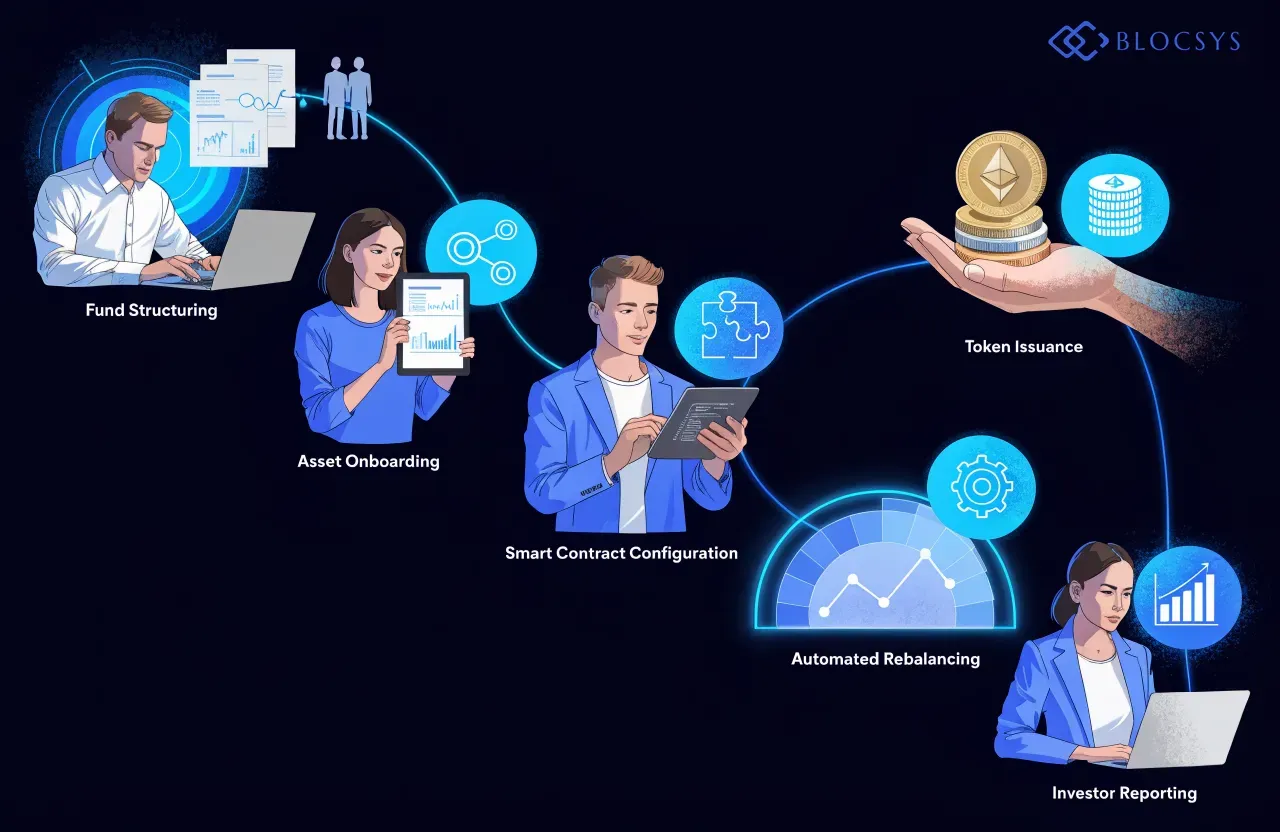
Decentralized traded funds change how portfolio managers operate day to day. Rebalancing that once required manual trade tickets and multi-day settlement cycles now happens through automated smart contract logic.
Digital asset fund management under a DTF model also improves transparency. Every transaction writes to an immutable ledger. Auditors and regulators can verify holdings without waiting on quarterly reports.
Moreover, fund managers gain granular control over strategy execution. You can encode rebalancing thresholds, risk limits, and liquidity rules directly into contract logic, removing much of the operational lag that legacy systems carry.
Enterprise Blockchain Infrastructure for DTF Platforms
Building a Decentralized traded fund platform requires enterprise blockchain infrastructure designed for institutional throughput, not retail experimentation. That means permissioned nodes, high-availability architecture, and interoperability across chains.
Institutional blockchain deployments typically combine private and public chain elements. Sensitive fund data stays on permissioned layers, while token settlement can settle on public networks for transparency.
Enterprise blockchain also needs to integrate with existing core banking and custody systems. That’s where a specialized partner like our Enterprise Blockchain Development team earns its keep, connecting new rails to legacy infrastructure without disruption.
Core Components of a Decentralized Traded Fund Stack
A working DTF stack generally includes token standards for fund shares, oracle networks for pricing data, custody integration, and a compliance layer. Each piece needs to interoperate cleanly.
Interoperability matters more than most teams expect. Institutional investors trade across multiple venues. Consequently, your DTF platform needs bridges or messaging protocols that keep asset data consistent across chains.
AI-Powered Portfolio Management and Fund Automation
AI portfolio management is where digital tokenized funds get genuinely interesting. Machine learning models can analyze market signals, liquidity conditions, and risk factors continuously, then trigger rebalancing through smart contracts automatically.
Here’s a practical scenario. An AI model detects rising correlation risk across a multi-asset tokenized fund. It flags the exposure, and the smart contract executes a rebalance within predefined risk parameters, no manual intervention required.
This isn’t full autonomy without oversight, though. Institutions typically keep human portfolio managers in the loop for strategy decisions, while AI handles execution speed and pattern detection at a scale humans simply can’t match.
Furthermore, AI-driven analytics improve investor reporting. Dashboards can surface real-time attribution, risk metrics, and performance data pulled directly from on-chain activity.
Multi-Asset Investment Strategies with Tokenized Funds
Digital tokenized funds aren’t limited to a single asset class. A well-built DTF can hold equities, fixed income, commodities, and tokenized real estate within one wrapper.
Multi-asset investment strategies benefit enormously from tokenization’s fractional structure. You can rebalance across asset classes without the settlement friction that traditional multi-asset funds face.
Picture a Swiss wealth manager building a diversified tokenized portfolio for UHNW clients. Real estate tokens sit alongside tokenized bonds and equity baskets, all managed through a single interface with unified reporting.
Consequently, portfolio diversification becomes more accessible, not just for large institutions but for smaller wealth advisory firms serving retail-adjacent clients too.
Tokenized Securities, RWAs, and Digital Investment Products
Tokenized real-world assets are expanding what a Decentralized traded fund can hold. Real estate, private credit, commodities, and even fine art now get represented as blockchain tokens with legal backing.
Our Real World Asset Tokenization work has shown us that legal structuring matters just as much as the technology. Token holders need enforceable claims on underlying assets, not just a digital receipt.
Tokenized securities also open new liquidity paths. Assets that once sat illiquid for years, like private equity stakes, can now trade on secondary markets designed for institutional participants.
Building Blocks for Digital Investment Products
Structuring digital investment products around DTFs typically involves an Asset Tokenization Platform, custody integration, and a compliance engine that enforces investor eligibility rules automatically.
Smart Contracts and Automated Fund Operations
Smart contracts are the operational backbone of any Decentralized traded fund. They handle issuance, redemption, fee calculation, and rebalancing without manual back-office processing.
What’s the practical benefit? Reduced operational risk. When rebalancing logic lives in audited contract code, human error in trade execution drops significantly.
Smart contracts also enforce compliance automatically. If an investor doesn’t meet accreditation requirements, the contract simply won’t allow the transfer. That’s a meaningful upgrade over manual compliance checks.
Smart contracts don’t replace compliance teams. They give compliance teams a system that actually enforces the rules it’s told to enforce, every single time, without fatigue.
Institutional Custody, Compliance, and Governance
Custody remains the single biggest concern for institutions evaluating digital tokenized funds. You need multi-signature wallets, hardware security modules, and clear key management protocols before you touch production capital.
Compliance frameworks for enterprise DTF platforms typically map to existing securities regulations. KYC and AML checks get embedded directly into onboarding flows, and transfer restrictions enforce accredited investor rules automatically.
Governance models vary by jurisdiction. Some platforms use a hybrid approach: decentralized execution paired with a centralized governance board that can pause operations if something goes wrong.
Regulators across the USA, UK, Europe, Switzerland, UAE, and Singapore are actively developing frameworks for tokenized securities. Institutions that build compliance-first from day one avoid costly retrofits later.
Security and Risk Management
Security can’t be an afterthought here. Smart contract audits, penetration testing, and formal verification all need to happen before a DTF platform touches institutional capital.
Risk management for digital tokenized funds also extends beyond code security. Market risk, liquidity risk, and counterparty risk all need monitoring, ideally through automated dashboards that flag anomalies in real time.
Additionally, disaster recovery planning matters. What happens if a validator node goes offline? Enterprise-grade platforms build redundancy into every layer, not just the smart contract itself.
Enterprise Use Cases for Financial Institutions
Investment banks are using tokenized structures to issue structured products faster than traditional processes allow. What once took weeks of legal drafting now compresses into days through templated smart contracts.
Wealth management firms use DTFs to offer fractional access to alternative assets, letting smaller clients participate in strategies once reserved for institutional-only allocators.
Family offices increasingly use tokenized multi-asset funds for cross-border estate planning, since token transfers settle faster than traditional cross-jurisdictional asset transfers.
Fintech platforms building next-generation trading products often pair DTF infrastructure with Institutional OTC Crypto Trading Platform Built on Blockchain capabilities, giving institutional clients both fund exposure and direct trading access in one ecosystem.
Benefits of DTF-Based Digital Tokenized Funds
Let’s bring this together. Decentralized traded funds deliver faster settlement, lower operational costs, broader investor access, and stronger transparency, all at once.
They also give asset managers a more flexible product structure. You can launch niche multi-asset strategies without the overhead traditional fund launches require.
Blockchain asset management, more broadly, benefits from the same automation and auditability that makes DTFs attractive. Every transaction is traceable, which simplifies both internal audits and external regulatory reviews.
Challenges and Best Practices
Adoption isn’t friction-free, of course. Regulatory uncertainty in some jurisdictions still slows institutional commitment. Legal recognition of tokenized ownership varies significantly by country.
Interoperability between chains remains a real technical challenge too. Institutions trading across multiple platforms need bridges that don’t compromise security for convenience.
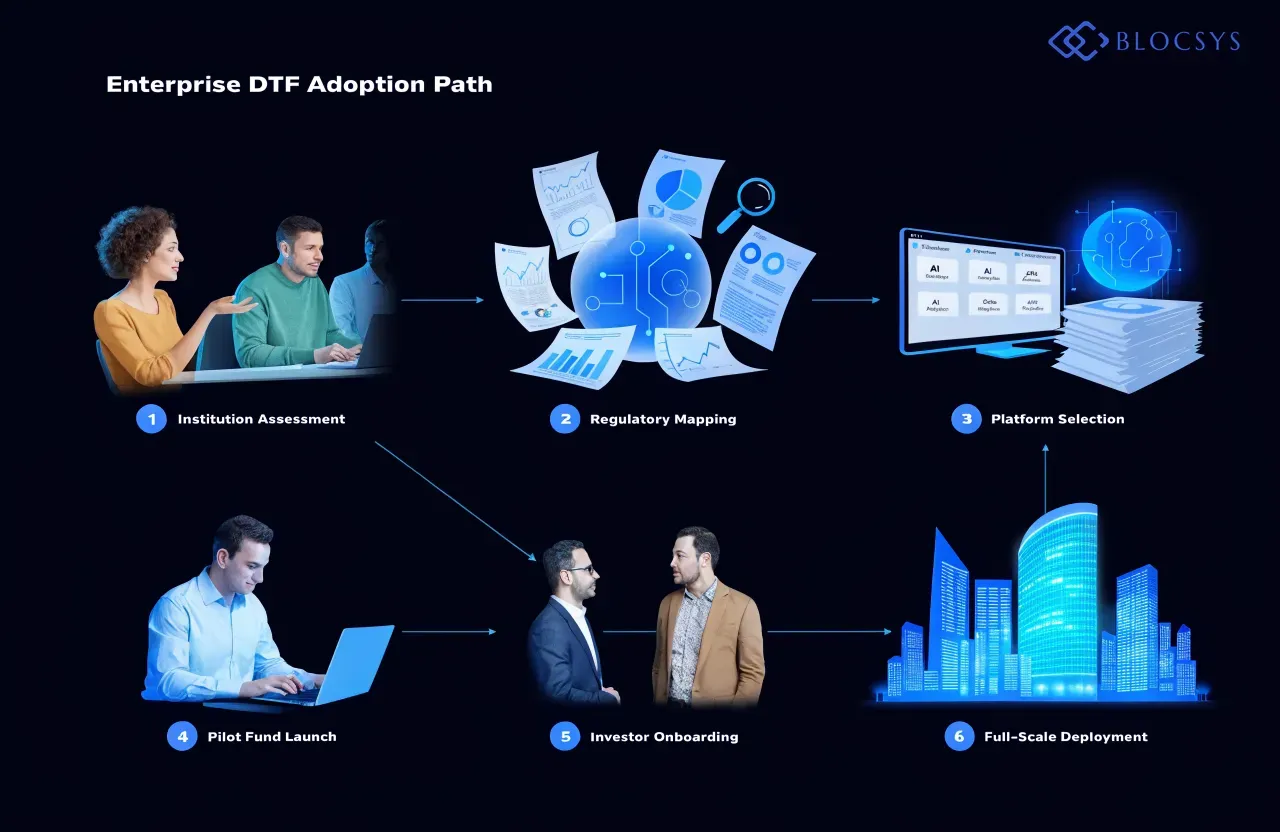
Practically speaking, start small. Pilot a single tokenized fund with a limited investor base before scaling to a full multi-asset platform. Work with legal counsel early, not after the smart contracts are written.
Future of Digital Tokenized Funds and Institutional Investment
Where does this go next? Expect deeper integration between AI portfolio management and on-chain execution, along with expanding regulatory clarity across major financial hubs.
Institutional blockchain adoption is accelerating across the USA, UK, Germany, Canada, and Australia, with regulators building sandboxes specifically for tokenized securities testing.
Consequently, we expect Decentralized traded funds to become a standard product line for asset managers within the next few years, not a niche experiment reserved for crypto-native firms.
Why Choose Blocsys for Enterprise DTF Platform Development
Building a compliant, secure, and scalable DTF platform requires a partner who understands both blockchain engineering and institutional finance. That’s exactly where Blocsys operates.
Our team combines expertise across Blockchain Development Company services, smart contract engineering, and AI-driven portfolio automation. We’ve built infrastructure for document verification, OTC trading, and asset tokenization, giving us a broad view of what institutional-grade blockchain products actually require.
If you need dedicated engineering capacity, our Dedicated Blockchain Engineering Teams and Hire Blockchain Developers services scale alongside your project, from pilot to full production rollout.
Fintech Blockchain for Digital Tokenized Funds
The adoption of fintech blockchain is creating new possibilities for financial institutions managing digital tokenized funds, enabling fund issuance, ownership tracking, transaction processing, and settlement through blockchain-based infrastructure. For institutions exploring DTF models, fintech blockchain can connect traditional financial operations with programmable digital-asset systems, helping automate fund-related workflows while improving transparency, operational efficiency, and control. This approach can support financial institutions as they explore more scalable and digitally native models for managing tokenized funds.
DTF for Digital Tokenized Funds: Enterprise Guide for Financial Institutions
GIFT City can be considered when financial institutions explore digital tokenized funds as an alternative approach to managing and representing investment assets. A DTF platform can support functions such as digital fund creation, investor access, ownership management, asset tracking, and transaction execution through blockchain infrastructure. This can help institutions evaluate how tokenized fund models could fit into their broader digital asset and investment strategies in GIFT City.
Frequently Asked Questions
Here are direct answers to the questions we hear most often about decentralized traded funds and digital tokenized fund management.
What are Digital Tokenized Funds?
Digital tokenized funds represent traditional or alternative fund shares as blockchain tokens. Each token reflects ownership of underlying assets like equities, bonds, or real estate.
This structure enables faster settlement, fractional ownership, and real-time transparency compared to traditional fund administration models.
What is a Decentralized Traded Fund (DTF)?
A Decentralized traded fund uses smart contracts to automate issuance, redemption, and rebalancing instead of relying solely on a centralized administrator. It combines blockchain transparency with programmable fund logic.
Many institutional DTF platforms still include governance oversight, blending decentralized execution with regulated control structures.
How do DTFs support digital tokenized funds?
DTFs provide the operational framework that makes digital tokenized funds function at scale. Smart contracts handle rebalancing, compliance checks, and fee distribution automatically.
This reduces manual back-office work and speeds up reporting, settlement, and investor onboarding significantly compared to legacy fund structures.
Why are financial institutions adopting digital tokenized funds?
Institutions adopt digital tokenized funds because they cut settlement times, reduce administrative costs, and open access to new investor segments through fractional ownership.
Additionally, real-time auditability simplifies regulatory reporting, which matters enormously for banks and wealth managers operating across multiple jurisdictions.
How do AI and blockchain improve digital tokenized fund management?
AI analyzes market data continuously and flags rebalancing opportunities or risk exposures in real time. Blockchain then executes those decisions through smart contracts without manual delay.
Together, they create a fund management system that’s faster, more consistent, and less prone to human error than traditional manual processes.
What types of assets can be included in digital tokenized funds?
Digital tokenized funds can hold equities, fixed income, commodities, tokenized real estate, private credit, and other tokenized real-world assets within a single wrapper.
This flexibility supports genuinely diversified multi-asset investment strategies that were previously difficult to structure efficiently.
What security and compliance measures are required for enterprise DTF platforms?
Enterprise DTF platforms need multi-signature custody, smart contract audits, KYC and AML integration, and automated transfer restrictions for accredited investor rules.
Regulatory alignment varies by jurisdiction, so platforms typically need configurable compliance modules that adapt to regional securities law.
How do digital tokenized funds differ from traditional investment funds?
Traditional funds rely on centralized administrators, manual reconciliation, and multi-day settlement cycles. Digital tokenized funds automate these processes through blockchain and smart contracts.
The result is faster settlement, lower costs, and fractional access that traditional fund structures generally can’t match.
What is the future of digital tokenized funds and institutional investing?
Expect broader regulatory clarity, deeper AI integration, and wider institutional adoption across major financial hubs including the USA, UK, Switzerland, and Singapore.
Decentralized traded funds are likely to become a standard institutional product rather than a niche offering within the next several years.
How can Blocsys build secure enterprise-grade DTF platforms for digital tokenized funds?
Blocsys combines blockchain engineering, smart contract auditing, and AI-driven portfolio automation to build compliant, scalable DTF platforms tailored to institutional requirements.
Our team handles everything from custody integration to regulatory-aligned compliance logic, giving financial institutions a production-ready path into digital tokenized fund management.
Conclusion
Decentralized traded funds aren’t a distant concept anymore. They’re an active infrastructure upgrade reshaping how institutions manage digital tokenized funds, execute multi-asset strategies, and report performance to investors.
If your institution is exploring digital tokenized funds, don’t build this alone. Explore our Decentralized Traded Funds (DTF) Platform — AI-Powered On-Chain Asset Management to see how Blocsys structures secure, compliant, AI-powered fund infrastructure for institutional clients.
Whether you need Digital Asset Platform Development, smart contract engineering, or full enterprise blockchain consulting, our team is ready to help you launch a DTF platform built for real institutional scale. Reach out to Blocsys today and start building the next generation of digital tokenized fund infrastructure.
Ready to move beyond theory and build an intelligent platform that delivers real-world value? Blocsys Technologies specialises in engineering enterprise-grade AI and blockchain solutions for the fintech, Web3, and digital asset sectors. Connect with our experts today to discuss your vision and chart a clear path from concept to a secure, scalable reality.
