
A bank can launch a digital rupee wallet, complete the initial connectivity work, and still see customers return to familiar payment methods after one trial. That’s the operational reality behind CBDC Integration in India. For technology leaders, the challenge isn’t merely connecting to an RBI pilot rail. It’s making e₹ wallets usable, reconcilable, secure, compliant, and compatible with the payment behaviour customers and merchants already understand.
This guide is for banks, NBFCs, fintechs, payment providers, and enterprise technology teams evaluating Digital Rupee Integration, CBDC APIs, wallet middleware, core banking connectivity, settlement, reconciliation, and security. It focuses on the infrastructure decisions that determine whether an integration remains a controlled pilot or can support a credible path towards production readiness. Teams planning broader blockchain capability can also review Blocsys’ blockchain development services alongside their CBDC architecture work.
Table of Contents
- The Reality of Digital Rupee Adoption and Integration
- Architecting the Core Banking and Wallet Middleware
- Solving the Acceptance Gap Through UPI Interoperability
- Security Protocols and Automated Reconciliation Workflows
- Comparing Retail Token and Wholesale Settlement Rails
- Executing the Integration Roadmap with Blocsys
The Reality of Digital Rupee Adoption and Integration
A customer can receive an e₹ wallet, complete one transaction, and return to UPI the same day because the merchant, workflow, or payment experience is more familiar. India’s digital rupee has moved beyond a small proof of concept, but everyday use still depends on acceptance, convenience, and repeat behaviour. The Reserve Bank of India launched the retail e₹-R pilot on 1 December 2022, while RBI FAQ material released in January 2025 stated that 19 banks were offering CBDC wallets. (RBI retail e₹-R pilot announcement)
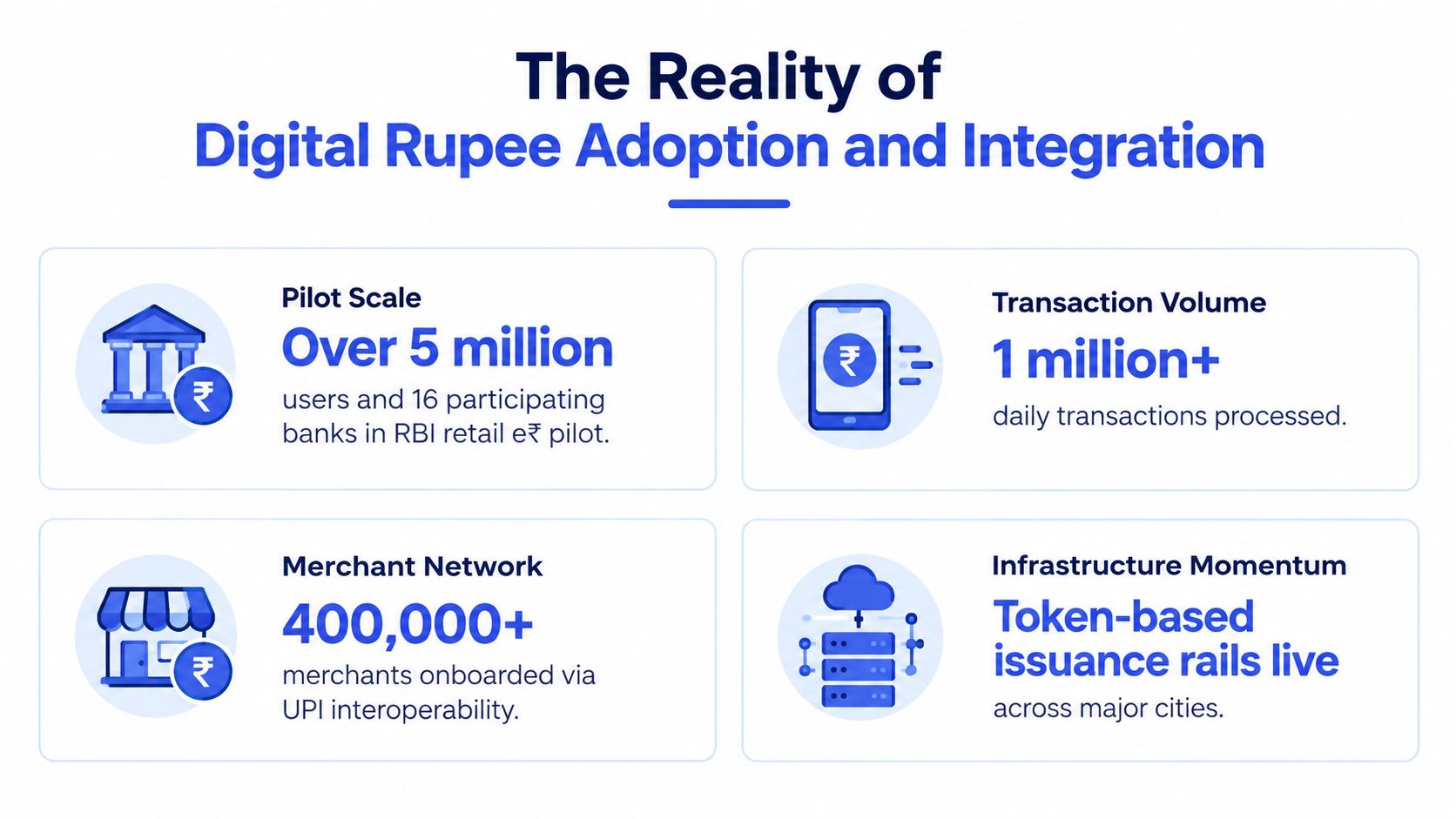
Retail CBDC circulation grew sharply during FY25. Reporting based on the RBI annual report said it increased by 334% in financial year 2024-25, reaching roughly ₹1,016.5 crore by 2025, compared with about ₹16.4 crore in 2023. The same reporting described a retail pilot with about 60 lakh users and circulation of roughly ₹1,016.5 crore by March 2025, up from about ₹103 crore in December 2023. (Moneycontrol’s coverage of the RBI annual report, Medianama’s reporting on the pilot)
Issuing wallets does not establish a payment habit. Industry reporting cited in 2026 noted roughly 10 million users and about 150 million cumulative retail transactions, while the retail stock of e₹ declined year over year. That combination suggests a retention and frequency problem. Customers may test the wallet for a campaign or incentive, then return to deposits and familiar payment methods if merchants do not accept it consistently.
What the pilot tells engineering teams
RBI’s staged rollout gives bank technology teams a practical operating baseline. The first retail phase covered four cities and four banks, then expanded across more banks and locations. Each stage tests wallet provisioning, onboarding, merchant acceptance, and interoperability before wider deployment.
Practical rule: Treat adoption as an integration outcome, not a wallet-launch outcome.
Measure repeat usage, merchant-side acceptance, transaction completion, reconciliation quality, fraud response, and support volumes. UPI raises customer expectations because its established bank and merchant coverage makes alternative payment flows harder to justify. Government-published NPCI data reported 703 banks live on UPI by FY 2025-26, compared with 44 banks in FY 2016-17. For CBDC teams, that scale makes UPI interoperability and clear fallback handling part of the adoption design, not a later enhancement. (The United Indian’s e₹ explainer)
Architecting the Core Banking and Wallet Middleware
A reliable Digital Rupee Integration should sit between RBI-facing connectivity, the bank’s core systems, customer applications, and its control functions. The bank needs more than a direct API connection. It needs a state-management layer that understands wallet status, customer identity, transaction limits, token movement, exceptions, and ledger reconciliation.
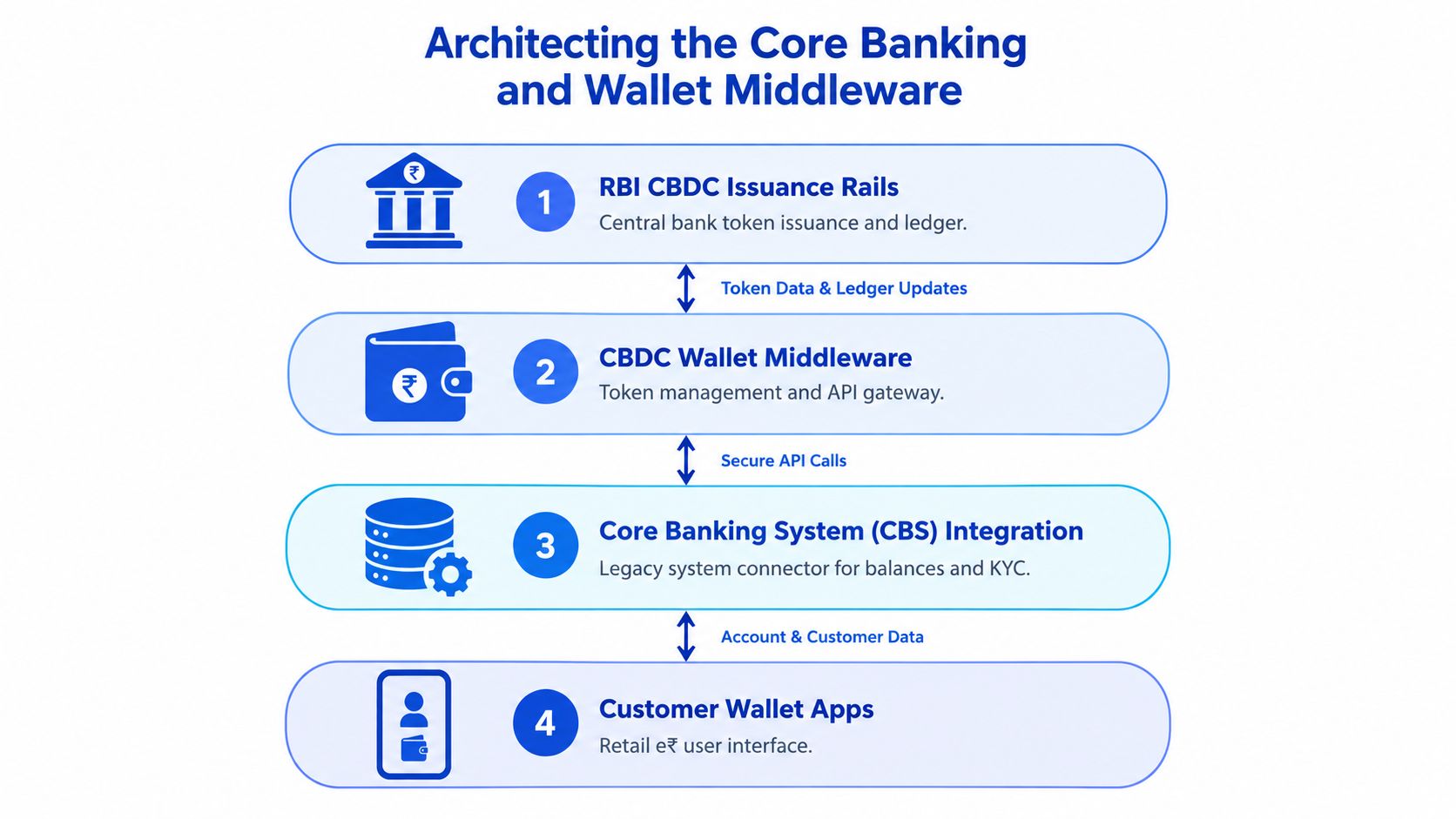
RBI’s FAQ material supports treating the e₹ as a controlled issuance rail. Banks need wallet provisioning, KYC linkage, transaction limits, and ledger reconciliation, rather than a card-network-style settlement flow. (RBI e₹ FAQ)
A practical middleware layout
The first layer is the RBI connectivity boundary. Keep this isolated behind an API gateway and an integration adapter. The adapter should translate approved message formats into internal events, preserve correlation identifiers, handle retries safely, and prevent duplicate processing when an external response is delayed.
The second layer is the CBDC wallet service. It should maintain wallet lifecycle states, provisioning requests, suspension and reactivation controls, transaction eligibility, balance views, and customer-device relationships. Avoid treating a wallet as a simple account record. Token-based flows require explicit handling of pending, accepted, rejected, reversed, and exception states.
The third layer connects the wallet service to the core banking system. This connector maps an eligible customer account to the CBDC wallet, records funding and redemption events, and keeps accounting entries aligned. Near-real-time synchronisation is preferable because delayed balance visibility can create duplicate attempts, avoidable disputes, and misleading customer notifications.
The fourth layer serves mobile, merchant, and service applications. Customer-facing applications should receive idempotent transaction responses, clear status messages, and support workflows that expose the difference between a failed request and a transaction awaiting confirmation.
| Middleware control | Engineering purpose |
|---|---|
| Wallet provisioning | Creates and manages the customer wallet lifecycle |
| KYC linkage | Connects wallet eligibility to verified customer records |
| Limit enforcement | Applies the applicable RBI-approved caps before submission |
| Ledger mapping | Links wallet activity with core banking entries |
| Idempotency | Prevents duplicate posting during retries |
| Reconciliation events | Flags mismatches for automated or manual resolution |
Banks should make the wallet-to-account relationship explicit in their data model. A wallet can have its own operational state, while the associated customer account remains the source for funding, redemption, accounting, and customer-service context. Teams evaluating custody boundaries should document the distinction between custodial and non-custodial wallet architecture before selecting key-management and recovery patterns.
For adjacent capital-markets workflows, a corporate bond tokenization platform can represent a separate but related architecture concern. Blocsys Technologies develops such platforms for digital bond issuance, smart contract automation, faster settlements, and investor management. That work shouldn’t be conflated with the RBI e₹ rail, but the integration lessons around identity, asset state, settlement, and auditability are relevant.
Solving the Acceptance Gap Through UPI Interoperability
A customer standing at a shop counter does not assess the Digital Rupee by its issuance model. They scan the QR code already displayed and expect the payment to work in an app they understand. If that journey fails, the wallet becomes a one-time experiment rather than a payment habit. That makes UPI interoperability a direct user-retention issue, not only an integration feature.
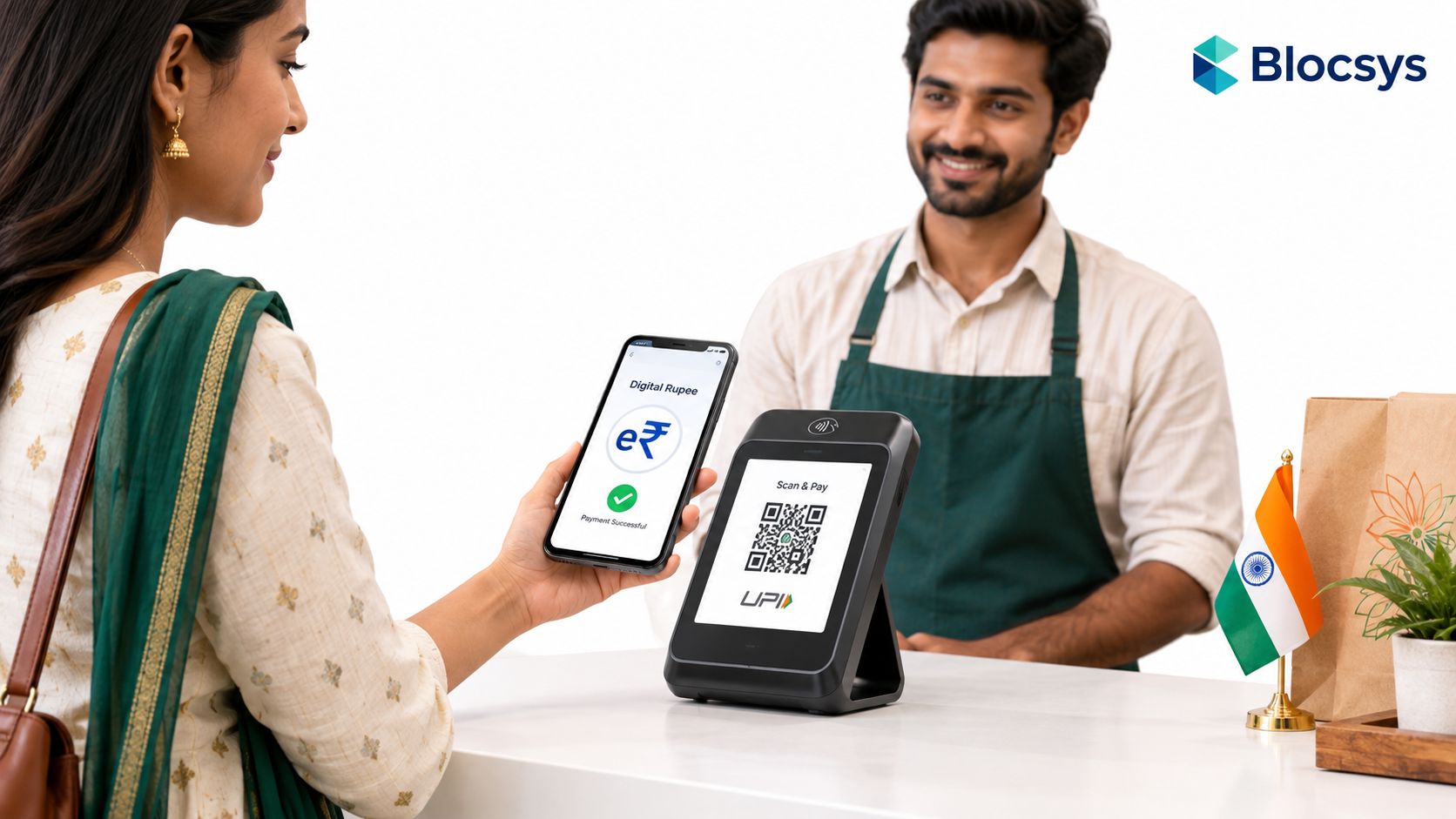
The India pilot highlights the value of familiar payment UX. UPI QR-code interoperability allows digital rupee payments to fit the same retail interaction customers and merchants already recognise, reducing the need to learn a separate acceptance process. It also reduces merchant resistance, since acceptance does not require a parallel QR workflow or a new operating routine.
What interoperability changes technically
A bank connecting CBDC payments to UPI-linked merchant acceptance must define routing before it writes the customer experience. The app needs to determine whether the transaction uses e₹ tokens or a conventional account-based UPI flow. The merchant needs a clear confirmation, while ledger and monitoring services must record the CBDC movement without posting it as an ordinary account transfer.
The integration boundary should cover:
- QR interpretation, allowing the app to identify supported merchant information.
- Payment orchestration, selecting the correct CBDC path without exposing rail complexity to the customer.
- Merchant confirmation, with distinct success, pending, and failure states.
- Risk controls, including velocity checks, device signals, and suspicious-pattern review.
- Customer support, using traceable identifiers for dispute investigation and escalation.
The trade-off is practical. A closed-loop wallet gives a bank tighter control during a pilot, but limits where customers can spend and leaves the bank with a separate merchant-acquisition task. Interoperability adds routing coordination, certification, testing, exception handling, and reconciliation work. That cost is justified only if the resulting wallet fits existing payment behaviour well enough to earn repeat use.
The integration question is not whether the bank can issue e₹. It is whether a customer can pay a merchant without learning a new payment habit.
Testing must follow the complete retail journey, not stop at a successful API response. Cover merchant QR variations, interrupted connectivity, duplicate taps, delayed confirmations, wallet-funding failures, refunds, and support escalation. Teams working across digital-asset rails can compare these patterns with stablecoin infrastructure architecture, while keeping the RBI e₹ regulatory and operating model distinct.
The useful benchmark is not wallet creation. It is whether customers can fund, spend, receive, and understand e₹ with little friction, and whether merchants can accept it without maintaining a separate operational process.
Security Protocols and Automated Reconciliation Workflows
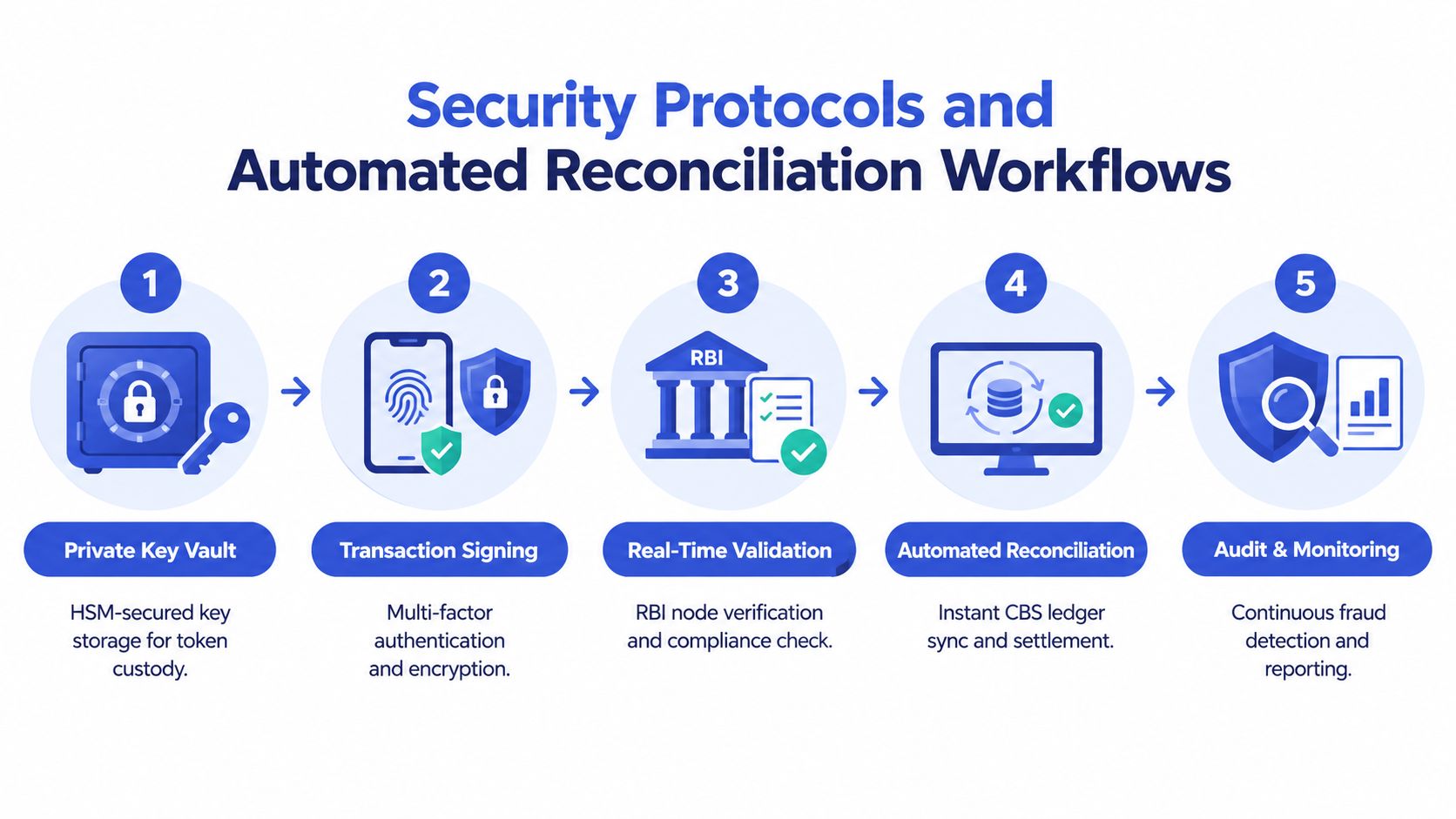
CBDC connectivity expands the bank’s attack surface across wallet services, customer applications, API gateways, identity systems, ledger interfaces, and operational tooling. Security must therefore be designed as a transaction lifecycle, not added as a perimeter control after the middleware is built.
Protecting keys, identities, and transaction paths
Private-key operations should be isolated from application code and protected through institutional key-management controls, including HSM-backed custody where the bank’s approved design requires it. Application services shouldn’t have unrestricted access to signing material. Access should be separated by environment, role, transaction type, and operational responsibility.
API security needs equivalent discipline:
- Authentication controls should validate every service and operator request.
- Authorisation policies should restrict actions by wallet state, customer status, and transaction purpose.
- Encryption should protect data in transit and at rest.
- Replay protection should prevent an old request from being submitted again.
- Rate controls should reduce abuse and service exhaustion.
- Immutable audit events should preserve who initiated, approved, submitted, and resolved an action.
KYC and AML controls belong in the transaction path, not only in onboarding. The middleware should verify that the wallet is linked to an eligible customer, apply relevant transaction restrictions, screen activity through the bank’s existing financial-crime processes, and route exceptions to investigators. Technical integration doesn’t provide RBI approval, authorisation, or compliance. The participating institution remains responsible for meeting applicable requirements and operating controls.
Reconciling multiple states
Reconciliation becomes difficult when the external CBDC state, wallet service state, core banking ledger, customer notification, and fraud-monitoring record don’t update at the same time. A design that records each lifecycle transition and assigns a correlation identifier that survives every internal hand-off is important.
A useful workflow is:
- Accept the request and create an idempotent transaction record.
- Validate eligibility through identity, limits, risk, and wallet status checks.
- Submit the transaction through the approved connectivity boundary.
- Process the response into a defined final or pending state.
- Post the accounting event to the core banking system.
- Compare records and raise an exception when states disagree.
- Resolve and report through controlled operational workflows.
The bank should separate technical retries from financial retries. A timeout may justify checking the transaction status, but it shouldn’t automatically create a second value movement. This distinction is one of the most important safeguards against duplicate posting and customer disputes.
For teams building broader financial-market workflows, DAML post-trade processing, settlement, and reconciliation illustrates the kind of explicit state and workflow thinking that complex ledger-connected systems require. A related Tokenization Platform Development practice can support secure and compliant platforms for RWAs, securities, real estate, commodities, and digital assets, but it remains a separate implementation scope from e₹ connectivity.
Comparing Retail Token and Wholesale Settlement Rails
Retail and wholesale CBDC rails impose different operational demands. The retail e₹-R uses a token-based model for consumers and merchants, while the wholesale e₹-W uses an account-based model for institutional settlement. RBI’s initial framework described separate rollout models for retail and wholesale applications, based on recommendations from its internal Working Group established in October 2020. (RBI CBDC pilot announcement and design context)
The wholesale pilot began on 1 November 2022 for secondary-market transactions in government securities. That constrained scope gives banks a defined institutional integration target. It does not justify treating e₹-W as a general-purpose payment rail. (Press Information Bureau announcement)
| Feature | Retail e₹, e₹-R | Wholesale e₹, e₹-W |
|---|---|---|
| Primary users | Consumers, merchants, and participating financial institutions | Banks and other institutional participants |
| Digital model | Token-based retail wallet model | Account-based institutional model |
| Main integration surface | Wallets, customer apps, merchant acceptance, payment routing | Settlement systems, securities workflows, and institutional accounts |
| Core operational concern | Wallet lifecycle, limits, UX, fraud, and reconciliation | Finality, account records, securities settlement, and institutional controls |
| Initial pilot purpose | Retail payments and controlled consumer experimentation | Secondary-market government securities settlement |
| Customer interface | Mobile or approved wallet experience | Institutional operations and settlement interfaces |
| Acceptance model | Requires merchant and payment-network usability | Requires market infrastructure and participant connectivity |
Allocate resources by rail
A retail implementation needs customer identity, mobile security, wallet support, merchant acceptance, and monitoring that can identify failed payments before users abandon the product. UPI interoperability also affects retention. If customers cannot move predictably between digital rupees, bank accounts, and familiar payment flows, wallet balances and transaction history become operational friction rather than a reason to return.
Wholesale capability requires settlement orchestration, securities-record alignment, participant permissions, and institutional processing controls. The bank should assign separate product ownership and service-level measures to these two operating environments.
Shared services can include identity, API management, observability, security operations, and reconciliation tooling. Transaction domains should remain modular. A retail wallet event should not be forced into a wholesale settlement schema, and a securities instruction should not inherit consumer-wallet assumptions.
Architecture decision: Share control services where the risk model is common, but govern retail and wholesale transaction domains independently.
The e₹-W pilot also shows why a single universal CBDC workflow is a poor design target. Each rail needs its own lifecycle, permission model, operational dashboard, and exception process, even when both use common platform capabilities. For teams examining capital-markets extensions, tokenised corporate bonds and CBDC settlement provides a related design reference. It should not be treated as part of the current e₹-W mandate.
Executing the Integration Roadmap with Blocsys
A bank should approach CBDC Infrastructure Integration as a controlled transformation programme. Starting with a wallet interface or a partner API without mapping ledger ownership, operational controls, and exception handling usually creates rework later.
Start with the operating model
Before selecting a technology stack, define who owns each responsibility:
- RBI connectivity ownership, including approved access, message handling, and operational escalation.
- Customer ownership, including KYC linkage, wallet support, consent, and communications.
- Value-movement ownership, including funding, redemption, posting, and reconciliation.
- Merchant and payment ownership, including routing, acceptance, refunds, and disputes.
- Control ownership, including fraud monitoring, AML review, audit, and incident response.
RBI requirements must be separated from engineering recommendations. The bank must follow applicable RBI directions, pilot terms, approved limits, security expectations, reporting requirements, and participation conditions. The engineering team can recommend API gateways, event-driven processing, idempotency keys, HSM-backed key protection, observability, service segmentation, and automated reconciliation, but those recommendations don’t constitute regulatory approval or compliance certification.
Build in controlled increments
A practical delivery sequence begins with interface discovery and sandbox connectivity. The team then models wallet and transaction states, creates the middleware boundary, connects KYC and core banking services, and tests customer and merchant journeys before expanding operational scope.
Use explicit exit criteria:
- Connectivity readiness, approved endpoints and message-handling behaviour are understood.
- Wallet readiness, provisioning, suspension, recovery, and limit controls work consistently.
- Ledger readiness, every value movement maps to an internal accounting event.
- Risk readiness, suspicious activity, velocity concerns, and operational exceptions reach the correct teams.
- Support readiness, service agents can trace a transaction without direct database intervention.
- Production readiness, monitoring, incident response, rollback, and reconciliation procedures are documented and tested.
Blocsys Technologies can be evaluated as an enterprise blockchain and fintech engineering partner for custom middleware, tokenisation workflows, smart-contract components, API integrations, and reconciliation services. Its dedicated blockchain development teams for enterprise projects are relevant where a bank needs specialised delivery capacity alongside its internal architecture, security, and compliance teams.
Cost should be scoped against integration boundaries, not just the wallet application. Core banking adapters, API security, UPI interoperability, transaction monitoring, reporting, testing, support tooling, and operational resilience can materially change the effort. A bank can use the Blocsys Cost Estimator as an initial commercial planning reference, then validate the scope through technical discovery and regulatory review.
A 12 to 24-month outlook should remain scenario-based rather than assumption-led. Banks that invest now in modular identity, ledger, reconciliation, and interoperability services will be better positioned to respond as RBI pilot requirements and participating networks evolve. The safest strategy is to build reusable financial infrastructure without assuming a particular future CBDC feature, settlement model, or adoption curve.
Blocsys Technologies offers customised blockchain, CBDC infrastructure, API, wallet, payment integration, reconciliation, and enterprise fintech engineering services for institutions evaluating Digital Rupee connectivity. Visit Blocsys Technologies to discuss your e₹ integration requirements, architecture review, delivery roadmap, and next implementation step.
