
India’s hospital information system market reached USD 1,250.0 million in 2025 and is projected to reach USD 2,890.3 million by 2033, which tells you one thing clearly, hospital software demand isn’t niche anymore. For Indian administrators, the question isn’t whether to digitise, it’s whether the platform can handle OPD flow, inpatient coordination, claims, pharmacy, lab work, accounting, and reporting without creating another layer of manual work. That’s the practical standard behind the Best Hospital Management Software Company- Blocsys conversation, especially for buyers who want a system built around Indian hospital realities rather than a generic export model.
Blocsys fits that buyer profile because it positions its hospital management software around end-to-end workflows, from registration and admissions to pharmacy, lab, discharge, insurance claims, and Tally integration, and it identifies itself as a Pune, Maharashtra-based firm incorporated in 2021 (Blocsys healthcare software overview). In India, that local context matters. Hospitals don’t just need features, they need software that can survive busy OPDs, layered approvals, scheme-based billing, and multi-department handoffs without fragmenting the patient record.
Table of Contents
- Why Indian Hospitals Need Modern Management Software
- Core Modules Every Hospital Management System Requires
- How Integrated Workflows Reduce Operational Friction
- Evaluating Hospital Management Software for Your Facility
- Security and Compliance Requirements for Indian Healthcare Data
- Implementation Process and Change Management Strategy
- Why Blocsys Delivers for Indian Healthcare Organisations
- Frequently Asked Questions About Hospital Management Software
Why Indian Hospitals Need Modern Management Software
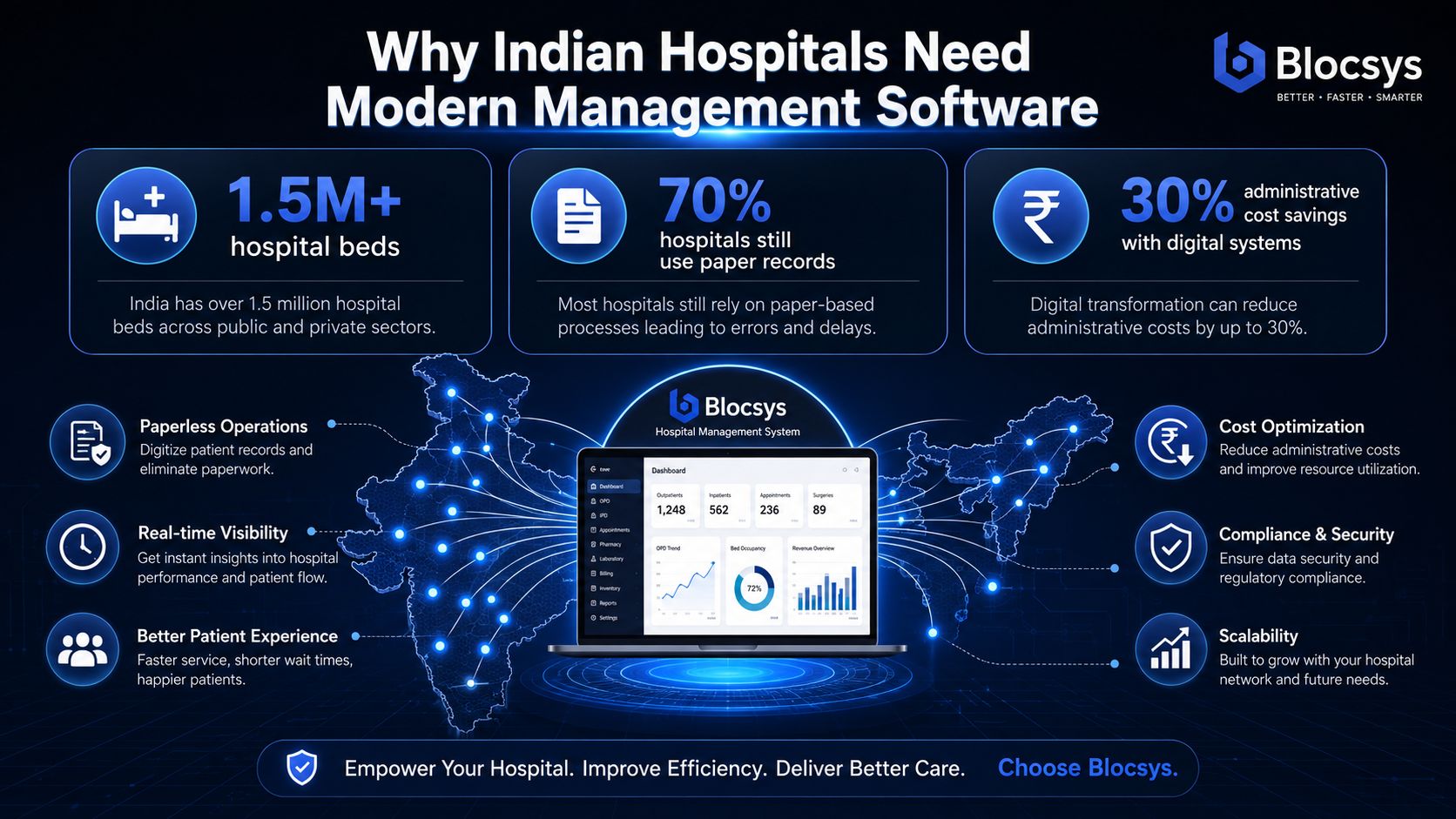
Indian hospitals operate at a reporting scale that manual registers and disconnected spreadsheets cannot handle for long. A national HMIS portal had already accumulated 17,704,350 total reports by 1 April 2020, and in 2019 to 2020 there were 169,125 available facilities, with 161,019 actively reporting (HMIS reporting scale in India). For administrators, that volume points to one practical reality, a modern hospital management system in India has to support multi-facility data capture, consistent reporting, and routine oversight across sites. The same scale also explains why many buyers study hospital management software development in India before they choose a platform.
What modern HMS actually changes
A proper hospital management software platform connects clinical work with administrative and financial work in one system. Patient registration feeds appointments, encounters, orders, billing, discharge summaries, insurance processing, and accounting entries, so the same data does not get retyped in three departments. That is the difference between software that only digitises forms and software that reduces operational drag.
The pressure shows up quickly in Indian hospitals. Front desks need fast registration, clinicians need quick access to history, finance teams need charge capture without leakage, and management needs reporting that can support daily decisions and audits. A modern hospital ERP software layer only helps if it follows the workflow, not if it forces staff to adapt to a rigid database structure.
Blocsys’s own HMS scope is built for that kind of workflow chain. It describes an 88-module system across 15 clinical and financial domains, with role-based access, session management, and audit trails designed to keep data unified rather than scattered across disconnected tools (Blocsys hospital management system). In practical terms, that matters because fragmented systems create duplicate entry, missed charges, and weak visibility across OPD, IPD, pharmacy, laboratory, and finance.
Practical rule: if a hospital still depends on separate tools for registration, billing, pharmacy, and accounts, staff end up doing the integration manually. That is where errors, delays, and reconciliation pain start.
For administrators evaluating healthcare management software, the key question is whether the platform can keep up with India’s reporting, compliance, and throughput demands while staying usable for everyday staff. In Indian settings, that also means checking whether the system can support NABH documentation, Tally integration, multi-facility HMIS reporting, and DPDP-aligned data security without turning daily work into extra admin. If it cannot, the hospital ends up with software that looks modern but behaves like a paper process with screens attached.
Core Modules Every Hospital Management System Requires
A credible hospital information management system in India needs more than a registration screen and a billing tab. It has to support the actual sequence of care, from first contact to final settlement, while giving administrators enough control to keep operations predictable. The strongest systems make each module useful on its own, but also, they make the handoffs between modules invisible to staff.
The modules that matter in daily Indian workflows
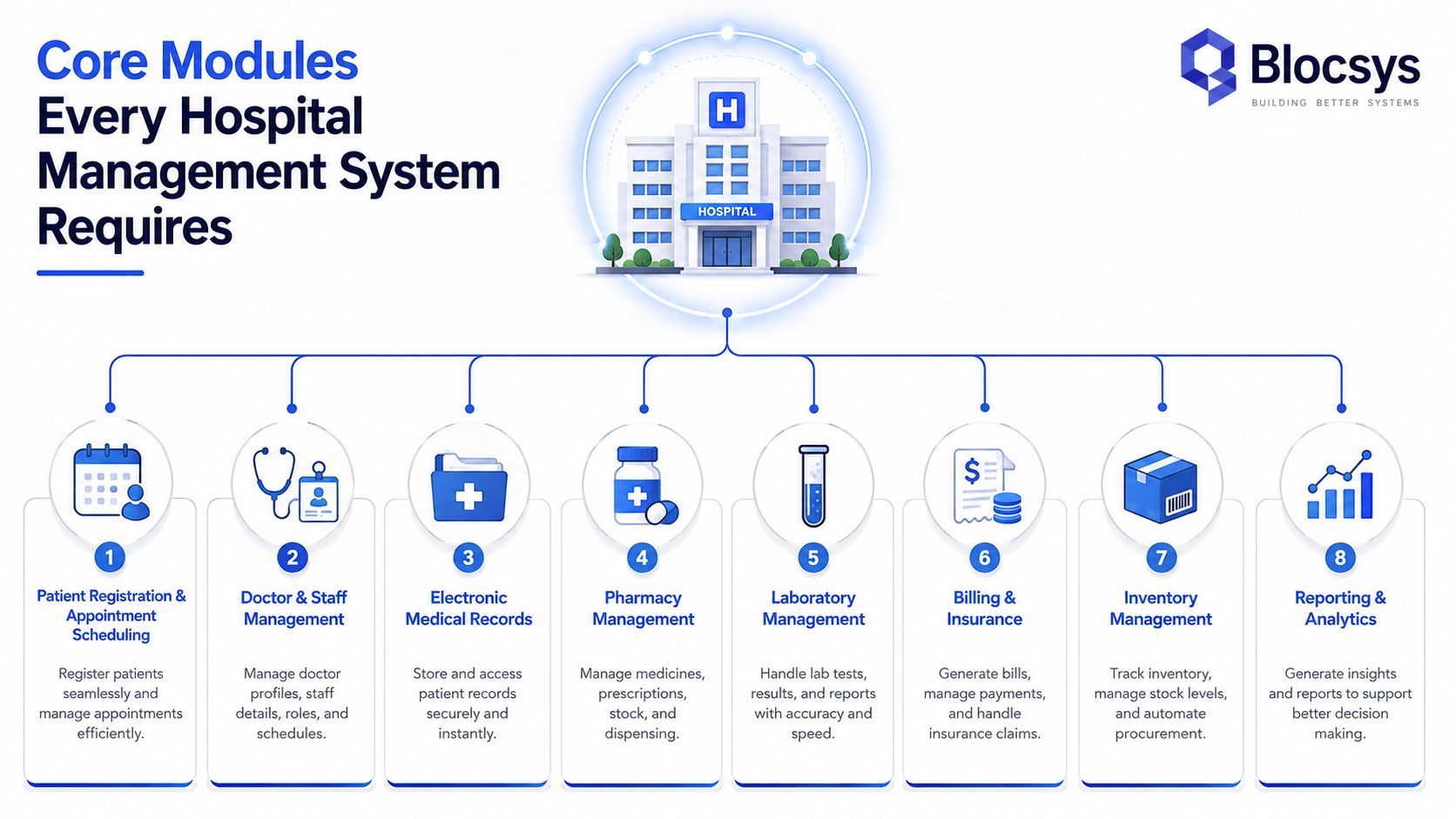
Patient registration and appointments should handle OPD tokens, queueing, and repeat visits without slowing the front desk. If a hospital is still juggling manual slips and spreadsheet logs, wait times rise quickly and registration becomes a bottleneck.
Doctor and staff management needs to map roles, duty rosters, and permissions. That isn’t just an HR convenience, it’s how hospitals control who can view, edit, or approve sensitive patient data.
Electronic medical records and electronic health records connect consultation notes, diagnostics, and follow-ups into one patient history. This reduces duplication and helps doctors avoid relying on memory or scattered files.
Billing and insurance should handle TPA flows, scheme-based pricing, package billing, and settlement tracking. In Indian hospitals, claims work best when charge capture happens during care, not after the patient leaves.
Where integration becomes operational, not theoretical
Pharmacy management must link prescriptions to dispensing and stock movement. Laboratory management should push results directly into the patient record instead of leaving staff to scan or re-enter findings. Inventory needs expiry, batch, and procurement visibility so stores teams know what’s available before a department runs short.
Reporting and dashboards are the final layer, but they’re only useful if the underlying data is clean. NABH-oriented teams need documentation discipline, and management needs a real-time operational picture rather than end-of-month summaries.
If you’re comparing vendors, a useful external reference point is Simbie AI hospital software, because it helps buyers think through how different HMS modules are packaged and evaluated in the market. For a deeper India-specific view of the same problem set, Blocsys’s HMIS positioning in India is worth reviewing (Blocsys HMIS in India).
A good HMS doesn’t just “have modules”. It makes registration, clinical notes, pharmacy, lab, claims, and reporting behave like one operational chain.
Hospitals that get this right usually notice the same outcome, fewer manual handoffs and less internal friction. Hospitals that don’t end up buying more software to compensate for the first software’s gaps.
How Integrated Workflows Reduce Operational Friction
Integration is where hospital software either earns its keep or adds clutter. In a real Indian facility, a patient doesn’t move through separate software products. They move through a single operational journey, and every department depends on the previous one entering data correctly.
What flow-based automation changes
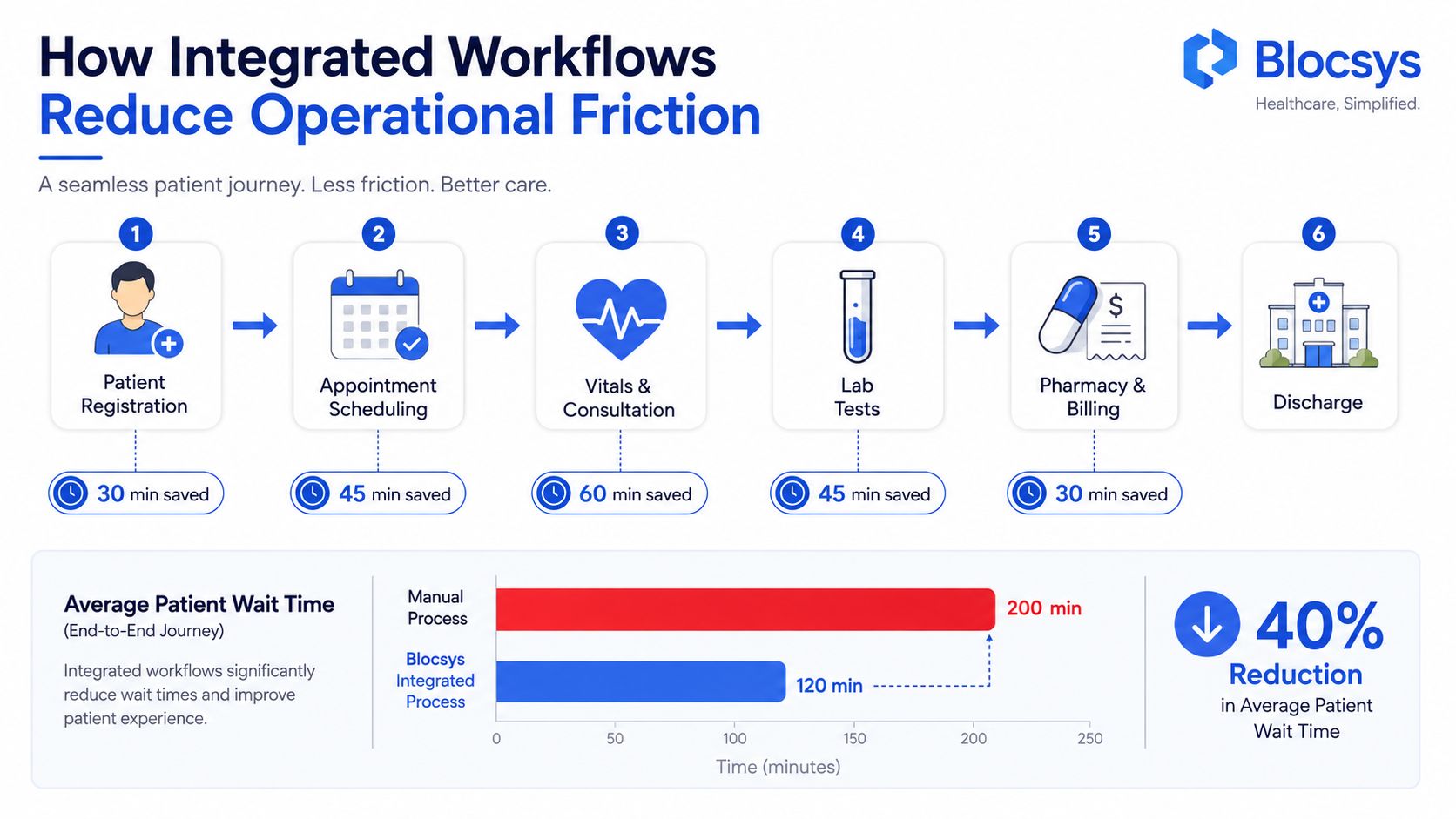
When registration creates the encounter, the doctor doesn’t need a separate form for the same patient details. When a prescription is entered, pharmacy can dispense against the same record and inventory can move accordingly. When lab results are posted, they attach to the encounter instead of sitting in another system waiting for manual reconciliation.
That’s also where finance becomes cleaner. Billing can capture charges as services happen, insurance records can be assembled from the same encounter data, and accounts can post transactions without duplicate entry. Blocsys describes this as a built-in accounting workflow with Tally synchronisation, so revenue posts into a double-entry ledger rather than being rekeyed between systems (Blocsys HMS with accounting).
The same principle applies to control. Role-based access and audit trails help hospitals see who did what, when, and from which session. That matters in busy departments where several people may touch the same encounter across a single day.
The embedded video below is useful if your team wants a visual walkthrough of the patient journey:
Why bolt-on systems fail in Indian hospitals
Point solutions often look cheaper at purchase time, then become expensive in operations. Registration in one tool, lab in another, pharmacy in a third, and accounts in a fourth creates reconciliation work every day. Staff then build informal workarounds, and those workarounds become part of the process whether management likes it or not.
That’s also why integrated systems matter for hospital software development decisions. If the workflow design doesn’t include accounting, claims, and cross-department permissions from the start, the hospital ends up paying for integration in time instead of money.
For teams exploring adjacent enterprise blockchain workflows, Tokenization Platform Development is a separate Blocsys offering focused on secure and compliant tokenization platforms for real-world assets, securities, real estate, commodities, and digital assets using enterprise blockchain technology. It’s a different domain, but the same discipline applies, one source of truth, strong controls, and traceable transactions.
Evaluating Hospital Management Software for Your Facility
A hospital software decision fails fastest when administrators start with features instead of operations. The right hospital management software India buyers choose depends on scale, workflow complexity, and how much integration the hospital already has. A small clinic does not need the same architecture as a 150-plus bed enterprise hospital, and treating them the same leads to overspending in one case and an underbuilt system in the other.
Start with the bed count, then map the departments that touch a patient encounter. Registration, OPD, lab, pharmacy, billing, discharge, and accounts often move at different speeds, especially in Indian facilities where one team may handle several handoffs in a single day. Administrators should also list claim volume, reporting obligations, and the amount of manual work still done on spreadsheets. If your team still uses spreadsheets for stock, claims, or discharge follow-up, the software scope has to reflect that reality.
| Facility Type | Bed Count | Typical Cost Range | Implementation Timeline | Key Considerations |
|---|---|---|---|---|
| Clinic | Small | ₹6–15 lakh | 3–6 months | Faster registration, OPD flow, billing, pharmacy, and light reporting |
| Enterprise hospital | 150+ beds | ₹35–70 lakh+ | 12–18 months | Multi-department integration, claims, accounting, stronger controls, deeper training |
These ranges come from Blocsys’s India-focused custom HMS guidance (custom hospital management software in India). They help buyers set a budget anchor before they compare feature lists, because the cost picture is usually shaped by migration, training, support, and the amount of process cleanup needed before go-live.
What to benchmark before you sign
Workflow fit matters more than demo polish. A clean interface that cannot handle OPD tokens, TPA claims, or discharge approvals will still fail under daily use. Indian hospitals also need to look at NABH reporting, front-desk pressure, and how the system behaves when a department runs on a weaker network or shared terminals.
Integration needs should be written down early. Many hospitals already have accounting, billing, diagnostic, or Tally-linked processes, and those connections become harder to manage when they are left out of discovery. If the vendor cannot explain how the HMS will connect with existing tools, the hospital ends up paying later in manual reconciliation.
Support model matters after go-live. If the vendor cannot help during staff churn, shift changes, or staggered rollout across departments, the hospital becomes dependent on a few internal power users. That is manageable in a small site, but it becomes fragile in a larger facility with multiple user groups and uneven digital adoption.
If you are comparing development partners, review Blocsys hospital management system development company in India for a practical view of how the platform is positioned for Indian healthcare operations. Blocsys Technologies also works on other regulated workflow systems, and that same discipline shows up in hospital software decisions, one source of truth, controlled access, and traceable transactions.
Budget rule: the cheapest HMS is usually the one that exposes hidden costs later, especially in migration, training, and support.
Administrators should also pay close attention to data cleansing. Patient master data, duplicate records, and old bills often need more cleanup than teams expect, and that work is easy to miss during a demo. It becomes expensive during implementation, especially when the hospital wants cleaner reporting across departments or across multiple facilities.
Security and Compliance Requirements for Indian Healthcare Data
Patient data security is a baseline requirement in India. Any hospital information system that stores patient records, billing data, and clinical history has to support data protection, access control, and auditability from day one. For Indian hospitals, that also has to work under NABH scrutiny, internal audit, scheme reporting, and the document trail needed for day-to-day administration.
Blocsys positions its HMS around DPDP-compliant data handling and full audit trails, which is the right direction for hospitals that need traceability across departments. In practice, that means sensitive actions should be logged, permissions should be role-based, and user sessions should be controlled tightly. For a closer look at the compliance issues behind audit-ready records, see DPDP compliance and blockchain document verification challenges.
What hospitals should demand from a vendor
Hospitals should ask for role-based access control, session management, and audit trails before they look at interface polish. They should also ask how the vendor handles encryption, backups, disaster recovery, and record retention. If those answers stay vague, the risk shows up later in daily operations.
The operating risk is bigger than a compliance checkbox. A breach can damage patient trust, interrupt clinical work, and create avoidable regulatory pressure. Accreditation teams also need dependable documentation, because missing records are often treated as process failures, not just IT issues.
Cloud and on-premise deployment both have trade-offs. Cloud systems can reduce local infrastructure burden and simplify support, while on-premise systems may suit hospitals that want tighter control over data residency and internal access. The right choice depends on the facility’s governance model, risk appetite, and IT maturity.
For adjacent compliance-sensitive infrastructure, electronics recycling for healthcare facilities is a useful reminder that data-bearing hardware also needs controlled disposal practices. Hospitals replacing legacy systems should think about record security not only in software, but also at the hardware retirement stage.
Implementation Process and Change Management Strategy
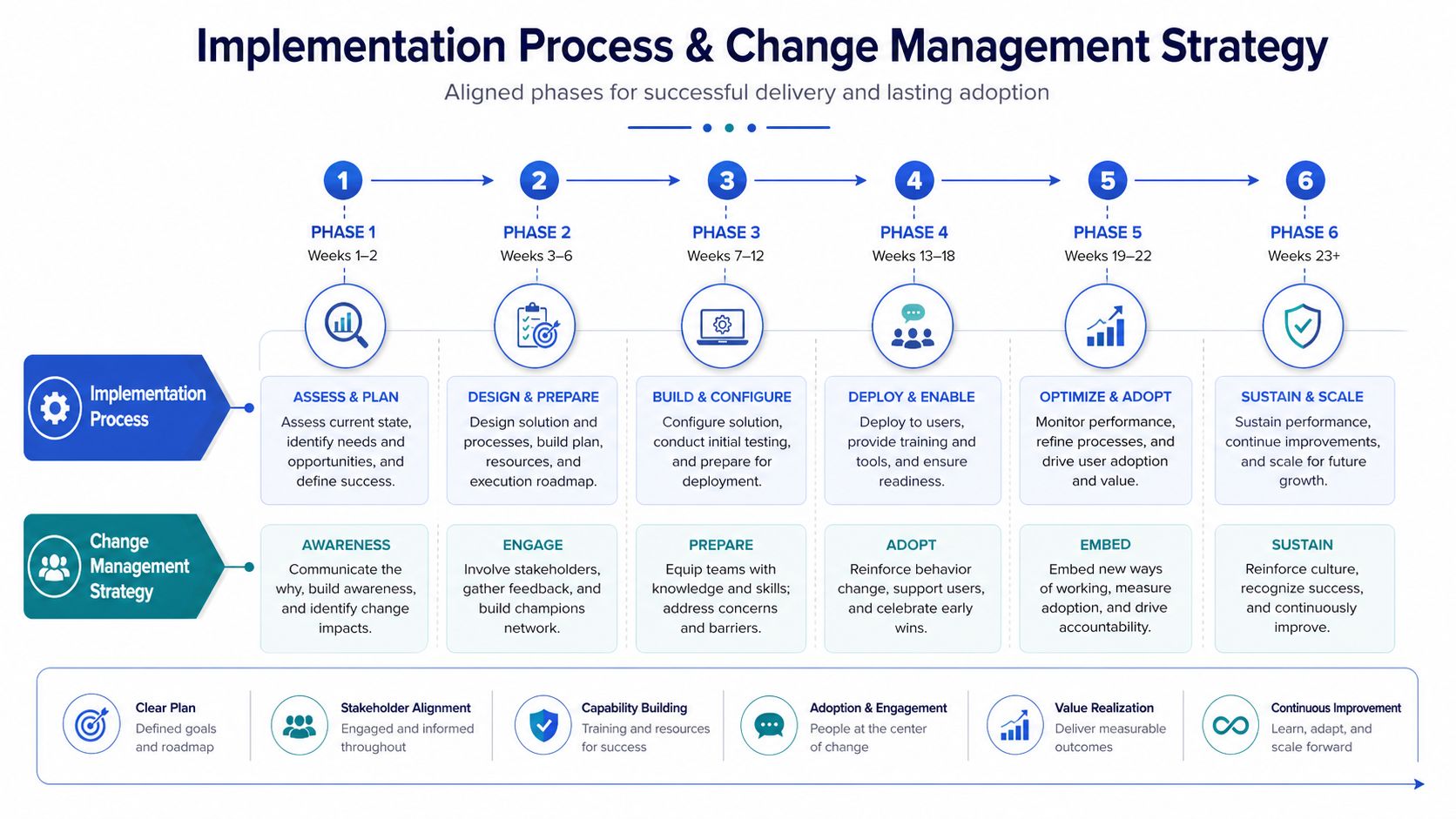
A hospital software rollout succeeds when the workflow is mapped before the configuration starts. The best implementations begin with department-by-department discovery, because OPD, IPD, pharmacy, lab, and finance often work differently even inside the same hospital. If the vendor doesn’t capture those differences early, staff will end up bending the software around old habits.
A realistic rollout sequence
Requirements and workflow mapping should come first. That’s where administrators define what each department does, who approves what, and where data needs to flow.
Configuration and migration come next. Historical patient records, stock data, tariff structures, and master lists need cleaning before they move. Bad source data stays bad in the new system unless someone fixes it deliberately.
Training and parallel run are the difference between adoption and resistance. Staff usually accept new software faster when they see the old and new processes running side by side for a short period.
The human side matters just as much as the technical side. Senior doctors need to see why the platform helps their consultations, not just why IT likes it. Managers need internal champions who can answer questions in real time when front-line staff get stuck.
Common mistakes hospitals keep making
Undertraining is a common failure point, especially where staff turnover is high. New joiners need repeatable training, not one-off orientation slides.
Poor legacy integration creates duplicated records and workarounds. If the new system doesn’t connect cleanly to existing tools, it won’t become the source of truth.
Weak post-go-live support causes otherwise good projects to stall. Go-live is the beginning of operational learning, not the end of implementation.
For hospitals seeking a custom build path, Blocsys’s own custom hospital management software in India guidance is relevant because it reflects the time and cost spread across smaller and larger facilities. That kind of planning helps avoid the common mistake of assuming all HMS deployments take the same effort.
Good change management is less about persuading people to love the software and more about making the new workflow easier than the old one.
Why Blocsys Delivers for Indian Healthcare Organisations
Blocsys is a fit for Indian hospitals because it speaks the language of operations, not just product features. Its HMS model is built around clinical, operational, and financial workflows in one platform, with 88 modules across 15 domains, role-based access, audit trails, and Tally synchronisation for accounting accuracy (Blocsys hospital management system). That combination is useful in India, where hospitals often need local accounting discipline as much as clinical digitisation.
The company is also India-incorporated, based in Pune, and founded in 2021 (Blocsys LinkedIn company profile). That matters for support, implementation timing, and the practical reality of working in the same business hours as the hospital team. It also helps when administrators want a vendor who understands local workflows, local reporting expectations, and rupee-based budgeting.
Blocsys’s approach to custom HMS development is straightforward. It starts with discovery, then moves through configuration, integration, migration, training, and ongoing support. That’s the right sequence for healthcare because the hospital’s operational discipline has to be built into the system, not patched on later.
If you’re comparing vendors, Blocsys is strongest where the project needs a unified hospital ERP-style workflow, accounting integration, and secure data handling without overcomplicating the rollout. That’s especially relevant for hospitals that want a locally aligned partner rather than a generic software reseller.
Frequently Asked Questions About Hospital Management Software
What is a hospital management system in India?
A hospital management system connects patient registration, appointments, clinical records, billing, pharmacy, lab work, insurance, and reporting in one platform. In India, the better systems also account for accounting discipline, department-wise workflows, and the reporting structure administrators need for day-to-day control.
How much does hospital management software cost?
Blocsys’s India guidance places a 10 to 30 bed clinic at ₹6–15 lakh and an enterprise hospital with 150+ beds at ₹35–70 lakh+, depending on scope and customisation. The cost depends on how much integration, configuration, migration, and training the hospital needs.
How long does implementation usually take?
Blocsys’s published guidance indicates 3–6 months for a smaller clinic build and 12–18 months for a larger enterprise hospital implementation, depending on complexity and integration needs. In practice, timeline pressure usually comes from data migration, user training, and the amount of process change the hospital is willing to absorb at once.
Can HMS integrate with Tally?
Yes. Blocsys positions Tally synchronisation as part of its HMS design, with accounting entries generated from billing and payments so finance teams do not have to rekey transactions. For Indian hospitals, that matters because billing accuracy and finance reconciliation often break down when clinical and accounting systems stay separate.
Does hospital software help with insurance and TPA claims?
Yes, if it captures encounters, charges, approvals, and supporting documentation in one workflow. That reduces manual claim assembly and gives finance teams a clearer view of settlement status, rejected items, and pending follow-ups.
Is mobile access useful in a hospital environment?
It is useful for doctors, supervisors, and management staff who need quick access to dashboards or patient data while moving between departments. The feature only works well if permissions, authentication, and audit controls are tight enough for clinical use.
What should Indian hospitals check for DPDP readiness?
They should ask about role-based access, audit trails, encryption, session management, backup policies, and data retention. Vendors should also explain how patient data is protected during normal use, during support activity, and when access is shared across departments or facilities.
Can one HMS support multiple facilities?
Yes, if it is designed for multi-site operation. Multi-facility hospitals need centralised visibility, consistent billing rules, controlled access by location, and reporting that can roll up data without losing facility-level detail.
What is the difference between HMS and EMR software?
EMR focuses on clinical records, while HMS covers the wider hospital operation, including registration, billing, pharmacy, lab, inventory, and reporting. EMR is often one module inside a broader HMS, which is why many hospitals that start with clinical documentation later ask for more operational control.
What implementation mistake hurts adoption the most?
Training gaps. If staff do not understand the new workflow, they create workarounds, and the system never becomes the source of truth. In Indian hospitals, that usually shows up first at registration, billing, nursing handoffs, and pharmacy coordination.
Why should a hospital consider Blocsys?
Blocsys offers an India-based hospital software approach with integrated workflows, accounting sync, secure access controls, and custom deployment support for different facility sizes. As outlined earlier, that matters most for hospitals that need local implementation support and a system shaped around actual operational discipline, not just feature checklists.
Can hospitals start small and expand later?
Yes, if the system is configurable per department and built for scale. That approach works better than forcing every facility to buy a full enterprise stack on day one, especially when the hospital wants to phase rollout by department, location, or workflow priority.
Blocsys Technologies builds hospital management systems that help Indian hospitals unify patient care, billing, pharmacy, lab, inventory, and accounting without forcing staff into fragmented workarounds. If your team is evaluating hospital management software development, EMR/EHR integration, or a custom hospital ERP for Indian workflows, visit Blocsys Technologies and speak with the team about your facility’s requirements, current systems, and implementation goals.
