
A fintech founder has a working brokerage interface, a custody partner, and a shortlist of tokenized assets. The difficult question is no longer whether users want a smoother investment experience. It’s whether the underlying infrastructure can support digital securities, compliance controls, settlement automation, and real-world asset tokenization without creating legal and operational problems later.
This guide is for CTOs, product leaders, compliance teams, banks, asset managers, investment firms, Web3 companies, and digital asset providers evaluating Robinhood Chain development or a similar Ethereum Layer 2 architecture. It focuses on how to assemble the stack, from asset onboarding and identity controls to smart-contract deployment, custody, interoperability, and production operations.
The central point is practical: tokenization isn’t one feature. It’s a coordinated system of legal rights, asset custody, smart contracts, user access, reporting, and settlement. A Robinhood-style chain can provide a useful reference architecture, but the product team still has to make every important decision around the asset lifecycle.
Table of Contents
- Why Build a Robinhood-Style Chain for Financial Apps
- Robinhood Chain Architecture and Layer 2 Stack Explained
- Robinhood Chain vs Other Layer 2 Networks for Tokenized Assets
- Building on Robinhood Chain with Smart Contracts and RWA Tokenization
- Financial Applications and DeFi Primitives You Can Ship
- Compliance, Security, and Interoperability Challenges
- How Blocsys Helps You Build and Scale Robinhood Chain Apps
Why Build a Robinhood-Style Chain for Financial Apps
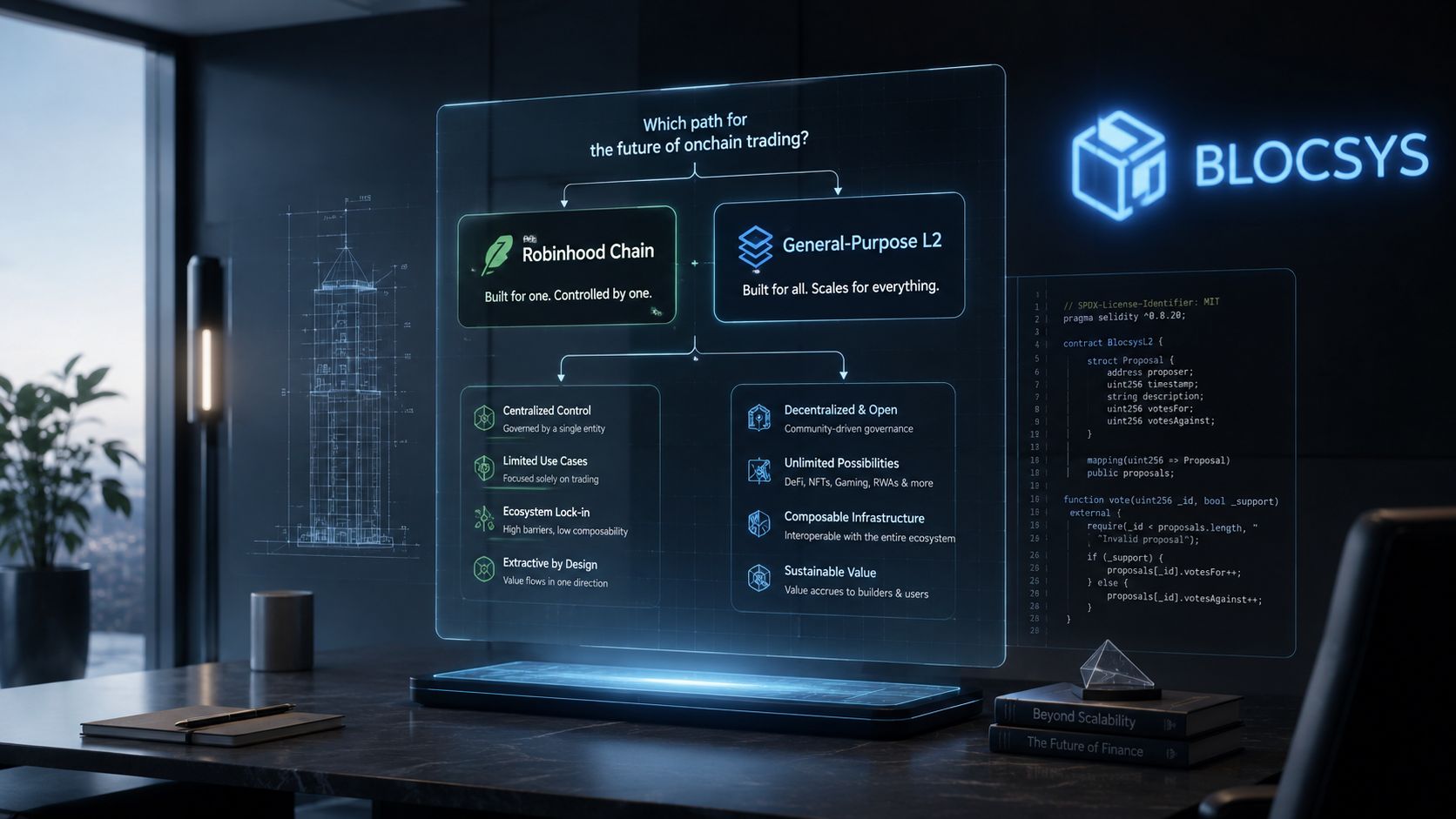
A team building tokenized equities, bonds, ETFs, or an on-chain brokerage usually faces three choices. It can build on a general-purpose Ethereum Layer 2, use a permissioned ledger, or adopt a Robinhood-style chain designed around financial workflows. The right choice depends less on brand recognition and more on the product’s settlement model, user base, regulatory perimeter, and interoperability requirements.
A general-purpose network may offer broad developer adoption and access to existing applications. A permissioned ledger may provide tighter control over participants and data. A Robinhood-style chain sits between those approaches, combining Ethereum compatibility with infrastructure choices that can support predictable execution, controlled asset transfers, and institutional integrations.
The distinction matters when the product handles restricted token transfers, investor eligibility, corporate actions, custody instructions, and audit-ready records. A basic token contract can represent a balance. It can’t, by itself, prove that the holder is legally entitled to the underlying asset or that a transfer is allowed in a particular jurisdiction.
Practical rule: Treat tokenization as a product stack, not as a minting button.
For early-stage teams, the architecture decision also affects fundraising, hiring, custody, and go-to-market planning. A specialised early stage investor search for trading platforms can help founders identify capital partners who understand regulated fintech infrastructure rather than evaluating the idea as a generic crypto application.
A Robinhood-style design makes the most sense when the application needs a retail-grade interface over institutional-grade rails. That may include a tokenized brokerage, an RWA marketplace, a compliant secondary market, or a financial app that lets users hold and transfer digital securities through familiar wallets. Teams researching Robinhood blockchain architecture and tokenized capital markets should begin by defining the asset, rights, participants, and settlement process before choosing frameworks or writing Solidity.
Robinhood Chain Architecture and Layer 2 Stack Explained
How does Robinhood Chain work? In practical terms, a Robinhood-style chain uses an Ethereum-compatible execution environment for application transactions while relying on a base layer for settlement and security assumptions. The application records trades, transfers, and contract events on the Layer 2, while the broader architecture determines how those records are confirmed, published, and ultimately challenged or finalised.
A product team doesn’t need to operate every protocol component itself, but it must understand the consequences of each one.
The core layers
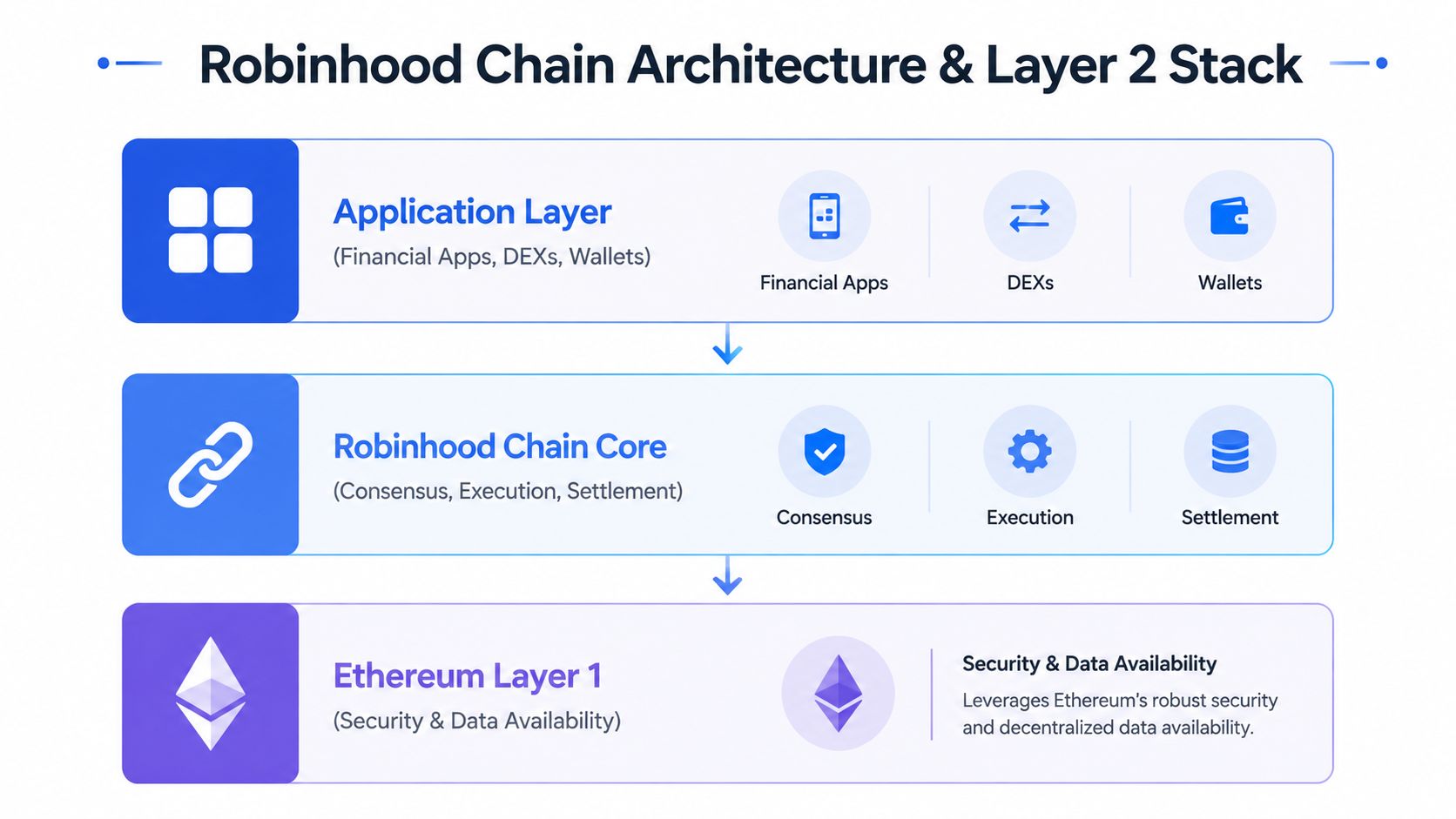
- Application layer: This contains the brokerage interface, wallets, trading venues, investor dashboards, issuer portals, and financial APIs. It’s where user permissions, order flows, portfolio views, and reporting are assembled.
- Execution layer: Smart contracts process token issuance, transfers, redemptions, settlement, fees, and corporate actions. Ethereum compatibility lets teams use familiar development tools, but financial contracts still require domain-specific controls.
- Consensus and sequencing: The sequencer orders transactions and presents a consistent view of activity. A finance-focused network may prioritise predictable execution and operational governance over the broad validator diversity of a general-purpose chain.
- Settlement layer: The base chain anchors transaction data or proofs and provides the final security reference. Teams should confirm what is published, how disputes work, and what finality means for custody and reporting.
- Oracles and data availability: Price feeds, NAV data, interest calculations, corporate actions, and identity attestations often arrive from outside the chain. The design must specify who can update those values, how updates are signed, and what happens when data is delayed or disputed.
For a financial application, the important question isn’t just whether the chain is fast. It’s whether the full stack can make a trade authorised, observable, reversible where legally required, and reconcilable with off-chain books. The discussion of Layer 2 solutions and blockchain scalability is useful background, but a tokenized securities team must go further into custody and transfer policy.
A corporate bond tokenization platform illustrates the application-layer requirements. Digital issuance, smart-contract automation, settlement, and investor management have to work together, rather than operating as isolated blockchain features.
This video provides additional visual context for Layer 2 design:
Robinhood Chain vs Other Layer 2 Networks for Tokenized Assets
The best chain for a tokenized financial app depends on the constraints the product can’t compromise. A Robinhood-style chain may suit a regulated retail workflow that needs controlled transfers and Ethereum compatibility. A general-purpose Layer 2 may be stronger when the application depends on a large open ecosystem, composable DeFi, or broad permissionless liquidity. A permissioned ledger may win when participant identity and institutional governance matter more than public composability.
| Criterion | Robinhood-style chain | General-purpose L2 | Permissioned ledger |
|---|---|---|---|
| Fee predictability | Designed around controlled financial workflows and predictable application operations | Depends on network demand and rollup economics | Usually controlled by the operating consortium |
| Compliance integration | Can place allowlists, identity checks, and transfer policies close to the asset layer | Often requires application-level controls and specialised contracts | Participant controls are usually native to the network |
| Ethereum compatibility | A core architectural objective for familiar tooling and contract deployment | Typically strong, depending on the network | May require different tools, languages, or integration layers |
| Validator trust model | May use a more curated operational model | Varies across networks and stages of decentralisation | Usually depends on known institutions |
| Tokenization tooling | Focuses on securities, RWA workflows, custody, and lifecycle management | Broad tooling, but financial controls must be assembled | Strong control, potentially weaker public liquidity |
| Interoperability | Requires deliberate bridge, messaging, and custody design | Often benefits from existing ecosystem integrations | Usually needs adapters to connect with public networks |
| Best fit | Retail-facing regulated finance and controlled asset markets | Open applications and broad ecosystem participation | Institutional consortia and private workflows |
Teams should resist treating decentralisation as a binary purchasing decision. The relevant issue is which parties must be able to validate, observe, challenge, or restrict an action. An open trading application and a legally restricted security don’t necessarily need identical infrastructure.
A general-purpose L2 can be the better choice when a product depends on permissionless composability, existing decentralised exchanges, or a wide range of third-party protocols. A permissioned ledger can be preferable for confidential settlement among known institutions. The Robinhood-style option is compelling when the product needs public-chain compatibility while preserving strong controls around regulated assets.
The comparison in Robinhood Chain versus Ethereum for tokenization should be treated as an architecture exercise, not a universal verdict. Document the product’s required jurisdictions, asset rights, transfer rules, liquidity venues, custody model, and data-retention requirements. Then test each network against those constraints.
Building on Robinhood Chain with Smart Contracts and RWA Tokenization
How to build on Robinhood Chain starts with the asset and legal arrangement, not the token contract. The engineering team should know whether it’s representing a share, bond, fund unit, receivable, commodity interest, property claim, or another instrument. It must also define what the holder receives, who holds the underlying asset, and how redemption works.
A production build sequence
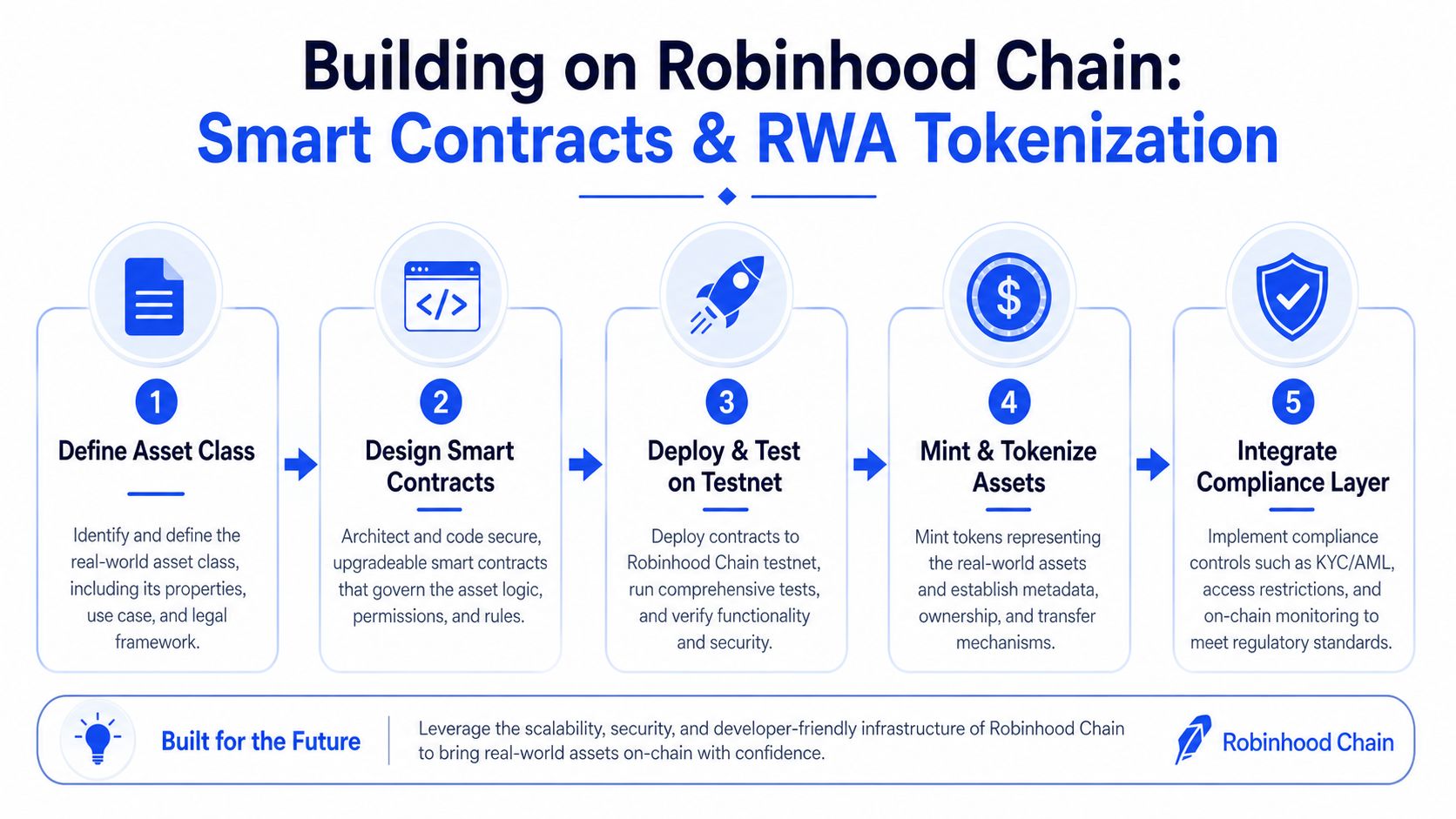
Define the asset class and rights. Create an asset model covering ownership, beneficial interest, redemption, income, voting, maturity, transfer restrictions, and default procedures. For a tokenized stock, dividend and voting logic may matter. For a bond, coupon schedules and maturity events may be central.
Separate onboarding from minting. The issuer, custodian, administrator, legal entity, and compliance officer should pass eligibility checks before tokens are minted. Asset documents, valuation data, custody confirmations, and investor terms belong in an auditable onboarding workflow.
Design the smart-contract system. Use separate modules for token balances, role management, identity or eligibility checks, transfer validation, corporate actions, and redemption. Upgrades need explicit governance, timelocks where appropriate, emergency controls, and a documented authority model.
Connect trusted data. Oracles can provide prices, net asset values, interest rates, maturity events, or corporate actions. Each feed needs source validation, signed updates, failure handling, and a clear policy for stale or conflicting data.
Build the investor and custody flows. A user may complete KYC, receive an identity attestation, subscribe to an issuance, hold tokens in a custodial wallet, and request redemption through an administrator. The user interface should expose status and restrictions without forcing investors to understand protocol mechanics.
Test financial edge cases. Test dividend and coupon distribution, partial redemption, failed payments, paused transfers, lost credentials, duplicate messages, oracle outages, sanctions changes, and corporate actions. Unit tests aren’t enough. Use integration, property-based, fuzz, access-control, and operational-recovery testing.
Deploy in stages. Begin with local development and a controlled testnet environment. Use independent security review, role separation, monitoring, incident runbooks, and a limited production release before expanding assets, jurisdictions, or liquidity venues.
The token lifecycle should be explicit: onboard, approve, mint, distribute, transfer, service, redeem, and burn or retire. A token contract that only handles minting and transfers leaves the hardest operational work outside the system.
Teams evaluating standards can review the ERC-3643 token standard for RWA tokenization while deciding whether an existing model or a custom contract structure better fits the target asset.
Financial Applications and DeFi Primitives You Can Ship
A full Robinhood-style financial ecosystem is too broad for most first releases. The stronger approach is to select one asset and one user journey, then add composability only after issuance, custody, compliance, and settlement operate reliably.
A practical first product might be a tokenized bond marketplace. An issuer onboards the instrument, eligible investors subscribe through a web or mobile interface, and the system distributes income according to contract rules. The product can begin with controlled transfers before introducing secondary trading or lending.
Another option is a tokenized fund or ETF experience. The app presents portfolio exposure through tokenized units, while an administrator manages subscriptions, valuation, and redemption. The contract can enforce investor eligibility and the platform can maintain a clear link between the token and the fund documentation.
Product patterns worth evaluating
- Tokenized brokerage: Combines onboarding, suitability checks, custody, order routing, portfolio accounting, and asset transfers.
- Digital securities venue: Provides issuance, investor registers, transfer validation, settlement, and reporting for approved instruments.
- RWA marketplace: Lists eligible assets with document access, pricing data, subscription workflows, and redemption terms.
- DeFi collateral layer: Allows approved tokenized assets to interact with lending or liquidity contracts under defined risk parameters.
- On-chain wealth platform: Packages portfolios, automated rebalancing, income distributions, and investor reporting into a single experience.
Interoperability becomes a product feature when the issuer, custodian, liquidity provider, and investor use different networks or systems. APIs, message verification, wallet abstraction, and reconciliation services can hide unnecessary complexity from the user.
A team hiring for this work may need protocol engineers, financial-model specialists, compliance technologists, and smart-contract auditors. The market for crypto economics specialist roles illustrates why tokenized finance often requires expertise beyond ordinary application development.
Compliance, Security, and Interoperability Challenges
The most dangerous assumption in RWA tokenization is that a blockchain token automatically creates enforceable ownership. Indian legal and policy developments show why that assumption is unsafe. The Asset Tokenisation (Regulation) Bill, 2026 is an introduced bill, not enacted law, and its text says a token doesn’t automatically transfer ownership unless the underlying arrangement provides for that transfer. The introduced bill text is a useful reminder that legal mapping must sit beside contract design.
India’s broader institutional direction also matters. The Government of India launched the Vishvasya Blockchain Technology Stack in September 2024 as a blockchain-as-a-service layer, and by 21 October 2025 it had verified more than 34 crore documents across government workflows. The stack operates across NIC data centres in Bhubaneswar, Pune, and Hyderabad, includes Vishwasya Stack, NBFLite, Praamaanik, and the National Blockchain Portal, and was reported with a budget of ₹64.76 crore. These facts provide a concrete benchmark for production-grade permissioned infrastructure and verification-oriented integrations in India. Background on the national blockchain rollout should inform architecture discussions, but it doesn’t replace legal advice for a financial product.
IFSCA’s 2025 expert committee report covers tokenisation of funds, bonds, stocks, payments, deposits, bills receivable, precious metals, commodities, intellectual property, and commercial real estate. That policy conversation supports a modular design in which asset onboarding, legal eligibility, investor access, and token lifecycle controls are separate components. The IFSCA tokenisation report is particularly relevant for teams targeting India’s financial-services market.
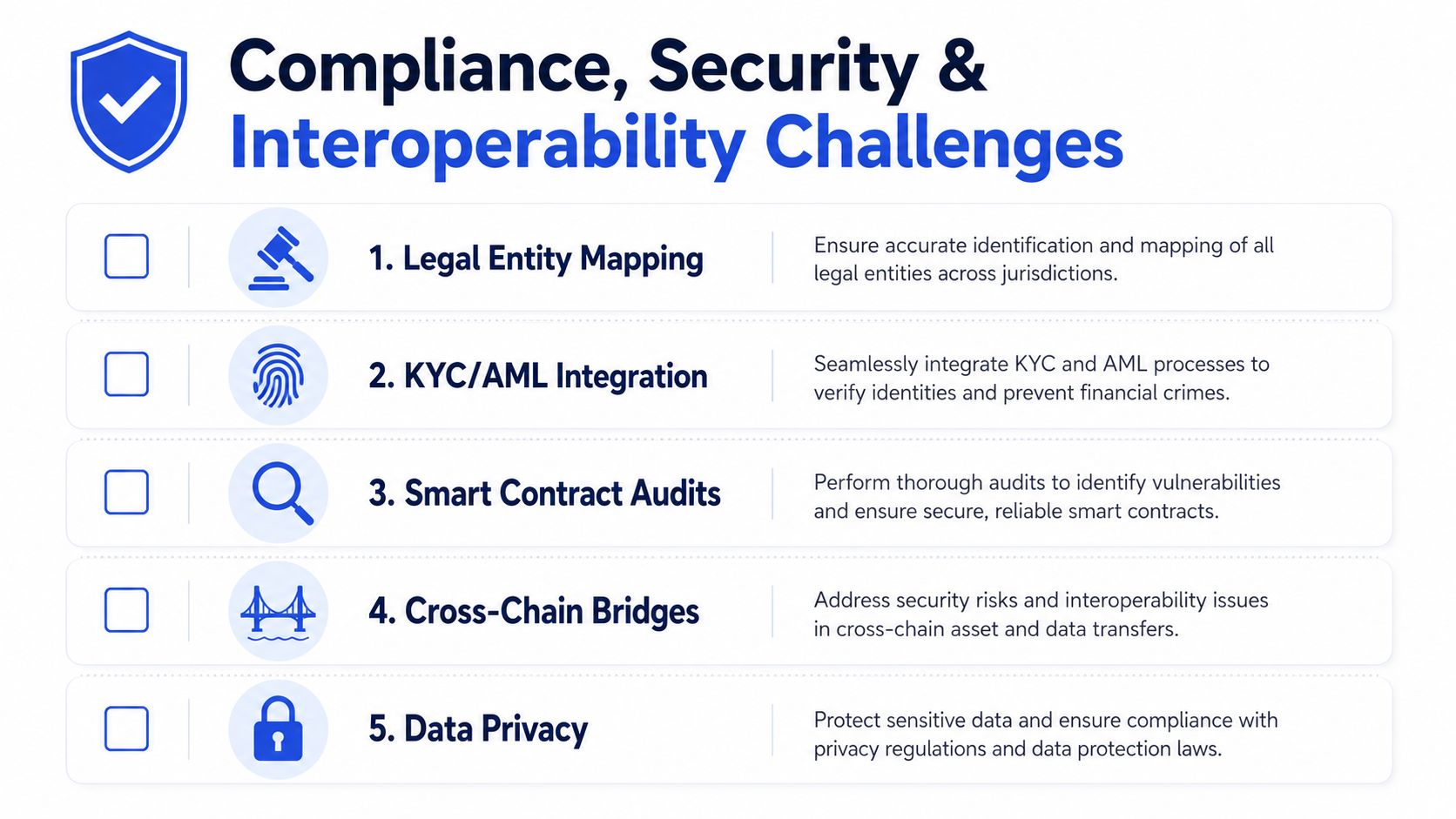
Controls to design before launch
- Legal entity mapping: Define the relationship between each token, issuer, custodian, administrator, and underlying asset.
- KYC and AML integration: Add identity verification, risk scoring, sanctions screening, transaction monitoring, FIU-IND obligations where applicable, STR workflows, and audit-ready records for relevant Indian VDA service providers. Indian fintech blockchain legal guidance describes why these controls should be modular from the start.
- Contract security: Use role separation, multisignature administration, formal review, fuzz testing, pause controls, and monitored upgrades.
- Bridge discipline: Minimise cross-chain custody complexity, verify messages, cap exposure, and define recovery procedures.
- Privacy and reporting: Keep sensitive identity data off-chain where appropriate, while preserving verifiable attestations and complete event histories.
Retail distribution adds another layer. Reporting on India’s regulated access environment states that 49 crypto exchanges registered with India’s FIU in 2025, including 45 domestic and 4 foreign platforms. The cited industry coverage reinforces a practical point: onboarding, traceability, custody, and audit trails are core product features.
How Blocsys Helps You Build and Scale Robinhood Chain Apps
Blocsys approaches a Robinhood-style build as an integration programme rather than a standalone smart-contract assignment. The work starts with the asset model, target jurisdictions, custody arrangement, investor journey, and settlement requirements. Architecture can then be shaped around the actual product instead of forcing a generic token into a regulated workflow.
For the asset layer, the team can design issuance, eligibility, transfer, income distribution, redemption, and reporting modules for tokenized securities and other real-world assets. The real-world asset tokenization platform catalogue item is described as infrastructure for securities, real estate, commodities, RWAs, and digital assets, with compliance and ownership management included in the product scope.
Trading applications require a different set of components. They may include order management, wallet connectivity, custody integration, liquidity controls, portfolio accounting, admin workflows, market data, and transaction monitoring. A tokenized bond product might need investor onboarding and coupon administration first, while a brokerage-style app may prioritise execution, portfolio views, and multi-asset permissions.
A partner model that matches enterprise reality
- Architecture discovery: Map business requirements to execution, settlement, identity, custody, data, and integration layers.
- Smart-contract engineering: Build and test token, access-control, corporate-action, issuance, and redemption logic.
- Compliance implementation: Connect KYC, AML, sanctions, identity attestations, monitoring, and reporting systems.
- Platform delivery: Develop investor interfaces, issuer dashboards, administrative tools, APIs, wallet flows, and operational controls.
- Launch support: Prepare deployment procedures, observability, incident response, upgrades, and post-launch maintenance.
Blocsys Technologies’ Blockchain Development offering covers custom blockchain applications for enterprises, startups, and governments across public, private, and hybrid networks. For an organisation with internal product ownership but limited protocol capacity, a dedicated engineering model can be evaluated alongside Blocsys’s enterprise blockchain team approach.
Frequently Asked Questions
What is Robinhood Chain?
Robinhood Chain is best treated as a reference architecture for an Ethereum-compatible Layer 2 aimed at financial applications. It combines off-chain or Layer 2 execution with settlement and security assumptions anchored to a base chain, while the application adds compliance, custody, asset, and investor controls.
How does Robinhood Chain work for tokenized assets?
A financial app uses smart contracts to record issuance, ownership, transfers, and settlement on the Layer 2. External systems still provide custody, identity, legal documentation, pricing, and asset servicing, so the chain is one part of a broader tokenization platform.
What are Robinhood Chain smart contracts used for?
They can manage token issuance, eligibility checks, restricted transfers, redemption, fees, dividend or coupon distribution, governance, and corporate actions. The exact design depends on the asset’s legal rights and the administrator’s operating responsibilities.
Can businesses build tokenized stocks on Robinhood Chain?
They can design a tokenized equity workflow, but the token must map to a legally valid ownership or beneficial-interest arrangement. Custody, investor eligibility, transfer restrictions, market rules, and corporate actions must be agreed before production deployment.
Which assets suit a Robinhood-style financial app?
Suitable candidates may include bonds, funds, equities, ETFs, receivables, commodities, real estate interests, and other assets with defined ownership, servicing, valuation, and redemption processes. The first release should usually focus on one asset class.
Is Robinhood Chain suitable for US and European institutions?
It may be suitable where Ethereum compatibility, controlled financial workflows, and institutional integrations matter. US, UK, German, Swiss, Dutch, Canadian, Australian, UAE, and Singaporean teams still need jurisdiction-specific legal, custody, investor-protection, and reporting analysis.
What compliance features should a tokenization platform include?
Common requirements include KYC and AML checks, sanctions screening, allowlists, investor eligibility, transfer restrictions, transaction monitoring, audit trails, role-based administration, reporting, and jurisdiction filters. The controls should be designed before minting begins.
How should a team secure Robinhood Chain contracts?
Use independent review, automated tests, fuzzing, access-control testing, multisignature administration, upgrade governance, monitoring, incident runbooks, and staged deployment. Security also includes wallet custody, APIs, oracles, bridges, and administrative infrastructure.
Does a Robinhood-style chain need interoperability?
It often does. Custodians, banks, exchanges, data providers, and investors may use different networks or legacy systems. Interoperability should be introduced through verified messaging, clear custody boundaries, reconciliation, and carefully limited bridge exposure.
How long does development take?
The timeline depends on the asset class, jurisdictions, custody model, compliance integrations, user experience, smart-contract scope, and testing requirements. A narrow pilot is easier to plan than a multi-asset brokerage with secondary trading and cross-chain settlement.
What does Robinhood Chain development cost?
There is no responsible universal figure. Scope changes substantially with the number of assets, jurisdictions, integrations, custody arrangements, compliance workflows, smart contracts, testing depth, and support requirements. A written discovery phase is more useful than a generic estimate.
When should a business hire a development partner?
A partner is useful when the organisation needs protocol, smart-contract, fintech, security, and integration expertise at the same time. Internal teams may retain product and compliance ownership while an experienced engineering group accelerates architecture, delivery, testing, and launch preparation.
Why work with Blocsys for this type of build?
Blocsys can support Robinhood Chain development, smart-contract engineering, RWA tokenization, digital asset platforms, blockchain infrastructure, DeFi components, and financial applications. The engagement should begin with a scoped architecture and delivery plan tied to the chosen asset and regulatory model.
The market case is becoming more concrete. Global tokenized RWAs reached about $19.3 billion by the end of Q1 2026, more than tripling from the start of 2025, while total on-chain RWAs rose 256.7% over roughly fifteen months, according to CoinGecko’s 2026 RWA report. For India specifically, one forecast estimates an asset-tokenization market of USD 133.5 million in 2026, rising to USD 245.7 million by 2033 at a 9.1% CAGR, as reported by Coherent Market Insights.
Those figures don’t decide the architecture. They do show why fintech teams are moving from conceptual tokenization discussions toward production questions about custody, compliance, settlement, and distribution.
Blocsys Technologies offers architecture planning, Robinhood Chain development, smart-contract engineering, RWA tokenization, digital asset platform development, blockchain infrastructure, and financial application delivery for fintechs, institutions, startups, and digital asset businesses. Visit Blocsys Technologies to scope a compliant tokenized-asset product, review your Layer 2 options, and define the next implementation step.
