
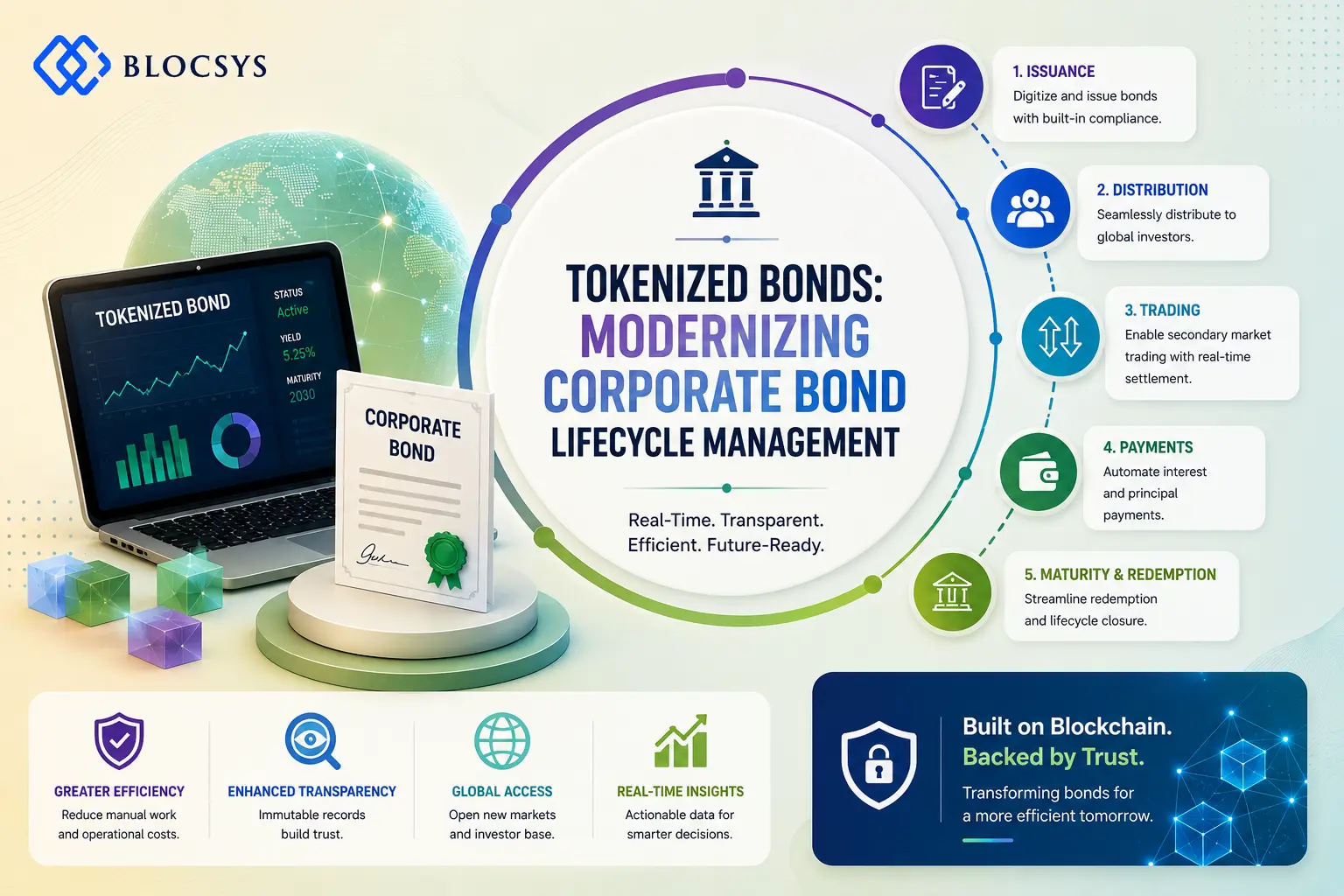
India’s corporate bond market is already large enough to make tokenization an infrastructure question, not a crypto thought experiment. NITI Aayog cites an outstanding corporate bond market of about USD 642 billion in 2025 in its assessment of India’s debt-market development. Against that backdrop, tokenized bonds matter because they can connect issuance, ownership, settlement, coupon servicing, covenant monitoring, and redemption through programmable systems.
This guide is for banks, issuers, asset managers, infrastructure providers, fintechs, and digital-asset teams evaluating tokenized corporate bonds across the US, Europe, the UK, Germany, France, Switzerland, Singapore, the UAE, Canada, Australia, and other regulated markets. The practical outcome is a clearer view of what blockchain can improve today, what still requires conventional market infrastructure, and how to assess a production-grade tokenized bond lifecycle.
Table of Contents
- The Corporate Bond Market Meets Blockchain Infrastructure
- What Are Tokenized Bonds and How Do They Work
- Legacy Settlement Versus Blockchain-Enabled Lifecycle Management
- Tokenized Bond Lifecycle Stages and Smart Contract Automation
- Liquidity Realities and Market Structure Considerations
- Institutional Implementations and Regulatory Pilot Programs
- Building Tokenized Bond Infrastructure with Blocsys
- Frequently Asked Questions About Tokenized Bonds
- What are tokenized bonds?
- How are corporate bonds tokenized?
- How does blockchain manage the tokenized bond lifecycle?
- Can tokenized bonds settle instantly?
- How are coupon payments automated?
- Who owns a tokenized bond?
- What happens at maturity and redemption?
- Do tokenized bonds improve secondary-market liquidity?
- Are tokenized corporate bonds crypto assets?
- Is a public blockchain necessary?
- What does a corporate bond tokenization platform include?
- What does corporate bond tokenization development cost?
- Why should an institution work with Blocsys?
- Are tokenized bonds suitable for every issuer?
The Corporate Bond Market Meets Blockchain Infrastructure
The important question isn’t whether a bond can be represented as a token. It can. The harder question is whether tokenization can reduce operational friction without weakening investor protection, settlement finality, custody controls, or regulatory oversight.
India provides a useful reference point. NITI Aayog places the country’s outstanding corporate bond market at about USD 642 billion in 2025, while SEBI continues to track issuance and trading activity across the segment through its corporate-bond statistics page. Separate reporting on SEBI’s discussion of tokenized corporate bonds connects the pilot to a much larger market base of roughly ₹59 lakh crore as reported in the discussion of the proposed tokenization framework.
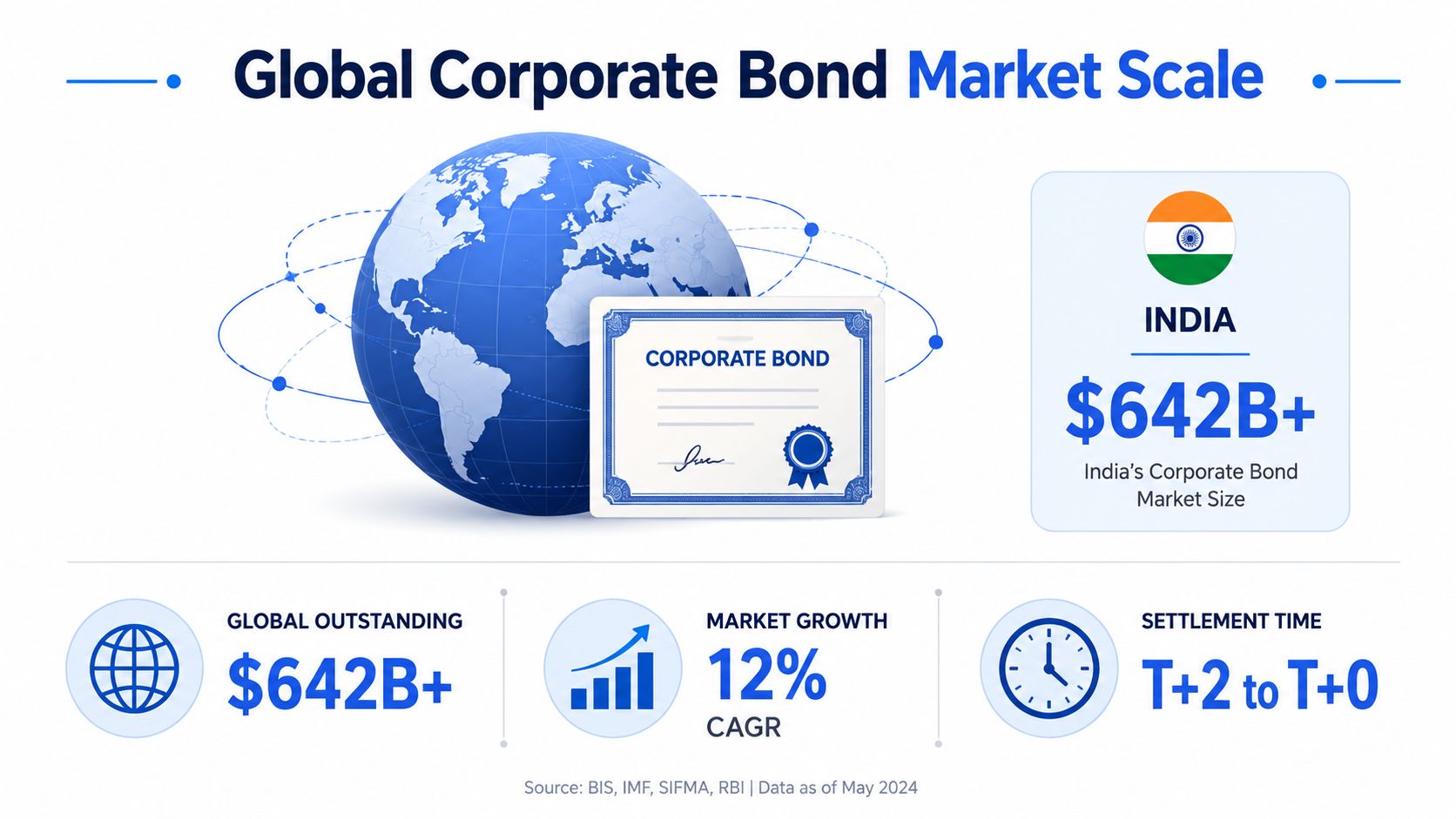
That scale changes the investment case. Even without assuming dramatic liquidity growth, improvements in issuance controls, settlement coordination, ownership updates, and post-issuance servicing could affect a significant debt-market workflow. Corporate bond tokenization is best understood as a market-infrastructure upgrade, not as an attempt to place regulated securities into an ungoverned crypto environment.
Why post-issuance operations matter
Issuance attracts attention because it creates a visible digital bond. Yet much of the cost and risk appears later. Paying agents calculate coupons, custodians reconcile positions, registrars maintain ownership records, trustees monitor covenants, and compliance teams validate transfers and investor eligibility.
A shared ledger can give authorised participants a common record of relevant events. Smart contracts can then apply defined rules to coupon dates, transfer restrictions, maturity, and redemption. That doesn’t remove governance. It makes governance more explicit, testable, and auditable.
SEBI’s current direction is especially relevant because the proposed pilot is tied to the Reserve Bank of India’s wholesale CBDC settlement rails. Those rails are already being used for settlement in government securities, inter-bank call money, and tokenized certificate-of-deposit issuance, according to reporting on the pilot and its market-plumbing context.
Practical rule: Treat the ledger, cash rail, custody model, identity layer, and regulatory permissions as one system. A token alone doesn’t modernise bond lifecycle management.
Institutions considering architecture choices can also compare network permissions, smart-contract standards, settlement models, and interoperability requirements in this review of blockchain platforms for corporate bond tokenization.
What Are Tokenized Bonds and How Do They Work
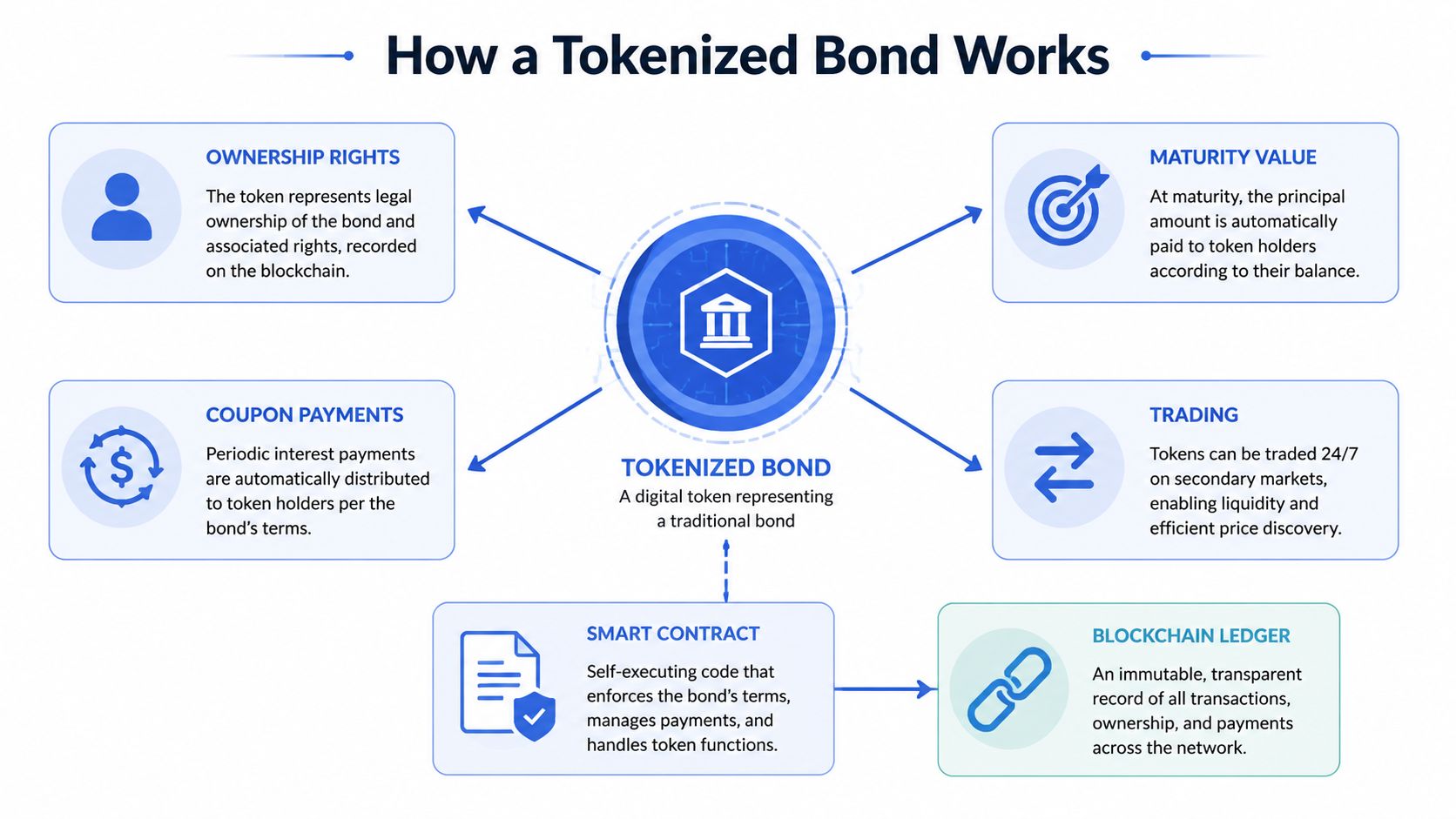
Tokenized bonds are regulated debt instruments represented by digital tokens on a blockchain or distributed ledger. The token can encode or reference ownership rights, coupon entitlement, transfer conditions, maturity value, and redemption claims. The underlying legal instrument remains a security. Tokenization changes how authorised participants record, validate, and execute lifecycle events.
A conventional book-entry bond already has a digital record. That record is usually split across issuer, depository, custodian, registrar, paying-agent, and trading-venue systems. A tokenized bond can place permitted ownership states and transaction history on a shared ledger, reducing reconciliation between separate records. The gain depends on governance, identity controls, and integration with regulated custody and payment infrastructure.
The token is more than a digital certificate
A tokenized corporate bond normally combines several components:
- Bond terms: Principal, coupon method, payment dates, maturity, and redemption conditions are defined in legal and technical specifications.
- Ownership state: The ledger records which approved investor or custodian controls the tokenized position.
- Transfer logic: Smart contracts can check wallet eligibility, holding limits, lock-up rules, and other restrictions before approving a transfer.
- Servicing instructions: Coupon and principal payments can connect to approved cash accounts, tokenized money, or a regulated payment agent.
- Audit evidence: Authorised users can inspect time-stamped lifecycle events and compare them with supporting records.
Smart-contract rules can automate coupon schedules and redemption instructions, but they do not replace the paying agent, trustee, custodian, or compliance function. Covenant monitoring also requires trusted inputs, such as financial disclosures or eligibility events, plus a defined response when a condition is breached. Automation works only when legal terms, data sources, exception handling, and approval rights are specified together.
Tokenization does not automatically make a bond fractional, public, or continuously tradable. Those outcomes depend on the legal wrapper, market rules, investor permissions, custody design, and trading venue. A permissioned network may suit transactions requiring confidentiality and jurisdictional controls better than a public chain.
Teams comparing implementation choices can use this guide to tokenizing corporate bonds on blockchain to separate issuance design from operational and compliance requirements. A corporate bond tokenization platform can support issuance, smart-contract automation, settlement, and investor management, while still requiring connections to legal documentation, identity verification, custody, payment processing, reporting, and existing market infrastructure.
Legacy Settlement Versus Blockchain-Enabled Lifecycle Management
The clearest operational benchmark in India is conventional T+2 settlement, where a corporate bond transaction settles two business days after the trade. Reporting on bond tokenization describes this lag as a source of counterparty and reconciliation exposure, while tokenized proposals are designed to compress the handoff between cash, security, and ownership records through shared-ledger settlement.
A tokenized model doesn’t eliminate every intermediary. It changes where responsibilities sit and how systems coordinate. The most meaningful design is atomic settlement, where central bank digital currency and bond tokens move simultaneously. Either both legs settle, or neither does.
Operational comparison
| Lifecycle Stage | Legacy T+2 Model | Tokenized Atomic Model |
|---|---|---|
| Trade matching | Participants match instructions across venue, broker, custodian, and depository systems | A shared execution layer can coordinate trade conditions and eligibility checks |
| Cash and security movement | Cash and securities follow separate processing paths before final settlement | Bond tokens and approved digital cash can transfer in one linked transaction |
| Ownership update | Multiple records may require reconciliation after settlement | The authorised ledger updates the ownership state as part of settlement |
| Coupon servicing | Paying agents, registrars, custodians, and investors exchange files and instructions | Smart contracts can trigger defined servicing workflows on scheduled dates |
| Corporate actions | Teams validate holders and distribute instructions across connected systems | Rules can identify eligible holders and produce auditable event records |
| Exception handling | Failed or incomplete instructions require manual investigation | The system can reject invalid transfers and preserve an event trail for review |
| Audit trail | Evidence is assembled from separate operational systems | Time-stamped ledger events can support a common transaction history |
The cash leg remains decisive
A bond token can settle quickly only if the payment asset can settle with comparable finality. India’s proposed architecture addresses this by connecting the Securities Ledger to the RBI’s wholesale CBDC-based settlement rails, rather than treating the bond as an isolated digital asset within the reported Unified Markets Interface model.
That distinction matters in the US, Europe, the UK, Switzerland, Singapore, the UAE, Canada, and Australia. Each market has its own rules for cash settlement, central securities depositories, custody, investor identity, and finality. Blockchain bond settlement works when the token network is integrated with an accepted cash and securities framework. It works poorly when the bond is digital but payment, legal ownership, and reconciliation remain entirely external.
A useful institutional comparison of operating models is available in this traditional versus tokenized corporate bonds analysis.
Tokenized Bond Lifecycle Stages and Smart Contract Automation
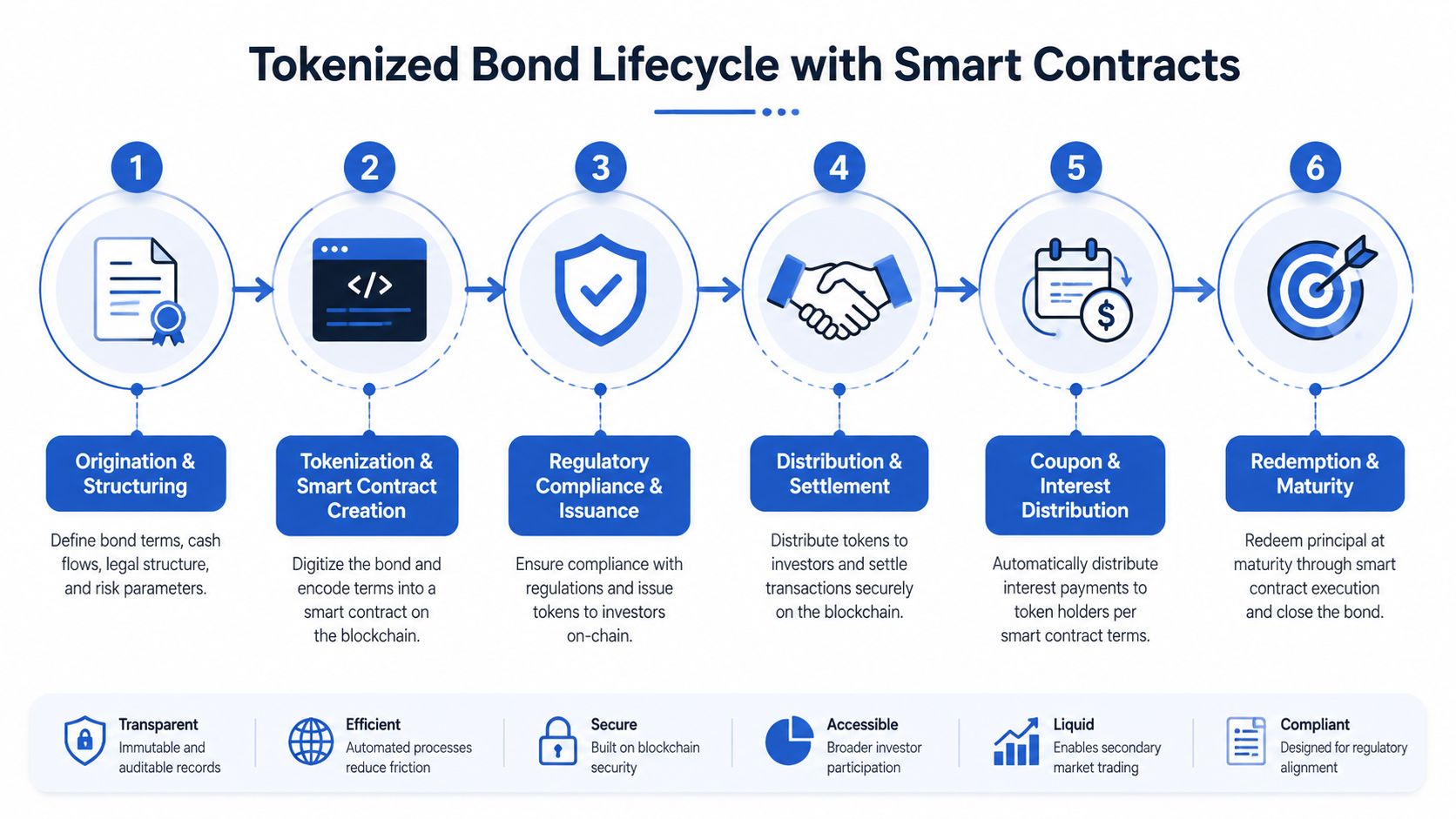
A tokenized bond lifecycle begins with legal and operational definitions. The issuer, counsel, arranger, trustee, registrar, custodian, and technology team must establish the authoritative record, permitted holders, transfer conditions, payment asset, exception process, and treatment of events outside the ledger.
Origination and issuance
The issuer defines the economic and legal terms first. A smart contract can encode supply, denomination, coupon schedule, maturity, redemption rules, and transfer restrictions. The code should not become the sole source of legal meaning. Offering documents and technical logic need a stated hierarchy for resolving discrepancies.
Allocation connects approved subscriptions with token delivery. Before minting or transferring tokens, an institutional platform normally verifies identity, jurisdiction, investor eligibility, allocation, payment status, and wallet or custody-account permissions.
Design principle: Encode rules that must execute consistently, while directing ambiguous legal and operational exceptions to authorised human operators.
Ownership and settlement
After issuance, the ledger records approved ownership changes. A transfer can be rejected when the buyer is ineligible, the seller lacks sufficient balance, the bond is locked, or the transaction breaches a holding restriction. Digital ownership records matter because position updates and policy checks can occur within the same controlled workflow, reducing dependence on later reconciliation.
Settlement still depends on the cash leg. A permissioned securities ledger can connect the bond token with digital cash, provided the payment asset has accepted finality and the surrounding custody and regulatory arrangements support the model. In India’s proposed architecture, the Unified Markets Interface and Securities Ledger are intended to operate as a parallel execution and settlement layer alongside the existing depository framework, with atomic transfer mechanics.
Servicing, covenants, and redemption
Coupon automation requires more than a calendar trigger. The system needs a reliable holder snapshot, a validated amount, an approved payment rail, procedures for failed payments, and records that reconcile with custody and accounting systems. Teams designing these workflows can also consult DAML post-trade processing, settlement, and reconciliation for a model of shared obligations and controlled state changes.
Corporate actions may include covenant tests, asset-cover checks, waivers, consent events, and notices. NSDL launched a blockchain-based Debenture Security and Covenant Monitoring platform on 1 April 2022 to manage issuance, asset-cover tracking, covenant monitoring, and immutable time-stamped records of debentures and backing assets as described in its lifecycle-monitoring material. The example demonstrates a DLT application that continues after issuance.
At maturity, the system identifies eligible holders, transfers principal through the approved cash process, and marks or burns the redeemed token under the governing rules. Production operations also need manual recovery for disputes, insolvency events, incorrect data, and interrupted payment services.
Liquidity Realities and Market Structure Considerations
Tokenization can improve transfer precision and settlement efficiency without automatically creating a liquid secondary market. Liquidity still depends on willing buyers and sellers, credible pricing, market-making arrangements, distribution, investor permissions, and reliable access to cash.
Fractional ownership is often presented as a straightforward route to broader participation. Smaller units may make an instrument easier to distribute, but they can also create fragmented positions in a market that remains institution-led. More holders don’t necessarily mean more executable two-way prices.
What tokenization can and can’t solve
Tokenized infrastructure is well suited to:
- Reducing reconciliation: Participants can refer to a shared, permissioned transaction state.
- Enforcing transfer rules: Smart contracts can check eligibility before ownership changes.
- Automating servicing: Coupon and redemption workflows can follow predefined conditions.
- Improving event traceability: The ledger creates time-stamped records for authorised review.
It doesn’t, by itself, solve:
- Thin demand: A tokenised bond still needs active investors and market makers.
- Price discovery: A transparent ledger doesn’t guarantee independent, frequent quotes.
- Concentration risk: Fractional positions may broaden access while leaving exposure concentrated among a narrow group of holders.
- Compliance burden: KYC, AML, sanctions controls, custody, reporting, and tax treatment still apply.
- Interoperability: A bond issued on one network may remain difficult to transfer or settle elsewhere.
Recent commentary on SEBI’s exploratory pilot makes this distinction explicit. The initiative aims to improve transparency and accessibility, but the pilot remains limited-scale and does not resolve low turnover, uneven distribution, or operational complexity in the existing market as discussed in this analysis of liquidity and concentration risk.
Institutional sponsors should therefore define liquidity as a measurable operating requirement. Ask which investors can hold the bond, where trading can occur, how quotes are formed, how transfers are approved, and what happens when a transaction fails. Tokenization is strongest as a settlement and servicing intervention. Its liquidity case must be proven through market structure, not assumed from token divisibility.
Institutional Implementations and Regulatory Pilot Programs
The most useful evidence comes from systems connected to regulated market plumbing. India’s SEBI pilot is a clear example of that approach. Reporting links the pilot to distributed ledger technology, the RBI’s wholesale CBDC settlement rails, and a proposed rollout window of 6 to 9 months in coverage of SEBI’s confirmation.
India’s regulated integration model
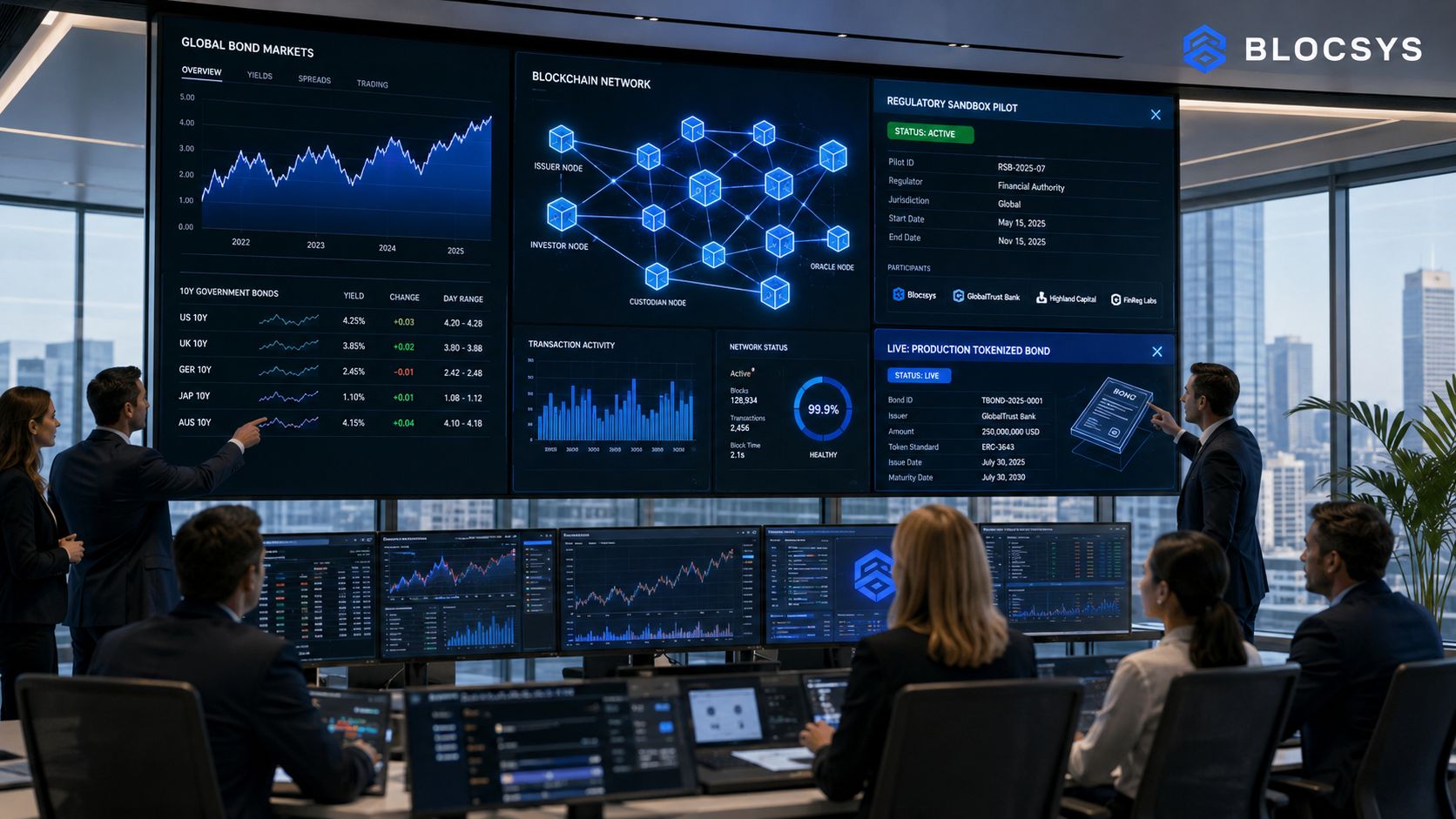
The proposed Unified Markets Interface uses a Securities Ledger as a parallel execution and settlement layer alongside existing depository arrangements. The important mechanic is atomic settlement. Central Bank Digital Currency and corporate bond tokens are intended to move together, so a payment leg doesn’t complete without the corresponding securities leg.
The pilot is also expected to cover automated coupon payments and other servicing events through smart contracts according to reporting on the proposed operating model. That focus is significant. It tests whether a tokenized bond can function through its post-issuance lifecycle, rather than merely demonstrate digital issuance.
NSDL’s blockchain-based debenture platform adds a separate production reference point. Its lifecycle scope includes issuance, asset-cover tracking, covenant monitoring, and immutable records, showing that distributed ledgers can support trustee and compliance workflows even where a full tokenized trading market isn’t yet in place.
Global deployment requires jurisdictional discipline
The US and Canada require careful treatment of securities registration, exemptions, custody, transfer restrictions, and investor eligibility. European programmes must account for national market infrastructure alongside EU-level digital-asset and securities rules. The UK, Switzerland, Singapore, the UAE, Germany, France, and Australia each bring distinct licensing, settlement, data, and financial-promotion considerations.
That means global institutions shouldn’t copy India’s model directly. They should identify the local securities ledger, cash instrument, legal holder record, regulated intermediary, and reporting obligations before selecting a chain or token standard. A useful jurisdiction-focused reference is this discussion of corporate bond tokenization use cases across banking and capital markets in the UK.
The adoption signal is real, but the maturity level varies. Confirmed lifecycle platforms and regulatory pilots should be separated from future possibilities, especially claims about broad retail access, deep liquidity, cross-chain collateral use, or universal T+0 settlement.
Building Tokenized Bond Infrastructure with Blocsys
A production tokenized bond system needs more than a minting contract. It needs an architecture that joins legal terms, investor onboarding, wallet or custody permissions, ledger state, payment processing, reporting, corporate actions, exception management, security monitoring, and integration with existing capital-market systems.
Blocsys Technologies develops secure and compliant Corporate Bond Tokenization platforms that support digital bond issuance, smart-contract automation, faster settlements, and investor management for banks, financial institutions, and capital markets worldwide. The practical scope should be evaluated against the institution’s jurisdiction, settlement asset, depository relationships, custody model, and operating controls.
Architecture decisions that deserve scrutiny
- Ledger selection: Choose public, private, or hybrid infrastructure according to confidentiality, participant governance, finality, resilience, and interoperability requirements.
- Smart-contract boundaries: Automate deterministic coupon, transfer, and redemption rules, while preserving controlled workflows for disputes, waivers, restructurings, and exceptional events.
- Compliance enforcement: Apply KYC, AML, sanctions, investor eligibility, holding restrictions, and jurisdictional transfer rules before state changes are committed.
- Integration design: Connect the tokenized bond lifecycle to core banking, custody, accounting, registrar, payment, depository, and reporting systems.
- Operational resilience: Include key management, role separation, contract upgrades, monitoring, recovery procedures, and independent testing.
- Data governance: Establish which system is authoritative for legal ownership, payment status, covenant data, and event history.
Blocsys provides Blockchain Development services for enterprises, startups, and governments using public, private, and hybrid blockchain networks. Institutions also need product discipline. Teams scaling a regulated financial product can benefit from guidance on scaling your fintech MVP, particularly when a pilot must evolve into controlled production without leaving compliance and operational debt behind.
For organisations evaluating commercial development, the Blocsys Cost Estimator Tool can support early budget discussions. The estimate should sit within a broader business case covering legal analysis, regulatory engagement, infrastructure, security audits, custody, integration, testing, support, and lifecycle governance.
The right partner won’t promise that blockchain fixes liquidity or replaces every intermediary. It will help define the smallest credible production scope, prove settlement and servicing mechanics, and create a controlled path from pilot to institutional adoption.
Frequently Asked Questions About Tokenized Bonds
What are tokenized bonds?
Tokenized bonds are debt securities represented by digital tokens on a blockchain or distributed ledger. The token can record ownership and apply programmed rules for transfers, coupon servicing, maturity, and redemption, while the security remains subject to applicable securities laws and market regulations.
How are corporate bonds tokenized?
An issuer defines the bond’s legal and economic terms, deploys or configures a smart contract, verifies eligible investors, receives approved payment, and allocates digital tokens. The tokenized system then records authorised ownership and applies transfer and servicing rules.
How does blockchain manage the tokenized bond lifecycle?
Blockchain can maintain a shared ownership record and time-stamped event history. Smart contracts can support issuance, allocation, transfer restrictions, coupon instructions, covenant events, maturity processing, and redemption, provided the system integrates with regulated custody, payment, identity, and reporting processes.
Can tokenized bonds settle instantly?
They can be designed for atomic settlement when the bond token and digital cash asset move in one linked transaction. India’s proposed model connects tokenized corporate bonds with wholesale CBDC-based settlement rails. The exact settlement outcome depends on jurisdiction, cash infrastructure, legal finality, and participant permissions.
How are coupon payments automated?
A smart contract can identify eligible holders, calculate or receive the required payment amount, and initiate distribution through an approved payment rail. Production systems still need controls for payment failures, tax treatment, incorrect data, disputed ownership, and changes to the bond terms.
Who owns a tokenized bond?
The authorised ledger records the permitted holder or custodian account. Legal ownership depends on the governing documents, applicable law, custody arrangement, and recognition of the ledger record by the relevant market infrastructure.
What happens at maturity and redemption?
At maturity, the system identifies eligible holders, processes principal repayment through the approved cash mechanism, and marks the position as redeemed. Token burning or retirement may be used to prevent further transfer, subject to the legal and operational design.
Do tokenized bonds improve secondary-market liquidity?
Not automatically. Tokenization can reduce transfer friction and improve record visibility, but liquidity still requires buyers, sellers, market makers, pricing, distribution, suitable trading venues, and efficient cash settlement. Fractionalisation can broaden access while also fragmenting positions.
Are tokenized corporate bonds crypto assets?
Tokenized corporate bonds are generally securities represented through digital tokens. They shouldn’t be treated as ordinary unregulated crypto assets because issuance, ownership, transfer, custody, investor eligibility, disclosure, and reporting remain subject to the relevant securities framework.
Is a public blockchain necessary?
No. A permissioned ledger may better suit institutions that require participant governance, confidential transactions, controlled access, and regulated settlement. A public network may offer broader connectivity, but it introduces additional questions about privacy, transaction ordering, identity, interoperability, and operational control.
What does a corporate bond tokenization platform include?
A serious platform may include digital issuance, investor onboarding, allocation, identity and eligibility checks, smart-contract lifecycle rules, ownership records, settlement connectivity, coupon servicing, corporate-action workflows, reporting, custody integration, and administrative controls.
What does corporate bond tokenization development cost?
Cost depends on the required regulatory analysis, ledger model, smart contracts, integrations, custody and payment design, security testing, reporting, and operational support. Organisations can use the Blocsys Cost Estimator Tool for an initial discussion, then validate the scope with legal, compliance, and technology stakeholders.
Why should an institution work with Blocsys?
Blocsys Technologies works on enterprise blockchain, tokenization, smart contracts, digital assets, and financial technology platforms. Institutions exploring tokenized bonds can engage Blocsys to assess architecture, design lifecycle workflows, integrate market infrastructure, and plan a controlled implementation.
Are tokenized bonds suitable for every issuer?
No. Suitability depends on issuance scale, investor base, jurisdiction, settlement requirements, custody relationships, regulatory permissions, operational readiness, and the expected value of automation. A conventional structure may remain more appropriate where the digital lifecycle cannot be supported end to end.
Tokenized Bonds, Tokenized Corporate Bonds, Corporate Bond Tokenization, Tokenized Bond Lifecycle, Blockchain Corporate Bonds, Digital Bonds, Tokenized Securities, Blockchain Bond Settlement, Digital Securities, Fixed-Income Tokenization, Tokenized Assets.
Blocsys Technologies offers corporate bond tokenization, tokenization platform development, smart contract development, digital asset platform development, and enterprise blockchain development for regulated financial and capital-market workflows. Visit Blocsys Technologies to discuss your tokenized bond lifecycle, settlement architecture, compliance requirements, and next implementation step.
