
The popular advice is simple: deploy an ERC-20 token on Robinhood Chain, add a few smart contracts, and you’ve created programmable finance. That advice is incomplete and dangerous for an institutional issuer. Robinhood Chain smart contracts can encode transfer and servicing logic, but they don’t create legal ownership, investor protection, regulatory approval, or operational readiness by themselves.
This guide is for banks, corporate bond issuers, asset managers, fintech companies, digital asset businesses, compliance teams, and technology leaders evaluating Robinhood Chain tokenization. The practical outcome is a clearer architecture for smart contracts for tokenized securities, including identity, eligibility, settlement, custody, compliance, and corporate actions across the US, UK, Europe, the UAE, Singapore, and other regulated markets.
Table of Contents
- Why Robinhood Chain Tokens Are Not Automatically Tokenized Securities
- What Smart Contracts and Programmable Finance Actually Mean
- How Smart Contracts Can Support Tokenized Securities
- Traditional Securities Infrastructure vs Programmable Blockchain
- Building a Production Tokenized Securities Platform on Robinhood Chain
- Regulatory Reality Check Across the US, UK, Europe, UAE, and Asia
- How Blocsys Helps You Build Programmable Finance That Works
Why Robinhood Chain Tokens Are Not Automatically Tokenized Securities
Minting a token on Robinhood Chain doesn’t automatically create a regulated security. A smart contract encodes transfer logic, not the complete legal rights attached to an instrument, the issuer’s disclosure duties, or the investor protections required by securities law.
Robinhood Chain’s documentation describes a permissionless, EVM-compatible network for Robinhood Stock Tokens and other contracts, as shown in its official contract documentation. EVM compatibility makes familiar development patterns possible. It doesn’t determine whether a token represents a share, bond, fund interest, derivative, receipt, or merely a digital record with no enforceable claim against an issuer.
The technical token and the security token are different objects
A technical token is a blockchain record controlled by contract code. It may support minting, burning, balances, approvals, and transfers. A security token must also connect that record to a legally defined instrument, an issuer or special-purpose vehicle, an offering structure, investor rights, disclosure documents, transfer restrictions, and regulated service providers.
The distinction matters because token representation doesn’t automatically establish legal ownership. The legal wrapper might be a direct record of ownership, a beneficial interest, a note, a trust interest, or a claim against an issuer. Each structure creates different obligations for custody, settlement, taxation, reporting, and enforcement.
Institutional rule: Treat the blockchain token as one layer of the securities stack, not as the securities stack itself.
India illustrates why this separation matters. The country currently lacks a dedicated legal framework for asset tokenisation, while the IFSCA’s consultation approach is designed to recognise digital tokens representing ownership or beneficial interests and to build mechanisms for issuance, trading, custody, clearing, and settlement. The IFSCA consultation paper therefore points toward market infrastructure, not a simple mint-and-transfer model.
Four layers sit around the contract
A production tokenized securities platform needs at least four additional layers:
- Legal wrapper: Defines what the token represents and which documents govern the holder’s rights.
- Identity and eligibility: Connects wallets to verified investors, jurisdictions, classifications, and permissions.
- Custody and transfer-agent integration: Reconciles on-chain balances with regulated custody, books, records, and recovery procedures.
- Regulatory disclosure: Carries offering terms, risk factors, reporting, tax treatment, and continuing obligations outside the code.
India’s draft Asset Tokenisation Regulation Bill, introduced in 2026, is significant because it proposes legal recognition, regulation, and supervision across issuance, trading, custody, and settlement. It assigns SEBI as the principal authority where tokenized assets involve securities, while the RBI oversees links to payment systems, stable value arrangements, or banking activities. The proposed bill text signals a regulated market infrastructure approach.
The contrarian conclusion is straightforward. Programmable finance is plumbing, not a compliance shortcut. Operational relevance inside a regulated securities framework is earned through architecture around the contract, regardless of whether the underlying network is Robinhood Chain, another EVM chain, or a permissioned ledger.
What Smart Contracts and Programmable Finance Actually Mean
A smart contract is software deployed on a blockchain that executes predefined instructions when it receives a valid transaction or authorised call. On an EVM-compatible network, developers can use familiar languages and tools to define balances, permissions, transfer conditions, payment logic, and administrative controls.
For institutional finance, programmable finance means encoding selected financial rules in software so transactions and lifecycle events follow consistent processes. It does not make every financial decision autonomous. Identity checks, legal interpretation, valuation, tax treatment, and dispute resolution can still require off-chain systems and human authority.

How an on-chain rule works
A transfer restriction can be technically simple. This Solidity pattern permits transfers only when both addresses appear on a whitelist:
mapping(address => bool) public approved;

function transfer(address to, uint256 amount) external returns (bool) {
    require(approved[msg.sender], "sender not approved");
    require(approved[to], "recipient not approved");
    _transfer(msg.sender, to, amount);
    return true;
}
The code exposes a hard boundary. It can reject a transaction based on a recorded wallet status. It cannot determine whether a passport is valid, whether one beneficial owner controls several wallets, or whether a regulator has changed an investor’s status. Controlled identity, compliance, and governance systems must supply those facts.
The architecture separates contract authority from data authority. A compliance registry may receive an attestation from a KYC provider, while a transfer hook reads that status before execution. An administrator may pause transfers after an incident, and a legal agreement may specify how the issuer handles a rejected or incorrectly executed transaction.
Composability changes the operating model
A token can connect to a dividend distributor, payment rail, custody service, exchange interface, and audit system. These connections can reduce duplicate data entry and make lifecycle events easier to observe. They also create dependency risk. A faulty oracle, compromised administrator key, or poorly designed upgrade path can affect every connected workflow.
Engineering teams assessing this operating model can Browse Fidelity digital assets jobs to review how digital asset roles combine blockchain engineering, custody, operations, and financial controls. The practical requirement extends beyond Solidity. Teams need expertise in ledgers, controls, product operations, and regulated markets.
Robinhood Chain is a delivery environment, not the definition of programmable finance. Its relevance depends on whether the surrounding system can connect assets, identities, payments, records, and governance to the issuer’s legal obligations. That assessment matters equally for metaverse blockchain integration and other blockchain deployments. The contract is only one component of an institutionally usable system.
How Smart Contracts Can Support Tokenized Securities
Smart contracts can support a tokenized security across its lifecycle, but readiness differs by function. Balance tracking and controlled transfers are established blockchain patterns. Automated coupon servicing, regulated delivery-versus-payment, and complex corporate actions require deeper integration with legal agreements, payment systems, identity providers, custodians, and market infrastructure.
The lifecycle from issuance to servicing
Issuance begins with controlled minting. A contract can restrict mint authority, enforce a supply cap, assign investor balances, and create an auditable record of issuance. The cap table still needs a legal and operational owner, particularly where the blockchain record must reconcile with a transfer agent or regulated custodian.
Eligibility uses identity attestations and compliance registries. A wallet can be associated with an approved investor status without exposing every personal detail publicly. The contract can then check whether the sender and recipient satisfy the relevant conditions.
Transferability can be limited through allow lists, jurisdiction rules, holding periods, investor classifications, or instrument-specific restrictions. A transfer hook may reject a transaction before the token moves. That provides deterministic enforcement of coded conditions, but it doesn’t replace legal review of whether the condition itself is correct.
Settlement can use atomic delivery-versus-payment. The token and an approved payment asset move in one coordinated transaction, subject to the relevant permissions. The arrangement still needs a valid payment instrument, liquidity, reconciliation, and a response when one leg fails or a transaction must be reversed.
Distributions may use push or pull payment patterns. A push model sends funds to eligible holders, while a pull model lets holders claim their entitlement after the contract records the distribution. For institutions, pull payments can reduce the risk of one failed wallet blocking a broader distribution, but they add claim management and expiry questions.
Corporate actions can be triggered through governance-controlled calls. Splits, redemptions, buybacks, rights issues, voting, and mergers can be represented in contract logic, provided the legal documents define the event and authorised parties control execution.
The ERC-1404 token standard explanation is relevant to this design conversation because security-token architectures often require transfer restrictions beyond ordinary fungible-token behaviour. For market research, a public token directory such as Solana Tokens can help teams understand how general token ecosystems differ from regulated securities infrastructure. It shouldn’t be treated as evidence that a token is a security or that a chain supports regulated issuance.
| Lifecycle Event | Smart Contract Mechanism | Production Readiness |
|---|---|---|
| Issuance | Role-controlled minting, supply rules, investor allocation | Established technical pattern, legal integration required |
| Ownership | Wallet balances, authorised records, event logs | Established technical pattern, legal meaning varies |
| Eligibility | Identity attestations, compliance registry, transfer hooks | Deployable with external identity systems |
| Transfer restrictions | Allow lists, deny lists, holding periods, jurisdiction logic | Established in controlled environments |
| Settlement | Atomic delivery-versus-payment | Emerging for regulated market workflows |
| Coupons and dividends | Distribution ledger, push or pull payments | Technically mature, operational integration required |
| Redemptions and buybacks | Burn, redemption queue, payment confirmation | Deployable with careful governance |
| Splits and mergers | Contract calls, migration or conversion logic | Emerging and legally documentation-dependent |
| Dispute handling | Pause, recovery, correction, administrator process | Essential control, not fully autonomous |
India has a concrete institutional example of this direction. SEBI has required DLT monitoring for non-convertible securities since April 2022, with the stated purpose of improving transparency and preventing duplicate pledges or asset-record manipulation. Industry and legal analysis places India’s tokenisation market at around USD 3 billion, with a projection of USD 100 billion by the end of the decade, implying more than 30x growth potential from that base, as reported by FinanceFeeds.
That evidence supports a broader point. Smart contracts can handle issuance, ownership updates, covenant tracking, and servicing events, but they can’t police beneficial ownership across wallets, enforce off-chain covenants, interpret ambiguous documents, or replace regulators. A corporate bond tokenization platform can therefore be useful only when its contract suite is connected to the issuer’s legal, investor-management, custody, and settlement processes.
Traditional Securities Infrastructure vs Programmable Blockchain
Programmable blockchain infrastructure doesn’t eliminate every function performed by transfer agents, custodians, broker back offices, clearing systems, or central securities depositories. It changes where certain records and rules live, and it shifts risk from manual reconciliation toward contract design, key management, oracle integrity, governance, and recovery.
| Lifecycle Event | Traditional Stack | Programmable Blockchain (Robinhood Chain) | Operational Risk Shift |
|---|---|---|---|
| Issuance and underwriting | Issuer, underwriters, legal documents, registrar, allocation files | Controlled minting linked to an approved issuance workflow | Less duplicate entry, greater risk from incorrect mint authority |
| KYC and AML gating | Onboarding platforms, compliance reviews, broker controls | Attestations and wallet permissions read by transfer hooks | Faster rule checks, continued dependence on trusted identity data |
| Cap-table management | Transfer agent records and reconciliations | On-chain balances with off-chain books and records | Better event visibility, difficult correction if records diverge |
| Transfer restrictions | Manual review, broker controls, legal opinions | Allow lists, holding periods, jurisdiction modules | Deterministic rejection, code may encode an incomplete rule |
| Clearing and settlement | Matching, netting, clearinghouse, depository processes | Atomic token and payment movement where supported | Reduced settlement coordination, new liquidity and integration dependencies |
| Custody reconciliation | Custodians, omnibus accounts, statements, control reports | Wallet balances, MPC or institutional custody, ledger reconciliation | More direct audit trail, higher key and wallet recovery responsibility |
| Coupon or dividend payment | Paying agents, calculation agents, bank payments | Contract-based entitlement and payment distribution | Fewer repetitive calculations, payment and tax exceptions remain |
| Corporate actions | Issuer notices, agents, elections, manual processing | Governance-authorised contract calls and holder elections | Faster execution, greater change-management and upgrade risk |
| Regulatory reporting | Periodic files assembled from multiple systems | On-chain events combined with compliance and reporting data | Stronger transaction traceability, privacy and data mapping challenges |
| Secondary trading | Venues, brokers, market makers, post-trade infrastructure | Permissioned transfer and trading interfaces | Potentially broader operating windows, liquidity still depends on permissions and demand |
The comparison should not be reduced to “old is slow, new is instant.” A blockchain can process a valid state transition efficiently. It doesn’t resolve a disputed ownership claim, recover a lost key, validate a complex tax position, or decide whether an investor remains eligible after a change in circumstances.
Programmable finance is strongest where rules are explicit, repetitive, and independently verifiable. Legacy infrastructure remains stronger where exceptions, legal interpretation, and recovery dominate.
For issuers comparing instruments, the analysis in this traditional corporate bonds versus tokenized corporate bonds comparison should be read as an operating decision, not a technology contest. A sensible design keeps proven controls where they work and moves only suitable functions on-chain.
Building a Production Tokenized Securities Platform on Robinhood Chain
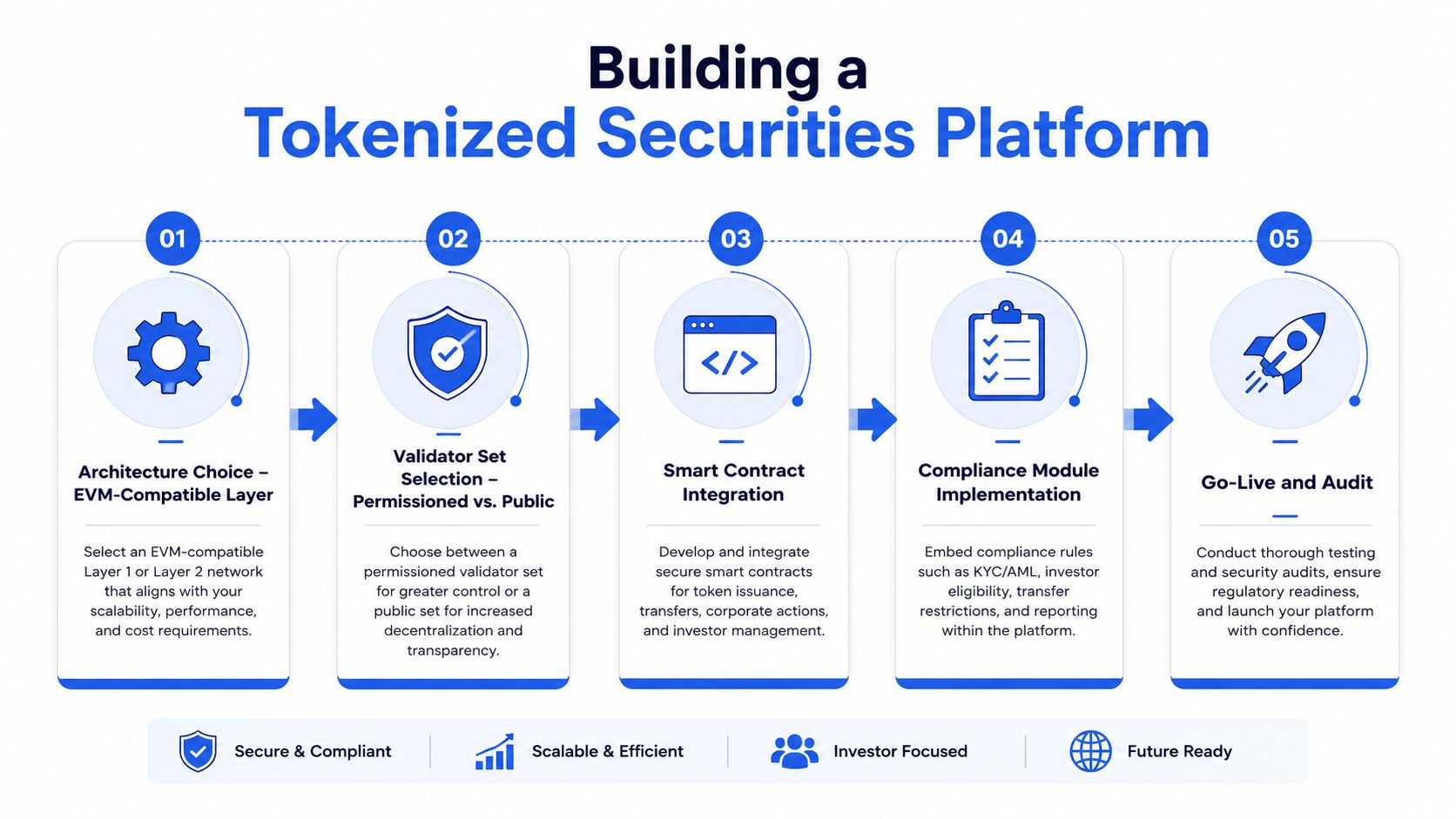
A production platform starts with market structure, not a token contract. The first decision is whether Robinhood Chain’s public, permissionless environment matches the instrument, investor base, privacy requirements, validator assumptions, and regulated intermediaries involved.
Architecture decisions come first
Choose the EVM compatibility layer and define which components are public, private, or permissioned. A team may use Robinhood Chain directly, an application-specific environment connected to it, or a separate settlement layer with controlled interoperability. The decision should account for transaction observability, upgrade authority, finality assumptions, data privacy, operational resilience, and regulator access.
Identity comes next. Link wallets to KYC and AML providers through attestations rather than placing sensitive personal information on-chain. Define how a status expires, who can revoke it, how a wallet is replaced, and what happens when one investor controls multiple addresses.
Custody needs explicit segregation. Separate operating, treasury, and investor balances, then connect institutional wallets through Fireblocks, BitGo, or self-custodial MPC where those arrangements fit the organisation’s risk model. Custody is not an afterthought. It determines who can sign, pause, recover, distribute, and approve upgrades.
Build the contract suite around controls
A typical security-token architecture can include:
- Restricted token logic: An ERC-1404-style transfer hook checks eligibility before balances change.
- Compliance registry: Approved jurisdictions, investor classifications, holding periods, and status expiry are recorded through role-controlled updates.
- Distribution module: A pull-payment distributor calculates entitlements and lets eligible holders claim funds without making every payment dependent on one transaction.
- Upgrade governance: A UUPS upgrade pattern can place changes behind a timelock, with a proposed 48-hour timelock used as an example of a review window, not a universal regulatory standard.
- Administrative controls: Pausing, minting, burning, recovery, and role rotation require separate permissions and monitored approval paths.
The test process should use Hardhat or Foundry, property-based fuzzing, invariant testing, and negative-path scenarios. Test not only successful transfers, but expired attestations, sanctions-list changes, blocked jurisdictions, duplicate claims, failed payments, wallet recovery, paused markets, and malicious upgrade attempts.
Reconcile before you launch
A third-party audit should be a gate, not a marketing badge. Formal verification is particularly valuable for transfer restrictions and supply invariants. Run a mainnet dry-run on testnet, then compare blockchain events against the legacy transfer agent or cap-table system through shadow reconciliation.
The launch checklist should include:
- Oracle redundancy: Use more than one source for eligibility, reference prices, or corporate-action data where those inputs affect settlement.
- Pause authority: Define who can stop transfers, under what evidence, and how the decision is reviewed.
- Incident runbooks: Cover compromised keys, incorrect distributions, contract bugs, provider outages, and regulatory instructions.
- Monitoring: Use Tenderly or OpenZeppelin Defender for transaction simulation, alerts, administrative activity, and runtime oversight.
- Reporting: Map on-chain events to accounting, tax, investor statements, regulatory filings, and audit evidence.
The compliance-ready blockchain platform guidance for Robinhood Blockchain reflects the right mindset. A regulated token is a coordinated system of contracts, identity, custody, operations, and governance.
Regulatory Reality Check Across the US, UK, Europe, UAE, and Asia
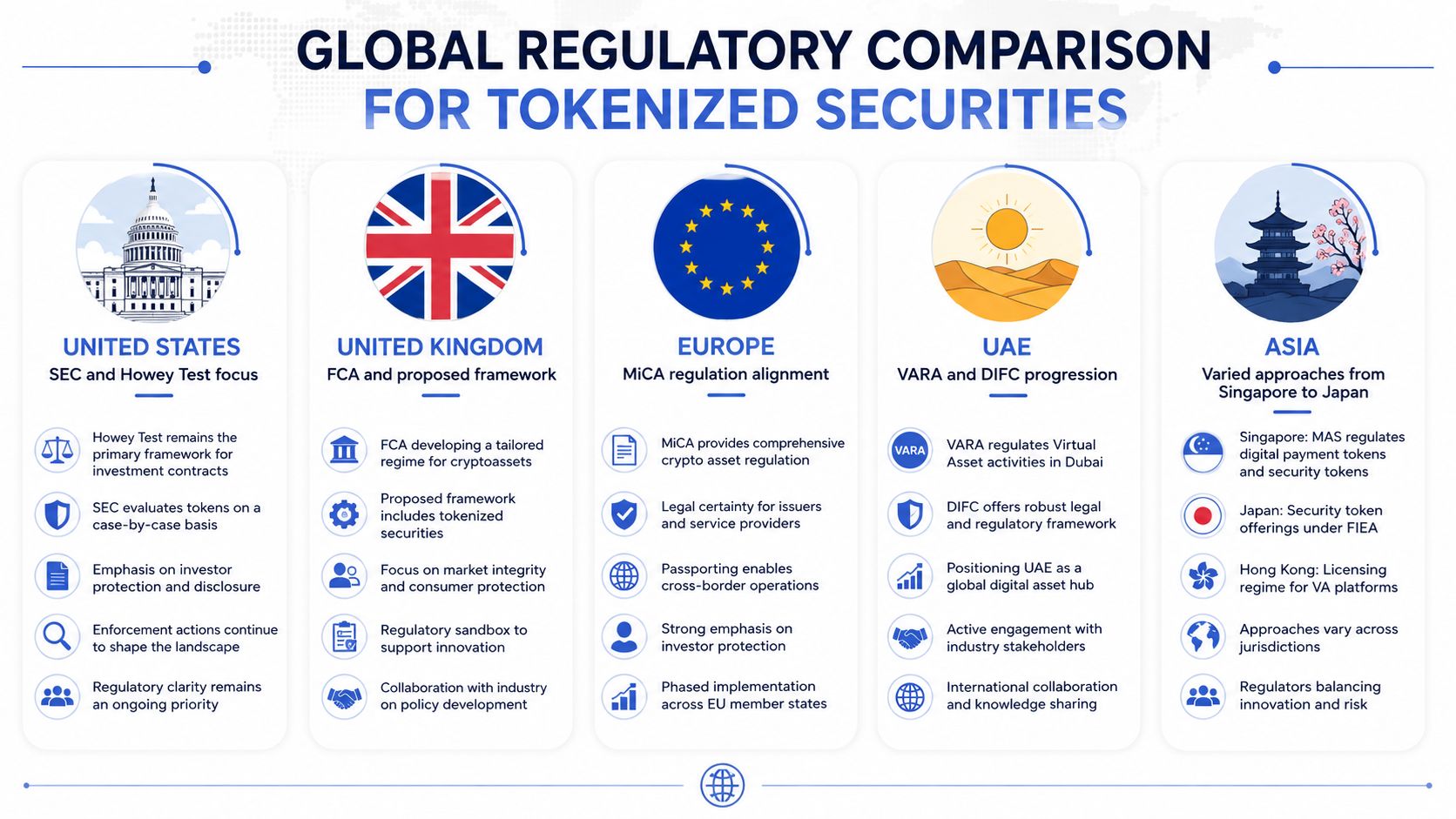
Smart contracts are not regulator-neutral. The same token design can face different classification, licensing, custody, disclosure, investor-access, and trading requirements depending on the issuer, asset, investor, venue, and jurisdiction.
In the United States, the SEC hasn’t blessed Robinhood Chain specifically. A tokenized instrument still requires analysis under applicable securities law, including whether the offering is registered or relies on an exemption. Smart contracts can enforce a holding period or investor whitelist, but they don’t replace offering documents, broker-dealer obligations, transfer-agent functions, custody controls, or legal opinions.
The UK requires a separate analysis of financial promotions, regulated activities, custody, payments, and market infrastructure. FCA sandbox participation can support controlled experimentation, but it isn’t a general approval for a tokenized securities business. Europe adds another layer through MiCA’s scope, MiFID II obligations for regulated trading activity, and the DLT market infrastructure pilot regime. A platform must determine which rules apply to the instrument and service, rather than assuming that “digital asset” is a sufficient classification.
In the UAE, teams may need to distinguish frameworks and permissions across VARA, ADGM, DIFC, and other financial-centre structures. Singapore has explored institutional digital-asset infrastructure through MAS initiatives including Project Guardian, while tokenized products can still trigger licensing and offering requirements. Hong Kong applies its own framework, including requirements relevant to tokenized funds, trading, custody, and virtual-asset services.
India offers the clearest illustration of the governance gap. The country lacks a dedicated tokenisation statute today, while GIFT City discussions focus on issuance, trading, custody, clearing, and settlement. SEBI has confirmed an active corporate bond tokenization pilot with RBI integration goals, and public commentary describes testing automated coupon payments and related servicing events. Reuters reported a planned tokenized corporate bond issue in September 2026, while India’s proposed bill seeks formal supervision across the market lifecycle, as discussed in reporting on SEBI’s corporate bond tokenization pilot.
The practical design response is jurisdiction-aware transfer logic, cooling-off controls where required, disclosure workflows, permissioned distribution, and clear recovery procedures. No smart contract substitutes for a legal opinion or licensed intermediary.
How Blocsys Helps You Build Programmable Finance That Works
Institutions usually underestimate the engineering around a compliant token. The difficult work includes identity-gated transfers, oracle-driven eligibility, audit-grade upgrade patterns, custody integrations, investor reporting, and exchange onboarding.
Blocsys Technologies develops enterprise blockchain and tokenization systems for fintechs, exchanges, and digital asset businesses. Its work can be organised into three practical tracks:
- Architecture sprint: Define contract ownership, compliance hooks, custody boundaries, settlement assumptions, and integration points.
- Build track: Develop audited token variants with role-based controls, restricted transfers, pausable operations, distribution logic, and reporting events.
- Operate track: Establish key-management processes, incident response, monitored upgrades, and feature rollouts through governed timelocks.
A serious delivery plan should specify test coverage, formal verification targets for transfer restrictions, and deployment playbooks for custody integrations such as Fireblocks and Anchorage. Teams assessing staffing needs can also review the Blocsys blockchain development team as one route to combine protocol, application, and compliance engineering.
Blocsys Technologies builds tokenization platforms, smart-contract systems, and blockchain financial infrastructure for institutions evaluating Robinhood Chain and other EVM environments. Visit Blocsys Technologies to schedule a discovery discussion and map your security issuance, compliance, custody, and settlement requirements into a practical delivery plan.
