
A settlement team can have the trade confirmed, the cash available, and the asset legally allocated, yet still spend days reconciling records across custodians, banks, exchanges, and regulators. The problem isn’t a lack of transaction data. It’s that each participant operates under different permissions, systems, and contractual obligations.
DAML smart contract development services address that problem by modelling financial agreements as controlled, multi-party workflows. This guide is for banks, fintechs, asset managers, custodians, exchanges, and technology leaders evaluating Daml development services for regulated markets across the US, UK, Europe, Singapore, the UAE, India, and other institutional finance centres. It focuses on what must be designed beyond the contract code, including privacy, authorisation, integration, testing, deployment, legal enforceability, and operational ownership.
Table of Contents
- The Shift to Privacy-Aware Multi-Party Financial Workflows
- Core Architecture of Daml Smart Contracts and Canton
- Managing Privacy Permissions and Regulatory Authorization
- Real-World Financial Use Cases and Market Momentum
- The Enterprise Daml Development and Integration Process
- Evaluating a Daml Smart Contract Development Company
- Strategic Insights for Daml Smart Contract Adoption
The Shift to Privacy-Aware Multi-Party Financial Workflows
A corporate bond transaction illustrates why general blockchain development patterns often fail in institutional finance. The issuer, investor, custodian, settlement bank, depository, and regulator may each need a different view of the same transaction. A public ledger can provide shared visibility, but that visibility may expose trading positions, client relationships, pricing, or settlement details that should remain confidential.
A collection of private ledgers solves confidentiality but creates another problem. Each organisation maintains its own version of events, then exchanges messages and reconciles records. The workflow remains dependent on manual controls, exception queues, and assumptions about when another party has completed its obligation.
Daml, or Digital Asset Modeling Language, is designed for multi-party business processes. NRI FT India describes DAML as a language that abstracts underlying blockchain and database complexity, allowing developers to focus on business logic for workflows such as settlement and asset servicing. That abstraction matters because a financial institution isn’t buying a programming language in isolation. It’s designing enforceable rights, obligations, approvals, ownership changes, and reporting events.
Why public smart contracts aren’t a direct substitute
General Web3 development often assumes that contract state can be visible to every network participant and that users interact through broadly exposed transactions. That model can work for permissionless applications, but regulated finance requires a different operating principle:
- Controlled participation: only approved parties should create, view, or exercise relevant contract actions.
- Privacy by design: a counterparty should see the information required for its obligation, not every transaction on the network.
- Deterministic business logic: settlement rules should produce consistent outcomes without relying on informal coordination.
- Integration with existing systems: the ledger must work with core banking, custody, risk, accounting, identity, and reporting platforms.
Daml smart contract developers therefore spend as much time mapping roles and information rights as they do writing code. A successful engagement produces a financial application that fits the institution’s control environment. It doesn’t just place an agreement on a blockchain and leave operations to adapt around it.
Practical rule: Treat Daml as a workflow and rights-modelling layer for regulated business, not as a replacement for every system already running inside the bank.
Core Architecture of Daml Smart Contracts and Canton
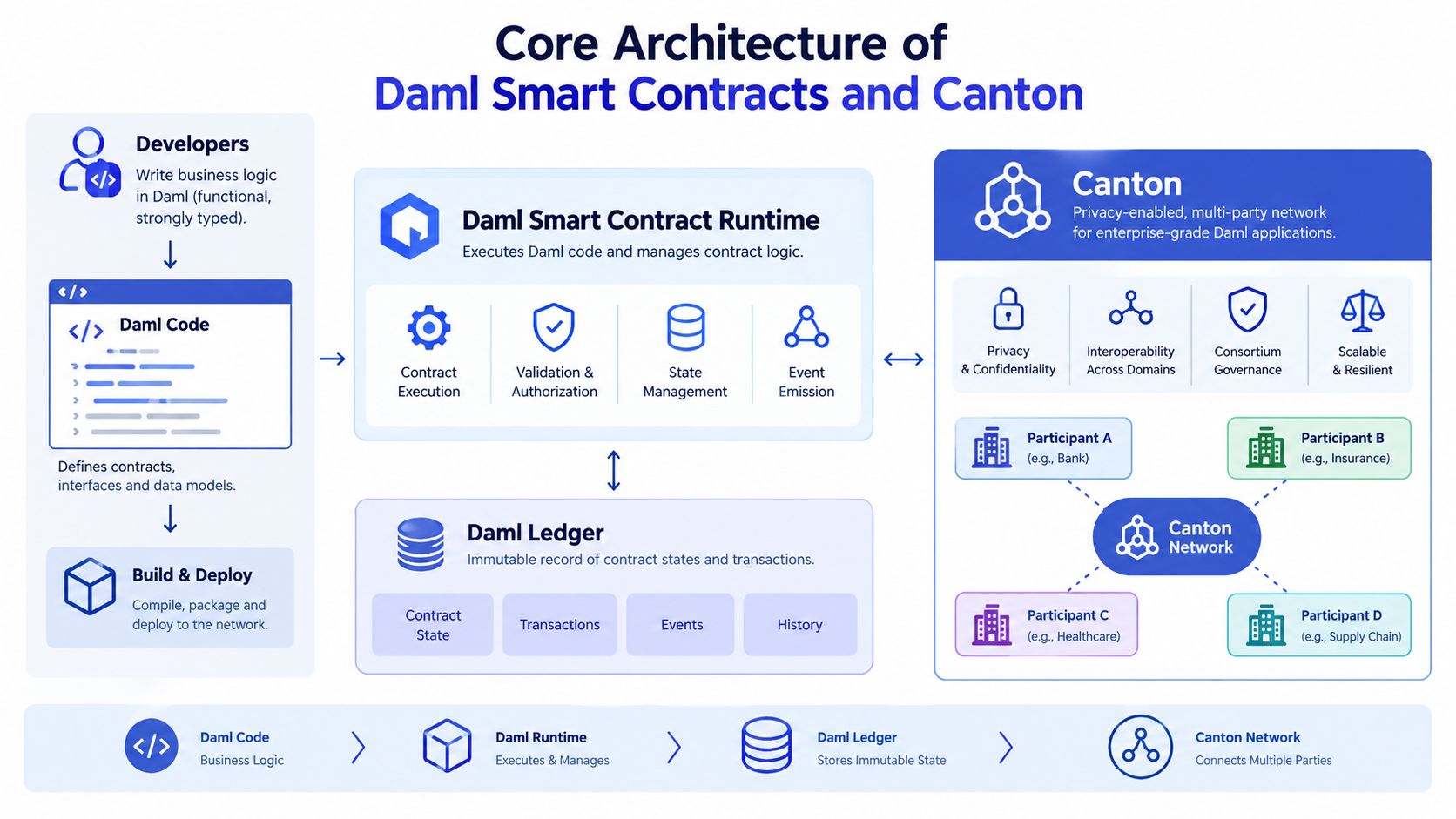
Daml smart contracts represent agreements between identified parties. A contract contains data, named participants, and choices that define permitted actions. A state change doesn’t mutate an existing record. The current contract is archived and a new contract is created through an authorised transaction.
That model is useful for financial workflows because ownership, consent, approval, and settlement can be expressed explicitly. A bond contract might identify the issuer, investor, custodian, and settlement parties. A choice could represent acceptance, transfer, coupon processing, redemption, or cancellation, with each action controlled by the parties entitled to perform it.
How the contract model works
Daml uses a functional programming approach. Developers define templates, data types, parties, signatories, observers, and choices rather than building a generic script that exposes arbitrary state transitions. The ledger checks whether the submitting party has the required authority and whether the proposed transaction satisfies the contract’s rules.
The essential components are:
| Component | Institutional purpose |
|---|---|
| Party | Represents an identified participant, such as a bank, custodian, issuer, or investor |
| Contract | Represents an agreement, asset, obligation, credential, or workflow state |
| Signatory | Confirms who must authorise creation of the agreement |
| Observer | Receives visibility without necessarily receiving control |
| Choice | Defines an action a participant may exercise |
| Contract ID | Provides a typed reference to a specific contract |
| Transaction | Records the authorised state transition and its consequences |
Daml’s contract model is distinct from general Daml language and enterprise smart contract framework explanations that focus primarily on terminology. For a production project, the important question is how these primitives map to actual operating policies, delegation rules, segregation of duties, and exception handling.
Canton and cross-application coordination
Canton provides the distributed ledger environment in which Daml contracts can interact across participating applications and organisations. It isn’t a public ledger where all data is broadcast to every node. Participants receive the transaction information required for the contracts and relationships in which they are involved.
This architecture supports workflows such as delivery-versus-payment, where the asset transfer and cash movement should complete together or not complete at all. It also supports interoperability between separately operated applications without requiring every institution to surrender control of its own data environment.
That distinction is important when comparing Daml application development with broader Blockchain Development services. General blockchain work may involve public, private, or hybrid networks. Daml development services require deeper modelling of contractual authority, participant visibility, and multi-entity transaction composition.
Managing Privacy Permissions and Regulatory Authorization
Privacy isn’t achieved merely by placing a blockchain behind a firewall. A financial application needs a deliberate answer to four questions: who may see a contract, who may create it, who may exercise each action, and what evidence must be retained for oversight.
Daml’s participant model helps developers express those controls in the contract design. Signatories authorise an agreement, observers receive specified visibility, and controllers exercise choices. The resulting transaction view can differ by party, which is essential when a custodian, regulator, issuer, and investor need related but non-identical information.
Design permissions before writing templates
Start with a party and information matrix. For every workflow state, document the participant, the information they need, the action they may perform, and the evidence that action should produce.
- Identify legal and operational roles. Separate issuer, beneficial owner, custodian, settlement agent, compliance officer, auditor, and regulator roles even when one organisation performs several of them.
- Classify information. Distinguish commercial terms, personal data, client identifiers, risk data, transaction status, and regulatory records.
- Map authority. Specify who can propose, approve, reject, transfer, freeze, amend, or close a contract.
- Define delegation. A department may operate a workflow, but the legal entity and authorised users must remain clear.
- Design exceptions. Include failed settlement, sanctions escalation, expired instructions, disputed ownership, and manual intervention paths.
This approach prevents a common implementation error: treating privacy as a deployment setting rather than as part of the business logic. A permissioned network can still expose too much information if the application creates broad observers or allows an overly powerful operator role.
Compliance needs an operational model
Daml doesn’t automatically make an institution compliant. The development team must connect contract events to identity, screening, case management, tax, reporting, records retention, and audit systems. India’s current digital-asset perimeter illustrates the issue. It includes VDA tax classification, FIU-IND reporting obligations for VASPs, FATF Travel Rule adoption, and mandatory crypto transaction reporting from April 2026, with penalties for mistakes, as summarised by India digital-assets regulation analysis.
The same principle applies in other jurisdictions. AML controls, data protection, outsourcing rules, market conduct obligations, and books-and-records requirements must be translated into system responsibilities. Teams should also borrow established practices for managing cloud audit trails, particularly when ledger events are combined with application logs, identity records, and infrastructure telemetry.
For tokenised instruments, Tokenization Platform Development is relevant only when the platform design connects ownership logic to issuance, custody, transfer restrictions, and compliance evidence. A token isn’t a substitute for legal title, settlement policy, or regulatory reporting.
Privacy principle: Give each participant the minimum information and authority needed to perform its role, then make every exception visible to the control function.
A detailed Daml security explanation can support the technical review, but legal, compliance, and operations teams still need to approve the resulting control model.
Real-World Financial Use Cases and Market Momentum
The commercial case for Daml is strongest where several institutions must coordinate a financial event and where reconciliation creates material operational risk. The candidate workflow should involve more than a simple record transfer. It should contain rights, obligations, approvals, conditional actions, and a need for selective visibility.
India provides a strong market context. The Indian Payments Handbook 2025-2030 reports that digital-payment transaction volume increased 37% year on year and transaction value increased 30% year on year from FY24 to FY25, as reported in analysis of India’s central-bank digital currency direction. Higher throughput and more complex payment activity increase the need for workflows that can coordinate reconciliation, settlement, and compliance across multiple parties.
The Reserve Bank of India describes the Digital Rupee, or e₹, as the digital form of India’s currency. The direction is significant for enterprise architects because payment rails, CBDC design, tokenised settlement, and programmable financial workflows are beginning to converge around institutional use cases.
Where Daml creates practical leverage
- Bond issuance and settlement: Model issuer obligations, investor ownership, depository records, payment instructions, and settlement conditions as coordinated contracts.
- Delivery versus payment: Link the asset leg and cash leg so neither completes without the other, subject to the relevant participant approvals.
- Asset servicing: Represent coupon, redemption, corporate-action, and entitlement workflows with explicit status transitions.
- Collateral management: Track eligible assets, valuation inputs, substitutions, release conditions, and counterparty permissions.
- Reusable KYC credentials: Allow an authorised provider to issue a verifiable credential that can be presented to another institution without exposing unnecessary underlying data.
- Trade finance: Coordinate document approval, financing conditions, shipment evidence, and payment obligations among banks, corporates, and logistics parties.
By September 2026, SEBI-linked market infrastructure had moved towards distributed-ledger-based bond settlement. India’s first indigenous distributed-ledger issuance of corporate bonds used statutory depositories to record ownership and a central bank digital currency to settle the cash leg, according to the National Blockchain Strategy and related institutional context. This is a regulated-market signal, not proof that every tokenisation project is ready for production.
Watch the accompanying overview for a visual explanation of how enterprise Daml workflows can connect business participants and settlement infrastructure.
The legal position still requires care. India has no dedicated blockchain-specific law, and smart contracts are generally assessed through existing contract and electronic-record rules. Chambers’ India blockchain guide notes that smart contracts can be enforceable under Indian law, while also warning that contracts need stamping and unstamped contracts aren’t admissible in court.
For teams assessing real-world assets, Daml and Canton for RWA tokenisation provides a useful reference point. The investment case should still be based on a defined workflow, a legal analysis, a measurable control improvement, and a credible integration plan.
The Enterprise Daml Development and Integration Process
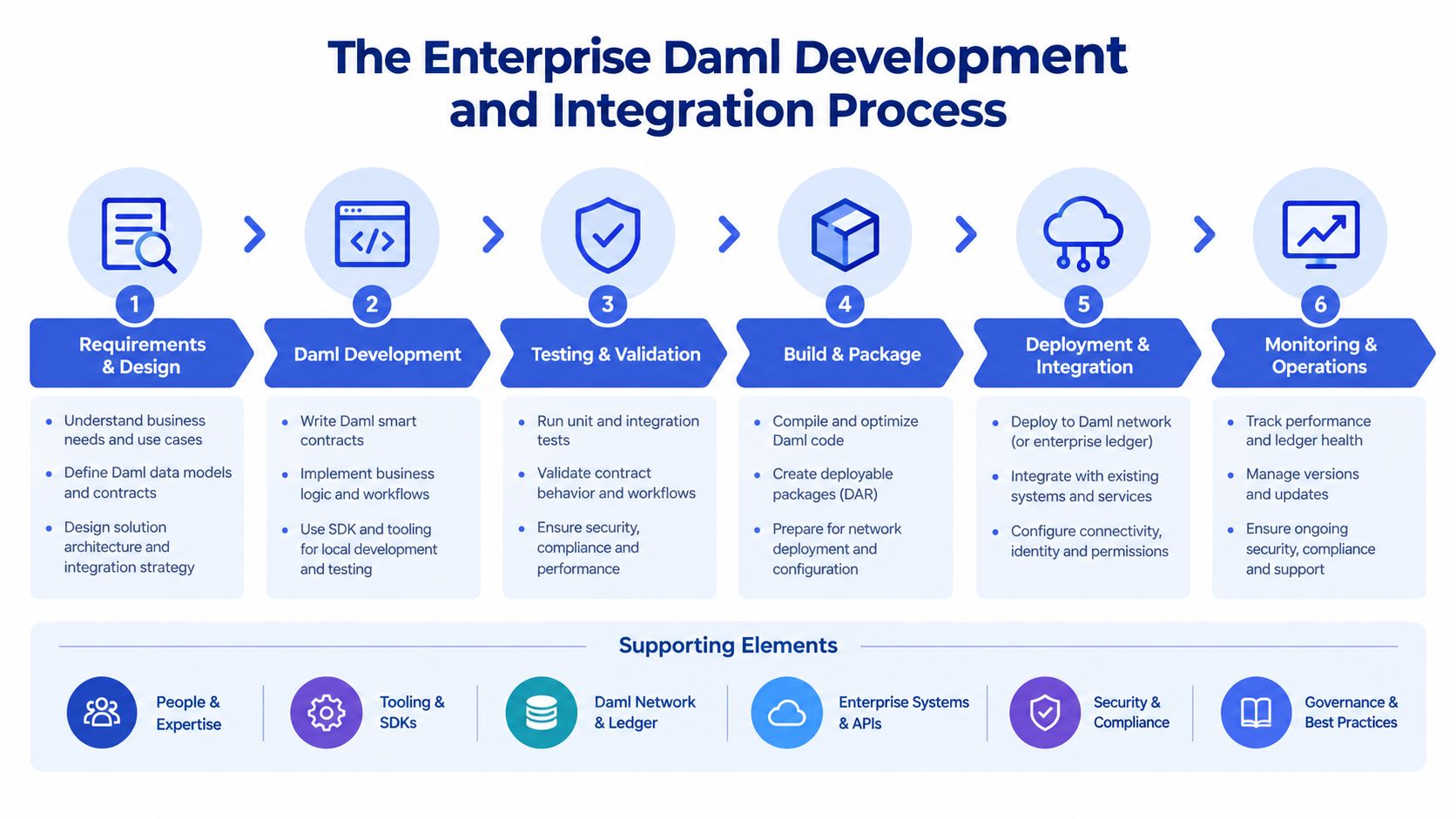
Daml application development fails when teams treat the ledger as the product. The product is the operating workflow around the ledger, including user interfaces, APIs, identity, controls, monitoring, data migration, and support procedures.
A production-oriented lifecycle
1. Discovery and workflow mapping. Document the current process from instruction through settlement and reconciliation. Identify every participant, system, approval, message, exception, and source of truth. The output should be a target operating model, not a vague blockchain use case.
2. Contract and data modelling. Translate legal and operational concepts into Daml templates, records, parties, choices, and lifecycle states. Decide which obligations are automated and which remain subject to human approval or external evidence.
3. Scenario testing. Use representative workflows to test successful settlement, rejection, expiry, duplicate instructions, conflicting actions, missing data, and unauthorised submissions. Daml Script and local ledger environments can help validate business scenarios before integration work begins.
4. Integration design. Connect the ledger application to core banking, custody, accounting, risk, identity, sanctions, tax, and reporting systems through suitable APIs and messaging patterns. The integration layer must handle retries, idempotency, reconciliation, and operational alerts.
5. Security and control review. Review party onboarding, key management, access administration, audit evidence, data retention, incident response, and segregation of duties. A contract audit alone won’t validate the entire application boundary.
6. Deployment and operations. Establish participant-node environments, release controls, observability, backup procedures, upgrade testing, support ownership, and change governance. Production readiness includes the runbook for a failed external dependency, not just a successful ledger transaction.
A tokenisation programme may need additional lifecycle decisions around issuance, transfer restrictions, redemption, and custody. The Daml and Canton tokenisation build guide is relevant to that architecture, but no template can resolve an unclear legal ownership model.
What to test before launch
Testing should cover both code and institutional behaviour:
- Authorisation tests: verify that each role can perform only its permitted choices.
- Visibility tests: confirm that each participant receives the intended transaction view.
- Concurrency tests: check competing instructions and stale contract references.
- Integration tests: validate duplicate messages, delayed responses, rejected downstream updates, and replay handling.
- Operational tests: rehearse key rotation, participant unavailability, incident escalation, and controlled release.
- Reconciliation tests: compare ledger events with accounting, custody, and reporting records.
Maintenance starts at go-live. Financial rules change, counterparties change, external systems evolve, and regulators request new evidence. A Daml smart contract development partner should therefore provide a change strategy that preserves historical interpretation while safely introducing new contract versions.
Evaluating a Daml Smart Contract Development Company
A bank shouldn’t select a Daml partner by asking only whether the team can write templates. The relevant question is whether the partner can turn a regulated, multi-party process into a controlled financial application and keep it supportable after deployment.
A generalist Web3 agency may be effective for a public token, wallet, or decentralised application. Its methods may not transfer to an institutional Daml project. A Daml smart contract development company should understand functional modelling, participant topology, Canton integration, financial operations, privacy analysis, and the governance required for production systems.
Compare partners against the actual risk
| Evaluation area | Weak evidence | Stronger evidence |
|---|---|---|
| Business modelling | Generic blockchain terminology | A precise mapping of legal roles, obligations, states, and exceptions |
| Daml capability | A basic demonstration contract | Scenario-tested templates with explicit signatory, observer, and controller design |
| Canton knowledge | Network familiarity without architecture | Clear explanation of participant nodes, application boundaries, synchronisation, and operational ownership |
| Privacy | “Permissioned” as the only answer | A documented information-flow model and participant-specific visibility tests |
| Integration | A ledger demo disconnected from bank systems | API, messaging, identity, reconciliation, and failure-handling design |
| Assurance | A promise of secure code | Test evidence, review gates, threat modelling, and a defined audit scope |
| Delivery model | Unclear handover | Source ownership, documentation, release process, monitoring, and support responsibilities |
Ask the vendor to model one difficult workflow during evaluation. Good candidates will ask about legal title, settlement finality, delegated authority, manual overrides, failed instructions, data retention, and regulatory access. They won’t rush to show a token transfer before understanding who is permitted to initiate and approve it.
The partner should also distinguish a proof of concept from a production service. A demonstration can omit identity integration, operational recovery, performance testing, monitoring, and records management. That isn’t necessarily a problem, provided the team states what remains and how it will be addressed.
Blockchain consulting partner selection guidance can help structure the commercial and technical assessment. Include legal, compliance, operations, security, architecture, and procurement stakeholders in the decision. A Daml project affects all of them.
Vendor test: Ask the team to explain what the application should refuse to do. Production expertise appears in rejected states, not just successful demos.
Commercially, clarify whether the engagement covers discovery, Daml programming, integration, testing, deployment, documentation, training, and ongoing development. The cheapest initial build may become expensive if the institution must later reconstruct the missing control and integration layers.
Strategic Insights for Daml Smart Contract Adoption
Daml adoption makes sense when the institution has a genuine multi-party coordination problem, not an interest in adding blockchain terminology to an existing database. The strongest candidates involve shared obligations, selective data access, recurring reconciliation, and a business benefit from atomic or controlled state transitions.
India’s adoption path offers a useful model for sequencing. The National Strategy on Blockchain records an IDRBT roadmap that moves from intrabank use, to interbank proofs of concept and testing, and then to central-level implementation, as described in the National Blockchain Strategy. That staged approach is more credible than starting with a broad network ambition before the institution can operate one workflow reliably.
Questions the steering committee should answer
Is a Daml contract legally sufficient by itself? No. The contract logic must align with the governing agreement, stamping requirements, electronic-record rules, asset law, and applicable regulatory obligations. Legal enforceability depends on the complete arrangement, not only the code.
Does privacy remove the need for compliance controls? No. Selective visibility reduces unnecessary disclosure, but the application still needs identity controls, transaction monitoring, reporting, retention, investigation workflows, and regulator access where required.
Should every business rule be automated? No. Automate deterministic rules with reliable inputs. Keep judgement-based approvals, disputed facts, and exceptional regulatory decisions under controlled human supervision.
Is Canton a replacement for core banking? Usually not. It should coordinate a defined multi-party workflow and exchange authoritative events with existing systems. The target architecture should make system boundaries explicit.
What should happen in the next 12 to 24 months? Institutions should prioritise a narrow production candidate, prove participant governance, establish integration patterns, and build a reusable control framework. Broader asset and network expansion should follow evidence from the first workflow rather than precede it.
For broader market context, Advisor Momentum fintech insights can complement a technical review with perspectives on how financial-service operating models are changing. The core decision remains architectural: choose Daml when privacy-aware contractual coordination is the problem, and choose a different approach when a public, permissionless or single-operator application is the better fit.
Blocsys Technologies offers Daml smart contract development, enterprise blockchain application engineering, tokenisation architecture, integration, and compliance-oriented workflow design for financial institutions. Discuss your settlement, asset servicing, digital-asset, or multi-party finance requirements with the team through Blocsys Technologies to define a practical discovery plan and production path.
