
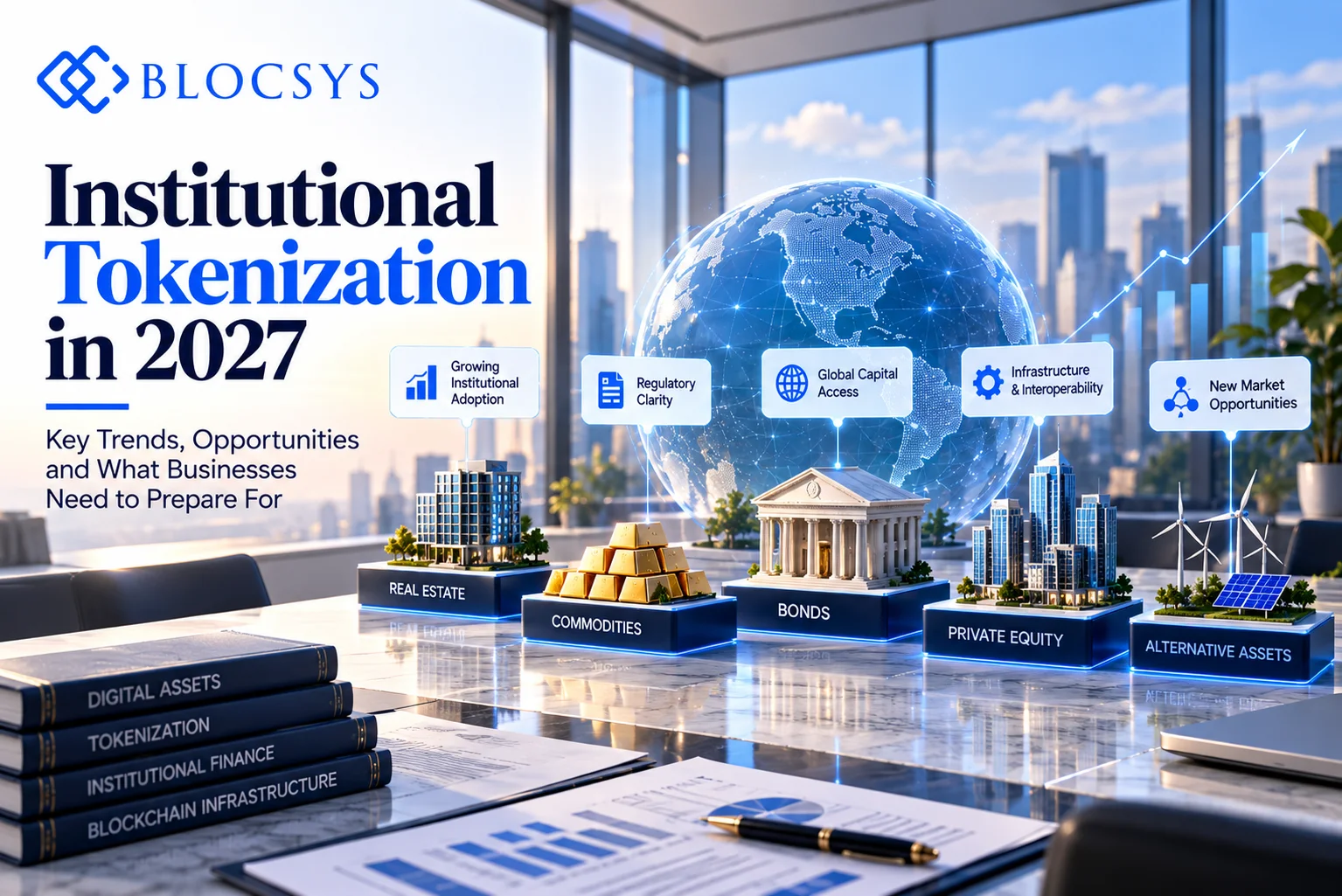
Institutional Tokenization in 2027: How Financial Markets Could Change
Walk into any capital markets technology conversation this year, and tokenization comes up within minutes. Banks, custodians, and asset managers across the US, UK, UAE, Germany, Canada, Australia, and Singapore are all asking the same question: what will institutional tokenization in 2027 actually look like in practice? The honest answer is that it depends. Tokenization may change how certain financial assets get issued, recorded, transferred, and serviced. However, the scale of that change will hinge on legal frameworks, custody arrangements, interoperability between systems, and whether enough institutions actually show up to trade. If you’re evaluating where institutional tokenization fits into your 2027 roadmap, real-world asset tokenization is a useful starting point for understanding what’s technically possible today versus what still needs market infrastructure to catch up.
What Institutional Tokenization Means for Financial Markets
Institutional tokenization refers to the use of blockchain-based digital tokens to represent financial assets such as securities, fund interests, bonds, or private credit positions, issued and managed within regulated or semi-regulated frameworks. That’s a different animal from retail crypto adoption. Nobody’s debating whether Bitcoin counts as a security here. Instead, institutions are asking how a token can represent a legally enforceable claim on an existing asset class.
Here’s the distinction that trips up a lot of newcomers: a token is not the asset itself. It’s a digital representation of rights tied to that asset. The legal agreement, the issuer’s obligations, and the investor’s ownership rights still live in traditional legal documentation, unless local law specifically recognizes the token as the authoritative record. Singapore’s Project Guardian and the Monetary Authority of Singapore’s broader digital asset initiatives have explored exactly this question — how to align distributed ledger records with enforceable legal title. The UK’s Financial Conduct Authority and the US Securities and Exchange Commission have likewise issued guidance distinguishing token mechanics from securities law obligations, though neither has created a universal tokenization rulebook.
Broader real-world asset tokenization, by contrast, often includes retail-facing platforms, collectibles, or less regulated asset classes. Institutional tokenization sits in a narrower lane: regulated securities, fund structures, and instruments where investor protection rules, custody requirements, and reporting obligations already apply.
Why Financial Institutions Are Exploring Tokenization
Most institutions aren’t chasing tokenization because it sounds innovative. They’re chasing it because their back offices are expensive and slow. Fragmented systems, manual reconciliation between custodians, and multi-day settlement cycles create real operational drag. A fund administrator might run five different reconciliation processes across transfer agents, custodians, and fund accountants for a single share class.
Tokenization, in theory, lets you represent ownership on a shared ledger that every authorized party can read. That could reduce reconciliation work and give asset servicers a common source of truth. Consequently, some institutions are piloting tokenized money market funds and tokenized repo arrangements specifically to test whether shared-ledger settlement actually cuts friction.
That said, not every problem needs a blockchain. If your reconciliation pain comes from poor data standards rather than siloed ledgers, tokenization won’t fix it. Legacy systems that already settle efficiently through established clearing arrangements may see little benefit from migrating to a token-based model. The honest evaluation starts with asking whether your bottleneck is a ledger problem or a process problem.
The institutions getting real value aren’t the ones tokenizing everything. They’re the ones that found one settlement bottleneck, proved the token model solved it, and only then scaled the approach to adjacent asset classes.
Financial Assets and Market Activities That Could Be Affected
Several asset classes have attracted genuine institutional pilots. Tokenized bonds are probably the most mature example — the European Investment Bank, HSBC, and UBS have issued blockchain-settled bonds in production, not just proofs of concept. Tokenized money market funds have seen production deployments too, with asset managers like BlackRock and Franklin Templeton running live tokenized fund share classes.
Private credit and fund interests are earlier-stage. Several platforms now tokenize limited partnership interests to streamline investor onboarding and secondary transfers, though transfer restrictions under fund documents still apply regardless of the token wrapper.
What won’t change automatically: eligibility, transferability, or liquidity. A tokenized private fund interest is still subject to the same investor qualification rules and lock-up terms as its paper equivalent. Tokenizing a corporate bond doesn’t make it instantly tradeable on every venue — distribution still depends on which investors and platforms are authorized to hold it. If you’re assessing corporate bond tokenization or an equity tokenization platform, treat the legal wrapper and the technical wrapper as two separate workstreams, because they are.
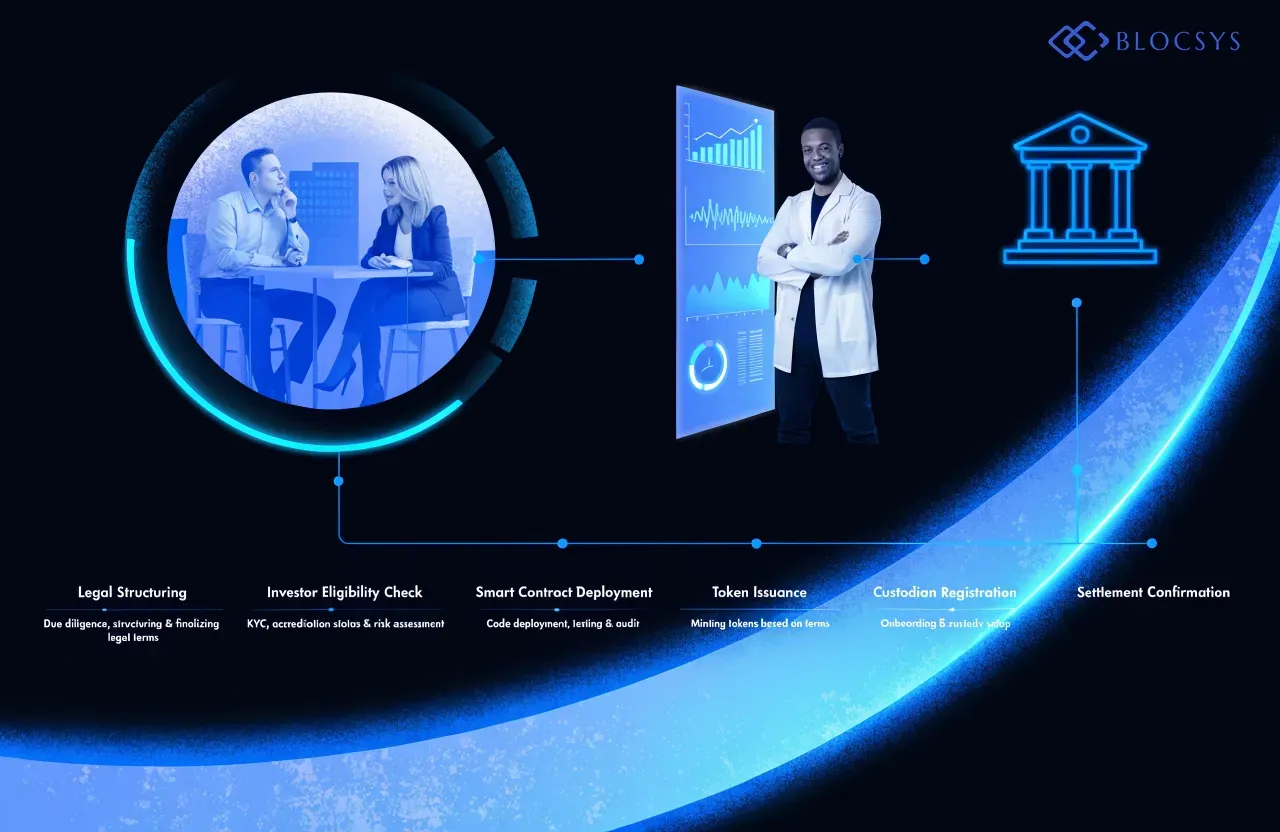
How Tokenization Could Change Financial Market Infrastructure
This is where the operational questions get interesting. Smart contracts can automate coupon payments, dividend distributions, and corporate actions that currently require manual processing across multiple intermediaries. Settlement, in principle, could move from T+1 or T+2 toward near-instant atomic settlement, since a token transfer and a payment leg can execute in the same transaction. The Reserve Bank of Australia’s wholesale CBDC pilot and the Swiss National Bank’s work with SDX have both tested exactly this kind of delivery-versus-payment automation at the wholesale level.
However, atomic settlement on a ledger only works if every counterparty connects to that ledger. If your custodian, your clearing agent, and your settlement bank all sit on different networks, you’ve recreated the fragmentation problem with extra steps. Interoperability between blockchain networks and between blockchain and legacy core banking systems remains unresolved for most institutions. Furthermore, custody arrangements need legal clarity on who holds the private keys, who bears liability for loss, and how that custody model satisfies existing safekeeping rules for regulated assets.
Demat registries also matter here. Markets that already run dematerialized securities, like India’s NSDL/CDSL framework, face a different integration question than markets still reliant on physical certificates. For institutions weighing how tokenized records might sit alongside or replace existing depository infrastructure, Demat 2.0 and CBDC integration approaches offer a relevant frame for thinking through that transition.
Opportunities for Financial Institutions in Institutional Tokenization in 2027
Where might the real business upside show up? Asset managers could design more granular fund structures, offering fractional exposure to vehicles that previously required large minimum tickets. Banks could offer new custody and servicing products built around digital asset infrastructure rather than bolting tokenization onto legacy platforms. Infrastructure providers — exchanges, central securities depositories, and clearing houses — have an opening to build tokenized settlement rails that complement, rather than replace, existing systems.
Transparency is another realistic gain. A shared ledger gives regulators and auditors a consistent record of ownership changes, which could simplify reporting for certain fund structures. That’s a meaningful efficiency story, even without touching liquidity or cost claims.
None of this guarantees lower costs, faster settlement for every instrument, or wider investor access. Those outcomes depend on adoption by counterparties, not just on deploying the technology. An issuer launching a tokenized note gets no liquidity benefit if no secondary venue exists to trade it. Treat these as plausible opportunities worth testing, not outcomes you can promise a board.

Challenges Slowing Institutional Tokenization Adoption
Regulatory fragmentation sits at the top of most risk committees’ lists. The UK, the EU under MiCA and DLT Pilot Regime, the UAE’s VARA framework, and US state-by-state money transmission rules all treat digital asset custody and tokenized securities differently. An issuer targeting UAE and German investors in the same offering needs separate legal analysis for each jurisdiction — there’s no shortcut around that.
Custody remains a genuine sticking point too. Regulated institutions need custody arrangements that satisfy capital adequacy and safekeeping rules, and not every digital asset custodian meets those bars yet.
Liquidity is probably the most misunderstood limitation. Tokenizing an asset doesn’t create buyers for it. Secondary markets for tokenized securities are thin in most jurisdictions, and cross-platform interoperability between tokenization venues is still limited. Add cybersecurity exposure, smart contract bugs, and the governance question of who can pause or reverse a faulty transaction, and you get a list of reasons institutions move carefully rather than quickly.
Coordination is the underlying theme across all of this. Issuers, custodians, investors, technology providers, and market infrastructure operators all need to agree on standards before tokenized markets reach meaningful depth. One bank moving fast doesn’t create a market; it creates an isolated pilot.
Regulatory, Security and Operational Considerations
Asset classification determines almost everything downstream. A tokenized instrument classified as a security triggers prospectus, disclosure, and investor protection obligations in most of Blocsys’s target markets, regardless of the technology used to issue it. Investor type matters too — qualified institutional buyers typically face different eligibility checks than retail participants, and tokenization platforms need to enforce those checks programmatically, not just assume compliance happens elsewhere.
Custody arrangements need separate legal sign-off from the technology vendor’s security claims. A platform’s multi-signature wallet architecture is a technical feature. Whether that architecture satisfies your jurisdiction’s safekeeping rules for client assets is a legal and regulatory determination, and your compliance team, not your technology provider, carries that responsibility. Recordkeeping obligations, transaction monitoring, and reporting to regulators like the SEC, the FCA, or ASIC still apply on top of whatever the smart contract logs natively.
Governance questions deserve equal attention. Who can upgrade the smart contract? Who holds admin keys? What happens if a transfer needs reversing under a court order? These aren’t hypothetical edge cases — they’re the questions regulators ask first.
How Institutions Can Prepare for Institutional Tokenization in 2027
Start with the business case, not the technology. What specific operational problem are you trying to solve — slow settlement, manual reconciliation, limited distribution reach? Validate that tokenization actually addresses that problem before committing budget to a platform build.
From there, a practical readiness framework covers a few core areas:
- Asset suitability: confirm the instrument’s legal structure permits a digital representation under applicable securities law.
- Legal and regulatory assessment: map jurisdiction-specific obligations for issuance, custody, and investor eligibility before building anything.
- Technology architecture: decide whether a permissioned or public-adjacent network fits your compliance and interoperability needs.
- Custody and security: select custody providers that meet your regulator’s safekeeping standards, not just technical best-in-class claims.
- Integration: plan how the token ledger connects to existing core banking, fund administration, and reporting systems.
- Governance: define who controls contract upgrades, key management, and incident response.
- Success criteria: set measurable targets — reconciliation time saved, settlement cycle reduction, onboarding speed — before launch, so the pilot has a real verdict.
Institutions evaluating a build-versus-partner decision should also look at whether an asset tokenization platform already handles the compliance and custody integration work, versus building that layer internally. For teams without in-house blockchain engineering depth, working with real-world asset tokenization developers can shorten the path from pilot to a defensible production system.
Conclusion: What Institutional Tokenization in 2027 Could Mean for Financial Markets
Institutional tokenization in 2027 won’t rewrite financial markets overnight, and it won’t look the same across every jurisdiction or asset class. What’s realistic is incremental change: tokenized bonds and funds expanding from pilots into steady production use, settlement automation improving for instruments where counterparties already share compatible infrastructure, and servicing workflows getting less manual where ledgers genuinely replace reconciliation work. What’s still uncertain is liquidity depth, cross-platform interoperability, and whether regulatory frameworks converge enough to support cross-border tokenized offerings at scale.
Institutions that succeed with institutional tokenization in 2027 will likely be the ones that picked a narrow, well-defined problem, tested it against real legal and custody constraints, and resisted the urge to tokenize everything at once. If you’re mapping out where your institution fits into that shift, real-world asset tokenization solutions built for regulated financial instruments are a reasonable place to validate your first use case before committing to a broader rollout.
Frequently Asked Questions
Here are direct answers to the questions we hear most often about institutional tokenization in 2027.
What is institutional tokenization?
Institutional tokenization is the use of blockchain-based tokens to represent regulated financial assets, such as securities, bonds, or fund interests, within legal and compliance frameworks that institutions already operate under. It differs from general crypto adoption by staying tied to existing securities regulation.
How could institutional tokenization change financial markets in 2027?
It could change how certain assets are issued, recorded, and serviced, with faster settlement and less manual reconciliation in cases where counterparties share compatible systems. The scale of change depends on regulatory alignment, custody readiness, and actual market participation.
Which financial assets can be tokenized for institutional use?
Bonds, money market funds, private credit, and certain equity and fund interests have seen institutional tokenization activity. Eligibility still depends on the asset’s legal structure, jurisdiction, and whether existing transfer restrictions allow a digital wrapper.
How can tokenization affect securities issuance and settlement?
Smart contracts can automate issuance steps and corporate actions, and some platforms support near-instant settlement when payment and token transfer execute together. However, this only works where custodians, clearing agents, and issuers connect to compatible infrastructure.
What benefits can financial institutions gain from tokenization?
Possible benefits include reduced reconciliation work, more transparent ownership records, and new product structures like fractional fund exposure. These are realistic opportunities under the right conditions, not guaranteed outcomes for every institution.
Does tokenization automatically improve liquidity in financial markets?
No. Tokenizing an asset doesn’t create buyers or secondary trading venues for it. Liquidity depends on investor demand, market participation, and interoperable trading infrastructure, none of which tokenization alone supplies.
What regulatory challenges affect institutional tokenization?
Regulatory treatment varies by jurisdiction, asset class, and investor type. The UK, EU, UAE, and US each apply different rules to custody, securities classification, and investor eligibility, requiring separate legal analysis for cross-border offerings.
How do custody and security work with tokenized financial assets?
Custody still requires arrangements that satisfy regulatory safekeeping standards, separate from any technical security features a platform offers. Institutions remain responsible for confirming custody meets their jurisdiction’s rules for client assets.
What prevents financial institutions from adopting tokenization at scale?
Thin liquidity, limited interoperability between platforms, unresolved custody questions, and regulatory fragmentation all slow adoption. Scaling also requires coordination among issuers, custodians, and investors, not just one institution’s technology decision.
How can financial institutions prepare for institutional tokenization in 2027?
Start by validating a specific operational problem tokenization could solve, then assess legal classification, custody options, system integration, and governance before building. Set measurable success criteria so a pilot produces a clear answer, not just a demo.
Ready to move beyond theory and build an intelligent platform that delivers real-world value? Blocsys Technologies specialises in engineering enterprise-grade AI and blockchain solutions for the fintech, Web3, and digital asset sectors. Connect with our experts today to discuss your vision and chart a clear path from concept to a secure, scalable reality.
