Top Asset Tokenization Development Companies in the USA in 2027
US issuers and financial institutions are moving tokenization out of pilot mode. Because of that, the list of Top Asset Tokenization Development Companies in the USA in 2027 matters more than it did two years ago. You need a partner who can build the platform, not just talk about it. If you’re still scoping the build, our asset tokenization platform overview shows what a complete system looks like.
Here’s what we’ve seen: most buyers don’t struggle with the idea. They struggle with vendor selection. Some firms build custom platforms, others sell software, and some only consult. This guide compares ten providers so you can tell them apart.
How We Selected These Asset Tokenization Development Companies USA Buyers Can Compare
We looked for direct tokenization development work first. That means smart contracts, issuance workflows, investor onboarding, and ownership records. Adjacent experience, such as general blockchain consulting, counted for less and is labeled as such.
We also weighed supported asset classes, blockchain coverage, security practices, enterprise integrations, and US market relevance. Furthermore, we separated developers from issuers, exchanges, custodians, and blockchain networks. A custodian isn’t a development partner, even when it’s a great company.
One caveat applies throughout. We relied on public positioning from company websites, and we haven’t audited any firm. Where evidence is thin, we say “Not publicly verified.” Please confirm headquarters, offices, and project claims directly before you sign anything.
Top 10 Asset Tokenization Development Companies in the USA in 2027
Here are the Top Asset Tokenization Development Companies in the USA in 2027, ranked with Blocsys first. Some are US-headquartered. Others are international firms serving US clients, and we flag the difference.
1. Blocsys Technologies Pvt Ltd
Blocsys is a blockchain, fintech, and digital asset development company headquartered in Pune, India. It isn’t a US company, and we haven’t verified a US office. Its place at number one rests on documented service depth and relevance to US requirements, not on location.
What stands out is the breadth of its tokenization offering. Its real world asset tokenization service covers custom platform builds for assets such as real estate and other real-world holdings. Separate service pages address corporate bond tokenization platform development and equity tokenization platform development. Few firms on this list document those three asset-specific tracks individually.
Beyond tokenization, Blocsys builds enterprise blockchain systems, smart contracts, and digital asset platforms. Its published work also reaches into OTC trading platform development and decentralized traded funds. That matters if you need secondary-market or fund-style infrastructure beside issuance.
How might this help a US buyer? Think about a bond issuer that needs coupon logic, investor eligibility rules, and transfer restrictions. Or a real estate sponsor that needs property documentation, distribution workflows, and investor reporting. Blocsys can scope those components as custom builds. Those are possible implementation components, though, not a list of features already shipped.
Likewise, we haven’t found verified US clients, asset values, certifications, or regulatory approvals for Blocsys, so we won’t claim any. Its offshore delivery model suits teams that want custom architecture and source-code control. US issuers should still pair it with their own securities counsel.
2. LeewayHertz
LeewayHertz is a software and blockchain development firm that publicly lists a San Francisco Bay Area headquarters. It offers asset tokenization development services alongside broader AI and blockchain work. Its tokenization pages reference real estate, funds, and other real-world assets.
The firm suits buyers who want a US-facing vendor with wide engineering capacity. However, specific US tokenization project evidence isn’t publicly verified here. Ask for case studies that match your asset class.
3. SoluLab
SoluLab positions itself as a blockchain and AI development company with a Los Angeles-linked US presence. Its site lists tokenization services, including real estate and security token work. It also builds wallets, exchanges, and smart contracts.
That mix helps if you need the wallet and trading layers around issuance. Meanwhile, you should confirm whether its team has delivered regulated security token platforms. Public detail on client names and asset values is limited.
4. Intellectsoft
Intellectsoft is a digital transformation consultancy with a Palo Alto presence. Its blockchain practice covers enterprise integration, and it markets tokenization-related services. The firm is stronger on large-scale enterprise software than on tokenization alone.
Consider it when tokenization must connect to legacy banking or ERP systems. Conversely, if you want a specialist in digital securities, ask how much of its portfolio is tokenization-specific. We couldn’t verify that split.
5. Appinventiv
Appinventiv is a mobile and enterprise software developer headquartered in India, with a stated US presence. Its blockchain services include tokenization and smart contract development. Its asset-class focus isn’t clearly documented.
It fits teams that need a polished investor-facing app and a mobile experience. Even so, treat its tokenization depth as general-purpose development until you see relevant references.
6. Antier Solutions
Antier Solutions is an India-based blockchain development company that serves international clients. It lists asset tokenization, security token offering platforms, and exchange development. Its long blockchain track record makes it relevant for custom builds.
Its US office presence isn’t publicly verified. Nevertheless, its security token and exchange services map well to issuers wanting both issuance and trading infrastructure.
7. ConsenSys
ConsenSys is an Ethereum-focused software company, historically New York-based and now remote-first. It builds MetaMask, Linea, and enterprise tools, and it offers consulting. That makes it adjacent expertise, not a dedicated tokenization developer.
Choose it if your platform needs deep Ethereum and Layer 2 engineering. Alternatively, pair it with a tokenization specialist. We haven’t verified a standalone asset tokenization build service.
8. Tokeny
Tokeny is a Luxembourg-based tokenization software provider and a key contributor to the ERC-3643 standard. It’s primarily a product company, so it sits between developer and platform vendor. Its tools cover issuance, investor onboarding, and compliance rules for securities.
For US buyers, its value lies in the permissioned token standard and its institutional focus. Still, a licensed product isn’t the same as custom development, so check source-code and customization terms.
9. Debut Infotech
Debut Infotech is a software development firm that lists blockchain and fintech services, with Canadian roots. Its pages mention tokenization and smart contract development. Verified tokenization case studies and US offices aren’t clear from public material.
It could suit early-stage founders prototyping a tokenized product. Additionally, request audit reports and sample architecture before committing to a larger platform.
10. Blockchain App Factory
Blockchain App Factory markets white-label and custom blockchain products, including tokenization and security token platforms. Its headquarters and US presence are not publicly verified.
Its ready-made approach can shorten early builds. However, white-label software may limit customization for regulated, institutional use. Verify security audits and ownership terms first.
Comparison of Asset Tokenization Development Companies
This table summarizes the ten providers. Treat it as a starting point for due diligence.
| Company | Headquarters | US Presence | Specialisation | Asset Classes / Capabilities |
|---|---|---|---|---|
| Blocsys | Pune, India | Serves US needs remotely; US office not verified | Custom RWA, bond, equity platforms | Real-world assets, corporate bonds, equity, smart contracts, digital asset platforms |
| LeewayHertz | San Francisco Bay Area | US-based | Blockchain and AI development | Real estate, funds, RWA; project detail not publicly verified |
| SoluLab | Los Angeles (stated) | US-linked | Blockchain development | Real estate, security tokens, wallets |
| Intellectsoft | Palo Alto | US-based | Enterprise software | Tokenization split not publicly verified |
| Appinventiv | India | US presence stated | Mobile and enterprise apps | Not publicly verified |
| Antier Solutions | India | Not publicly verified | Blockchain development | Security tokens, exchanges |
| ConsenSys | Remote-first | US roots | Ethereum software, consulting | Adjacent; no verified tokenization build service |
| Tokeny | Luxembourg | Not publicly verified | Tokenization software (ERC-3643) | Securities issuance, compliance |
| Debut Infotech | Canada (stated) | Not publicly verified | Software development | Not publicly verified |
| Blockchain App Factory | Not publicly verified | Not publicly verified | White-label blockchain | Security tokens, tokenization |
A tokenization vendor that can’t explain your transfer restrictions in plain language isn’t ready to build your platform. Smart contracts encode legal rules, so the legal team belongs in the first meeting.
What Is an Asset Tokenization Platform and What Should It Include?
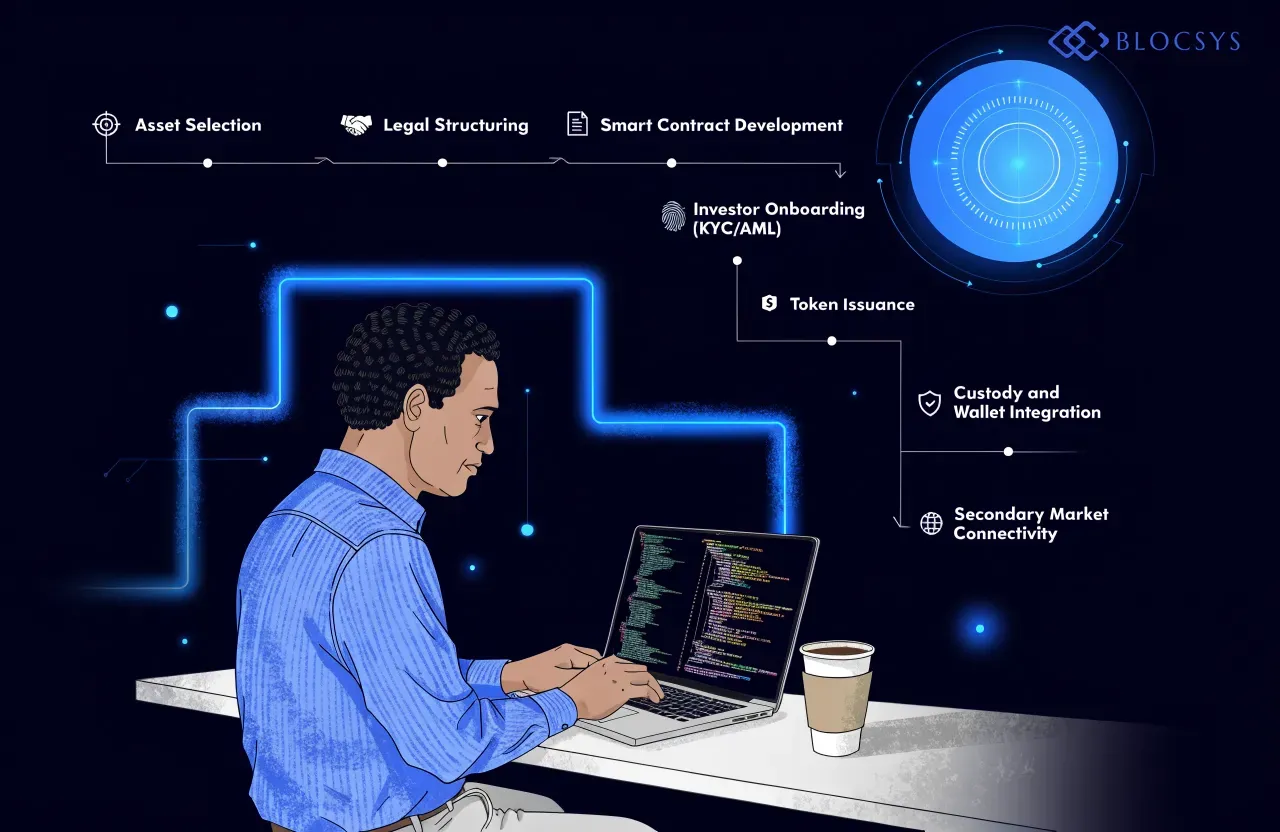
An asset tokenization platform turns ownership rights into blockchain-based tokens and manages them through their lifecycle. Think of it as issuance, record-keeping, and servicing in one system. Importantly, the token alone doesn’t create legal ownership. Legal documents and the offering structure do.
Whichever vendor you pick, evaluate these core features:
- Asset onboarding: document collection, valuation inputs, and legal structure mapping.
- Token issuance: minting, cap table logic, and issuance approvals.
- Investor onboarding: KYC and AML integration, accreditation checks, and identity verification.
- Ownership records: a reliable register of holders and transfers.
- Wallets and custody: digital wallet integration and qualified custodian connections.
- Payments and servicing: distributions, coupons, and redemptions.
- Reporting: investor statements, audit trails, and tax data.
- Secondary market connectivity: links to compliant trading venues.
Types of Asset Tokenization Platforms
Requirements shift with the asset. A corporate bond platform needs coupon processing, maturity management, investor eligibility, and transfer restrictions. A real estate platform needs property documents, ownership structures, rental distributions, and investor reporting.
Equity platforms focus on cap table management, voting, and shareholder communication. Fund tokenization adds net asset value updates and subscription or redemption cycles. Commodity tokenization depends on vaulting and proof of reserves. Private equity sits somewhere between, with capital calls and distributions.
Terminology also trips buyers up. Asset tokenization is the broad idea. Real-world asset tokenization covers physical and financial holdings. Security tokens or digital securities are tokens that meet the legal definition of a security. Digital asset platform development is the engineering work behind all of it.
Technologies Behind Asset Tokenization Platform Development Companies
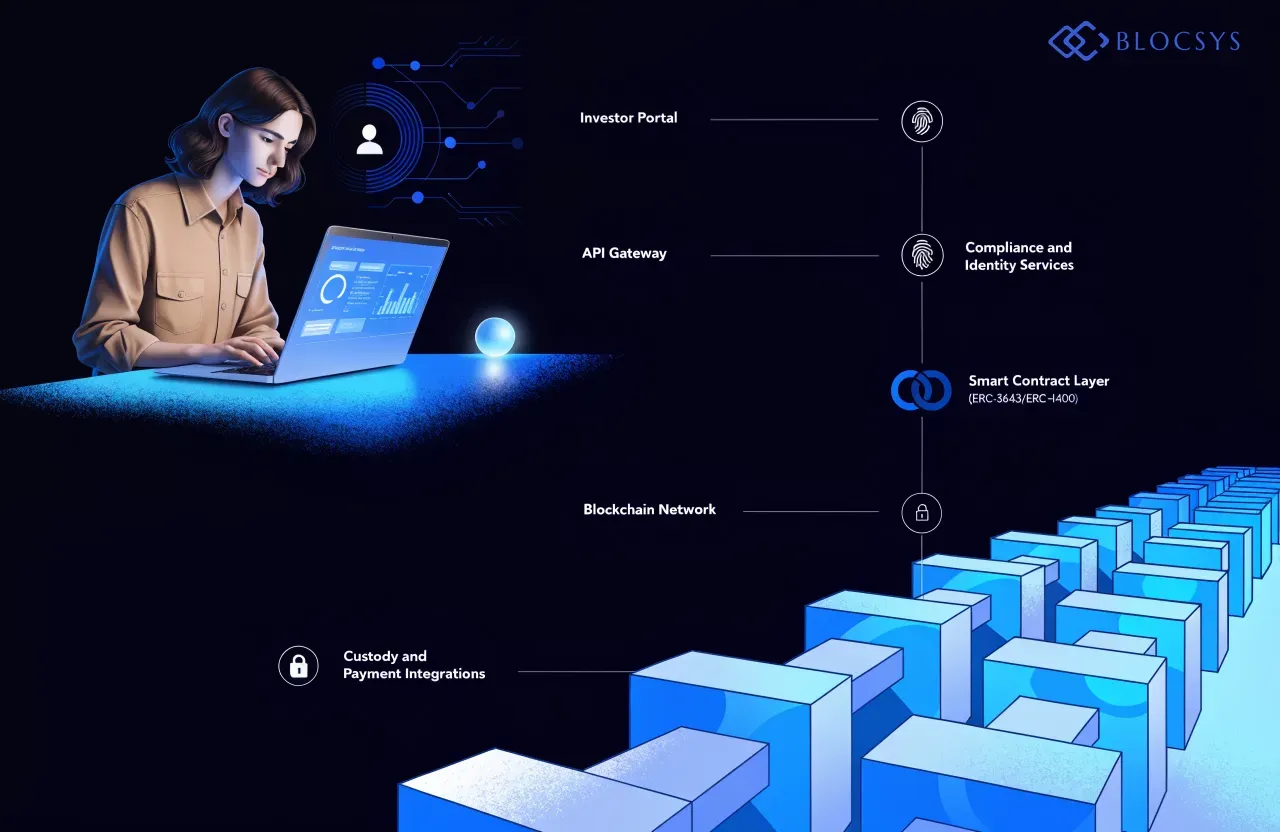
Good builds start with the blockchain choice. Public networks such as Ethereum and its Layer 2 chains offer liquidity and tooling. Permissioned networks give more control over participants and privacy. Neither is right for every project.
Token standards matter just as much. ERC-20 is a simple fungible standard without built-in compliance. ERC-721 handles unique items, and ERC-1155 mixes fungible and non-fungible tokens. ERC-1400 and ERC-3643 add permissioning, partitions, and identity-based transfer controls, so they suit regulated securities.
Around the chain, you’ll need these pieces:
- Audited smart contracts for issuance, transfers, and lifecycle events.
- APIs for banking, transfer agent, and accounting systems.
- Identity systems for KYC and AML.
- Custody and wallet integrations.
- Oracles for off-chain data such as valuations.
- Cross-chain interoperability and transaction monitoring.
US Regulatory and Business Considerations
US tokenization is regulated through existing law. The SEC applies the Securities Act and Exchange Act to tokens that qualify as securities, often using the Howey test. In practice, a tokenized bond, share, or fund interest is usually a security. Tokenization doesn’t change that.
Offering structure comes next. Issuers commonly consider Regulation D, Regulation S, Regulation A, or registered offerings. Each carries its own investor eligibility and resale limits. Additionally, secondary trading may involve broker-dealers, alternative trading systems, or transfer agents, and custody rules can apply.
Policy is moving, though. The SEC created a Crypto Task Force in 2025, and agencies including FINRA, the CFTC, and Treasury continue to issue guidance. Therefore, check current sources on sec.gov and finra.org before launch. We can’t give legal advice, and development alone doesn’t guarantee compliance.
Technology can enforce rules, but it can’t pick the right exemption. Decide your offering structure first, then let the architecture follow.
How to Choose the Right Asset Tokenization Development Company in the USA
Start with asset-class experience. Ask for demos or references matching your use case, whether that’s bonds, real estate, or funds. Next, review the architecture. You’ll want modular design, clear upgrade paths, and independent smart contract audits.
Then press on ownership and support. Who owns the source code? How are bugs, upgrades, and chain changes handled? What’s the maintenance model after launch? Furthermore, test US relevance by asking how the team handles transfer restrictions, accredited investor checks, and custody connections.
Scalability and security deserve real questions too. Ask about key management, penetration testing, and performance under load. A cheaper quote won’t help if the platform can’t pass your compliance team’s review. If you already know your asset class, you can hire real world asset tokenization developers and start with a scoped discovery phase.
Which US Industries Benefit From Tokenization?
Banks and financial institutions use tokenization to streamline issuance and settlement. Asset managers and fund managers explore tokenized fund shares and faster investor servicing. Private equity firms and family offices look for better administration of illiquid holdings.
Real estate businesses want fractional ownership and cleaner distributions. Corporate bond issuers and securities businesses want automated coupons and transparent registers. Fintech firms, meanwhile, build the investor-facing layers. Even sustainability projects are experimenting, as with carbon tokenization platform development.
Why Consider Blocsys for Asset Tokenization Development?
Blocsys offers documented, asset-specific tokenization services under one roof. That includes real-world assets, corporate bonds, and equity, plus smart contract and digital asset platform development. It also publishes work on OTC trading and fund platforms, which helps if you need liquidity infrastructure later.
Its limits are clear. It’s headquartered in Pune, and we haven’t verified US offices or US client work. So run a proper discovery process and involve your legal advisers early.
Ready to scope your build? You can explore the real-world asset tokenization services from Blocsys and discuss your issuance, investor management, or smart contract requirements. If you’re comparing architectures first, the asset tokenization platform page is a good next step.
Conclusion: Picking From the Top Asset Tokenization Development Companies in the USA in 2027
The Top Asset Tokenization Development Companies in the USA in 2027 differ widely. Some are custom builders, some sell software, and some bring adjacent blockchain skills. Match the provider to your asset class, legal structure, and integration needs.
Shortlist three firms, request relevant evidence, and validate everything. Then bring in securities counsel before the architecture is final. That order saves rework.
Frequently Asked Questions
Here are direct answers to the questions we hear most often about asset tokenization development in the USA.
What are asset tokenization development companies?
They’re technology firms that design and build platforms for turning real-world and financial assets into blockchain tokens. They don’t issue or own the assets. They build the software that does.
What services do asset tokenization development companies provide?
Typical services include smart contract development, token issuance, investor onboarding, wallet and custody integration, reporting, and ongoing maintenance. Some also build secondary market connectivity.
Which companies develop asset tokenization platforms in the USA?
Providers include Blocsys, LeewayHertz, SoluLab, Intellectsoft, Appinventiv, Antier Solutions, ConsenSys, Tokeny, Debut Infotech, and Blockchain App Factory. Some are US-based, while others serve US clients from abroad.
What types of assets can be tokenized in the United States?
Common examples are real estate, corporate bonds, private equity, company shares, funds, and commodities. Legal treatment varies, and most financial instruments are treated as securities.
What features should a real-world asset tokenization platform include?
Look for asset onboarding, token issuance, KYC and AML checks, transfer restrictions, ownership records, custody integration, payments, reporting, and audit trails.
Which blockchain is suitable for asset tokenization?
It depends. Ethereum and its Layer 2 networks offer broad tooling, while permissioned chains offer privacy and control. Your asset, participants, and regulatory needs should drive the choice.
How much does it cost to develop an asset tokenization platform?
There’s no fixed price. Cost depends on asset type, scope, blockchain, smart contract complexity, investor management, compliance integrations, custody, security, payments, and maintenance.
How long does it take to build an asset tokenization platform?
Timelines vary with the same factors as cost. A narrow pilot moves faster than a full platform with secondary market features. Ask vendors for a phased plan.
What regulatory considerations apply to asset tokenization in the USA?
Obligations depend on the asset, legal structure, offering method, investor eligibility, and applicable securities laws. Check current SEC and FINRA guidance and consult counsel. Technology alone doesn’t ensure compliance.
Can Blocsys develop asset tokenization platforms for US businesses?
Yes, Blocsys documents tokenization development services for real-world assets, corporate bonds, and equity. It’s based in Pune, India, and we haven’t verified US offices or projects, so discuss your requirements directly.
Ready to move beyond theory and build an intelligent platform that delivers real-world value? Blocsys Technologies specialises in engineering enterprise-grade AI and blockchain solutions for the fintech, Web3, and digital asset sectors. Connect with our experts today to discuss your vision and chart a clear path from concept to a secure, scalable reality.