Pre-IPO Equity Tokenization: Opportunities and Challenges for Growing Companies
Growth costs money. Indian companies that expand into new cities, build technology or acquire rivals often need fresh capital long before an IPO is realistic. Pre-IPO Equity Tokenization is one idea now being explored for that stage. It uses blockchain records to represent and administer eligible equity interests. However, it doesn’t replace company law, securities regulation or the IPO itself. If you’re weighing options, our work on equity tokenization platform development shows what the technology can and can’t do.
What Is Pre-IPO Equity and How Does It Work?
Pre-IPO equity means shares in a company that hasn’t yet listed on a stock exchange. Investors buy them through negotiated deals, not on an exchange screen.
Ownership usually sits with founders, promoters, early angels, venture capital funds and private equity firms. Employees may hold shares through stock option plans. Each group has different goals, and that matters later.
A typical deal involves a negotiated valuation, due diligence and a shareholders’ agreement. Transfer restrictions and investor eligibility conditions often apply too. Moreover, these shares aren’t equivalent to listed shares. Anyone can sell a listed share on an exchange in seconds, but a private-company share needs a willing, eligible buyer and the right approvals.
Why Do Growing Companies Seek Capital Before an IPO?
Many Indian companies stay private for years. They may not yet meet listing requirements, or the market window may not suit them. Meanwhile, the business keeps growing.
Take a hypothetical Pune-based logistics company. It needs ₹150 crore for warehouses, fleet technology and a small acquisition. An IPO is two or three years away. So it looks at private placements, private equity rounds or strategic investors.
These routes carry different considerations from a public offering. Disclosure is lighter, but investor choice is narrower. Furthermore, each round resets the valuation conversation, which shapes how the eventual IPO is perceived.
What Challenges Do Growing Companies Face in Traditional Pre-IPO Fundraising?
Finding eligible investors comes first. Most companies rely on a handful of relationships, bankers and advisers. Reach is limited.
Valuation is the next hurdle. Private company valuation has no daily market price, so founders and investors negotiate it. Disagreements can stall a round for months.
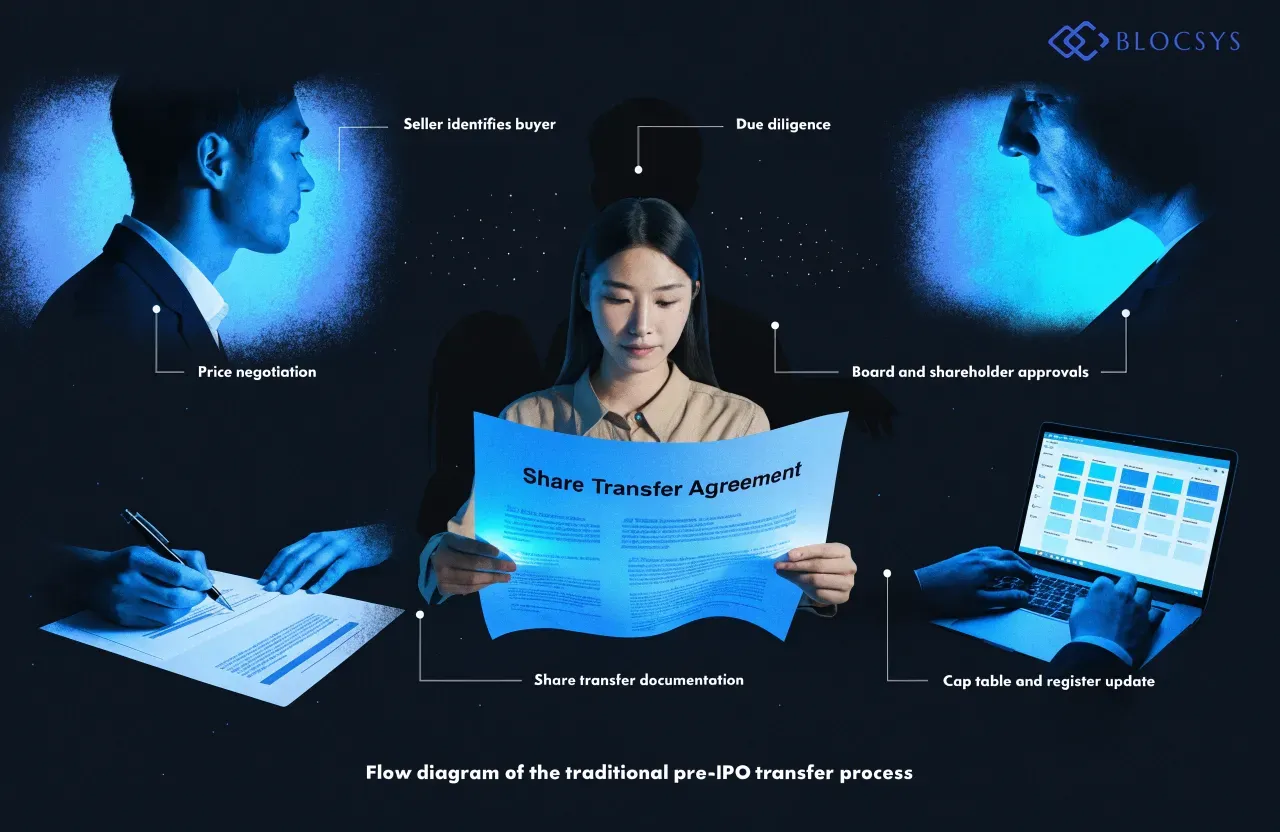
Then comes paperwork. Due diligence, agreements, board and shareholder approvals, and filings all take time. Dilution adds pressure as well. Founders must balance the capital they need against the control they’re willing to give up.
Administration also grows with every round. Equity ownership records, cap tables and investor information must stay accurate. Consequently, errors compound as the shareholder list lengthens. And a future IPO won’t fix any of this. It simply adds new requirements on top.
Most pre-IPO friction isn’t about money. It’s about trust, paperwork and who’s allowed to buy what. Technology helps only when those rules are already clear.
Why Do Existing Shareholders Face Liquidity Challenges Before an IPO?
Early investors and employees often hold shares for five to ten years. Life changes, funds reach the end of their terms, and some want to exit. Yet exits are hard.
Eligible buyers are few. Articles of association may restrict transfers, and the company may hold rights of first refusal. Valuation uncertainty makes sellers and buyers disagree on price. Approvals add delay.
Permitted secondary transactions and negotiated transfers do exist. Even so, they happen deal by deal. Tokenization can’t create buyers or guarantee liquidity. It can only organise parts of the process.
What Is Pre-IPO Equity Tokenization and How Does It Work?
Pre-IPO Equity Tokenization means creating blockchain-based tokens that represent specified rights or economic interests linked to eligible private-company equity. Think of it as a digital layer on top of existing shares.
The token isn’t the share. The legal share, recorded in the company’s statutory registers, remains the source of ownership. A token’s value depends on the legal structure behind it, such as a trust, a special purpose vehicle or direct recognition where the law allows it.
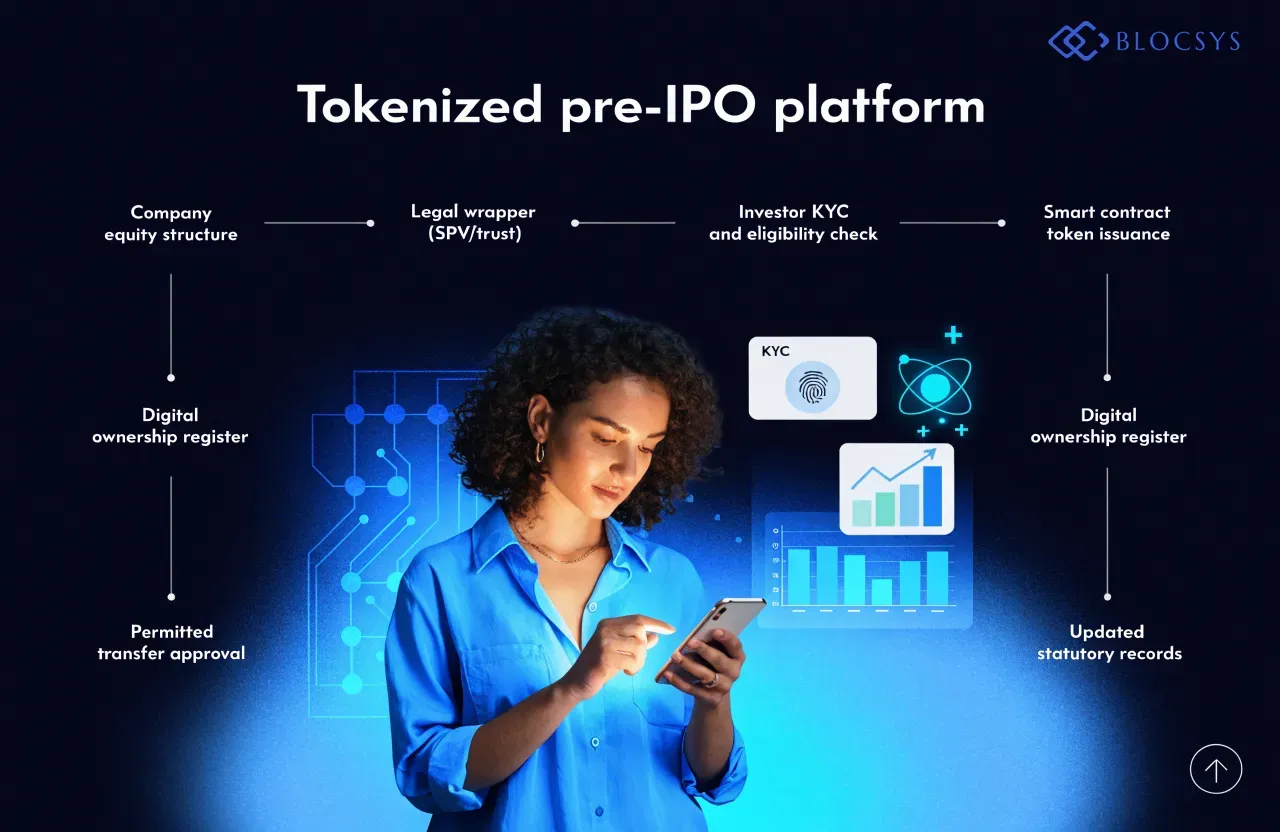
Here’s a hypothetical flow. A Bengaluru fintech approves a private placement to eligible investors. A platform verifies each investor’s identity and eligibility. Smart contracts then record token issuance and enforce agreed transfer conditions. Meanwhile, the company keeps its statutory records in step.
Three activities must stay separate. Primary issuance raises new capital and creates new shares. Digital representation mirrors shares that already exist. Secondary transfer moves existing holdings between holders without raising money for the company. Each affects the cap table, the company’s cash and the legal paperwork differently.
What Opportunities Could Pre-IPO Equity Tokenization Create for Growing Companies?
The honest answer is operational. Equity Tokenization for Growing Companies could make ownership administration more structured. It won’t make private shares public, and it won’t set a valuation.
Cleaner Ownership Records
A shared digital ledger gives founders, investors and administrators one consistent view of holdings and transaction history. For a company with dozens of investors across rounds, that reduces reconciliation work before an IPO’s due diligence begins.
Faster, Structured Investor Onboarding
Investor onboarding and KYC can sit inside the platform. Documents, eligibility checks and approvals follow one workflow. Therefore, a private equity firm joining a round faces fewer email chains and scattered PDFs.
Programmable Transfer Conditions
Smart contract-based transactions can encode rules such as lock-ins, rights of first refusal and eligible-buyer checks. The rules still come from legal agreements. The code only enforces them consistently.
Fractional Representation
Tokens can be divided into smaller units, which could lower minimum participation sizes in a properly structured, lawful offering. However, a smaller token unit doesn’t automatically create legally recognised fractional share ownership. The legal structure decides that.
Every one of these benefits maps to a real need: cleaner records, easier onboarding, and enforceable transfer rules. That’s the test to apply to any proposal. Does it solve a problem your company actually has?
How Could Tokenization Support Pre-IPO Fundraising and Investor Participation?
It could serve as a technology layer for a private offering. Token issuance records, investor lists and ownership updates would live in one system. That’s administration, not fundraising magic.
Indian rules still govern the offer. A private placement must follow Section 42 of the Companies Act, 2013 and related rules. Investor eligibility, company approvals and securities regulations don’t disappear because a token is involved. Nor does tokenization allow unrestricted public fundraising.
Participation could improve in practice. Eligible family offices, institutions and funds might reach a structured, well-documented opportunity more easily. Yet demand still depends on the company’s story and price.
How Could Tokenization Support Existing Shareholder Transfers and Pre-IPO Liquidity?
For secondary transactions, a platform could hold verified buyer and seller records, show transaction history and route approvals. Conditions could execute automatically once approvals arrive. As a result, a permitted transfer could take less coordination effort.
A more efficient process isn’t the same as liquidity. Real liquidity needs eligible buyers, agreed pricing, contractual permission and legal compliance. A faster pipe doesn’t add water.
For OTC-style workflows, our overview of OTC trading platform development explains how negotiated trades can be administered digitally.
Traditional Pre-IPO Equity vs Tokenized Pre-IPO Equity
Both approaches rest on the same legal foundations. Tokenization changes how information moves, not what the law requires.
| Aspect | Traditional pre-IPO equity | Tokenized pre-IPO equity |
|---|---|---|
| Ownership record | Statutory registers, cap tables | Digital ledger linked to statutory records |
| Onboarding | Manual documents and checks | Platform-based KYC and eligibility workflow |
| Transfers | Deal-by-deal paperwork | Rule-based workflow, still needing approvals |
| Liquidity | Limited, negotiated | Not automatically improved |
| Legal basis | Established and tested | Depends on structure; evolving |
Blockchain adds clarity and automation. Conventional corporate and legal infrastructure remains necessary. Neither approach is automatically safer or more valuable.
What Challenges and Risks Could Growing Companies Face with Pre-IPO Equity Tokenization?
Legal enforceability tops the list. If a token’s link to a share is unclear, investors may hold something courts won’t recognise as they expect. Regulatory clarity, shareholder approvals and transfer restrictions all need review.
Market risks persist too. Tokenized shares can stay illiquid, and valuation uncertainty doesn’t vanish. Additionally, thin demand can leave sellers stuck.
Technology brings its own risks. Smart contract bugs, cybersecurity gaps, custody arrangements, platform downtime and poor interoperability can all hurt investors. Therefore, companies take on new operational duties. Before adopting anything, assess legal, financial, operational and technology readiness together.
Regulatory and Compliance Considerations for Pre-IPO Equity Tokenization in India
Start with what exists. The Companies Act, 2013 governs share issuance and transfer. Section 42 and the Companies (Prospectus and Allotment of Securities) Rules cover private placements, including offer-letter and allotment procedures and limits on the number of persons offered securities. Private companies also face transfer restrictions under their articles.
Dematerialisation matters as well. Under the Depositories Act, 1996, NSDL and CDSL maintain electronic securities records. Rule 9B of the Prospectus and Allotment Rules requires unlisted public companies to issue securities in dematerialised form, and the Ministry of Corporate Affairs extended similar requirements to many private companies. Verify the current scope for your entity.
IPO rules differ from pre-listing rules. SEBI’s ICDR Regulations govern public issues, including pre-IPO placement conditions and lock-in requirements. They don’t govern ordinary private placements. Meanwhile, investment through funds falls under SEBI’s Alternative Investment Funds Regulations, 2012.
As far as we know, India has no dedicated approved framework that makes tokenized pre-IPO shares freely tradable. Regulatory treatment depends on the underlying instrument, issuer structure, investor category, transfer mechanism and token rights. Tokenization provides no exemption from securities laws. Please take legal advice before designing any model. This isn’t legal advice.
Regulators don’t regulate the technology. They regulate the instrument, the issuer and the investor. A token inherits those obligations.
Real-World Applications and Industry Developments in Pre-IPO and Private Equity Tokenization
Overseas experiments offer context, not proof for India. Tokenized private-market funds, such as feeder funds of private equity managers distributed through regulated digital-securities platforms, show that fund interests can be recorded on a blockchain. That’s a fund structure, not direct company equity.
Tokenized treasury funds from large asset managers prove institutions will use ledgers for regulated products. Again, that’s a different asset. Singapore’s Project Guardian, led by the Monetary Authority of Singapore, is an industry pilot exploring tokenized assets with regulated institutions.
In 2025, Robinhood offered tokens in the EU that gave exposure to some private companies. These were derivative-style instruments, and at least one company publicly said they weren’t its equity. Consequently, they illustrate why structure matters. None of these examples shows that Indian pre-IPO shares can be tokenized in the same way.
Technology Infrastructure Required for a Pre-IPO Equity Tokenization Platform
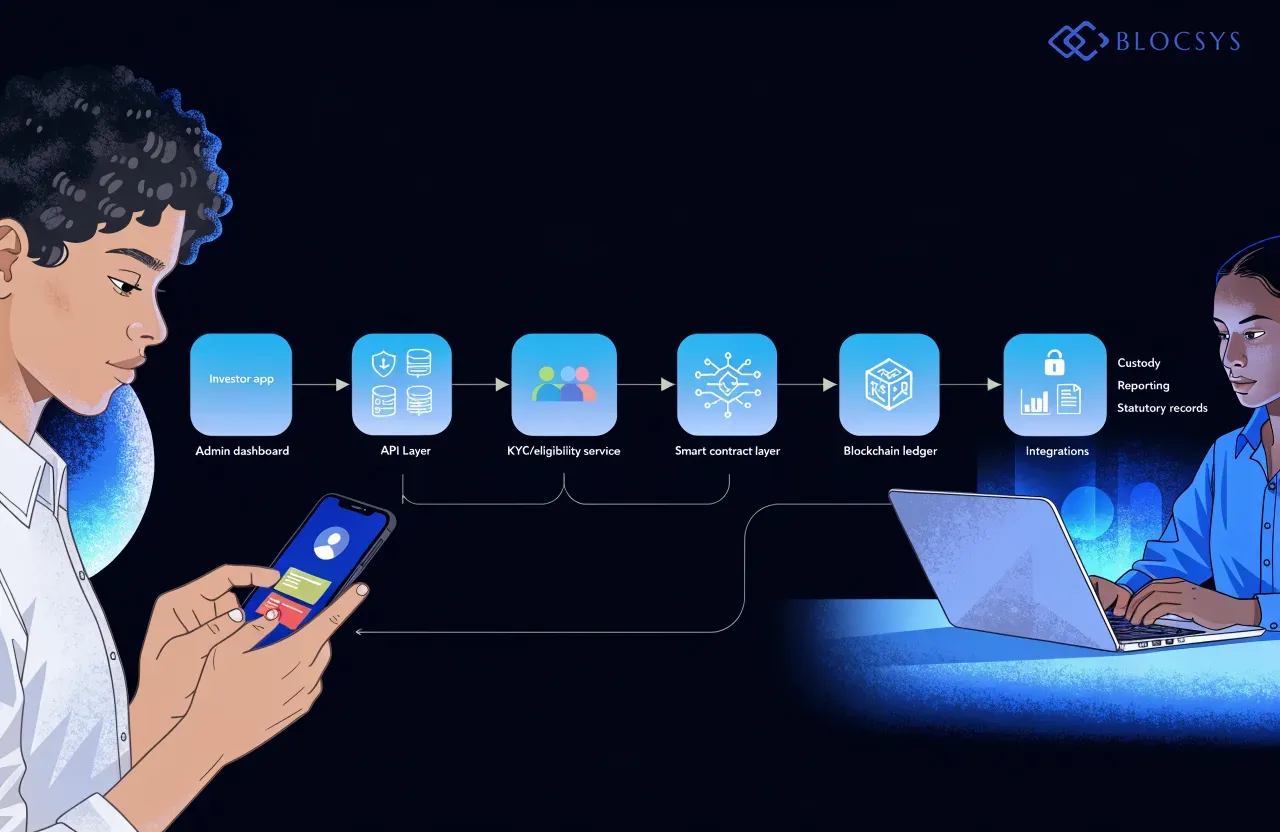
A serious platform has several layers. The blockchain layer, public, permissioned or hybrid, comes first. Smart contracts handle token issuance, transfer rules and ownership updates.
Around that sit identity verification, investor eligibility controls, a digital ownership register, transaction monitoring and reporting. Custody integrations and administrative dashboards complete the picture. Auditability, privacy, security and scalability must be designed in from the start.
Architecture varies with need. An equity issuance platform differs from a shareholder management system, and both differ from a broader digital securities ecosystem. Our work on asset tokenization platforms reflects that range. Choosing a blockchain doesn’t establish compliance. Legal design and controls do.
Pre-IPO Equity Tokenization Platform Development Services Offered by Blocsys
Blocsys is a technology development company. We build blockchain and digital asset platforms for businesses exploring tokenization. We’re not a law firm, broker, depository or exchange, and we don’t offer legal or regulatory services.
Our capabilities include custom blockchain development, smart contract development, token issuance infrastructure, investor-facing applications, backend systems, admin dashboards, API development and third-party integrations. For depository-linked thinking, see our perspective on Demat 2.0, tokenization and CBDC integration.
We plan architecture around your equity structure, intended users, business model, security needs and regulatory framework. Legal advisers define the framework, and we build to it.
Why Choose Blocsys for Pre-IPO Equity Tokenization Platform Development?
You need a partner who understands both blockchain engineering and business workflows. Blocsys works as a technology partner for growing companies and financial businesses. We build scalable, secure and business-oriented systems, covering smart contracts, backend services and web applications.
Moreover, we customise rather than force a template. Different equity structures, investor workflows and ownership requirements need different platforms. We don’t promise approvals, returns, liquidity or fixed timelines. We promise careful engineering around your requirements.
The Future of Pre-IPO Equity Tokenization for Growing Companies
Much depends on regulatory clarity, custody infrastructure, investor protection and interoperable platforms. If these mature, private markets could gain more organised ownership systems, onboarding processes and secondary-transfer infrastructure.
Growing companies, private equity firms, institutions, technology providers and regulators will all shape the outcome. Tokenization could complement existing capital-raising and ownership administration. It won’t replace IPO requirements. We can’t predict approvals, adoption, returns or liquidity, and anyone who does is guessing.
Conclusion: Are the Opportunities of Pre-IPO Equity Tokenization Worth Exploring?
Growing companies need capital, shareholders want exits and investors want access. Traditional processes handle all three, but slowly and with plenty of paperwork. Pre-IPO Equity Tokenization could support digital ownership representation, investor onboarding, equity administration and permitted transfers.
It’s an enabling technology, not a fundraising or liquidity solution. Success depends on sound legal structures, real investor demand, compliance and reliable engineering. Still, it’s a development worth watching in India’s private capital markets.
Exploring pre-IPO equity tokenization for your business? Connect with Blocsys to discuss your digital equity platform requirements, blockchain architecture and smart contract infrastructure. You can also review our equity tokenization platform development approach first.
Frequently Asked Questions
Here are direct answers to the questions we hear most often about Pre-IPO Equity Tokenization.
What is pre-IPO equity tokenization?
It’s the use of blockchain tokens to represent eligible rights or interests linked to private-company equity before listing. The token supports records and administration. The underlying legal share remains the source of ownership.
How does equity tokenization work for growing companies?
A company structures the offering legally, verifies investors, issues tokens through smart contracts and keeps digital and statutory records aligned. Transfer rules can be coded into the platform.
Can pre-IPO shares be tokenized in India?
We’re not aware of a dedicated approved framework for it. Any model must satisfy the Companies Act, SEBI rules and depository requirements. Take legal advice on your specific structure.
How could tokenization help companies raise capital before an IPO?
It could streamline investor onboarding, issuance records and ownership management in a lawful private placement. It doesn’t create investors or permit public fundraising.
Can tokenization improve liquidity for existing pre-IPO shareholders?
It may make permitted transfers easier to administer. However, liquidity still needs eligible buyers, agreed pricing and legal permission.
What is the difference between traditional pre-IPO equity and tokenized equity?
Traditional equity relies on registers and manual paperwork. Tokenized equity adds a digital ledger and rule-based workflows. Both remain subject to the same legal requirements.
Can tokenized pre-IPO shares be traded on secondary markets?
Not automatically. Transfers must comply with the articles, agreements and applicable law. Free public trading isn’t established for these instruments in India.
What are the major risks of pre-IPO equity tokenization?
Key risks include unclear legal enforceability, regulatory uncertainty, illiquidity, valuation uncertainty, smart contract flaws, cybersecurity threats and custody issues.
Does tokenization guarantee investor exits before an IPO?
No. An exit requires a willing, eligible buyer and a permitted transaction. Technology can’t guarantee either.
How can a company develop a pre-IPO equity tokenization platform?
Begin with legal structuring and requirement mapping. Then work with a technology partner like Blocsys to design architecture, smart contracts, onboarding and integrations, followed by security testing.
Ready to move beyond theory and build an intelligent platform that delivers real-world value? Blocsys Technologies specialises in engineering enterprise-grade AI and blockchain solutions for the fintech, Web3, and digital asset sectors. Connect with our experts today to discuss your vision and chart a clear path from concept to a secure, scalable reality.