Choosing a Blockchain Development Partner in India — A CTO’s Due Diligence Checklist
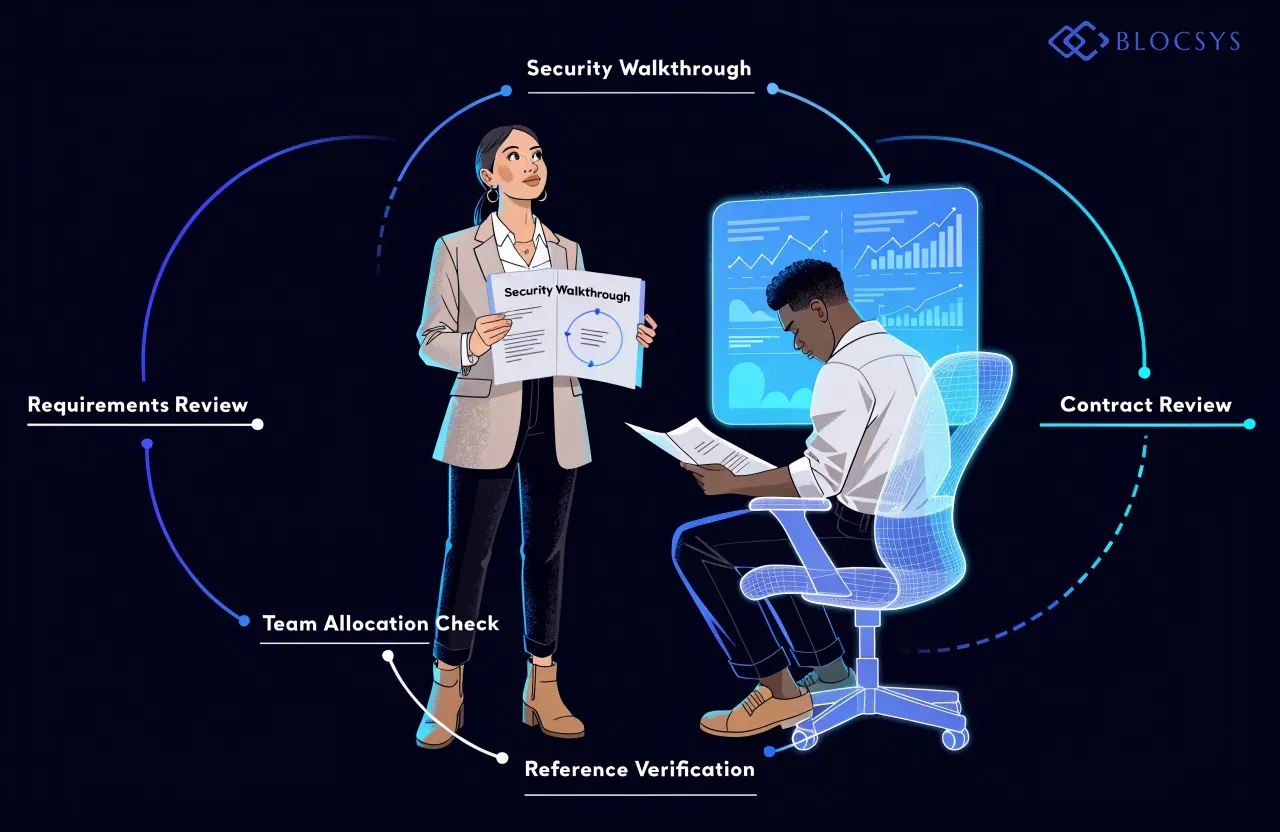
Picking a blockchain development partner in India isn’t a procurement exercise you can settle by comparing rate cards and portfolio screenshots. Blockchain vendor evaluation needs to go deeper — into architecture judgment, security discipline, delivery governance, and whether a team can actually support what it builds after launch. This article gives you a structured due diligence checklist you can run during shortlisting, technical interviews, and final contract review. You’ll learn what evidence to request, which questions expose real engineering depth, and how to score vendors consistently instead of relying on gut feel. We’ll also walk through how Blocsys approaches these same criteria, so you have a concrete reference point as you evaluate your own shortlist.
What Should CTOs Evaluate Before Choosing a Blockchain Development Partner?
Before you narrow a shortlist, define what actually matters. A rigorous blockchain vendor evaluation rests on six categories: technical expertise and architecture judgment, relevant production experience, security and testing discipline, team composition, delivery governance, and post-launch support. Each one maps to a specific business risk.
Architecture judgment determines whether your system scales and integrates cleanly later. Production experience tells you whether a vendor has shipped real systems, not demos. Security discipline protects you from costly exploits. Team composition tells you who’s actually writing your code. Delivery governance keeps timelines and budgets honest. Support determines whether the system survives past year one.
None of these categories work in isolation. A vendor with strong architecture skills but no testing discipline still exposes you to risk. That’s why blockchain vendor evaluation has to be structured, not a single impressive conversation.
A polished demo tells you a vendor can present. A production incident post-mortem tells you whether they can engineer. Ask for the second one before you ever ask for the first.
The CTO’s Blockchain Development Partner Due Diligence Checklist
Here’s the practical blockchain due diligence checklist we recommend running against every vendor on your shortlist, in order.
1. Verify Technical Expertise and Architecture Judgment
Strong vendors ask about your business requirements before naming a blockchain or framework. Weak ones lead with a technology recommendation. Watch for this early — it’s the clearest signal you’ll get in a first call.
Ask how they’d decide between a public, permissioned, or hybrid architecture for your use case. A credible answer references your transaction volume, privacy requirements, governance model, and who needs to verify transactions. It also separates on-chain logic (state changes, asset ownership, settlement) from off-chain components (user interfaces, analytics, document storage).
Example: if a vendor recommends a public blockchain for an internal settlement system handling regulated financial data, push back. Ask why public finality and open validator access fit your privacy and compliance requirements. If they can’t connect the choice to your specific constraints, that’s a gap worth noting, not necessarily a dealbreaker — but it’s a gap.
Smart contract design deserves the same scrutiny. Ask how they handle upgradability, access control, and interoperability with existing systems. A mature answer covers proxy patterns or migration strategies, not just “we’ll write the contract.”
2. Validate Relevant Project Experience
Logos and testimonials tell you who hired a vendor, not how well they performed. Ask instead for a specific technical walkthrough: what was the vendor’s exact role, what problem did the architecture solve, and what went wrong along the way.
A vendor confident in its work will explain a real technical challenge — a gas optimization problem, a data consistency issue between on-chain and off-chain systems, an integration failure — and how they fixed it. Vague answers like “we delivered on time and the client was happy” tell you nothing.
Ask who on the current team actually worked on the referenced project. Teams rotate; the person pitching you isn’t always the person who built the thing you’re being shown.
3. Examine Security and Testing Practices
Security has to be visible in process, not just promised in a sales deck. Ask about secure coding standards, peer code review requirements, and automated test coverage for smart contracts and backend logic. Ask how they threat-model a new feature before writing code.
For smart contracts specifically, ask about unit testing frameworks, static analysis tools, and how access control and upgrade paths are tested under adversarial conditions. The OWASP project publishes widely used guidance on secure development practices, and a credible partner should be able to map their process to recognized frameworks like it, rather than inventing their own vocabulary.
Here’s an important clarification: an external audit is one component of a security program, not a guarantee against vulnerabilities. If a vendor claims an audit means a system “can’t be hacked,” that’s a red flag in itself. Ask instead how they handle vulnerability remediation after an audit finds issues, and what deployment safeguards — multi-sig controls, timelocks, staged rollouts — they use regardless of audit outcomes.
4. Assess Team Composition and Senior Technical Involvement
You need to know, by name or role, who owns architecture decisions on your project. Ask for a staffing plan that breaks down smart contract engineers, backend developers, frontend engineers, QA, infrastructure, and security specialists against your actual scope.
Watch for mismatches. A tokenization platform with regulatory reporting needs backend and compliance-aware engineering, not just contract developers. A high-throughput consumer app needs infrastructure expertise that a two-person contract-focused team won’t have.
Ask directly whether senior engineers stay involved through delivery or hand off to juniors after the proposal stage. This is one of the most common gaps between pitch and execution.
5. Review Delivery Governance and Communication
A dependable partner makes delivery risk visible early, not at the deadline. Ask how milestones get defined, how acceptance criteria get written, and how progress gets reported — weekly demos, ticket-level tracking, sprint reviews.
Ask about their issue escalation path. Who do you contact when something slips, and how fast do they respond? Ask how code review works internally and whether you’ll get visibility into pull requests, not just status summaries.
Short version: if a vendor can’t describe their reporting cadence specifically, assume it doesn’t exist yet.
6. Confirm Intellectual Property, Repository Access, and Ownership
Source code ownership needs to be explicit in the contract, not assumed. Confirm you’ll get full repository access, admin-level permissions, deployment keys, and documentation — not just a final code drop at project end.
Ask about third-party dependencies and licensing terms attached to any libraries or frameworks used. Clarify handover obligations if you switch vendors later. Because these terms carry real legal weight, have qualified legal counsel review the IP and ownership clauses before signing.
7. Evaluate Scalability, Maintenance, and Post-Launch Support
Production readiness extends past launch day. Ask how the vendor handles monitoring, incident response, dependency upgrades, and ongoing technical support. Clarify response time commitments and what’s included versus billed separately.
A system that works at launch but has no defined maintenance path is a liability waiting to surface. Get support terms in writing before you sign, not after something breaks.
Questions CTOs Should Ask a Blockchain Development Partner
This table goes beyond the checklist — it gives you the follow-up questions that separate a confident, evidence-backed answer from a rehearsed one.
| Question to Ask | What a Strong Answer Should Demonstrate | Warning Sign |
|---|---|---|
| Why this blockchain architecture for our use case? | Direct link to your privacy, throughput, and governance requirements | Generic praise of one network’s popularity |
| How do you test smart contracts before deployment? | Specific tools, unit test coverage, adversarial test cases | “We review it carefully” with no named process |
| Who exactly will work on our project day to day? | Named roles, seniority, and availability commitments | Vague references to “our team” with no specifics |
| What happens if a milestone slips? | Defined escalation path and communication cadence | Reassurance without a documented process |
| Who owns the repository and deployment keys after launch? | Clear transfer terms written into the contract | Reluctance to commit to full access |
| What does post-launch support actually include? | Specific response times, scope, and cost structure | “We’ll take care of you” with no defined terms |
Red Flags to Watch for During Vendor Due Diligence
Certain patterns should slow you down, even if no single one disqualifies a vendor outright.
Recommending a stack before understanding requirements. Ask them to restate your business constraints back to you before accepting any architecture proposal.
Unrealistic delivery or security guarantees. Ask for the assumptions and dependencies behind any aggressive timeline or absolute security claim.
Vague prior-project explanations. Push for specific technical detail; if answers stay surface-level after two follow-ups, treat that as a signal.
Security treated as an afterthought. Ask when in the development lifecycle security review happens — it should be continuous, not a final-week checkbox.
Avoiding ownership and access discussions. Request explicit contract language on repository and credential handover before moving forward.
Estimates without defined scope. Ask for a written scope document with acceptance criteria tied to the quoted price.
No clear maintenance plan. Ask what happens operationally in month three after launch, not just at go-live.
How to Score and Compare Blockchain Development Partners
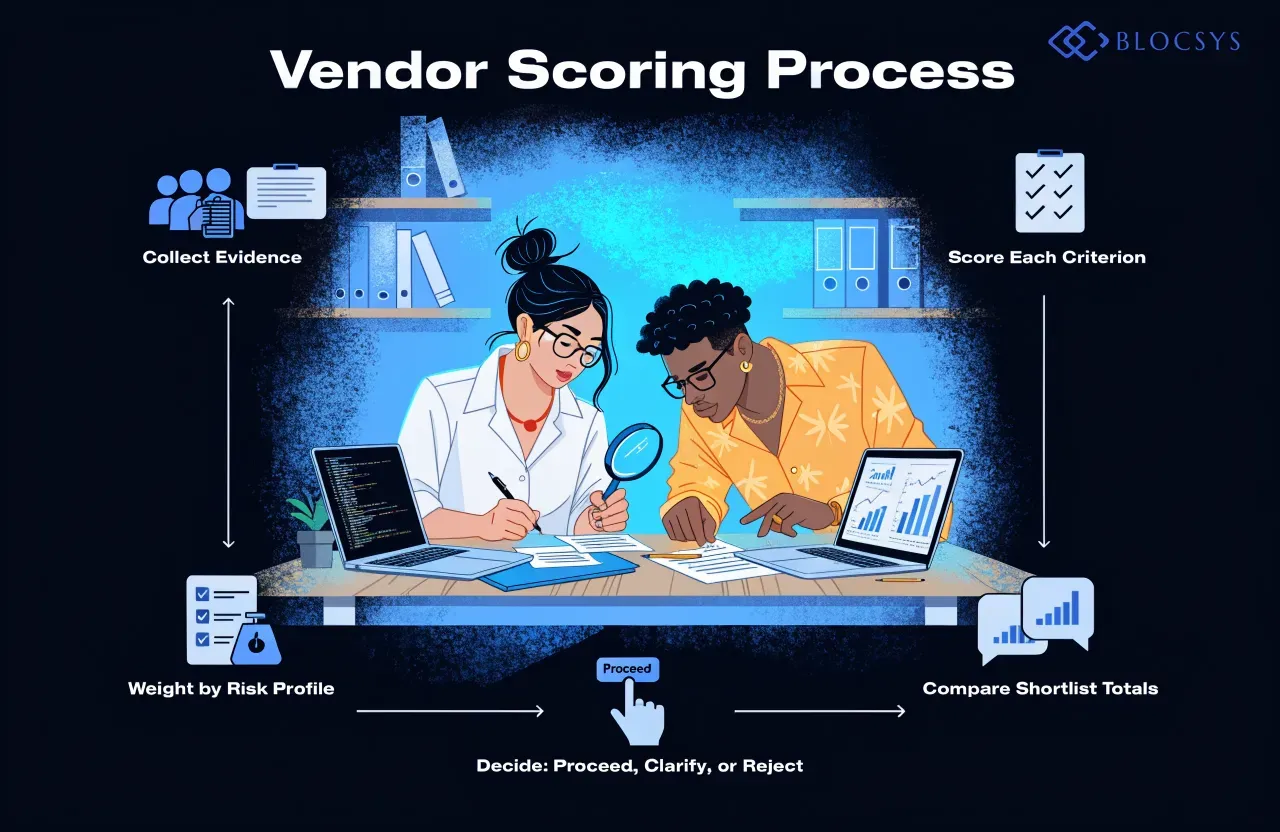
Use a weighted scorecard to keep your blockchain vendor evaluation consistent across every vendor you review, instead of relying on impressions from separate conversations.
| Evaluation Criterion | Weight |
|---|---|
| Technical expertise and architecture judgment | 20% |
| Security and testing practices | 20% |
| Relevant project experience | 15% |
| Team quality and senior technical involvement | 15% |
| Delivery governance and communication | 10% |
| Ownership, documentation, and contractual clarity | 10% |
| Maintenance and post-launch support | 10% |
These weights are a suggested starting framework, not an industry standard. Adjust them to your project’s risk profile — a regulated fintech deployment should probably weight security and ownership even higher. Score each category against documented evidence from calls, sample code, and reference checks, not marketing material. Record the reasoning behind every score so you can defend the decision later.
How Blocsys Approaches Blockchain Development and Technical Partnership
Blocsys structures its engagement model around the same criteria outlined above. Its blockchain development work starts with requirements-led technical planning — understanding transaction patterns, privacy needs, and integration points before proposing a network or architecture, rather than defaulting to a preferred stack.
On the security side, Blocsys’s blockchain testing and smart contract audit services address code review, functional testing, and vulnerability assessment as part of the development lifecycle, not a bolt-on step. For regulated use cases, its blockchain consulting work for financial institutions reflects the compliance and governance considerations that fintech and enterprise buyers raise during due diligence.
For teams that need direct engineering capacity rather than a fixed-scope project, Blocsys also offers dedicated blockchain engineering teams and lets you hire blockchain developers directly into your delivery process, which gives you more visibility into who’s actually writing your code — a point raised earlier in the team composition section.
None of this means Blocsys fits every project automatically. Scope, domain complexity, and compliance requirements vary, and a serious technical discussion should still cover architecture rationale, testing evidence, and support terms before you commit. You can review the Blocsys team page and its custom blockchain development services to see how its stated capabilities map against your own checklist.
Conclusion: Choose a Partner You Can Verify, Not Just a Vendor That Promises Results
Choosing a blockchain development partner in India comes down to evidence, not enthusiasm. The vendors worth trusting explain their architecture decisions, show real production experience, document security practices, make delivery risk visible, and commit to clear ownership and support terms in writing. Run the blockchain vendor evaluation checklist in this article against every name on your shortlist, score consistently, and don’t skip the contract-stage legal review.
If you’re currently comparing blockchain development companies in India, talk to Blocsys about your specific architecture, security, and delivery requirements, and assess independently whether its approach fits your project.
Frequently Asked Questions
Here are direct answers to the questions we hear most often about choosing a blockchain development partner in India.
How do you choose a blockchain development partner in India?
Run a structured blockchain vendor evaluation covering architecture judgment, security practices, production experience, team composition, delivery governance, and support terms. Score vendors consistently rather than comparing pitches informally.
What should a CTO verify before hiring a blockchain development company?
Verify who will actually staff the project, how they test and secure smart contracts, what production systems they’ve shipped, and what the contract says about code ownership and post-launch support.
How can businesses verify a blockchain company’s technical expertise?
Ask for a detailed technical walkthrough of a past project, including specific challenges and fixes, rather than accepting a polished demo or client logo list as proof.
What security practices should a blockchain development partner follow?
Expect secure coding standards, peer code review, automated and manual smart contract testing, threat modeling, and defined vulnerability remediation processes. An audit supports this process; it doesn’t replace it.
What questions should you ask a blockchain development company before signing a contract?
Ask about architecture rationale, testing methodology, named team members, escalation paths, code and repository ownership, and exact post-launch support terms.
How do you evaluate a blockchain development company’s portfolio?
Look past screenshots and testimonials. Ask for the vendor’s specific role, technical challenges faced, and lessons learned on each referenced project.
Who should own the source code developed for a blockchain project?
Typically the client, with full repository access, deployment credentials, and documentation transferred under explicit contract terms reviewed by legal counsel.
How can businesses compare blockchain development companies objectively?
Use a weighted scorecard across technical expertise, security, experience, team quality, delivery governance, ownership clarity, and support, scored against documented evidence.
Why is post-launch support important for blockchain applications?
Production blockchain systems need ongoing monitoring, dependency upgrades, and incident response. Without defined support terms, operational risk shifts entirely onto your team after launch.
How can businesses evaluate whether Blocsys is the right blockchain development partner?
Review Blocsys’s stated services in development, testing, and consulting against your own due diligence checklist, and raise the same architecture, security, and support questions directly with its team before deciding.
Internal links pending manual insertion.
Primary Interlinking Pages:
Homepage: https://blocsys.com/
Real-world asset tokenization: https://blocsys.com/real-world-asset-tokenization/
Asset tokenization platform development: https://blocsys.com/asset-tokenization-platform/
Ready to move beyond theory and build an intelligent platform that delivers real-world value? Blocsys Technologies specialises in engineering enterprise-grade AI and blockchain solutions for the fintech, Web3, and digital asset sectors. Connect with our experts today to discuss your vision and chart a clear path from concept to a secure, scalable reality.