Bullion App Development for Zaveri Bazaar and Mumbai Dealers: Features and Business Requirements
If you run a bullion business near Zaveri Bazaar, you already know how fast a trading day moves. Rates shift, customers call, orders pile up on WhatsApp, and someone’s still updating a rate board by hand. That’s exactly why Bullion App Development for Zaveri Bazaar Dealers has become a practical conversation for wholesalers, retailers, and jewellery manufacturers who want fewer manual steps and more control over daily operations. This isn’t about chasing trends. It’s about matching your app to how your business actually works.
Zaveri Bazaar isn’t one kind of business. You’ve got bullion wholesalers, retail jewellers, manufacturers, and dealers who each handle rates, customers, and orders differently. A rate-display app might suit one. A full dealer management platform might suit another. Before you build anything, you need to know which category fits your operations — and that’s what this article walks through.
Why Should Bullion Dealers in Zaveri Bazaar Consider Developing Their Own App?
Short answer: because manual rate communication and phone-based order taking don’t scale well once your customer base grows. A dedicated app gives you one place to manage rates, customers, and orders instead of juggling calls, messages, and paper registers.
Here’s what a well-planned Bullion App Development for Zaveri Bazaar Dealers project can offer, depending on scope:
- Centralised gold and silver rate communication to customers and dealers.
- Better customer access to your business information, catalogue, and rates.
- Digital wholesale order requests instead of phone-based booking.
- Structured dealer and customer management under one system.
- Clearer visibility into order records and transaction history.
- Centralised administrative controls for your team.
- A foundation to support business expansion across locations.
However, these benefits depend entirely on which features you actually build. A basic rate app won’t give you order management. A full platform needs more planning, more development time, and more ongoing maintenance. Therefore, the real value comes from matching the app to your existing processes, not from the app alone.
A bullion app is only as useful as the workflow it replaces. If your team still reconciles orders on paper after the app launches, the technology hasn’t solved anything — it’s just added a screen.
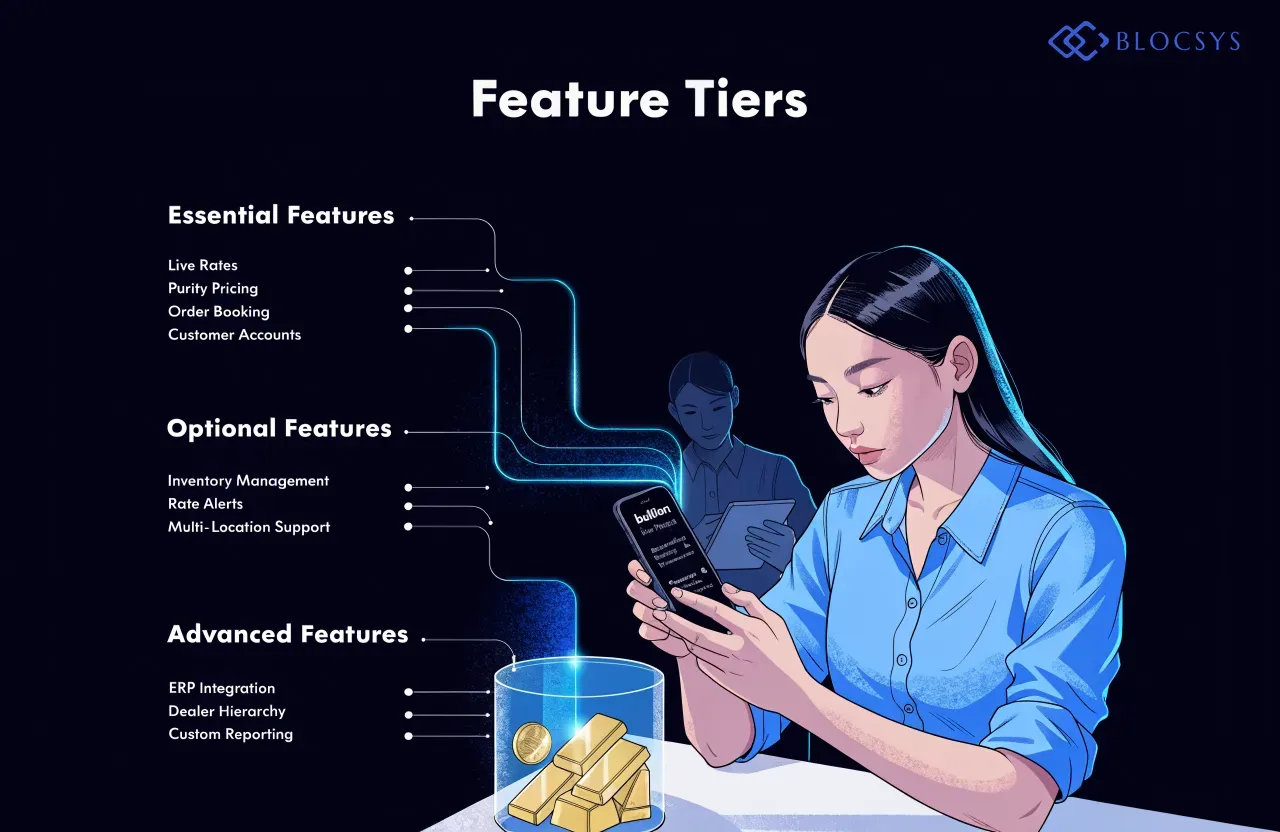
Essential Features of a Bullion Trading App for Zaveri Bazaar Dealers
What features should a bullion trading app include? At minimum, live rate display, purity-based pricing, customer accounts, and order booking. Beyond that, features depend on whether you’re running a rate app, a trading app, or a full dealer platform.
Customer-Facing Features
- Live Gold and Silver Rates: Rates that update automatically instead of being typed in manually every hour.
- Gold and Silver Purity Categories: Separate pricing for 995 and 999 gold rates, along with relevant silver purities.
- Buy and Sell Rate Display: Clear separation between buying and selling prices for transparency.
- Customer Registration and Login: A simple sign-up process for repeat customers.
- Notifications and Rate Alerts: Push alerts when rates cross a threshold a customer has set.
Business-Facing Features
- Dealer and Wholesale Customer Accounts: Separate account types with different pricing or order limits.
- Bullion Order Booking: A structured form for product, quantity, and purity selection.
- Order Status and Transaction History: A running record customers and your team can both check.
- Customer Account Management: Tools to track repeat buyers, outstanding dues, and contact details.
- Inventory Management: Optional, but useful once order volume grows.
- Admin Dashboard and Reporting: A single screen for owners to monitor daily activity.
- Role-Based Access and Permissions: Different access levels for admins, sales staff, and dealers.
Not every business needs every feature on day one. Essential features get your core workflow digital. Optional features — like ERP integration or multi-location inventory — can come later, once the basics are working well.
Gold and Silver Rate Management for Zaveri Bazaar Bullion Businesses
How can bullion dealers manage gold and silver rates digitally? Through a system that pulls live market data, applies your own margins, and displays purity-based pricing automatically — instead of someone updating a board by hand.
It helps to understand three distinct layers here. International benchmark prices, such as those referenced by the London Bullion Market Association, set a global baseline. Domestic references, including data tracked through the Multi Commodity Exchange of India, reflect Indian market conditions, duties, and currency movement. Dealer-defined customer-facing rates are what you actually quote, after applying your own margin, purity adjustments, and business rules.
A custom application typically handles this through:
- Live market data integration via a gold and silver price API.
- Automatic purity-based rate calculation (995, 999, and other categories).
- Separate buy and sell pricing logic.
- Manual rate override options for administrators, where needed.
- Rate history logs and change notifications.
- Monitoring tools to flag unusual price jumps or feed failures.
Not every dealer follows the same pricing method, and that’s fine. Some apply a flat margin. Others adjust by customer type or order size. The point of custom Bullion App Development for Zaveri Bazaar Dealers is building rate logic around your actual pricing model, not a generic template.
Customer and Dealer Management Features
Can a custom application manage bullion customers and dealers together? Yes — through role-based accounts that separate retail customers, wholesale dealers, and your internal team, each with different permissions and pricing visibility.
Consider a practical example. A wholesaler might want three account types: retail customers who see standard rates, registered dealers who see wholesale rates, and admin staff who manage both groups. Each role needs different screens and different data access.
Typical functionality includes:
- Customer registration with basic KYC-style details.
- Dealer and wholesale customer accounts with distinct pricing tiers.
- User roles and access permissions for staff and management.
- Customer-specific information, such as preferred products or purity.
- In-app communication or notification channels.
- Account activity and transaction records for audit purposes.
- Administrative approval workflows for new dealer sign-ups, where required.
This structure matters because a bullion dealer management system isn’t just a contact list. It’s the backbone that connects pricing, orders, and reporting to the right people. Without it, you’re back to tracking everything in spreadsheets.
Wholesale Order Booking and Transaction Management
Can a bullion app support wholesale order booking? Yes, through a structured booking flow that captures product, quantity, purity, and rate reference at the moment of order placement — then routes it for confirmation.
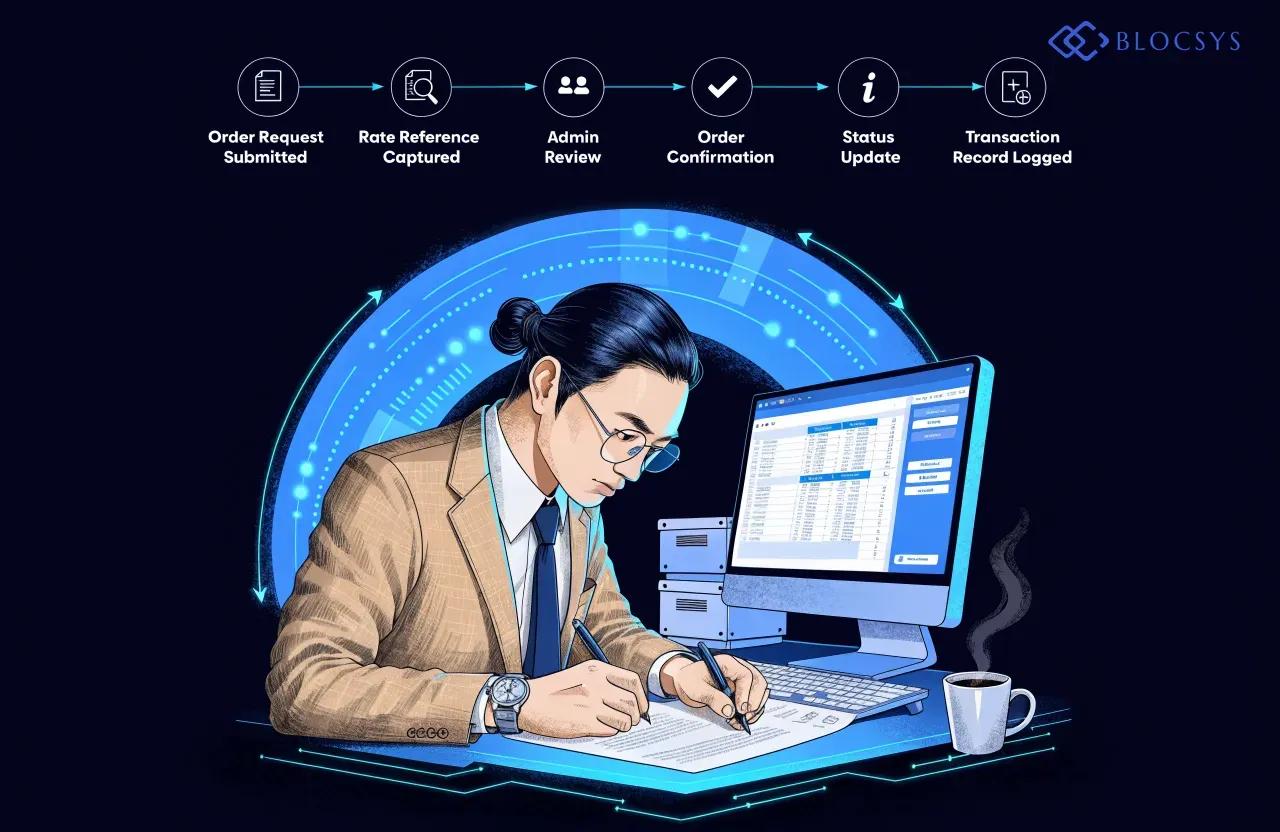
A typical wholesale bullion trading software workflow looks like this:
- Customer or dealer submits an order request with product and quantity details.
- The app records the rate reference applicable at that moment.
- Your team reviews and confirms the order.
- Order status updates move through stages — pending, confirmed, processed.
- Transaction history logs the full order lifecycle for both sides.
- Notifications keep the customer informed at each stage.
It’s worth being clear here: this workflow manages the order process digitally. It doesn’t automatically execute financial settlement or handle physical bullion delivery. Those remain business processes that your team manages separately, with the app simply keeping an accurate digital record. The exact order rules — minimum quantities, approval steps, credit limits — should reflect your own business policies, not a generic template.
Inventory and Business Management Integration
Can a bullion application support inventory and business management? It can, through modules that track stock movement, link orders to inventory records, and generate reports — though this works alongside your physical stock verification, not instead of it.
Relevant inventory functionality includes:
- Gold and silver inventory records by product and purity category.
- Stock visibility across counters or locations.
- Inward and outward stock entries tied to purchases and sales.
- Order-to-inventory workflows that update stock as orders process.
- Reporting tools for stock valuation and movement trends.
- ERP and accounting system integration, where your business already uses one.
Here’s an important distinction. Inventory tracking software records what your system believes is in stock. It doesn’t replace physical bullion custody, vault security, or manual verification. Think of it as a digital ledger that supports your existing stock-handling practices, not a substitute for them.
Mobile App, Web Portal and Admin Dashboard Requirements
How can a bullion dealer develop an application for Android, iOS and web? By defining which user groups need which interface first — customers, dealers, and admins typically need different experiences, not one shared screen.
| Interface | Primary User | Typical Use |
|---|---|---|
| Android App | Retail and wholesale customers | Rate viewing, order booking, notifications |
| iOS App | Customers on Apple devices | Same functionality as Android, native experience |
| Web Portal | Dealers and wholesale buyers | Order placement, transaction history, account management |
| Admin Dashboard | Business owners and staff | Rate control, order approval, reporting |
Each interface connects to a centralised backend, so rate updates and order data stay consistent everywhere. Before development starts, decide which platforms you actually need. A wholesaler dealing mostly with repeat dealers might prioritise the web portal first and add mobile apps later.
Technology and Architecture for a Custom Bullion Application
What’s the architecture behind a bullion trading platform? Essentially, a mobile and web frontend, a backend handling business logic, a database, and a pricing API — all connected through secure, role-based access.
The main components typically include:
- Mobile application frontend (Android and iOS).
- Web application frontend for dealers and admins.
- Backend services managing orders, pricing logic, and user roles.
- Database for customer, order, and rate history.
- Gold and silver price API integration for live data.
- Authentication and role-based access control.
- Administrative dashboard for monitoring and reporting.
- Cloud infrastructure for hosting, scaling, and monitoring.
These pieces work together so that a rate update on the backend reflects instantly across the customer app, dealer portal, and admin screen. There’s no single mandatory technology stack here — the right choice depends on your scale, budget, and integration needs, which is something to discuss with your Bullion Rate App Development partner during planning.
Security and Scalability Requirements
Security in a bullion application covers secure authentication, encrypted data storage, API protection, and audit trails — not the physical safety of your bullion stock, which remains a separate operational concern.
Key requirements to plan for:
- Secure login with role-based permissions for every user type.
- API security to protect rate feeds and transaction data.
- Data encryption for customer and transaction records.
- Regular backups and disaster recovery planning.
- Audit trails for order changes and rate adjustments.
- Monitoring systems to flag unusual activity.
Scalability matters too. As your dealer network grows or you add locations, your app should handle more users and data without a full rebuild. Plan your database and backend architecture with that growth in mind from the start, rather than retrofitting it later.
Custom Bullion App Development vs Ready-Made Software
Should you build custom or buy ready-made bullion software? It depends on how specific your workflows are, your budget, and how much control you want over future changes.
| Factor | Custom Development | Ready-Made Software |
|---|---|---|
| Workflow fit | Built around your exact process | You adapt to their structure |
| Branding | Full ownership and control | Often limited or white-labelled |
| Integrations | Flexible, built to your needs | Limited to supported options |
| Scalability | Designed for your growth path | Depends on vendor roadmap |
| Costs | Higher upfront, no recurring licence fees | Lower upfront, ongoing subscription |
| Maintenance | Your responsibility or your dev partner’s | Handled by the vendor |
Neither option is automatically better. A small dealer testing digital order booking might start with ready-made software. A growing wholesaler with specific dealer tiers and pricing rules often outgrows generic platforms quickly. Weigh your resources and long-term plans before deciding.
How to Plan a Bullion App Development Project for Your Zaveri Bazaar Business
Planning starts with clarity, not code. Before approaching a development team, work through these steps:
- Identify your application objectives — rate display, order booking, or full management.
- Define customer and dealer account requirements.
- Document your existing rate management process.
- Map out your wholesale order workflow.
- Select essential features first, optional ones later.
- Decide between Android, iOS, and web based on your user base.
- List required third-party integrations, such as payment gateways or ERP tools.
- Plan security and administrative controls upfront.
- Define an initial development scope you can launch with.
- Plan for future upgrades and ongoing maintenance.
A practical approach: start with rate management, customer accounts, and order booking. Once that’s running smoothly, add inventory tracking or ERP integration. This phased approach keeps your first launch manageable and lets you learn what your customers actually use before investing in advanced modules.
Bullion App Development Services Offered by Blocsys
This is where a development partner like Blocsys fits in. We work with bullion dealers, gold wholesalers, and precious metal businesses to build custom mobile and web applications around their actual business model — not a one-size-fits-all template.
Our capabilities cover custom mobile and web application development, backend systems, administrative dashboards, database architecture, and third-party API integrations for pricing feeds and payment gateways. We also support digital gold and silver app development for businesses exploring digital bullion products alongside traditional trading features. Where blockchain-based verification or tokenised assets are relevant, that’s something we can scope into the architecture too.
Before writing a single line of code, we focus on understanding your rate management process, your customer and dealer structure, and your order workflow. That groundwork shapes the entire build.
Why Choose Blocsys for Bullion App Development?
Choosing a development partner for Bullion App Development for Zaveri Bazaar Dealers comes down to whether they understand both the technology and your business model. Here’s what we bring to that conversation:
- Custom mobile application development for Android and iOS.
- Web application development for dealer and admin portals.
- Backend systems built for rate accuracy and order reliability.
- Administrative dashboards tailored to how you actually run reports.
- Third-party API integrations for pricing data and payments.
- Custom business workflows instead of forced templates.
- Scalable architecture that grows with your dealer network.
We don’t start with assumptions. We start by understanding how you manage rates, how your customers and dealers interact with your business, and how your order process actually works today. That’s what shapes a platform that fits rather than one you have to work around.
Conclusion – Build a Custom Bullion Application for Your Zaveri Bazaar Business
A custom bullion application can bring your rate management, customer relationships, wholesale orders, inventory visibility, and administrative operations into one connected system. However, the right scope always depends on your specific operating model — there’s no universal blueprint that fits every dealer in Zaveri Bazaar.
Whether you’re starting with simple rate display or planning a full dealer management platform, the key is building around your actual workflow, not a generic solution. Planning to develop a custom bullion application for your Zaveri Bazaar business? Connect with Bullion Rate App Development at Blocsys to discuss your requirements for gold and silver rate management, customer accounts, wholesale order booking, and a customised mobile or web platform.
Frequently Asked Questions
Here are direct answers to the questions we hear most often about bullion app development for Zaveri Bazaar dealers.
Why should bullion dealers in Zaveri Bazaar develop their own mobile application?
A dedicated app replaces phone and WhatsApp-based rate sharing and order booking with a centralised, trackable system. It reduces manual errors and gives you one place to manage customers, dealers, and orders.
What features should a bullion trading app include?
Essential features include live gold and silver rates, purity-based pricing, customer accounts, order booking, and transaction history. Optional features like inventory management and ERP integration can be added as your business grows.
Can a bullion app display live gold and silver rates?
Yes, through integration with a gold and silver price API. The app can then apply your own margins and purity-based adjustments before displaying rates to customers.
Can a custom bullion application support wholesale order booking?
Yes. It can capture product, quantity, purity, and rate reference at the time of booking, then route the order through confirmation and status tracking stages based on your business rules.
How much does it cost to develop a custom bullion application in Mumbai?
Costs vary based on features, platforms, and integrations required. A basic rate and order booking app costs less than a full dealer management platform with inventory and ERP integration. An accurate estimate needs a proper requirements assessment.
Ready to move beyond theory and build an intelligent platform that delivers real-world value? Blocsys Technologies specialises in engineering enterprise-grade AI and blockchain solutions for the fintech, Web3, and digital asset sectors. Connect with our experts today to discuss your vision and chart a clear path from concept to a secure, scalable reality.