
71% of hospitals were already using predictive AI integrated with the EHR in 2024, up from 66% a year earlier, and that shift changes what “Hospital ERP” has to do in production. It’s no longer enough for hospital software to manage ledgers, beds, and payroll. It now has to carry the operational data that AI needs to move claims, scheduling, inventory, and patient flow without breaking clinical trust. For hospital leaders planning Hospital ERP Development: The Complete Guide to AI-Powered Healthcare Management, the question is not whether to add AI, but whether the data, governance, and workflows are ready for it. If you’re evaluating build-versus-buy decisions, start with a clear view of your integration layer and connect the discussion to practical implementation paths such as Blocsys’s hospital management system and its AI integration service.
Table of Contents
- Why Hospital ERP Has Become the AI Operations Layer
- Core Hospital ERP Modules and Workflow Integration
- AI-Powered Automation in Hospital Operations
- The Unstructured Data Problem Blocking AI Adoption
- Phased Implementation Roadmap with Data Maturity Gates
- Cloud Versus On-Premise Deployment for Healthcare ERP
- Why Choose Blocsys for Hospital ERP Development
Why Hospital ERP Has Become the AI Operations Layer
Hospitals are reaching a point where AI only becomes useful when it sits on top of the systems that run day-to-day work. That shift is visible in adoption patterns, not just vendor messaging. A 2025 HealthIT.gov data brief found that 71% of hospitals reported using predictive AI integrated with the EHR in 2024, up from 66% in 2023. The same brief shows the most common use was predicting health trajectories or risks, while the fastest-growing use cases were simplifying billing and facilitating scheduling. HealthIT.gov’s hospital predictive AI brief points in the same direction, AI is moving into operational work, not staying in isolated pilot projects.
That shift makes Hospital ERP the control layer for finance, billing, staffing, pharmacy, scheduling, and supply chain data. Global market data from the healthcare ERP sector supports that view. The market was estimated at US$7.7 billion in 2024 and is projected to reach US$10.8 billion by 2030, with finance and billing expected to grow at a 6.7% CAGR to US$3.7 billion by the end of the period, according to GII Research’s healthcare ERP report. That growth reflects where hospitals are already putting money and attention.
Practical rule: if your ERP cannot produce clean, auditable operational data, AI will mostly generate more alerts, not better decisions.
What hospital ERP really means in 2026
A strong hospital ERP platform brings together the operational functions that used to sit in separate systems, patient administration, scheduling, financials, inventory, HR, and reporting. In production, that matters because AI performs best where workflows are repeated, structured, and measurable. Billing automation and scheduling support get traction quickly for that reason, they sit closest to transaction data and decision support.
The teams that get ROI fastest usually make one different choice. They treat ERP selection as a data architecture decision, not a software shopping exercise. That is also where implementation partners matter, because hospital AI works only when the ERP layer, the integration layer, and the governance model are designed together. For a closer look at the integration piece, see Blocsys’s AI integration service.
Where AI starts to matter operationally
AI changes ERP outcomes in three places first. It improves revenue-cycle work by reducing manual routing and surfacing exceptions earlier. It sharpens patient flow by helping teams respond faster to scheduling volatility and bed movement. It also gives administrators a more realistic view of how demand, staffing, and inventory interact across departments.
Data readiness is the primary bottleneck. Hospitals that still run disconnected modules spend more time reconciling records than acting on them, and unstructured data makes that worse. Clinical notes, scanned documents, free-text orders, and inconsistent master data weaken model quality long before anyone notices it in a dashboard. Teams that want to streamline operations with Nolana AI, see streamline operations with Nolana AI, still need the same foundation, governed data, clear ownership, and integration that preserves the source of truth.
Hospitals that unify their modules can make predictive AI useful because the model sees the same operational record that staff use. That is where AI in Hospital ERP stops being a demo feature and starts affecting throughput, cash flow, and service coordination.
Core Hospital ERP Modules and Workflow Integration
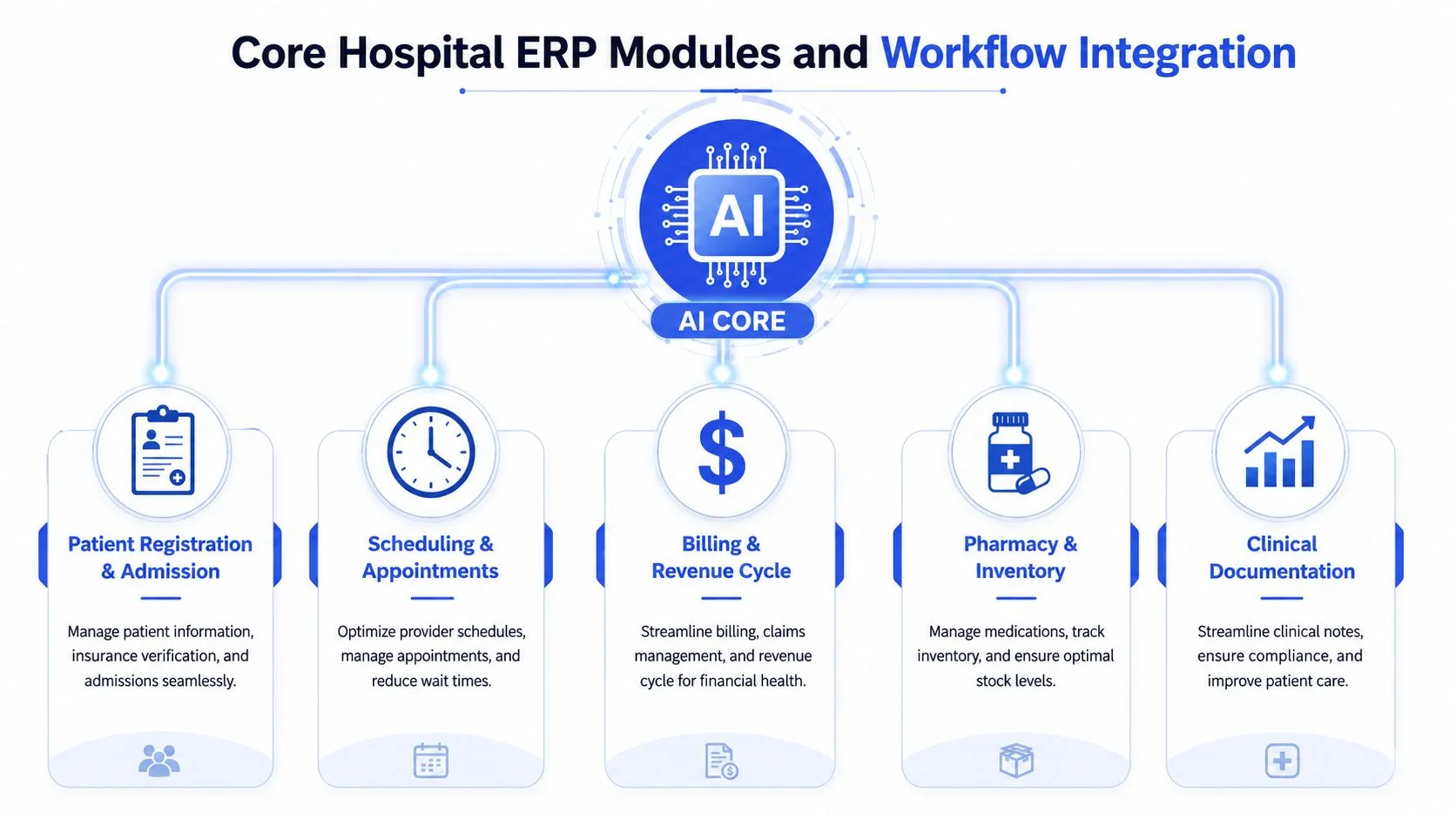
A hospital ERP only works when the modules talk to each other in real time, or close to it. That sounds obvious, yet many deployments still treat registration, billing, pharmacy, and finance like separate projects. In practice, the patient’s journey starts at registration, but the data trail has to stay intact through admission, treatment, discharge, claims, and follow-up.
The modules that matter most
Patient registration and appointment scheduling usually set the tone for the whole platform. If front-desk teams enter inconsistent demographic or insurance data, every downstream process feels it. Billing and revenue cycle management then depend on those fields staying clean, because claim quality is built much earlier than the finance team usually realises.
Pharmacy, laboratory, radiology, inventory, HR, payroll, CRM, and analytics are not add-ons. They’re the operational system around care delivery. For example, if a lab result is available but the EMR integration is poor, clinicians lose time toggling systems. If pharmacy stock is not linked to dispensing and purchase data, inventory forecasting becomes guesswork.
A useful comparison point comes from Wonderment Apps’ ERP software development services, which describes ERP builds as workflow-centric rather than module-centric. That framing is right for hospitals too. The point is not to collect features. It’s to make the hand-offs between departments visible and auditable.
Workflow integration is where most hospital ERP projects win or fail
The best hospital ERP designs map actual staff behaviour. Registration creates the patient record. Scheduling reserves a slot. Clinical documentation feeds coding and billing. Pharmacy records consumption. Finance closes the loop with reconciliation and reporting. Once those events are linked, AI can start predicting exceptions instead of guessing at isolated events.
The opposite pattern is common in legacy environments. Departments keep their own spreadsheets, then export files into a central system daily. That creates delays, duplicate records, and weak analytics. It also makes AI brittle, because the model learns from late, partial, or inconsistent data.
Implementation insight: prioritise the modules that produce the most reusable operational data first, then add AI only after those workflows are stable.
Hospitals with multiple facilities should also think in terms of data consistency, not just module coverage. A shared patient identity model, a shared billing logic, and a shared item master matter more than a long feature list. That’s why many enterprise projects start with the same core modules and then extend by department or location. In India, customisation frequently starts with a custom hospital management software approach because local billing, language, and workflow patterns often need to be reflected in the platform design.
AI-Powered Automation in Hospital Operations
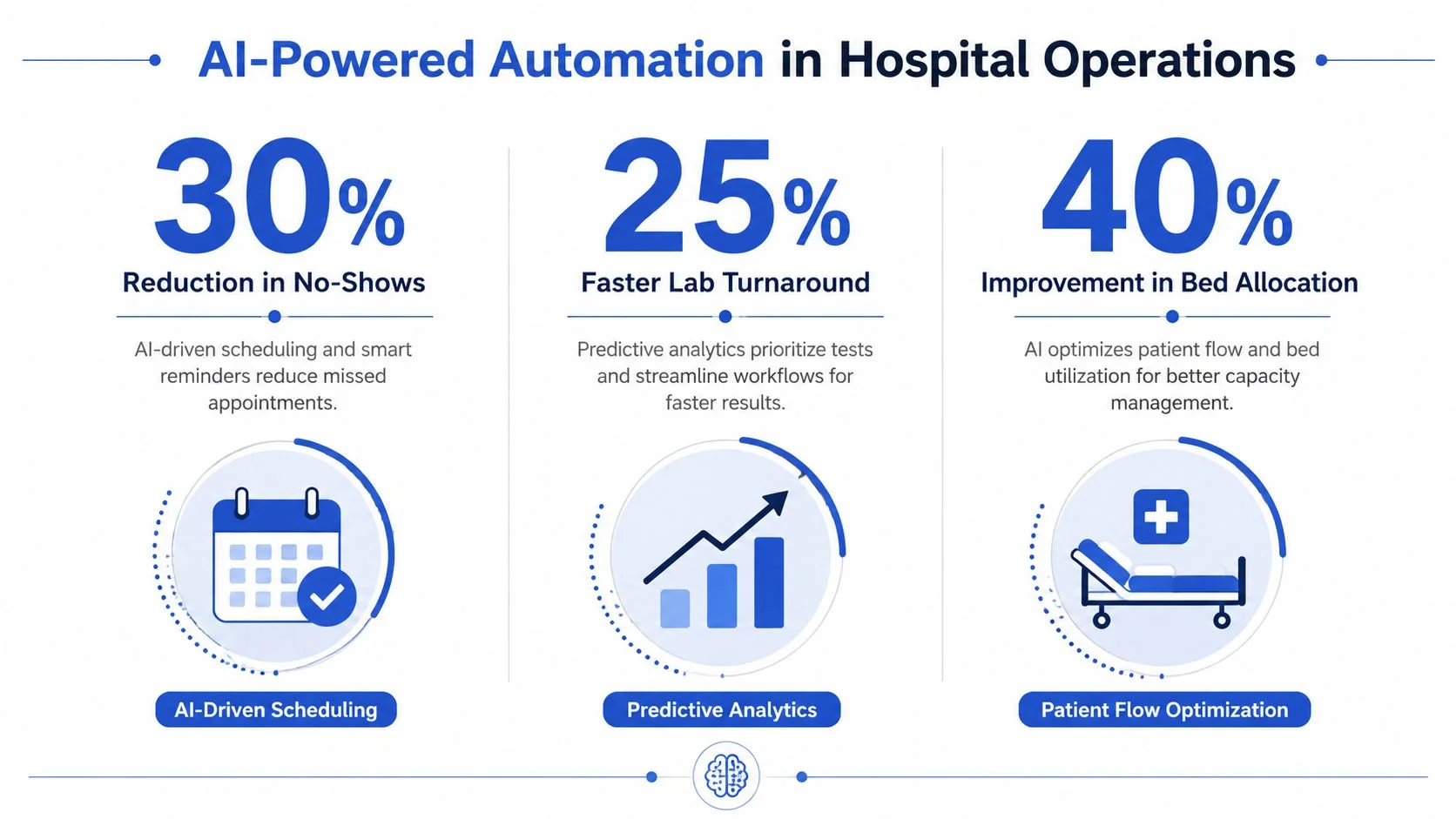
The fastest ROI in hospital AI usually comes from administrative work, not from the most glamorous clinical use cases. That matches the adoption pattern already visible in hospital data. Billing automation rose from 36% in 2023 to 61% in 2024, and scheduling support rose from 51% to 67% in the same period, according to the HealthIT.gov brief cited earlier. Those functions are rising quickly because they sit inside the ERP boundary and depend on structured operational data.
Where automation pays first
AI-driven scheduling is a practical starting point because appointment data is relatively structured. Hospitals can use it to reduce manual rebooking effort, flag likely capacity gaps, and improve appointment coordination. Billing automation follows the same logic, with rules-based processing, document routing, and exception handling all becoming easier when the ERP keeps the underlying records consistent.
Inventory management is another strong use case. A 2025 review on PubMed Central lists predictive inventory management, facility management with predictive maintenance, resource allocation optimisation, and supply-chain optimisation during emergencies as real hospital-management AI applications. The same review also names billing and claims processing, AI-driven scheduling, and document-processing automation as administrative use cases. That review is useful because it shows how broad the AI surface area has become.
Hospitals also evaluate automation through practical operating metrics. They want fewer claim errors, less rework, better slot utilisation, and fewer stock-outs. Those are not abstract AI goals. They are budget-line outcomes.
What to automate before what
A lot of implementations fail because teams start with the flashiest use case. That’s a mistake. If claim data is messy, automate claims later. If scheduling rules aren’t standardised, don’t expect a model to solve that chaos by itself. The smart order is usually the one with the least ambiguity and the clearest feedback loop.
A useful engineering pattern is to combine ERP workflow rules with AI only after the core process is stable. One practical guide recommends building on a shared data layer first, then activating model layers after the hospital has enough operational history to train them safely. That idea lines up with what works in production, AI should augment a process that already works, not become the process.
A focused view on combining RPA and AI is also available in this guide to better results. Used well, that combination removes repetitive clicks without hiding exceptions from staff.
The Unstructured Data Problem Blocking AI Adoption
Most hospital ERP pitches overpromise because they ignore a simple truth, a lot of healthcare data is still not machine-ready. One research source in the brief notes that roughly 80% of healthcare data remains unstructured. That matters because AI can only automate what it can reliably read, classify, and route. Scanned referrals, handwritten notes, multilingual documents, and inconsistent attachments all slow that down.
Where the bottleneck shows up
Claims processing is one of the biggest pressure points. If the payer packet includes scanned discharge summaries, fragmented referral letters, and unclear coding support, AI extraction quality falls fast. Referral management has the same problem, especially when documents arrive from external providers in different formats or languages.
Inventory and procurement records can also be messy, although in a different way. The issue there is often partial documentation and inconsistent naming, not just paper. Clinical documentation adds another layer, because physicians, nurses, and allied staff often document differently even when they follow the same protocol. That makes downstream automation harder than it looks in demos.
A good internal reference point is Blocsys’s note on metadata canonicalization, because the core lesson transfers directly to hospital data. Identical-looking records can behave differently when metadata, naming, or structure changes.
Why document automation alone is not enough
Hospitals sometimes buy document extraction tools and expect the problem to disappear. It doesn’t. If the workflow still routes documents manually after extraction, the team just gets a prettier version of the same bottleneck. Staff capability matters too, because people need to know when to trust automation and when to escalate.
Governance becomes operational, not theoretical. Hospitals need defined data ownership, validation rules, exception handling, and clear decision rights for AI-assisted workflows. They also need to be honest about where digital maturity is uneven across departments, because the best automation plan for a tertiary care network is not the same as the best plan for a small private hospital.
Operational advice: prioritise the documents that sit closest to revenue, risk, or patient flow first. That usually means claims, referrals, discharge paperwork, and high-volume administrative forms before more specialised clinical archives.
The right sequencing reduces failure rates. It also keeps the AI layer from becoming a source of trust issues. If staff can see how a document moved through the workflow, and why the system made a recommendation, adoption is much easier to sustain.
Phased Implementation Roadmap with Data Maturity Gates
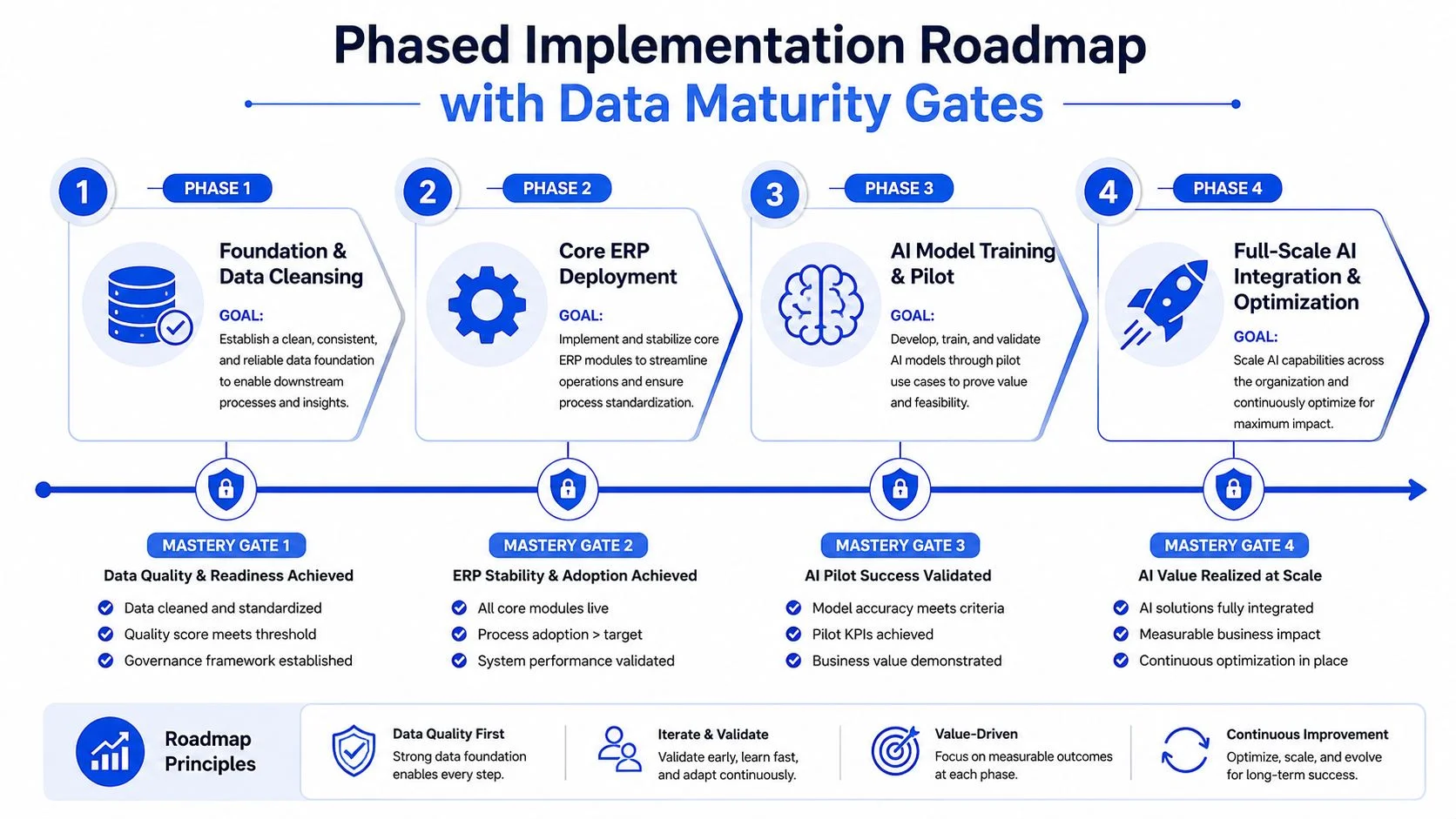
Hospitals rarely fail because they picked the wrong AI model. They fail because they turned it on too early. A safer approach is to phase the ERP build around data maturity, so the system creates the history the AI will later depend on. One implementation plan in the brief recommends starting with core scheduling, billing, HR, and analytics on a shared data layer, then waiting for specific thresholds before training AI modules.
The gates that actually matter
The practical thresholds are straightforward. For no-show prediction, wait until the system has at least 90 days of scheduling data. For coding-model baseline accuracy, wait for 500+ coded encounters. For denial prediction, wait for 12+ months of claim history. Those gates matter because AI needs enough structured history to learn patterns that are not just noise.
That sequencing also changes the project team’s job. The first phase is mostly about process mapping, master data, interface testing, and user adoption. The second phase is about stabilising transactions and auditing data quality. The third phase is about model testing, exception handling, and control design. Only after that should the hospital move into broader automation.
What to validate before each phase
| Phase | What must be true | What to avoid |
|---|---|---|
| Foundation | Core workflows are mapped and owners are named | Training AI on incomplete process data |
| Core ERP | Transactions are consistent across departments | Allowing local spreadsheets to remain the main record |
| AI pilot | Enough clean history exists for one narrow use case | Expanding use cases before one workflow is stable |
| Scale-up | Exceptions, audits, and overrides are documented | Treating model output as final without human review |
The sequencing above is also why integration matters so much. If interfaces are brittle, the ERP will collect partial data and the model will learn from gaps. That’s one reason a data pipeline architecture conversation is never really separate from Hospital ERP Development.
Hospitals that succeed usually keep one rule in place. No AI module goes live without a named business owner, a technical owner, and an escalation path for exceptions. That keeps the implementation accountable and prevents the common “pilot that never scales” problem.
Cloud Versus On-Premise Deployment for Healthcare ERP
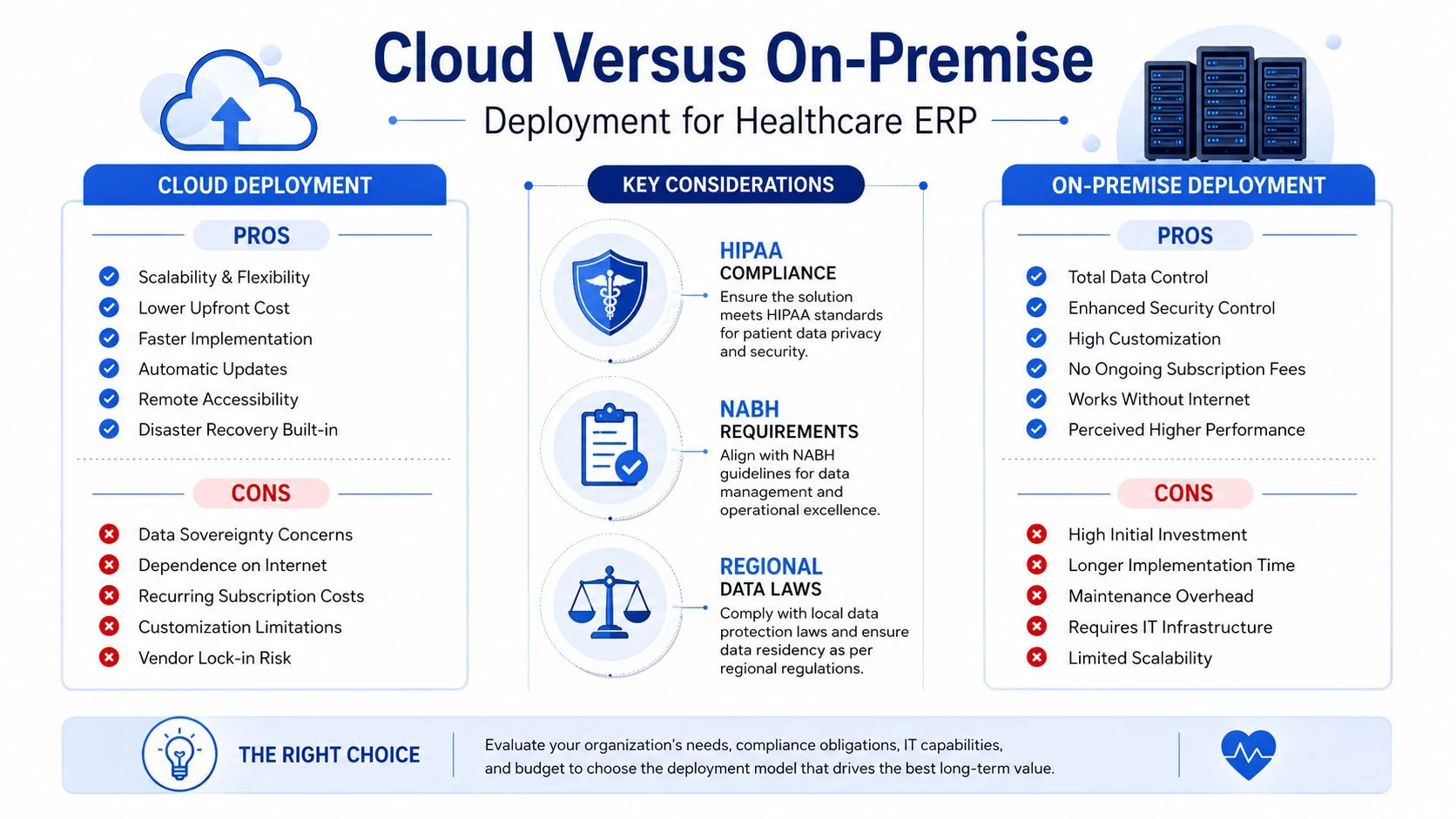
The right deployment model depends on regulation, internal IT maturity, and how much control the hospital wants over data and infrastructure. Cloud is attractive because it scales faster and usually reduces upfront infrastructure burden. On-premise still matters where strict control, legacy integration, or local policy makes central hosting difficult.
How to compare the options
Cloud deployments work well for multi-site healthcare groups that need central visibility and flexible access. They’re also attractive where the team wants faster upgrades, simpler disaster recovery, and easier expansion. The downside is the need to think carefully about data sovereignty, access control, and the way regional health data laws apply.
On-premise deployments give hospitals tighter control over their environment. That can matter for sensitive patient data, local audit expectations, or organisations with established data-centre investments. The trade-off is higher internal responsibility for uptime, patching, backup, and recovery. In practice, many hospitals land on hybrid designs, where sensitive data stays under tighter local control and analytics or AI workloads use cloud components where appropriate.
Security and compliance shape the decision
Security cannot be bolted on later. Healthcare systems need encryption, role-based access, audit trails, and clear incident response procedures from day one. Regulatory expectations differ across markets, but the planning logic is consistent, the hospital needs to know where data lives, who can touch it, and how actions are logged.
A hybrid model is often the most realistic answer for cross-border groups operating in India, the US, the UK, Europe, the UAE, Singapore, Germany, Canada, and Australia. It gives hospitals room to meet local obligations without blocking modern analytics. It also gives IT teams a more manageable path to AI adoption, because not every workload needs to sit in the same place.
Decision rule: choose the deployment model that fits your governance maturity first, then optimise for cost and scale.
Why Choose Blocsys for Hospital ERP Development
Blocsys fits well where hospitals need more than a feature list. The challenge in hospital ERP development is not adding modules, it’s making the data architecture, integration paths, and governance model strong enough for AI to work in production. That’s where a practical implementation partner matters.
Blocsys approaches hospital software in the same way strong enterprise teams approach any regulated platform, with workflow mapping first, then module design, then integration and automation. For hospital buyers, that means attention to patient registration, billing, claims, scheduling, inventory, and reporting without treating any one department as an isolated system. It also means designing around EMR and EHR integration from the start, rather than stitching it in later.
Blocsys is relevant for hospitals and healthcare enterprises that need custom Hospital ERP software, AI-enabled workflow automation, and cloud-ready architecture. It’s also a fit for teams that need a healthcare software development company that understands the operational gap between a demo and a working hospital deployment. The difference is in the details, especially around data readiness, exception handling, and auditability.
If your hospital is still deciding where to begin, start with the flows that create the highest administrative drag. Then assess what data you have, what your staff can sustain, and what needs to be phased rather than rushed. That’s the point where implementation stops being theory and starts becoming a system people can use every day.
If you’re planning Hospital ERP Development, Blocsys Technologies can help you scope the workflow, define the data architecture, and build the integrations that make AI useful in production. Visit Blocsys Technologies to discuss Hospital ERP, AI healthcare solutions, and EMR or EHR integration for your hospital or healthcare enterprise.
Frequently Asked Questions
What is hospital ERP software?
Hospital ERP software is an integrated healthcare management system that connects administrative, financial, operational, and selected clinical workflows within a single platform. A modern hospital ERP can bring together patient administration, scheduling, billing, claims, inventory, pharmacy, HR, payroll, reporting, and healthcare-system integrations so that departments work from consistent operational data.
What modules should a hospital ERP system include?
A hospital ERP system should typically include patient registration, appointment scheduling, billing and revenue-cycle management, claims, inventory, pharmacy, laboratory, radiology, HR, payroll, finance, reporting, and analytics. Depending on the hospital’s requirements, the platform can also integrate EMR/EHR systems, AI-powered automation, CRM, supply-chain workflows, and multi-location management.
How does AI improve hospital ERP software?
AI improves hospital ERP software by automating repetitive administrative workflows, identifying exceptions, supporting scheduling, improving billing and claims processing, forecasting inventory needs, and helping administrators analyse operational data. AI is most effective when it operates on structured, consistent ERP data rather than disconnected spreadsheets, scanned documents, or incomplete departmental records.
What are the best AI use cases in hospital ERP?
The strongest AI use cases in hospital ERP include billing and claims automation, appointment scheduling, no-show prediction, inventory forecasting, document processing, patient-flow optimisation, resource allocation, and operational analytics. These use cases are particularly valuable because they work with recurring operational processes that generate measurable outcomes such as fewer claim errors, better slot utilisation, reduced manual work, and fewer inventory shortages.
Why is data quality important for AI-powered hospital ERP?
Data quality is critical for AI-powered hospital ERP because AI models depend on accurate, structured, and consistent operational data to produce reliable results. Inconsistent patient records, fragmented systems, scanned documents, free-text information, and different departmental data formats can reduce automation accuracy, making data standardisation, integration, governance, and master-data management essential parts of hospital ERP development.
How can a hospital ERP integrate with EMR and EHR systems?
A hospital ERP can integrate with EMR and EHR systems through APIs and healthcare interoperability standards such as HL7 and FHIR. Integration allows operational information such as patient registration, billing, scheduling, clinical documentation, laboratory results, and other authorised data to move between systems while maintaining appropriate access controls, audit trails, and data governance.
Should hospitals choose cloud or on-premise ERP deployment?
Hospitals should choose cloud or on-premise ERP deployment based on their data governance, security requirements, IT capabilities, regulatory environment, infrastructure, and scalability needs. Cloud deployment can provide easier scaling, centralised access, upgrades, and disaster recovery, while on-premise deployment can provide greater direct control over infrastructure and data. Hybrid architectures can combine local control with cloud-based analytics or AI workloads where appropriate.
How long does it take to develop and implement hospital ERP software?
Hospital ERP development and implementation can take several months to more than a year depending on the number of modules, integrations, custom workflows, data migration, deployment model, security requirements, and hospital size. A phased approach is generally more practical because hospitals can first stabilise core workflows such as scheduling, billing, HR, and analytics before introducing advanced AI automation.
What data maturity is needed before implementing AI in hospital ERP?
The required data maturity depends on the AI use case, but hospitals should first establish stable workflows and enough clean historical data for meaningful model validation. For example, the article recommends waiting for at least 90 days of scheduling data for no-show prediction, 500 or more coded encounters for a coding-model baseline, and 12 or more months of claim history for denial prediction.
What security and compliance features should a hospital ERP include?
A hospital ERP should include encryption, role-based access control, audit trails, secure authentication, data governance, backup and recovery, incident-response procedures, and controlled access to sensitive healthcare information. The deployment architecture should also clearly establish where patient data is stored, who can access it, how actions are recorded, and how data-processing responsibilities are managed across cloud, on-premise, or hybrid environments.
How much does it cost to build an AI-powered hospital ERP?
The cost of building an AI-powered hospital ERP depends on the number of modules, custom workflows, AI use cases, EMR/EHR integrations, healthcare interoperability requirements, deployment model, data migration, security controls, analytics, user roles, and ongoing maintenance. A focused ERP implementation with a limited number of AI workflows generally costs less than a large enterprise platform supporting multiple hospitals, complex integrations, advanced automation, and extensive data governance.
