
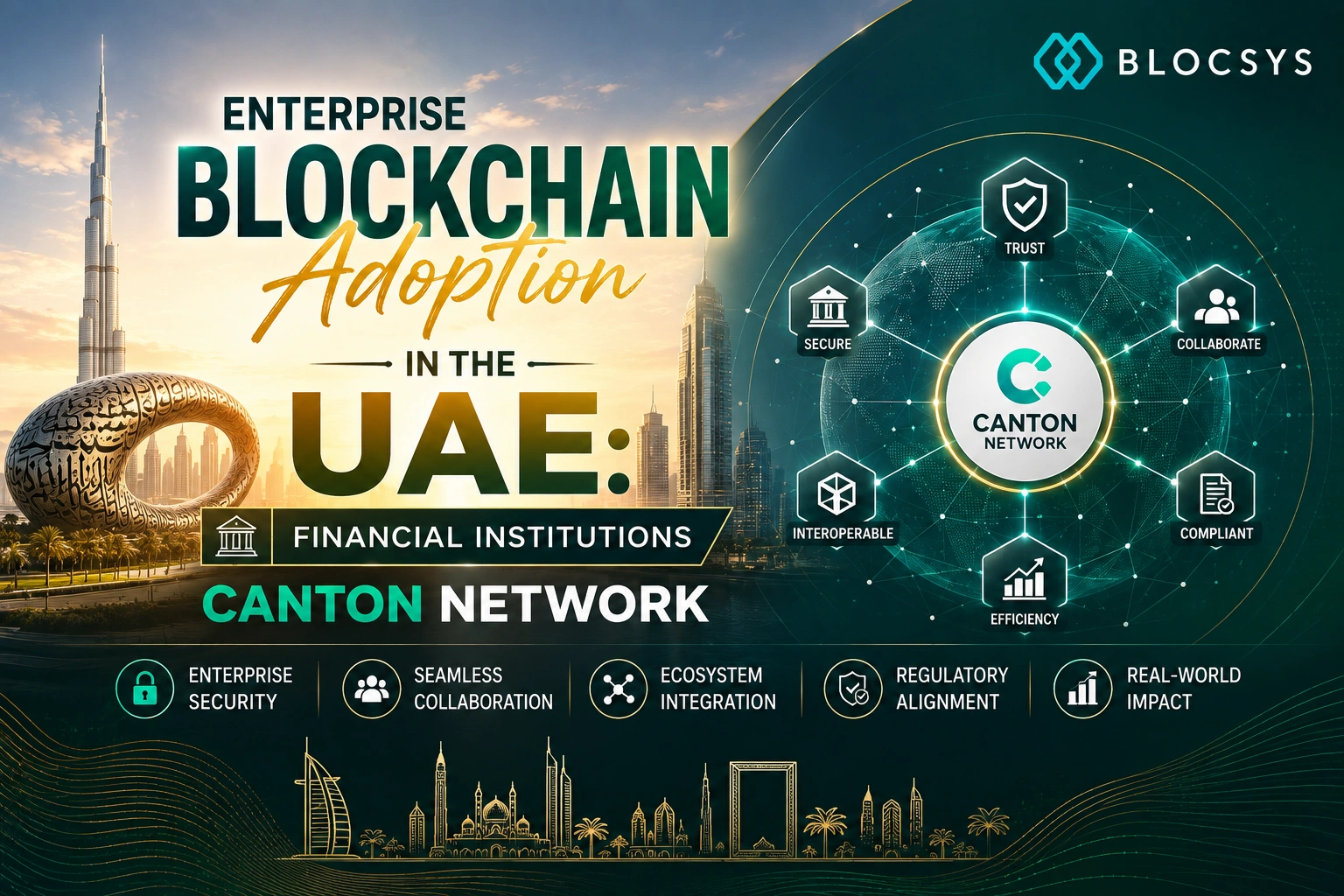
If you’re a bank CTO, CIO, or digital assets lead in the UAE, you’ve probably already run one pilot that looked promising on paper and then stalled in integration. The hard part isn’t proving that blockchain can move value. The hard part is making it survive custody controls, compliance reviews, audit demands, and core banking reality without turning into another isolated sandbox.
That’s why Enterprise Blockchain Adoption in the UAE: Financial Institutions Canton Network has moved from theory to operating discussion. The market is no longer asking whether enterprise blockchain has a place in regulated finance. It’s asking what it takes to connect it to bank workflows, who owns the control points, and where the implementation risks usually hide.
Table of Contents
- Why UAE Banks Are Rethinking Settlement Infrastructure
- How Canton Network Works for Regulated Institutions
- DAML Smart Contracts and Institutional Authorization
- UAE Banking Use Cases and the Regulatory Structure Behind Them
- The Integration Problem Banks Underestimate
- Why GIFT City and IFSCA Matter to UAE Institutions
- The Next 12 to 24 Months for UAE Institutional Finance
- Frequently Asked Questions on Enterprise Blockchain in the UAE
Why UAE Banks Are Rethinking Settlement Infrastructure
A UAE bank CTO who has already funded two blockchain pilots is usually asking a different question from the one buyers asked three years ago. The question now is whether the rail can carry regulated settlement, tokenised assets, and cross-institution workflows without breaking existing controls or forcing a parallel operating model.
The UAE’s institutional blockchain market in banking has already moved beyond experimentation. Ken Research estimates the UAE Blockchain in Banking Market at approximately USD 290 million, and says the BFSI sector accounts for more than half of blockchain adoption in the UAE, driven by fraud reduction, operational efficiency, and regulatory compliance Ken Research. That market size matters because it points to a real procurement environment, not a lab exercise.
A wider ecosystem is also in place. A World Economic Forum white paper on the UAE found more than 40 government entities, 120 blockchain companies, and 200-plus initiatives working across public and private sectors World Economic Forum white paper. For a bank, that means shared identity projects, settlement coordination, and document verification are no longer fringe ideas. They sit inside a national digital infrastructure environment.
Practical rule: if a blockchain proposal can’t show how it fits custody, compliance, and reconciliation, it’s still a pilot, no matter how polished the demo is.
The policy backdrop has also changed. Dubai and the wider UAE now have live institutional blockchain usage with scale signals that matter to finance leaders, including regulated digital asset activity and production settlement experimentation Dubai adoption coverage. That means decision-makers are weighing production rails, not abstract architecture debates. A bank that waits for perfect clarity usually ends up integrating under pressure later.
For readers mapping Canton to their own stack, the useful outcome is simple. By the end of this article, you should have a clear picture of Canton Network’s fit for UAE institutional finance, the integration work that matters, and a defensible path from sandbox to controlled production. If your current roadmap touches stablecoin settlement, tokenised securities, or cross-border payments, the change is already underway, and the question is whether your operating model is ready for it. For a practical angle on settlement design, see this discussion of stablecoin settlement infrastructure for tokenized assets.
| Adoption driver | Ecosystem enabler |
|---|---|
| Fraud reduction in regulated workflows | 40+ government entities already active in blockchain initiatives |
| Operational efficiency across bank processes | 120 blockchain companies supporting enterprise use cases |
| Regulatory compliance and controlled deployment | 200-plus initiatives across public and private sectors |
| Institutional appetite for live production rails | USD 290 million UAE blockchain in banking market Ken Research |
How Canton Network Works for Regulated Institutions
Canton works like a controlled shared ledger rather than a public broadcast network. Each institution keeps its own permissions and governance, then synchronises only the transaction state that another counterparty needs to see. That design matters in regulated finance because banks don’t want full ledger exposure, they want shared settlement logic without leaking positions, terms, or internal records.
This is why Canton fits collateral mobility, internal transfer orchestration, and regulated asset settlement better than retail-style blockchain use cases. A bank can keep bilateral terms confidential while still participating in a common workflow across institutions. That makes it more suitable for bank-to-bank tokenisation than a public chain that exposes everything by default.
The architecture also lines up with enterprise control boundaries. Operations teams care about finality and workflow consistency. Compliance teams care about who can see what, and who can prove it later. Technology teams care about how state moves across systems without breaking segregation or creating a reconciliation mess.
A regulated institution should evaluate Canton by asking one question, can we share the minimum necessary state and still complete the workflow end to end?
For interoperability work, the technical conversation becomes much easier when teams stop describing blockchain as “distributed” and start describing it as selectively shared state with enforced permissions. That language maps to bank reality. It also explains why public transparency is often the wrong default for capital markets, treasury, and custody operations.
For teams comparing architecture options, the relevant Blockchain Development service snapshot is simple, it covers custom blockchain development for enterprises, startups, and governments using public, private, and hybrid blockchain networks. That’s the right lens for Canton design discussions, because the decision is not whether to use blockchain, but which control model matches the workflow.
The same design logic is why Canton interoperability and public blockchain integration has become a practical question for institutions, not just a technical curiosity.
DAML Smart Contracts and Institutional Authorization
DAML matters because it models rights, obligations, and authorisation, not just token movement. That is a better fit for institutions that need to encode who can do what, under which condition, and with what visibility. In a bank workflow, that usually means treasury, legal, compliance, and operations all need to agree before a transaction can move.
Compared with generic smart contract stacks, DAML gives regulated teams a cleaner way to express institutional roles. It’s useful where one party can see a transaction, another can approve it, and a third can only audit the outcome later. That separation of concerns is exactly what capital markets and collateral workflows need.
Here’s the practical comparison.
| DAML on Canton | General-purpose stack |
|---|---|
| Confidentiality by design | Often public by default |
| Institutional authorisation controls | Usually requires extra layer design |
| Workflow-based legal logic | More token-centric execution |
| Cross-institution coordination | More manual integration work |
The difference becomes obvious when you look at regulated instruments. A corporate bond tokenisation workflow needs issuance rules, transfer permissions, investor eligibility, and settlement logic tied together. That’s where a corporate bond tokenization platform is relevant, because the platform snapshot focuses on digital bond issuance, smart contract automation, faster settlements, and investor management for banks and capital markets.
If your bank is asking whether DAML is “just another smart contract language”, the answer is no. It’s closer to a controlled workflow layer for financial agreements. That makes it easier to align with internal controls, external counterparties, and audit expectations.
For a deeper security lens, the DAML security and permissioned smart contracts guide is a useful reference when teams are mapping contract logic to enterprise risk controls.
Rule of thumb: if legal and operations can’t point to the same contract state, the model isn’t ready for a regulated launch.
UAE Banking Use Cases and the Regulatory Structure Behind Them
UAE banking blockchain use cases are converging around licensed virtual asset service provider operations, real-world asset tokenisation, and stablecoin issuance Chambers practice guide. Each use case pulls a different control thread. One touches custody and licensing. Another touches securities handling and asset servicing. The third touches payments and reserve logic, which means treasury, risk, and compliance all have a stake in the design.
The regulatory structure is multi-jurisdictional, so enterprise implementation cannot be built around one rulebook. Federal regulators, Dubai-level regulators such as VARA and DFSA, and financial free zones like ADGM and DIFC each shape the operating perimeter. Production design has to reflect that overlap from the start, otherwise legal review becomes the bottleneck later and integration teams end up reworking controls after the pilot has already been approved.
A sandbox still has value, but only if teams treat it as a control validation exercise. For a plain-language explanation of that control gap, the sandbox environment security guide is a useful reference for teams testing permissions, access boundaries, and incident response before production.
Dubai already offers a practical example. The DIFC and Mashreq blockchain KYC platform prepares each corporate KYC record during licensing, then shares it, with customer approval, via blockchain to Mashreq and eventually other financial institutions and licensing authorities. That model matters because it turns identity into reusable infrastructure rather than a one-off onboarding event.
The implementation lesson is straightforward. Reusable identity works only when compliance teams, legal teams, and client onboarding teams agree on consent, data scope, and update responsibility. If they do not, the blockchain layer becomes a faster way to distribute bad records, and operations still carry the cleanup burden.
For teams exploring tokenised ownership structures, the private equity tokenization guide for the UAE fits naturally here because it shows how regulated ownership and transfer logic has to be designed around local market rules and internal approval paths.
The Integration Problem Banks Underestimate
Most banks don’t fail on Canton because the network is weak. They fail because custody, keys, compliance, and core settlement systems were never wired to support live blockchain workflows. The board sees “tokenisation” and “privacy” in the deck. The implementation team sees HSMs, approval chains, reconciliations, and reporting feeds that all need to keep working.
Custody integration is usually the first hidden constraint. Existing HSM and key management policies were built for current asset rails, so the security team must decide how signing authority, recovery, and segregation of duties will work when blockchain nodes become part of production. That’s not a blockchain ideology issue. It’s an operational control issue.
Compliance integration is the second layer. AML, KYC, sanctions screening, and transaction monitoring can’t be bolted on after go-live. They need event feeds, alert routing, and exception handling that fit the bank’s current risk engine. The same goes for regulatory reporting, because audit trails have to be consistent across internal systems and external obligations.
If the reconciliation team can’t explain one ledger movement to an auditor in plain language, the design still needs work.
The regional signal is clear that the market is moving toward regulated workflows, not another experiment. Further Asset Management signed an MOU to explore a Canton Super Validator in the UAE, tying the network directly to tokenisation, collateral mobility, and on-chain market infrastructure in Abu Dhabi Further Asset Management signal. In parallel, market reporting says Digital Asset raised $355 million to expand Canton’s institutional infrastructure market reporting on Digital Asset capital raise. The point is not the fundraising story itself. The point is that the ecosystem is funding regulated integration capacity.
For architecture teams, a key derivation and reconciliation guide is a useful reference point when designing wallet and ledger consistency models, even though the stack context is broader than Canton. It reinforces the same practical truth, key management and reconciliation are not back-office afterthoughts, they’re the operating core.
A Tokenization Platform Development engagement also has to include how the token platform talks to custody, compliance, and settlement services. The platform snapshot here is focused on secure and compliant tokenisation for RWAs, securities, real estate, commodities, and digital assets, which is exactly the sort of scope banks need when they move beyond proof of concept.
Why GIFT City and IFSCA Matter to UAE Institutions
UAE institutions should pay attention to GIFT City and IFSCA because they create a complementary corridor for regulated digital asset activity, not a competing narrative. For a bank in Dubai or Abu Dhabi, the useful question is whether tokenised instruments can move across compliant rails between jurisdictions without forcing a fresh legal build each time. That’s where this hub matters.
One scenario is treasury and liquidity management. A UAE institution can structure tokenised flows that interact with counterparties operating in an IFSC environment, where the regulatory perimeter already supports fintech, digital assets, and institutional banking activity. Another scenario is tokenised fund or asset distribution, where issuance, transfer, and servicing rules need to stay aligned across both sides of the corridor.
A third scenario is cross-border settlement design. If both sides of a transaction stack are built for regulated, permissioned workflows, then Canton-style infrastructure becomes more valuable because it can support shared logic without exposing unnecessary state. That is a practical operating advantage, not a branding point.
Implementation roadmap is straightforward if the bank treats it like a systems programme.
Phase 1 Scope the business outcome
Pick one measurable workflow, such as settlement, tokenised issuance, or reusable KYC. Treasury, product, and operations should own the business case together, because isolated ownership usually leads to a stalled pilot.
Phase 2 Clear the regulatory perimeter
Legal, compliance, and risk need to map the activity to relevant oversight, including VARA, DFSA, and ADGM where appropriate. This is also where internal audit should be involved early, not after architecture is frozen.
Phase 3 Integrate the control plane
Security, operations, and core banking teams need to connect custody, KYC, reporting, and ledger events. If those teams don’t share the same status model, production will produce exceptions faster than it produces value.
Phase 4 Launch with limits
Start with defined transaction caps, clear audit trails, and exit criteria. That gives the board something measurable and gives operations a way to stop the rollout if controls drift.
For banks comparing providers, the checklist should be blunt. Ask who owns custody integration, who maps compliance events, who signs off on reconciliation, who maintains audit evidence, and who carries incident response. If the partner can’t answer those questions in operational terms, the deployment path isn’t mature enough.
The Next 12 to 24 Months for UAE Institutional Finance
The next two years will be shaped by regulated stablecoins, tokenised Treasuries, repo workflows, and enterprise blockchain rails converging instead of competing. The UAE already has live signals in that direction, including the approval of the dirham-backed DDSC stablecoin, plus institutional blockchain infrastructure used for real-time cross-border payments, settlements, and remittances. That makes the next phase a practical integration period for banks that want to be ready before production expectations harden across the market.
The main error now is waiting for a single universal model. The market is moving through regulated nodes, private permissions, and interoperable rails that fit specific workflows. Canton is relevant in that environment because it fits high-volume institutional usage and controlled state sharing, not because it is trying to behave like a public retail chain.
Forward indicator: if your institution is still treating tokenisation as a front-office experiment, your competitors are already wiring it into custody and settlement.
Banks should watch four indicators closely. First, tokenised repo and settlement activity on institutional rails. Second, Super Validator deployments in the region. Third, licensing and sandbox activity across ADGM and DIFC. Fourth, the pace at which treasury, compliance, and operations teams start asking for live production controls instead of demo environments.
The integration work now sits with specific teams. Treasury owns the business case. Compliance defines what can move and who can see it. Operations owns reconciliation and exception handling. Security and platform engineering own node access, key management, and infrastructure controls. When those owners are not aligned, the pilot stays isolated from core banking, which is where most programs lose momentum.
For institutions that need production engineering rather than another slide deck, Blocsys is positioned around the exact integration problems discussed here. That includes DAML smart contract development, Canton Network node and validator integration, tokenisation builds for real-world assets and corporate bonds, KYC and digital asset platform development, and Web3 staff augmentation for in-house teams that need extra engineering capacity. A useful starting point is the earlier discussion of why financial institutions are adopting DAML and Canton Network for digital assets, because it connects the architecture conversation to delivery work.
The same support model can extend into hire blockchain developers, hire Web3 developers, and adjacent platform work when a bank’s internal team needs extra engineering muscle.
Emirates Crypto and Enterprise Blockchain Adoption in the UAE
The growth of emirates crypto is contributing to the UAE’s expanding digital-asset ecosystem, where financial institutions are exploring blockchain for tokenized assets, digital payments, settlement, and institutional financial workflows. As enterprise blockchain adoption increases, platforms such as Canton Network can provide infrastructure for connecting financial institutions through secure and controlled blockchain environments. This allows UAE-based institutions to explore new digital-asset opportunities while maintaining the operational controls, privacy, interoperability, and compliance requirements expected in enterprise finance.
Frequently Asked Questions on Enterprise Blockchain in the UAE
What does enterprise blockchain mean for a regulated financial institution? It means a permissioned or privacy-aware blockchain designed to fit internal controls, audit requirements, and counterparty rules. For banks, the value is controlled workflow automation, not open participation. Compliance, operations, and security usually own the control points.
Why are UAE banks adopting Canton Network specifically? Canton fits regulated finance because it allows institutions to share only the transaction state they need, while keeping permissions and governance separate. That makes it suitable for settlement, tokenisation, and bilateral workflows where confidentiality and interoperability both matter.
How does DAML improve enterprise blockchain applications? DAML helps banks encode rights, obligations, and authorisation into the workflow itself. That matters because regulated transactions are rarely just “send token A to B”. They involve approvals, eligibility, legal terms, and audit visibility across multiple teams.
What are the main benefits of enterprise blockchain in banking? The main benefits are controlled settlement, reusable identity, better coordination across institutions, and tighter auditability. It also helps reduce manual reconciliation when the bank’s custody, compliance, and ledger systems are integrated properly.
How does Canton Network support digital assets and tokenisation? Canton is designed for regulated asset workflows, so it can synchronise required state across institutions without exposing full ledger details. That makes it useful for tokenised securities, collateral movement, and settlement patterns that need confidentiality.
What role do GIFT City and IFSCA play in institutional blockchain? They matter as part of a cross-border corridor for regulated digital assets and institutional fintech activity. For UAE institutions, they can support compliant structures for treasury, tokenised flows, and cross-border settlement design.
What are the biggest implementation challenges? The main challenges are custody integration, key management, compliance wiring, core banking reconciliation, and audit trail design. Most production failures come from operating-model gaps, not from the blockchain network itself.
How should a UAE bank choose an enterprise blockchain partner? Pick a partner that can speak to controls, integration, and delivery ownership in bank language. They should understand custody, DAML, Canton, reporting, and production governance, not just protocol features.
Who should own the implementation inside the bank? Treasury should own use case value, security should own keys and access, compliance should own monitoring, operations should own settlement flow, and internal audit should define evidence requirements. That shared ownership avoids late-stage disputes.
Can blockchain replace existing core banking systems? No, and it shouldn’t try to. In a regulated bank, blockchain usually sits alongside core systems as a coordination layer. The winning design connects to existing ledgers instead of forcing a wholesale replacement.
What is the safest way to move from sandbox to production? Start with one contained workflow, validate the regulatory perimeter, integrate custody and reporting, then launch with limits and exit criteria. The production go-live should be a control decision, not a marketing milestone.
How long does it take to make Canton production-ready in a bank? That depends on custody, compliance, and core-system complexity. The timeline is set by internal sign-off, integration depth, and whether the bank already has reusable identity or tokenisation components in place.
Blocsys Technologies helps banks, fintechs, asset managers, and government teams turn blockchain strategy into production systems, from Canton and DAML integration to tokenisation, KYC, and regulated digital asset platforms. If you’re planning enterprise blockchain work in the UAE or building a cross-border institutional workflow, visit Blocsys Technologies and start a conversation about the controls, architecture, and delivery path that fit your institution.
