
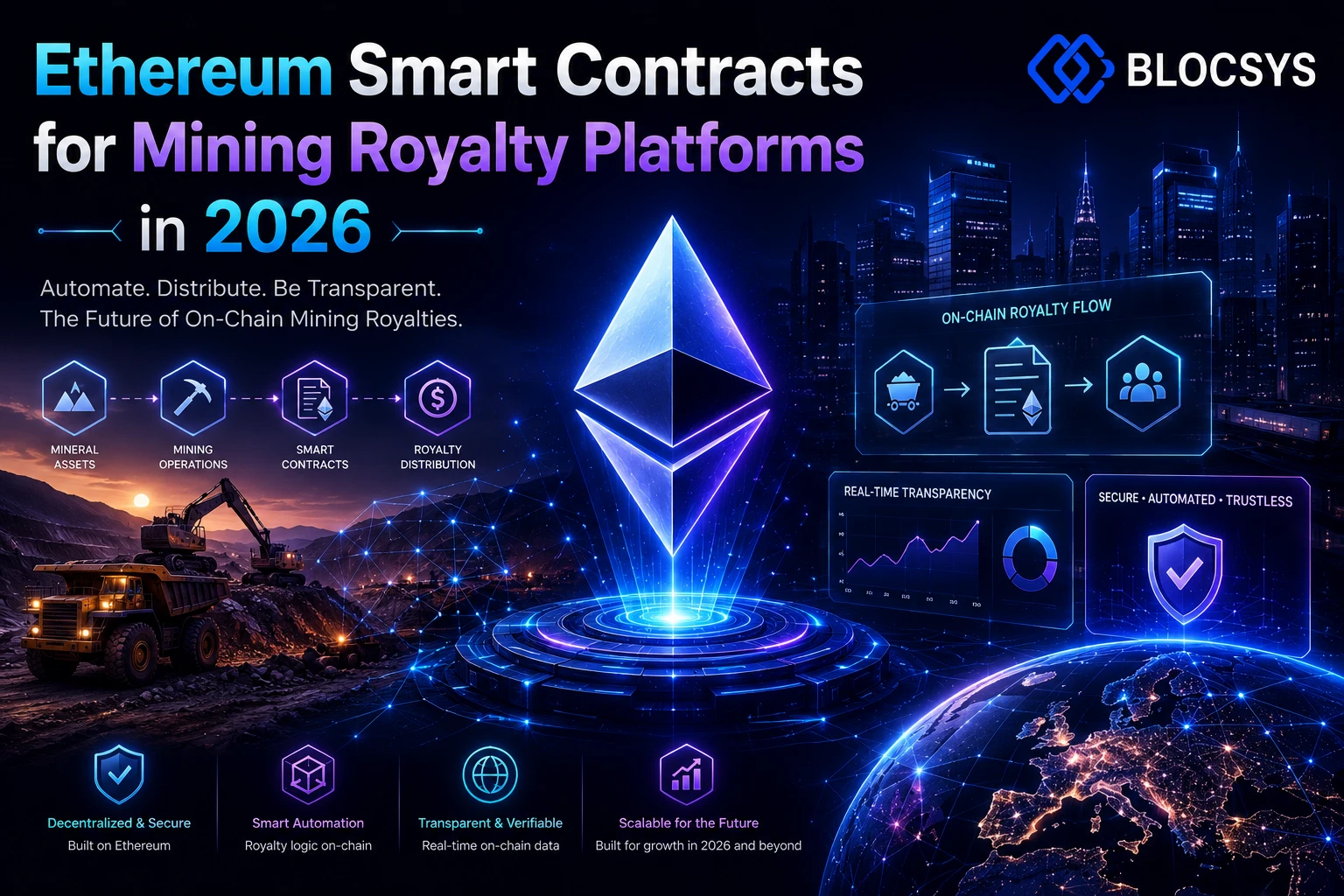
If you’re evaluating a mining royalty platform right now, the same questions usually surface fast. Can royalty cash flows be tokenised without creating a reconciliation mess? Can payments be automated without losing control over compliance, auditability, and investor reporting? And if Ethereum is still the settlement layer, what belongs on mainnet versus a rollup in 2026?
That’s the practical lens that matters. Mining companies want faster capital formation and cleaner royalty administration. Investment firms want enforceable ownership logic, transparent payout rules, and infrastructure that won’t collapse under operational edge cases. Founders and platform teams want an architecture they can ship, audit, and scale.
Ethereum smart contracts for mining royalty platforms in 2026 are no longer just a conceptual fit. They are a workable foundation for tokenised royalty systems, provided the platform is designed around real constraints: offchain data dependency, gas sensitivity, immutable contract risk, and jurisdiction-specific compliance workflows.
Table of Contents
- The Challenge with Traditional Mining Royalty Management
- What Is an Ethereum-Based Mining Royalty Platform
- How Ethereum Smart Contracts Automate Royalty Distribution
- The Mining Royalty Tokenization Process Explained
- A Blueprint for Your 2026 Platform Architecture
- Unlocking Value Benefits for Miners and Investors
- Build Your Mining Royalty Platform with Blocsys
- Frequently Asked Questions FAQ
The Challenge with Traditional Mining Royalty Management
Traditional royalty administration still breaks down in the same places. Revenue arrives through multiple operating systems, counterparties use different reporting standards, and each payout cycle turns into an exercise in matching production records, pricing inputs, contractual waterfall rules, and beneficiary entitlements. That doesn’t scale cleanly, especially when royalty interests are split across funds, originators, operators, and minority holders.
The problem isn’t only delay. It’s uncertainty. When stakeholders can’t see the same ledger, every distribution becomes a potential dispute about timing, basis, deductions, or entitlement.
Where the friction actually sits
Most mining royalty structures still rely on a patchwork of legal agreements, spreadsheets, custodial banking rails, and manual approvals. That creates several predictable pain points:
- Opaque reporting: Investors often receive statements, not live visibility into entitlement logic or payment status.
- Manual reconciliation: Finance teams spend time validating source data instead of overseeing exceptions.
- Delayed distributions: Payment timing depends on back-office coordination, not a deterministic rules engine.
- Dispute exposure: A small mismatch in output, pricing, or ownership records can trigger larger governance problems.
- Poor transferability: Secondary transfers of royalty interests are operationally heavy and legally awkward.
A mining executive usually feels this as administration drag. An investment firm feels it as reduced confidence in the asset’s operational integrity.
Practical rule: If a royalty platform still depends on spreadsheet-based entitlement calculation at payout time, it isn’t really a platform. It’s a manual service layer with a blockchain wrapper.
Why investors hesitate
Liquidity is another weak point. Traditional mining royalties can be attractive, but they are hard to break into smaller investable units and harder still to transfer efficiently between eligible participants. That limits who can participate and how quickly a royalty issuer can widen its capital base.
The accounting model also discourages smaller, more frequent distributions. When each payment cycle creates disproportionate admin overhead, operators tend to batch, delay, or simplify. That may be manageable in a closed group of experienced counterparties, but it doesn’t work well for a modern digital asset product.
Blockchain becomes less of a branding choice and more of an operational correction. A royalty platform needs one shared execution layer, one auditable state history, and one deterministic rules engine. Without those, tokenisation only adds a new interface to an old set of bottlenecks.
What Is an Ethereum-Based Mining Royalty Platform
A mining company closes a concentrate sale, the operator confirms the payable amount, and multiple royalty holders expect accurate settlement under different contract terms and jurisdictional restrictions. An Ethereum-based mining royalty platform is the system that turns that process into controlled software instead of a monthly reconciliation exercise.
At its core, an Ethereum-based mining royalty platform records royalty ownership, enforces transfer and payout rules, and settles distributions through smart contracts deployed on Ethereum or Ethereum-compatible infrastructure, usually with an L2-first design in 2026. For an executive team, the practical point is simple. The platform becomes the operating layer for royalty administration, investor servicing, and auditability across the life of the asset.
What the platform actually includes
A workable platform combines legal structure, contract logic, tokenized ownership records, and onchain settlement. If any one of those pieces is weak, the product looks digital on the surface but still depends on manual exception handling underneath.
| Component | What it does | Why it matters |
|---|---|---|
| Legal rights layer | Connects the token or onchain record to an actual royalty claim | Keeps token ownership tied to enforceable offchain rights |
| Smart contract layer | Encodes transfer rules, payout logic, snapshots, and permissions | Reduces manual execution in routine operations |
| Token layer | Represents fractional ownership or economic claims | Makes a royalty stream easier to divide, hold, and transfer within policy limits |
| Settlement layer | Records final state changes and distributions onchain | Creates an auditable trail for ownership and payment events |
Mining royalty tokenization fits within the broader real-world asset model, but the implementation details matter more than the label. The token is only the container. The asset is the legally defined claim on royalty cash flows, plus the controls that govern who can hold it, when it can transfer, and how distributions are approved and recorded. That distinction is often missed in early platform designs, especially where teams blur on-chain vs off-chain royalties.
Why Ethereum still matters in 2026
Ethereum remains the default base layer for enterprise royalty platforms because it offers mature smart contract tooling, established token standards, and settlement records that institutional investors and auditors already understand. In practice, many production systems will execute day-to-day activity on Ethereum L2s for fee control and throughput, while anchoring state and security assumptions to Ethereum.
That matters for mining because royalty platforms are long-duration systems. They need contract logic that can survive staff turnover, operator changes, refinancing events, and secondary transfers. Ethereum gives teams a deep vendor ecosystem for custody, identity, token standards, analytics, and compliance integrations. It also gives investment firms a familiar diligence path.
Security is part of the definition, not an add-on. A royalty contract may hold entitlement logic, transfer restrictions, and payment routing for years, so the design should include formal role controls, upgrade governance, pause conditions, and independent review through a smart contract auditing process for tokenized royalty platforms.
Adoption conditions also support this direction. The World Economic Forum’s work on asset tokenization reflects how financial infrastructure is shifting toward programmable representations of real-world claims. For mining issuers, the implication is practical. A royalty platform built on Ethereum is no longer a crypto experiment. It is a structured way to issue, govern, and service a global investment product with better operational discipline than legacy royalty administration.
How Ethereum Smart Contracts Automate Royalty Distribution
The core automation model is straightforward. A smart contract holds the payout rules, receives verified revenue inputs, calculates each eligible holder’s share, and settles the distribution to wallets without relying on a finance team to recalculate entitlements every cycle.
What makes this useful in mining is not the token itself. It’s the shift from discretionary back-office processing to deterministic execution.
The payout engine in practice
A technically sound royalty contract should combine oracle-fed revenue verification with a pro-rata payout engine. Smart contracts can’t natively read external sales or performance data, so they need an oracle layer. Chainlink notes that Chainlink Functions can query external APIs and return verified data onchain for distribution logic, allowing a platform to calculate payouts from inputs such as extractor output reports or commodity-grade pricing and then execute automated stablecoin settlement, as described in Chainlink’s guide to tokenized royalties and smart contract distribution.
A practical payout cycle usually looks like this:
- Revenue data is produced offchain. This might come from operator reports, production systems, or pricing feeds.
- The oracle layer verifies and submits the data. The contract receives the approved input in a format it can use.
- A snapshot is taken. The platform identifies who held the royalty tokens or entitlement positions at the relevant block or record time.
- The contract calculates pro-rata claims. Each wallet’s share is determined by the encoded ownership logic.
- Stablecoin payouts are executed. Funds are distributed directly to eligible wallets and the full event trail remains onchain.
For teams weighing design choices, this breakdown of on-chain vs off-chain royalties is useful because it shows where automation is strong and where legal or commercial logic still needs an external system of record.
What works and what fails
What works is narrow, explicit contract design. Keep the onchain contract focused on entitlement, distribution, auditability, and clearly bounded permissions. Put raw reporting complexity, document storage, and heavy analytics offchain.
What fails is trying to force messy operational reality directly into immutable code. If the data model is unclear, the contract won’t fix it. It will preserve the confusion more efficiently.
A royalty smart contract should never be the first place where parties discover they disagree on ownership logic.
Security matters here because distributions are irreversible once executed. Before deployment, the payout engine, access controls, oracle callbacks, emergency pause rules, and treasury flows should go through dedicated review. That’s why teams building these systems usually include smart contract auditing as a release gate rather than a late-stage checkbox.
The Mining Royalty Tokenization Process Explained
Mining royalty tokenisation usually starts long before any token is minted. The core work begins with turning a contractual revenue right into a structure that can be represented digitally without losing legal enforceability or commercial clarity.
That journey is less about crypto mechanics and more about clean translation between legal, financial, and technical layers.
From legal right to digital asset
A typical process moves through four stages.
First comes legal and financial structuring. The royalty interest needs a clean holder, clear entitlement language, transfer rules, and a compliant issuance model. Many projects use a ring-fenced entity or similar structure so the onchain token maps to a specific economic right rather than a vague platform promise.
Second is contract modelling. The platform team converts commercial terms into machine-readable logic. That includes ownership records, transfer restrictions, payout frequency, snapshot rules, treasury permissions, and exception handling.
Third is token issuance. The platform mints the asset representation. Depending on the design, this may function as a fractional economic claim, a restricted investor instrument, or a permissioned digital security format.
Fourth is platform distribution and lifecycle management. Investors onboard, pass eligibility checks, receive wallet allocations, and begin interacting with a system that supports reporting, transfers, and distributions.
For firms mapping this journey in more detail, this guide to mining royalty tokenization is a useful reference point because it frames the commercial and technical path as one integrated process.
Where projects usually slow down
The slowest stage is rarely smart contract coding. It’s alignment. Teams often discover late that the royalty agreement leaves room for interpretation, the reporting cadence is inconsistent, or the investor transfer model doesn’t fit the jurisdictional wrapper.
Common failure points include:
- Unclear entitlement definitions
- Weak linkage between token and legal claim
- Incomplete compliance assumptions
- No operating model for disputes or corrections
- Treasury design that ignores payout frequency realities
The cleanest token structure in the world won’t help if the offchain royalty agreement still needs human interpretation at every distribution cycle.
The strongest projects treat tokenisation as controlled infrastructure design, not digital packaging.
A Blueprint for Your 2026 Platform Architecture
For production systems, the most practical architecture in 2026 is an L2-first, EVM-compatible stack. Ethereum mainnet gives you durable settlement and ownership anchoring. Rollups give you a workable cost profile for minting, snapshots, frequent distributions, and routine state updates.
That split matters because mining royalty platforms rarely operate like low-frequency vaults. They accumulate many operational events: entitlement changes, eligibility checks, payout calculations, reporting updates, and periodic investor actions.
The right split between L1 and L2
Ethereum’s own developer documentation supports this architecture direction. For an Ethereum royalty platform in 2026, the most practical design is an L2-first, EVM-compatible stack, where teams push minting and payout logic onto rollups while keeping settlement and ownership on Ethereum, as outlined in Ethereum’s smart contract documentation.
In practice, the split looks like this:
| Layer | Best use in a mining royalty platform | What to avoid |
|---|---|---|
| Ethereum L1 | Ownership anchoring, final settlement records, critical governance contracts | Frequent micro-payout execution |
| L2 rollup | Snapshotting, payout processing, user interactions, routine contract actions | Weakly monitored bridge dependencies |
| Offchain services | KYC, reporting pipelines, analytics, document management, CRM workflows | Unverifiable revenue inputs |
| Oracle network | Delivery of approved production, pricing, or revenue data to contracts | Ad hoc manual operator uploads without validation |
This is also where compliance design becomes operational, not theoretical. A mining royalty platform serving global markets needs wallet screening, investor eligibility logic, transfer restrictions, tax-aware reporting, and admin permissions that are narrow enough to pass scrutiny.
The modules that matter
A strong 2026 stack usually includes these modules:
- Permissioned onboarding layer: KYC and AML checks should determine who can receive, hold, or transfer restricted royalty assets.
- Oracle-fed data ingestion: Revenue and pricing inputs must be validated before they touch the payout contract.
- Distribution engine: This handles snapshots, entitlement calculations, payout batching, and failed transfer management.
- Treasury controls: Stablecoin custody, reserve management, and payout approvals need auditable workflows.
- Role management: Access should be segmented across finance, compliance, operator, and technical roles. For teams reviewing permission models, this RBAC best practices guide is a useful operational reference.
- Investor interface: Holders need a dashboard that shows positions, payout history, notices, and document access without exposing sensitive admin functions.
The central design trade-off is simple. The more frequent and granular the distributions, the more dangerous it is to rely on L1-only execution. General platform overviews still frame Ethereum as processing roughly 20 to 40 tps in practice and note growing adoption of L2s and EVM-compatible chains to address cost and scalability constraints, according to PixelPlex’s smart contract platform overview. That matters when your platform must support many small royalty events while also carrying compliance overhead.
For enterprise teams preparing architecture, governance, and control requirements, a structured RWA tokenization checklist for 2026 helps separate what belongs in contract code from what belongs in operational policy.
Unlocking Value Benefits for Miners and Investors
A mining company with a producing asset and a financing target does not need another opaque fund structure. It needs a way to sell a defined share of future royalty cash flow, enforce the rules consistently, and give investors reporting they can verify without waiting for a quarterly reconciliation cycle. That is the business case for tokenised royalties in 2026.
Value only shows up when the platform reduces friction for both sides of the transaction. If the issuer still relies on manual spreadsheets and side letters, or if investors still depend on trust-heavy reporting, the technology layer has not solved the problem.
For royalty originators
For miners, royalty holders, and project sponsors, tokenisation changes the financing toolkit in practical ways.
- Wider access to capital: A royalty interest can be divided into smaller positions and offered under a compliant structure to a broader set of eligible investors.
- Lower administrative overhead: Entitlements, payout calculations, investor records, and notice delivery can run through a controlled system instead of fragmented manual processes.
- More precise product design: Teams can issue exposure to a single mine, a ring-fenced revenue stream, a defined production window, or another clearly scoped economic right without wrapping everything into common equity.
That precision matters. In mining finance, investors often want exposure to cash flow from a specific asset or jurisdiction, not to corporate-level balance sheet risk across the whole group.
Tokenisation also improves optionality. Originators can test smaller issuances, structure follow-on tranches, or segment investor classes without rebuilding the operating model each time. That gives finance teams more room to match capital formation to production plans, reserve development, or refinancing windows.
For investors and platform operators
Investors usually ask a simple question first. How do I know the asset, my rights, and the payout process are being administered correctly?
A well-designed Ethereum-based platform answers that with system behavior, not marketing language. Ownership records are time-stamped. Distribution logic is deterministic. Transfer restrictions can be enforced in code and through offchain compliance checks. Payment history is easier to audit because the platform keeps a consistent entitlement record across the token lifecycle.
For investors, the benefits are straightforward:
- Clearer ownership evidence
- More transparent payout logic
- Auditable distribution records
- Potential secondary transfer paths, subject to legal restrictions
- Direct exposure to a real cash-flow instrument rather than synthetic price exposure
Operators benefit in a different way. They get fewer exceptions, tighter controls, and a cleaner operating perimeter for finance and compliance teams. A disciplined token management system for digital asset operations supports investor onboarding, entitlement administration, transfer approvals, document access, and reporting from one controlled environment.
There is also a real trade-off. Frequent royalty payments sound attractive to investors, but small onchain distributions can become inefficient if the architecture is poorly chosen. Teams that want monthly or event-driven payouts usually get better economics from an L2-first design with batched settlement, while reserving Ethereum mainnet for higher-assurance checkpoints, governance actions, or final state anchoring.
That is the difference between a pilot and a platform. A pilot proves that tokens can represent royalty interests. A platform proves that the business can issue, service, govern, and report on those interests at scale.
Build Your Mining Royalty Platform with Blocsys
A mining royalty platform isn’t a single smart contract. It’s a coordinated system that sits across legal structuring, asset modelling, oracle design, payment automation, security controls, onboarding, and reporting. If the implementation partner only talks about token minting, they’re missing the hard part.
What an implementation partner should handle
For enterprise-grade delivery, the build scope usually needs to cover:
- Royalty model translation: Turning commercial agreements into precise entitlement logic.
- L2-first contract architecture: Keeping routine execution efficient while preserving secure settlement design.
- Oracle integration: Bringing external revenue inputs onchain in a controlled and auditable way.
- Compliance workflows: Connecting KYC, AML, permissions, and transfer restrictions to platform behaviour.
- Security review and upgrade planning: Managing immutable logic carefully, with clear governance over admin powers and emergency actions.
- Investor operations: Wallet flows, dashboard UX, cap table visibility, distribution reporting, and document handling.
Where Blocsys fits
Blocsys custom blockchain development services are relevant here because the company builds blockchain infrastructure for tokenisation systems, trading platforms, and compliance-aware digital asset products. For a mining royalty use case, that kind of scope maps directly to smart contract development, payout orchestration, operator dashboards, and integration with external compliance and treasury systems.
If your organisation is assessing a new issuance, modernising an existing royalty administration workflow, or designing a cross-border Ethereum royalty management platform, the sensible next step is to pressure-test the architecture before code is written. That means validating asset structure, entitlement logic, oracle inputs, operational roles, and distribution mechanics together.
For teams that need adjacent support, Blocsys also offers real-world asset tokenization services and access to blockchain developers for Ethereum and digital asset platforms, which fits projects moving from concept into delivery planning.
Frequently Asked Questions FAQ
The questions below are the ones mining operators, royalty managers, and investment teams usually ask once the discussion moves from concept to implementation.
| Question | Answer |
|---|---|
| What is a mining royalty platform | A mining royalty platform is a system for administering royalty ownership, payout rules, reporting inputs, and investor access tied to mining revenue. On Ethereum, smart contracts hold the entitlement logic and settlement records, which reduces spreadsheet-driven administration and gives both operators and investors a clearer audit trail. |
| How do Ethereum smart contracts automate royalty payments | The contract stores the distribution rules, wallet eligibility checks, and record date logic. After verified production or revenue data arrives through the oracle stack, the system calculates each holder’s share and can route payments automatically based on the royalty agreement. |
| What is mining royalty tokenisation | Mining royalty tokenisation converts an economic interest in future royalty cash flows into a digital asset. The token represents the onchain ownership or payment right, while the legal agreements, issuer structure, and servicing model determine what that token legally entitles the holder to receive. |
| Why use Ethereum for mining royalty management | Ethereum remains a practical base layer for royalty platforms because it has mature tooling, proven settlement infrastructure, and broad support from custodians, wallet providers, and digital asset firms. In 2026, the stronger design is usually Ethereum plus an L2, with the L2 handling day-to-day transfers and distributions while Ethereum anchors final state and higher-value controls. |
| Can mining assets be tokenised without putting all data onchain | Yes. That design is usually preferred. Ownership logic, transfer restrictions, payment events, and selected proofs can sit onchain, while contracts, compliance files, reserve reports, and operational data remain in controlled offchain systems with signed references or hashes recorded where needed. |
| What are the biggest risks in a royalty smart contract system | The hard problems are usually legal and operational, not just technical. Common failure points include weak legal-to-token mapping, incorrect oracle data, payout edge cases, admin roles with too much authority, and transfer controls that do not match securities and jurisdiction requirements. Once capital is raised, fixing those mistakes is slow and expensive. |
| How is investor compliance handled in tokenised royalty platforms | Serious platforms split compliance across offchain and onchain layers. Identity checks, accreditation status, sanctions screening, and document review are typically handled in regulated systems, then the token contract uses whitelists, transfer gates, jurisdiction rules, and wallet permissions to enforce who can hold or receive the asset and enable automated settlement. |
| How can a company prepare for a 2026 launch | Start with asset definition, reporting discipline, and control design. If royalty calculations, source data ownership, investor eligibility, treasury operations, and dispute handling are still unclear, the project is not ready for build. Teams that launch well usually settle the legal structure, oracle model, and L2 operating approach before discussing issuance terms with the market. |
If you’re planning a mining royalty tokenisation project, evaluating Ethereum smart contracts for mining royalties, or designing an RWA platform for resource-backed cash flows, Blocsys Technologies can help you scope the architecture, development path, and operating model. For early budgeting, the software development cost estimator is a practical starting point. For a technical discussion around platform design, smart contract execution, and compliant rollout planning, connect with Blocsys directly.
Frequently Asked Questions
Can royalty cash flows be tokenised without creating a reconciliation mess?
Yes, provided the platform is designed around real constraints such as offchain data dependency, gas sensitivity, immutable contract risk, and jurisdiction-specific compliance workflows. A workable platform combines a legal rights layer, contract logic, tokenized ownership records, and onchain settlement so entitlement isn’t recalculated manually at payout time. If any one of those pieces is weak, the product looks digital but still depends on manual exception handling underneath.
What belongs on Ethereum mainnet versus a rollup in 2026?
Ethereum-based mining royalty platforms in 2026 are generally built with an L2-first design, using Ethereum or Ethereum-compatible infrastructure for settlement. The right split between L1 and L2 is described as part of the platform’s core architecture blueprint. This split matters for balancing gas sensitivity with the need for a shared, auditable execution layer.
What is an Ethereum-based mining royalty platform?
It’s a system that turns royalty settlement into controlled software instead of a monthly reconciliation exercise. When a mining company closes a concentrate sale and the operator confirms the payable amount, the platform records royalty ownership, enforces transfer and payout rules, and settles distributions through smart contracts. For an executive team, it becomes the operating layer for royalty administration, investor servicing, and auditability across the life of the asset.
Why do traditional mining royalty structures create problems for investors?
Traditional structures rely on a patchwork of legal agreements, spreadsheets, custodial banking rails, and manual approvals, leading to opaque reporting, manual reconciliation, delayed distributions, dispute exposure, and poor transferability. Investors often receive statements rather than live visibility into entitlement logic or payment status. Royalty interests are also hard to break into smaller investable units and hard to transfer efficiently, which limits liquidity and participation.
Can payments be automated without losing control over compliance and auditability?
The blog frames this as the central practical question platforms must answer, since firms want enforceable ownership logic, transparent payout rules, and infrastructure that won’t collapse under operational edge cases. A shared execution layer, one auditable state history, and one deterministic rules engine are positioned as the requirements for automation to work reliably. Without these, tokenisation only adds a new interface to the same old bottlenecks.
Why does blockchain matter more than just as a branding choice for royalty platforms?
Blockchain becomes an operational correction rather than a branding choice because it replaces fragmented reporting and manual reconciliation with one shared execution layer, one auditable state history, and one deterministic rules engine. Without those elements, tokenisation just adds a new interface on top of the same old bottlenecks. This is why the blog treats Ethereum smart contracts as a workable foundation rather than merely a conceptual fit.
