
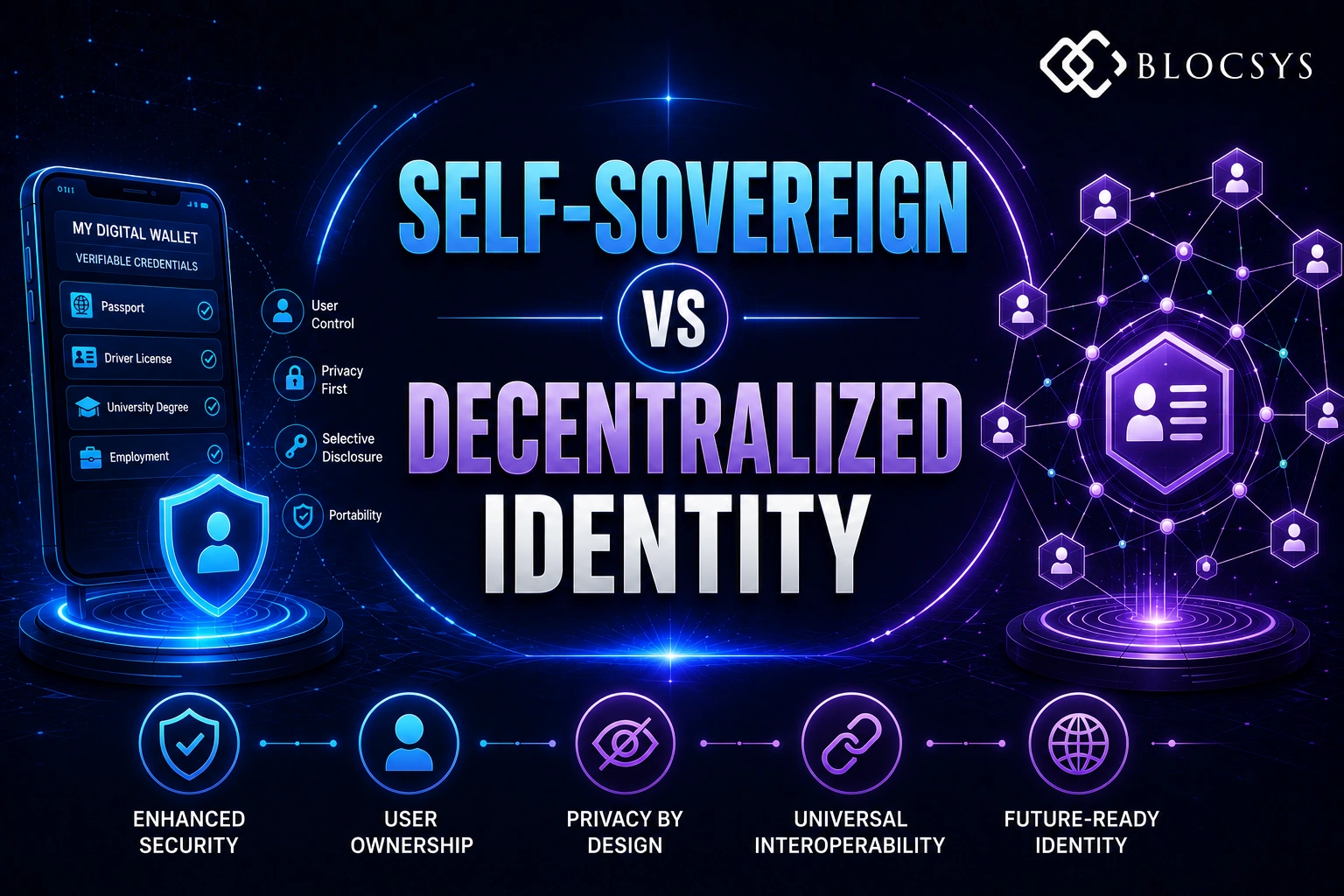
The popular advice says to choose Self-Sovereign Identity (SSI) or Decentralized Identity (DID), then select a wallet, blockchain, or vendor. That advice starts with a category error. SSI is an identity model focused on user control, portability, and consent. A DID is a technical identifier that can support that model. They aren’t competing products, and choosing the wrong layer can produce an expensive architecture that still fails your privacy, compliance, or interoperability goals.
This guide is for enterprise CTOs, CIOs, fintech and banking teams, Web3 companies, governments, universities, healthcare providers, and identity specialists evaluating SSI identity solutions, decentralized identifiers, Verifiable Credentials, digital identity wallets, and enterprise identity infrastructure. It gives you a practical verdict: when SSI is the right strategic target, when DID is the right engineering primitive, and when an existing federated identity system should remain in place.
For implementation teams, the decision also belongs beside wallet custody, key management, consent, credential revocation, trust frameworks, and regulatory mapping. Companies exploring broader Web3 and enterprise technology development should treat identity as infrastructure, not as a branding exercise.
Table of Contents
- Why the SSI vs DID Question Is Usually Framed Wrong
- What Decentralized Identity Refers To
- SSI and DID Compared Side by Side
- How Verifiable Credentials and Wallets Tie Everything Together
- Enterprise Use Cases by Region and Industry
- Security, Privacy, Compliance, and Cost Considerations
- The 12 to 24 Month Outlook for Decentralized Identity
- Frequently Asked Questions
Why the SSI vs DID Question Is Usually Framed Wrong
Most comparison articles declare SSI and DID rivals. That makes the headline easy to write, but it makes the buying decision harder. An enterprise doesn’t normally choose between a business model and one component inside its technical stack. It chooses how much control users should have, then selects the identifiers, credentials, wallets, registries, and governance mechanisms that can deliver that outcome.
Self-Sovereign Identity is the model. It describes an arrangement in which the individual or organisation holding an identity can control credentials, approve disclosures, and carry proofs between services. The issuer still matters. A government, university, bank, or employer may attest to a fact, but the holder doesn’t need to surrender a permanent copy of every credential to each verifier.
A useful analogy is a physical wallet that can prove a fact without opening every compartment. You could prove that you’re over 18 without showing your full birth date. In a digital system, that requires more than a user interface. It requires signed credentials, a way to identify issuers and holders, a secure wallet, and verification rules that support selective disclosure.
The three pillars of SSI
- User control: The holder controls keys and consents to each presentation. In practice, recovery and account support still need careful design, because losing control of keys can undermine the user experience.
- Portability: A credential should be usable across compliant verifiers rather than being trapped inside one provider’s database or application.
- Cryptographic verifiability: A verifier checks signatures, key relationships, credential status, and presentation rules instead of relying only on a phone call or a central database lookup.
SSI isn’t a blockchain, wallet application, or single protocol. It’s a goal state created by combining governance and technology in a way that gives the holder meaningful control. DIDs can provide the identifier layer, while W3C Verifiable Credentials can provide the signed data layer.
Practical rule: If your product requirement says “users must control what they share,” you’re describing an SSI outcome. If it says “the verifier needs a resolvable identifier and public keys,” you’re describing a DID requirement.
The distinction matters in Web3 identity, but it also matters in conventional enterprise architecture. A company moving from Web 2.0 to Web 3.0 can use this comparison of Web 2.0 and Web 3.0 to frame the broader shift in control and infrastructure without assuming that every decentralised system needs the same identity design.
What Decentralized Identity Refers To
Decentralized identity is the broader ecosystem category. It includes identifiers, credential formats, wallets, resolution services, status mechanisms, trust registries, governance rules, and verifier integrations. The ecosystem can reduce dependence on a single identity provider, but decentralisation doesn’t automatically create user sovereignty. A system may use a decentralised identifier while still giving a platform control over the wallet or disclosure policy.
The W3C DID Core model gives architects a precise primitive. A DID has three useful layers:
- The DID string identifies a subject. Its generic structure is
did:method:method-specific-id. - The DID Document contains the public information needed to interact with or verify that DID.
- DID resolution retrieves the document through a method-specific verifiable data registry.
The phone analogy helps. The DID resembles a phone number. The DID Document resembles the contact card associated with that number, including public keys and service endpoints. The resolution method is the lookup service that knows how to retrieve and interpret the document.
What appears in a DID Document
A DID Document can contain properties such as:
id, the DID represented by the document.verificationMethod, which identifies public keys or other verification material.authentication, which describes how the DID can authenticate.assertionMethod, which supports signed claims and credential issuance.service, which can point to communication or interaction endpoints.
Examples of DID method syntax include did:key, did:web, did:ion, and did:ethr. These examples don’t mean that all methods have identical privacy, cost, resolution, or governance characteristics. A DID method turns the abstract W3C identifier model into a working resolution and update system.
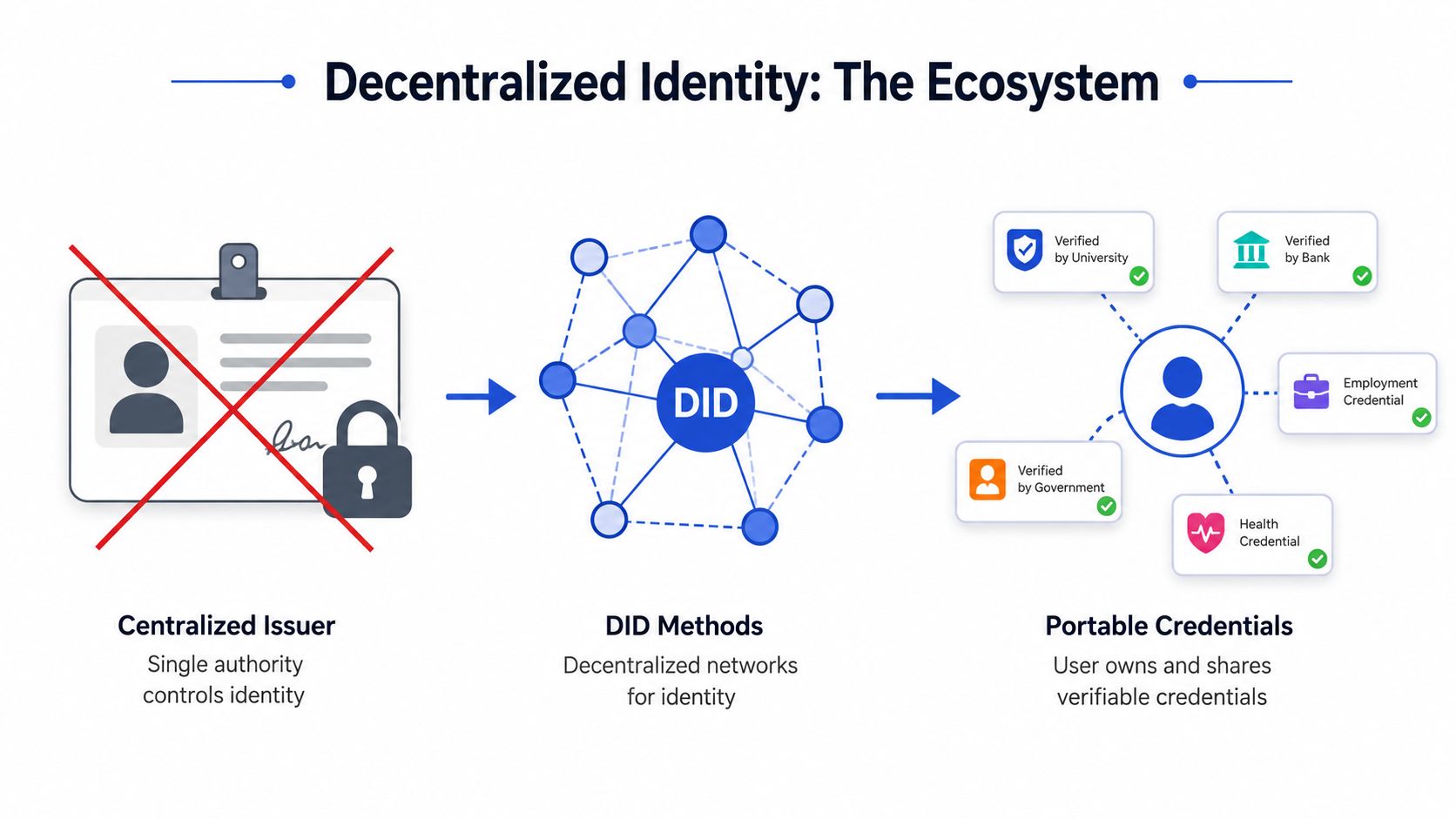
A DID is not a wallet, credential, identity profile, or proof that a real-world person has a particular attribute. It provides an identifier and verification context. The credential supplies the claim, and the wallet stores and presents it.
That distinction becomes important for blockchain digital identity architecture. Blockchain can host or anchor certain registry information, but decentralised identity can also use other registries and resolution approaches. For teams building regulated asset systems, Tokenization Platform Development may involve identity, eligibility, and investor credentials as part of a wider enterprise blockchain design.
SSI and DID Compared Side by Side
The shortest accurate answer to “What is SSI vs DID?” is this: SSI describes who controls identity and how consent works. DID describes a class of identifiers and the mechanisms used to resolve verification information.
| Dimension | Self-Sovereign Identity (SSI) | Decentralized Identifier (DID) |
|---|---|---|
| Model layer | Identity philosophy and governance model | Technical identifier and resolution mechanism |
| Artifact | A user-control principle implemented through several components | A resolvable identifier with a method-specific format |
| Credential format | Doesn’t prescribe one format by itself | Can anchor verification for credentials such as W3C VCs |
| Custody assumption | Usually expects a user-controlled wallet and consent flow | Depends on the DID method and surrounding architecture |
| Governance | Depends on the ecosystem’s trust and operating rules | Defined through W3C DID Core and individual DID methods |
| Best fit | Product strategy for portability, consent, and data minimisation | Engineering specification for identifiers, keys, and resolution |
SSI can use DIDs, but SSI isn’t identical to DID-based identity. A DID can support a centralised or platform-controlled experience if the surrounding wallet, issuer, and verifier arrangements don’t give users meaningful control.
Teams evaluating self-sovereign identity blockchain use cases should therefore document both layers. First define the desired control and disclosure model. Then select DID methods, credential formats, wallet architecture, and trust frameworks that satisfy it.
How Verifiable Credentials and Wallets Tie Everything Together
The working system is easiest to understand through the issuer, holder, verifier trust triangle.
A university, acting as the issuer, creates a Verifiable Credential stating that a student earned a qualification. The issuer signs the credential using cryptographic keys associated with its DID. The student, the holder, receives the credential in a digital identity wallet and controls when to present it.
An employer, the verifier, requests proof of the qualification. The wallet generates a presentation, potentially revealing only the required attributes. The employer checks the issuer’s DID Document, validates the signature and presentation, and checks credential status. The verifier can accept the proof without asking the university to send the underlying record during every transaction.
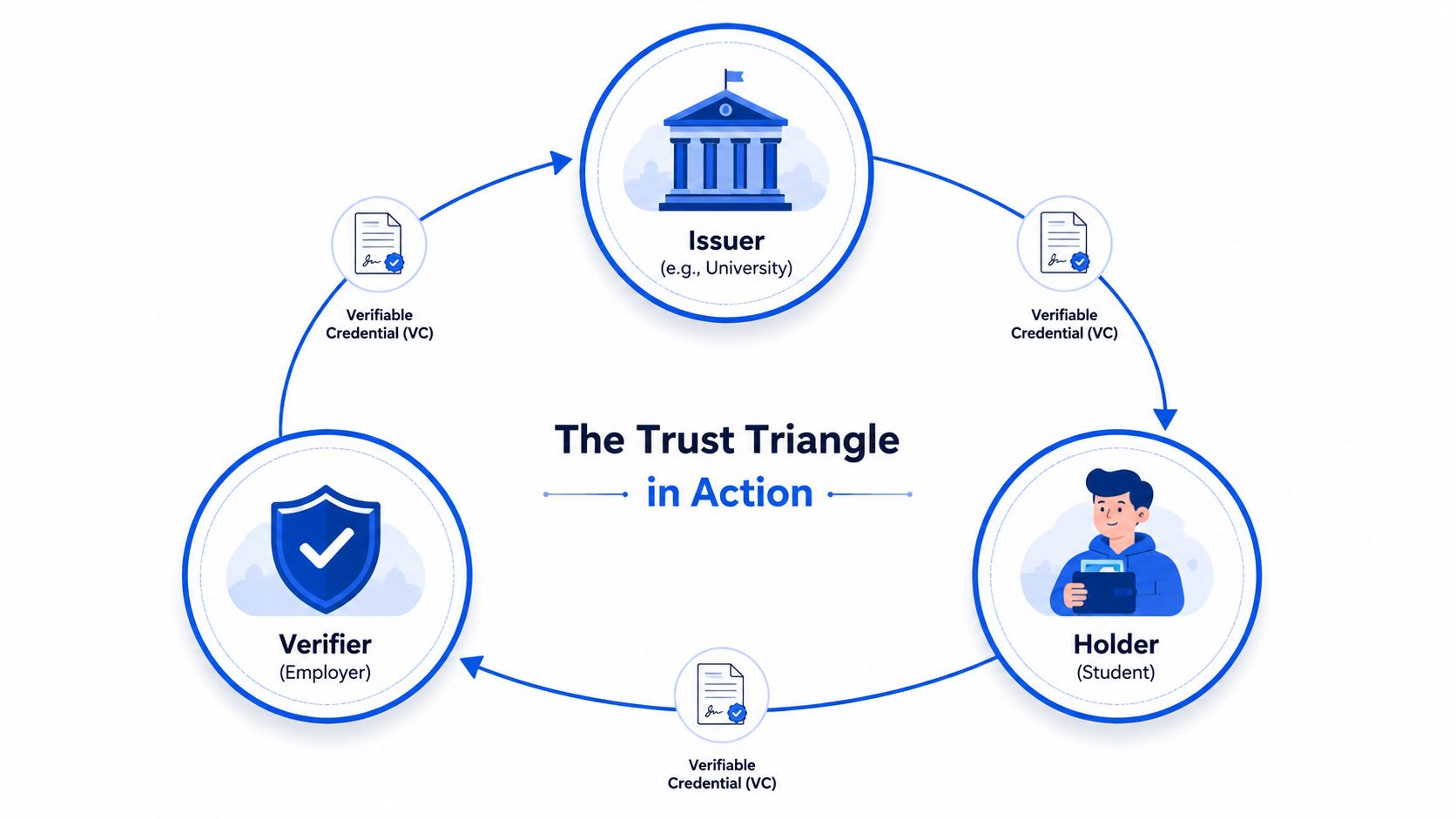
The wallet is the SSI control point. The credential is the data artifact. The DID anchors identity and key verification.
A production wallet needs more than storage:
- Key custody: It must protect signing and presentation keys, with a recovery model that matches the assurance level.
- Selective disclosure: It should let holders share the minimum necessary claim rather than the complete credential.
- Revocation and status checking: Verifiers need current information about whether an issuer has suspended or withdrawn a credential.
You can explore the operational difference between provider-managed and user-controlled keys through custodial and non-custodial wallet architecture.
A custodial wallet gives a provider significant responsibility for keys, recovery, and support. It can offer a smoother enterprise experience, but it concentrates trust and creates a provider compromise or insider-risk concern. A self-custody wallet gives the user stronger control, but device loss, recovery, accessibility, and support become harder. Hybrid designs can place high-assurance keys in protected infrastructure while allowing users to approve disclosures through a familiar interface.
Enterprise Use Cases by Region and Industry
The right architecture depends on the trust environment around the transaction. A regulated bank may need government-backed identity proofing, reusable compliance attributes, and strong audit evidence. A university may prioritise portable qualifications. A Web3 platform may need wallet-native credentials that connect eligibility, jurisdiction, and account permissions without storing excessive personal data.
In Europe, eIDAS 2.0 and European Digital Identity Wallets put attention on interoperable digital credentials, including person identification and mobile driving licence scenarios. Banks and telecommunications companies can use reusable KYC attributes, but they still need clear issuer trust, verifier obligations, and consent records.
India offers a different architecture lesson. The government reported more than 144 crore Aadhaar numbers generated by March 2026, while Aadhaar authentication crossed 15,011.82 crore cumulative transactions by April 2025, including nearly 210 crore authentications in that month alone. The same government release reported 2,393 crore cumulative e-KYC transactions by April 2025. These figures show that India has already solved high-volume identity issuance and verification through national digital public infrastructure. SSI and DIDs are more likely to complement those rails than replace them.
The UAE and Singapore provide examples of government-led digital identity environments where reusable credentials, KYC, payments, travel, and regulated financial activity can intersect. In the United States, Canada, the UK, Germany, and Switzerland, enterprise teams are also evaluating mobile credentials, employee identity, education records, healthcare attributes, and cross-border verification.
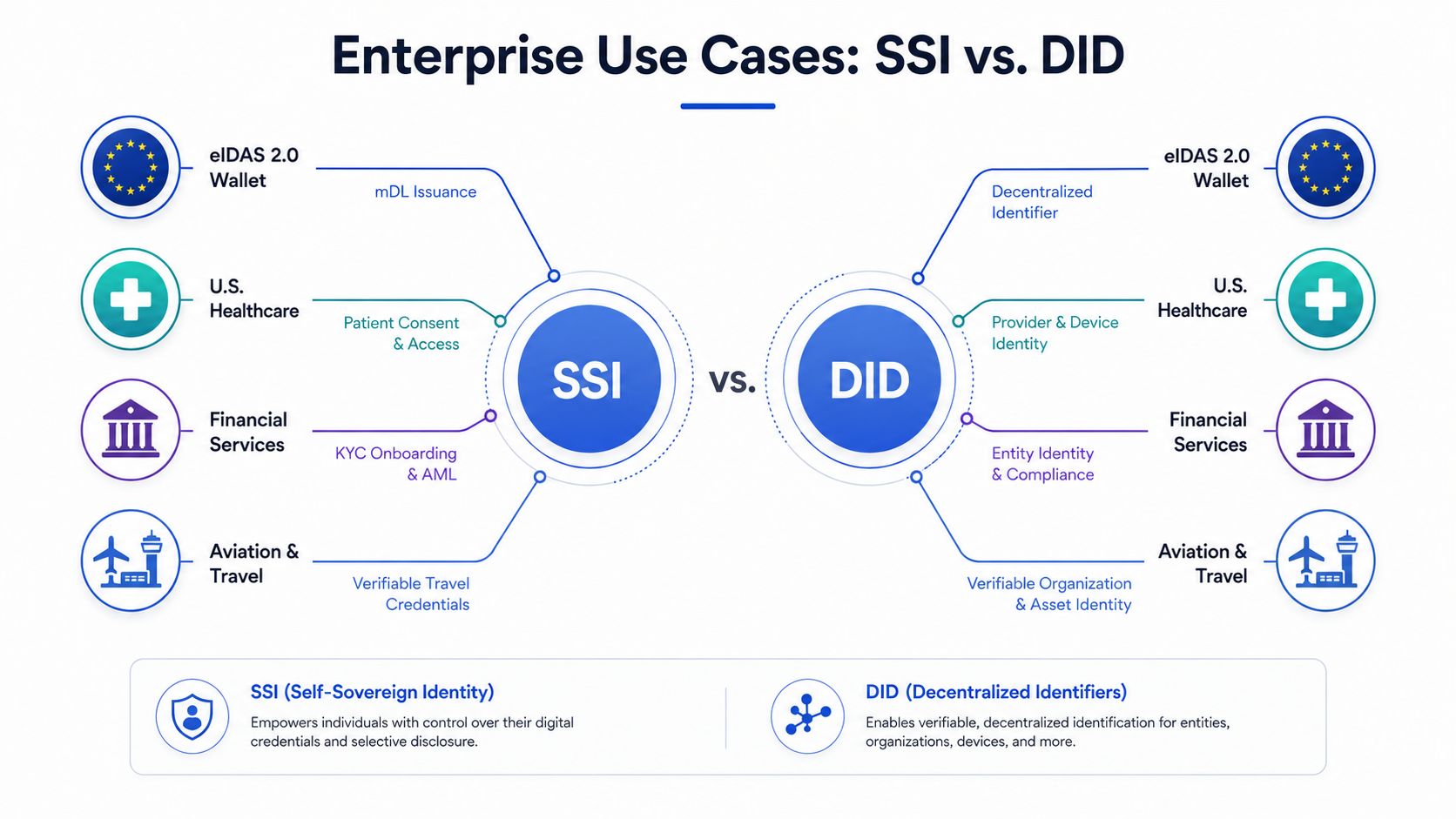
The recurring pattern is clear. DID is often the integration concern for verifiers and issuers. SSI is often the privacy and consent concern for users. Strong deployments address both.
Security, Privacy, Compliance, and Cost Considerations
Security comes from the system around identity, not from the label “decentralised”. Key custody, credential design, resolver availability, status checking, recovery, and governance determine the actual risk. SSI supplies the operating model, while DID supplies mechanisms for identifiers, resolution, and verification. Treating them as competing security features leads to poor architecture.
Wallet operations create different exposure patterns. Custodial wallets simplify recovery but place more responsibility on the provider. Non-custodial wallets give users greater control, yet device loss and key recovery become product risks. Hybrid designs can keep routine approvals separate from high-assurance signing. A practical security review should test each path, including compromised devices and unavailable recovery services.
Revocation requires the same operational discipline. Status lists and related credential status mechanisms depend on verifiers retrieving current information. Resolver uptime, status endpoint availability, cache policy, and failure behaviour belong in security tests and monitoring. A credential that cannot be checked reliably is not a reliable credential.
India’s privacy direction makes architecture choices more concrete. The DPDP Rules, 2025 became operational in November 2025, requiring deployed systems to connect consent, data minimisation, and credential lifecycle controls, as described in the published DPDP Rules document. Teams can review these requirements alongside DPDP compliance considerations for document verification. DSCI and Digi Yatra framing places SSI above W3C DIDs and Verifiable Credentials, while Aadhaar, UPI, and DigiLocker can continue supporting identity proofing and trusted records.
India’s scale also creates a trust challenge. An Okta 2025 report cited 81% of Indian respondents concerned about identity fraud, compared with a 63% global average, in coverage by CIO Economic Times. SSI can reduce unnecessary disclosure, but fraud controls still require reliable issuers, secure wallets, strong authentication, and usable recovery.
Cost planning should cover DID method fees where applicable, resolver hosting, HSM or MPC protection for issuer keys, credential lifecycle storage, wallet development, compliance work, and verifier SDK maintenance. Estimate the architecture, not the acronym. The Blocsys Software Development Cost Estimator can support early budgeting.
The 12 to 24 Month Outlook for Decentralized Identity
The next phase will be shaped by regulation, interoperability, and software agents acting for people. The outlook isn’t a clean replacement of centralised identity with wallets. It points toward hybrid systems in which governments, banks, employers, and platforms remain trusted issuers while holders present portable proofs at the edge.
In Europe, eIDAS 2.0 implementation and wallet obligations will push enterprises to examine credential schemas, assurance levels, trust lists, and selective disclosure. In India, DPDP enforcement and Aadhaar-linked verification developments will make consent and data minimisation concrete architecture requirements. India’s adoption signals are already substantial. UIDAI reported 141.80 crore Aadhaar numbers issued by 31 March 2025, 276.19 crore e-Aadhaar downloads by that date, average daily authentications rising from 8 crore to 9.6 crore in 2024-25, and face authentication peaking at 1.5 crore in September 2025, according to UIDAI reporting covered by Biometric Update. Reports also said the Aadhaar app had exceeded 40 million downloads by mid-2026, while biometric lock and activation actions reached 19.1 million, showing demand for mobile, consent-based identity management. Those developments indicate DID-style capabilities gaining traction inside a nationally governed ecosystem, not the disappearance of Aadhaar.
What enterprise teams should prepare
- Inventory credentials: Identify which KYC, employee, education, healthcare, investor, or access attributes your organisation could issue or verify.
- Pilot one verifier flow: Start with an existing onboarding or compliance process, then measure integration friction, disclosure quality, recovery, and auditability.
- Select methods deliberately: Evaluate a chain-based and an off-chain method against privacy, uptime, governance, resolution, and operating-cost requirements.
- Budget for wallet UX: The wallet is a trust and support product, not only a cryptographic container.
- Map regulation: Connect consent, minimisation, retention, revocation, and incident response to DPDP, GDPR, eIDAS 2.0, or applicable local obligations.
The blunt verdict is buyer-specific:
- Regulated EU enterprise: Prefer eIDAS 2.0-aligned wallet and credential architecture, with DID methods selected for interoperability and selective disclosure.
- Emerging-market platform: Combine government-issued credentials and existing digital public infrastructure with DID-based wallets where portability adds value.
- B2B federation: Keep SAML or OpenID Connect brokers for existing application access, while piloting DIDs for portable business attributes.
- Web3 or digital asset platform: Use SSI principles for consent and minimisation, then implement DIDs, VCs, wallet controls, and compliance workflows as concrete infrastructure.
Blocsys can support DID method integration, Verifiable Credential schemas, issuer onboarding, wallet architecture, and compliance alignment across DPDP, GDPR, and eIDAS 2.0. Its work spans enterprise blockchain, smart contracts, AI-enabled workflows, Web3 infrastructure, and digital identity systems.
Frequently Asked Questions
What is the difference between SSI and DID?
SSI is a user-controlled identity model. A DID is a decentralised identifier used to identify and verify a subject. SSI can use DIDs, Verifiable Credentials, and wallets together, but a DID alone doesn’t provide user sovereignty.
Is SSI the same as decentralized identity?
No. Decentralized identity is the wider ecosystem, while SSI is a stronger user-control model within that ecosystem. Decentralised identity may distribute infrastructure without giving holders full control over custody or disclosure.
Is DID part of SSI?
Usually. DIDs are a common identifier layer for SSI, but SSI can use other identifier mechanisms. The surrounding wallet, credential, consent, and governance design determines whether the result is genuinely self-sovereign.
Which is better, SSI or DID?
Neither is a direct substitute for the other. Choose SSI as the strategic model when consent and portability matter, then choose DID methods as implementation components where resolvable identifiers and cryptographic verification are required.
Can a company issue Verifiable Credentials without DIDs?
Yes. A company can issue credential formats such as JWT-VC or SD-JWT without using DIDs, depending on the trust framework and verification method. DIDs become valuable when the system needs decentralised identifier resolution and key relationship management.
Are DID wallets safe for government IDs?
They can be, but safety depends on hardware-backed key custody, certified wallet software, strong recovery controls, issuer status checks, and secure authentication. A wallet label alone doesn’t establish assurance.
Which is better for enterprise KYC, SSI or federated SSO?
SSI suits cross-border portability and reusable attributes. Federated SSO suits fast access inside an existing application ecosystem. Many enterprises should run both, because they solve different identity problems.
Blocsys Technologies designs SSI development, decentralised identity and DID solutions, Verifiable Credential platforms, digital identity wallets, blockchain identity infrastructure, and enterprise Web3 systems. Visit Blocsys Technologies to discuss your identity architecture, compliance requirements, and next implementation step.
