
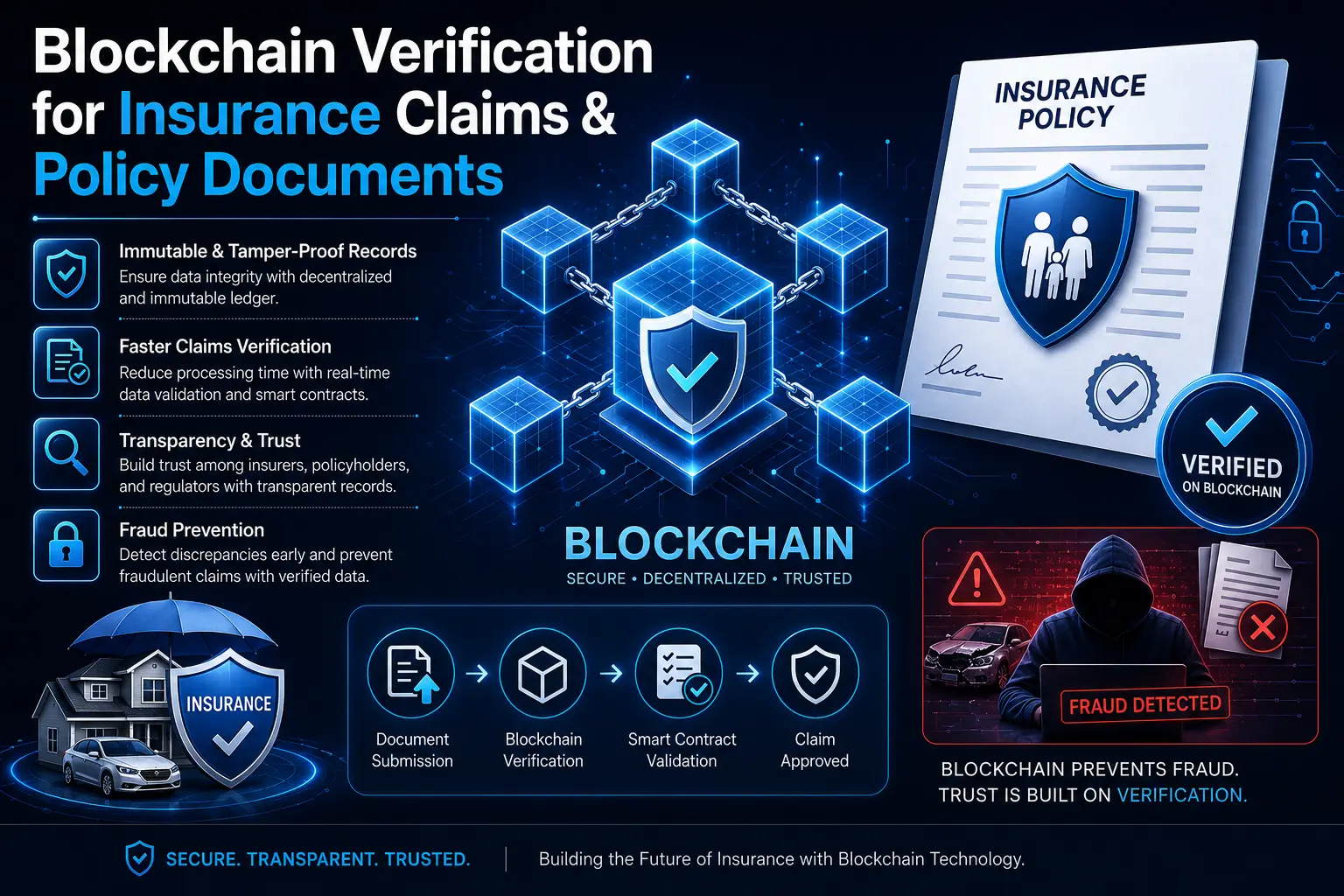
Insurance teams don’t have a blockchain problem. They have a verification boundary problem.
Most claims platforms can already move documents from one queue to another. What they struggle to prove is simpler and more important: which version of a policy is valid, whether a submitted document was altered, who approved what, and whether the claim workflow followed the rules the business thought it had encoded. That’s where Blockchain Verification for Insurance Claims & Policy Documents becomes useful. Not as a slogan, but as an implementation pattern.
For product managers, claims leaders, compliance teams, and engineering heads, the question isn’t whether blockchain is “good for insurance”. It’s whether you can build a system that gives every participant a defensible record of document integrity, approval history, and policy-linked claim state without exposing sensitive data or breaking the rest of your stack. In practice, that means designing for auditability, consent, interoperability, and operational reality from day one.
I’ve seen teams overcomplicate this by treating blockchain as a replacement for core insurance systems. It works better as a trust and verification layer above existing policy administration, claims handling, identity, and document systems. If you want a deeper view of how ledger anchoring changes fraud controls, Blocsys has a useful explanation of how blockchain-based document verification prevents fraud in 2026.
Table of Contents
- Introduction The Multi-Billion Dollar Case for Blockchain in Insurance
- Why Traditional Insurance Verification Systems Fail
- How Blockchain Creates a Single Source of Truth for Claims
- Architecting Your Enterprise Blockchain Verification Platform
- Navigating Security, Compliance, and Data Privacy
- Your Go-to-Market Launch Checklist for Blockchain Verification
- How Blocsys Builds Your Enterprise Verification Engine
- Frequently Asked Questions
- What is blockchain insurance document verification
- How does blockchain improve insurance claims verification
- How do smart contracts automate insurance claims
- How does blockchain prevent insurance fraud
- What are tamper-proof insurance policy documents
- Why are insurers adopting hybrid verification architectures
- How should an enterprise start
Introduction The Multi-Billion Dollar Case for Blockchain in Insurance
Insurance fraud and document disputes aren’t edge cases. They sit inside ordinary operations. A claim can fail because a hospital document can’t be validated quickly, because an assessor saw a stale version of the policy wording, or because three parties each hold a different record of the same event.
That’s why blockchain deserves serious attention in insurance. Not because immutability sounds impressive, but because claims and policy servicing are fundamentally record-verification problems. When multiple parties need to trust a shared process, a tamper-evident ledger can reduce ambiguity around origin, sequence, and approval.
The strongest enterprise use case is narrow and practical. Use blockchain to prove that a policy artefact, claim submission, approval event, or supporting document hash existed in a known state at a known time. Keep the business documents themselves in controlled storage. That split matters.
Practical rule: Put evidence of integrity on-chain. Keep sensitive content off-chain unless you have a very specific legal and operational reason not to.
For regulated insurers, TPAs, brokers, employer benefit platforms, and insurtech teams, the implementation challenge isn’t coding a ledger entry. It’s deciding which business events become on-chain assertions, how consent and access are enforced, and how the system integrates with existing claims operations without creating a second operational universe.
The rest of the work is architecture discipline. You need clean state models, signed inputs, strong identity binding, predictable workflows, and audit outputs that legal, operations, and engineering teams can all understand.
Why Traditional Insurance Verification Systems Fail
A typical claim touches more systems than one might expect. Policy administration. CRM. Claims platform. Email. Shared drives. Hospital records. Repairer invoices. TPA notes. Internal approval logs. Sometimes spreadsheets that no one admits still matter.
That fragmentation creates delays first, then disputes, then fraud exposure.
Where the process breaks first
Take a motor claim with injury treatment attached. The claimant submits accident photos, a repair estimate, ID, policy details, and hospital paperwork. The insurer checks coverage. The repair shop sends a revised invoice. A medical provider sends discharge documents. The TPA wants clarification. A claims manager asks whether pre-authorisation was valid under the active policy terms.
None of this is unusual. The problem is that each participant usually verifies against a different source copy.
Three failure modes show up repeatedly:
- Document version drift. Staff review attachments forwarded through email or downloaded from portals instead of the original signed artefact.
- Manual comparison fatigue. Adjusters and operations teams compare names, dates, diagnosis text, and policy clauses by eye, often under time pressure.
- Weak provenance. The system may store the file, but not a defensible proof of when it was issued, whether it changed, or who attested to it.
When policyholders get stuck in this cycle, dissatisfaction escalates fast. So do disputes over exclusions, timing, and missing evidence. For a claimant-side view of how opaque handling can feel in practice, this guide to combating adjuster claim denials is a useful reference.
Why fraud hides inside normal operations
Fraud rarely announces itself as fraud. It often appears as ordinary documentation friction. An altered invoice looks like a correction. A resubmitted PDF looks like a cleaner scan. A changed discharge summary looks like an updated record.
That’s why traditional systems underperform. They weren’t designed to preserve a shared chain of custody across organisations. They were designed to move files.
The result is a process that depends too heavily on trust in local systems and individual reviewers. If you want a good technical contrast between these operating models, Blocsys has a clear breakdown of blockchain vs traditional systems.
Traditional insurance stacks are good at storage and workflow routing. They’re much weaker at cross-party proof.
How Blockchain Creates a Single Source of Truth for Claims
A blockchain verification layer works when it records the right thing. Not every document. Not every field. The right thing.
For insurance, that usually means anchoring document hashes, signer identity references, workflow events, policy state changes, and claim-state transitions into a ledger that authorised participants can inspect. That becomes the shared record everyone can verify against.
A simple process view helps:
What goes on-chain and what does not
Teams often make two mistakes. They either try to put everything on-chain, which creates privacy and performance problems, or they put almost nothing on-chain, which weakens the value of the system.
A better split looks like this:
On-chain records
- Document hash
- Policy artefact identifier
- Claim identifier
- Event timestamps
- Signer or issuer reference
- State transition record
- Approval or rejection outcome
Off-chain records
- Full policy PDF
- Medical records
- KYC files
- Surveyor images
- Hospital notes
- Invoices and supporting attachments
This is the core of blockchain insurance document verification. The ledger proves integrity and process history. Your secure storage and access controls handle the actual content. If you need a concise explanation of this integrity model, Blocsys outlines it well in what is digital proof of document integrity.
How the claim lifecycle becomes verifiable
The strongest implementations treat a claim as a controlled state machine, not as a loose collection of tickets and files.
A practical flow looks like this:
Policy issuance
The insurer generates a signed policy artefact. Its hash and metadata are anchored to the ledger.Claim submission
The claimant or intermediary submits evidence. Each submitted file is hashed. The claim is opened in a defined state.Evidence validation
Off-chain services validate hospital, repair, KYC, or employer evidence. The verification outcome is written back as a ledger event.Decisioning
Smart contract logic checks whether the claim can move from one state to the next based on policy-linked rules and authorised approvals.Settlement or rejection
The final workflow event is anchored with outcome, timestamp, and approval trail.
Here’s the video version of that operating model in action:
Why formal verification matters
Most insurance teams stop at testing. That isn’t enough for multi-stage claims logic.
A more reliable method comes from the ClaimChain research pipeline. It uses a practical verification workflow for blockchain-based insurance claims: model each chaincode as a Finite State Machine, encode functional requirements as Linear Temporal Logic properties, and check the resulting model in NuSMV. The paper reports that this was applied to the ClaimChain consortium insurance-claims platform to verify claim-process correctness across multiple stages, showing that policy and workflow rules can be translated into machine-checkable invariants before deployment (ClaimChain research on ArXiv).
For architects, the lesson is simple. Enumerate lifecycle states explicitly. A claim should not drift from submission to payment through loosely coupled service calls. It should move through constrained transitions such as submission, validation, approval, and settlement, with contract logic proving that invalid paths are blocked.
If you can’t draw the allowed state transitions on a whiteboard, you’re not ready to encode them in smart contracts.
Architecting Your Enterprise Blockchain Verification Platform
The design choices that matter most aren’t glamorous. They’re the ones that determine whether the platform survives procurement, legal review, and production load.
Choose the network around governance
Teams often start by asking which chain is fastest. The better question is who needs write access, who needs read access, and who has authority to validate records.
A public chain can work when transparency and open verification matter more than confidentiality, but most insurance document flows don’t fit that profile. Claims operations usually need restricted participation, clear data governance, and controllable permissioning. That pushes many implementations towards a private or consortium chain.
The trade-off is straightforward. Public networks maximise decentralised trust. Consortium networks usually fit insurance operating models better because governance is explicit and participant access is controlled.
Design the data model before smart contracts
Smart contracts don’t rescue a weak data model. They freeze it.
For insurance claims verification using blockchain, the core entities usually include policy artefact, insured party reference, claim case, evidence package, verifier decision, and settlement event. Each should have a stable identifier and a clear lifecycle.
Your document model also needs fields for:
- Issuer binding. Who created the artefact.
- Verification method. Signature check, issuer API check, registry lookup, or internal approval.
- Consent status. Whether the current party is allowed to access associated off-chain content.
- Retention rule. How long the linked off-chain record is kept.
When teams skip this, they end up with contracts that can record events but can’t explain them later. For a more implementation-focused view of automation patterns, Blocsys covers how smart contracts automate secure document authentication.
Architectural Decision Framework for Insurance Verification
| Decision | Option A | Option B | Key Consideration |
|---|---|---|---|
| Network model | Public chain | Private or consortium chain | Governance, participant trust model, confidentiality needs |
| Data placement | More metadata on-chain | Minimal hashes and event proofs on-chain | Privacy, storage cost, audit depth |
| Identity model | Wallet-centric user identity | Enterprise IAM plus wallet abstraction | User experience and enterprise control |
| Contract scope | Broad business logic on-chain | Narrow verification and state logic on-chain | Upgrade complexity and risk surface |
| Integration pattern | Rebuild workflow around chain | Anchor into existing PAS and claims systems | Delivery speed and operational disruption |
| Verification method | Simple hash anchoring | Hash anchoring plus issuer validation and rule engine | Integrity alone doesn’t prove document truth |
A few decisions are usually mandatory in regulated environments:
- Don’t store raw medical or personal data on-chain unless law, consent, and governance are exceptionally clear.
- Don’t let external documents trigger approvals without off-chain validation.
- Don’t encode policy wording loosely. Convert it into explicit decision rules and state transitions.
Navigating Security, Compliance, and Data Privacy
Security and compliance aren’t final-stage checks. They shape the architecture from the beginning.
Privacy law changes the architecture
This matters most in cross-entity insurance workflows. A blockchain can prove integrity. It can’t by itself justify processing personal data.
The practical verification gap is especially visible in India. As noted in analysis focused on insurance blockchain deployments, the Digital Personal Data Protection Act, 2023 requires a lawful purpose and consent for data processing. That means blockchain can prove a document’s integrity, but it doesn’t solve data minimisation or consent rules for medical records. The key challenge is a hybrid system that stores hashes on-chain while keeping sensitive documents off-chain behind strong consent management (analysis of insurance blockchain privacy requirements).
That same architectural principle travels well beyond India. It aligns with how regulated insurers in Europe, the UK, Singapore, the UAE, and North America typically need to think: verifiable proof on-chain, controlled content off-chain, and auditable consent around access.
Identity and access are part of verification
A document isn’t trustworthy because it has a hash. It becomes trustworthy when you can tie that hash to a valid issuer, a permitted verifier, and a lawful workflow.
That means enterprise identity design matters as much as ledger design. In practice, you want:
- Issuer authentication tied to hospital, insurer, broker, employer, or surveyor identity
- Role-based access controls for claims handlers, TPAs, auditors, and compliance staff
- Consent-aware retrieval for medical or sensitive policy-linked records
- Audit trails that show who viewed or acted on which document and under what authority
Legal and compliance teams often need tooling support around redaction, audit trails, policy review, and evidentiary workflows. This guide to legal tech for professionals is a useful starting point for that adjacent toolset.
Security controls that actually matter
The biggest mistake in blockchain-based insurance verification is assuming ledger immutability equals system security. It doesn’t.
The controls that matter most are more mundane:
- Strong signing of source documents before anchoring
- Tamper-evident off-chain storage
- Key management with separation of duties
- Smart contract review and upgrade governance
- API authentication between insurer systems and the ledger
- Monitoring for abnormal submission or approval patterns
If your off-chain storage is weak, attackers don’t need to alter the chain. They can attack the document source, the identity layer, or the integration path. That’s why a hybrid model usually beats a chain-only design. Blocsys has a useful technical comparison in centralized vs blockchain-based document verification which is more secure.
A ledger can prove that a file changed. It cannot prove that the original file was truthful, authorised, or lawfully shared.
Your Go-to-Market Launch Checklist for Blockchain Verification
Most insurance blockchain projects fail before launch for one of two reasons. They start too broadly, or they ignore integration reality.
A better rollout starts with a tightly bounded use case and a clear operating model.
Phase one strategy and design
Pick one product line or one claims corridor. Don’t start with every policy and every document type.
A sensible pilot usually has these traits:
- Repeatable workflow. The same evidence types appear often.
- Multi-party friction. Verification delays already affect settlement.
- Clear audit need. Internal or regulatory review benefits from a stronger proof trail.
Bima Sugam in India is a useful signal for architects because it reflects movement towards a unified digital insurance platform and a more standardised servicing model. The practical lesson is that verification systems should be built for interoperability, auditable document hashes, and service APIs, not as isolated monoliths that try to replace each insurer back office (Bima Sugam and blockchain interoperability context).
Phase two build and integrate
During build, keep the ledger scope narrower than the business ambition.
Your minimum production path should include:
- Policy artefact anchoring
- Claim-state ledger events
- Off-chain document hashing
- Issuer and verifier identity binding
- Core system connectors for policy administration and claims workflow
- Ops dashboard for exception handling
This is also where vendor selection becomes obvious. If a partner can only build the chain but not the identity, API, security, and workflow layer around it, you’ll own the hardest part internally.
Phase three pilot and launch
A real pilot needs operational criteria, not just technical success.
Use a launch checklist that asks:
- Can claims staff explain the new flow in plain language?
- Can auditors reconstruct a claim path from issuance to settlement?
- Can a verifier confirm document integrity without seeing prohibited data?
- Can exceptions fall back to human review without breaking chain state?
- Can external participants join without needing deep blockchain knowledge?
The launch shouldn’t force policyholders or hospital administrators into a wallet-heavy experience unless your market supports it. In many insurance contexts, wallet abstraction or managed credentials are more practical than direct end-user key management.
How Blocsys Builds Your Enterprise Verification Engine
Most insurers don’t need a generic blockchain build. They need a verification engine that fits existing policy, claims, and compliance workflows.
That usually means four workstreams running together. Smart contract design for policy and claim-state logic. Enterprise integrations with claims systems, document stores, and identity services. Security architecture around keys, permissions, and auditability. Operational tooling for exceptions, approvals, and evidence review.
One implementation option in this market is Blocsys Technologies, which describes a document verification approach that combines AI analysis, blockchain anchoring, smart contract workflows, and enterprise integrations. In practical terms, that model fits insurers that want uploaded documents checked, hashed, validated against authoritative data sources, and then recorded with verification outcomes for later proof.
What matters more than vendor branding is fit. A capable delivery partner should be able to do three things well:
- Translate policy and workflow rules into verifiable state transitions
- Separate on-chain proof from off-chain sensitive content
- Integrate with existing insurance operations without forcing a platform rewrite
If they can’t show how a claim moves from submission to settlement with controlled evidence checks and auditable state changes, the proposal is still at the concept stage.
Frequently Asked Questions
What is blockchain insurance document verification
It’s a method for proving that an insurance policy or claim document existed in a specific form at a specific time. The usual design stores a document hash and workflow events on-chain while keeping the full file in controlled off-chain storage.
How does blockchain improve insurance claims verification
It gives insurers, TPAs, and other authorised parties a shared record of claim-state changes, approvals, and document integrity checks. That reduces disputes over version history, sequence of events, and whether a supporting file was altered after submission.
How do smart contracts automate insurance claims
Smart contracts can enforce workflow rules such as which claim states are valid, which approvals are required, and what evidence must be present before a claim can move forward. They work best when paired with off-chain validation services and clear exception handling.
How does blockchain prevent insurance fraud
It helps prevent certain forms of document tampering, duplicate process manipulation, and approval ambiguity by creating a tamper-evident audit trail. It doesn’t remove the need for identity checks, issuer validation, or investigation of false underlying evidence.
What are tamper-proof insurance policy documents
In practice, they’re policy artefacts whose integrity can be verified against an anchored hash, signature, or ledger event. The term shouldn’t imply that the full policy lives on-chain. Usually, the proof is on-chain and the document remains in secure off-chain storage.
Why are insurers adopting hybrid verification architectures
Because regulated insurance needs two things at once. Strong proof of integrity and controlled handling of sensitive data. A hybrid architecture supports both by keeping hashes and workflow proofs on-chain while storing policy and medical records off-chain under access controls.
How should an enterprise start
Start with one use case, one workflow, and one integration path. Policy issuance verification, hospital document validation, or high-friction claims review are all good candidates. Build the verification boundary first. Expand only after operations, legal, and engineering agree on the model.
If you’re evaluating tamper-evident claims workflows, policy document authentication, or a hybrid architecture for secure insurance verification, connect with Blocsys Technologies. Blocsys works with teams building production-ready blockchain and AI systems and can help scope the ledger model, workflow design, integration path, and security controls needed for enterprise deployment.
