
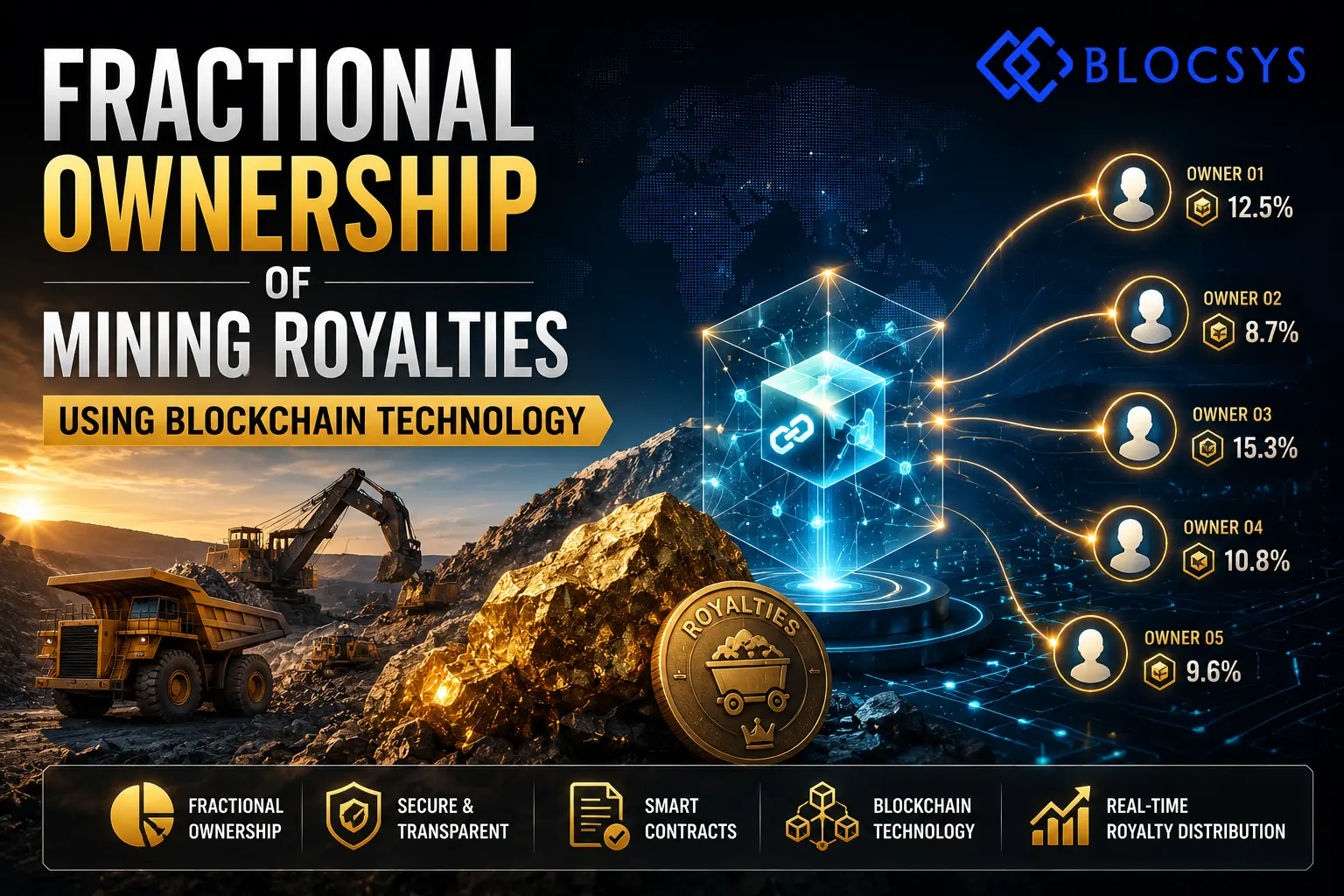
The new digital gold rush is no longer only about digging ore out of the ground. It’s about turning future royalty streams into digital assets that investors can access, trade, and audit. The broader blockchain market that underpins this model was valued at about $7.4 billion in 2022 and is projected to generate over $94 billion in revenue by the end of 2027, with a 66.2% CAGR. That matters because mining royalties have always been operationally valuable, but structurally awkward. Ownership is hard to divide, transfers are slow, and payout reporting often sits across spreadsheets, escrow processes, and legal paperwork.
That friction is exactly where blockchain fits. In mining, distributed ledgers can track data from the block to the concentrate to the metal, support geological data sharing, and reduce fraud risk across supply chains, according to industry coverage summarised by GTIA. For mining companies, institutional investors, and fintech operators, fractional ownership of mining royalties using blockchain technology isn’t just a funding story. It’s an infrastructure story.
This guide compares seven platforms and infrastructure options that matter if you’re serious about mining royalty tokenization. Some are regulated distribution venues. Others are tokenization rails, compliance layers, or purpose-built chains. The right choice depends on what you’re issuing, who can buy it, and where liquidity is expected to come from.
If you’re already familiar with private placements and syndication models, it helps to contrast tokenization with traditional pooling structures. A useful primer is this guide on how to streamline syndication with Homebase.
Table of Contents
- 1. Mining Royalty Tokenization A 2026 Guide to RWA Investing
- 2. ProspEx Group
- 3. Securitize
- 4. INX One
- 5. Tokeny
- 6. Polymesh
- 7. Provenance Blockchain
- 7-Platform Comparison: Tokenized Mining Royalties
- From Blueprint to Reality Build Your Mining Royalty Tokenization Platform with Blocsys
1. Mining Royalty Tokenization A 2026 Guide to RWA Investing
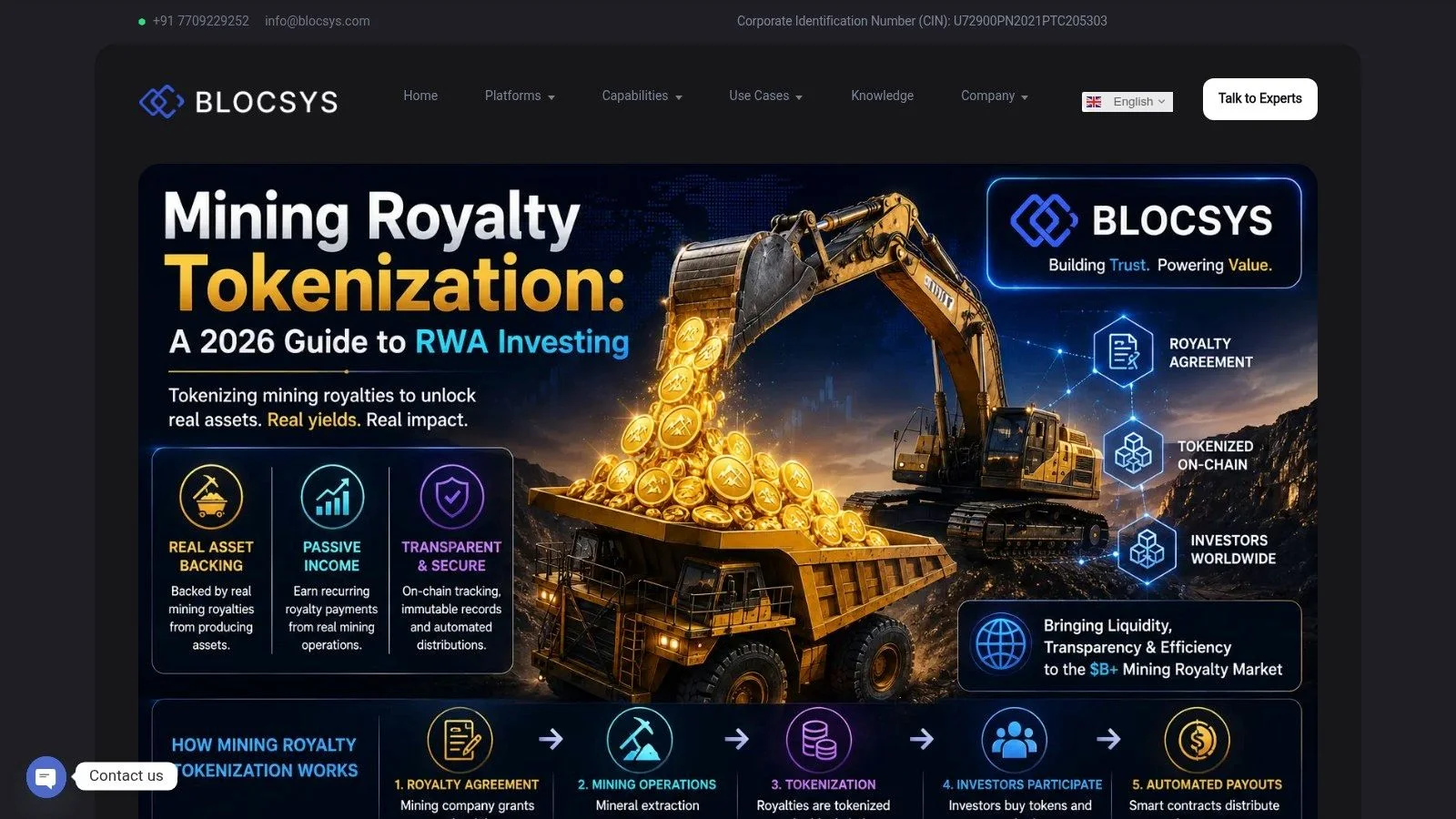
Blocsys is the strongest option here for teams that need more than token issuance software. It approaches mining royalty tokenization as a full operating model. That includes legal wrapper design, permissioned token standards, investor onboarding, payout automation, and enterprise implementation support.
The biggest mistake I see in this segment is treating mining royalties like generic RWAs. They aren’t. Royalty structures depend on title, permits, state or provincial obligations, production reporting, and the exact legal rights a token holder receives. That’s why a build that starts with smart contracts and ignores structuring usually creates more risk than value.
Why Blocsys leads with structure, not just code
Blocsys positions mining royalty tokenization as a compliance-first product, not a speculative token launch. The practical architecture usually combines an SPV, a regulated token standard such as ERC-3643, KYC and AML workflows, and smart contracts that handle entitlement logic and payout mechanics. If you need a broader foundation before designing the royalty product itself, this explanation of how real-world asset tokenization works in blockchain is the right starting point.
That matters because tokenization only removes admin friction. It doesn’t remove legal complexity. One of the clearest gaps in current market coverage is whether a mining royalty token is treated as a security, a derivative, or a direct beneficial interest, and what that means for enforceability, transfer restrictions, custody, and investor recourse in policy-sensitive jurisdictions such as India, as discussed in Chainlink’s overview of tokenized royalties and smart contracts.
Practical rule: If the legal claim isn’t crystal clear before minting, the token will create confusion faster than it creates liquidity.
Where this approach works best
Blocsys is best for fintechs, exchanges, commodity investment firms, and mining operators that want a production-ready mining royalty blockchain platform without stitching together five vendors. It’s particularly useful when the issuer wants institutional credibility from day one and expects investors to ask hard questions about distributions, audits, transfer controls, and default scenarios.
What works:
- Compliance-first design: SPV structuring plus identity-gated tokens helps reduce operational and legal ambiguity.
- Programmable payouts: Smart contracts can automate revenue-sharing logic and make payout histories easier to audit.
- Enterprise implementation: Teams don’t need to build legal, identity, and token infrastructure from scratch.
- Better investor access: Divisible, permissioned royalty interests can open a broader buyer base than traditional bilateral deals.
What doesn’t magically solve itself:
- Jurisdictional variation: Cross-border mining royalty tokenization still needs bespoke legal work.
- Secondary liquidity: Tokenization improves transferability, but it doesn’t guarantee active trading.
- Data integrity: On-chain logic is only as reliable as the off-chain production and revenue data feeding it.
For issuers that want fractional ownership of mining royalties using blockchain technology with real commercial discipline, Blocsys is the most complete path in this list. Its edge isn’t just development. It’s packaging legal engineering, token controls, and investor operations into one delivery model.
Learn more at Blocsys mining royalty tokenization services.
2. ProspEx Group
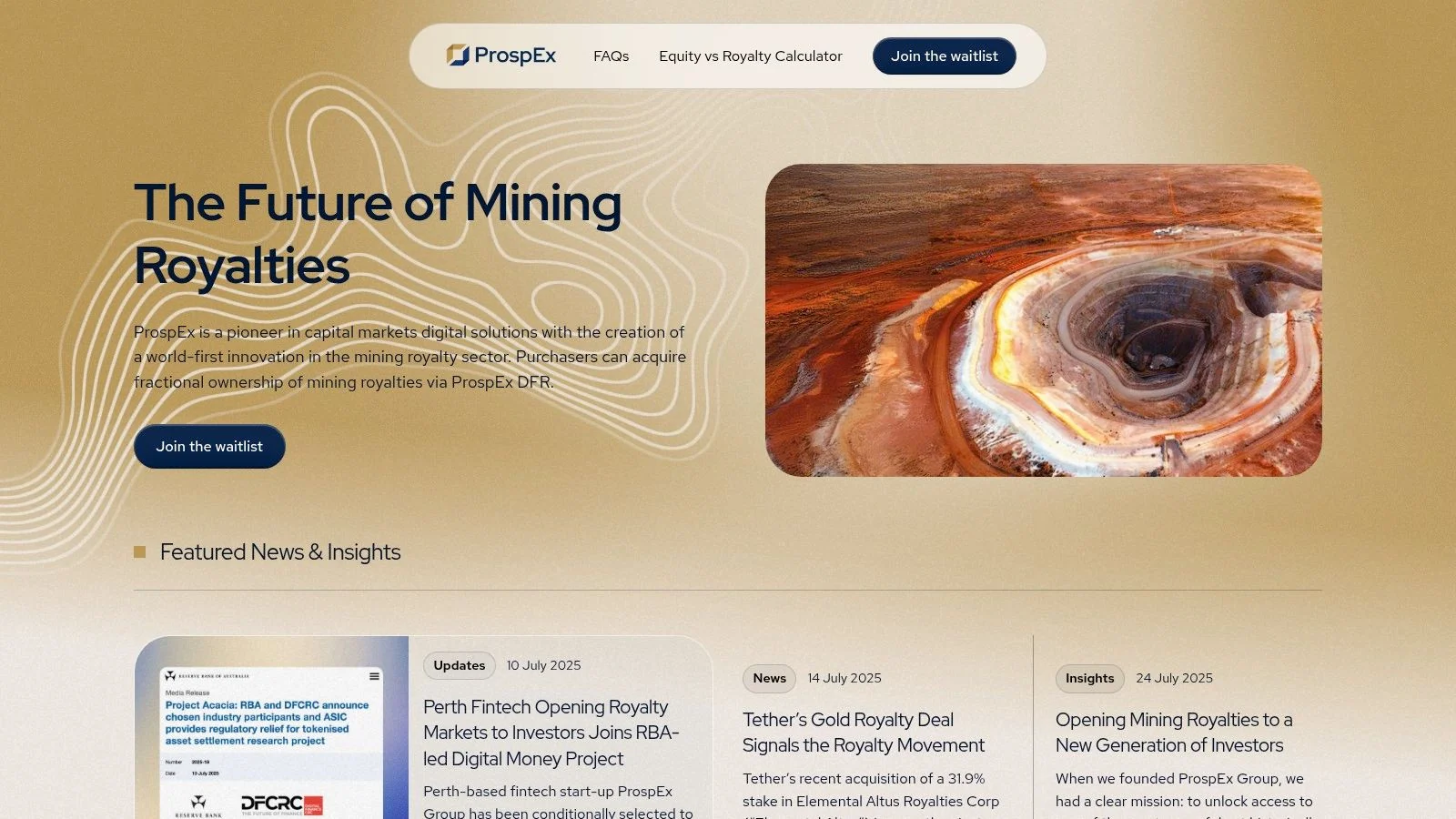
ProspEx Group is one of the few names on this list that speaks the language of mining royalties natively. That sounds minor until you’ve worked on a tokenization project where the platform team understands securities plumbing but not royalty cash flow logic, reserve disclosure sensitivities, or how issuers talk to mining investors.
Its proposition is straightforward. Fractionalize royalty interests into digital instruments, register ownership on-chain, and support pro-rata distributions with a marketplace model built around mining-specific assets. For teams that want a sector-focused venue rather than a general-purpose tokenization stack, that specialization matters.
Why mining specialists matter here
ProspEx is attractive because it doesn’t force mining issuers into a generic RWA narrative. The workflows, disclosures, and investor framing are built around royalty issuance rather than retrofitting a real estate or private credit template. It also benefits from participation in Australia’s Project Acacia pilot, which gives it relevance for issuers watching institutional tokenized asset rails develop in a serious regulatory environment.
There’s also a commercial point that’s easy to miss. Fractionalization is only useful if buyers trust the reporting. The underserved issue in this market isn’t whether tokens can be minted. It’s whether independent verification, reserve reporting, and payout data are credible enough to support repeat investor demand. That trade-off is well captured in this discussion of blockchain and royalty payment workflows in energy and resource contexts.
Mining-first platforms usually win early trust faster than generic token platforms. They still need to prove that trust can turn into sustained liquidity.
ProspEx is strongest for mining sponsors that want sector alignment and can live with a platform still moving toward fuller market functionality. It’s weaker if you need broad cross-border distribution immediately or want a battle-tested global secondary market from day one.
In practice, the pros and cons are clear:
- Mining-native product design: Better fit for royalty disclosures and investor messaging.
- On-chain ownership registry: Useful for transfer records and payout clarity.
- Planned marketplace model: A positive signal, but near-term trading depth remains a live question.
- Regional concentration: Australia is a strength for some issuers and a limitation for others.
Visit ProspEx Group.
3. Securitize
Securitize isn’t mining-specific, but it is one of the most credible regulated tokenization stacks available for income-bearing digital securities. If your royalty token will almost certainly be treated as a security, Securitize deserves serious attention.
Its value is operational depth. Issuance, investor onboarding, transfer-agent functions, servicing, and compliant trading support sit within one ecosystem. That reduces the number of moving parts enterprise issuers need to coordinate.
Where Securitize fits best
I’d shortlist Securitize when a mining company, commodity investment firm, or structured-product sponsor wants to originate royalty-linked instruments for regulated investors and doesn’t want to invent the compliance stack itself. This is especially true when the commercial plan includes secondary trading and ongoing investor servicing from the start.
The practical benefit is that revenue-sharing instruments are messy over time, not just at issuance. Investors change status. Transfers need controls. Payout records need to be maintained. Servicing obligations don’t shrink after the token sale. That’s where full-stack regulated infrastructure often beats a custom build.
A good companion resource before selecting a provider like this is Blocsys’s asset tokenization project checklist for 2026, because it forces the right early questions around legal rights, operational data, venue strategy, and distribution design.
What Securitize does well:
- Regulated stack: Useful when tokens represent economic rights that fit securities treatment.
- Secondary trading pathway: Important if liquidity is part of the investment thesis.
- Institutional investor workflows: Strong fit for onboarding, transfer restrictions, and servicing.
- Cross-chain orientation: Helpful if distribution eventually spans multiple environments.
What to watch:
- Jurisdiction limits: Its strongest footprint is in regulated markets where securities treatment is clearer.
- Enterprise buying motion: Commercial terms, timelines, and legal work are typically bespoke.
- Not mining-native: Issuers still need subject-matter expertise on reserve data, permits, and royalty mechanics.
Securitize is a strong option when the legal form of the product matters more than mining-sector branding.
Explore Securitize.
4. INX One
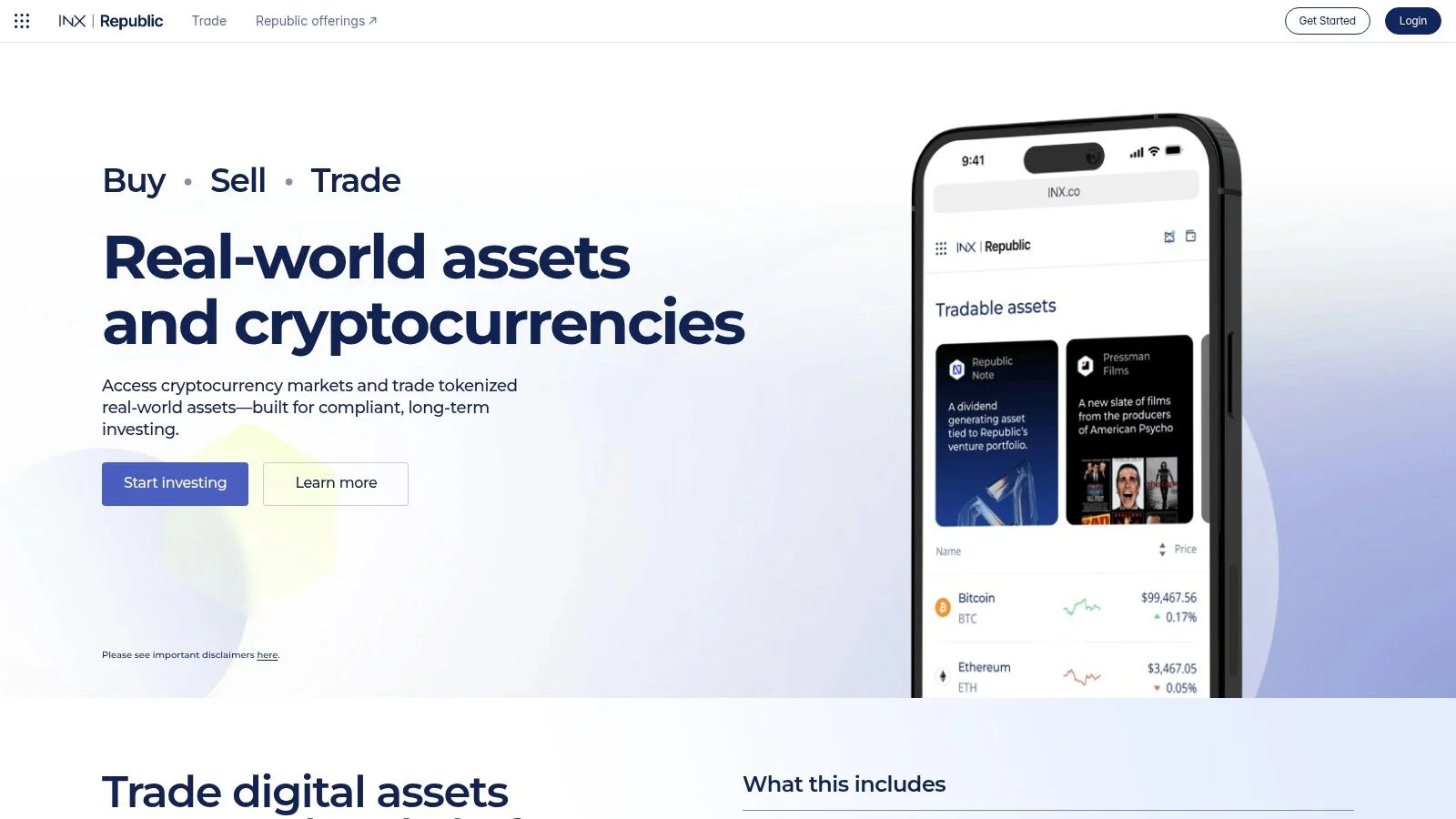
INX One appeals to issuers who want fewer handoffs between issuance and trading. That’s its practical advantage. You can structure an offering and think about secondary market access within the same regulated environment rather than treating liquidity as someone else’s problem later.
For mining royalty tokenization, that matters because investor conversations always come back to the same two questions. What exactly do I own, and how do I exit if I need to?
The practical upside of a single regulated venue
INX One offers a single-venue path for tokenized securities in the US market. That doesn’t eliminate structuring work, but it does simplify the commercial plan. For many issuers, especially first-time issuers, operational simplicity is more valuable than maximum technical flexibility.
This model suits royalty or revenue-share instruments aimed at regulated investors who care about venue legitimacy. It’s less attractive if your target market is broad global retail participation across multiple jurisdictions, because that usually introduces additional structuring layers and transfer restrictions.
A useful benchmark for why better payout and reconciliation rails matter comes from blockchain use in the mining sector itself. Industry analysis notes that blockchain can enable real-time reconciliation of invoices and autonomous revenue distribution, while also supporting geological data sharing and supply-chain validation through a unified source of truth, as outlined in this mining-focused review in Mineral Economics.
If your business case depends on “eventual liquidity,” choose the venue before you choose the token standard.
INX One is strongest when the issuer wants:
- A regulated US route: Clearer for securities-oriented offerings.
- Integrated issuer services: Helpful for onboarding, servicing, and operational coordination.
- A realistic liquidity plan: Better than issuing first and searching for a venue later.
Its constraints are equally clear:
- US market focus: International distribution often needs extra legal design.
- Securities discipline: This isn’t a casual launch environment.
- Lead time: Diligence and legal preparation still shape the schedule.
See INX One.
5. Tokeny
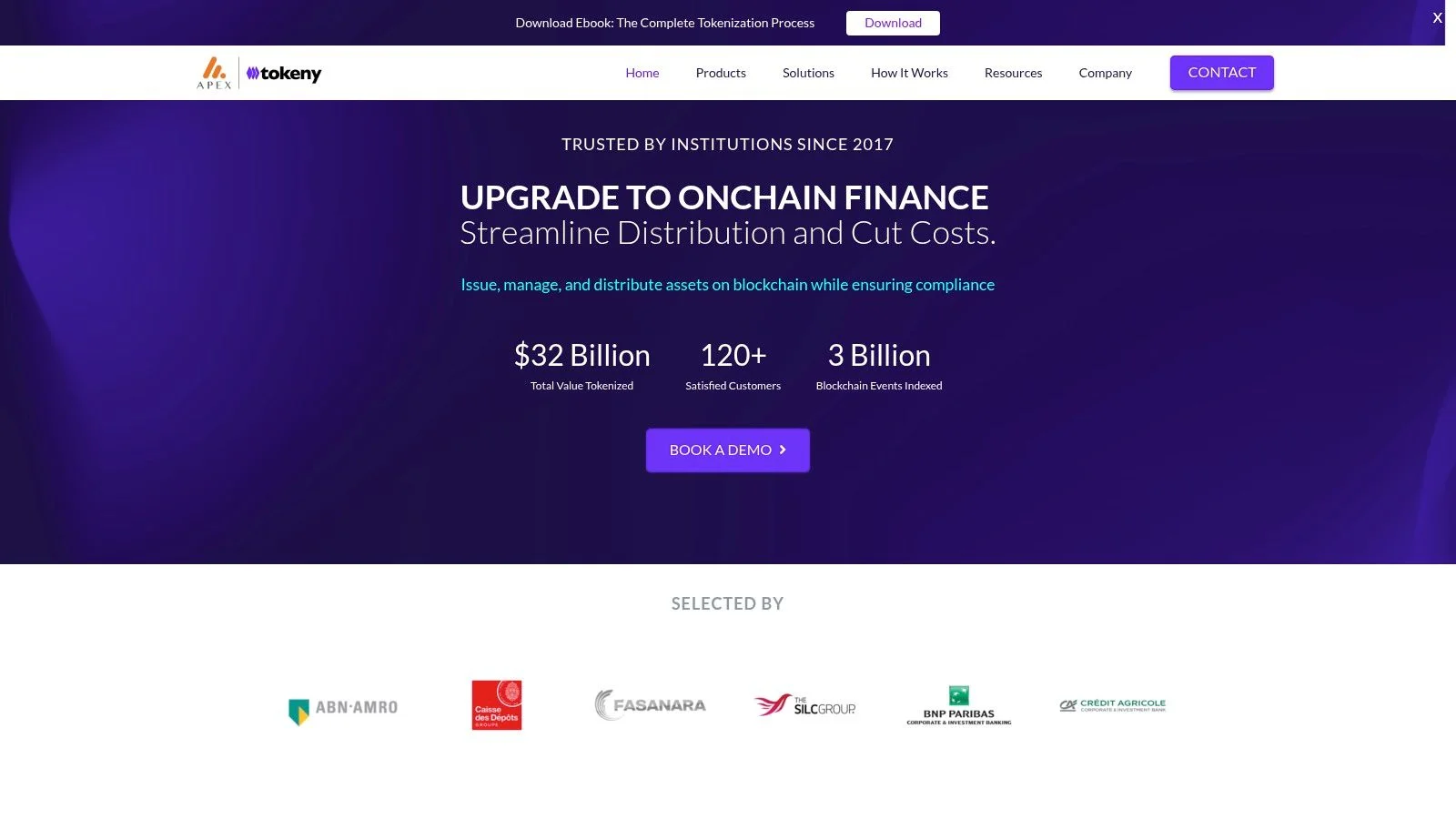
Tokeny is the pick when transfer control is the central design requirement. It’s not primarily a marketplace. It’s a tokenization operating system built around identity-aware, permissioned assets.
That distinction matters for mining royalty blockchain platforms because these products rarely behave like open crypto assets. Eligibility rules, jurisdiction filters, wallet-level permissions, and compliance checks are part of the product, not an add-on.
What Tokeny does well
Tokeny is closely associated with ERC-3643 and the T-REX framework, which is why it comes up often in institutional tokenization discussions. For royalty products, that standard is useful because it supports identity-linked transfer restrictions. You can define who may receive a token, under what conditions, and in which jurisdictions.
For mining issuers, that’s practical, not theoretical. Many royalty products will involve private placement style restrictions, qualified investor filters, or geography-based transfer constraints. General-purpose ERC-20 design doesn’t handle that cleanly.
Blocsys breaks down the broader institutional context in this piece on the tokenization revolution in banking, and the same principle applies here. Institutions buy tokenization systems that can enforce rules automatically. They don’t want compliance living in a PDF while the asset trades freely on-chain.
A realistic view of Tokeny looks like this:
- Best-in-class compliance primitives: Strong for permissioned fractional ownership.
- White-label flexibility: Good for issuers building branded investor experiences.
- Multi-chain orientation: Useful where Ethereum-compatible deployment matters.
- Partner-led model: Suitable if you already know how you’ll handle custody, legal structuring, and distribution.
The main limitation is simple. Tokeny gives you the operating system, not the full market structure. You still need legal design, investor distribution, and usually a broker or regulated venue if secondary trading matters.
For infrastructure-first teams, Tokeny is one of the most practical choices in the market.
Visit Tokeny.
6. Polymesh
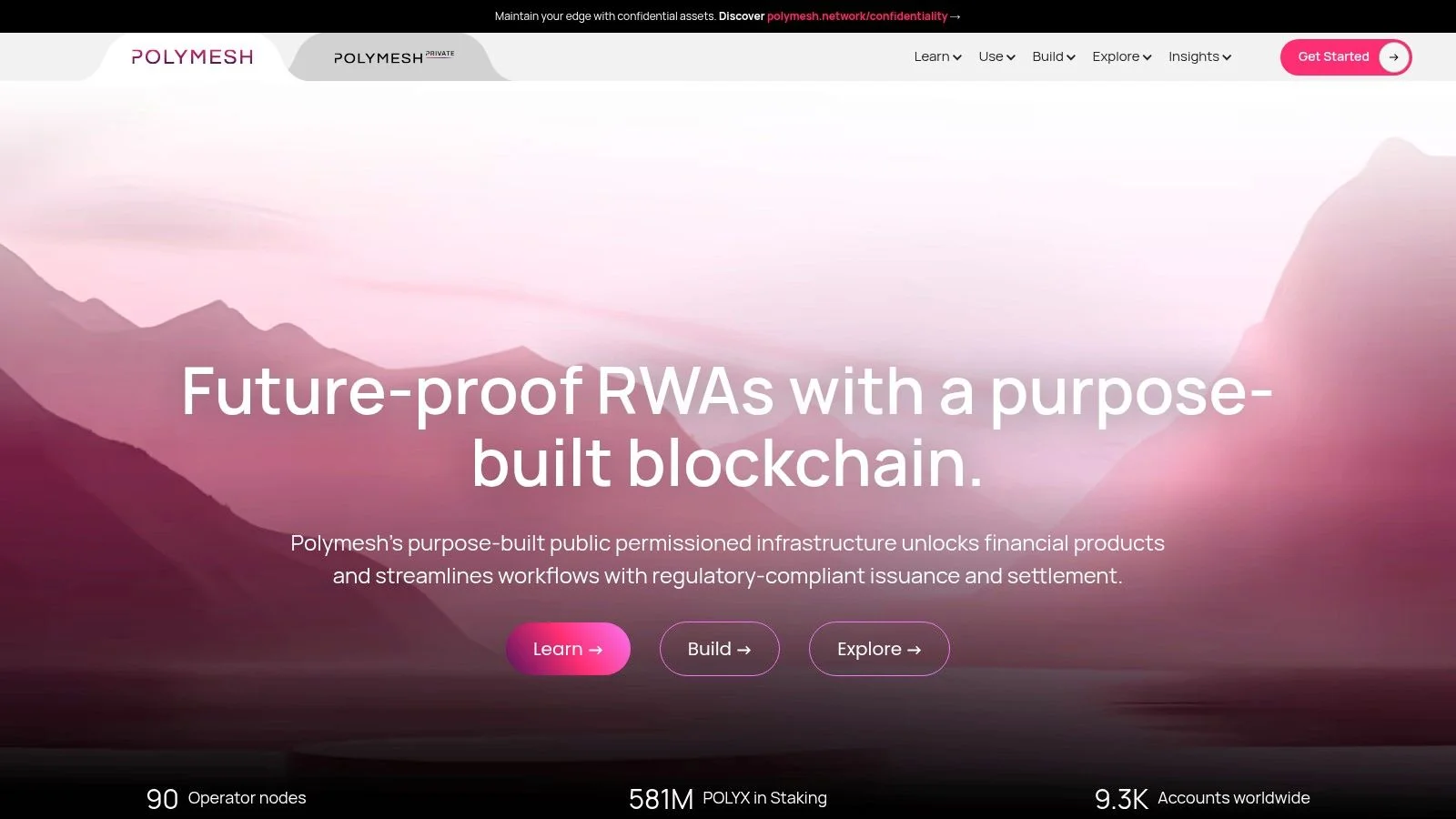
Polymesh takes a different route from Ethereum-first tokenization stacks. It pushes compliance and identity deeper into the chain itself. For institutional issuers, that’s often appealing because it reduces the amount of custom smart-contract logic needed to police security-like behaviour.
I generally recommend Polymesh to teams that care more about regulatory clarity and operational control than open ecosystem reach. It’s a purpose-built environment, and that focus is the point.
Why some teams choose chain-level compliance
Mining royalty products often need hard transfer rules. You may need to stop transfers to ineligible wallets, reflect lifecycle events cleanly, and keep an auditable trail without building every control from scratch. Polymesh gives you more of that at the protocol layer.
That lowers engineering burden, but it also shapes your ecosystem choices. You aren’t plugging into the broadest retail crypto market. You’re choosing a more controlled environment for regulated assets.
In one mining tokenization example discussed publicly, PJKT72’s coal-token model described each token as representing 1 ton of coal and framed the structure as a way to raise capital for new mine projects while automating royalty and payment flows. Whether a team uses Polymesh or another stack, that example captures the central design challenge. Commodity-linked token structures need programmable economics plus clear asset logic.
Controlled infrastructure usually feels slower at the start. It often saves time later when compliance, transfers, and audits become real operational work.
Polymesh is well suited to:
- Institutional-grade regulated assets
- Projects that want native identity and rule enforcement
- Issuers aiming to reduce custom compliance engineering
Its trade-offs:
- It’s infrastructure, not distribution
- You still need issuance software and investor channels
- Ecosystem breadth is narrower than Ethereum-based environments
If your product team keeps saying “we need fewer moving parts in compliance,” Polymesh is worth serious attention. Blocsys also offers a useful perspective on standards evolution in this guide to the ERC-7943 universal RWA standard.
Explore Polymesh.
7. Provenance Blockchain
Provenance Blockchain is less visible in mainstream tokenization chatter than some Ethereum-adjacent names, but finance teams often like it for exactly that reason. It feels closer to structured financial infrastructure than to crypto-native product experimentation.
For mining royalties, that’s a meaningful distinction. Royalty tokens are recurring cash-flow instruments. They need record-keeping, servicing logic, metadata discipline, and auditable lifecycle management. Provenance’s design philosophy lines up well with those needs.
Best fit for servicing-heavy assets
If the asset requires ongoing disclosures, periodic payouts, controlled data handling, and institutional reporting, Provenance makes sense. It’s particularly relevant when the sponsor expects the product to behave more like a financial instrument administered over time than like a token distributed and left alone.
That also aligns with the economic reality of mining royalties. Demand for fractionalized products depends less on the novelty of token issuance and more on whether buyers believe the underlying reporting, verification, and servicing processes are dependable. In practice, tokenization may be more useful as a capital-raising and treasury-management tool for mid-sized operators than as a mass retail product, a nuance highlighted in this resource-sector discussion of royalty workflow modernization.
Where Provenance stands out:
- Finance-grade posture: Better fit for documentation-heavy, recurring payout assets.
- Asset lifecycle tooling: Useful for ownership records, disclosures, and servicing workflows.
- Interoperable architecture: Helpful for building controlled networks around compliant components.
Where it falls short for some issuers:
- No built-in issuance business: You still need implementation partners.
- No native retail marketplace angle: Distribution depends on ecosystem relationships.
- Lower public familiarity: Some issuers may prefer a more recognisable tokenization brand.
For enterprise issuers building serious mining investment tokenization systems, Provenance is a strong infrastructure candidate. Blocsys expands on similar architecture choices in its guide on navigating real-world asset blockchain protocols.
Visit Provenance Blockchain.
7-Platform Comparison: Tokenized Mining Royalties
| Solution | 🔄 Implementation complexity | 💡 Resource requirements | 📊 Expected outcomes | ⚡ Ideal use cases | ⭐ Key advantages |
|---|---|---|---|---|---|
| Mining Royalty Tokenization: A 2026 Guide to RWA Investing (Blocsys) | Moderate, end-to-end platform reduces engineering, but legal/jurisdictional tailoring required | Platform access/integration, legal SPV work, KYC/AML operations | Faster time-to-market, auditable on-chain payouts, potential for fractional liquidity | Fintechs, exchanges, digital-asset firms launching regulated mining royalties | ⭐ Compliance-first SPV + ERC‑3643, automated payouts and enterprise-ready delivery |
| ProspEx Group | Low–Moderate, domain-specific workflows simplify issuer onboarding; trading functionality still rolling out | Onboarding, sector disclosures, compliance support; platform dependency (Australia focus) | Fractional access and designed liquidity once secondary market launches; near-term liquidity limited | Mining issuers seeking a mining‑first marketplace, Australian issuers | ⭐ Sector-tailored DSR/DFR structure, lower minimums, mining-specific investor messaging |
| Securitize | Moderate, regulated full‑stack reduces bespoke engineering but requires enterprise integration | Transfer agent / broker‑dealer / ATS services, compliance tooling, enterprise fees | Compliant issuance and secondary trading on registered ATS; strong compliance controls | Large issuers needing US/EU regulated stack and built-in ATS trading | ⭐ Battle-tested regulated stack with built-in ATS and extensive compliance tooling |
| INX One | Moderate, single‑venue simplifies flow from issuance to secondary trading, with US regulatory requirements | Issuance services, broker‑dealer/ATS engagement, US legal diligence | Streamlined route from compliant offering to US liquidity; issuer-specific costs | Issuers targeting US market and regulated secondary liquidity | ⭐ One‑venue issuance + US‑regulated ATS for practical path to liquidity |
| Tokeny | Moderate, provides mature issuance tooling but requires broker/ATS for secondary markets | White‑label modules, identity integrations, legal/SPV arrangements, integration effort | Permissioned, identity‑aware tokens with granular transfer controls; secondary trading needs venue | Issuers needing identity‑bound tokens and transfer restrictions across jurisdictions | ⭐ ERC3643/T‑REX compliance, multi‑chain support and investor management tools |
| Polymesh | Moderate, chain‑level compliance reduces custom smart‑contract work but needs issuance/trading software | L1 integration, issuance partners, settlement and custody arrangements | Protocol‑enforced transfer rules and auditability; lower legal/engineering complexity for compliance | Institutional issuers prioritizing chain-level compliance for securities | ⭐ Native identity and compliance rails that simplify regulated token lifecycle |
| Provenance Blockchain | Moderate, finance‑grade primitives available but issuers need software/venue partners | Cosmos‑SDK integration, institutional tooling, partner ecosystem for distribution | Auditability, finance‑grade asset lifecycle control, suited for recurring cash flows | Banks, fintechs and institutional issuers tokenizing royalty revenue streams | ⭐ Purpose-built financial asset tooling with production track record and auditability |
From Blueprint to Reality Build Your Mining Royalty Tokenization Platform with Blocsys
Fractional ownership of mining royalties using blockchain technology is finally moving from concept decks into operational design. The market is maturing, but the essential work still happens in the boring parts. Legal rights, payout data, investor eligibility, custody, and servicing determine whether a mining royalty token is investable or just marketable.
That’s the main takeaway from comparing these seven options. There isn’t one universal “best” platform. ProspEx brings mining-first positioning. Securitize and INX One bring regulated market structure. Tokeny gives you strong compliance-aware token rails. Polymesh and Provenance offer purpose-built infrastructure for institutional asset servicing. Each can be the right answer in the right context.
What usually fails is the half-designed model. Teams often start with token issuance before they’ve resolved what the token legally represents, how production and revenue data will be verified, who is allowed to hold the asset, and where secondary transfers are meant to happen. In mining, those details aren’t edge cases. They are the product.
The commercial trade-off is just as important. Tokenization can reduce administrative friction, improve auditability, and make historically illiquid royalty interests easier to divide. It doesn’t automatically create investor demand. Liquidity still depends on trust, distribution, pricing discipline, and a credible servicing process. If reserve reporting is weak or payout data is hard to validate, even a technically strong token won’t attract the right capital.
That’s why Blocsys is well positioned in this segment. The company isn’t approaching mining royalty tokenization as a one-layer smart contract project. It approaches it as a full stack investment infrastructure build. That includes token architecture, investor onboarding, compliance automation, payout logic, and the product decisions around how a mining royalty instrument should function in the market.
For issuers, funds, exchanges, and digital asset businesses, that integrated view matters. You need a platform that can satisfy lawyers, operations teams, compliance leads, and investors at the same time. Blocsys brings that enterprise-grade mindset to real-world asset tokenization solutions, and for teams still modelling scope and timelines, the software development cost estimator is a practical place to start.
If you’re planning a mining royalty tokenization platform, the right next step isn’t minting. It’s design. Define the legal claim, map the payout workflow, choose the right token and chain architecture, and decide where regulated market access fits. Once those pieces are aligned, the build becomes straightforward.
Blocsys Technologies helps fintechs, exchanges, mining operators, and digital asset businesses turn complex tokenization ideas into production-ready platforms. If you’re evaluating fractional ownership infrastructure, regulated royalty token models, or enterprise blockchain development for mining assets, connect with Blocsys Technologies to discuss architecture, compliance workflows, platform development, or the right execution path for your project.
Frequently Asked Questions
What is fractional ownership of mining royalties using blockchain technology?
It’s a model that turns future mining royalty streams into digital assets, or tokens, that investors can access, trade, and audit. This addresses the traditionally awkward structure of royalty ownership, where dividing stakes, transferring interests, and reporting payouts often depend on spreadsheets, escrow processes, and legal paperwork.
Why is mining royalty ownership considered “structurally awkward” without blockchain?
Mining royalties have always been operationally valuable, but ownership is hard to divide, transfers are slow, and payout reporting is scattered across spreadsheets, escrow processes, and legal paperwork. Blockchain is positioned to fit directly into that friction by tracking data from block to concentrate to metal and reducing fraud risk across supply chains.
Is a mining royalty token treated as a security, derivative, or beneficial interest?
This is described as one of the clearest gaps in current market coverage, since the classification affects enforceability, transfer restrictions, custody, and investor recourse, particularly in policy-sensitive jurisdictions such as India. The practical rule given is that if the legal claim isn’t crystal clear before minting, the token will create confusion faster than it creates liquidity.
What does the Blocsys approach to mining royalty tokenization typically include?
The architecture usually combines an SPV, a regulated token standard such as ERC-3643, KYC and AML workflows, and smart contracts that handle entitlement logic and payout mechanics. Blocsys treats this as a compliance-first product covering legal wrapper design, permissioned token standards, investor onboarding, payout automation, and enterprise implementation support, rather than just a speculative token launch.
Who is this tokenization approach best suited for?
It’s best for fintechs, exchanges, commodity investment firms, and mining operators that want a production-ready mining royalty blockchain platform without stitching together multiple vendors. It is especially useful for issuers seeking institutional credibility from day one, since investors are expected to ask hard questions about distributions, audits, transfer controls, and default scenarios.
Does tokenizing mining royalties guarantee active secondary trading?
No. While tokenization improves transferability and can open a broader buyer base through divisible, permissioned royalty interests, it doesn’t guarantee active trading. Other unresolved factors include jurisdictional variation in cross-border deals and the reliability of the off-chain production and revenue data feeding the on-chain logic.
