
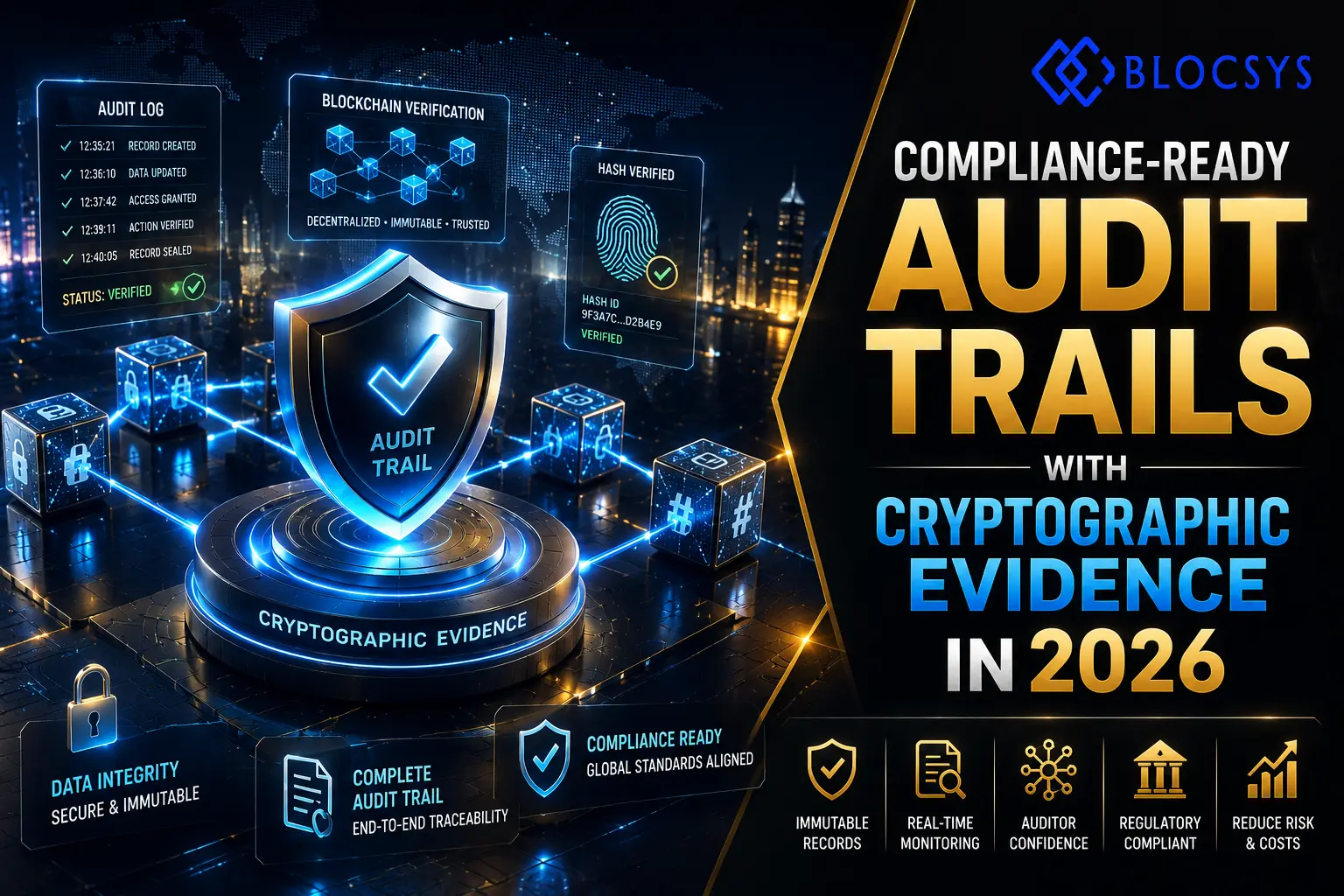
In today’s complex regulatory environment, traditional audit trails have become a significant liability. For CTOs, compliance officers, and enterprise decision-makers in Europe, the USA, and the UAE, the question is no longer if legacy systems will fail, but when. These systems, often built on mutable, centralized databases, are fundamentally ill-equipped to provide the verifiable proof of integrity that modern compliance frameworks demand. Their inherent vulnerability to tampering—whether malicious or accidental—makes them a weak point in any enterprise security strategy.
This guide is for enterprise leaders in fintech, legal tech, and SaaS who need to build a secure, future-proof compliance architecture. We will break down why traditional logs are obsolete, explain the technical pillars of cryptographic evidence, and provide a clear blueprint for architecting a blockchain compliance infrastructure that meets the stringent demands of 2026 and beyond.
Table of Contents
- Why Traditional Audit Trails Fail Modern Enterprises
- What Is Cryptographic Evidence in an Audit Trail?
- How Does Blockchain Create an Immutable Compliance Ledger?
- How to Architect a Tamper-Proof Cryptographic Audit System
- What are Enterprise Use Cases for Cryptographic Audit Trails?
- The Future of Cryptographic Compliance Infrastructure (2026-2028)
- How Blocsys Delivers Enterprise-Grade Compliance Solutions
- Frequently Asked Questions (FAQ)
- What are compliance-ready audit trails?
- How does cryptographic evidence improve enterprise compliance?
- Why are blockchain audit trails more secure than traditional logs?
- How does cryptographic verification prevent tampering?
- What industries require immutable audit records?
- How can blockchain improve compliance reporting systems?
- Why are audit trails important for enterprise security?
- How does cryptographic evidence support regulatory compliance?
- What are the benefits of tamper-proof enterprise audit systems?
- Why is blockchain-based compliance infrastructure important in 2026?
Why Traditional Audit Trails Fail Modern Enterprises
For compliance teams in sectors like fintech, healthcare, and digital assets, the central question is whether their current audit systems can withstand sophisticated cyber threats and intense regulatory scrutiny in hubs like Singapore, Germany, or Dubai. For many, the answer is a resounding no. The core problem lies in the architecture of traditional logging systems.
When audit logs are stored in a standard database, a single compromised administrator account or a sophisticated internal actor can alter, delete, or forge entries without leaving a trace. This makes it impossible to prove data integrity to auditors, creating a critical gap in your secure enterprise audit trail.
This vulnerability has severe real-world consequences, leading to failed audits, significant financial penalties, and a complete loss of trust with regulators and customers. Regulations such as MiCA in Europe and HIPAA in the US don’t just ask for logs; they require provable, tamper-proof audit trails.
What are the Core Vulnerabilities of Legacy Audit Systems?
The fundamental flaws of traditional audit trails create unacceptable risks for modern enterprises. These systems are often a blind spot in an otherwise robust security posture.
- Mutability and Tampering: Centralized logs can be easily modified. There is often no mechanism to mathematically prove that a record from six months ago is the same as when it was originally written, undermining any blockchain record integrity.
- Centralized Failure Points: A single point of compromise in a centralized database can invalidate the entire audit history, leaving the organization exposed.
- Lack of Verifiable Integrity: Without cryptographic evidence, providing auditors with “reasonable assurance” becomes a matter of trust, not proof. This is no longer sufficient for stringent compliance frameworks.
- Inefficiency and High Costs: Manually verifying and cross-referencing traditional logs during an audit is time-consuming and expensive, often requiring extensive forensic work.
Traditional audit logs are a known vulnerability. Their mutable, centralized nature makes data integrity failures, failed audits, and severe financial penalties an inevitability, not just a risk for any modern enterprise.
Contrasting these outdated methods with modern demands reveals a clear gap. If you want to learn more about the fundamental differences, you can check out our guide on blockchain vs traditional systems for a deeper comparison. The shift towards cryptographic evidence is not just an upgrade—it’s a baseline requirement for survival in regulated industries.
What Is Cryptographic Evidence in an Audit Trail?
A compliance-ready audit trail elevates every log entry into a piece of cryptographic evidence. This provides mathematical proof that a record is authentic and has not been altered, creating the bedrock for modern, high-assurance compliance systems. Instead of just trusting a log file, you can now mathematically verify its integrity using a cryptographic verification system. This is essentially an automated digital notary service embedded into every system event.
This powerful verification is achieved through three core technologies working together to build a secure digital chain of custody, forming the basis of a secure digital audit trail.
The Three Pillars of Cryptographic Verification
These techniques are not used in isolation; they combine to create an unbreakable record for every piece of data.
- Hashing (SHA-256): A hashing algorithm acts like a unique digital fingerprint. It converts any amount of data into a fixed-length string of characters, known as a “hash.” If even a single character in the original log entry changes, the resulting hash will be completely different. This makes it the perfect tool for proving data integrity—if the hash matches, the data is unchanged.
- Digital Signatures: Using public-key cryptography, a digital signature proves who created a log entry. The system signs the entry’s hash with a private key. Anyone with the corresponding public key can then confirm the signature is valid, guaranteeing the data’s origin and that it hasn’t been modified since it was signed. This is a core component of digital evidence verification.
- Secure Timestamping: A secure timestamp proves when an event was logged, making it impossible to backdate or alter records. This is typically handled by a trusted timestamping authority (TSA) or a decentralized method that cryptographically binds the log’s hash to a specific point in time.
By combining hashing, digital signatures, and secure timestamping, you create an immutable audit record. It’s no longer just a log entry; it’s a piece of verifiable, tamper-proof digital evidence that can stand up to intense regulatory scrutiny.
To really see the difference, let’s look at how these elements upgrade a standard log entry. This transformation is what turns a simple log into a system of tamper-proof audit logs. For a more detailed look at this topic, you can learn more about what is digital proof of document integrity in our dedicated article.
Traditional Log Entry vs. Cryptographically Secured Log Entry
The table below offers a direct comparison. Notice how the addition of cryptographic components profoundly enhances the log’s utility for both security and compliance, making it a cornerstone for any compliance monitoring system.
| Log Component | Traditional Log Example | Cryptographically Secured Log Example |
|---|---|---|
| Event Data | User 'admin' deleted file 'report.docx' | User 'admin' deleted file 'report.docx' |
| Timestamp | 2026-10-26 14:30:15 | Timestamp: 2026-10-26 14:30:15.123Z (TSA Signature: 0x...) |
| Integrity Proof | None | Hash (SHA-256): 9f86d0818... |
| Origin Proof | None | Digital Signature: 304502210... |
This clear distinction shows why cryptographic evidence is no longer a “nice-to-have” feature. For any enterprise that needs to generate verifiable, trustworthy records, it has become the essential foundation for building a compliance-ready audit trail.
How Does Blockchain Create an Immutable Compliance Ledger?
While strong cryptography secures individual log entries, blockchain technology elevates this protection to the system level. It creates the definitive compliance-ready audit trail by engineering a ledger that is, by design, immutable. At its core, a blockchain is an append-only log where each new record is cryptographically chained to the last, making retroactive changes practically impossible.
This architecture fundamentally overcomes the weaknesses of centralized databases. Even with the best security, a centralized system always has a single point of failure: a privileged administrator who could theoretically alter or delete records. Blockchain eliminates this threat through decentralization and consensus.
Blockchain vs. Centralized Databases
The real difference isn’t just the database structure; it’s how records are validated and added. A centralized ledger is controlled by one authority. In a blockchain-based secure compliance system, a distributed network of nodes must mathematically agree that a new record is valid before it’s ever added to the chain.
- Decentralization: The ledger isn’t stored in one place. Instead, it’s copied and distributed across a network, removing any single point of control or failure.
- Consensus Mechanisms: Algorithms like Proof of Work or Proof of Stake force all participants to agree on the ledger’s state, making it computationally infeasible for a bad actor to force through fraudulent data.
- Verifiability: Since the ledger is shared, any authorized party can independently verify the entire history of transactions. This delivers total transparency and creates trust in the immutable audit records.
Blockchain’s core innovation for compliance isn’t just its cryptography—it’s the fusion of cryptography with a decentralized consensus model. This creates a system where trust isn’t a prerequisite; it’s a mathematical certainty.
This level of assurance is no longer optional. A 2025 study revealed that the global financial sector was hit with over $10.5 billion in fines tied to data integrity failures in the preceding year. Worse, a 2024 report from a leading regulatory body found that 68% of fintechs using non-immutable systems failed at least one regulatory audit. These numbers are pushing a rapid industry-wide move towards more resilient solutions. You can find more on these audit trail best practices and how leading firms are adapting.
Enterprise Adoption Beyond Cryptocurrency
It’s important to separate enterprise blockchain applications from public cryptocurrencies like Bitcoin. For compliance purposes, organizations rely on private or permissioned blockchains. These are closed, invitation-only networks where only verified participants can view or add to the ledger, offering a perfect blend of decentralized security and corporate control.
This blockchain compliance infrastructure is already being used to lock down everything from financial transactions in New York and London to supply chain records in Singapore and Dubai. It provides an unmatched guarantee of data integrity for regulators in the US, EU, and Asia, proving that the technology’s most lasting impact will be in setting a new gold standard for enterprise verification platforms.
How to Architect a Tamper-Proof Cryptographic Audit System
Moving from theory to practice, building a truly tamper-proof cryptographic audit system demands a well-structured architectural blueprint. This is about more than just logging events; it’s about creating a secure enterprise audit trail that can withstand intense regulatory scrutiny and deliver mathematical proof of its integrity.
At its heart, the system is designed to do three things: ingest data, secure it with cryptography, and anchor it to an immutable public record. This reference architecture is flexible enough to be adapted for countless enterprise needs, from tracking fintech transactions with a blockchain audit trail to securing patient data logs in healthcare.
What are the Core Components of a Secure Audit Architecture?
A robust architecture for a cryptographic verification system is built from several key modules, each playing a critical role.
- Data Ingestion Layer: This is the front door for all your data. It pulls logs from applications, databases, and other infrastructure—often through APIs or CDC streams—and standardizes them into a consistent format for the next step.
- Cryptographic Hashing Module: Each log entry is immediately passed through this module, where it’s converted into a unique SHA-256 hash. Think of this as a “digital fingerprint” that represents the event’s exact state at the moment it was created.
- Secure Timestamping Service: The hash is then sent to a trusted timestamping authority (TSA) or a secure internal service. This cryptographically binds the hash to a specific, verifiable point in time, making it impossible to backdate.
- Blockchain Anchoring Ledger: Finally, the timestamped hash is anchored to a blockchain. This is the crucial step that creates an immutable, permanent record. Once the hash is part of a decentralized, append-only chain, it can never be altered.
The diagram below shows how these components work in concert, turning raw data into a permanent, verifiable compliance record.
This systematic process ensures every single log entry is secured from the moment it’s created, building a tamper-proof audit log that is verifiable by design.
Monolithic vs. Microservices Architecture for Compliance Systems
When it’s time to build, CTOs typically face a choice between a monolithic or microservices approach. A monolithic design, where all components are bundled into a single application, can be simpler to deploy at first.
However, a microservices architecture offers far greater flexibility and resilience for a modern enterprise verification platform. In this model, each component (ingestion, hashing, anchoring) is a separate, independently scalable service. This is particularly important for enterprise compliance blockchain solutions designed for high-throughput environments. For systems handling thousands of proofs at scale, you might also want to explore Merkle Batching for efficient on-chain transactions.
The global trend towards this type of stringent architecture is accelerating, especially in Asia. Regulatory pressure from bodies like Singapore’s Monetary Authority (MAS) has made cryptographic evidence mandatory. By 2025, 91% of MAS-licensed crypto firms had adopted WORM storage and SHA-256 hash chaining. This forward-looking approach demonstrates the tangible benefits of adopting robust, cryptographically-secured designs early.
What are Enterprise Use Cases for Cryptographic Audit Trails?
The real power of a compliance-ready audit trail backed by cryptographic evidence emerges when you see it in action. For businesses in highly regulated sectors across the USA, Europe, and the UAE, these systems are a core competitive advantage and a regulatory must. By shifting from vulnerable, old-school logs to blockchain compliance verification, companies are realizing tangible gains in both security and operational efficiency.
Let’s look at the ‘before and after’ in key industries to understand the impact of adopting a secure enterprise audit trail.
Fintech: From AML Flags to Provable Compliance
In financial services, Anti-Money Laundering (AML) checks are a relentless operational pressure. Before cryptographic evidence, a fintech firm would depend on database logs to trace funds. An auditor had to simply trust that these logs, sitting in a centralized system, were complete and unaltered—a huge leap of faith.
With a blockchain audit trail, every transaction is hashed and anchored. Now, when an auditor flags a transaction, the firm can provide indisputable cryptographic proof of its entire lifecycle. This digital evidence verification is mathematically certain, turning a weeks-long forensic deep-dive into a simple, automated check. You can see this in practice in our detailed guide on blockchain verification for KYC in banking.
The shift is profound. Instead of saying, “we believe our logs are accurate,” you can state, “we can mathematically prove our logs are accurate.” This transforms adversarial compliance audits into collaborative, trust-based reviews.
Healthcare: Securing PHI Under HIPAA
Under HIPAA regulations in the USA, safeguarding Patient Health Information (PHI) is non-negotiable. A traditional system logs who accesses patient records, but a malicious insider could potentially view records and then tamper with the logs to hide their activity. Proving a breach happened—or, just as importantly, proving one didn’t happen—becomes incredibly difficult.
A secure digital audit trail changes the game. Every access event—a view, an edit, or an export—is captured as a cryptographically signed and timestamped entry on an immutable ledger. If a compliance officer needs to investigate potential unauthorized access, the chain of custody is perfect and irrefutable, crucial for blockchain record integrity.
Legal Tech and Government Contracting
For the legal tech sector, the chain of custody for digital evidence is everything. In government contracting, fraud prevention is a constant battle. As experts like Logical Commander on contractor fraud point out, strong internal controls are fundamental. Cryptographic proof verification delivers an unbreakable chain of custody, ensuring digital evidence is tamper-proof from the moment it’s created.
This growing need is echoed by tightening global regulations. The EU’s Markets in Crypto-Assets Regulation (MiCA), for instance, now mandates cryptographic evidence. This follows findings from the UK’s Financial Conduct Authority, which reported that firms using cryptographic audit trails cut their audit costs by 38% and reduced compliance review times by an average of 22 days. This showcases the power of a tamper-proof compliance system.
The Future of Cryptographic Compliance Infrastructure (2026-2028)
Looking 12-24 months ahead, the adoption of compliance-ready audit trails will not only be standard practice but will evolve significantly. The future of enterprise verification platforms lies in greater automation, deeper integration with AI, and the rise of decentralized identity (DID) frameworks. For startups, this technology offers a way to build trust from day one, while for enterprises, it’s about future-proofing operations against escalating regulatory and cyber risks.
We predict a shift from passive logging to proactive compliance monitoring, where AI-driven systems analyze immutable audit records in real-time to detect anomalies and predict potential compliance breaches before they occur. This will transform the role of compliance teams from forensic investigators to strategic risk managers. Furthermore, the integration with real world asset tokenization will demand even more robust verification systems to ensure the integrity of off-chain data linked to on-chain assets.
How Blocsys Delivers Enterprise-Grade Compliance Solutions
Moving from vulnerable legacy logs to a compliance-ready audit trail backed by cryptographic evidence is a strategic necessity. The architectural blueprints and real-world examples we’ve covered show a clear path for enterprises that need to achieve bulletproof regulatory standing and strengthen their security. The challenge isn’t about why this is needed anymore; it’s about how to execute the build.
This is where expert implementation becomes the critical factor. Constructing a secure enterprise audit trail that works seamlessly with your existing systems demands deep expertise in blockchain, AI, and enterprise-grade software engineering. At Blocsys, we specialize in designing and delivering these complex systems. Our team helps leading enterprises and disruptive startups build robust platforms with intelligent compliance workflows baked in from day one. Whether you need to hire blockchain developers or architect a full-scale enterprise verification platform, we bridge the gap between concept and execution.
Adopting this technology is about building a foundational layer of trust into your digital operations. Blocsys helps you translate that vision into a secure, scalable reality, ensuring your blockchain compliance infrastructure is built for security, scale, and long-term success.
You can explore our insights on building an API-first trust infrastructure for developers in 2026 to learn more. Ready to build with confidence?
Connect with our experts to discuss your project and build your next-generation compliance infrastructure.
Frequently Asked Questions (FAQ)
What are compliance-ready audit trails?
A compliance-ready audit trail is a system that automatically records events in a secure, immutable, and verifiable manner. Unlike traditional logs, it uses cryptographic techniques to ensure that once a record is written, it cannot be altered or deleted without detection, making it suitable for strict regulatory environments.
How does cryptographic evidence improve enterprise compliance?
Cryptographic evidence transforms audit logs from simple records into mathematically verifiable proofs of integrity. This allows an enterprise to prove to auditors and regulators that their data has not been tampered with, significantly reducing the risk of non-compliance penalties, strengthening enterprise security, and building trust.
Why are blockchain audit trails more secure than traditional logs?
Blockchain audit trails are more secure because they are decentralized and immutable by design. Traditional logs stored in a central database can be altered by a compromised administrator. A blockchain audit trail cryptographically links records in a chain across a distributed network, making unauthorized changes computationally infeasible and instantly detectable.
How does cryptographic verification prevent tampering?
Cryptographic verification prevents tampering by creating a unique digital “fingerprint” (a hash) for each log entry. This hash is then time-stamped and anchored to a blockchain. Any change to the original entry, no matter how small, would alter its hash, breaking the cryptographic chain and immediately signaling that tampering has occurred.
What industries require immutable audit records?
Industries with high regulatory burdens and data sensitivity require immutable audit records. This includes financial services (for AML and transaction integrity), healthcare (for HIPAA and protecting patient data), legal tech (for chain of custody), and government sectors (for accountability and fraud prevention).
How can blockchain improve compliance reporting systems?
Blockchain streamlines compliance reporting by providing a single, trusted source of verifiable data. Auditors can directly and independently verify the integrity of records without needing to rely on the company’s internal controls, drastically reducing audit times, costs, and friction.
Why are audit trails important for enterprise security?
Audit trails are critical for enterprise security because they provide a chronological record of system activities. This allows security teams to detect and investigate unauthorized access, reconstruct events after a security incident, and hold individuals accountable for their actions, forming a key part of any robust compliance monitoring system.
How does cryptographic evidence support regulatory compliance?
Cryptographic evidence provides the irrefutable proof required by modern regulations like the EU’s MiCA and the USA’s HIPAA. It allows organizations to demonstrate that they have maintained data integrity and have a tamper-proof system of record, moving beyond “trust us” to “verify it yourself.”
What are the benefits of tamper-proof enterprise audit systems?
The primary benefits include drastically reduced risk of compliance fines, enhanced security against internal and external threats, lower audit costs and complexity, increased trust with regulators and customers, and a solid foundation for secure digital transformation.
Why is blockchain-based compliance infrastructure important in 2026?
By 2026, as regulations tighten globally and cyber threats become more sophisticated, a blockchain-based compliance infrastructure will be a baseline requirement for operating in regulated industries. It provides the only practical way to achieve mathematically verifiable proof of integrity at scale, ensuring business resilience and competitive advantage.
