
You’re comparing three hospital management software quotes, and each vendor seems to define “complete HMS” differently. One includes billing and appointments, another adds pharmacy and laboratory workflows, while the third includes ABDM connectivity, Tally integration, multi-branch controls, and migration support. The prices look inconsistent because the scopes are inconsistent.
This guide is for hospital owners, administrators, CIOs, CTOs, clinics, diagnostic centres, and healthcare IT teams in India evaluating a hospital management system, hospital ERP, or custom hospital software. It explains the cost bands, the step-change triggers behind them, and the three-year total-cost-of-ownership questions that matter more than a monthly subscription. For broader healthcare technology planning, you can also review Blocsys as one potential implementation partner.
Table of Contents
- What Hospital Management Software Actually Does
- How Much Hospital Management Software Really Costs in India
- Cost Drivers That Move the Final Bill
- Custom HMS vs Ready-Made HMS
- Cloud vs On-Premise and the Real Cost of Integrations
- Timelines, AI Features, and Maintenance Over 12-24 Months
- ROI of Hospital Management Software in Indian Hospitals
- How Blocsys Helps You Build the Right HMS
What Hospital Management Software Actually Does
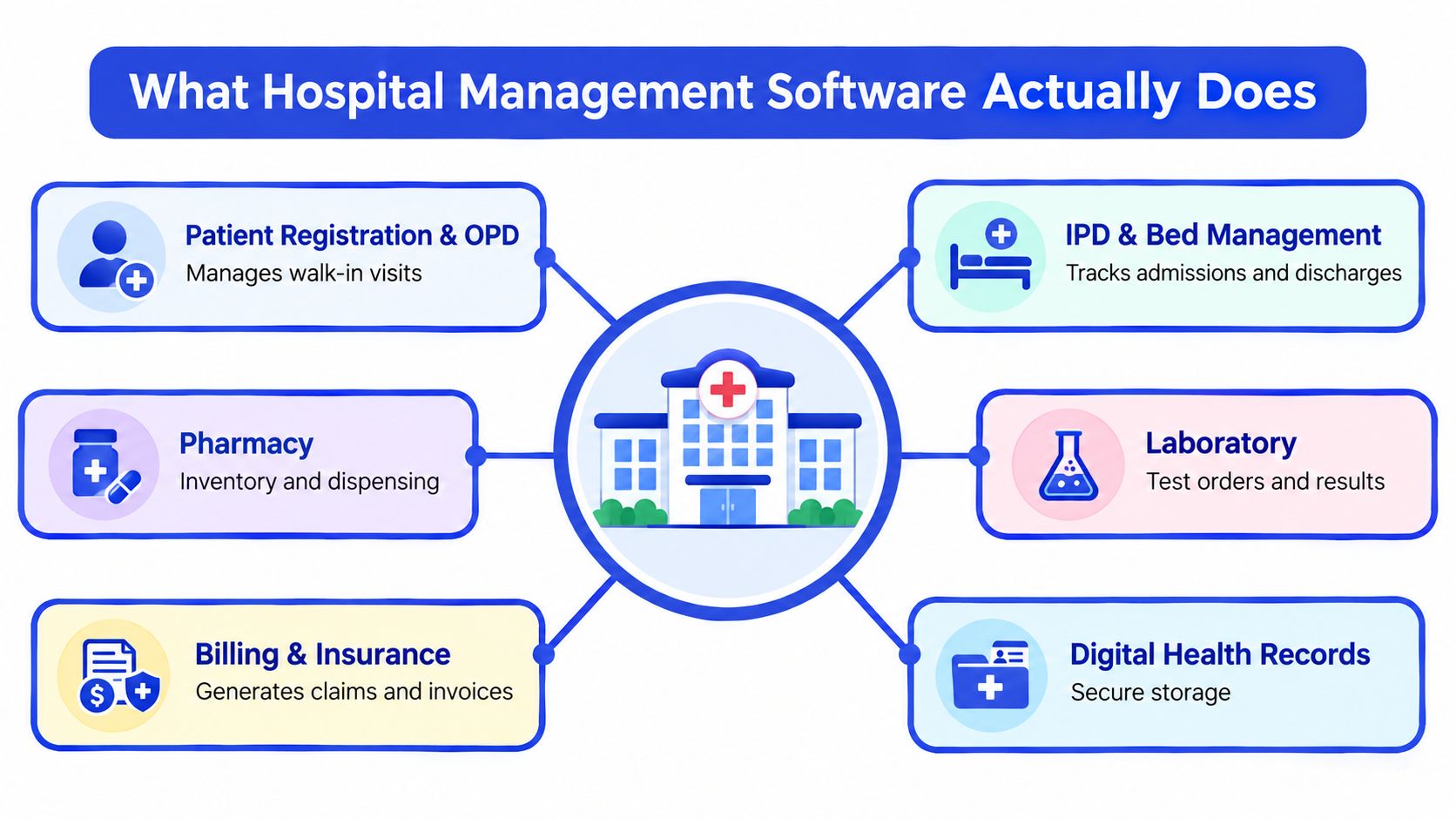
Hospital management software is the operating layer that connects patient registration, clinical care, diagnostics, pharmacy, revenue collection, inventory, accounting, and reporting. A basic clinic billing application handles only a narrow slice of that work. A modern hospital management system in India connects the full patient and financial journey, from the first appointment to discharge and settlement.
A hospital administrator comparing vendors should start with the workflow, not the feature count. Ask what happens when a patient registers, sees a doctor, receives a laboratory order, collects medicine, gets admitted, uses an insurance or TPA facility, and reaches discharge. If staff must re-enter the same information across separate systems, the hospital is buying digital forms, not an integrated HMS.
The operational backbone
A practical HMS usually covers:
- Patient registration and OPD: Captures demographics, appointments, visits, queues, and doctor encounters.
- IPD and bed management: Manages admissions, bed allocation, transfers, discharge summaries, and clearances.
- Pharmacy and inventory: Connects prescriptions, dispensing, stock, batches, suppliers, and expiry controls.
- Laboratory and radiology: Links orders, samples, results, imaging workflows, and reports to the patient record.
- Billing and insurance: Handles tariffs, packages, refunds, approvals, claims, invoices, and payment reconciliation.
- Records and reporting: Provides secure clinical histories, audit trails, dashboards, and management reports.
For clinics, the required scope may remain limited to registration, OPD, prescriptions, billing, pharmacy, and basic reports. A multi-specialty hospital may need IPD, operation theatre, emergency, laboratory, radiology, insurance, TPA, inventory, accounting, and multi-site reporting. That difference is why a hospital information management system in India should be scoped around departments and workflows rather than marketed module totals.
NABH-oriented operations also make traceability important. Access permissions, consistent documentation, approval histories, and audit trails help hospitals maintain operational discipline. Teams wanting additional context on clinical record support can review EHR support for clinics.
The three pricing dimensions recur throughout every HMS proposal:
- Deployment model, cloud SaaS, hybrid, or on-premise.
- Module depth, from basic billing to clinical, financial, and operational coverage.
- Integration scope, including ABDM, laboratory equipment, Tally, TPA, APIs, and legacy migration.
How Much Hospital Management Software Really Costs in India
The most useful answer is that hospital management software cost in India is tiered, not fixed. A 2026 India pricing survey reported cloud packages for small clinics at about ₹999 to ₹3,000 per month, mid-tier hospitals at roughly ₹3,000 to ₹25,000 per month, and enterprise deployments at around ₹25,000 to ₹50,000 per month. The same benchmark placed custom on-premise systems at approximately ₹5 lakh to ₹50 lakh or more upfront, depending on modules and integrations. See the India HMS pricing benchmark.
| Facility type | Cloud SaaS, per month | Custom or on-premise, upfront |
|---|---|---|
| Small clinic | ₹999 to ₹3,000 | Scope-dependent |
| Mid-tier hospital | ₹3,000 to ₹25,000 | Scope-dependent |
| Enterprise deployment | ₹25,000 to ₹50,000 | Scope-dependent |
| Large network, premium enterprise scenario | Scope-dependent | ₹2 lakh to ₹10 crore |
The upper range applies to projects involving large networks, multiple branches, ABDM or API connectivity, HL7/FHIR interoperability, custom analytics, and complex rollout requirements. It shouldn’t be compared directly with a small clinic subscription. A low monthly SaaS quote may cover registration and billing, while a premium enterprise proposal may include data migration, workflow redesign, interfaces, testing, security controls, training, and multi-site governance.
Another India-focused reference places cloud SaaS for small hospitals around ₹12,000 to ₹35,000 per month, with enterprise or hybrid systems for facilities with 200 or more beds reaching ₹75,000 to ₹2,500,000 or more per year. The difference between these bands reflects varying assumptions about users, modules, support, and integration scope. The hospital software development cost breakdown is useful when separating licence charges from implementation work.
Procurement rule: Never approve an HMS quote until the vendor has listed included modules, users, integrations, migration tasks, training, support, and renewal obligations.
For finance leaders, software should be assessed alongside the cost of manual billing, delayed claims, and reconciliation. A practical resource on ROI on outsourcing medical billing can help frame the wider revenue-cycle discussion, even when the hospital plans to keep billing in-house.
Blocsys also develops a corporate bond tokenization platform for digital bond issuance, smart contract automation, faster settlements, and investor management. That is a separate financial technology use case, but it illustrates the same budgeting principle: regulated workflows cost more when control, traceability, and integration are part of the required scope.
Cost Drivers That Move the Final Bill
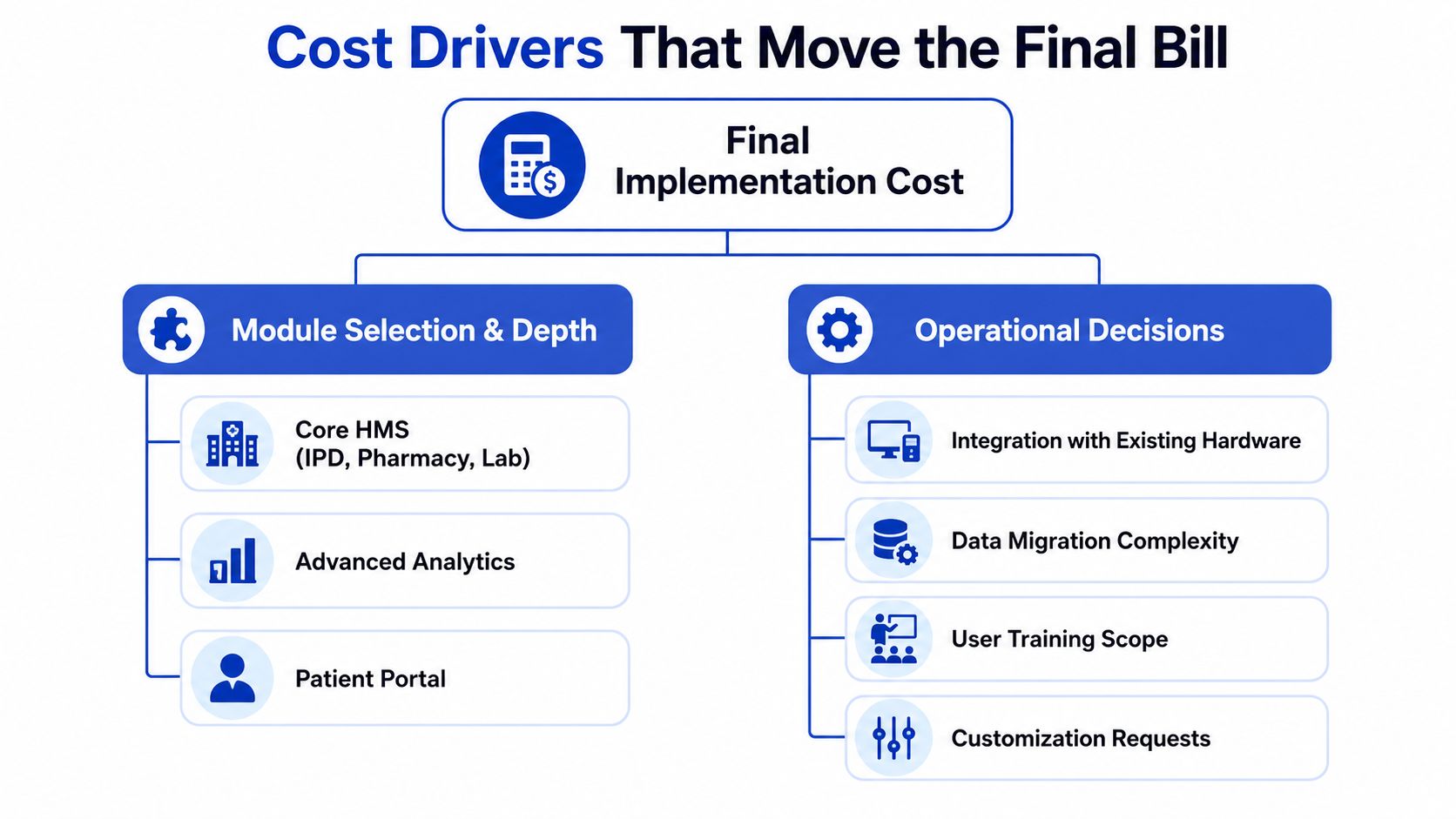
A hospital can receive a quote near the lower end of the market and still face a much larger implementation bill after discovery. The reason is that module depth and integration complexity create step changes, not small incremental additions. A billing-only deployment and a hospital ERP with IPD, pharmacy, lab, insurance, migration, and multi-branch controls are different engineering projects.
The scope triggers buyers underestimate
Module depth affects workflows, permissions, database relationships, testing, and training. IPD introduces bed, admission, nursing, discharge, and package logic. Pharmacy adds stock, batches, dispensing, returns, and billing connections. Laboratory and radiology add orders, samples, reports, equipment interfaces, and result validation. Insurance and TPA workflows add pre-authorisation, documentation, claim status, and settlement tracking.
Customisation becomes expensive when the hospital wants unique approval chains, tariffs, forms, discharge rules, specialty workflows, or branch-specific policies. Configuration is usually cheaper than changing core product behaviour, so procurement teams should distinguish between “can be configured” and “requires custom engineering”.
Integration is another major trigger. ABDM connectivity, third-party APIs, Tally or accounting synchronisation, laboratory equipment, PACS, payment gateways, pharmacy point-of-sale systems, and insurance platforms each require interface design, authentication, error handling, testing, and support ownership.
Build the RFP around cost triggers
Use a cost checklist before requesting final proposals:
- Users and roles: Include doctors, nurses, front-desk staff, pharmacists, technicians, finance teams, administrators, and external users. Role-based access control affects configuration, permissions, auditability, and training.
- Data migration: Identify legacy patient records, tariffs, inventory, supplier lists, claims, and accounting data. Migration complexity depends on data quality and source formats, not only volume.
- Billing rules: Specify GST-compliant billing, packages, discounts, refunds, scheme tariffs, deposits, and approval limits.
- Mobility: Decide whether doctors, patients, managers, or field teams need mobile applications, notifications, dashboards, or remote access.
- Analytics and AI: Separate essential reporting from predictive analytics, auto-coding, voice-to-EMR, clinical decision support, or automated operational recommendations.
- Security: Budget for access control, audit logs, encryption, backup policies, vulnerability assessment, disaster recovery, and security testing.
The software development cost estimator accuracy guide can help buyers understand why early estimates are directional until workflows, integrations, and migration assumptions are confirmed.
A clear RFP reduces scope creep because every vendor prices the same operating model. Without that discipline, the lowest proposal often excludes the work that makes the system usable.
Custom HMS vs Ready-Made HMS
Ready-made SaaS is usually the sensible starting point for a small clinic with standard workflows. It reduces upfront infrastructure work, supports faster configuration, and lets the clinic pay for a defined service rather than commission a full product. The risk appears when the hospital needs unusual tariffs, multi-branch controls, complex TPA processes, deep laboratory integration, or a customized accounting flow that the packaged system can’t support.
Custom HMS development provides control over workflows, data structures, interfaces, security policies, and future changes. It also creates responsibility for product ownership, testing, documentation, infrastructure, upgrades, and support. A custom build isn’t automatically more economical, and a subscription isn’t automatically cheaper over the full operating life.
A practical decision screen
Score the facility against five questions:
- Are the workflows standard? If registration, OPD, billing, pharmacy, and reporting follow common patterns, ready-made software may fit.
- Will the hospital add branches or specialties? Expansion increases the value of configurable architecture and centralised governance.
- Does the hospital already own infrastructure? Existing data-centre capability can improve the case for on-premise, but only if internal IT can operate it.
- Are integrations mandatory? ABDM, HL7/FHIR, Tally, laboratory equipment, PACS, TPA, and legacy systems may exceed a packaged product’s native scope.
- Who owns change requests? A vendor-controlled roadmap can create lock-in when the hospital needs urgent workflow changes.
Published India-focused pricing guidance commonly describes small hospitals with roughly 5 to 50 beds as paying about ₹15,000 to ₹60,000 monthly for SaaS or ₹5 lakh to ₹12 lakh for a custom build, while hospitals above 50 beds may spend ₹15 lakh to ₹50 lakh or more on enterprise implementation. These figures are from the India custom HMS pricing guide, and they should be read as scope-dependent benchmarks, not universal quotes.
A 10-bed clinic that buys a custom platform may carry unnecessary engineering and maintenance costs. A 50-bed multi-specialty hospital with specialised workflows may outgrow a limited SaaS product and then pay again for migration, replacement, and integration. The right comparison is three-year total cost of ownership, including subscriptions, implementation, support, training, customisation, migration, and the cost of changing platforms.
For hospitals considering a custom approach, custom hospital management software in India provides a relevant reference point for evaluating configurable workflows and implementation scope.
Cloud vs On-Premise and the Real Cost of Integrations
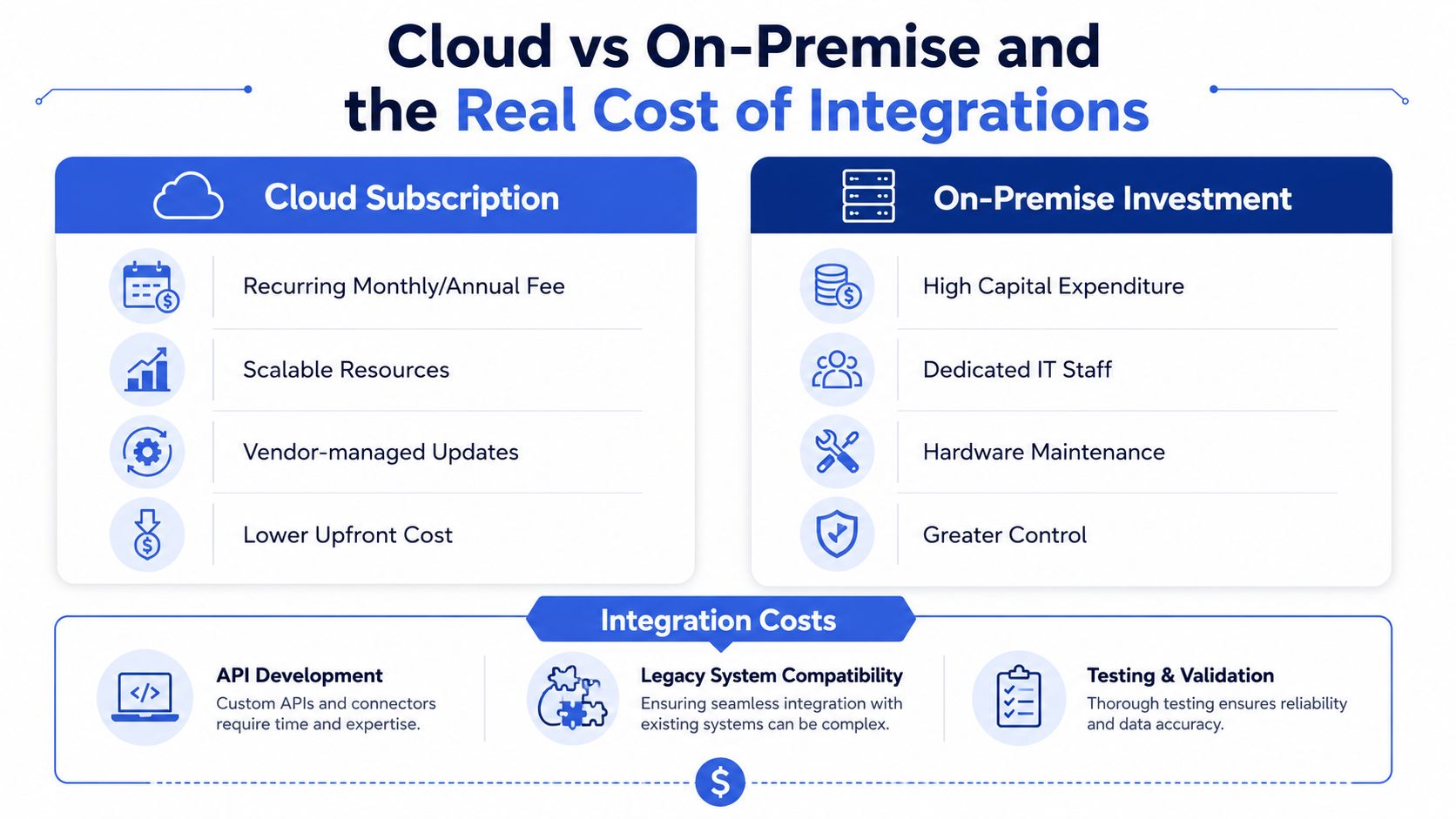
Cloud and on-premise models shift costs rather than eliminate them. Cloud SaaS normally reduces upfront infrastructure spending and moves more responsibility for hosting, updates, monitoring, and backups to the vendor. On-premise deployment gives the hospital greater control over infrastructure and data residency, but the hospital carries hardware, maintenance, security operations, backup, disaster recovery, and internal support responsibilities.
What the deployment choice changes
Cloud often suits clinics and hospital groups that want scalable resources without running their own infrastructure. On-premise can make sense for organisations with established IT operations, strict internal hosting policies, unreliable connectivity in a facility, or a need for local control. Hybrid deployment may be appropriate where core records remain under tighter control while selected services use managed infrastructure.
Neither model removes integration work. A cloud system still needs secure APIs, authentication, monitoring, failure handling, and interface testing. An on-premise system still needs network access, device compatibility, upgrades, and integration maintenance.
Key integration lines include:
- ABDM and ABHA connectivity: Requires interoperability planning, identity handling, consent-aware workflows, testing, and operational support.
- HL7, FHIR, and laboratory interfaces: Connects analysers, radiology systems, PACS, and external diagnostic centres.
- Tally and accounting: Maps billing transactions, chart-of-account structures, vouchers, tax treatment, refunds, and reconciliation.
- Insurance and TPA workflows: Covers pre-authorisation, claim documentation, status tracking, and settlement updates.
- Mobile applications: Adds authentication, notification services, device support, and separate user-experience testing.
The National Health Authority’s DocMitra HMIS under ABDM establishes a government-backed lightweight baseline for appointments, medical histories, prescriptions, and related provider tasks. The Ministry of Health and Family Welfare also describes its HMIS framework as a web-based system for monitoring and planning health programmes. Private hospital software therefore competes not only with vendors, but also with public digital infrastructure and existing internal tools.
The Digital Information Security in Healthcare Act, or DISHA, may appear in buyer discussions, but procurement teams should ask vendors to state the exact legal and security basis of their proposal rather than accept broad compliance language. Security, audit readiness, and interoperability need explicit deliverables.
Timelines, AI Features, and Maintenance Over 12-24 Months
HMS spending continues after go-live. The initial budget should cover discovery, configuration or development, data migration, testing, training, deployment, and stabilisation. The following budget needs room for support, security updates, infrastructure, integrations, new departments, reporting changes, and user onboarding.
Blocsys’s research material gives a broad development range of 3 to 12 months, based on complexity, features, and customisation. Use it for planning, not as a promise. A small clinic with clean data and standard workflows may move faster than a hospital handling multi-branch migration, laboratory interfaces, TPA rules, and extensive training.
What to plan across the first operating cycle
At launch, prioritise registration, OPD, billing, pharmacy, core records, and workflows that create immediate operational value. Activating every module before staff can use the foundation reliably increases training and support costs.
After stabilisation, address migration clean-up, dashboards, approval rules, additional departments, accounting reconciliation, and integration exceptions. This stage also shows which requested customisations solve a real operating problem and which can wait.
During the 12 to 24-month horizon, assess AI features against clean data and defined use cases. Clinical decision support, predictive bed management, auto-coded billing, voice-to-EMR, and operational analytics can add value, but each requires model governance, validation, privacy controls, monitoring, and user training. AI built on inconsistent master data will not correct the underlying process.
The AI-powered hospital ERP development guide helps teams decide where advanced automation belongs in the roadmap.
Maintenance has four separate cost areas:
- Application support: Incident response, user assistance, configuration changes, and issue resolution.
- Infrastructure support: Hosting, monitoring, backups, capacity, disaster recovery, and network dependencies.
- Security maintenance: Vulnerability remediation, access reviews, audit-log monitoring, and security testing.
- Product evolution: Regulatory changes, interoperability updates, new reports, mobile support, and AI roadmap work.
A hospital expanding from one facility to a larger network will need stronger tenancy, role segregation, consolidated reporting, master-data governance, and deployment processes. Discuss those capabilities before expansion starts, rather than paying for emergency additions later.
ROI of Hospital Management Software in Indian Hospitals
The financial case for an HMS comes from operational control, not from owning a modern dashboard. A well-scoped system can reduce missed charges, billing rework, duplicate data entry, manual reconciliation, untracked inventory movement, delayed claim preparation, and time spent assembling reports. The value appears when the software connects clinical activity to billing, finance, and management action.
A simple payback model should compare:
Expected annual benefit = recovered revenue leakage + avoided manual effort + reduced rework and reconciliation + operational capacity released
Then compare that benefit with the full annualised cost of the system. Include implementation, subscriptions or licence costs, support, training, migration, infrastructure, integrations, and internal project time. The result won’t be reliable if the hospital counts only the vendor invoice.
Where value usually appears
- Revenue capture: Charges from OPD, IPD, pharmacy, laboratory, radiology, and procedures are recorded within connected workflows.
- Claims discipline: Pre-authorisations, supporting documents, claim status, and exceptions become easier to track.
- Staff productivity: Teams spend less time re-entering patient data, matching records, and preparing routine reports.
- Patient flow: Coordinated appointments, beds, diagnostics, and discharge tasks can reduce avoidable administrative delays.
- Audit readiness: Digital permissions and records provide clearer evidence of who entered or approved information.
The investment may not pay back when the hospital buys modules staff won’t use, skips workflow design, underestimates migration, or treats training as a one-time presentation. A technically capable system can still fail if front-desk, nursing, pharmacy, laboratory, and finance teams continue using parallel spreadsheets.
Hospitals exploring other systems that require strong traceability may also encounter Blockchain Development for secure, scalable applications using public, private, or hybrid blockchain networks. That is separate from HMS procurement, but the governance principle is similar: define the process, control access, and make transactions auditable.
How Blocsys Helps You Build the Right HMS
Blocsys approaches hospital management software development by mapping departments, billing rules, accounting requirements, integrations, roles, and deployment constraints before finalising scope. Its hospital management systems cover clinical, operational, financial, EMR/EHR, pharmacy, laboratory, insurance, TPA, reporting, and healthcare automation needs, with SaaS and on-premise deployment options.
That approach addresses the two costly procurement mistakes. Hospitals shouldn’t pay for modules they won’t use, and they shouldn’t omit integrations they can’t operate without. ABDM connectivity, GST-compliant billing, Tally synchronisation, multi-branch access, laboratory and radiology workflows, migration, and audit controls need explicit treatment in the proposal.
For hospitals, clinics, diagnostic centres, and healthcare networks, the practical next step is a workflow-led scope review rather than another generic product demo. Blocsys can discuss Hospital Management Software Development, Custom HMS Development, Hospital ERP Development, EMR/EHR Integration, and scalable healthcare technology solutions around the facility’s actual operating model.
Frequently Asked Questions
How much does hospital management software cost in India?
Hospital management software in India can range from about ₹999 to ₹50,000 per month for cloud-based deployments, while custom or on-premise systems can range from several lakh rupees to much higher amounts depending on the scope. The final cost depends on factors such as hospital size, modules, integrations, deployment model, number of users, data migration, and customisation requirements.
What factors affect the cost of hospital management software?
The main factors affecting hospital management software cost are the number and depth of modules, user roles, integrations, deployment model, data migration, custom workflows, security requirements, reporting, mobile applications, and ongoing support. Features such as ABDM connectivity, laboratory interfaces, Tally integration, insurance workflows, and multi-branch management can significantly increase the overall project scope.
How much does custom hospital management software cost?
Custom hospital management software can cost from several lakh rupees to significantly more for large or complex deployments. The cost depends on the number of departments, custom workflows, integrations, data migration, security controls, reporting requirements, number of facilities, and deployment architecture. A multi-specialty hospital or hospital network typically requires more development than a small clinic with standard workflows.
Is custom HMS better than ready-made hospital management software?
Custom HMS is generally better when a hospital needs specialised workflows, complex integrations, multi-branch controls, custom reporting, or greater control over its technology roadmap. Ready-made hospital management software can be more suitable for smaller facilities with standard workflows because it typically requires less upfront development and can be deployed faster.
What modules should a hospital management system include?
A hospital management system commonly includes patient registration, OPD, IPD and bed management, pharmacy, laboratory, radiology, billing, insurance and TPA workflows, inventory, medical records, reporting, and administrative functions. Larger hospitals may also require operation theatre, emergency management, accounting, multi-branch controls, EMR/EHR integration, and advanced analytics.
How much does ABDM integration add to hospital management software cost?
ABDM integration can increase hospital management software cost because it requires interoperability planning, identity handling, consent-aware workflows, API integration, testing, security controls, and ongoing operational support. The exact cost depends on the hospital’s existing architecture, required ABDM workflows, data structure, and the number of connected systems.
What is the difference between cloud and on-premise hospital management software?
Cloud hospital management software is hosted on managed infrastructure and generally reduces the hospital’s need to operate its own servers, while on-premise software is deployed within the organisation’s infrastructure and provides greater direct control over hosting. Cloud can reduce upfront infrastructure costs, whereas on-premise deployments require the hospital to budget for hardware, maintenance, security operations, backups, disaster recovery, and internal IT support.
How long does it take to develop hospital management software?
Hospital management software development can take roughly 3 to 12 months depending on the project’s complexity, features, integrations, customisation, migration requirements, and deployment model. A small clinic with standard workflows can typically require less time than a multi-specialty hospital with ABDM connectivity, laboratory interfaces, insurance workflows, multiple branches, and extensive data migration.
What integrations are important in hospital management software?
Important hospital management software integrations can include ABDM and ABHA connectivity, HL7 and FHIR interfaces, laboratory equipment, PACS and radiology systems, Tally or accounting software, insurance and TPA platforms, payment gateways, pharmacy systems, and mobile applications. Integration requirements should be defined during project scoping because each interface can add authentication, data mapping, testing, monitoring, and maintenance requirements.
What are the ongoing maintenance costs of hospital management software?
Ongoing hospital management software maintenance costs typically include application support, infrastructure and hosting, security maintenance, backups, monitoring, integrations, regulatory updates, reporting changes, and product enhancements. Hospitals should include these costs in their total cost of ownership rather than evaluating the software only by its initial development or subscription price.
How can hospitals calculate the ROI of hospital management software?
Hospitals can calculate the ROI of hospital management software by comparing the annual benefits from reduced revenue leakage, lower manual effort, less billing and reconciliation rework, improved operational capacity, and better claim management against the complete annual cost of the system. The calculation should include implementation, licensing or subscriptions, support, training, migration, infrastructure, integrations, and internal project costs.
Blocsys Technologies offers custom hospital management systems, hospital ERP development, EMR/EHR integration, healthcare automation, and scalable cloud or on-premise healthcare technology solutions. Visit Blocsys Technologies to discuss your modules, integrations, deployment model, migration needs, and three-year cost plan with a healthcare software team.
