
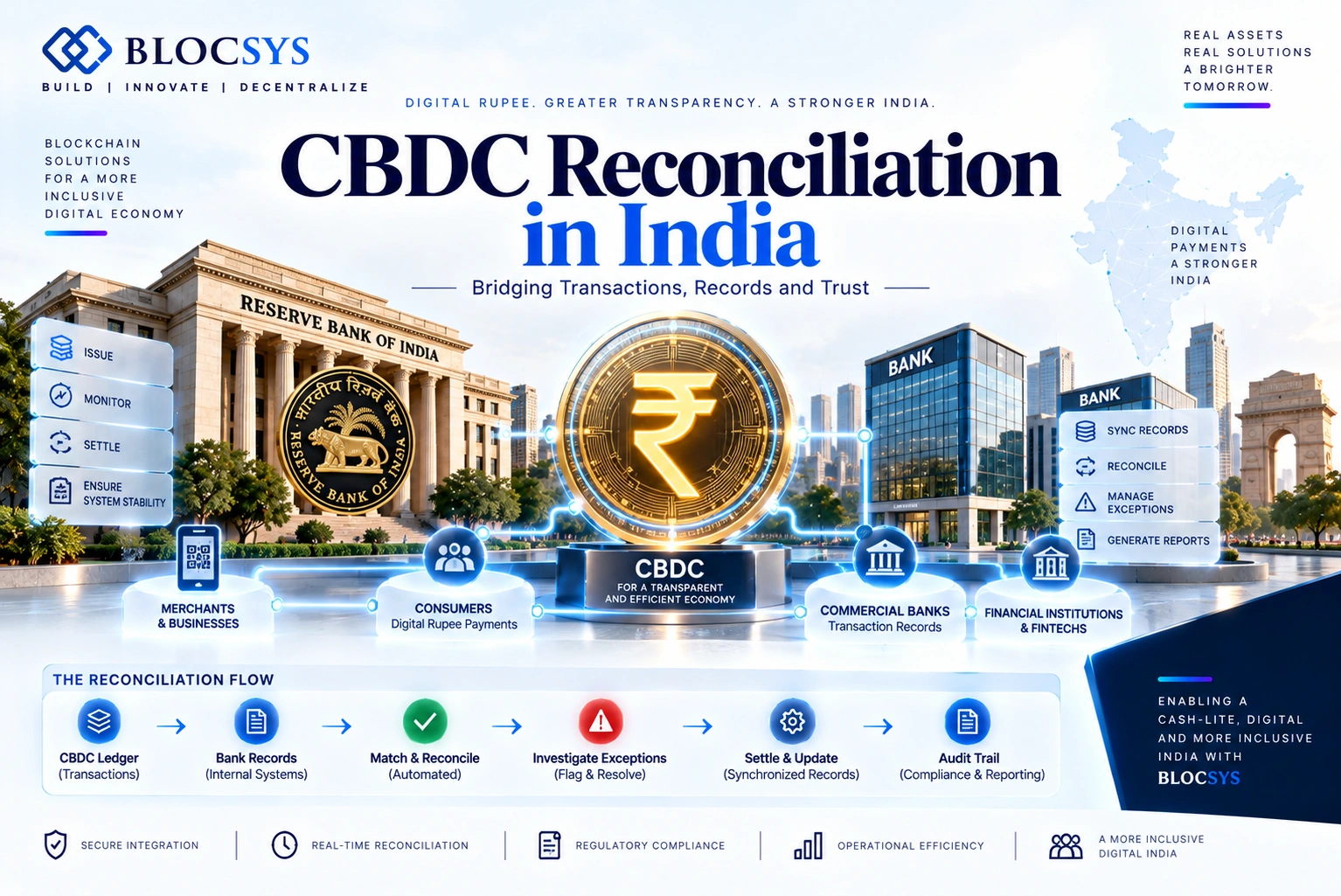
Your operations team closes the day with three different views of the same Digital Rupee activity. The CBDC wallet says a merchant payment succeeded. Core banking shows the wallet load but not the spend. Finance has parked the item in a suspense queue because the customer raised a complaint before the bank’s internal posting completed.
That’s where CBDC reconciliation in India becomes a real banking problem, not a theoretical one.
If you’re running e₹ flows inside a bank, NBFC, fintech, payment provider, or enterprise treasury setup, you don’t need another high-level CBDC explainer. You need a practical way to match Digital Rupee transactions, verify settlement, detect exceptions, and keep audit trails clean across wallet systems, UPI-linked acceptance, core banking, and reporting.
India’s Digital Rupee has already moved beyond a small pilot footprint. By the end of March 2025, RBI-reported figures showed the retail e₹ ecosystem had expanded to 17 participating banks, 60 lakh users, and ₹1,016 crore in CBDC circulation, up from ₹234 crore a year earlier, as covered by The Hindu’s reporting on RBI annual report figures. Once transaction activity reaches that scale, manual matching stops being a tolerable back-office habit.
Teams dealing with Digital Rupee integration usually discover the same thing. Reconciliation isn’t only about wallet-to-wallet movement. It extends into loading and unloading between customer accounts and wallets, QR-based merchant payments, reversals, failed postings, and mixed-rail processing where CBDC touches existing banking systems. That broader operating picture is why many teams reviewing Digital Rupee infrastructure connectivity patterns for banks in India quickly end up redesigning reconciliation and control flows as well.
Table of Contents
- Introduction to CBDC Reconciliation for Digital Rupee in India
- What CBDC Reconciliation Means for Digital Rupee Transactions
- Why Banks Need Automated Reconciliation as Digital Rupee Scale Grows
- How Digital Rupee Transaction Matching and Settlement Verification Works
- Managing Exceptions Discrepancies and Failed Transactions at Scale
- Building a Secure Automated CBDC Reconciliation Architecture
- Choosing a CBDC Reconciliation Provider and How Blocsys Can Help
- FAQs
- What is CBDC reconciliation in India
- Why do banks need Digital Rupee reconciliation
- How are Digital Rupee transactions reconciled
- What is Digital Rupee transaction matching
- How does settlement verification work for e₹ transactions
- How do banks handle failed or duplicate CBDC transactions
- Can CBDC reconciliation connect with core banking systems
- What security controls matter in CBDC reconciliation
- Can CBDC reconciliation be automated end to end
- What affects CBDC reconciliation implementation cost
- Conclusion
Introduction to CBDC Reconciliation for Digital Rupee in India
A bank product manager may think the hard part is launching the wallet. In practice, the pressure shows up later. Ops teams start asking why one e₹ transaction appears in the wallet ledger, another appears in core banking, and a third sits unresolved because the customer journey crossed systems that weren’t designed to share the same transaction state.
That problem is growing inside India’s CBDC environment because the Digital Rupee pilot now has meaningful scale and institutional breadth. Industry reporting tied to RBI data notes that India’s pilot began on 1 November 2022, with the retail pilot expanding on 1 December 2022, and by FY2025 had surpassed 60 lakh users and 17 banks, as summarised by the CBDC Tracker entry for India. For reconciliation teams, that means the e₹ is no longer a lab exercise. It’s an operational rail.
Where teams usually get stuck
Many teams begin by thinking in familiar payment-ops terms.
They ask:
- Did the debit and credit post?
- Did the settlement file arrive?
- Can finance close the day?
Those are still valid questions, but CBDC changes where the truth sits. In account-based systems, reconciliation often centres on bank account entries and end-of-day files. In a Digital Rupee setup, the truth may first appear at the wallet and CBDC ledger layer, then move into CBS, accounting, reporting, and customer support systems.
The operational challenge isn’t just matching balances. It’s preserving one reliable transaction story across every system that touched the e₹ movement.
What a practical automation roadmap looks like
Banks and fintech teams usually need five things in place:
- A transaction-state model that defines pending, successful, failed, reversed, and disputed events.
- A matching engine that compares wallet, banking, and accounting records.
- Exception workflows for duplicates, delayed postings, and cross-rail mismatches.
- Settlement verification controls for both retail wallet activity and institutional flows.
- Audit-grade reporting that support, finance, risk, and auditors can all use.
That’s the shift this article focuses on. Not CBDC theory, but how to automate Digital Rupee transaction matching in a way that works for banking operations.
What CBDC Reconciliation Means for Digital Rupee Transactions
CBDC reconciliation for the Digital Rupee is the process of matching e₹ transaction records across wallet systems, bank systems, accounting records, and settlement controls to confirm that each movement was posted correctly, completed with finality, and handled properly if it failed, reversed, or stayed unresolved.
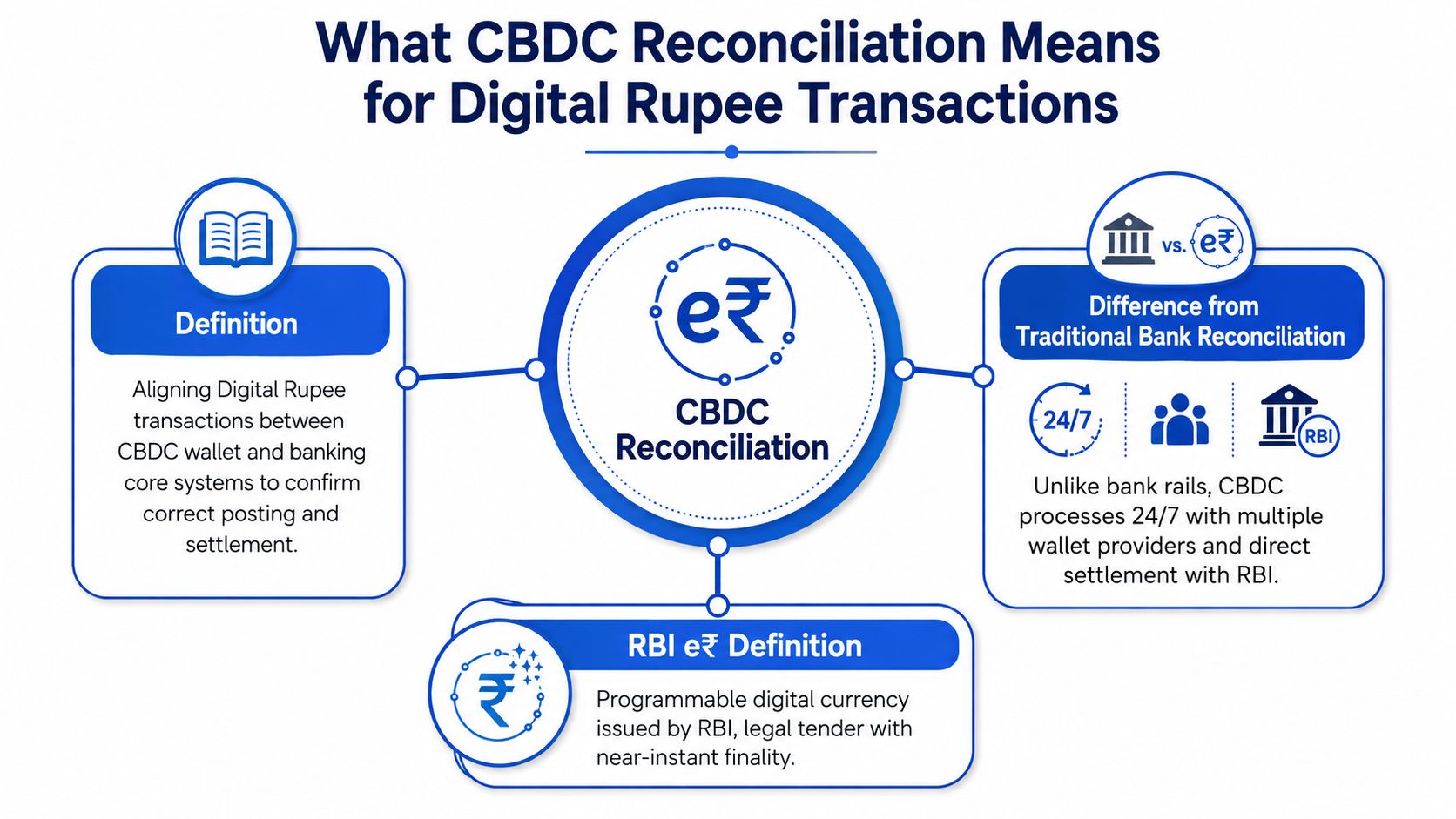
The starting point is RBI’s own definition. RBI describes the digital rupee, or e₹, as the digital form of physical rupee, issued by the central bank, at par with cash, with finality of settlement and cash-like convenience, as stated in the RBI Digital Rupee FAQ. That matters because reconciliation has to respect a cash-like settlement model, not force it into card or account assumptions.
How it differs from traditional bank reconciliation
In a normal account-based payment flow, operations teams often reconcile debits and credits across internal books, switch files, and bank postings. Delays are expected. Batch controls are normal. Some systems only become authoritative at day end.
Digital Rupee retail flows work differently. Reporting on RBI’s design notes that P2P and P2M transfers between e₹ wallets settle instantaneously without passing through user bank accounts, which shifts reconciliation away from end-of-day account matching and towards ledger-level validation at the wallet and CBDC layer, as explained in this discussion of Digital Rupee reconciliation design implications.
That one design choice changes the architecture.
Instead of asking, “Did account A debit and account B credit?”, a reconciliation engine often asks:
- Did the CBDC ledger confirm the wallet transfer?
- Did the bank’s wallet platform record the same event state?
- Did downstream systems mirror that state correctly?
- Did any load, unload, refund, or reversal create a second accounting event?
RBI requirements versus technical recommendations
RBI defines the instrument and the pilot environment. Institutions still have to build the operating model.
A practical distinction helps:
- RBI requirement: treat e₹ as a central bank-issued digital form of rupee with settlement finality.
- Technical recommendation: build event-driven reconciliation around transaction states, correlation IDs, exception queues, and immutable audit logs.
That recommendation doesn’t grant regulatory approval. It’s how banks reduce operational breaks.
For teams handling more complex post-trade flows, the same state-management thinking appears in DAML post-trade processing and settlement reconciliation workflows, where transaction truth must stay aligned across connected ledgers and downstream books.
Why Banks Need Automated Reconciliation as Digital Rupee Scale Grows
At 10:30 p.m., a customer loads money from a savings account into an e₹ wallet, pays a merchant on a UPI QR flow, then receives a partial reversal after a timeout dispute. By midnight, operations may need to confirm four different facts. Did the wallet load complete, did the merchant leg post, did CBS record the funding movement correctly, and did the reversal create a second accounting event?
That is why Digital Rupee reconciliation changes as volumes rise. It stops being a wallet balance check and becomes an always-on control layer for multi-leg transaction flows.
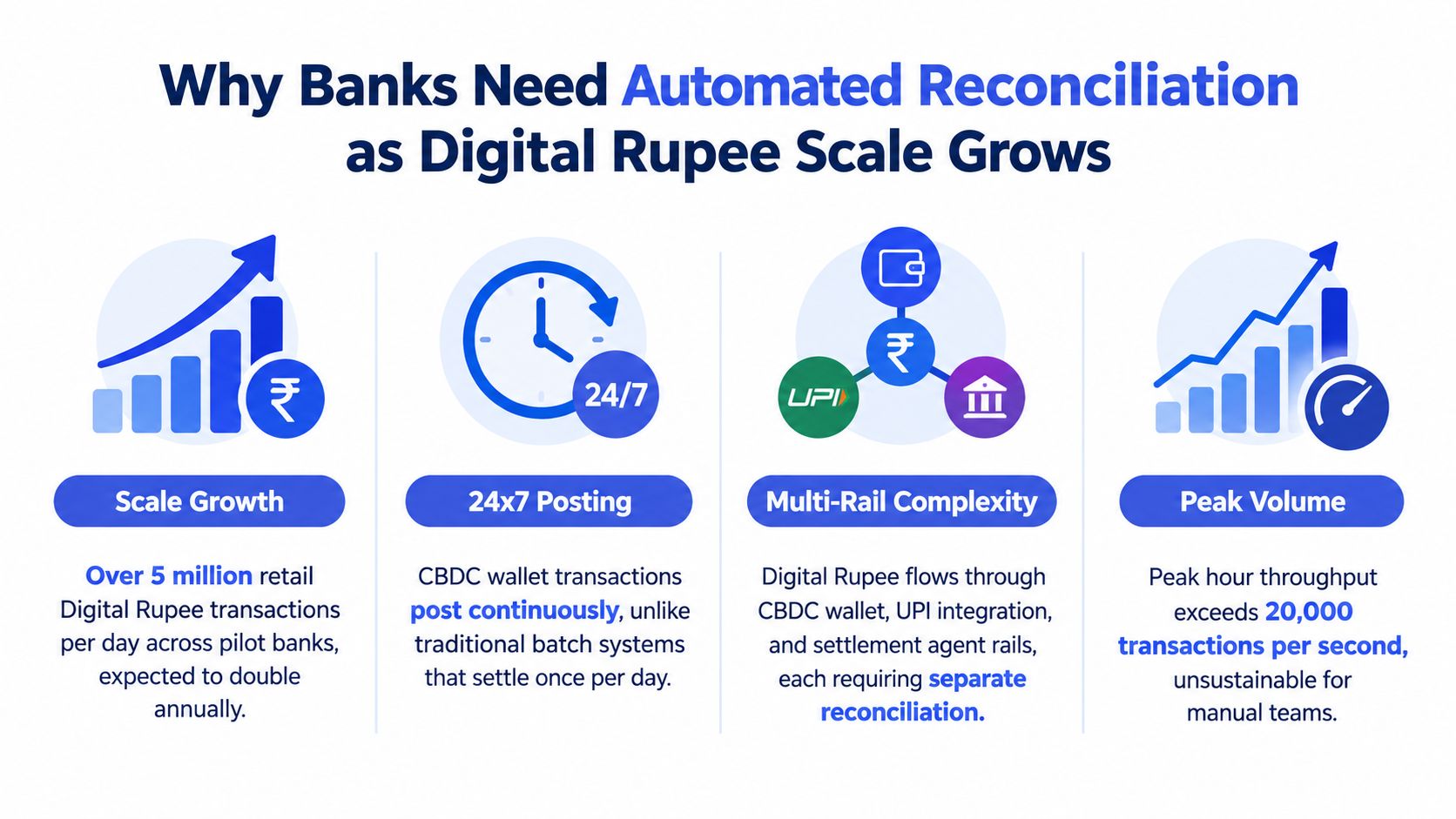
By the end of March 2025, the retail Digital Rupee pilot had reached 17 participating banks, 60 lakh users, and ₹1,016 crore in circulation, up from ₹234 crore a year earlier. The same RBI-reported figure reflected a 334% year-on-year surge, according to The Hindu’s coverage of the RBI annual report. At that scale, manual review stops working as a primary control.
Continuous operations change the control model
RBI states that the e₹ wallet is available 24 hours a day, 7 days a week, as noted in the RBI Digital Rupee FAQ PDF. A once-a-day reconciliation cycle fits end-of-day files. It does not fit a rail that keeps creating financial events overnight, on weekends, and during holidays.
A useful analogy is card authorization versus final settlement. Ops teams do not wait until the next afternoon to discover a large batch of failed authorizations. Digital Rupee controls need the same posture. Exceptions must surface while customer support can still act, while treasury can still assess exposure, and while finance can still prevent misstatement across connected books.
The hard part is cross-system choreography
A frequently missed signal appears in a 2025 Central Bank of India procurement document, which asks vendors to support end-to-end reconciliation across CBDC Wallet with UPI (CBDC to UPI QR), token-to-token, and CBDC with CBS settlement, as seen in the bank’s corrigendum document. That request matters because it mirrors what product and operations teams face in production.
The break usually sits between systems, not inside one system.
For example, a wallet load can look successful on the CBDC side but remain delayed in CBS posting. A CBDC to UPI QR payment can complete for the merchant while a downstream reconciliation key fails to map correctly. An unload can post back to the customer account while a linked fee, refund, or reversal remains unresolved. In wholesale or treasury-linked use cases, the same pattern extends to delivery-versus-payment style workflows, where one leg may be complete and the other may still need settlement confirmation.
This is closer to reconciling a travel itinerary than checking a single ticket. One customer action can create several connected records, each with its own status, timestamp, reference, and accounting consequence.
Manual teams cannot keep pace with exception volume and timing
As transaction counts increase, banks do not just get more records. They get more timing gaps, retries, duplicates, partial completions, and state mismatches. Those are operationally expensive because each one can trigger customer complaints, suspense entries, finance adjustments, and audit review.
Automated reconciliation helps in three specific ways:
- It matches related legs across systems using transaction IDs, wallet references, account postings, and settlement markers.
- It detects exceptions early so unresolved loads, unloads, QR payments, and reversals do not sit unnoticed until end of day.
- It assigns the right queue to operations, finance, support, or treasury based on the type of break.
That routing point gets overlooked. A merchant payment timeout and a CBS posting mismatch are both reconciliation issues, but they should not land with the same resolver group.
Retail and institutional programmes raise different reconciliation demands
Retail programmes usually feel the pressure first in customer service and merchant operations. Institutional programmes create a different burden. They need stronger proof that linked settlement events completed in the right order and posted to the right books.
That is why architecture choices matter early. Banks that design reconciliation only around wallet debits and credits often need to rebuild once they add UPI acceptance, account load and unload flows, programme disbursements, or wholesale settlement use cases. Banks that start with a multi-leg model can extend more easily because the reconciliation engine already expects one business event to create several dependent records.
Reuters reported in May 2026 that RBI planned to expand the digital rupee into welfare payments and test cross-border transactions, according to Reuters on RBI’s 2026 Digital Rupee expansion plans. That direction matters operationally. Programme flows and cross-border flows add more participants, more status dependencies, and more exception paths. They increase the need for an automated reconciliation layer that can prove what happened across every leg of a Digital Rupee transaction.
How Digital Rupee Transaction Matching and Settlement Verification Works
A workable reconciliation design starts with one assumption. Every Digital Rupee transaction has a lifecycle, and each system sees only part of it.
That’s why strong reconciliation engines don’t begin with reports. They begin with state capture.
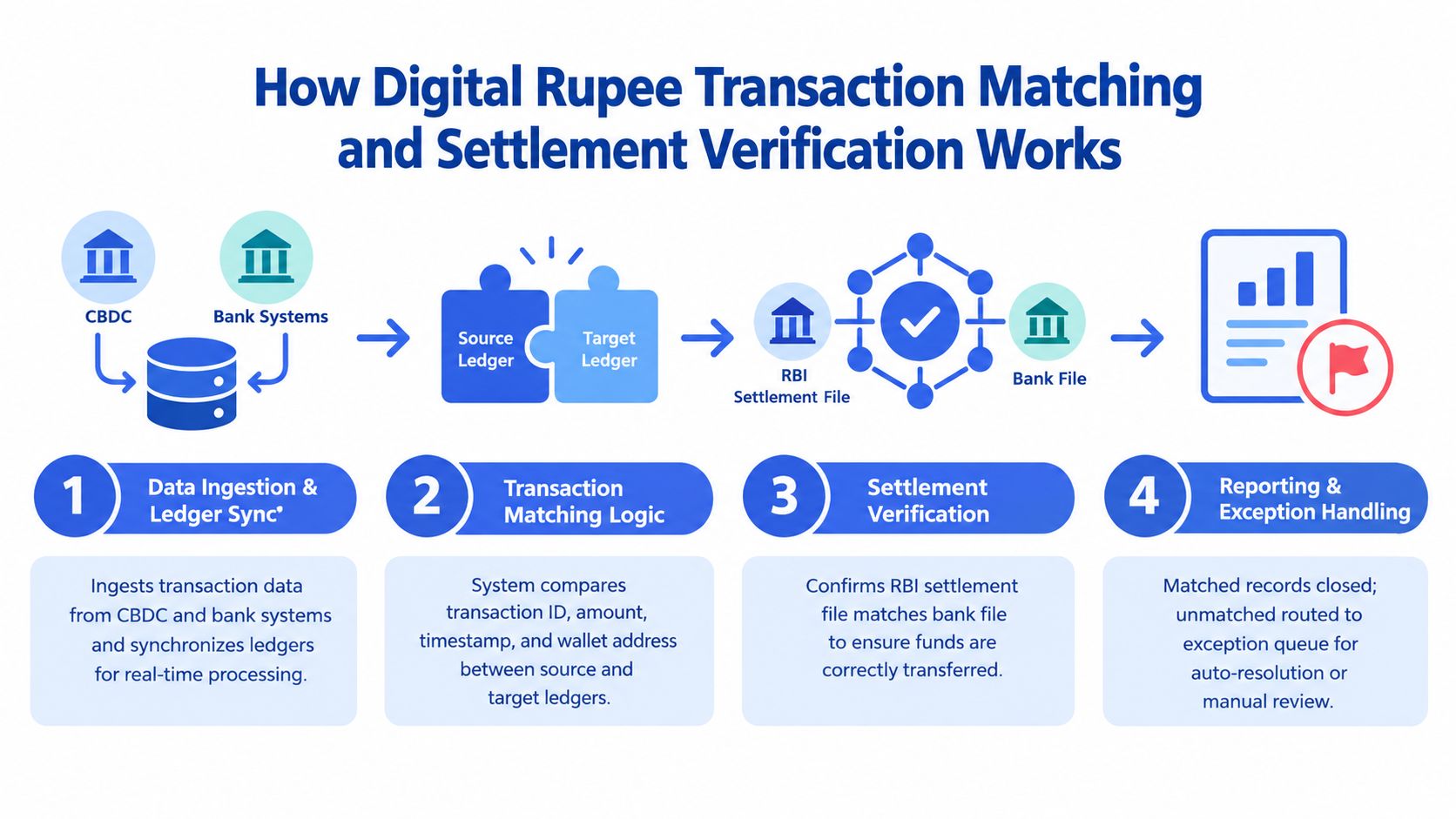
The four operating stages
| Stage | What Is Reconciled | Automation Outcome |
|---|---|---|
| Data ingestion | Wallet events, core banking entries, accounting records, status responses, settlement references | Creates one normalised transaction record |
| Matching | Transaction IDs, amounts, timestamps, wallet references, load or unload relationships | Marks records as matched, partial, duplicate, or unmatched |
| Settlement verification | Final settlement state, downstream posting state, linked cash or securities leg where relevant | Confirms closure or opens an exception case |
| Reporting and audit | Exception history, operator actions, reversals, ageing, and final disposition | Produces audit-ready records and operational dashboards |
Step one is data ingestion and ledger synchronisation
The first task is to pull transaction events from each relevant system into a common model. In a retail Digital Rupee flow, that usually means wallet platform records, core banking entries for loads and unloads, accounting events, and any merchant or channel status updates tied to the payment journey.
The key design choice is normalisation. If one system says “success”, another says “posted”, and a third says “final”, the engine needs a common state map. Without that, teams compare labels instead of facts.
Step two is transaction matching logic
A good matching engine doesn’t rely on amount alone.
It usually compares:
- Primary identifiers such as transaction or correlation IDs
- Monetary values across source and target systems
- Wallet and customer references where permitted in the operating model
- Timestamps and sequence windows to handle asynchronous updates
- Transaction type such as load, spend, receive, reversal, or unload
For merchant QR use cases, one event may begin in a customer wallet action and conclude through merchant confirmation. For wallet-to-wallet transfers, the flow is tighter, but support teams still need traceability if one side claims success and the other side doesn’t show the corresponding state.
Systems with very high event counts often apply batching and proof-based validation to downstream integrity checks. That’s where engineering patterns such as Merkle batching for large-scale transaction proof aggregation can be relevant for architecture teams assessing efficient record verification approaches.
Step three is settlement verification
Settlement verification is where many teams confuse status with finality.
In retail wallet transfers, the main question is whether the CBDC ledger state and the bank’s recorded state agree. Because the user bank account isn’t the direct transfer rail for wallet-to-wallet P2P or P2M movement, the reconciliation point sits closer to the CBDC transaction state than in a standard account-transfer model.
In wholesale use cases, the pattern changes again. Reporting on India’s 2026 Demat 2.0 pilot for tokenized corporate bonds states that the structure uses RBI’s wholesale digital rupee as the payment leg and connects securities records to the Unified Market Interface for atomic delivery-versus-payment, so the bond and cash legs either settle together or not at all, according to FinanceFeeds on the SEBI and RBI-linked tokenized bond pilot.
That matters because reconciliation effort drops sharply when cash and securities settle in one linked act rather than two separate systems.
In atomic DvP models, reconciliation shifts from post-trade repair to settlement-state confirmation.
Step four is reporting, closure, and downstream workflow
Once a transaction is matched and settlement is verified, the system should close the item automatically and update reporting layers used by finance, operations, and audit.
If the transaction fails matching or stays incomplete, the engine should open an exception case with:
- Root-cause category
- Current state
- Required operator or system action
- Escalation clock
- Final resolution history
That’s the point of automation. Not just identifying a break, but routing it to the right queue with enough context to resolve it.
Managing Exceptions Discrepancies and Failed Transactions at Scale
Most reconciliation projects succeed or fail on exception handling.
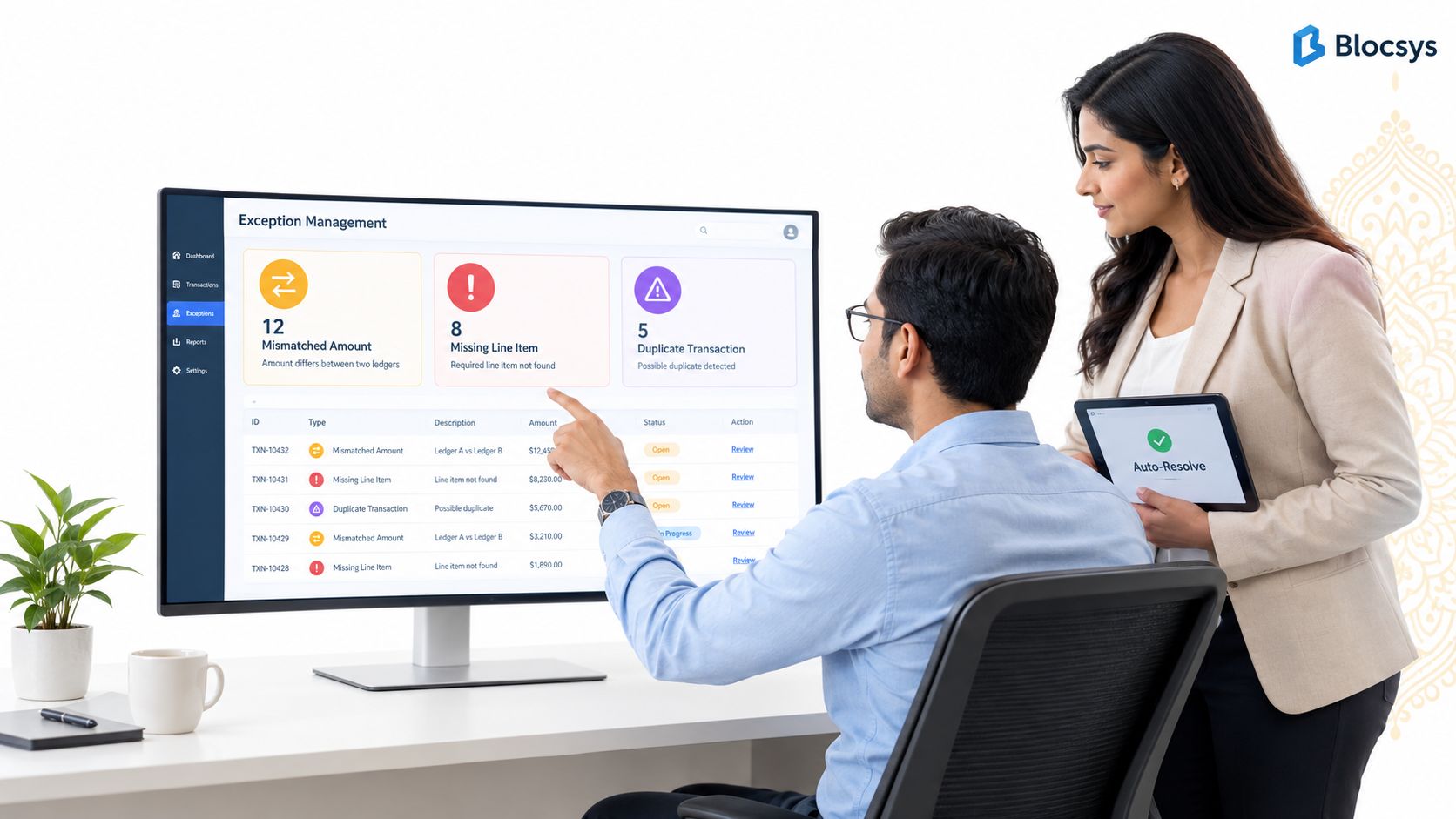
A matched transaction is easy. A delayed wallet unload, duplicate retry, missing CBS entry, or CBDC-to-UPI QR dispute is where operations teams lose hours.
Not all exceptions should be treated the same way
A practical operating model separates exception types by both financial risk and resolution path.
Some common categories are:
- Missing entry cases where one system has the transaction and another doesn’t
- Value mismatches where amount or transaction type differs
- Duplicate processing caused by retries or repeated submissions
- Reversals and refunds that were initiated but not fully reflected downstream
- Loading and unloading failures between bank account and wallet
- Mixed-rail exceptions when CBDC records and UPI-facing merchant states don’t line up
A manual team usually handles all of those through one shared queue. That’s inefficient because the fix for each category is different.
Automated triage changes the ops model
A stronger setup uses rules and case management.
For example:
- A duplicate suspected from retry logic may need automatic suppression and a status check rather than a fresh financial posting.
- A missing CBS leg on a wallet load may need replay through an integration adapter.
- A merchant QR discrepancy may need channel-level verification before finance posts any correction.
- A reversal mismatch may need an ageing rule and human approval.
The difference between manual and automated ops is not only speed. It’s decision quality. Teams that still rely on spreadsheets often struggle to preserve a complete action trail, especially once more than one team touches the same case. A useful comparison appears in manual versus automated billing operations for trust platforms, where the same core lesson applies. Queue everything manually, and control quality degrades fast.
A reconciliation platform should record not only the mismatch, but also why it happened, who touched it, what changed, and whether the issue can recur.
What good exception controls look like
Banks should expect these controls at minimum:
- Rule-based classification so common exceptions don’t wait for human triage.
- Ageing and escalation because unresolved CBDC breaks can affect support, finance, and treasury at the same time.
- Reprocessing controls that distinguish technical retries from financial retries.
- Audit logs that preserve every operator action and system-generated change.
- Root-cause tagging so recurring issues become engineering fixes, not permanent operations labour.
That’s especially important when e₹ activity intersects with core banking and familiar merchant acceptance paths. Cross-system friction is where exception volumes tend to accumulate.
Building a Secure Automated CBDC Reconciliation Architecture
A production-ready architecture for Digital Rupee reconciliation should be simple in shape, even if the underlying integrations are complex. The cleanest designs usually separate ingestion, matching, exception management, settlement verification, and reporting into distinct services with clear ownership.
A practical reference architecture
A bank or fintech team can evaluate the stack in five layers:
Ingestion layer
Connects wallet systems, CBDC interfaces, CBS, accounting, and channel records. It standardises event formats and preserves correlation IDs.Matching engine
Applies reconciliation logic, status mapping, tolerance rules where appropriate, and duplicate detection.Exception manager
Routes unmatched or partially matched items into case queues with ageing, assignment, and reprocessing controls.Settlement verifier
Confirms final transaction state and, for institutional flows, validates linked asset and cash movement.Reporting and audit layer
Produces operational dashboards, finance outputs, dispute support trails, and auditor-facing evidence.
Security and data integrity need to sit inside the workflow
CBDC reconciliation isn’t only an integration problem. It’s also a control problem.
A sound design should include:
- Access control by role and function
- Immutable event logging for operator and system actions
- Encryption in transit and at rest
- Idempotency safeguards to prevent duplicate processing
- Segregation between financial retry logic and technical retry logic
- Data lineage from initial request to final accounting state
These are technical recommendations, not regulatory approvals. Each institution remains responsible for meeting RBI requirements and its own internal control standards.
Integration with banking and ledger systems
Most institutions won’t replace their core stack. They’ll connect Digital Rupee reconciliation into existing systems through APIs, middleware, and event flows.
That usually means:
- wallet platforms feeding transaction states,
- CBS handling load and unload accounting impact,
- finance systems consuming reconciled postings,
- operational dashboards surfacing unresolved items.
For delivery teams building the underlying ledger-connected components, Blockchain Development is relevant in a factual sense because it covers custom blockchain applications for enterprises, startups, and governments across public, private, and hybrid networks. In a CBDC context, that matters when institutions need secure middleware, ledger-aware workflows, or token-linked transaction services around the reconciliation layer.
Refresh cycles should be part of the operating model
CBDC-related controls shouldn’t be treated as a one-time implementation.
A sensible refresh cycle includes:
- Regulatory review updates when RBI guidance or pilot scope changes
- Channel and workflow updates when new payment paths are introduced
- Tokenization and post-trade review if wholesale or capital-market use cases expand
- Security and audit review for 24×7 transaction operations
That review discipline matters because India’s CBDC environment is still evolving.
Choosing a CBDC Reconciliation Provider and How Blocsys Can Help
The provider shortlist should start with operating fit, not demo quality. A strong CBDC reconciliation partner should be able to work across wallet systems, banking integrations, settlement logic, audit trails, and exception workflows without assuming that Digital Rupee operations look like card processing or conventional bank reconciliation.
What to check before selecting a provider
Use a practical checklist:
Banking integration depth
Can the provider connect CBDC transaction flows with CBS, accounting, reporting, and support systems?API and event maturity
Can the platform ingest continuous transaction states and maintain traceability across systems?Exception automation
Does it classify duplicates, reversals, failed loads or unloads, and mixed-rail discrepancies in a usable way?Retail and wholesale readiness
Can the architecture support both wallet-driven retail flows and linked settlement workflows?Security and evidence quality
Are logs, operator controls, and reporting strong enough for internal audit and operational review?
How a practical rollout usually works
Most institutions should phase the work:
- discovery and transaction mapping
- source-system integration
- matching rule design
- exception workflow configuration
- reporting and audit setup
- controlled rollout with support playbooks
One relevant option in this space is token lifecycle management for automated digital asset operations, particularly for teams that need asset-state visibility, workflow automation, and operational controls around tokenised financial processes. Used carefully, that kind of capability can complement CBDC reconciliation design where Digital Rupee workflows intersect with broader digital asset operations.
Blocsys fits this market as an enterprise blockchain, fintech, CBDC, and digital asset technology company that can build customised reconciliation and financial integration solutions. The role is technical. Not regulatory. That distinction matters.
FAQs
What is CBDC reconciliation in India
CBDC reconciliation in India is the process of matching Digital Rupee transaction records across CBDC wallet systems, banking systems, accounting records, and settlement controls so institutions can confirm that each e₹ transaction was posted correctly, reached final state, and was handled properly if it failed, reversed, or remained unresolved.
Why do banks need Digital Rupee reconciliation
Banks need Digital Rupee reconciliation because e₹ transactions can touch more than one system, including wallet platforms, core banking, accounting, customer support, and reporting, and without automated matching the institution can struggle to detect mismatches, duplicates, delayed postings, unresolved reversals, and audit gaps in a timely way.
How are Digital Rupee transactions reconciled
Digital Rupee transactions are usually reconciled by ingesting records from wallet systems and internal banking systems, normalising them into a common transaction model, matching them by identifiers and state, verifying settlement or final posting, and then routing matched items to closure and unmatched items to an exception queue for review or automated reprocessing.
What is Digital Rupee transaction matching
Digital Rupee transaction matching is the rule-based comparison of e₹ records across systems using fields such as transaction ID, amount, timestamp, wallet reference, and transaction type so a bank or fintech can confirm whether the same value movement was recorded consistently across wallet, ledger, and downstream financial systems.
How does settlement verification work for e₹ transactions
Settlement verification for e₹ transactions checks whether the transaction reached its intended final state and whether connected internal systems reflect that state correctly, which may involve wallet-level confirmation for retail flows and linked cash-and-asset confirmation for institutional flows where CBDC is used as the payment leg.
How do banks handle failed or duplicate CBDC transactions
Banks handle failed or duplicate CBDC transactions by classifying them into exception types, applying rules to distinguish technical retries from real financial retries, suppressing duplicate processing where appropriate, triggering rechecks or replay logic for missing records, and escalating cases that require operator approval or customer support action.
Can CBDC reconciliation connect with core banking systems
Yes, CBDC reconciliation can connect with core banking systems through APIs, middleware, or event-driven integration layers so that wallet loads, unloads, accounting entries, exception states, and reporting records stay aligned with existing banking infrastructure rather than creating a separate unmanaged ledger process.
What security controls matter in CBDC reconciliation
Important security controls in CBDC reconciliation include role-based access, encryption, immutable logging, idempotency controls, clear data lineage, segregation of duties, and strong handling of transaction-state changes so institutions can protect financial data, reduce duplicate processing risk, and maintain reliable evidence for operational and audit review.
Can CBDC reconciliation be automated end to end
CBDC reconciliation can be highly automated end to end for ingestion, matching, exception classification, reporting, and audit logging, but most institutions still keep controlled human review for material breaks, unusual reversals, and policy-sensitive cases because automation improves control quality but doesn’t remove the need for governance.
What affects CBDC reconciliation implementation cost
CBDC reconciliation implementation cost depends on integration scope, number of source systems, complexity of wallet and core banking workflows, exception categories, reporting requirements, security controls, operating hours, and whether the institution also needs related capabilities such as API middleware, audit tooling, token-linked workflows, or custom engineering support.
Conclusion
Digital Rupee reconciliation in India isn’t just a new label for bank reconciliation. It’s a different operating discipline.
The core shift is this. Reconciliation no longer stops at account entries or wallet balances. It has to follow the full transaction lifecycle across the e₹ ledger, internal books, support workflows, exception queues, and, increasingly, institutional settlement models. Teams that design for that reality early will have a cleaner path as retail, welfare, and wholesale CBDC use cases continue to develop.
Blocsys Technologies builds customised blockchain, fintech, CBDC, and digital asset infrastructure for institutions that need reliable transaction matching, settlement verification, exception workflows, and banking integrations around Digital Rupee operations. If you’re planning or refining your reconciliation stack, visit Blocsys Technologies to discuss your architecture, integration roadmap, and implementation priorities.
