A token issuer can have a working smart contract, a connected wallet, and a polished dashboard, yet still fail when a mint event doesn't reach the ledger, a replacement transaction creates duplicate records, or a treasury approval lands on the wrong network. Web3 token infrastructure development addresses that operational gap. It gives Web3 businesses, fintechs, exchanges, enterprises, and digital asset teams the technical foundation to issue, move, store, monitor, and reconcile assets across blockchain networks and business systems. This guide focuses on the infrastructure layer, including smart contracts, wallets, APIs, indexing, transaction processing, security, compliance architecture, and enterprise integration, so decision-makers can distinguish a production system from a convincing prototype.
Table of Contents
- What Web3 Token Infrastructure Actually Means
- Core Components of a Token Infrastructure Stack
- Token Issuance, Smart Contracts, and Wallet Integration
- Transaction Processing and On-Chain Off-Chain Data Sync
- Multi-Chain Support, Security, and Transaction Monitoring
- Enterprise Integrations, Reporting, and Scaling
- How Blocsys Supports Web3 Token Infrastructure Development
What Web3 Token Infrastructure Actually Means
Web3 token infrastructure is the runtime layer that connects a digital asset's smart contract to wallets, blockchain networks, applications, and off-chain records. It includes the services that submit transactions, observe chain events, derive balances, protect signing authority, expose APIs, and reconcile blockchain state with business ledgers. The token is the asset. Infrastructure is what allows that asset to operate reliably.
A production stack must answer practical questions. Which contract can mint? Which wallet can sign? How does the system know whether a transfer is final? What happens when an RPC provider is unavailable? How does an exchange, bank, ERP, or compliance service receive the event? What record wins when an indexed balance differs from the chain?
The runtime layer versus the product layer
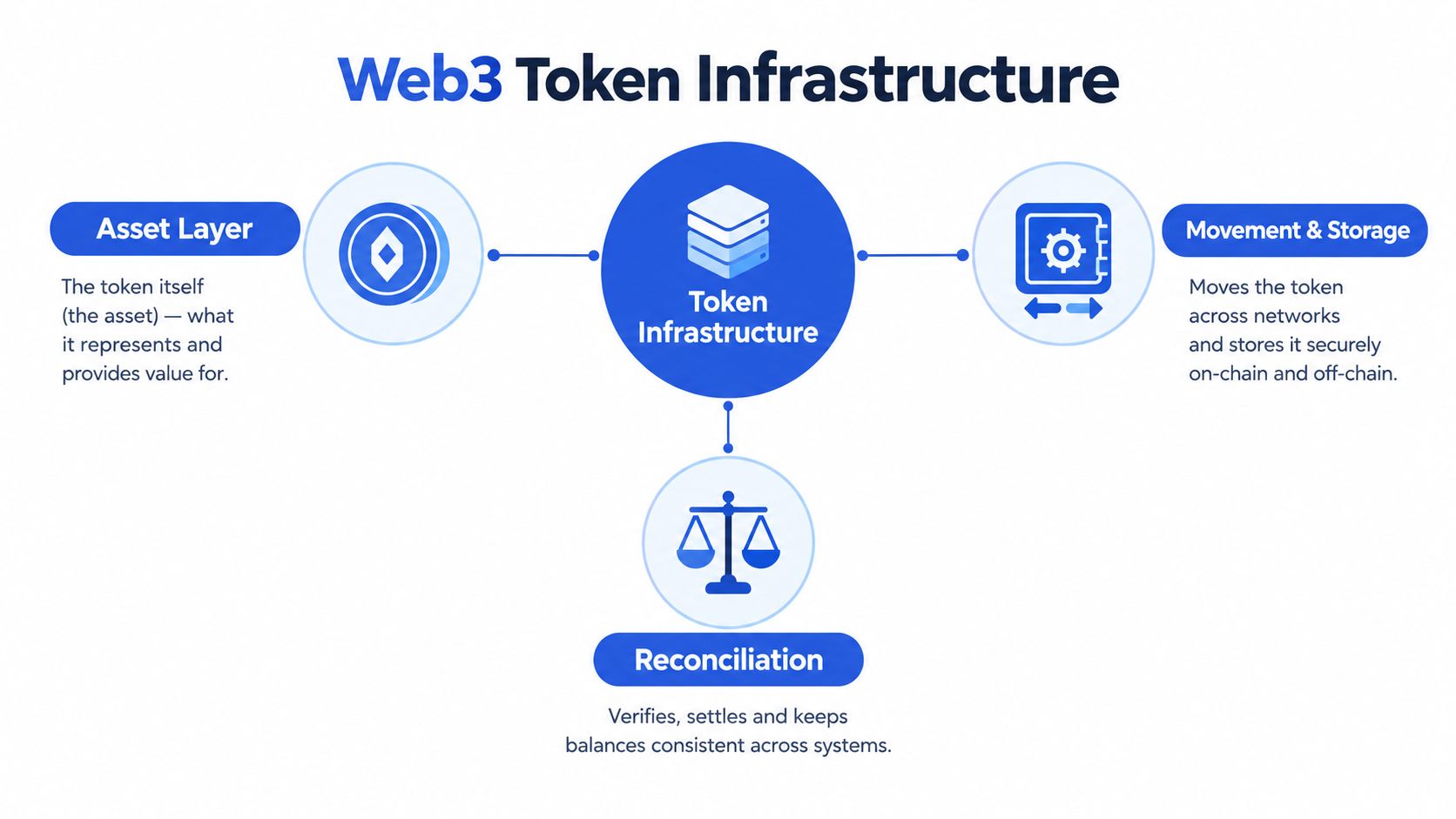
Token infrastructure sits underneath the customer-facing product. Its main responsibilities include:
- Asset execution: Deploying contracts, enforcing mint and burn rules, applying supply controls, and recording ownership on-chain.
- Movement and storage: Connecting custodial, non-custodial, MPC, or hardware-backed wallets to signing and transaction services.
- Chain connectivity: Operating or consuming RPC endpoints, handling gas, tracking confirmations, and receiving contract events.
- Data services: Indexing transfers, balances, metadata, and transaction status so applications don't query raw nodes for every screen.
- Reconciliation: Comparing on-chain state with internal ledgers, settlement files, treasury records, and customer-facing balances.
A token management system generally sits above these services. It may manage KYC gating, whitelists, investor permissions, corporate actions, administrative approvals, reporting, and operational workflows. Token infrastructure provides the technical plumbing that makes those workflows enforceable and observable.
The difference matters during vendor selection. A provider selling a dashboard may offer policy configuration without operating the indexers, signing service, event pipeline, or reconciliation engine underneath. Conversely, an infrastructure team may deliver reliable contract and data services without building the full compliance or investor portal.
Practical rule: Ask vendors to show the transaction path from user intent to signed payload, blockchain confirmation, indexed event, ledger update, and final API response. If they can only demonstrate a dashboard, you haven't yet evaluated the infrastructure.
Production architecture also needs clear failure handling. A mint can be mined while its webhook fails. A transfer can appear in an index before the chain reaches the finality threshold your business accepts. A wallet can sign a transaction for the wrong chain. The system should preserve raw events, transaction states, block references, and reconciliation outcomes so an operator can investigate the incident without guessing.
For teams evaluating digital asset infrastructure development, the right scope is therefore broader than smart-contract deployment. It includes issuance, signing, transaction processing, wallet integration, indexation, metadata, multi-chain operations, monitoring, and enterprise connectivity. Those components form the connective layer between Web3 applications and the regulated or operational systems that make digital assets usable.
Core Components of a Token Infrastructure Stack
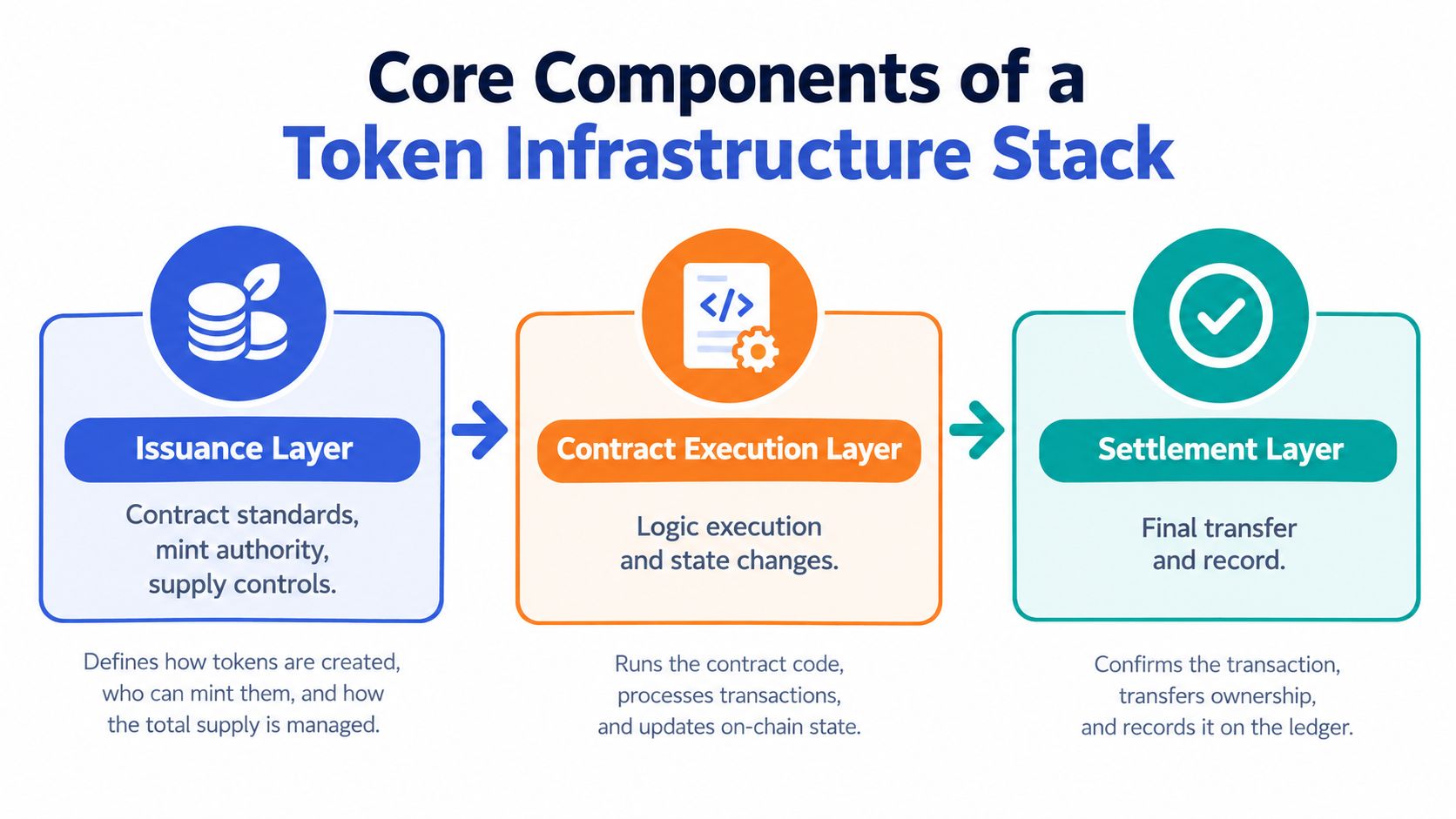
A token infrastructure stack works as a pipeline, not as a list of disconnected features. The issuance layer defines what the asset can do. The execution layer applies that logic. The settlement and data layers prove what happened and make the result usable by other systems.
The stack in operational terms
- Issuance layer: Contract standards, mint authority, burn permissions, supply caps, metadata registration, and administrative roles.
- Contract execution layer: Smart-contract state changes, gas estimation, nonce management, upgrade patterns, proxy administration, and transaction simulation.
- Wallet and signing layer: Custodial wallets, non-custodial connections, MPC services, hardware-backed treasury signing, policy checks, and approval workflows.
- API and indexing layer: REST or GraphQL APIs, custom indexers, subgraphs where suitable, WebSocket streams, webhook delivery, and query optimisation.
- Data and reconciliation layer: On-chain event storage, balance derivation, internal double-entry records, exception queues, and audit trails.
- Integration layer: KYC and AML providers, custody partners, banking rails, exchanges, ERP systems, treasury tools, and reporting destinations.
A typical transfer starts with an application request. The policy service validates the user and transaction context, the wallet signs a payload, and a transaction service broadcasts it to the network. The system tracks the mempool record, observes inclusion in a block, waits for the required confirmation or finality condition, ingests the contract event, recomputes balances, and publishes an idempotent update to downstream systems.
For an enterprise implementation, enterprise blockchain tokenization should be evaluated as an integrated architecture problem, not just a contract exercise. A Blockchain Development engagement may involve public, private, or hybrid networks, depending on the asset, counterparties, privacy needs, and operating model.
The most common architectural mistake is allowing the user interface to become the source of truth. The interface should display state derived from indexed chain data and controlled internal records. It shouldn't decide whether a token exists, whether a transfer settled, or whether a supply cap was respected.
Token Issuance, Smart Contracts, and Wallet Integration
Token issuance starts with the asset's operating rules, not the contract template. Decide who can mint, whether transfers need permissioning, how supply changes are authorised, and what a wallet must prove before receiving the asset. Those decisions determine the suitable standard, access model, and integration workload.
Selecting a token standard
An interchangeable payment or utility asset may fit ERC-20. A regulated or permissioned asset may need transfer restrictions and identity-aware hooks. ERC-721 suits unique assets, while ERC-1155 can support mixed fungible and non-fungible classes within a shared contract model.
| Standard | Best For | Key Capability |
|---|---|---|
| ERC-20 | Interchangeable digital assets | Fungible balances and transfers |
| ERC-1404 | Restricted or permissioned assets | Transfer restriction checks |
| ERC-3643 | Identity-aware regulated assets | Permissioned token operations with compliance-oriented identity controls |
| ERC-721 | Unique assets | Non-fungible ownership |
| ERC-1155 | Mixed asset classes | Fungible and non-fungible tokens in one contract framework |
The table is a starting point, not a compliance decision. A corporate bond use case may require controlled investor eligibility, issuance records, transfer restrictions, and settlement integration. In that context, a corporate bond tokenization platform is an application context that still depends on carefully designed contract, wallet, identity, and data infrastructure underneath.
Designing contracts that survive operations
Use role-based access control instead of placing every authority behind one owner key. Separate minting, pausing, upgrading, treasury, and compliance administration where the operating model requires it. Enforce supply caps inside the contract, because a limit that exists only in the application can be bypassed by another contract caller.
Upgradeability brings flexibility and governance risk. Transparent proxies can make administration easier to reason about, while UUPS proxies reduce some proxy overhead but place more responsibility in implementation contracts and upgrade authorisation. Whichever pattern you choose, document who can upgrade, how upgrades are proposed, how they are reviewed, and what emergency process applies.
Pausability should be scoped carefully. A global pause may protect users during an incident but can also stop legitimate settlement. Function-specific circuit breakers often provide more control.
Wallet architecture follows the asset's risk profile. Non-custodial wallets preserve user-held keys, while custodial wallets centralise operational control. MPC can distribute signing authority for institutional flows, and hardware-backed signing can add protection for treasury operations. The custodial versus non-custodial wallet architecture should be selected according to recovery, policy, user experience, and counterparty requirements, not fashion.
Transaction Processing and On-Chain Off-Chain Data Sync
A reliable transaction pipeline separates intent, authorisation, submission, confirmation, indexing, and reconciliation. Treating those as one status called “complete” creates operational ambiguity and makes customer support harder.
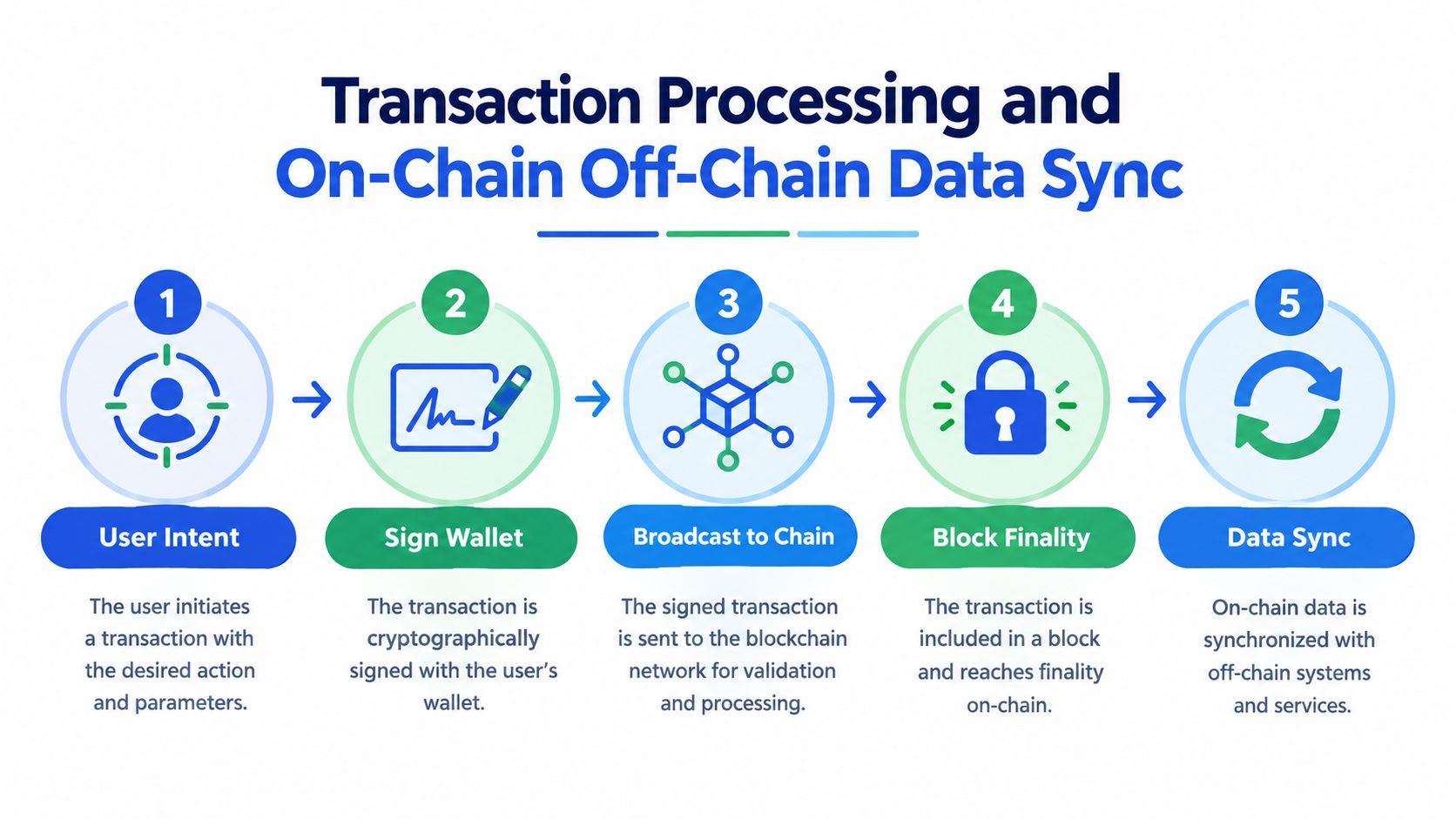
The application first captures user intent, including the asset, source, destination, amount, network, and business reference. A policy service validates permissions and limits before a wallet signs the transaction. The transaction service then broadcasts it, records the hash, monitors inclusion and finality, and passes confirmed events to the indexer. The reconciliation process compares the resulting on-chain state with the internal ledger before the API marks the business operation as settled.
Where production systems lose accuracy
Mempool replacements can leave multiple transaction hashes representing one user action. Underpriced gas can keep a transaction pending while the interface suggests progress. Reorganisations can invalidate an unconfirmed read, and token swaps can create double-spend exposure if internal reservations aren't handled atomically.
On-chain state remains authoritative for settlement, but customer-facing reads shouldn't depend on repeatedly calling raw RPC nodes. Dedicated indexers or suitable subgraphs can serve balances, transfers, metadata, and history faster and more consistently. A scheduled reconciliation job should compare indexed state with chain reads, identify missing events or drift, and place exceptions into an operator queue.
Event-driven webhooks reduce unnecessary polling, but delivery must be retried safely with idempotency keys and durable event storage. Polling still has a role for backfilling, provider recovery, and verification. Running archival nodes gives greater control over historical queries and provider dependence, while managed infrastructure reduces operational burden but introduces vendor and availability considerations.
A clear data pipeline architecture should define event schemas, replay behaviour, confirmation policies, and ownership of correction workflows. Without that design, the platform may show plausible balances while its internal records diverge.
Multi-Chain Support, Security, and Transaction Monitoring
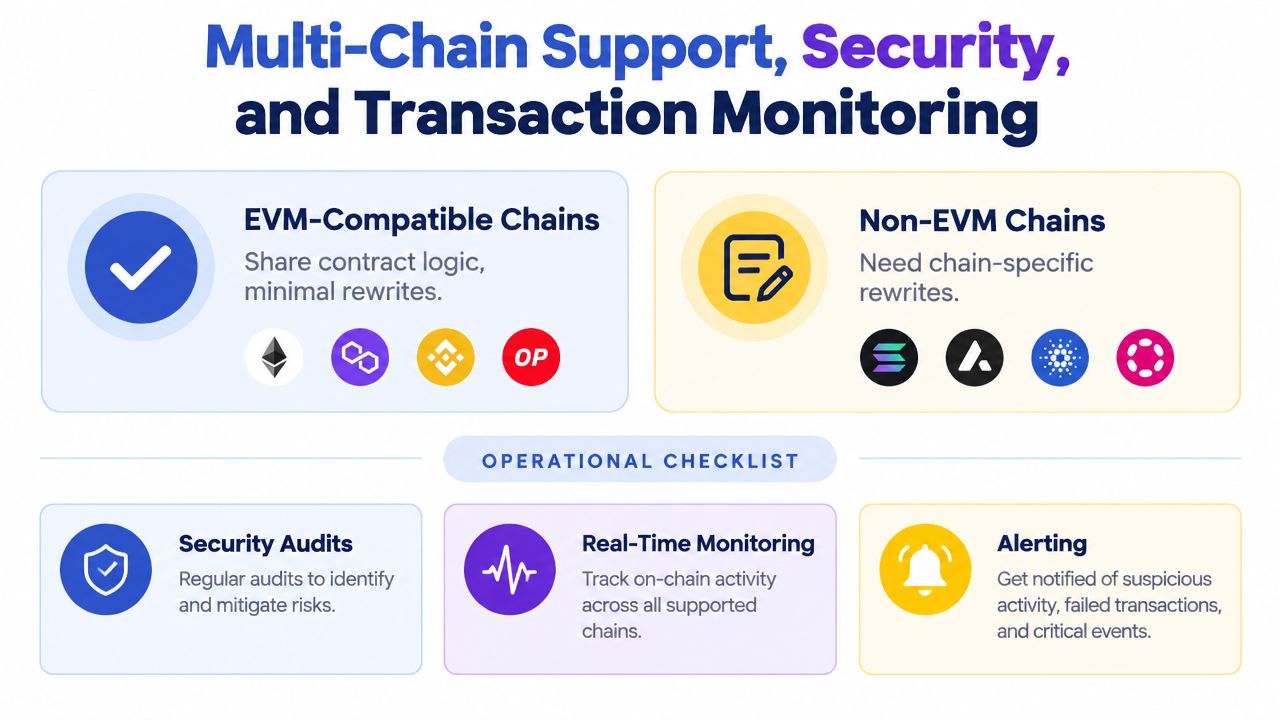
Multi-chain support is an operational discipline, not a checkbox in a product plan. EVM-compatible networks can often share contract concepts and deployment tooling, but differences in finality, gas markets, RPC behaviour, and token conventions still require network-specific configuration. Non-EVM environments such as Solana, Aptos, or Stellar generally require chain-specific contract or program implementations rather than a direct copy of EVM logic.
Bridges add another decision layer. Their design affects custody exposure, message verification, recovery procedures, and settlement timing. If an asset doesn't need cross-chain movement, avoiding a bridge may be safer than adding interoperability for marketing reasons. If cross-chain distribution is essential, model the bridge as part of the asset's trust and incident-response boundary.
Controls that belong below the application
- RPC protection: Rate-limit calls, isolate provider credentials, and fail over without altering transaction context.
- Treasury policy: Allowlist destination contracts, require multi-signature approval for sensitive actions, and separate operational from upgrade authority.
- Contract response: Pause targeted functions when anomaly rules trigger, while preserving a documented process for review and restoration.
- Monitoring: Track failed transactions, confirmation delays, gas conditions, indexer lag, unusual transfer patterns, and balance drift.
- Counterparty controls: Apply appropriate wallet screening and sanctions checks through the organisation's compliance process.
Security engineering should cover code, infrastructure, people, and operating procedures. The practical overview of security engineering from TekRecruiter is useful background for teams that need to treat monitoring and response as engineering responsibilities rather than post-launch administration.
MEV-aware routing matters for swap operations, especially when a platform submits transactions on behalf of users. The system should simulate calls, apply slippage and destination controls, and record the route and approval context. A blockchain interoperability architecture should also define message authenticity, replay prevention, asset mapping, and recovery when one network confirms before another.
Enterprise Integrations, Reporting, and Scaling
A token platform can run smoothly on a test network and still fail at the first connection to a core banking ledger, SAP, a card processor, or a treasury reporting process. Enterprise integration changes the definition of success. The platform must produce reliable records, retryable events, traceable approvals, and reconciliation outputs that finance and compliance teams can understand.
KYC and AML services may send onboarding decisions, refresh events, risk changes, and case outcomes. Custody partners may return signing status and wallet policy results. Banking and settlement systems may provide statements or files that must be matched against on-chain transfers. ERP and treasury systems need consistent asset identifiers, valuation context, transaction references, and exception handling.
Integration patterns that hold up
Use durable event delivery with idempotency keys. A downstream consumer should be able to receive the same event again without creating a second ledger entry. Store the source event, transformation result, delivery attempts, and final acknowledgement so support teams can trace a record across systems.
For read-heavy dashboards, indexed data and caching reduce pressure on RPC providers and transactional databases. For high-volume event processing, Kafka or a similar event backbone can separate ingestion, enrichment, compliance checks, balance updates, and reporting consumers. Indexer fan-out lets different chains or contracts be processed independently, limiting the impact of a single network or parser failure.
Reporting should distinguish pending, confirmed, final, failed, replaced, reversed in the internal workflow, and reconciled states. Blockchain transactions may not be reversible on-chain, so business correction procedures must never pretend that an operational adjustment changes historical chain state.
Architecture test: Ask where an operator looks when the chain shows a transfer but the bank statement doesn't, or when the bank statement shows settlement but the indexer missed the event. A production design needs an answer for both directions.
Scaling decisions belong in the architecture phase. RPC throughput, database writes, webhook queues, indexer memory, signing latency, and audit-log retention all become constraints under real usage. Caching can accelerate reads, but stale balances need clear labels and finality rules. Increasing worker counts can improve throughput until nonce management, database contention, or external provider limits become the new bottleneck.
How to assess a development partner
Request evidence of mainnet deployments for relevant standards, verifiable contract addresses, and independent audit reports where available. Ask how the team handles upgrades, key rotation, incident response, indexer recovery, and reconciliation exceptions. A testnet demo proves that a transaction can execute. It doesn't prove that the organisation can operate the system after a failed deployment or provider outage.
| Criterion | What to Verify | Red Flag |
|---|---|---|
| Contract delivery | Relevant standards, deployment records, review process, audit scope | Only screenshots or testnet demonstrations |
| Key management | Custody model, approval policy, recovery and rotation procedures | One owner key controls every action |
| Data operations | Indexer design, replay process, reconciliation jobs, event retention | UI reads directly from unreliable raw RPC calls |
| Enterprise integration | Webhooks, idempotency, KYC and AML events, ledger matching | “API integration” without schemas or failure handling |
| Security posture | Audit history, bug bounty participation, and applicable SOC 2 or ISO 27001 status | Vague security language with no evidence |
| Ongoing support | Monitoring ownership, incident response, upgrades, and maintenance scope | Repository handover with no operating model |
A token infrastructure development company should explain trade-offs in plain language and show how its team works beyond the initial repository. If your requirement includes higher-level lifecycle workflows, keep the boundary clear and evaluate a token lifecycle management platform separately from the underlying runtime services.
How Blocsys Supports Web3 Token Infrastructure Development
Blocsys Technologies Pvt Ltd is a blockchain technology and digital asset infrastructure provider for organisations building token and Web3 systems. Its relevant scope includes smart-contract development, blockchain infrastructure, tokenisation, multi-chain deployment, wallet and API layers, digital asset integrations, and operational components needed to connect on-chain activity with enterprise applications.
A practical engagement should begin with an architecture decision record. The team needs to define the asset model, target networks, token standard, custody approach, signing policy, identity and compliance interfaces, event model, reconciliation rules, reporting requirements, and operational ownership before implementation starts. ERC-20, ERC-1404, ERC-3643, SPL, and other standards aren't interchangeable choices. The right option depends on fungibility, permissioning, identity, transfer restrictions, and the receiving ecosystem.
Multi-chain deployments require a canonical asset and chain-specific adapters. Reconciliation should map chain transaction identifiers, wallet addresses, asset identifiers, and internal ledger entries, while preventing a message from being applied twice. Enterprise integrations commonly include KYC and AML providers, custody services, core banking systems, ERP platforms, treasury tools, exchanges, and reporting systems.
A realistic delivery plan moves through discovery, architecture, contract implementation, integration, testing, security review, deployment, and operational readiness. The schedule depends on the number of networks, contract complexity, custody and compliance requirements, audit scope, integrations, and whether the team is extending an existing stack or building new infrastructure. Ongoing maintenance includes network upgrades, dependency changes, key-policy updates, monitoring, indexer recovery, security fixes, and reconciliation support.
Blocsys can structure work around a defined build, additional engineering capacity, or longer-term platform ownership. The useful question isn't whether a vendor can launch a token. It's whether the vendor can operate the connected system when transactions fail, records drift, requirements change, and enterprise stakeholders need an auditable explanation.
Frequently asked questions
What is Web3 token infrastructure?
Web3 token infrastructure is the technical runtime that connects token smart contracts with blockchain networks, wallets, signing services, APIs, indexers, off-chain ledgers, applications, and monitoring tools. It supports issuance, transaction submission, confirmation tracking, balance derivation, metadata handling, reconciliation, and enterprise integrations. It differs from a complete token management product, which may add policy, compliance, investor, and administrative workflows above that runtime.
What components does a token infrastructure stack include?
A production stack normally includes an issuance layer, smart-contract execution, wallet and key management, blockchain connectivity, transaction services, indexers, APIs, event streams, metadata storage, reconciliation pipelines, monitoring, and integration adapters. The components must share consistent asset identifiers, transaction states, event schemas, and failure-handling rules. A dashboard alone isn't token infrastructure if it doesn't reliably connect those services.
How does token issuance work?
Token issuance begins by defining asset behaviour, supply authority, transfer rules, permissions, and metadata. The development team selects a suitable token standard, implements and reviews the smart contract, configures signing and approval controls, deploys to the chosen network, and connects mint events to indexed and off-chain records. Issuance should be tested as an end-to-end workflow, not only as a successful contract call.
What role do smart contracts play in token infrastructure?
Smart contracts enforce on-chain rules such as balances, transfers, minting, burning, pausing, supply limits, and permission checks. Infrastructure around the contract handles deployment, upgrades, transaction simulation, signing, gas management, event ingestion, monitoring, and reconciliation. The contract is therefore a critical component, but it isn't the entire operating system for a digital asset.
How should a business choose a token standard?
Choose the standard according to the asset's behaviour and distribution model. ERC-20 is suited to interchangeable assets, ERC-721 to unique assets, ERC-1155 to mixed classes, ERC-1404 to restricted transfers, and ERC-3643 to identity-aware permissioned operations. The final choice should also consider wallet support, exchange compatibility, auditability, upgrade requirements, and the legal and operational context of the asset.
What is the difference between custodial and non-custodial wallets?
A custodial model places key control with a service or operating entity, while a non-custodial model leaves signing authority with the user or asset holder. MPC and hardware-backed signing can support stronger institutional policy controls, but they introduce their own integration and recovery considerations. The decision should reflect user experience, governance, recovery, transaction approval, counterparty, and operational risk requirements.
Why do token platforms need APIs and indexers?
Applications need reliable access to balances, transfers, metadata, transaction states, and ownership history without sending every read directly to a raw RPC endpoint. Indexers process contract events and chain data into queryable records, while APIs expose consistent data to portals, exchanges, custody systems, and enterprise applications. Together, they separate application reads from node connectivity and support replay, monitoring, and reconciliation.
How should multi-chain token infrastructure prevent balance drift?
Use a canonical asset model with chain-specific adapters, unique transaction and event identifiers, finality-aware state transitions, durable event storage, and idempotent consumers. Reconciliation jobs should compare indexed and internal records with authoritative chain state, flag missing or duplicated events, and route exceptions to operators. Cross-chain transfers also need replay protection, message verification, and explicit handling for partial settlement.
What security controls belong in token infrastructure?
Important controls include role-based access, multi-signature approvals, secure key storage, hardware-backed or MPC signing where appropriate, contract audits, transaction simulation, destination allowlists, rate-limited RPC access, pause controls, secrets management, alerting, and incident-response procedures. Security also includes operational training and review of human approval flows, because authorised users can still approve harmful transactions.
How should a business choose a Web3 token infrastructure development partner?
Look for demonstrated experience with the relevant networks and token standards, clear architecture documentation, verifiable deployment evidence, security review practices, indexer and reconciliation expertise, integration capability, and post-launch monitoring. Ask how the team handles upgrades, key rotation, chain outages, failed webhooks, reorgs, incident response, and maintenance. A suitable partner can explain trade-offs and operating responsibilities rather than presenting token issuance as a one-time delivery.
Blocsys Technologies offers smart-contract development, blockchain infrastructure, wallet and API integration, tokenisation, and digital asset platform engineering for businesses building connected Web3 systems. Visit Blocsys Technologies to discuss your token infrastructure requirements, target networks, custody model, enterprise integrations, and the next practical step from architecture to production.