
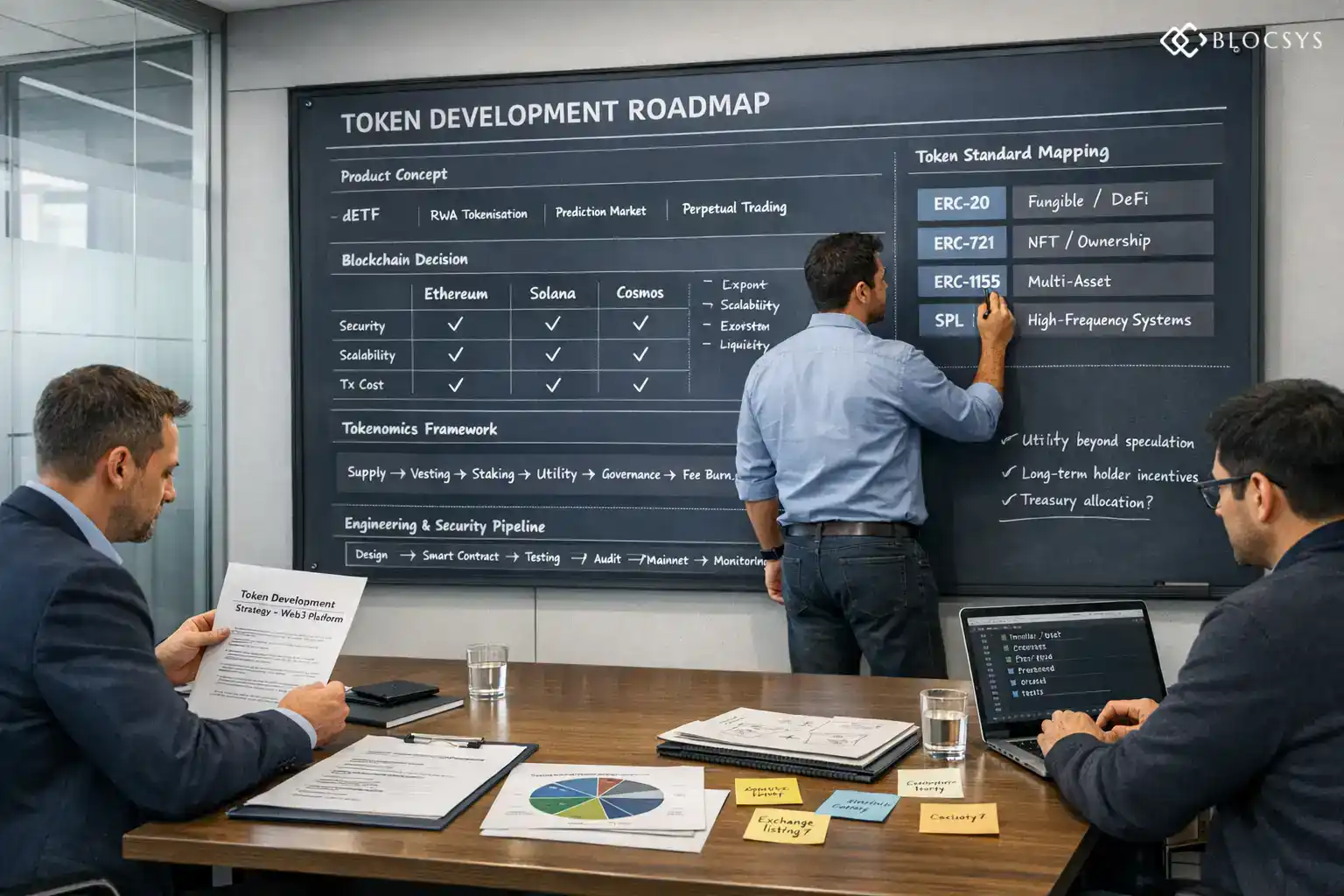
Crypto Token Development: A Complete 2026 Guide
Crypto token development is the process of designing, coding, and launching digital assets that run on a blockchain. These programmable tokens can represent a stake in a decentralised venture, a governance vote, or a key that unlocks a digital service. Consequently, founders now use token development to build entirely new financial products, platforms, and economies. This guide gives founders, project leads, and enterprises in Web3, AI, and DeFi a strategic roadmap for building real-world value in 2026.
What Is Crypto Token Development?
Crypto token development is the end-to-end process of designing, engineering, and launching a digital token on a blockchain. A token is more than code; it’s a programmable asset that can unlock new business models, automate complex processes, and create decentralised economies. Therefore, understanding its purpose is the first step toward building a successful project.
This guide cuts through the technical jargon to deliver a strategic plan for founders and decision-makers in Web3, DeFi, and AI. Whether you’re launching a decentralised equity-traded fund (dETF), a real-world asset (RWA) tokenisation platform, or a new perpetual trading system, the fundamentals below apply.
- A decentralised equity-traded fund (dETF)
- A real-world asset (RWA) tokenisation platform
- A new perpetual trading system or prediction market
Our goal is to walk you through the entire journey. This includes refining your initial concept, designing sustainable tokenomics, engineering secure smart contracts, and planning an impactful launch.
From Niche Concept to Global Industry
The token landscape has exploded over the past few years. In mid-2022, roughly 21,555 cryptocurrencies existed. By 2026, that number has climbed past 2.5 million, and specialised crypto solutions for token projects have become a distinct industry of their own. This growth is especially strong in markets like India, which continue to mature into innovation hubs for next-generation on-chain products.
Since the 30% tax on crypto gains took effect, India’s regulatory environment has matured considerably. As a result, the market now attracts nimble start-ups and established companies alike, all seeking compliant, scalable infrastructure. This rapid growth creates massive opportunities, but it also introduces real complexity that founders must plan for early.
A token is more than just code; it’s a programmable asset that can unlock new business models, automate complex processes, and create decentralised economies. Understanding its purpose is the first step toward building a successful project.
Ultimately, successful crypto token development transforms a powerful idea into a secure, functional, and valuable digital asset that users trust. This guide shows you exactly how to achieve that.
How to Develop a Crypto Token: Step-by-Step Walkthrough
Founders often ask how to develop a crypto token without getting lost in technical detail. The process breaks down into six clear stages, and each one builds directly on the last.
- Define the use case. Decide whether your token drives governance, utility, or asset ownership before writing any code.
- Choose your blockchain and standard. Match your platform to your speed, security, and cost requirements.
- Design your tokenomics. Model supply, distribution, utility, and vesting to build a sustainable economy.
- Engineer the smart contract. Translate your rules into secure, tested, audited code.
- Build supporting infrastructure. Add wallets, custody, liquidity, and oracle integrations around the contract.
- Test, audit, and launch. Run third-party audits, then deploy to mainnet with a clear go-to-market plan.
Skipping any of these steps introduces risk. Therefore, treat this sequence as a checklist rather than a suggestion, and revisit each stage as your project scales.
Choosing the Best Platform for Token Development
Choosing a blockchain and its corresponding token standard is the most critical architectural decision you will make. This choice defines your token’s speed, security model, transaction costs, and compatibility within the broader digital economy. It must align with your project’s long-term vision and use case.
How to Evaluate Blockchains Using the Trilemma Framework
Every blockchain platform balances three core properties: security, scalability, and decentralisation. This trade-off, known as the “blockchain trilemma,” means most platforms excel in two areas while compromising on the third. Use this framework as your first filter when narrowing platform options.
For instance, a project tokenising high-value real estate would prioritise the battle-tested security and decentralisation of Ethereum. In contrast, a prediction market requiring thousands of transactions per second would gravitate toward a platform built for scalability and speed.
A Strategic Comparison of Popular Token Standards
This table breaks down the most popular token standards. It helps founders and developers choose the right foundation based on project goals, performance needs, and ecosystem compatibility.
| Token Standard | Blockchain | Type | Primary Use Case | Key Advantage |
|---|---|---|---|---|
| ERC-20 | Ethereum | Fungible | Utility tokens, governance tokens, stablecoins | The industry standard; vast ecosystem support |
| ERC-721 | Ethereum | Non-Fungible | Digital art, collectibles, unique assets (NFTs) | Guarantees true digital ownership and uniqueness |
| ERC-1155 | Ethereum | Multi-Token | Gaming assets, batch minting of NFTs | Manages multiple token types in one smart contract |
| SPL | Solana | Fungible/NFT | High-frequency DeFi, gaming, payments | Extreme speed and ultra-low transaction fees |
| CW-20 | Cosmos | Fungible | Cross-chain applications, community tokens | Native interoperability across different blockchains |
Choosing the right standard is about more than technical features; it’s about joining an ecosystem. Your decision dictates which wallets, exchanges, and DeFi protocols your token can interact with. Consequently, it’s crucial to align your choice with your long-term growth strategy.
- ERC Standards (Ethereum): As the original smart contract platform, Ethereum’s ecosystem remains unmatched in maturity and liquidity. ERC-20 is the gold standard for fungible tokens, ERC-721 powers the NFT world, and ERC-1155 offers a flexible hybrid for managing both in a single contract.
- SPL (Solana Program Library): Built for high performance, SPL suits applications where speed is paramount. Its low fees and near-instant settlement make it a top choice for DEXs, crypto gaming, and high-throughput systems.
- CW-20 (Cosmos): The CW-20 standard lives within the Cosmos ecosystem, often called the “internet of blockchains.” Through the Inter-Blockchain Communication protocol, CW-20 tokens move across sovereign blockchains, making it powerful for projects bridging multiple Web3 ecosystems.
Choosing a token standard is not just about technical features. It’s about joining an ecosystem. Your choice determines which wallets, exchanges, and DeFi protocols your token will be compatible with from day one.
How to Make the Final Decision for Your Project
Map your project’s non-negotiable requirements directly to a platform’s strengths. A decentralised ETF platform, for example, demands robust security and deep liquidity, making an Ethereum ERC-20 token a natural starting point. A carbon credit tokenisation project targeting global reach, however, might find Cosmos’s cross-chain capabilities essential.
Migrating a live token from one blockchain to another is a monumental task, even though cross-chain bridges offer some flexibility. Therefore, it pays to get this foundational decision right the first time. To go deeper, explore our guide on the universal RWA standard ERC-7943, which breaks down how standards are evolving for specific asset classes.
Ethereum Token Development Step-by-Step: ERC-20 vs ERC-721 vs ERC-1155
Ethereum token development remains the most common entry point for new projects because of its mature tooling and massive user base. Before writing a single line of code, however, you must decide which ERC standard fits your use case.
Use ERC-20 when you need a fungible, interchangeable token for governance, payments, or a stablecoin. Use ERC-721 when every token must be unique, such as a deed, certificate, or collectible. Use ERC-1155 when your project needs both fungible and non-fungible assets managed under one contract, which is common in gaming.
A typical Ethereum token development workflow follows these steps:
- Define token parameters. Set the name, symbol, decimals, and total supply.
- Select a framework. Most teams build on OpenZeppelin’s audited contract libraries rather than starting from scratch.
- Write and compile the contract. Developers use Solidity to implement minting, burning, and access-control logic.
- Test on a testnet. Deploy to a test network first to catch bugs without risking real funds.
- Audit the code. An independent review confirms the contract behaves exactly as intended.
- Deploy to mainnet. Once audited, the contract goes live and becomes immutable.
Because Ethereum’s ecosystem is so mature, developer tooling, security libraries, and community support make it easier to move quickly without sacrificing safety.
Tokenomics Development Framework: Supply, Distribution, Utility, and Vesting
If the token standard is your project’s foundation, tokenomics development is its economic engine. It’s the set of rules governing supply, demand, and the flow of your token, and it ultimately decides whether your project creates lasting value or fades away.
Effective tokenomics development requires modelling supply and demand carefully. The core question you must answer is simple: why should anyone hold your token beyond pure speculation?
Structuring Token Supply and Distribution
Start by fixing your total supply and deciding how it’s allocated. A typical distribution might reserve a portion for the team, a portion for investors, a portion for the community, and a portion for a treasury or ecosystem fund. Each allocation needs a clear, public rationale.
Transparency here builds trust. Consequently, projects that publish detailed distribution breakdowns tend to earn stronger community confidence than those that don’t.
How to Build Genuine Utility Into Your Token
A token’s value ties directly to the real-world functions it performs within its ecosystem. Without tangible use cases, a token remains merely a speculative asset. Key drivers of utility include:
- Governance Rights: Empowering token holders to vote on protocol upgrades, treasury spending, or key parameter changes creates a vested interest in the project’s long-term success.
- Staking Rewards: Allowing users to lock up tokens to secure the network or provide liquidity reduces circulating supply while rewarding committed participants.
- Access to Services: Tokens can unlock exclusive features, secure reduced fees on a trading platform, or grant access to premium data.
A well-designed token economy aligns the incentives of every participant—users, developers, and investors—toward a common goal. When the community wins, the token’s value naturally follows.
For a DeFi startup, utility might mean giving liquidity providers a larger share of trading fees. For an enterprise-grade RWA platform, utility could tie to rights over a fraction of a tokenised asset, such as a share of rental income from a property.
Vesting Schedules and Scarcity Mechanisms
Managing supply is just as critical as creating demand. The goal is a predictable, often deflationary environment that rewards long-term holders.
Token burns permanently remove tokens from circulation, effectively reducing total supply. Projects achieve this by burning a portion of transaction fees or other protocol revenue, which creates deflationary pressure over time.
Vesting schedules for team and investor tokens matter just as much. A long-term schedule, where tokens release gradually over several years, signals deep commitment and prevents large sell-offs that could destabilise the market post-launch.
India’s cryptocurrency market alone is projected to reach US$10.5 billion in revenue by the end of 2026, driven by more than 93.5 million owners. This sophisticated user base demands projects with robust economic models, which is exactly why disciplined tokenomics development has become non-negotiable for serious teams.
Crypto Coin vs Crypto Token: Key Differences Developers Should Know
Developers frequently confuse coins and tokens, but the distinction shapes your entire build strategy. A coin, such as Bitcoin or Ether, is the native asset of its own independent blockchain and secures that network directly. Building a coin means building an entire blockchain from scratch.
A token, on the other hand, is built on an existing blockchain like Ethereum or Solana. It leverages that chain’s security and infrastructure, so developers can focus on their application instead of reinventing the underlying network.
This matters for planning purposes. Because token development doesn’t require consensus mechanism design, network validators, or node infrastructure, it’s faster, cheaper, and far more accessible for most founders than launching a coin.
The Engineering Process for Crypto Token Development
This phase is where strategy becomes reality. Your tokenomics and blockchain choice translate into a functional, secure digital asset. Understanding the engineering lifecycle is critical for project leaders who need to oversee development, manage timelines, and ensure the final product matches the vision.
At the heart of every token sits its smart contract, a self-executing piece of code deployed on the blockchain. It contains all the rules governing your token, and once live, it functions as an immutable digital agreement.
How to Choose Your Development Language
Your chosen blockchain largely determines your programming language, which in turn influences developer availability, security tooling, and performance.
- Solidity: The dominant language for Ethereum and other EVM-compatible chains. Its large developer community and extensive documentation make it reliable for tapping into the largest DeFi ecosystem.
- Rust: The go-to language for high-performance blockchains like Solana. Known for memory safety and speed, it suits applications processing thousands of transactions per second.
Key System Components to Integrate
Building a production-ready system requires integrating several components that support your smart contracts:
- Secure Custody and Wallet Systems: Options range from browser extension wallets to institutional-grade custody using multi-party computation (MPC), which eliminates single points of failure by splitting private key fragments. Learn more about building a robust token management system.
- Order-Book and Liquidity Mechanisms: To enable trading, you need a way to match buyers and sellers, whether through a traditional order book or an automated market maker liquidity pool.
- Oracle Integrations: If your token’s function relies on real-world data, such as an RWA token pegged to a commodity price, you need oracles to securely bridge that data to your smart contracts.
- Backend Infrastructure and User Interfaces: You need scalable backend servers to manage data and communicate with the blockchain, plus a front-end interface, ranging from a web app to a Telegram mini-app.
Engineering isn’t just about writing code. It’s about architecting a complete, interconnected system where every component—from the smart contract to the user interface—is secure, scalable, and built for its intended purpose.
How to Secure Your Crypto Token Project From Day One
In Web3, security is the absolute bedrock of your project’s survival. A single smart contract vulnerability can lead to catastrophic fund loss, destroy your reputation, and end your project. Security cannot be an afterthought; instead, it must be woven into every stage of your crypto token development lifecycle.
This institutional-grade mindset starts long before code is deployed. It begins with scrutinising every architectural decision for potential attack vectors, because that discipline is the only way to earn and retain user trust.
Why You Must Integrate Security Into Your Development Pipeline
Modern development integrates security directly into the workflow, a practice known as DevSecOps. Instead of waiting until the end to find flaws, teams treat security as an automated, routine part of the build process.
This means running static analysis tools that scan code for common vulnerabilities as it’s written. This proactive stance catches issues early, when they’re cheap and easy to fix.
What Is the Role of Third-Party Audits?
While internal testing is crucial, it isn’t enough on its own. An independent, third-party smart contract audit is a non-negotiable step before launching on mainnet. Think of it as hiring elite ethical hackers to try to break your system before malicious actors do.
These specialised firms bring fresh perspective and deep expertise, often spotting vulnerabilities an internal team might miss. A successful audit report identifies problems and provides a clear roadmap to fortify your code. Publicly sharing that report has become the gold standard for proving your commitment to security.
In an industry where trust is everything, a comprehensive and transparent security audit is one of the most powerful signals you can send to your community and potential investors.
Learn more in our detailed guide on smart contract auditing.
Key Ongoing Defence Strategies Post-Launch
Launching your token is a milestone, not the finish line. Security demands constant vigilance and rapid adaptation to new threats.
- Penetration Testing (VAPT): This goes beyond the smart contract, stress-testing your entire infrastructure—web servers, APIs, and front-end applications—to find weak points.
- Bug Bounty Programs: Inviting white-hat hackers to find and report vulnerabilities for a reward is a cost-effective way to crowdsource security.
- Continuous Monitoring: Real-time monitoring tools watch for suspicious on-chain activity, giving your team an early warning and precious time to react.
By embracing this multi-layered strategy, you shift from a reactive to a proactive posture. Ultimately, this comprehensive approach protects user funds, supports compliance, and builds long-term resilience.
Crypto Development Solutions for Token Projects: Services, Audits, and Tooling
We’ve walked through the multi-stage roadmap for launching a successful crypto token. Now it’s time to connect that strategy to execution. At Blocsys, we deliver crypto solutions for token projects that turn ambitious on-chain concepts into production-ready platforms. We don’t just advise; we build.
Our specialisation covers the systems discussed throughout this guide. We’ve engineered everything from decentralised ETFs and perpetual trading platforms to complex RWA tokenisation for commodities like gold. Our teams bring hands-on technical expertise to every engagement, which is where your vision meets disciplined execution.
From Architecture to Deployment
We operate as a direct extension of your team, embedding our expertise at every stage of the project lifecycle. This integrated approach ensures your strategic goals translate directly into technical realities, built from day one for security and scale. Our partnership model rests on a few core pillars:
- Protocol and System Architecture: We design the foundational blueprint for your platform, ensuring it’s secure, scalable, and aligned with your business objectives.
- Smart Contract Engineering: Our deep expertise in Solidity and Rust lets us build robust, efficient, fully audited smart contracts that form the core of your tokenised ecosystem.
- Institutional-Grade Security: We bring a relentless security posture to every project, integrating DevSecOps, mandating third-party audits, and implementing continuous monitoring.
- Scalable Backend Infrastructure: Great projects go beyond smart contracts. We build the critical off-chain infrastructure, from high-performance order-book systems to secure custody solutions.
At Blocsys, we build serious decentralised infrastructure, not experiments. Our focus is on execution discipline, transparent communication, and delivering systems that are ready for real-world use and long-term growth.
For founders and enterprises ready to move from a great idea to a live, scalable system, the next step is aligning your vision with an engineering team that can deliver. Our focus on execution ensures your crypto token development journey doesn’t just succeed; it sets a new standard for what’s possible on-chain. Explore our approach to full-stack Web3 engineering to see how we can support your roadmap.
Frequently Asked Questions
How Much Does Crypto Token Development Cost?
Cost depends entirely on project complexity. A standard ERC-20 token can be created for a few thousand dollars. A sophisticated DeFi protocol with custom tokenomics development, complex smart contracts, and multiple third-party audits, however, typically requires between $50,000 and over $250,000. This higher range reflects the engineering and security work needed to protect user funds.
How Long Does It Take to Create a Crypto Token?
Timeline scales with complexity. A basic token can launch in a few weeks. A professional, full-scale project—including tokenomics design, smart contract engineering, UI development, and external security audits—typically takes 4 to 9 months from kickoff to a secure mainnet launch.
What Is the Difference Between a Coin and a Token?
A coin is the native asset of its own independent blockchain and secures that network directly. A token is built on an existing blockchain, such as Ethereum or Solana, and leverages that chain’s security instead of building new infrastructure.
Which Platform Is Best for Ethereum Token Development?
Ethereum remains the strongest choice when you need maximum security, liquidity, and ecosystem compatibility. If your project instead needs extremely high transaction throughput and low fees, a chain like Solana may fit better. Match the platform to your specific performance and security requirements.
What Happens After the Token Is Launched?
A token launch is the starting line, not the finish. Real work begins post-launch: managing liquidity on exchanges, executing the project roadmap, engaging the community, and running continuous security monitoring to adapt to new threats.
At Blocsys Technologies, we’re the engineering partner that guides you through every stage of this journey, from the first architectural sketch to post-launch growth. We don’t just build; we build secure, scalable, production-ready decentralised infrastructure that stands the test of time.
Ready to transform your vision into an on-chain reality? Connect with our experts today and let’s talk about your project.
