

Your team has already shipped a spot exchange. The order book works, deposits reconcile, and withdrawals have survived production traffic. Then someone suggests adding trading on borrowed capital as a new product surface. Within weeks, the roadmap fills with problems that spot trading never had, partial liquidations, stale prices, funding accrual, collateral haircuts, duplicate liquidation jobs, negative balances, and regulatory records that must explain every decision.
A cryptocurrency margin trading platform isn’t a spot exchange with a multiplier. It’s a real-time risk engine wrapped around matching, custody, compliance, and settlement. This guide is for founders, product leaders, and engineering teams deciding how to build one, especially for India-facing markets. The outcome should be a platform design that balances execution speed with liquidation safety, auditability, and jurisdiction-aware controls.
Table of Contents
- Why Building a Margin Platform Is a Different Engineering Problem
- Core System Architecture for a Margin Trading Platform
- Collateral Management and Liquidation Engine Mechanics
- On-Chain and Off-Chain Trade Settlement Models Compared
- Compliance, KYC, and Risk Controls for Margin Products
- Designing Safer Borrowing Limits and Retail Protections
- Testing, Monitoring, and Go-to-Market Checklist
Why Building a Margin Platform Is a Different Engineering Problem
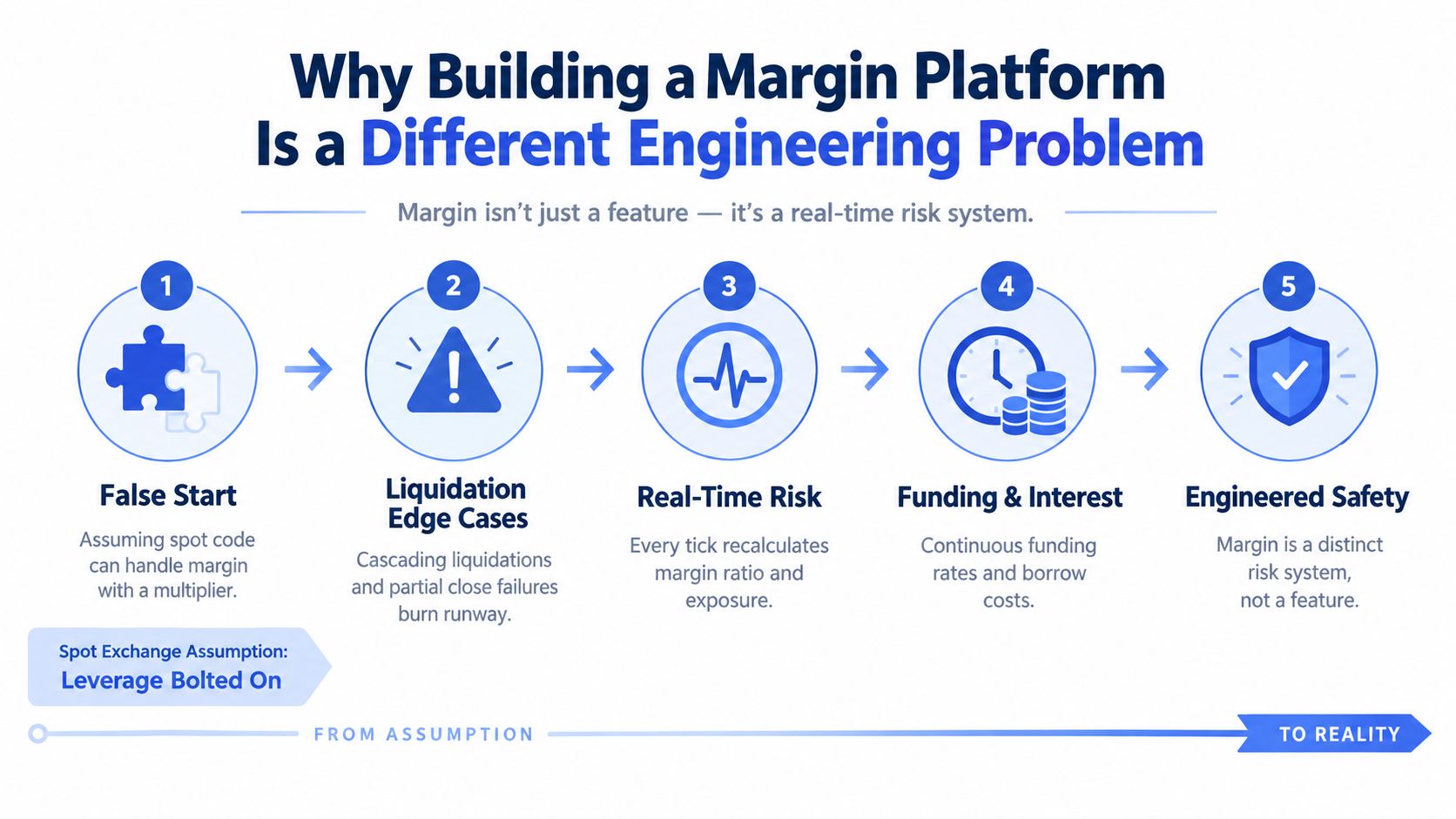
A trader opens a position during a fast market move, the mark price updates, and available collateral falls below the maintenance threshold. The platform must value the account, reserve funds, prevent conflicting orders, and start a controlled close without creating a duplicate liquidation or negative balance. That chain is why margin belongs in the core architecture, not as a multiplication field added to a finished spot exchange.
Every fill now creates an obligation, consumes collateral, changes maintenance requirements, and can trigger an automated close. The design must keep execution speed aligned with liquidation safety, auditability, custody controls, and jurisdiction-specific compliance.
India’s market history shows why compliance cannot be bolted on later. The RBI issued its first public warning about virtual currencies in December 2013, the Supreme Court struck down the RBI’s banking ban in March 2020, and the Ministry of Finance brought covered virtual digital asset activities under the Prevention of Money Laundering Act on 7 March 2023, including KYC and FIU-India registration requirements for relevant service providers. The timeline is documented in this history of cryptocurrency regulation in India. For an India-facing margin venue, onboarding, surveillance, reporting, and record retention must shape the first system design.
Four decisions to settle before development
Choose the matching model. A central limit order book provides deterministic price-time priority and supports professional execution. An automated market maker adds composability, while making oracle quality, liquidity provisioning, and adverse selection primary engineering concerns.
Define collateral and settlement assets. Decide whether users post fiat-backed stablecoins, major cryptoassets, tokenised assets, or a controlled combination. Each option affects haircuts, custody, withdrawal queues, valuation, and reconciliation.
Set borrowing limits by jurisdiction and user profile. Limits should depend on the asset, customer type, verification status, collateral quality, and applicable rules. They are risk-profile attributes, not universal product settings.
Separate trading custody from reserves. Hot wallets should handle operational liquidity. Cold reserves should remain segregated behind controlled transfer procedures. The ledger must distinguish customer collateral, borrowed funds, fees, insurance reserves, and platform treasury balances.
Practical rule: If a product decision changes liquidation behaviour, put it through risk design review, not only the product backlog.
These choices determine latency targets, oracle dependencies, service boundaries, and audit trails. Start with the exchange as one component of a broader crypto trading platform architecture, then model every state transition that can change customer equity. Judge the design by how safely it handles a fast market, not by how many amplification options it displays.
Core System Architecture for a Margin Trading Platform
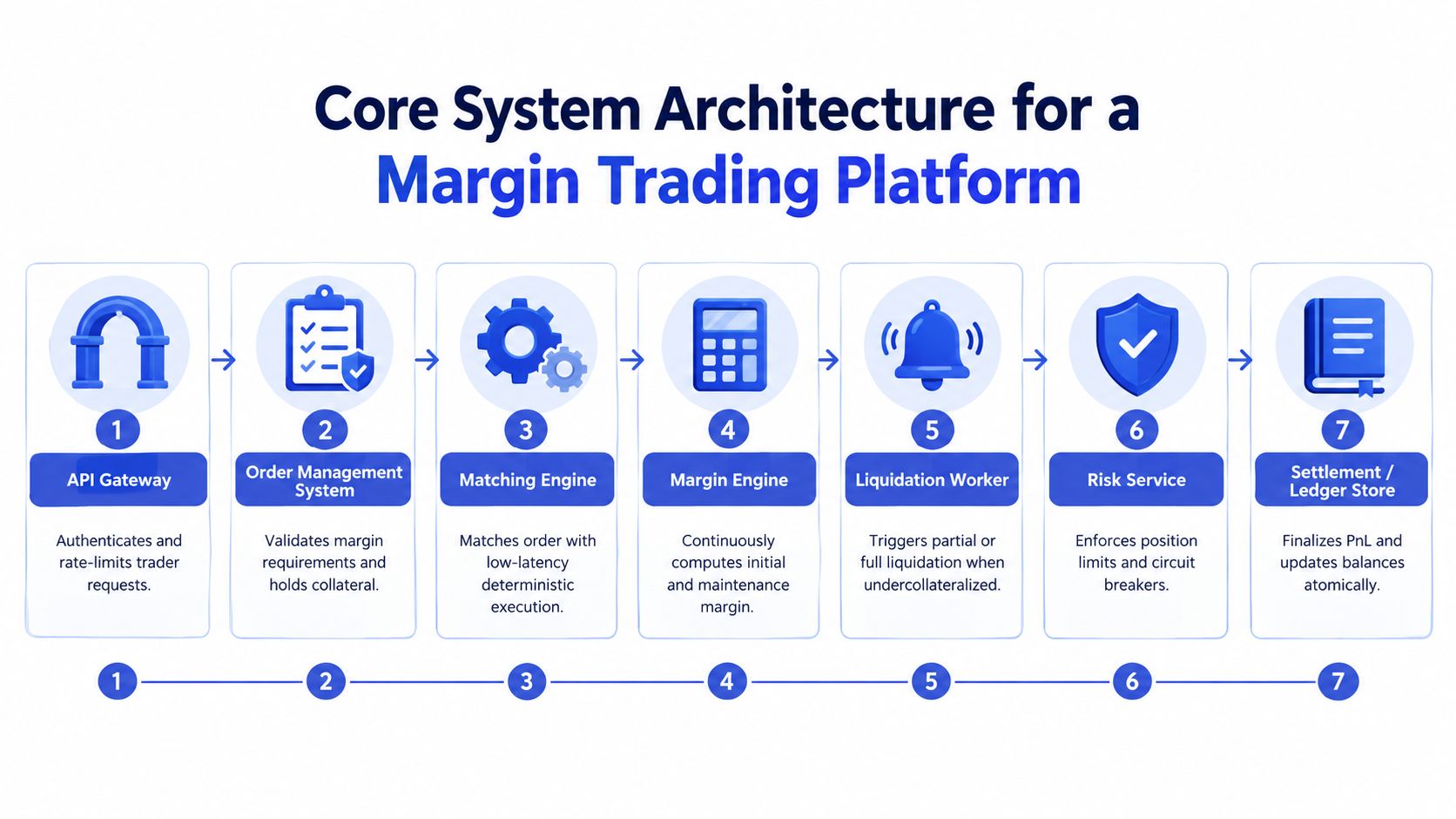
A production margin venue needs clear ownership of state. I normally separate seven services, even when an early-stage team deploys several of them together.
- API gateway: Authenticates requests, applies rate limits, validates signatures, and prevents abusive request patterns.
- Order management system: Checks account eligibility, available collateral, order constraints, and reservation requirements before an order reaches execution.
- Matching engine: Maintains price-time priority and executes orders deterministically.
- Margin engine: Calculates initial margin, maintenance margin, unrealised profit and loss, funding, borrow costs, and available equity.
- Liquidation worker: Closes undercollateralised positions through controlled partial or full liquidation workflows.
- Risk service: Enforces position limits, concentration caps, circuit breakers, and account-level restrictions.
- Settlement and ledger store: Records fills, fees, collateral movements, realised profit and loss, and balances atomically.
How one order moves through the system
A trader submits an order through REST or a persistent API connection. The gateway authenticates it, the OMS validates the account and reserves collateral, and the risk service checks position and concentration limits. The matching engine then processes the order through a single writer per market, which preserves deterministic sequencing and simplifies replay.
After a fill, the engine publishes an event. The margin engine consumes that event idempotently, updates the position, recalculates equity, and emits the new margin state. The ledger persists the financial result, while surveillance receives the order, fill, account, and market context needed for later investigation.
Latency isn’t equally important everywhere. A price tick to margin recalculation path should be engineered for sub-50 millisecond response, as specified in the platform design brief, while ledger writes should favour durable consistency over marginal speed. The liquidation worker needs leader election or an equivalent ownership mechanism. Two workers must never submit competing liquidations for the same position.
Every component should emit structured events with an event ID, account ID, instrument, sequence number, source timestamp, valuation inputs, and resulting state. That event trail supports reconciliation, surveillance, incident replay, and customer support. Generic application logs aren’t enough when a trader asks why a position was closed.
For teams reviewing order-book behaviour and market conditions, Qoory market intelligence for traders can provide useful context around limit-order-book analysis. The engineering principle remains simple: the hybrid exchange platform architecture should preserve deterministic execution while allowing risk and compliance services to scale independently.
Collateral Management and Liquidation Engine Mechanics
A fast market move exposes weak collateral logic immediately. The engine must value collateral, position notional, unrealised profit and loss, fees, and maintenance requirements from one consistent state before it considers closing a position. Last-trade pricing is unsafe: a thin print or manipulated wick can trigger an avoidable cascade. Use a composite index price from approved venues, with staleness checks, outlier rejection, and a defined fallback policy.
For a simple long-position model, initial margin is a percentage of notional. Maintenance margin is the threshold at which liquidation begins. A trader posting 0.1 BTC as collateral while BTC is priced at $60,000 controls a position with $60,000 notional value and $6,000 collateral value. A simplified calculation solves for the price at which account equity reaches the maintenance requirement.
Liquidation price = entry price minus (initial equity minus maintenance requirement and accrued costs) divided by position size.
The result depends on fees, funding, borrow costs, mark-price rules, and the maintenance schedule. Funding and interest must accrue frequently enough for the displayed liquidation price to remain aligned with the engine’s actual state. If the user interface and risk service calculate different values, support teams will eventually face disputes that ledger reconciliation cannot resolve quickly.
Store borrowing limits as a risk profile
Borrowing limits should be stored as versioned risk profiles, not as UI toggles. Link each profile to the customer, instrument, collateral type, and jurisdiction. A change must be auditable and should not alter positions that were already assessed under an earlier version without an explicit policy decision.
| Tier | Maximum Borrowing Limit | Initial Margin | Maintenance Margin | Liquidation Buffer |
|---|---|---|---|---|
| Retail | 5x | 20% | Configured by risk schedule | Configured by risk schedule |
| Verified pro | 20x | 5% | Configured by risk schedule | Configured by risk schedule |
| Institutional | Negotiated | Profile-specific | Profile-specific | Profile-specific |
The retail and pro figures are design examples from the requested configuration model, not universal legal standards. India’s regulated equity margin framework provides a useful control analogue: at least 50% of trade value is provided by the investor, while the broker can fund the remaining 50%, with eligibility restricted to approved Group 1 stocks and daily interest on the funded portion, as described in this SEBI margin facility overview. Crypto products require their own legal assessment. The engineering rule is practical: enforce borrowing limits before order execution, not after the account has gained exposure.
Partial liquidation can reduce market impact and preserve some customer collateral. Full liquidation is easier to implement, but fast markets can produce worse slippage. A liquidation buffer gives the worker time to close before equity reaches zero. An insurance fund may absorb an eligible shortfall, but it cannot replace correct accounting, conservative collateral haircuts, or reliable price inputs.
This guide offers a clear explanation of staged closure in soft liquidation explained simply. Institutional workflows may also benefit from Canton Network collateral management for financial institutions, particularly when collateral records must remain coordinated across participants. For real-world assets, Tokenization Platform Development covers platforms for tokenizing RWAs, securities, real estate, commodities, and digital assets with enterprise blockchain infrastructure.
Persistence must precede progression. Write every margin-state change durably before the matching engine confirms the next order. A restart, retry, or duplicate event must not let an account trade against collateral already consumed by the risk engine. The liquidation path should also retain the valuation inputs, risk-profile version, order sequence, and resulting account state so operators can reproduce the decision.
On-Chain and Off-Chain Trade Settlement Models Compared
Settlement architecture determines more than transaction speed. It shapes custody, market microstructure, regulatory exposure, oracle design, and the amount of capital trapped between venues.
Fully on-chain settlement suits composable decentralised finance. Smart contracts can hold collateral and settle positions transparently, but block confirmation, reorganisation risk, gas conditions, oracle lag, and extractable value affect execution. The design must also handle what happens when a liquidation transaction remains pending while collateral value continues to fall.
Centralised off-chain settlement supports a fast order book and controlled liquidation. The platform can sequence trades, net positions, and update an internal ledger without waiting for block finality. That improves capital efficiency for derivatives, but it concentrates custody, operational, and counterparty responsibility in the operator.
Hybrid settlement keeps matching and intraday risk off-chain while connecting wallets, custody providers, or smart contracts for deposits, withdrawals, and selected settlement events. This model usually gives a regulated venue the most practical balance, provided the operator can reconcile the internal ledger with on-chain balances and pause withdrawals during a material discrepancy.
Decision matrix for the default design
| Dimension | On-Chain | Off-Chain | Hybrid |
|---|---|---|---|
| Matching | Smart contract execution | Centralised matching engine | Off-chain matching with controlled on-chain connectivity |
| Latency | Constrained by network conditions | Lowest and most predictable | Low for trading, variable for blockchain actions |
| MEV exposure | Material design concern | Reduced at protocol layer | Depends on the on-chain component |
| Custody | Contract-controlled | Operator-controlled | Segregated custody or contract plus operator ledger |
| Capital efficiency | Limited by settlement timing | High through internal netting | High intraday efficiency with external reconciliation |
| Main failure mode | Oracle, re-org, or contract failure | Ledger, custody, or operator failure | Reconciliation and cross-system coordination |
The withdrawal queue deserves its own design review. A platform shouldn’t release collateral based only on a user balance. It must check open positions, pending fees, liquidation status, blockchain confirmation, sanctions controls, and reserve availability. Cross-chain support adds another reconciliation boundary, not merely another wallet connector.
For teams designing settlement around stablecoins and tokenised assets, stablecoin settlement infrastructure for tokenised assets provides a useful reference point. My default for high- products is hybrid: off-chain deterministic matching, real-time internal risk, segregated custody, and explicit on-chain settlement checkpoints. Pure on-chain execution is valid when composability is the product. It isn’t automatically the safer choice for retail trading.
Compliance, KYC, and Risk Controls for Margin Products
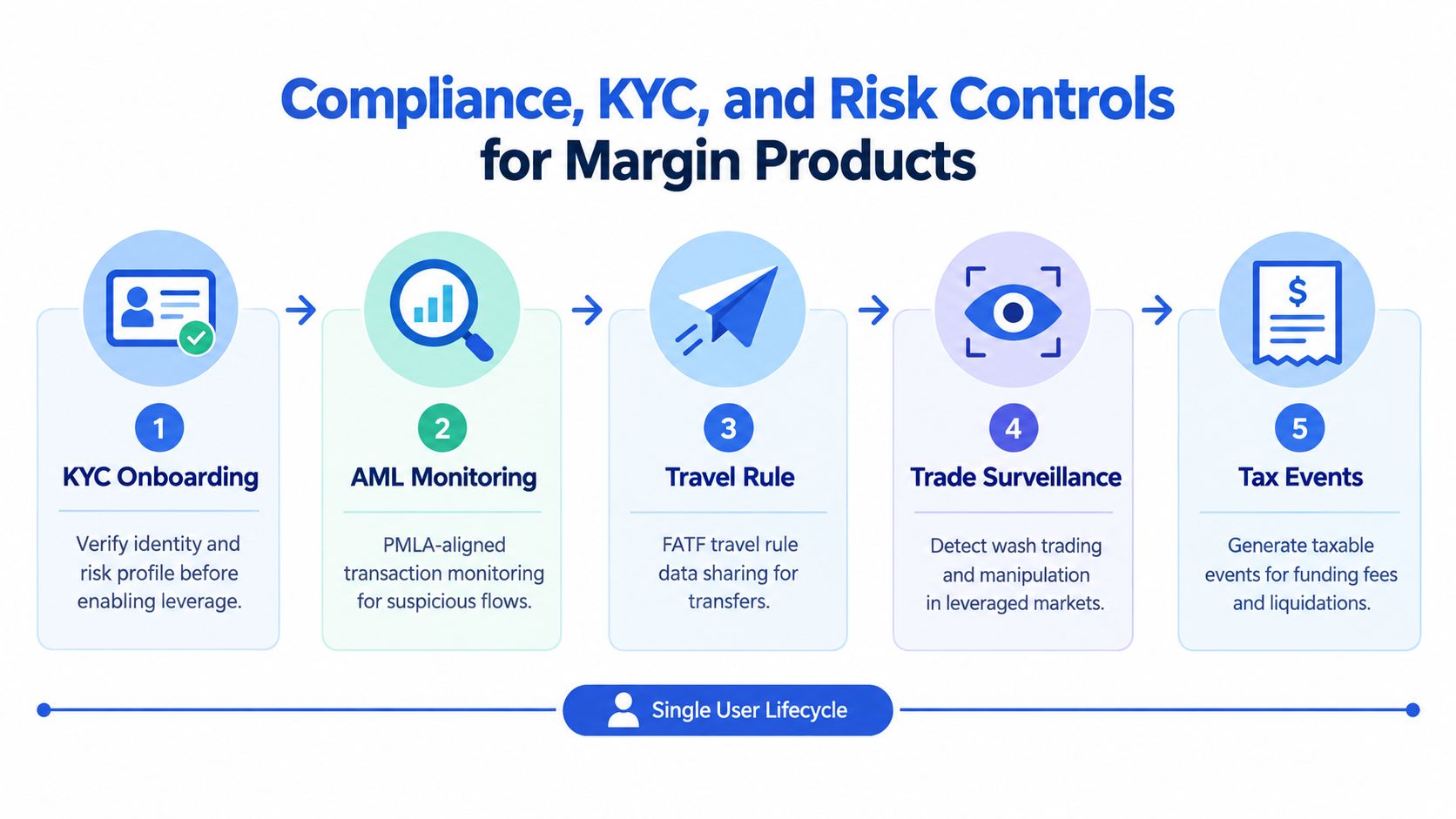
A margin platform should treat compliance as one customer lifecycle. KYC determines who the customer is and which products they can access. AML monitoring evaluates account activity and transfers. The ledger creates the evidence needed for tax, reporting, investigations, and dispute handling. If these systems don’t share stable identifiers and event histories, the platform will spend its first incident assembling facts from incompatible databases.
India’s current compliance environment reaches beyond exchange execution. Businesses that exchange, transfer, safekeep, or provide financial services connected with virtual digital assets can fall under PMLA oversight, with FIU-IND registration, KYC, and record-keeping obligations described in this India crypto regulation guide. The platform therefore needs controls around onboarding, transfers, custody, and reporting, not only around orders.
Map each control to its evidence
- KYC onboarding: The identity provider supplies verification results, source-of-funds information where required, jurisdiction, and risk classification.
- AML monitoring: The transaction monitoring engine evaluates deposits, withdrawals, collateral transfers, and behavioural patterns against configured rules.
- Travel Rule handling: Transfer workflows capture and exchange the required originator and beneficiary information where applicable.
- Trade surveillance: Orders, cancellations, fills, self-trading indicators, account relationships, and price impact feed detection for wash trading or manipulation.
- Tax event generation: Ledger events identify transfers, realised profit and loss, funding fees, borrow charges, and forced liquidations for downstream tax processing.
Margin products need product-specific suitability controls because amplified exposure magnifies customer harm. The onboarding flow should require clear risk acknowledgement, disclose liquidation mechanics, identify eligible customer categories where the legal framework requires them, and prevent users from bypassing a rejected product tier by opening another account.
Pre-trade controls should check account status, collateral, concentration, instrument eligibility, and order size. At-trade controls should monitor exposure, price bands, funding, mark-price health, and circuit breakers. Post-trade controls should reconcile balances, preserve immutable event histories, generate reports, and route suspicious activity for investigation.
A vendor can reduce initial build time for identity or monitoring, but it adds dependency, data-transfer, and configuration risk. An in-house stack gives deeper control over latency and detection logic, but it creates staffing and operational obligations. Either way, the risk engine must remain authoritative for whether a customer may open or retain a position that uses borrowed funds. Blockchain verification for KYC and customer onboarding in banking is relevant when teams evaluate verifiable identity workflows, but legal accountability still rests with the regulated operator.
Designing Safer Borrowing Limits and Retail Protections
High borrowing limits are often marketed as a volume feature. That logic confuses order size with healthy platform economics. A trader liquidated quickly may generate activity, but the venue also absorbs support costs, disputes, bad-debt risk, reputational damage, and regulatory scrutiny. Set limits around the customer’s ability to withstand loss, not around headline turnover.
The Indian evidence warrants caution. SEBI reported that 93% of futures and options traders lost money in FY 2024-25, according to the margin trading risk analysis. SEBI-linked reporting also said the individual derivatives trader base fell 19% in FY26 to 78.6 lakh, while another report said 87.7% of retail F&O traders lost ₹91,685 crore in FY26, as reported by The Hindu. These figures concern regulated derivatives rather than crypto specifically, but they expose the customer-harm mechanics of products funded with borrowed money.
Put limits around behaviour, not just account status
Use several independent guards instead of one maximum-trading field.
- Asset-sensitive exposure: Give volatile instruments lower limits and require larger maintenance buffers. A major asset may support more exposure than a thin altcoin, but no asset should inherit one global setting.
- Tenure-based progression: Start new accounts with constrained exposure. Increase limits only after the customer demonstrates stable collateral behaviour and understands liquidation.
- Position and concentration caps: Limit notional size by account, instrument, collateral type, and market. A customer should not be able to turn one correlated position into a platform-wide loss.
- Cooling-off controls: After liquidation, impose a pause or require renewed risk acknowledgement before the customer can reopen a borrowed position.
- Transparent risk UI: Show estimated liquidation price, margin ratio, collateral consumed, funding, borrow costs, and the proposed order’s effect before confirmation.
Auto-deleveraging needs an ordered queue with explicit fairness rules. Negative-balance protection should exist at the wallet level where the business model and legal framework support it. Monitor the insurance fund as a risk resource, not as a customer guarantee.
India’s derivatives-led crypto activity makes conservative defaults more important. Reports cited that futures and perpetuals represented more than 80% of trading volume on Indian exchanges, with estimated daily derivatives notional around $4 billion and total daily trades around $5 billion. One report estimated individuals accounted for about 70% of futures trades, equivalent to roughly $2.8 billion in daily retail-linked derivatives turnover, as outlined in this Indian crypto futures market report. When retail participation is structurally important, safer defaults protect both the platform’s balance sheet and its customers.
Testing, Monitoring, and Go-to-Market Checklist
Launch margin as a staged programme, not a deployment event. The engine needs historical replay, adversarial testing, operational alarms, and a customer rollout that gives the team room to observe failure without exposing the full market immediately.
Week one for deterministic replay
Replay six months of BTC and ETH tick data through the matching and margin engines. Force liquidations at 25%, 50%, and 100% drawdowns to verify collateral calculations, partial-close behaviour, fee accrual, mark-price handling, and ledger idempotency. Compare every replay result with an independently calculated reference model.
Week two for load and chaos
Run load tests targeting 50,000 orders per second with adversarial bursts, cancellation storms, and concentrated activity around liquidation levels. Kill the price feed, liquidation worker, and database replicas mid-session. The expected result isn’t uninterrupted service at any cost. It is a controlled response, including trading pauses, state recovery, duplicate-event protection, and accurate customer balances.
Week three for operational visibility
Create dashboards for margin health, open interest, insurance fund balance, per-tier exposure, stale oracle time, liquidation queue age, ledger lag, and reconciliation differences. Connect thresholds to PagerDuty or an equivalent incident system. Alerts should distinguish a market-wide volatility event from a single account breach.
Week four for controlled rollout
Start with internal traders who can explain every failure mode. Move to an invite-only beta capped at 1,000 users with 3x multipliers. Open 10x and above only after funding-rate stability is proven and the risk committee has reviewed liquidation outcomes.
Gate each stage on the previous one. Don’t let marketing pressure remove the scenarios most likely to expose a flawed liquidation path. The market already leans heavily towards derivatives, and a 2025 report said futures positions in India could reach 10 to 50 times a trader’s initial capital, making control a defining platform responsibility, as reported by the Times of India. Testing should assume customers will use the most aggressive permitted configuration, not the safest one.
Blocsys Technologies helps fintechs, exchanges, and digital asset businesses build production-ready blockchain and AI-powered platforms, including trading infrastructure and intelligent compliance workflows. If you’re planning a cryptocurrency margin trading platform, visit Blocsys Technologies to discuss the risk engine, custody model, settlement architecture, and staged delivery plan before implementation begins.
