
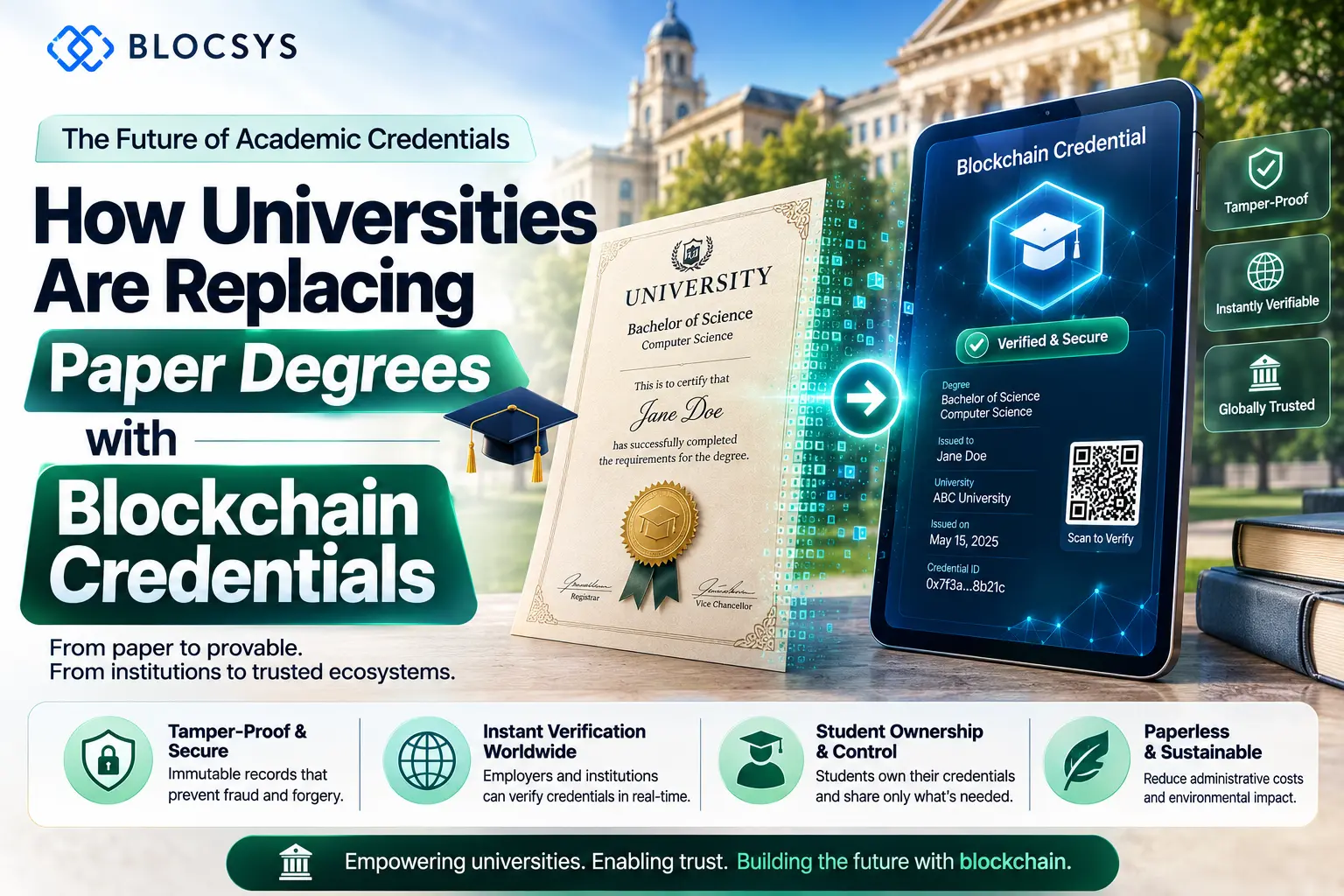
AKTU’s plan to issue about 50,000 blockchain-based degrees in one convocation cycle shows how quickly academic credentialing is moving from paper administration to production-grade digital infrastructure. The question for a university CIO is no longer whether blockchain credentials are technically possible. It’s whether the institution can issue, verify, protect, revoke, and integrate them without creating another administrative burden.
This guide is for registrars, CIOs, CTOs, academic administrators, government education bodies, EdTech companies, employers, and universities evaluating digital degree certificates. It explains the operational shift behind blockchain credentials, from issuer controls and student identity to QR-based verification, privacy, legacy-system integration, and cross-border portability. It also sets out the questions institutions should ask vendors such as Blocsys before moving from a pilot to production.
Table of Contents
- Why Universities Are Moving From Paper to Blockchain Credentials
- What Blockchain Credentials and Verifiable Credentials Actually Are
- How Issuance and Verification Actually Work in Production
- Benefits for Universities, Students, and Employers
- Privacy, Security, and Interoperability Architecture
- Implementation Roadmap, Hidden Costs, and Common Challenges
- Why Partner With Blocsys and What to Do Next
Why Universities Are Moving From Paper to Blockchain Credentials
Paper degrees create a trust problem at the exact point when graduates need to move quickly. A student may need to prove a qualification to an employer, another university, a government agency, or an immigration authority, yet the verifier often has to depend on scans, email exchanges, phone calls, or manual registrar checks.
Centralised PDFs improve availability, but they don’t automatically prove who issued the document or whether someone changed it after download. Blockchain credentials add a cryptographic signature and a tamper-evident record, allowing a verifier to validate the document without relying on a scanned image alone.
India has already moved beyond isolated demonstrations. MIT Art, Design and Technology University issued 2,212 blockchain-powered degree certificates in a single convocation cycle, describing them as globally verifiable and tamper-resistant. The university’s deployment illustrates the move from paper issuance to remote verification.
The public-sector direction is also visible through NIT Kurukshetra’s blockchain-secured graduation degrees, launched by the President of India on 29 November 2022, and through the National Informatics Centre’s Certificate Chain platform. NIC says authorised people and institutions can securely retrieve certificates and confirm that they haven’t been altered, while CBSE academic documents are available through the system. The national Certificate Chain product description provides the clearest picture of this infrastructure.
The operational forces behind the change
Universities are responding to several pressures at once:
- Credential fraud: Forged degrees damage institutional reputation and complicate recruitment.
- Cross-border mobility: Employers and receiving institutions need a portable way to validate qualifications.
- Student ownership: Graduates expect records that can travel with them rather than remain locked in an archive.
- Administrative workload: Registrars need to reduce repeated manual checks and reprinting.
- Digital government infrastructure: National systems make secure certificate retrieval more practical than it was previously.
The distinction between experimentation and production matters. A pilot can prove that a university can mint a credential. Production requires identity proofing, approval workflows, key custody, revocation, privacy controls, support processes, and integration with student information systems.
Decision rule: Choose blockchain when the credential must remain independently verifiable across organisations and borders. A blockchain layer isn’t automatically justified for an internal PDF archive.
| Dimension | Paper Degree | Centralised Digital PDF | Blockchain Credential |
|---|---|---|---|
| Authenticity | Relies on physical features and issuer contact | Relies on file controls or a central portal | Uses issuer signatures and a tamper-evident ledger anchor |
| Verification | Manual or in-person | Depends on access to the issuing system | Can be checked remotely against issuer and ledger evidence |
| Portability | Easy to lose or damage | Shareable, but may be difficult to validate independently | Designed for wallet-based sharing and machine verification |
| Fraud risk | Vulnerable to alteration and forgery | Vulnerable if files or portals are compromised | Alterations can invalidate the cryptographic proof |
| Administration | Printing, storage, reprinting, manual checks | Digital storage and portal maintenance | Issuance controls, key management, revocation, and integration |
| Best fit | Formal ceremonies and archival presentation | Basic digital access | High-value, portable, independently verifiable credentials |
Universities considering the move should also assess the wider operating model described in this guide to tamper-proof verification platforms. By the end of this guide, a university leader should be able to map the full issuance and verification flow, identify hidden implementation work, and evaluate a blockchain credential development partner with greater precision.
What Blockchain Credentials and Verifiable Credentials Actually Are
A verifiable credential is a digitally signed statement about an achievement. In education, that statement might say that a named university awarded a degree to a particular student under defined academic conditions. The issuer signs the record, the student holds it, and an employer or receiving institution verifies it.
A decentralised identifier, or DID, gives an issuer or holder a portable digital identity reference. The university uses its DID and associated public keys to prove that it authorised the credential. The student may use a wallet or another controlled presentation method to share the credential.
The blockchain usually doesn’t contain the full diploma. It stores a cryptographic hash, issuer metadata, public keys, or another proof that allows a verifier to check whether the presented credential matches the record anchored at issuance. Think of the credential as a signed digital document and the blockchain anchor as a tamper-evident timestamped receipt.
A simple mental model for university administrators
A paper degree is like a certificate stamped by a notary. To verify it, someone may need to contact the notary or inspect the physical document.
A blockchain credential is like a signed receipt that carries enough proof for another party to check its authenticity independently. The verifier doesn’t need to call the registrar for every application, provided the issuer’s key, credential format, and revocation status remain available.
The standard stack generally includes:
- W3C Verifiable Credentials: A structured format for signed digital claims.
- DIDs: Portable identifiers for issuers, students, and sometimes verification services.
- Cryptographic hashes: Fingerprints that change if the underlying credential changes.
- Permissioned or consortium networks: Controlled environments where recognised institutions manage governance and access.
- Digital wallets: Student-controlled locations for receiving and presenting credentials.
- Verification services: Web or mobile tools that check signatures, anchors, status, and issuer policy.
IIT Kanpur described a system in which the university’s public key and certificate template are stored on-chain, the certificate is placed in a student digital wallet, and public verification can take place from anywhere in the world using a zero-knowledge protocol. Its blockchain-based digital degree design is useful because it separates the certificate from the public proof used to validate it.
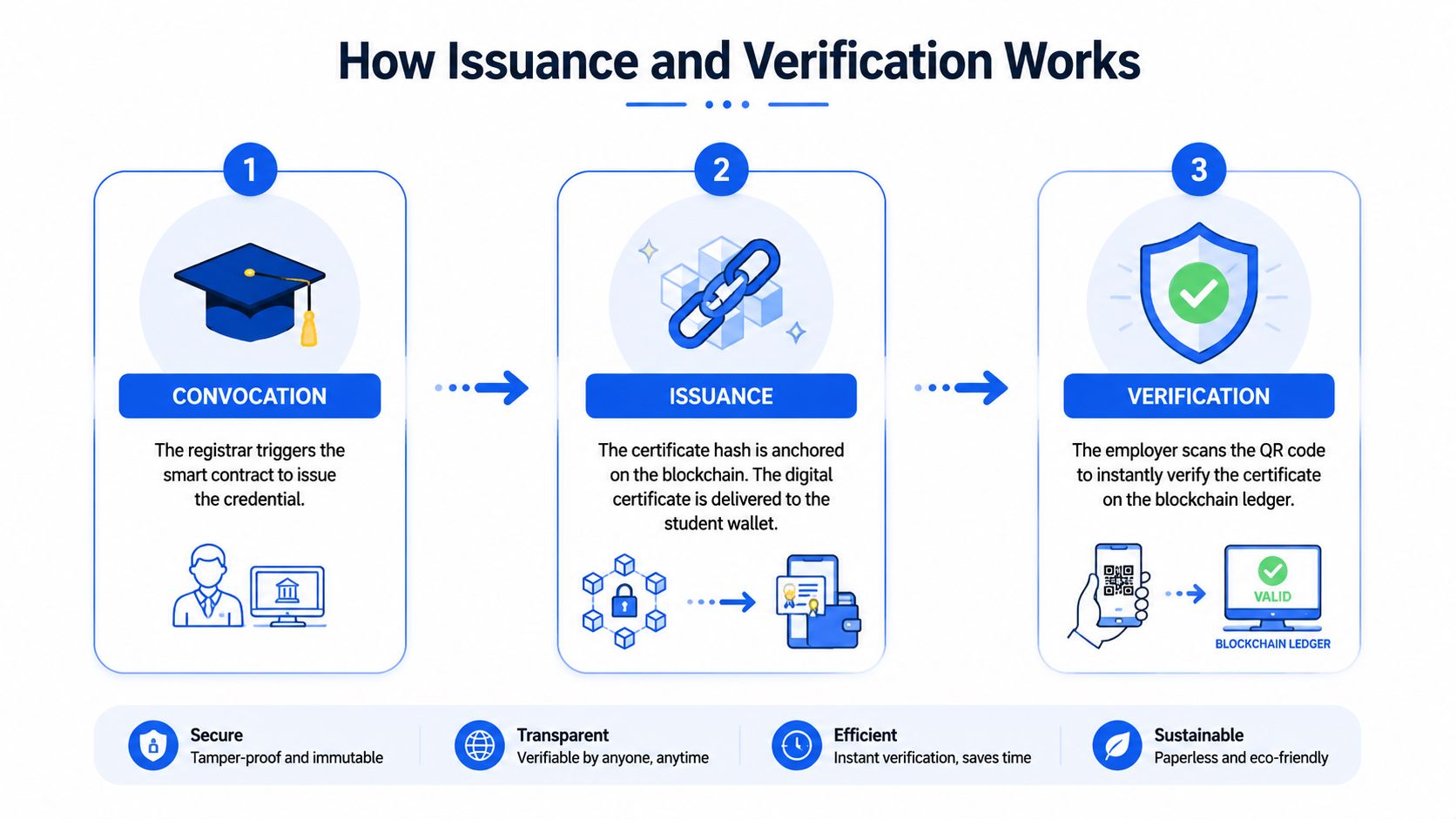
For an institution, the important point is that blockchain is an integrity and verification layer, not a substitute for the student information system. The SIS remains the source for academic decisions. The credential platform converts an approved result into a signed, shareable record.
The combination of W3C VC, DID methods, and a permissioned or consortium chain is mature enough for institutional adoption in 2026, but maturity doesn’t remove the need for governance. Universities still need clear policies for who can issue, what can be disclosed, how a credential is revoked, and how a lost wallet is recovered. A practical introduction to this identity model is available in decentralised digital identity for document verification.
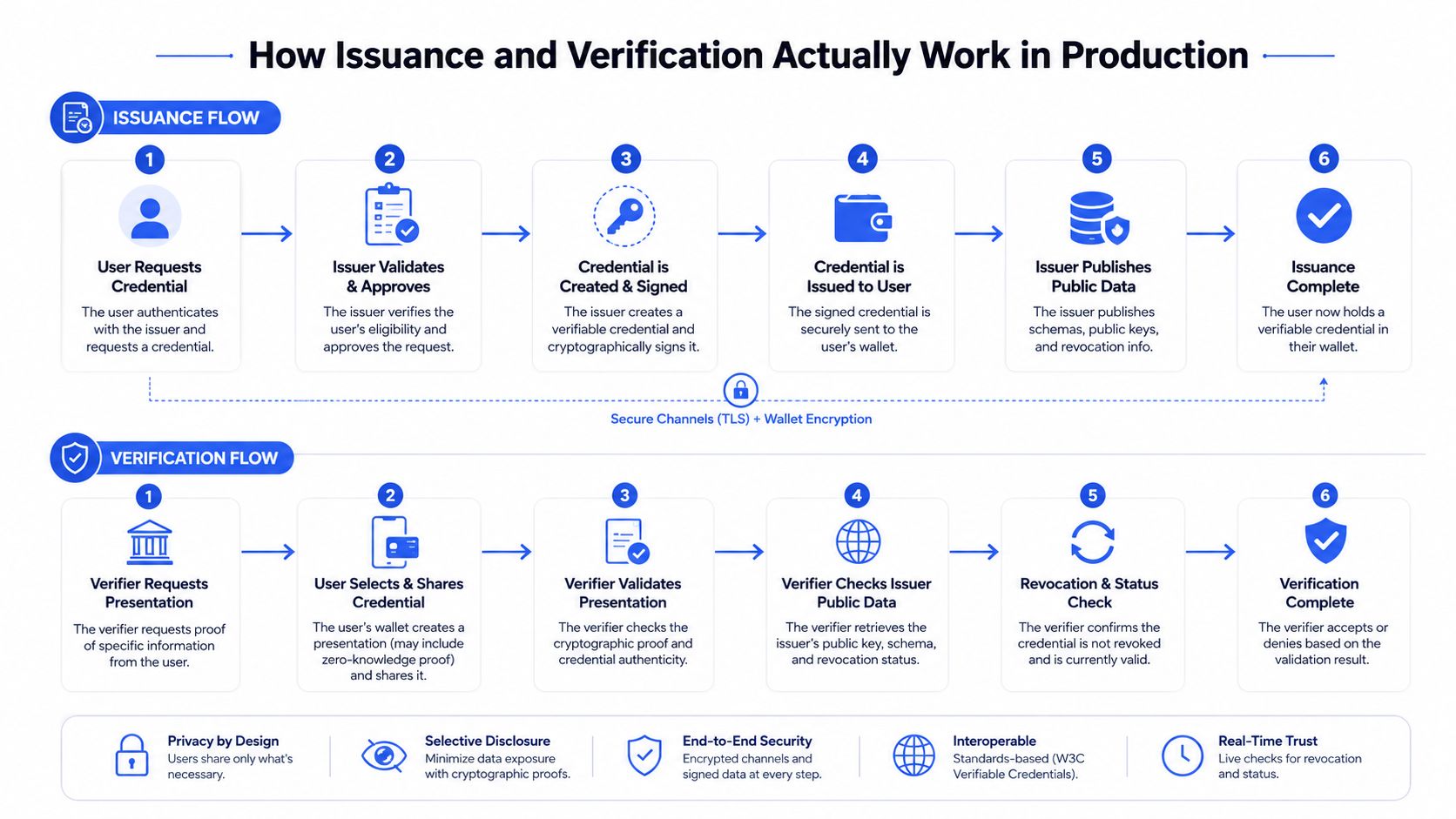
How Issuance and Verification Actually Work in Production
A production workflow begins before convocation. The university must finalise the academic result, confirm the student identity, approve the credential data, and ensure that the authorised issuer key is available. Only then should the registrar trigger the issuance process.
The core sequence looks like this:
- Approval: The SIS or examination system marks the student as eligible.
- Credential creation: The platform generates a machine-readable degree record with issuer, student, programme, award, and date information.
- Signature: The university signs the credential using its controlled issuer key.
- Anchoring: A hash or proof is written to the blockchain.
- Delivery: The student receives the credential in a wallet or a DigiLocker-style vault.
- Presentation: The student shares a credential link, file, or QR code.
- Verification: An employer or institution checks the issuer signature, blockchain anchor, and current status.
MIT World Peace University announced blockchain-anchored digital degrees and diplomas for more than 2,568 students, through a partnership with CertOnce. The deployment was presented as a university-scale implementation, rather than a purely internal technology trial.
MIT Art, Design and Technology University provides another operational signal, with 2,212 blockchain-powered certificates issued in one convocation cycle. The significance isn’t only the quantity. It shows that a registrar’s workflow can connect approved graduate records to remote employer verification without treating every request as a new manual case.
Where the blockchain layer helps
Paper and PDF systems often fail at the handoff between the student and the verifier. A student may possess a genuine document, but the employer still needs confidence that the file is original and current. Blockchain verification addresses that gap by comparing the presented proof with the issuer’s public key and the anchored record.
| Workflow concern | Paper process | PDF process | Blockchain process |
|---|---|---|---|
| Issuer trust | Physical seal or manual contact | Portal or email confirmation | Cryptographic issuer signature |
| Document changes | Difficult to detect | May require file comparison | Hash mismatch exposes alteration |
| Employer access | Registrar interaction | Central portal access | QR or link to verification service |
| Revocation | Manual notification | Portal update | Status registry or revocation mechanism |
| Scale | Printing and handling burden | File management burden | Integration and key-management burden |
| Portability | Limited | Depends on issuer portal | Designed for independent verification |
The system still needs an issuer status service. A valid credential may later require correction, replacement, or revocation. A university should therefore maintain a revocation registry, define replacement rules, and issue QR-linked views that expose status without revealing unnecessary personal data.
NIC’s Certificate Chain demonstrates the national relevance of secure certificate retrieval and authorised verification. CBSE documents are stored within the system, showing how academic documents can be made available through an institutional infrastructure rather than through repeated third-party confirmation. Universities can use this model when designing blockchain-based document verification.
The same architectural logic appears in other regulated document systems. For example, a corporate bond tokenization platform uses secure digital issuance, smart contract automation, settlement workflows, and investor management. Academic credentials have different legal and privacy requirements, but both contexts show why issuance controls and lifecycle status matter as much as the ledger itself.
Benefits for Universities, Students, and Employers
The value of blockchain credentials depends on who is using them. A registrar wants fewer repetitive checks. A graduate wants a credential that survives a move between countries. An employer wants to know whether the degree is genuine without waiting for an institution to respond.
Universities gain a controlled issuance process
For a university, the strongest benefit is operational consistency. Once the examination system approves an award, the credential platform can produce a standard record, apply the university’s issuer signature, anchor the proof, and deliver the result to the student.
That reduces dependence on printed stock, manual scanning, and repeated re-verification. It also creates a clearer audit trail. The institution can see who approved issuance, which key was used, when the record was anchored, and whether a later status change occurred.
Maharashtra’s project was expected to cover almost one million certificates through an Ethereum-based verification network, according to the legal and policy analysis cited in the project coverage. That proposed scale shows why a university should design for batch issuance, identity reconciliation, and support operations from the beginning.
Students receive portable academic records
Students benefit when they control a usable copy of their achievements. A digital diploma can be shared with an employer, another university, or a government body without mailing the original or asking the registrar to repeat the same verification.
The wallet can eventually hold more than a degree. It may include certificates, professional training, micro-credentials, and other verifiable learning records. The university still decides what it awards, but the graduate gains a more portable way to present those achievements.
The student experience must remain simple. A technically correct credential that requires specialised software, complicated recovery steps, or unfamiliar terminology will create support demand. The interface should explain what the credential proves, what data will be shared, and how to revoke access to a presentation.
Employers and receiving institutions reduce verification friction
Employers can use a QR code or verification link to check whether a credential was signed by the named institution and whether its proof remains valid. Another university can use the same process when assessing a transfer, postgraduate application, or international qualification.
That doesn’t mean blockchain credentials automatically improve hiring outcomes. Public evidence remains limited on whether recruiters trust blockchain credentials more than established digital certificates, or whether graduates receive measurable advantages in placement speed, salary, or cross-border recognition.
Candid assessment: Blockchain can solve an authenticity and workflow problem without solving the signalling problem. A verifiable degree from an unfamiliar institution may still receive less attention than a traditional degree from a well-known university.
Universities should therefore measure more than issuance volume. They should monitor verifier adoption, student sharing, support requests, correction rates, and the number of external organisations that can validate a credential without registrar intervention. Those indicators reveal whether the institution has built a working ecosystem or only digitised its certificate design.
Privacy, Security, and Interoperability Architecture
A blockchain credential system isn’t secure because it uses the word blockchain. Security comes from the combination of data minimisation, cryptographic signatures, key custody, access policy, revocation, and standards-based exchange.
The first architectural decision is what not to place on-chain. A university should avoid putting sensitive student information directly into an immutable ledger where correction or deletion may be difficult. The ledger can hold a hash, issuer reference, public key, and status evidence, while the credential itself remains in a controlled wallet or secure repository.
Privacy begins with selective disclosure
Zero-knowledge proofs can allow a student to prove possession of a degree from a named university without revealing grades or other unrelated attributes. This matters when an employer needs confirmation of qualification but doesn’t need a complete academic history.
Selective disclosure should be designed into the credential schema, not added as a last-minute interface feature. The university must decide which fields are mandatory, which are optional, and which can be proven without being revealed.
Teams working through these choices can use this guide to implementing privacy by design as a practical reference for reducing unnecessary data exposure during system design.
Keys and networks require institutional governance
The university’s issuer key is a critical asset. If an unauthorised party uses it, that party may issue credentials that appear genuine. If the key is lost, the institution may struggle to validate historical records or issue future credentials under the same identity.
A university should define:
- HSM custody: Hardware security modules can protect signing keys from ordinary application access.
- Multi-party approval: Multiple authorised officers can be required for sensitive issuance operations.
- Key rotation: The institution needs a documented process for replacing keys while preserving trust in earlier credentials.
- Qualified custody: A specialist vendor may operate custody controls under a contract with clear responsibility and audit rights.
- Revocation policy: The university must define how corrections, cancellations, and replacements appear to verifiers.
Permissioned or consortium networks often provide a practical starting point for universities because governance is explicit and participating institutions are known. A public chain may offer broader transparency, but it can create additional questions around transaction management, data exposure, and long-term operating policy.
NIC’s Certificate Chain describes a model in which authorised people and institutions can access secure certificate storage and retrieval without an intermediary. That principle is useful even when a university selects a different technical stack. The compliance questions are explored further in GDPR, DPDP Act, and blockchain document verification.
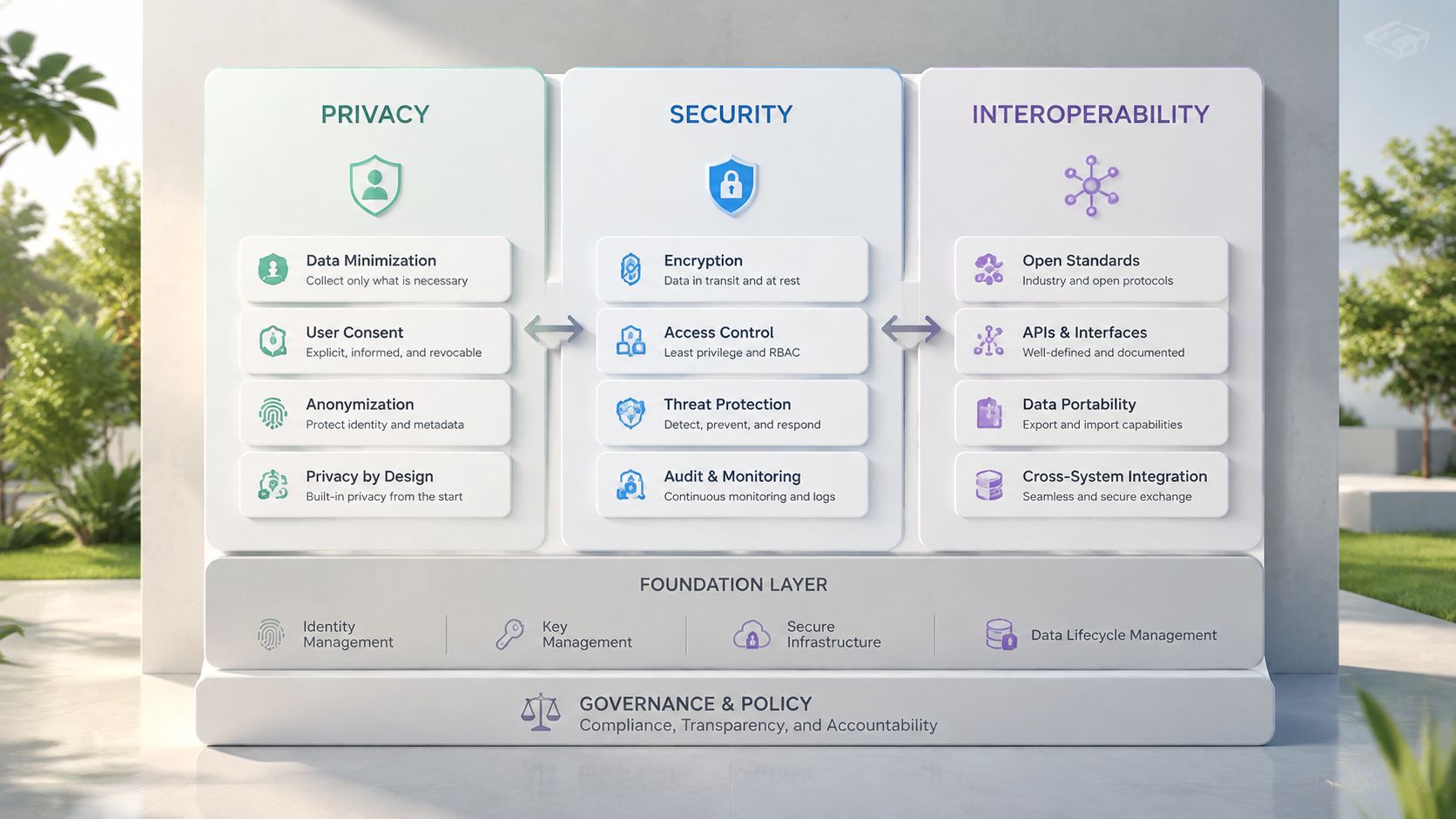
Interoperability becomes more important when credentials move between India, the EU, the Gulf, Singapore, Canada, Australia, the UK, and the US. The university should require machine-readable formats, documented APIs, stable issuer identifiers, and a clear approach to cross-chain or off-chain verification.
In this setting, Blockchain Development can involve public, private, or hybrid networks. The correct choice depends on governance, privacy, verifier access, and the university’s existing systems, not on which network is most fashionable.
Implementation Roadmap, Hidden Costs, and Common Challenges
A university can launch a blockchain credential programme within a controlled 12-month rollout, but the technology build is only one workstream. Policy, examination operations, identity reconciliation, student support, key custody, and verifier onboarding determine whether the platform works after launch.
The first phase should not begin with smart contract code. It should begin with a process map. Identify how a result moves from examiner approval to senate or academic-board confirmation, certificate generation, correction, dispatch, and later verification. Blockchain should address a defined failure point, not become a replacement label for the entire records system.
A phased production plan
| Phase | Timeline | Goal | Key Deliverable | Risk Checkpoint |
|---|---|---|---|---|
| Alignment and policy | Month 0 to 2 | Confirm scope, authority, and compliance | Credential policy, data map, governance model | Unclear issuer authority or retention rules |
| Issuer and custody design | Month 2 to 4 | Protect signing operations | Issuer DID, key custody plan, approval workflow | Single-person key access or no recovery process |
| Faculty pilot | Month 4 to 6 | Test one controlled issuance path | Pilot credentials, wallet flow, verifier page | Student identity mismatch or poor support experience |
| Systems integration | Month 6 to 9 | Connect academic operations | SIS, examination workflow, wallet, and DigiLocker integration plan | Manual exports remain the main process |
| Production launch | Month 9 to 12 | Issue at institutional scale | Production issuance, verifier portal, support model | No revocation registry or audit process |
The largest hidden costs often sit outside the blockchain network. Legacy SIS platforms may have weak APIs or inconsistent student identifiers. Examination systems may require manual approval before release. Registrars and examiners need training, while IT teams need procedures for key rotation, incident response, wallet recovery, and audit evidence.
Indian coverage has often focused on the promise of faster verification and tamper resistance, while public reporting provides limited detail on implementation cost, long-term maintenance, or staff workflow changes. That gap should become part of the procurement process, not a reason to avoid the technology.
Questions to put to every vendor
Ask the vendor to demonstrate the complete lifecycle, not just a successful issuance screen:
- Identity reconciliation: How does the platform match the approved student record to the correct wallet?
- Key custody: Who can sign, rotate, suspend, or recover the university’s issuer key?
- Revocation: Can a verifier distinguish an original credential from a corrected or withdrawn one?
- Interoperability: Does the output support standard machine-readable credentials and documented APIs?
- Privacy: Which fields are stored on-chain, in the wallet, and in the verifier interface?
- Operations: What happens if the wallet is lost, the student changes name, or the university changes its issuer key?
- Auditability: Can the registrar produce an evidence trail for issuance and status changes?
- Integration: How will the platform connect with the SIS, examination workflow, student portal, and DigiLocker-style services?
A vendor that can’t answer these questions may be selling a certificate generator rather than a credential system. Universities should also evaluate batch anchoring and proof aggregation, including approaches such as Merkle batching for thousands of proofs, while ensuring the design remains understandable to auditors and administrators.
The red flags are straightforward: no revocation registry, no key custody plan, no identity recovery process, no standards roadmap, no privacy model, and no documented integration approach. For budget planning, a university can use the software development cost estimator to structure an initial discovery discussion, but the final estimate should follow a systems and policy assessment.
Why Partner With Blocsys and What to Do Next
Replacing paper degrees isn’t a single smart contract project. It’s a coordinated transformation across academic records, identity, issuance, student experience, verification, privacy, and institutional governance.
Blocsys Technologies can be evaluated as an implementation partner for this operating model. Its relevant service areas include custom blockchain development, blockchain document verification, decentralised identity development, smart contract development, and enterprise blockchain solutions. For a university, the practical question is how those capabilities map to the institution’s existing SIS, examination process, student portal, wallet model, and verifier requirements.
Match the capability to the operational problem
- Blockchain development: Design the network, data model, governance rules, APIs, and deployment architecture.
- Document verification: Create QR-linked certificate views and verification services that check issuer signatures, hashes, and status.
- Decentralised identity: Establish university and student identifiers with appropriate recovery and key-rotation procedures.
- Smart contracts: Automate approved issuance and status logic while keeping academic decisions under institutional control.
- Enterprise education solutions: Connect credential workflows with academic administration, student support, reporting, and external verifiers.
The partnership should start with a discovery assessment, not a technology commitment. The assessment should map the current certificate lifecycle, classify data, identify issuer roles, review integration constraints, define a pilot population, and specify how success will be measured.
A sensible pilot can focus on one faculty or credential type. The university should test the complete experience, including approval, identity matching, issuance, wallet delivery, QR presentation, employer verification, correction, revocation, and support. If the pilot only demonstrates minting, it hasn’t tested the most important operational risks.
The 12-month path is therefore a governance and integration programme as much as a blockchain programme. Early months establish policy and custody. Middle phases prove issuance and connect academic systems. Later phases add production controls, verifier access, monitoring, and institutional support.
Blocsys can also support adjacent enterprise blockchain work where an institution is exploring tokenised records or other regulated digital assets, but those projects should remain separate from academic credential governance unless the legal and operational requirements have been assessed carefully. The credential programme should stay focused on trusted educational achievement, student privacy, and portable verification.
A CIO should leave the first vendor meeting with concrete artefacts: a target architecture, credential schema, integration map, key-management model, privacy assessment, implementation phases, and an ownership matrix. Those documents make it possible to compare vendors on execution rather than presentation quality.
Universities, colleges, EdTech platforms, and government education bodies can now take the next step by asking Blocsys Technologies for a discovery call or technical assessment covering blockchain credential development, digital certificate platforms, blockchain document verification, decentralised identity, and enterprise education workflows.
Frequently Asked Questions
What are blockchain credentials for universities?
Blockchain credentials are digitally signed academic records that allow universities to issue degrees, diplomas, and other qualifications in a tamper-evident and independently verifiable format. Instead of relying only on paper certificates or centralised PDFs, blockchain credentials use cryptographic signatures and blockchain-based proof to help students, employers, and other institutions verify academic achievements.
How do blockchain-based university degrees work?
Blockchain-based university degrees typically work by connecting the university’s academic system to a credential platform that creates, digitally signs, and anchors an approved academic record. The student receives the credential through a digital wallet or similar system, while an employer or institution can verify it through a QR code, link, issuer signature, blockchain proof, and current credential status.
What is a verifiable credential in education?
A verifiable credential in education is a digitally signed statement that confirms an academic achievement issued by an authorised institution. It can contain information such as the student’s qualification, programme, issuing university, and award date, while cryptographic signatures allow a verifier to confirm that the credential was issued by the legitimate institution and has not been improperly altered.
Do blockchain degrees replace traditional university degrees?
Blockchain degrees do not necessarily replace the academic degree itself; they replace or modernise the way the credential is issued, stored, shared, and verified. The university remains responsible for awarding the qualification, while blockchain technology provides an additional verification and portability layer that can reduce dependence on paper certificates, scanned documents, and manual registrar checks.
How can employers verify a blockchain-based degree?
Employers can verify a blockchain-based degree using a verification link or QR code connected to the credential record. The verification process can check the university’s issuer signature, credential data, blockchain anchor, and current status, allowing the employer to determine whether the credential is authentic, valid, corrected, or revoked without relying entirely on manual communication with the university.
Are blockchain credentials secure and tamper-proof?
Blockchain credentials can provide strong tamper-evidence when they combine cryptographic signatures, secure issuer keys, blockchain anchoring, access controls, and credential status management. The blockchain does not automatically make the entire credential system secure; universities also need appropriate key custody, identity management, privacy controls, revocation procedures, and governance policies.
What information is stored on the blockchain for a digital degree?
A university should generally avoid storing sensitive student information directly on a public blockchain. Instead, the blockchain can contain a cryptographic hash, issuer reference, public key, credential identifier, or other proof that allows a verifier to confirm the integrity and authenticity of the credential while the detailed academic record remains in a controlled wallet, repository, or institutional system.
How do universities protect student privacy with blockchain credentials?
Universities can protect student privacy by using data minimisation, selective disclosure, controlled credential storage, secure key management, and privacy-preserving verification methods. Sensitive academic information should not be unnecessarily placed on an immutable blockchain, while techniques such as zero-knowledge proofs can allow students to prove specific qualifications without revealing unrelated academic information.
Can blockchain credentials be revoked or corrected?
Yes, blockchain credentials can be revoked or corrected when the credential system includes a status or revocation mechanism. Universities should maintain a clear process for handling withdrawn awards, errors, replacements, name changes, and other status updates so that verifiers can distinguish a valid credential from one that has been revoked or replaced.
Can blockchain credentials integrate with university systems?
Blockchain credential platforms can integrate with university systems such as student information systems, examination platforms, student portals, digital wallets, and services such as DigiLocker through APIs and structured data exchange. Integration allows approved academic results to flow into credential issuance without requiring universities to replace their existing academic information systems.
How much does it cost to build a blockchain credential platform for a university?
The cost of building a blockchain credential platform for a university depends on factors such as credential volume, blockchain architecture, verifiable credential standards, digital identity, wallet functionality, university system integrations, issuer key management, verification portals, privacy controls, revocation, security requirements, and ongoing maintenance. A limited pilot can cost significantly less than a production platform designed for institution-wide or multi-university credential issuance.
Blocsys Technologies develops enterprise blockchain and digital identity solutions for universities and education platforms moving from paper degrees to secure, verifiable digital credentials. Visit Blocsys Technologies to discuss a technical assessment for blockchain certificate issuance, document verification, smart contracts, and production-ready credential infrastructure.
