An RWA tokenization platform in 2026 can start at $15,000 to $40,000 for an MVP, move to $40,000 to $80,000 for a mid-level platform, and exceed $80,000 to $150,000+ for enterprise-grade builds in one India-based pricing model, while compliant modular or mid-scale platforms in India more typically sit at $100,000 to $250,000, enterprise platforms at $300,000 to $800,000, and high-complexity projects can reach $1,000,000 to $3,000,000 depending on asset class, compliance, and architecture. The true cost question isn't the headline build figure. It's the total cost of ownership across compliance, security, integrations, upgrades, and operations.
Organizations often underestimate RWA tokenization platform development cost because they budget for software and overlook the necessary infrastructure. The token contract is the visible part. The expensive part is everything that makes it lawful, secure, operable, and maintainable under institutional scrutiny.
This matters to CTOs, founders, digital asset product leaders, and investment firms planning issuance platforms, investor portals, tokenized real estate systems, debt issuance rails, or private market infrastructure. If you're evaluating Blocsys as an enterprise blockchain development company or need an early budget model, the software development cost estimator is a useful starting point before technical discovery.
RWA tokenization platform development cost, real world asset tokenization cost, RWA platform development, asset tokenization platform cost, blockchain tokenization platform, enterprise tokenization platform, digital asset platform development, blockchain development services, smart contract development, enterprise blockchain development company, tokenization software development, digital assets, blockchain infrastructure, fintech platform development, blockchain consulting.
Table of Contents
- Introduction Decoding the Investment in RWA Tokenization
- Deconstructing RWA Platform Development Costs in 2026
- Key Architectural Decisions That Drive Costs
- The Unseen Costs Compliance and Security
- Technology Stack and Smart Contract Costs
- Beyond the Build Ongoing Maintenance and Operational Costs
- How Blocsys Delivers Enterprise-Grade RWA Tokenization Platforms
- Frequently Asked Questions About RWA Tokenization Costs
- What is an RWA tokenization platform
- How much does it cost to build an RWA tokenization platform in 2026
- What affects real-world asset tokenization platform development cost most
- Which blockchain is best for RWA tokenization
- How long does it take to build an asset tokenization platform
- What compliance requirements are usually needed
- What technologies are commonly used in RWA tokenization platforms
- Why are smart contract audits a separate budget item
- Are maintenance costs significant after launch
- Can AI improve RWA tokenization platforms
- Why do enterprises invest in asset tokenization
- How can Blocsys help with a secure enterprise-grade RWA platform
Introduction Decoding the Investment in RWA Tokenization
Traditional issuance and transfer workflows still create friction for real estate sponsors, private credit managers, fund operators, and digital asset businesses. Tokenization is attractive because it can turn fragmented ownership, manual approvals, and opaque transfer controls into programmable workflows with clearer auditability and better operational control.
That doesn't mean every platform should be built the same way. A simple issuer dashboard for one asset class is a different programme from a regulated multi-asset platform with onboarding, compliance orchestration, wallet controls, settlement logic, registrar functions, and reporting. Teams that conflate those two projects usually underfund the second one.
A lot of the buying intent around this topic overlaps with broader fintech software development, because RWA systems sit at the intersection of capital markets software, compliance tooling, and blockchain infrastructure. If you need a technical baseline before budgeting, this primer on how real-world asset tokenization works in blockchain is useful context.
Practical rule: If the platform has to satisfy legal, compliance, treasury, investor operations, and security stakeholders, treat it like regulated infrastructure, not a Web3 product sprint.
The cost conversation also changes once you look beyond launch. Boards usually ask for the upfront build number. Operators end up dealing with upgrades, policy changes, audits, support workflows, and exception handling. That's where total cost of ownership decides whether the platform scales cleanly or becomes a custom system nobody wants to touch a year later.
Deconstructing RWA Platform Development Costs in 2026
A compliant RWA platform can start in the low five figures and still end up costing seven figures once legal structure, controls, integrations, audits, and operating overhead are added. That spread is the point. Budgeting fails when teams price the interface and token contract, but ignore the operating model the platform has to support for years.
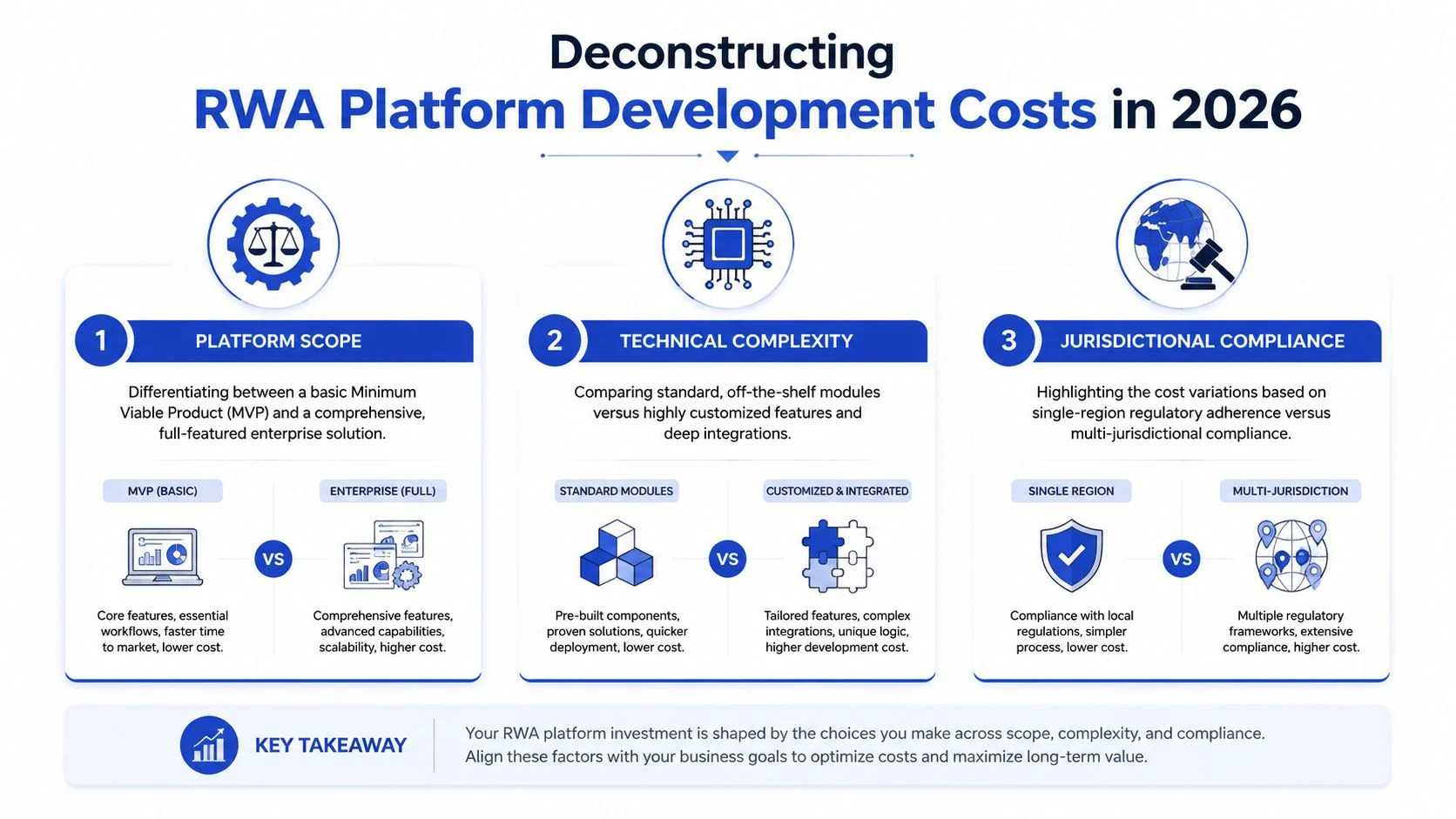
Earlier market estimates placed lightweight India-based MVPs around $15,000 to $40,000, mid-level builds around $40,000 to $80,000, and broader enterprise software builds above $80,000 to $150,000+. They also noted that smart contract audits can add $10,000 to $25,000. Separate market analysis put compliant modular platforms much higher, with mid-scale programmes around $100,000 to $250,000, enterprise-grade delivery around $300,000 to $800,000, and high-complexity asset programmes reaching $1,000,000 to $3,000,000, with legal and compliance work taking a large share of spend and annual maintenance often landing at 20–30% of initial build cost.
Those figures describe different scopes, not conflicting realities.
The lower range usually covers software delivery for a narrower use case. The higher range reflects what boards end up funding when the platform must support regulated onboarding, document controls, policy enforcement, reconciliation, support operations, and external assurance. For CTOs, that is the more useful lens. The main question is not "what does tokenization software cost to build?" It is "what does a production platform cost to launch, govern, and keep audit-ready?"
Estimated RWA platform development cost by tier
| Development Phase | MVP Cost Range | Mid-Scale Cost Range | Enterprise Cost Range |
|---|---|---|---|
| Discovery and requirements mapping | Included within $15,000 to $40,000 MVP scope | Included within $40,000 to $80,000 mid-level scope | Included within $80,000 to $150,000+ enterprise scope |
| Core platform and tokenisation workflows | Included within $15,000 to $40,000 MVP scope | Included within $40,000 to $80,000 mid-level scope | Included within $80,000 to $150,000+ enterprise scope |
| Compliance automation and investor controls | Limited in MVPs, often lighter scope | Usually broader automation inside $40,000 to $80,000 | Deep customisation often pushes projects into $300,000 to $800,000 |
| Smart contract audit allocation | Audit can add $10,000 to $25,000 | Audit can add $10,000 to $25,000 | Audit can add $10,000 to $25,000, often alongside wider assurance work |
| Fully compliant platform delivery | Often outside lightweight MVP assumptions | Commonly $100,000 to $250,000 for modular or mid-scale compliant builds | Commonly $300,000 to $800,000, with high-complexity projects reaching $1,000,000 to $3,000,000 |
The most expensive mistake is under-scoping the non-functional work. Teams approve a budget for issuance and wallet flows, then discover they also need role segregation, exception handling, data retention rules, reconciliation jobs, permission reviews, investor communications, and support tooling. None of that looks impressive in a demo. All of it drives real cost and determines whether the platform can survive internal audit, regulator questions, and daily operations.
Cost discipline starts with operating discipline. Standard cloud FinOps methodologies help control environment sprawl, logging spend, idle infrastructure, and test environments that keep running long after a sprint ends. Those controls matter more in tokenization programmes than many teams expect, because staging environments often mirror production integrations and security controls closely enough to become expensive fast.
For planning, I prefer a cost model shared by product, engineering, compliance, and finance before detailed stories are written. This framework for blockchain development cost estimation factors and budgeting is a useful starting point for that workshop.
A short explainer is useful if your non-technical stakeholders need a visual overview:
What changes the budget fastest
- Asset structure and servicing model: A single private issuance is much cheaper than a platform that has to support real estate, credit products, fund interests, distributions, and lifecycle events with different legal treatment.
- Control depth: Manual review lowers initial build cost, but it pushes cost into operations. Policy-driven transfer rules, approvals, and exception paths cost more upfront and usually lower risk later.
- Integration surface area: Custody, payments, KYC and AML vendors, registrar systems, CRM, ERP, reporting, and document platforms add more than API work. They add testing cycles, failure handling, vendor coordination, and support burden.
- Assurance requirements: Internal security review, third-party audits, penetration testing, legal sign-off, and evidence collection often stretch timelines and budgets more than core feature development.
- Scalability assumptions: A platform designed for one issuer and one jurisdiction is cheaper. A platform expected to support multiple issuers, asset classes, entities, and regulatory regimes needs a different foundation, and that changes TCO from day one.
Key Architectural Decisions That Drive Costs
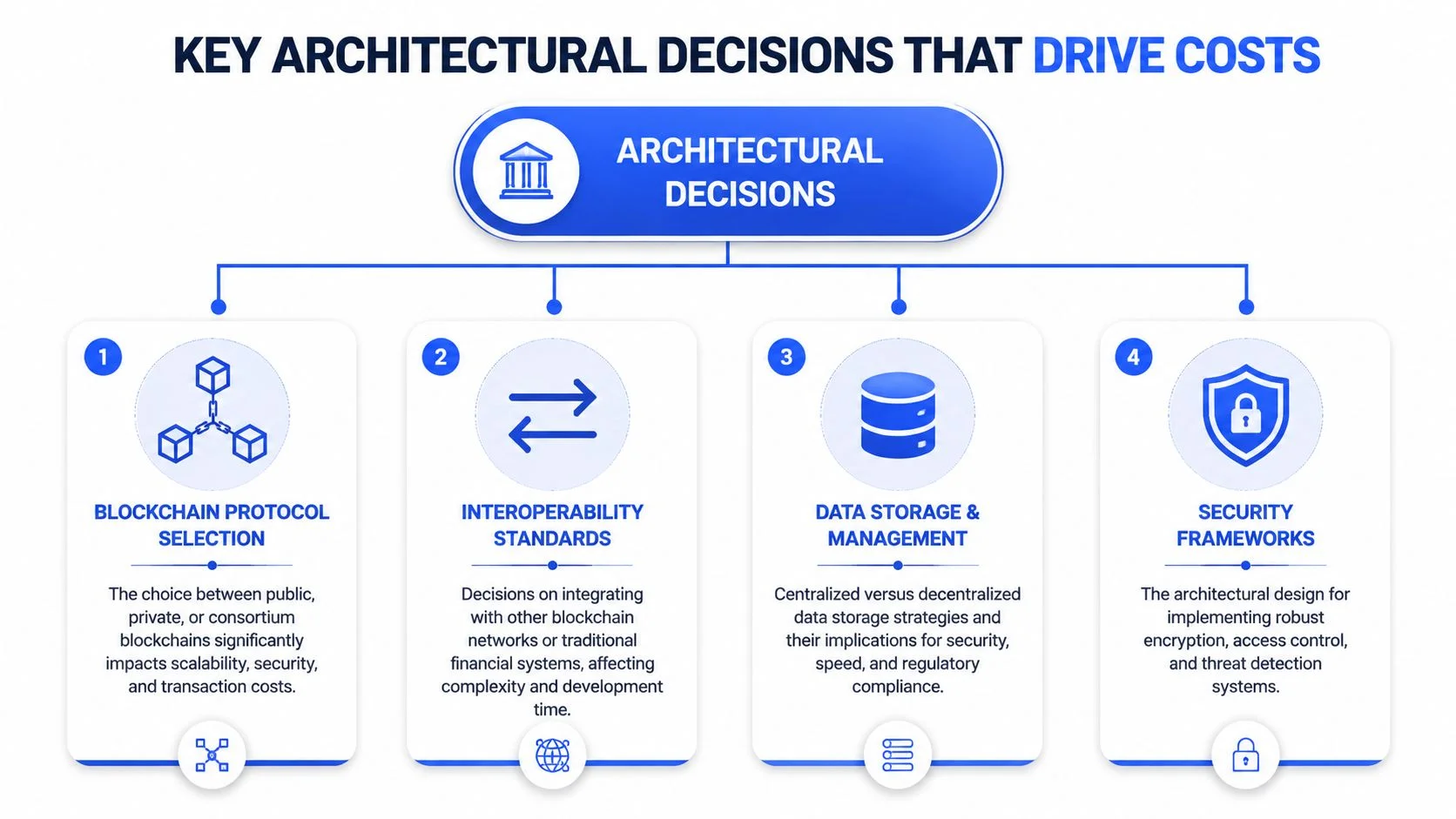
A lot of cost overruns trace back to architecture choices made too casually in the first month. Teams focus on feature lists and leave structural decisions vague. Then they discover the platform can't support policy-driven transfers, operational segregation, or future asset classes without refactoring core components.
Public versus permissioned chains
Public chains give you broader ecosystem compatibility, familiar tooling, and easier wallet interoperability. They also force you to think harder about privacy, transaction finality expectations, operational controls, and how much sensitive business logic belongs on-chain.
Permissioned or consortium models give institutions more control over access, privacy, and governance. They can also create integration and adoption challenges if counterparties, investors, custodians, or external venues expect public-chain compatibility.
Pick the chain after the operating model is clear. Don't pick the chain because the engineering team likes the tooling.
For many enterprise builds, the right answer isn't ideological. It's modular. Keep identity, document workflows, compliance engines, and reporting layers flexible enough that the ledger choice doesn't infect every part of the stack. That approach aligns well with modular blockchain architecture for scalable networks.
Monolith versus modular services
A monolith is usually quicker to ship when the product is still narrow. That's attractive for pilots and contained issuance flows. The problem starts when legal teams want rule variations by jurisdiction, operations wants asset-specific workflows, and product wants multiple user roles with different approval states.
A modular service architecture costs more upfront because it requires cleaner interfaces, stronger DevOps discipline, and better observability. But it gives you room to replace pieces without destabilising the full platform. In tokenization, that matters because KYC providers change, custody preferences change, and legal processes change.
A practical comparison looks like this:
| Decision | Lower initial cost | Better long-term flexibility |
|---|---|---|
| Core application design | Monolith | Modular services |
| Compliance engine | Hard-coded rules in app flows | Policy service and reusable rules engine |
| Wallet support | Single wallet pattern | Abstracted custody and wallet orchestration |
| Reporting | Manual exports and admin views | Dedicated data pipelines and reporting services |
Interoperability and data design
Cross-chain ambitions often inflate budgets before the first issuance is live. Most platforms don't need multi-chain support at launch. They need clean boundaries between token logic, off-chain records, and external integrations.
The more important design question is usually where critical records live and how they stay consistent. If legal ownership data, investor eligibility status, and registrar records drift apart, the platform becomes expensive to operate no matter what chain you chose.
Strong architecture keeps these layers distinct:
- On-chain state: Ownership representation, transfer logic, event history.
- Off-chain control plane: Identity status, documents, approvals, sanctions checks, reporting context.
- Enterprise integrations: CRM, accounting, custody, notifications, treasury, analytics.
That structure doesn't remove complexity. It localises it. That's what keeps long-term cost under control.
The Unseen Costs Compliance and Security
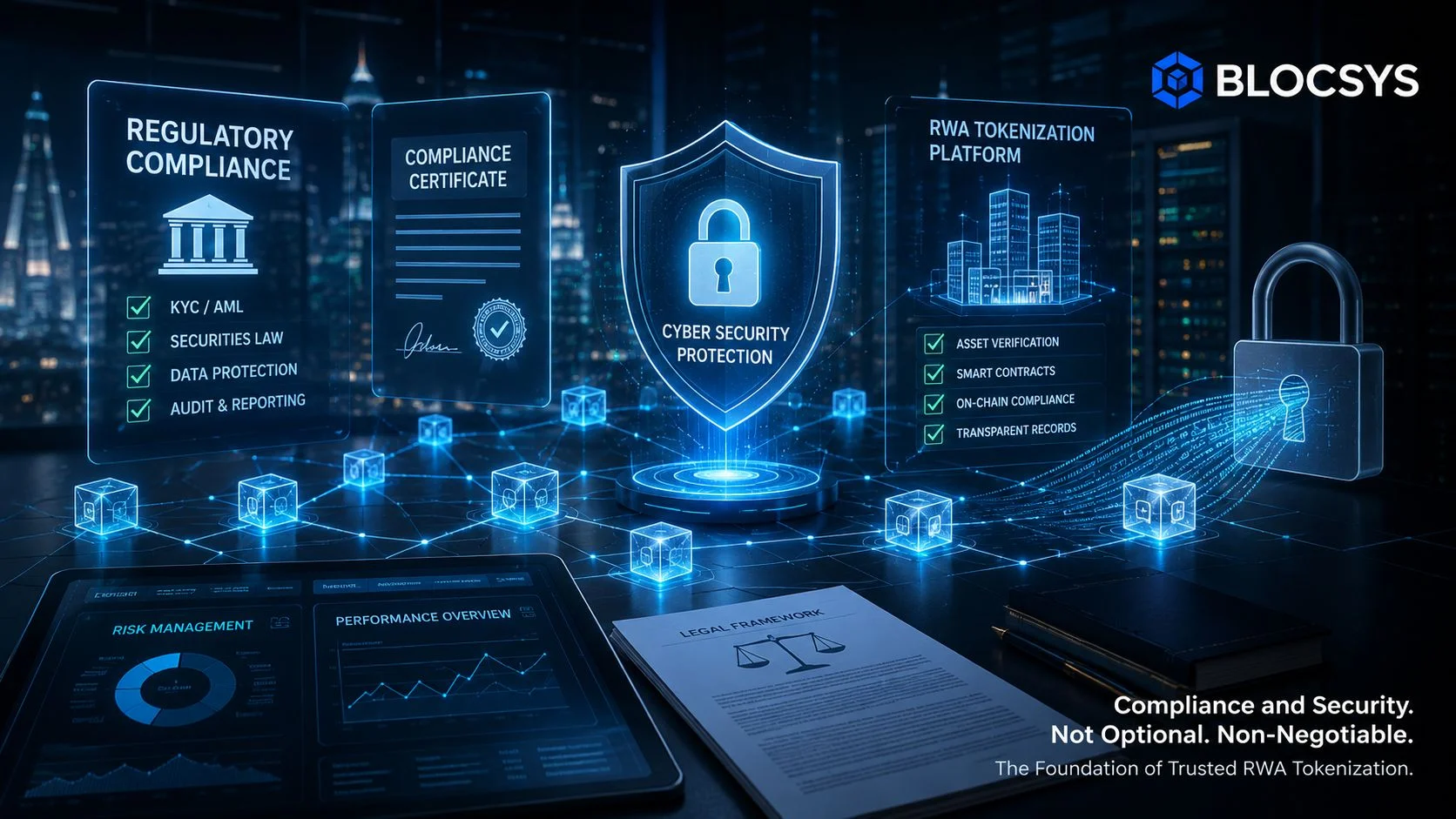
40% of budget overruns in enterprise software come from governance, risk, and compliance work that was treated as a later phase instead of a design input. RWA platforms are especially exposed because every issuance ties software behavior to legal rights, investor eligibility, and asset records. If those controls are bolted on after launch, the platform becomes expensive to operate, difficult to audit, and risky to scale.
Compliance is a product requirement
As noted earlier, compliant builds can consume a large share of total project spend. The reason is straightforward. Cost does not come from legal advice alone. It comes from converting policy into system behavior, approval flows, audit trails, exception handling, and evidence that stands up in reviews by regulators, auditors, banking partners, and institutional investors.
That work grows fast in multi-jurisdiction programs. A transfer rule that is acceptable for one market may fail in another because of investor classification rules, holding periods, disclosure obligations, or local record-keeping requirements. CTOs often budget for launch approvals and underestimate the ongoing cost of change control. Every new asset class, distribution region, custody model, or secondary transfer path can trigger legal review and product changes.
Privacy requirements add another layer of TCO. Identity documents, accreditation evidence, sanctions results, and investor communications cannot be scattered across admin tools and email threads. Data retention, deletion rights, residency constraints, and access logging need to be designed into the platform. The operational implications are similar to the issues covered in GDPR, DPDP Act and blockchain document verification compliance challenges.
The practical question is not whether compliance costs money. It is whether the platform can absorb regulatory change without rewriting core workflows every quarter.
Security spend that teams try to postpone
Security budgets are often framed too narrowly. Smart contract auditing matters, but it is only one control in a larger assurance program. In production environments, losses usually come from a chain of smaller failures: weak admin permissions, poor key custody procedures, unprotected APIs, incomplete logging, or recovery processes that were never tested under pressure.
A serious security program usually includes four layers:
- Smart contract assurance: Reviews of issuance logic, transfer restrictions, upgrade controls, admin roles, and failure states.
- Application security: Hardening for portals, back-office consoles, APIs, session controls, role boundaries, and workflow abuse cases.
- Operational security: Key ceremonies, secrets rotation, segregation of duties, release approvals, and incident response playbooks.
- Independent validation: External testing and evidence for boards, issuers, custodians, and regulated counterparties. Teams often use attested manual pentesting when automated scans are not enough.
The trade-off is real. A lighter control set reduces early spend, but it increases the probability of expensive remediation later. I have seen teams save on release assurance, then spend far more rebuilding admin permissions, re-running investor checks, and explaining gaps to legal and audit stakeholders after a near miss.
Security also has a timing problem. Costs spike at predictable moments: before first issuance, before external audits, after contract upgrades, after adding a new custody provider, and after expanding onboarding rules. Those are not surprise expenses. They are part of operating an enterprise-grade tokenization platform.
The hidden cost is not the first audit invoice. It is the recurring effort required to keep controls current as the platform, the asset program, and the regulatory obligations change.
Technology Stack and Smart Contract Costs
Enterprise tokenization budgets rarely fail because of the token contract alone. They fail because the full system around that contract was underestimated.
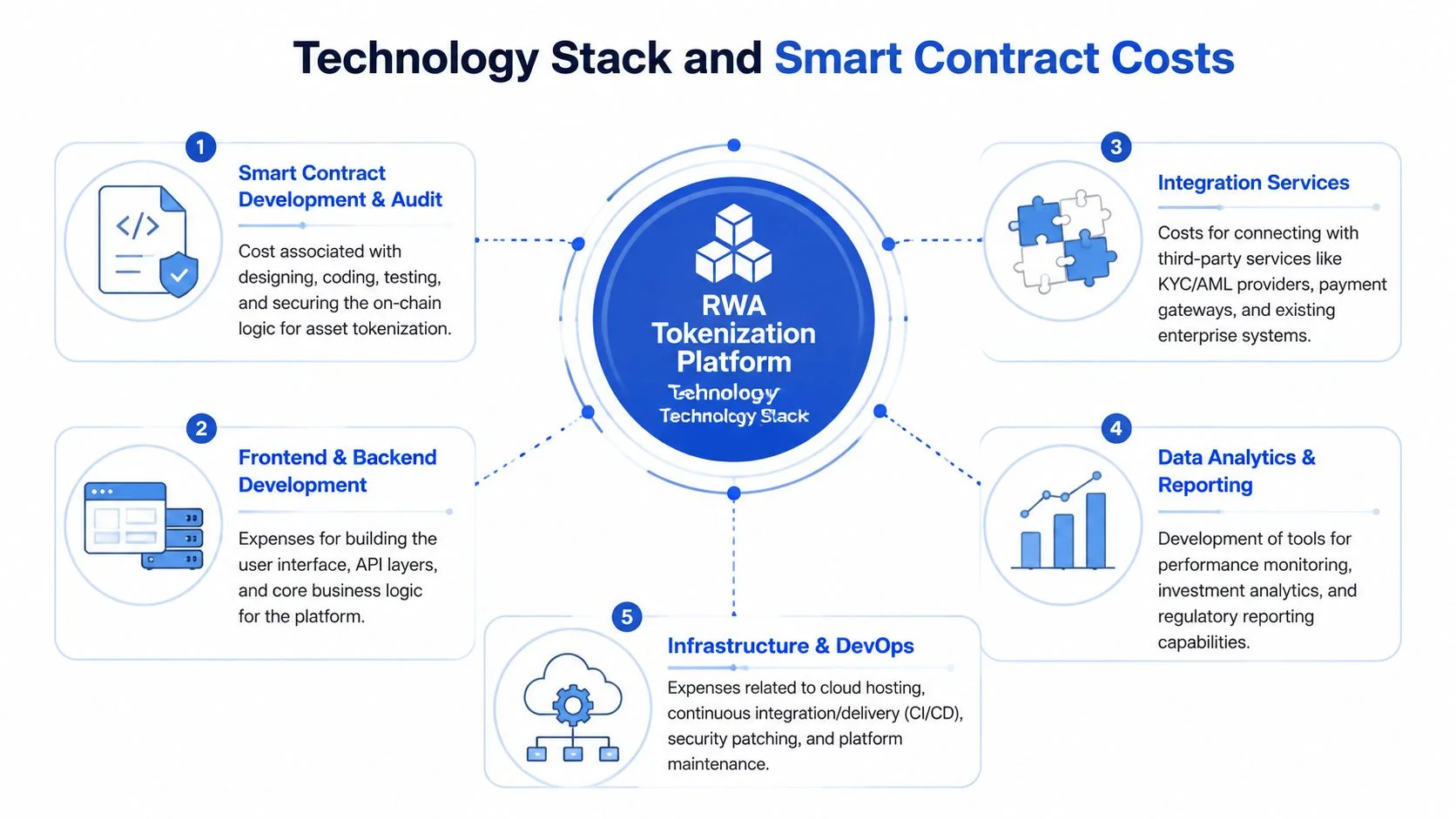
For a real RWA platform, the token is one layer in a larger operating system that has to coordinate legal terms, investor state, payment events, approvals, and reporting. That is where total cost of ownership starts to separate from the headline build estimate. A team can ship a basic contract quickly. Running an issuance program with controlled transfers, reconciled records, and predictable upgrade paths is a different cost profile.
The stack usually includes a web application for issuers and investors, backend services for workflow orchestration, integrations for KYC and payments, data services for reporting, and smart contracts that enforce issuance and transfer policy. The expensive work sits in the dependencies between those layers. If onboarding depends on sanctions screening, document review, accreditation status, wallet approval, and jurisdiction rules, each transition has to be traceable and recoverable. That design work affects delivery time, testing effort, and post-launch change cost.
Core build elements typically include:
- Smart contracts: Token issuance, mint and burn permissions, transfer restrictions, redemption flows, corporate actions, and upgrade controls.
- Backend services: Eligibility rules, document handling, notifications, orchestration across vendors, and audit logging.
- Frontend surfaces: Issuer dashboard, investor portal, compliance workspace, and support tooling.
- Wallet and custody layer: External wallets, embedded wallet options, custodial operations, or institution-managed key controls.
- Reporting stack: Cap table views, transaction history, subscription tracking, exception reporting, and evidence exports.
Smart contract scope changes the entire estimate because contract design drives application behavior. Once the asset requires whitelist controls, partitioned ownership, payout logic, lockups, or governed upgrades, the contracts stop being a thin technical layer and become part of the product's control framework. I advise CTOs to cost contracts together with admin workflows, reporting, and migration strategy. Otherwise the first major change request usually lands after deployment, when fixes are slower and far more expensive.
Auditability should shape architecture early, not after development. Teams that want a realistic planning baseline should review the cost drivers in a smart contract audit cost breakdown, then use those findings to simplify role design, reduce unnecessary upgrade complexity, and document failure handling before code freezes.
A useful way to frame the trade-offs is side by side:
| Component | Lower-cost approach | Higher-cost, enterprise-ready approach |
|---|---|---|
| Token model | Basic issuance logic | Policy-aware contracts with transfer controls and lifecycle events |
| Wallet experience | External wallet only | Mixed custody model with investor-friendly recovery and approval flows |
| Onboarding | Semi-manual review | Automated KYC orchestration with status sync across systems |
| Admin tooling | Minimal issuer dashboard | Segregated roles, approval chains, and operational controls |
| Reporting | Static exports | Live operational reporting with compliance evidence trails |
The pattern is consistent. Lower upfront scope reduces initial spend, but it often pushes cost into manual operations, exception handling, and later rework.
Blocsys is one provider in this category through its real-world asset tokenization services, alongside other specialist blockchain and fintech development firms. The selection criterion is straightforward. Choose the team that can model regulated asset operations across contracts, workflows, integrations, and future change requests, not a team that only knows how to deploy tokens.
Beyond the Build Ongoing Maintenance and Operational Costs
For enterprise RWA platforms, the budget usually shifts after go live. Build cost is the entry point. Long-term platform economics are shaped by maintenance, compliance change, vendor overhead, and the internal operating team needed to keep the system under control.
As noted earlier, post-launch maintenance and change work can consume a meaningful share of the original implementation budget each year. In practice, that spend is rarely driven by hosting alone. The larger cost sits in coordinated change across contracts, workflows, integrations, controls, and support operations.
A CTO should expect recurring spend across five areas:
- Infrastructure operations: Cloud workloads, blockchain nodes, databases, observability, backup, disaster recovery, and environment management.
- Third-party services: KYC and AML providers, sanctions screening, identity verification, e-signature, document storage, messaging, and analytics tools.
- Application maintenance: Bug fixes, API version updates, dependency patches, regression testing, and release management.
- Control and policy updates: Changes to approval chains, transfer restrictions, exception handling, reporting logic, and audit findings.
- Operational staffing: Support, platform operations, compliance coordination, incident response, and technical ownership for releases.
This is the part many first-time issuers underestimate.
A tokenization platform tied to regulated assets changes more often than a standard internal business application. Jurisdiction rules evolve. Banking or custody partners change integration requirements. Counsel may require revised investor flows or stronger evidence trails. Each of those changes touches more than code. It affects testing, approvals, documentation, and user communications.
The TCO question is not whether upgrades will happen. It is whether the platform was designed so upgrades remain controlled, predictable, and affordable.
Teams with a mature operating model budget for scheduled change windows, release governance, rollback planning, and recurring assurance work from the start. They also separate what can be configured by operations from what requires engineering intervention. That design choice has a direct financial effect. If every policy change requires developers, legal review, full regression testing, and smart contract redeployment, operating cost rises fast.
One practical test helps expose future cost early:
If a routine policy or workflow update triggers legal escalation, contract review, integration retesting, investor communication planning, and emergency engineering support, the platform is too tightly coupled for regulated scale.
Before finalising the business case, answer four operating questions with named owners and documented process:
- Who approves releases across product, legal, compliance, security, and operations?
- Which policy changes are configurable, and which require contract or backend code changes?
- How quickly can the team replace a vendor without breaking onboarding or reporting workflows?
- Can operations resolve common exceptions without opening an engineering ticket?
The difference between a durable platform and an expensive pilot often shows up here. Projects fail less often because the initial build was too small, and more often because the post-launch operating model was never funded properly.
How Blocsys Delivers Enterprise-Grade RWA Tokenization Platforms
The organisations that execute well usually make one decision early. They choose to design the operating model and the architecture together.
Blocsys approaches RWA delivery that way. The work typically starts with asset scope, jurisdiction logic, control requirements, integration mapping, and target operating model. From there, the platform can be structured as modular services instead of a tightly coupled application that becomes costly to change.
For teams that need specialist capacity, hire blockchain developers is one route. For broader execution support, real-world asset tokenization development and hire Web3 developers are relevant service paths depending on whether the immediate need is architecture, delivery, or team extension.
The practical advantage is straightforward. A disciplined build programme reduces rework across compliance logic, wallet orchestration, admin tooling, and reporting. That doesn't make the project cheap. It makes the spend more predictable and the platform more durable.
Frequently Asked Questions About RWA Tokenization Costs
What is an RWA tokenization platform
An RWA tokenization platform is software that turns ownership rights or claims on real-world assets into blockchain-based digital tokens. In practice, it usually includes issuance workflows, investor onboarding, compliance controls, smart contracts, wallets or custody connections, and reporting tools.
How much does it cost to build an RWA tokenization platform in 2026
Verified India-based estimates place MVPs at $15,000 to $40,000, mid-level builds at $40,000 to $80,000, and enterprise-grade platforms above $80,000 to $150,000+ in one model, while another puts compliant modular or mid-scale platforms at $100,000 to $250,000, enterprise builds at $300,000 to $800,000, and high-complexity projects at $1,000,000 to $3,000,000 depending on scope and asset class.
What affects real-world asset tokenization platform development cost most
The biggest cost drivers are asset complexity, compliance depth, smart contract sophistication, integrations, custody model, and operational governance. Jurisdiction matters a lot because regulated issuance requires legal and process design, not just software development.
Which blockchain is best for RWA tokenization
There isn't one best chain for every platform. The right choice depends on privacy requirements, investor access model, ecosystem compatibility, transaction patterns, governance needs, and how much off-chain control your operating model requires.
How long does it take to build an asset tokenization platform
Timelines depend on scope, approval cycles, and integration depth. A limited MVP can move much faster than an enterprise platform that includes compliance automation, custody, audit preparation, and multi-role operational tooling.
What compliance requirements are usually needed
Most platforms need KYC, AML, sanctions screening, investor eligibility controls, transaction restrictions, audit logs, and document workflows. The exact rule set depends on asset type, offering structure, and jurisdiction.
What technologies are commonly used in RWA tokenization platforms
Typical stacks include smart contracts, backend workflow services, web dashboards, identity and onboarding integrations, wallet or custody layers, cloud infrastructure, monitoring tools, and reporting systems.
Why are smart contract audits a separate budget item
Audits test contract logic, edge cases, permissions, and security assumptions independently of the application build. Verified India-based estimates show smart contract audits alone can add $10,000 to $25,000 to the budget.
Are maintenance costs significant after launch
Yes. Verified India-based data indicates annual maintenance, upgrades, and regulatory adaptation can consume 20–30% of the initial build cost per year for compliant platforms. That's why TCO matters more than the first build estimate.
Can AI improve RWA tokenization platforms
Yes, qualitatively. AI can support document review, exception routing, fraud detection, investor support, and compliance operations. It should augment human control functions, not replace them in regulated workflows.
Why do enterprises invest in asset tokenization
They want better control over issuance, transfer restrictions, ownership records, investor operations, and reporting. The strongest business case usually comes from operational efficiency and product flexibility, not hype around token creation alone.
How can Blocsys help with a secure enterprise-grade RWA platform
Blocsys can support architecture planning, smart contract design, workflow engineering, blockchain integration, and delivery resourcing for tokenization systems. The right engagement depends on whether you need strategy, implementation, or team augmentation.
If you're planning a tokenized asset platform and need a realistic view of build cost, compliance scope, architecture trade-offs, and long-term operating model, Blocsys Technologies can help you assess the project before you overcommit budget or under-scope risk. Connect with Blocsys to discuss your asset class, jurisdiction requirements, and platform roadmap, and turn the estimate into an executable plan.