
You’re comparing platforms because a corporate bond tokenisation project has moved beyond a concept deck. Treasury teams, debt-capital-markets desks, banks, asset managers and fintech operators now need to decide which provider can support issuance, investor onboarding, settlement, custody, servicing and eventual trading without confusing a blockchain demonstration with production infrastructure. This guide compares 10 corporate bond tokenisation platforms and institutional digital-securities providers, using documented activity where available and treating India’s SEBI and REC pilot as a practical benchmark for execution in 2026.
The distinction matters. A corporate bond tokenisation platform isn’t a token generator. It’s infrastructure for creating legally meaningful digital debt securities, controlling transfers, recording ownership, moving cash and securities, and administering coupons and redemption. For a broader view of how investors are assessing the category, this tokenisation market outlook for investors provides useful market context, while the comparison below concentrates on issuance evidence and operational design. You can also review the difference between conventional and digital debt structures in this comparison of traditional and tokenised corporate bonds.
Table of Contents
- What Issuers Need from Corporate Bond Tokenization Platforms
- How Corporate Bond Tokenization Works in Practice
- Comparison of the Top 10 Corporate Bond Tokenization Platforms
- Platform Profiles and Real-World Corporate Bond Examples
- Key Features to Evaluate Before Choosing a Platform
- Liquidity, Distribution, and the Hard Problems Tokenization Must Solve
- Choosing the Right Platform and Next Steps with Blocsys
What Issuers Need from Corporate Bond Tokenization Platforms
Issuers evaluating corporate bond tokenisation platforms must verify five operating capabilities: legal issuance controls, investor identity management, settlement integration, bond lifecycle administration and institutional connectivity. The label covers both full-stack providers and specialists supplying smart contracts, investor wallets, compliance controls, settlement or registry services.
A platform earns relevance in capital markets only when its token connects to the enforceable debt structure and the parties that administer it. The issuer needs defined offering terms, investor eligibility rules, transfer restrictions and an ownership record that participants can rely on. It must also connect the digital security with cash settlement, paying agents, trustees, custodians and reporting obligations. A technically polished token without those links remains a demonstration rather than corporate-bond infrastructure. This distinction is also central to the comparison of traditional and tokenised corporate bonds and the broader tokenization market outlook for investors.
India’s pilot sets a production test
India’s SEBI pilot offers a practical benchmark because it treats tokenisation as a regulated market-structure exercise. The stated objectives include simultaneous securities transfer, automated coupon servicing through smart contracts and lower reconciliation costs, with rollout subject to the relevant approvals. Reuters’ reporting on the SEBI tokenised-bond pilot also identifies unresolved questions involving investor scope, onboarding, wallet interoperability and settlement procedures.
The useful question is therefore not which blockchain is fastest. It is whether a provider can operate the complete transaction model:
- Legal and issuance controls, covering offering terms, investor eligibility and transfer restrictions.
- Digital identity and wallet management, with KYC and AML processes linked to security ownership.
- Cash and securities settlement, with reconciliation between relevant ledgers.
- Bond lifecycle administration, including coupon events, redemption, notices and reporting.
- Institutional integration, connecting custodians, trustees, paying agents, exchanges and market infrastructure.
- Secondary-market readiness, while recognising that tokenisation alone does not create liquidity.
This framework separates providers with documented issuance capability from those that mainly market the concept. It also keeps the commercial test in view: a tokenised bond must fit established legal, servicing and distribution relationships, not merely exist on-chain. Corporate bond tokenisation can improve coordination and recordkeeping, but the platform still has to address investor access, transfer rules and the absence of automatic secondary-market demand.
How Corporate Bond Tokenization Works in Practice
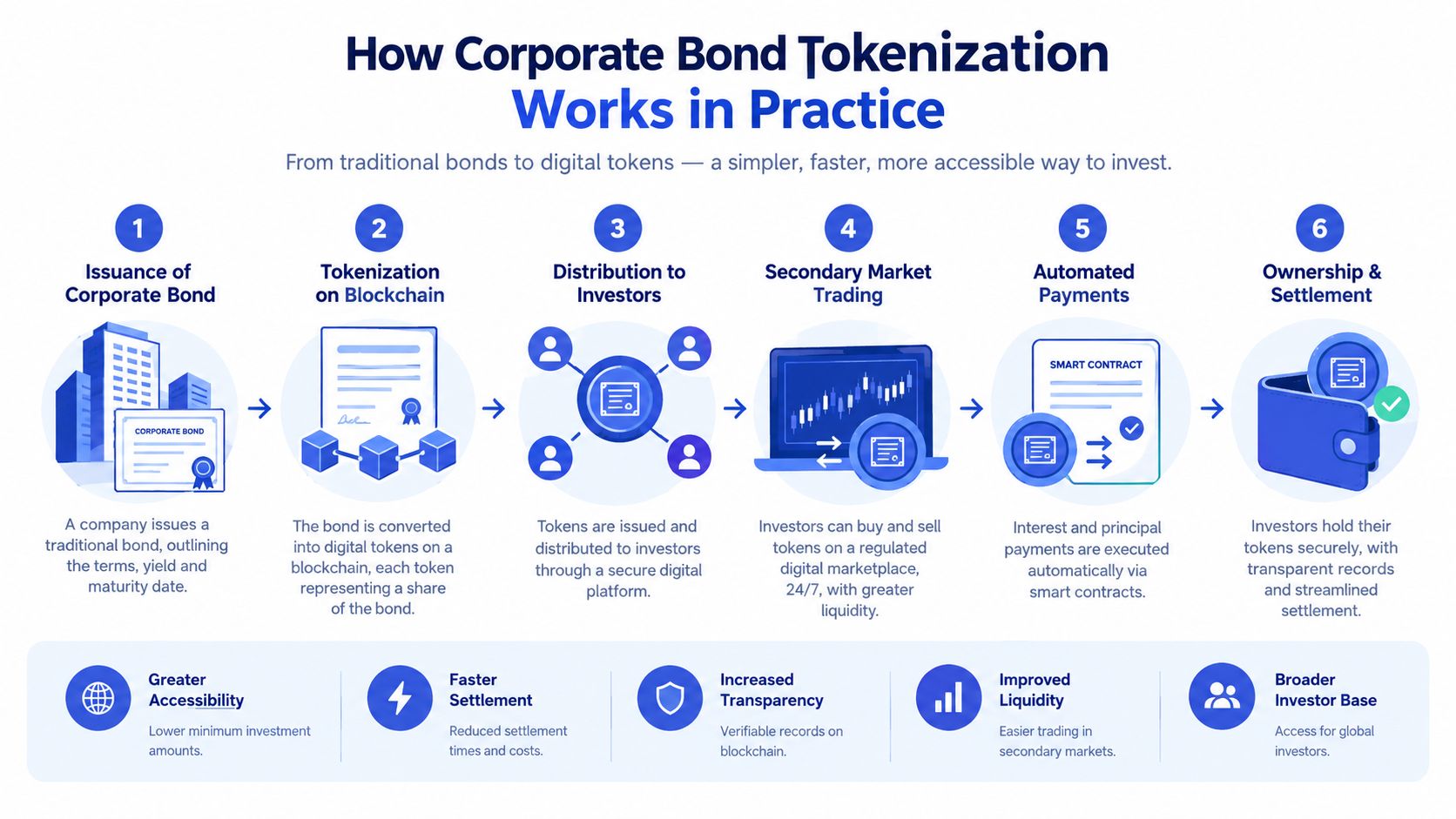
A tokenised corporate bond begins with the same commercial decisions as a conventional bond. The issuer defines principal, maturity, coupon, ranking, security, covenants and investor eligibility. Legal counsel and transaction participants then determine what the token represents, which jurisdiction governs the instrument and how the digital record relates to the enforceable debt obligation.
The technology platform translates those terms into issuance rules. It may deploy a smart contract that controls supply, transfer permissions, coupon events and redemption, while a separate registry, custodian or depository maintains the legally recognised ownership record. The important question is whether the token itself is the authoritative record or whether it mirrors an off-chain record.
The India pilot shows the importance of the cash leg
The planned REC transaction provides a concrete operating reference. Reuters reported that the issue was expected to be under ₹500 crore, about $57 million, with investors using two digital accounts: a bank-issued wholesale CBDC wallet and a new securities wallet called DEMAT 2.0 (Reuters’ REC bond report). The design separates the cash leg, settled through RBI wholesale CBDC rails, from the securities leg, recorded in a DLT-based securities wallet.
That two-ledger model can reduce reconciliation points, but it also makes interoperability central. An investor must be onboarded correctly, linked to the permitted wallet structure and able to receive the security under the applicable transfer rules. The issuer, arranger or merchant banker, trustee, custodian and platform must agree on who controls each operational event.
The lifecycle continues after issuance
After subscription, the platform must support ownership updates, coupon calculations, payment instructions, investor notices and redemption. Smart contracts can automate parts of that lifecycle, but automation doesn’t remove the need for governance, exception handling and legal accountability.
A practical workflow usually includes:
- Structuring and documentation, where the bond terms and token rights are defined.
- Investor onboarding, including KYC, AML checks, eligibility screening and wallet creation.
- Token deployment, with supply, transfer and corporate-action rules configured.
- Primary allocation, where approved investors subscribe and securities are delivered.
- Cash settlement, using bank money, CBDC, stablecoins or another approved rail.
- Servicing and redemption, with payment events reconciled against the ownership register.
A corporate bond tokenisation platform can sit across these workflows by combining digital issuance, smart-contract automation, settlement processes and investor management. The step-by-step guide to tokenising corporate bonds on blockchain is useful when mapping the required components before selecting a vendor.
Comparison of the Top 10 Corporate Bond Tokenization Platforms
The table distinguishes development infrastructure from institutional settlement networks and issuance protocols. A documented digital-bond example is stronger evidence than a general tokenisation claim, but it still doesn’t prove that every feature is available in every jurisdiction.
Top 10 Corporate Bond Tokenization Platforms Compared
| Platform | Type | Blockchain Infrastructure | Regulatory Standing | Institutional Focus | Verified Corporate Bond Example |
|---|---|---|---|---|---|
| Blocsys | Corporate bond tokenisation platform development company | Not publicly specified | Technology provider. Specific authorisations depend on the deployment | Banks, financial institutions and capital-markets organisations | Corporate bond tokenisation infrastructure offering. Specific client issuance not publicly specified |
| Onyx by JPMorgan | Institutional blockchain and digital-assets infrastructure | Not publicly specified in the supplied evidence | Institutional infrastructure. Specific regulatory status depends on the product and jurisdiction | Banks, institutional investors and collateral users | Money-market-fund pilots and tokenised collateral use cases. Corporate bond example not publicly specified |
| Goldman Sachs GS DAP | Institutional digital-asset platform | Not publicly specified in the supplied evidence | Product and transaction status depends on jurisdiction | Institutional issuance and structured products | GSOL and structured-product activity. Corporate bond detail not publicly specified |
| HQLAx | Securities-lending and collateral-mobility infrastructure | Distributed-ledger infrastructure. Network details not publicly specified here | Specific permissions depend on participating institutions and jurisdictions | Banks, custodians and securities-finance participants | Institutional collateral and securities-lending use cases. Corporate bond issuance not publicly specified |
| SETL | Enterprise settlement and digital-securities infrastructure | Distributed-ledger infrastructure | Specific regulatory status depends on deployment | Market infrastructure and institutional settlement | openCORP and settlement infrastructure activity. Corporate bond issuance detail not publicly specified |
| IBM Blockchain and Hyperledger stacks | Enterprise blockchain infrastructure | Hyperledger-based enterprise stacks | Technology layer, not a blanket securities authorisation | Financial institutions and enterprise consortia | Bond pilots. Issuer and transaction details vary by deployment |
| Polymesh | Permissioned chain for regulated digital securities | Polymesh blockchain | Network design addresses regulated securities workflows. User authorisation remains jurisdiction-specific | Issuers, financial institutions and tokenisation providers | Digital-securities activity involving MAS-licensed entities. Corporate bond detail not publicly specified |
| Securitize | Digital-securities issuance, transfer and servicing platform | Network varies by product and deployment | Regulatory status is product and jurisdiction-specific | Institutions, funds and digital-securities issuers | Tokenised securities and debt-related infrastructure. Specific corporate bond example not publicly specified |
| Tokeny | Digital-securities issuance and compliance infrastructure | T-REISE protocol and supported networks | Compliance tooling does not itself establish issuer authorisation | Institutions and regulated digital-asset issuers | Permissioned bond-token infrastructure. Specific corporate bond issuance not publicly specified |
| Obligate | On-chain corporate debt issuance protocol | Blockchain infrastructure not specified in the supplied evidence | Market access and legal structure depend on jurisdiction and transaction | Corporate issuers, investors and underwriters | Keyrock issued a tokenised corporate bond through Obligate, with Sygnum as distribution partner, in 2026 |
This ranking is not a claim about market share or transaction volume. It’s a relevance list for teams comparing digital bond platforms, enterprise DLT infrastructure and actual corporate debt workflows. A wider regional view of tokenisation providers is available in this overview of tokenisation companies in Europe.
Platform Profiles and Real-World Corporate Bond Examples
1. Blocsys
Blocsys is positioned here as a corporate bond tokenisation platform development company, rather than as a securities exchange or issuer. Its stated scope covers blockchain-powered infrastructure for issuing, trading and managing tokenised corporate bonds, alongside smart-contract automation and investor management for financial institutions and capital-markets users.
That role matters for organisations that already understand their transaction model but need the technology built around it. Relevant workstreams include issuance engines, compliance workflows, transfer controls, bond lifecycle management, APIs and integrations with institutional systems. The supplied public positioning doesn’t specify a named corporate bond issuance, so buyers should evaluate Blocsys on architecture, delivery methodology, integration capability and the legal operating model of the proposed deployment.
2. Onyx by JPMorgan
Onyx by JPMorgan represents institutional blockchain infrastructure connected to bank and capital-markets workflows. Its documented areas include money-market-fund pilots and tokenised collateral use cases, which are relevant because corporate bonds require more than primary issuance. They must also interact with collateral, funding and settlement processes.
The platform’s relevance is strongest for institutions assessing how distributed ledgers could connect cash, collateral and securities operations. The supplied evidence doesn’t establish a specific corporate bond issue or a universal regulatory status, so procurement teams should examine the exact product, participants and jurisdiction rather than treating the Onyx brand as a blanket authorisation.
3. Goldman Sachs GS DAP
Goldman Sachs’ GS DAP is an institutional digital-asset platform associated with GSOL and structured-product activity. Its significance lies in the connection between digital securities infrastructure and a major investment-bank operating environment.
For a bond issuer, the key diligence question is whether the relevant deployment supports the desired instrument, investor base, settlement asset and jurisdiction. The available evidence doesn’t specify a named corporate bond transaction, so GS DAP belongs in a shortlist for institutional infrastructure evaluation, not in a transaction track-record claim beyond its documented digital-asset activity.
4. HQLAx
HQLAx focuses on securities lending and collateral mobility. That’s adjacent to corporate bond tokenisation, but strategically important. A tokenised bond that cannot move efficiently through collateral and financing workflows may deliver limited value beyond the primary issuance.
HQLAx should therefore be assessed as a market-infrastructure layer rather than a conventional corporate bond issuance platform. Its relevance is the institutional movement and reuse of securities, while the supplied evidence doesn’t document a specific corporate bond issuance or identify a particular blockchain network.
5. SETL
SETL provides enterprise settlement and digital-securities infrastructure, including the openCORP initiative referenced in the supplied evidence. Its role is closer to market plumbing than to a retail tokenisation interface.
For banks and market infrastructures, SETL’s value proposition is the ability to model issuance and settlement processes within enterprise DLT systems. The available evidence doesn’t provide a named corporate bond transaction, so an evaluation should focus on integration, governance, finality, reconciliation and the division of responsibilities between the platform and regulated intermediaries.
6. IBM Blockchain and Hyperledger stacks
IBM Blockchain and Hyperledger-based enterprise stacks provide configurable distributed-ledger infrastructure used in bond pilots and institutional experiments. They’re not, by themselves, a complete corporate bond product. The issuer or implementation partner still needs to design legal ownership, investor onboarding, token controls, settlement and servicing.
This category is useful for enterprises that want control over deployment architecture or need to integrate DLT with existing systems. It also carries a responsibility that hosted platforms may absorb more directly, including network governance, node operations, access policies and application support.
7. Polymesh
Polymesh is designed as a permissioned blockchain for regulated digital securities. Its institutional relevance comes from identity-aware transfers and a network model intended for securities rather than unrestricted token movement.
The supplied evidence connects Polymesh activity with entities holding MAS licences, but that association doesn’t automatically authorise every issuer or transaction. A corporate bond deployment still needs its own legal analysis, offering restrictions, custody arrangements and investor controls. The chain can support the technical design, while regulated participants remain accountable for the transaction.
8. Securitize
Securitize provides digital-securities issuance, transfer and servicing infrastructure. Its relevance extends beyond token creation because institutional securities need cap-table or register management, transfer administration, investor access controls and ongoing servicing.
The platform belongs on a corporate debt shortlist where the issuer needs an established digital-securities operating model. However, the supplied evidence doesn’t identify a specific corporate bond issue, so buyers should request transaction-level evidence, applicable permissions and details of how debt instruments are administered from issuance through redemption.
9. Tokeny
Tokeny’s T-REISE protocol addresses permissioned digital securities and compliance-aware issuance. That makes it relevant to bond structures where not every wallet can receive or transfer a token and where investor identity must remain connected to ownership rights.
Tokeny is best evaluated as a protocol and infrastructure component within a larger transaction stack. The protocol can encode transfer logic, but legal enforceability, custody, settlement assets and local regulatory obligations still depend on the transaction design and participating institutions.
10. Obligate
Obligate is the clearest example in this list of an on-chain corporate debt protocol. The supplied evidence records that Keyrock issued a tokenised corporate bond through Obligate with Sygnum as distribution partner in 2026. That relationship demonstrates a practical division of labour, with the protocol supporting issuance and debt workflows while a financial institution contributes to distribution.
The example is more informative than a generic platform announcement because it shows the importance of connecting an issuer, an issuance venue and a distribution partner. It also reinforces a central limitation. A completed primary transaction doesn’t automatically prove deep secondary liquidity, broad investor access or universal regulatory portability.
Key Features to Evaluate Before Choosing a Platform
A vendor presentation can make every platform appear similar. A procurement process should force each provider to show how its product behaves under the specific legal, operational and settlement conditions of the proposed bond.
Start with the security and identity model
Ask whether the token standard supports permissioned transfers, verified wallets, investor whitelists and jurisdiction-specific eligibility. KYC and AML should connect to the transfer logic, rather than sitting in a separate manual process that can drift away from the ownership register.
Check how the platform handles:
- Investor onboarding, including identity verification, eligibility and beneficial-owner records.
- Transfer restrictions, such as jurisdiction, investor type and holding limitations.
- Corporate actions, including coupon calculation, notices, redemption and exception management.
- Digital custody, including wallet recovery, key control and institutional approval policies.
An explanation of permissioned token architecture, including the ERC-3643 token standard, can help technical and compliance teams use the same vocabulary during vendor discussions.
Test the settlement and integration design
A platform should show precisely how the cash leg and securities leg interact. Ask whether it supports bank money, CBDC, stablecoins or another approved settlement asset, and whether the design creates a single atomic transaction or a controlled sequence with reconciliation.
Then map the surrounding systems. The bond workflow may need connections to a custodian, trustee, paying agent, transfer agent, central securities depository, exchange, order-management system and regulatory reporting process. A blockchain network is only one component of that operating chain.
Separate evidence from positioning
Request transaction documentation, participant roles, production status, supported jurisdictions and post-issuance servicing records. Treat an announced pilot differently from a completed issuance, and treat a technology capability differently from a regulatory authorisation.
Practical rule: Require the provider to demonstrate one complete lifecycle event, not only token creation. Coupon processing, restricted transfer, investor reporting and redemption reveal more about production readiness than a minting screen.
Liquidity, Distribution, and the Hard Problems Tokenization Must Solve
The SEBI and REC pilot exposes the harder question in corporate bond tokenisation. Its design uses a wholesale CBDC wallet and a securities wallet, with an initial three-month lock-in and exchange-based secondary trading expected by December 2026, according to the supplied Reuters evidence. The structure tests issuance and settlement under controlled conditions. It does not establish that investors will trade actively, dealers will make markets, or institutions will accept the token as collateral.
India’s outstanding corporate bond market is around $0.56 trillion as of March 2024, or about 22% of GDP (NITI Aayog market material). Its distribution remains less developed than the government bond market. Tokenisation can improve records, settlement and servicing workflows, but it cannot create investor demand or secondary-market depth.
Distribution must be designed separately
A platform assessment should identify:
- Who underwrites and distributes the bond?
- Which investors may hold and transfer it?
- Can custodians connect their existing systems?
- Will repo venues and counterparties recognise the instrument?
- How will pricing, benchmarks and secondary-market quotations work?
- Can the token operate across borders under existing documentation?
The digital architecture may improve while commercial distribution stays unchanged. Real issuance evidence therefore matters more than a token creation demonstration. The strongest examples connect the issuance platform to an arranger, bank, custodian or distribution partner. Keyrock’s transaction through Obligate, with Sygnum involved in distribution, illustrates that institutional connection more clearly than a standalone token launch.
Liquidity also depends on operational recognition. Custody, collateral eligibility, transfer restrictions, pricing data and investor reporting must fit existing workflows. If each participant needs a separate process, the token can add compliance work instead of reducing it.
The unresolved issue is whether surrounding institutions can make the bond investable, financeable and transferable at scale. Settlement efficiency is only one part of that outcome.
Choosing the Right Platform and Next Steps with Blocsys
The right provider depends on the gap you need to close. An issuer with an existing regulated issuance process may need integration and lifecycle software. A bank may need permissioned wallets, settlement connectivity and institutional APIs. An exchange may prioritise transfer controls, investor eligibility and secondary-market interfaces.
Use a staged decision process:
- Define the instrument, investor population, jurisdiction and settlement asset.
- Select the infrastructure model, whether a hosted platform, protocol, enterprise DLT stack or custom build.
- Map legal ownership, custody, trustee responsibilities and the authoritative register.
- Configure onboarding and transfer controls, then test restricted and exception scenarios.
- Run a controlled issuance, with servicing and redemption included in the acceptance criteria.
- Plan liquidity separately, including distribution, market-making and institutional connectivity.
Blocsys fits the custom-build and integration side of this decision. Its stated corporate bond offering covers digital issuance, smart-contract automation, faster settlement workflows and investor management for banks, financial institutions and capital-markets organisations. The company can also be assessed as an engineering partner for issuance modules, compliance tooling, lifecycle management and integrations around selected blockchain infrastructure. Its approach to assembling enterprise engineering capability is outlined in Blocsys’ dedicated blockchain development team model.
The most defensible shortlist combines evidence with architecture. Ask each provider to show a legally supportable bond structure, an investor-control model, a settlement sequence, a complete servicing workflow and a path to secondary-market participation. That process will usually remove platforms that only demonstrate token creation, while preserving options for institutions that need a customized digital-securities operating model.
Frequently Asked Questions
1. What is a corporate bond tokenization platform?
A corporate bond tokenization platform is a digital infrastructure solution that represents corporate debt securities as blockchain-based tokens. It can support bond issuance, investor onboarding, ownership management, transfers, settlement, coupon payments, redemption, and reporting.
2. How does corporate bond tokenization work?
Corporate bond tokenization starts by defining the bond’s financial and legal terms, including principal, maturity, coupon, investor eligibility, and transfer conditions. These rules can then be represented through smart contracts and connected with investor wallets, settlement systems, custody infrastructure, and ownership records.
3. What features should a corporate bond tokenization platform have?
Key features can include digital bond issuance, investor onboarding, KYC and AML integration, permissioned token transfers, smart contract automation, wallet management, settlement integration, coupon and redemption management, ownership tracking, reporting, and institutional APIs.
4. What are the benefits of tokenizing corporate bonds?
Tokenization can help streamline issuance and settlement, improve ownership tracking, automate parts of bond servicing, reduce reconciliation requirements, and create programmable transfer and compliance rules. It can also provide a common digital infrastructure for issuers, investors, custodians, and other participants.
5. How are smart contracts used in corporate bond tokenization?
Smart contracts can automate predefined bond lifecycle events such as token issuance, investor eligibility checks, transfers, coupon calculations, payment instructions, and redemption. They can also enforce restrictions on who can receive or transfer a token.
6. How does a tokenized corporate bond handle investor eligibility?
A tokenized bond platform can connect investor identity and KYC information with wallet addresses and transfer permissions. This allows the platform to restrict ownership or transfers based on factors such as investor type, jurisdiction, eligibility requirements, and holding limits.
7. What role does settlement play in corporate bond tokenization?
Settlement connects the transfer of the digital bond with the corresponding movement of cash or another approved settlement asset. A well-designed platform needs to coordinate both sides of the transaction and provide mechanisms for reconciliation, exceptions, and transaction confirmation.
8. Can tokenized corporate bonds support coupon payments and redemption?
Yes. Smart contracts and supporting financial infrastructure can automate parts of coupon servicing and redemption. The platform can identify eligible holders, calculate applicable payments, generate payment instructions, and update ownership or redemption records after the event.
9. What is the difference between a corporate bond tokenization platform and a blockchain network?
A blockchain network provides the underlying distributed-ledger infrastructure, while a corporate bond tokenization platform provides the application and financial workflows built around that infrastructure. A complete platform may include issuance, compliance, investor management, custody, settlement, servicing, and reporting components.
10. Can tokenized corporate bonds be traded on secondary markets?
Yes, tokenized bonds can be designed for secondary-market transfers where the applicable legal and regulatory framework permits them. However, tokenization itself does not guarantee liquidity. Investor participation, distribution channels, custody, transfer permissions, market infrastructure, and availability of buyers and sellers also influence secondary-market activity.
11. What should financial institutions consider when choosing a corporate bond tokenization platform?
Financial institutions should evaluate the platform’s security model, investor identity controls, transfer restrictions, smart contract architecture, settlement capabilities, custody integrations, bond lifecycle management, regulatory requirements, interoperability, institutional APIs, and ability to integrate with existing capital-market infrastructure.
12. Can Blocsys help businesses build a corporate bond tokenization platform?
Yes. Blocsys can support the development of customized corporate bond tokenization infrastructure, including digital issuance, smart contract automation, investor management, compliance workflows, transfer controls, bond lifecycle management, settlement integrations, and institutional APIs. The final architecture can be tailored to the issuer’s business model, target investors, jurisdiction, and required financial infrastructure.
Blocsys Technologies develops corporate bond tokenisation infrastructure for digital issuance, smart-contract automation, investor management and settlement workflows. Visit Blocsys Technologies to discuss the architecture, integrations and delivery plan for a production-ready tokenised debt platform.
