
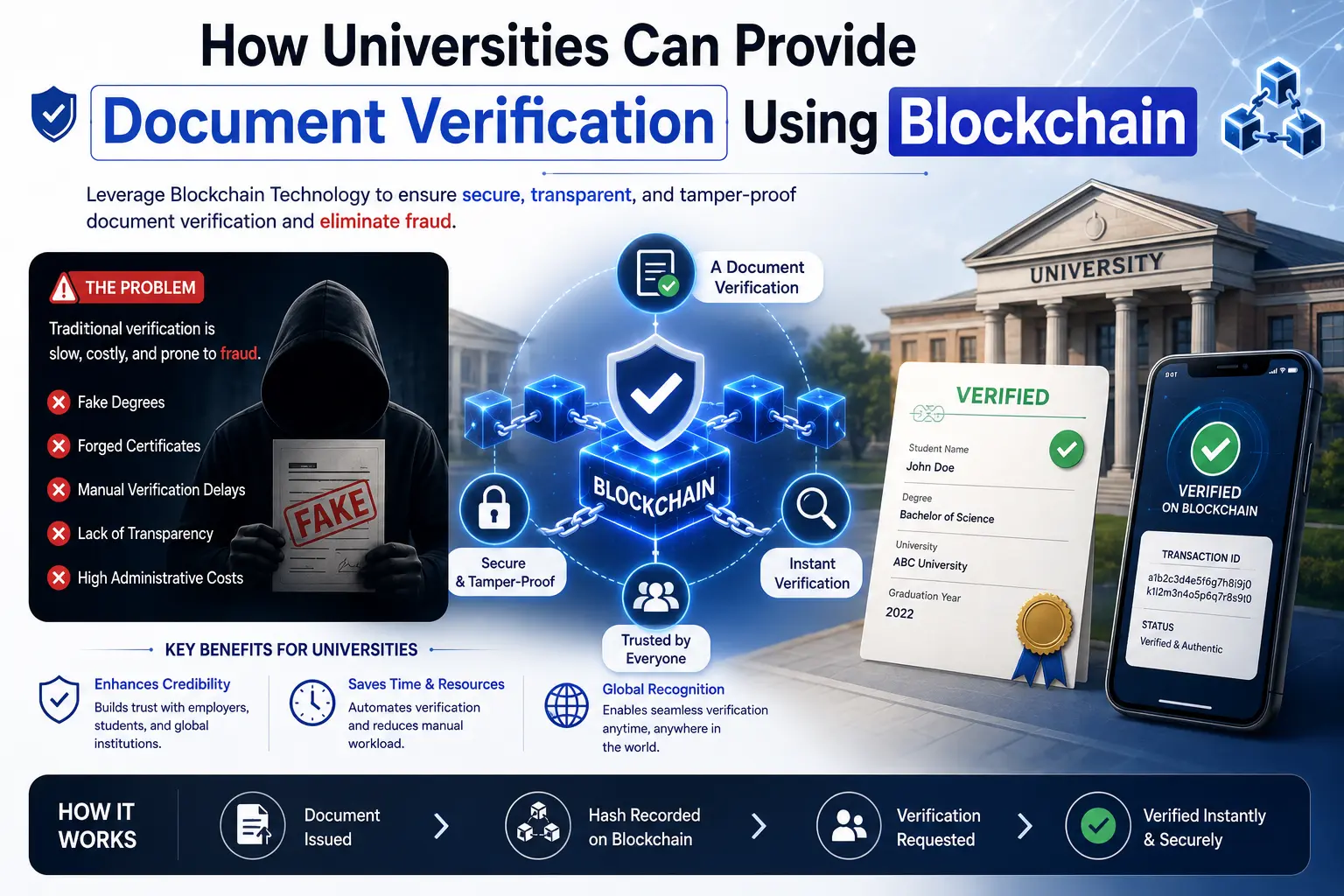
How Universities Can Provide Document Verification Using Blockchain
Blockchain academic verification is transforming how universities issue, share, and protect academic records. A registrar approves a degree. An HR team waits days for a response. A student follows up twice. Meanwhile, fraudulent credentials circulate freely. This broken workflow still defines verification at far too many institutions. However, universities that adopt blockchain academic verification can eliminate manual delays, reduce fraud risk, and give every graduate a credential that verifiers trust instantly.
The Rising Tide of Academic Fraud and Why It Demands Action
The most common failure in academic verification is ordinary, not dramatic. An employer receives a polished certificate and a transcript PDF. The only way to confirm authenticity is to contact the issuing institution and wait.
That model creates uncertainty for everyone involved. HR teams cannot confidently onboard someone with unverified qualifications. Universities do not want forged credentials circulating under their name. Government departments and licensing bodies need assurance that a submitted document is authentic, current, and unchanged.
This pressure is global. Universities in the US, UK, UAE, Singapore, Australia, Canada, and India all face the same underlying issue. Credentials move faster than verification offices do. Students apply across borders. Employers hire remotely. The older the process, the more fragile it becomes.
Industry insight: “If verification depends on a person manually checking an inbox, the system will fail under scale. Blockchain changes the operating model by making authenticity self-evident rather than institution-dependent.”
Therefore, blockchain-based verification changes the operating model entirely. Instead of asking the university to reconfirm a document every time, the institution publishes a tamper-evident proof of issuance. A verifier can then validate authenticity against that proof without depending on repeated back-office intervention.
For institutional leaders, that matters because the business case is bigger than fraud prevention. It affects brand trust, service quality, auditability, and staff workload. For IT teams, it creates a path toward secure digital verification that sits alongside existing systems rather than replacing everything at once.
Why Traditional Certificate Verification Systems Are Failing
Traditional certificate verification still relies on email, PDFs, paper records, and siloed databases. Those methods worked when verification volumes were lower and most checks happened locally. However, they break down when universities need to support digital-first, cross-border, always-on verification.
Manual Verification Does Not Scale
A blockchain-based system can reduce verification from days to seconds. Verifiers check a credential hash or QR code against a shared ledger instead of emailing registrars. This approach lowers administrative overhead and eliminates manual follow-ups at scale.
That difference changes the economics of verification. Staff stop spending time answering repetitive authenticity requests. Employers and partner institutions stop waiting in queues. Additionally, students stop carrying the burden of chasing confirmation from an issuing office.
A second issue is inconsistency. Some universities verify by email. Some use downloadable PDFs. Some rely on sealed documents. The result is a fragmented trust experience that no external verifier can navigate confidently.
Forgery Thrives in Fragmented Systems
Forgery happens when a verifier cannot easily distinguish a legitimate record from a manipulated one. Static PDFs, edited scans, and unaudited digital copies are all vulnerable once they leave the university’s direct control.
Three practical problems surface again and again:
- Administrative dependency: Every verification request returns to the registrar or records office.
- Weak tamper evidence: A visual document can look authentic even after unauthorised edits.
- Poor cross-border usability: External verifiers often do not know which portal, office, or process to trust.
Universities do not just need digital certificates. They need secure educational documents on blockchain — credentials that remain trustworthy after they leave the university’s own systems entirely.
What Is Blockchain Academic Verification and How It Works
Blockchain academic verification uses cryptographic technology to create a permanent, tamper-evident record of every credential a university issues. Think of it as a digital notary system. The university issues a credential, generates a unique cryptographic fingerprint, and records that fingerprint on a blockchain. If anyone later changes even a single character, the fingerprint no longer matches. The mismatch immediately exposes tampering.
Furthermore, the blockchain acts as a shared proof layer. No single party controls it. No one can alter a recorded proof without every participant in the network detecting the change. This makes blockchain diploma verification fundamentally more resilient than any centralised database or paper archive.
The Technical Architecture in Plain Terms
The practical architecture is well established. A university hashes each issued credential, anchors only the hash plus issuer and student identifiers on-chain, and stores the full certificate off-chain. This approach reduces on-chain storage cost and improves scalability considerably.
A working issuance flow looks like this:
- The university issues a credential from its registrar or SIS-driven workflow.
- A cryptographic hash generates from the final document.
- The hash and minimal identifiers write to the blockchain as proof of issuance.
- The full certificate stores off-chain in a content-addressed repository such as IPFS.
- A verifier checks the presented document by matching it against the on-chain proof.
Additionally, tamper-proof digital certificates for academic and employee verification demonstrate clearly why on-chain proof plus off-chain storage outperforms attempts to place entire documents directly on the blockchain.
Where Smart Contracts Add Real Value
Smart contracts automate verification rules without human intervention. In a university verification system, smart contracts handle issuance logic, issuer authorisation, credential status checks, and revocation workflows. They enforce that only approved institutional wallets issue new credentials.
However, smart contracts should not replace core academic governance. Degree conferral, corrections, appeals, and transcript generation still need institutional systems of record. Blockchain verifies outcomes. It does not replace the policy decisions behind them.
A strong implementation keeps these boundaries clear:
- SIS and registrar systems remain the source of truth for academic events.
- Blockchain stores tamper-evident proof and status references.
- Verification services present a usable interface for employers, agencies, and partner institutions.
Benefits of Blockchain Verification for Universities, Students, and Employers
The strongest case for digital credential verification covers all stakeholders, not just the institution. Each group gains distinct, measurable advantages.
Benefits for Universities
Universities gain significant operational efficiency immediately. Staff stop handling repetitive verification requests. Registrar teams focus on higher-value work instead of answering the same email repeatedly. Furthermore, universities protect their institutional brand by making forged credentials instantly detectable.
Blockchain also gives institutions scalable trust infrastructure. Once the system handles graduation certificates, the same capability supports transcripts, micro-credentials, and continuing education records. Therefore, the initial investment pays dividends across multiple academic workflows over time.
Benefits for Students
For students, the biggest improvement is portability. A graduate presents a trusted credential without needing the issuing office to intervene. Digital credential verification via QR code works globally, making it especially valuable for students applying to international employers or postgraduate programmes.
Additionally, students gain direct control over their own records. They share credentials on demand without waiting for an office response. This independence reduces frustration and speeds up every application or hiring process they enter.
Benefits for Employers and Institutions
HR teams want a faster route to confidence. A verifiable digital credential lets them validate authenticity directly and move hiring forward without uncertainty. Employers no longer send emails and wait days for a registrar to respond.
Public agencies and licensing bodies gain the same advantage. When a professional qualification depends on an academic document, the agency trusts both the issuer and the document integrity simultaneously. Moreover, combining AI and blockchain to detect fake documents in real time adds an additional layer, flagging anomalies that pure hash-checking alone might miss.
Blockchain Verification vs. Traditional Credential Verification: A Direct Comparison
University leaders adopt a new verification model because the current model creates avoidable cost, delay, and institutional risk. The comparison below focuses on operating reality rather than technical jargon.
| Metric | Traditional System | Blockchain-Based System |
|---|---|---|
| Verification speed | Days — depends on registrar email response | Seconds — near real-time hash check |
| Administrative effort | High manual handling by records staff | Lower ongoing effort after initial setup |
| Fraud resistance | Relies on visual checks and institutional response | Cryptographic matching detects any tampering instantly |
| External verifier access | Limited to business hours and institution-specific portals | Available 24/7 for remote verification anywhere globally |
| Scalability | Difficult at high volume | Suited to repeatable, high-volume checks efficiently |
| Auditability | Fragmented across inboxes and manual logs | Consistent proof trail recorded on the blockchain |
| Student experience | Students chase the institution for confirmation | Students present credentials with instant independent verification |
The key difference is repeatability. Traditional systems can verify a credential. However, they cannot do it consistently, elegantly, or at institutional scale. Moreover, a blockchain-based system becomes more valuable over time as more credential types move onto the same trust layer.
Real-World Use Cases: Education, HR, and Government
The strongest blockchain verification projects succeed because they solve problems for more than one stakeholder. Universities issue the records. Students carry them. Employers assess them. Regulators and public agencies rely on them. Therefore, a well-designed system serves everyone in that chain simultaneously.
Students and Admissions Teams
Transfer applications, postgraduate admissions, and international academic mobility all become easier when credentials validate from a proof record rather than through manual reprocessing. A QR code attached to every credential lets a verifier scan, retrieve the on-chain entry, and compare it with the presented document in real time.
That QR-driven model is especially valuable when the verifier sits outside the issuing country’s institutional network. A hiring team in Dubai or Singapore does not need to understand the university’s internal systems. They need a reliable check they can perform quickly and independently, without specialist knowledge of blockchain technology.
Employers, Regulators, and Public Agencies
HR teams validate credentials directly and move hiring forward with less uncertainty. Three ecosystem use cases stand out particularly:
- Employer screening: Hiring teams validate university degree verification blockchain records without waiting on back-office correspondence.
- Inter-university exchange: Receiving institutions review student credentials with less friction during transfers or advanced admissions.
- Regulatory verification: Government or licensing authorities confirm that an academic record was issued by the right institution and has not been altered.
Furthermore, universities that adopt tamper-proof academic credentials position themselves as preferred partners for international collaborations, employer partnerships, and government accreditation schemes globally.
Step-by-Step Implementation Guide for Universities
Most blockchain articles stop too early. They explain immutability, show a credential diagram, and assume implementation is straightforward. It is not. The hard part is making the system work inside a real university — with existing SIS platforms, governance structures, and compliance obligations already in place.
Step 1: Map Your Existing Workflows First
Start with the operational map, not the blockchain selection. Teams often begin by debating public versus private chains. That discussion matters, but it should not come first. Ask these questions before choosing infrastructure:
- Which system triggers issuance — SIS, registrar platform, or a dedicated credential engine?
- What data fields define the credential — student identifier, programme, award status, issue date?
- Who approves final issuance — automated workflow, registrar sign-off, or a hybrid process?
- What happens when a record needs correction — replacement, revocation, or both?
If those decisions remain undocumented, the blockchain layer will only reproduce existing confusion in a new format. Therefore, document every workflow decision before touching infrastructure.
Step 2: Define Governance Before Go-Live
Governance determines whether the platform remains trustworthy after launch. Universities need clear ownership of each area shown below:
| Governance Area | Key Questions to Settle |
|---|---|
| Issuer authority | Which department or system may issue records |
| Key management | Who controls signing keys and handles rotation |
| Revocation policy | How cancelled or replaced credentials are marked |
| Support operations | Who resolves verifier disputes and student issues |
| Consortium rules | Who defines standards when multiple institutions participate |
Many projects stall at this stage. The technology is workable, but no one has agreed who owns exceptions. Additionally, digital proof of document integrity is a critical concept to understand early. It clarifies what must remain immutable, what can change, and how verifiers interpret credential status over time.
Step 3: Address Compliance and Privacy Requirements
Universities in Europe, the UK, North America, the Gulf, and Asia all face different compliance conditions. However, the same architectural principle applies everywhere. Put only what is necessary on-chain. Keep personal data exposure to a minimum. Design for revocation, audit, and lawful record handling from day one.
A sensible implementation checklist includes:
- Data minimisation: Record only proof elements and essential identifiers needed for verification.
- Privacy review: Confirm on-chain and off-chain components align with institutional data-handling policies.
- Business continuity: Ensure the verification service continues if a vendor changes or a system migrates.
- User adoption: Train registrar staff and admissions teams so they understand what each credential shows and how it verifies.
- Interoperability planning: Plan how the system may later connect with national education stacks or digital identity layers.
Step 4: Start Narrow, Then Scale
The strongest rollout pattern is always phased. Start with a narrow credential class such as graduation certificates or completion records. Stabilise the workflow thoroughly. Then expand to transcripts or additional academic documents. Moreover, smart contracts that automate secure document authentication can enforce issuance rules at the system level, reducing reliance on manual controls as volume scales upward.
Cost, Scalability, and Integration Considerations
Cost is a genuine concern for universities evaluating blockchain verification. However, the total cost of ownership often favours blockchain when measured against long-term registrar labour, fraud remediation, and reputational risk combined.
Key cost drivers include:
- Platform setup and SIS integration: The largest upfront investment. Complexity depends on the existing SIS and workflow architecture.
- On-chain transaction fees: Minimal when the design stores only hashes rather than full documents on-chain.
- Ongoing maintenance: Lower than traditional systems because fewer manual touchpoints exist at scale.
- Staff training: A one-time investment that reduces long-term support overhead significantly over time.
Scalability improves dramatically with the hash-plus-IPFS architecture. Therefore, transaction costs remain low even as credential volumes grow. A university issuing thousands of degrees annually does not face proportionally higher blockchain costs, because only compact proof data writes to the chain itself.
Integration is where most projects encounter real complexity. The verification layer needs connectors into the SIS, registrar approval logic, document generation workflows, and identity checks for authorised staff. Additionally, institutions operating across multiple campuses may need to map credentials to national identity frameworks or ministry reporting requirements.
Building Your Verification System with Blocsys
A registrar approves a degree. The Student Information System stores the record. An employer scans a QR code six months later and expects an instant, trustworthy answer. That verification chain only works when a university connects policy, systems, and controls all the way from issuance to validation consistently.
Blocsys Technologies works specifically in this part of the stack. For universities, the practical value is not a branded verification page. It is the system design behind it — how proof writes on-chain, how the credential payload stays off-chain, how issuer permissions are controlled, and how the verification result stays consistent across web portals, PDFs, and mobile scans.
Furthermore, universities need more than blockchain connectivity. They need connectors into the SIS, registrar approval logic, document generation workflows, and identity checks for authorised staff. Institutions operating across multiple campuses or jurisdictions may also need to map credentials to national identity frameworks or ministry reporting requirements.
A credible implementation partner answers practical questions before procurement completes. How will the platform read from the current SIS without disrupting term-end operations? What happens when a registrar corrects a name or confers a replacement award? How does the verification service continue if the university changes document templates or cloud providers?
Those details drive adoption and ROI. If staff need workarounds, issuance slows down. If verifiers receive ambiguous results, trust falls back to manual email checks. Therefore, for universities, edtech providers, HR verification firms, and public-sector teams ready to implement secure educational documents on blockchain, Blocsys Technologies can help you assess architecture choices, design tamper-evident verification workflows, and build a system that fits real registrar operations.
Frequently Asked Questions About Blockchain Academic Verification
What is blockchain academic verification?
Blockchain academic verification is a method of proving that a certificate, diploma, or transcript was issued by an authorised institution and has not been altered since issuance. The blockchain stores a cryptographic proof of each credential at the moment the university issues it. Any verifier can check a presented document against that proof instantly, without contacting the registrar manually at any point.
How do employers verify blockchain credentials?
Employers verify blockchain credentials by scanning a QR code on the digital certificate or entering a verification link into a portal. The system checks the presented document against the on-chain proof record automatically. If the hash matches, the credential is authentic. If it does not match, the system flags the discrepancy immediately. No email or phone call to the university is necessary at any stage of the process.
Does university degree verification blockchain expose student data publicly?
Not when the system is designed correctly. The standard approach keeps full documents off-chain and records only cryptographic proof data on-chain. This gives universities tamper evidence and strong auditability without exposing full academic records to the public. Personal data stays under institutional control and within applicable privacy regulations at all times.
Can blockchain verification integrate with existing university systems?
Yes, but integration is the real project. The verification layer must connect with the student information system, registrar approval workflows, document generation tools, and credential status handling. Universities that skip proper workflow integration typically end up with a demonstration rather than a durable, production-ready service that staff and verifiers can rely on daily.
What types of credentials can universities verify on blockchain?
Universities can verify any official academic document using blockchain, including graduation certificates, diplomas, transcripts, micro-credentials, continuing education certificates, and professional development records. The same tamper-proof academic credentials infrastructure handles all credential types once the core issuance and verification workflow is established and tested properly.
If your institution is evaluating blockchain document verification, digital credential verification infrastructure, or tamper-proof academic credentials, Blocsys Technologies can help you assess architecture choices, design tamper-evident verification workflows, and build a system that fits real registrar operations. Connect with Blocsys to discuss your verification goals, integration constraints, and next implementation steps.
