
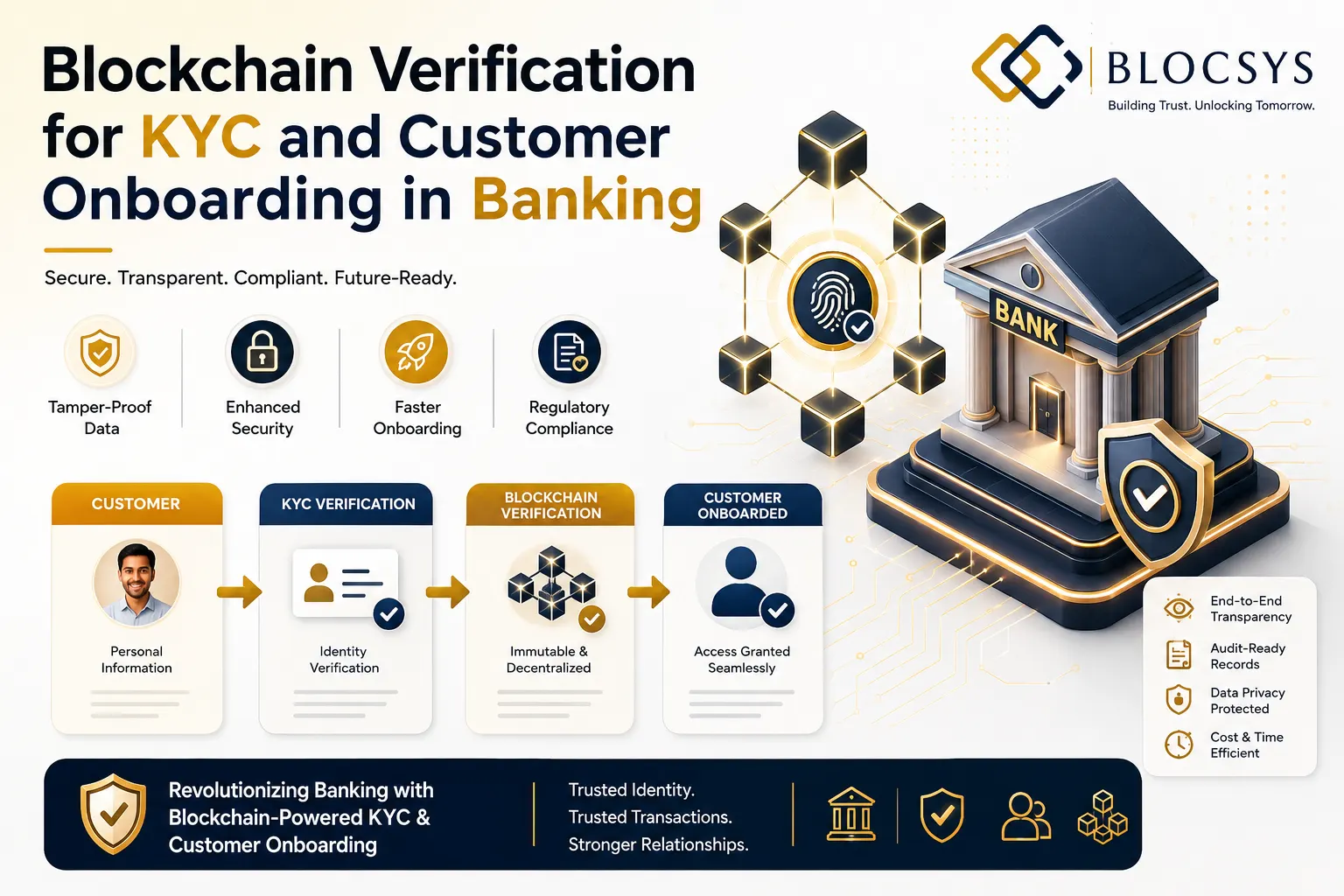
Banking teams don’t need another abstract discussion about digital identity. They need an onboarding model that can survive regulator scrutiny, reduce duplicate verification effort, and handle scale without turning KYC into a permanent operations bottleneck. That’s why blockchain verification for KYC and customer onboarding in banking has moved from theory to architecture review.
The strongest signal comes from markets where reusable digital identity is already practical. India’s identity stack reached 1.33 billion Aadhaar numbers generated by 31 March 2024, and Aadhaar e-KYC enables electronic identity verification with the resident’s consent, reducing paper-heavy onboarding friction for banks and financial institutions, as noted in this analysis of blockchain-based verification in KYC processes. That matters because blockchain KYC models are built around the same operational goal. Verify once, reuse with permission, and keep an auditable proof trail.
For banking leaders, compliance teams, fintech operators, and digital transformation owners across regulated markets, the primary question isn’t whether blockchain offers novel approaches. It’s where it fits, what it should store, what it should never store, and how to design a model that improves onboarding without creating a privacy or liability problem.
Table of Contents
- The Future of Trust in Banking Verification
- Why Traditional KYC and Onboarding Systems Are Failing
- How Blockchain Secures Customer Onboarding Verification
- Architecting a Decentralized Banking Verification Platform
- Global Use Cases and Practical Implementation Hurdles
- The Future of Blockchain Compliance and Fraud Prevention
- How Blocsys Delivers Enterprise Blockchain Banking Solutions
- Frequently Asked Questions
The Future of Trust in Banking Verification
Trust in banking used to mean collecting more documents, adding more reviewers, and building more checkpoints. That model still satisfies control objectives on paper, but it scales badly. Every new product, partner, and jurisdiction adds another layer of duplicate checks.
A better trust model doesn’t remove controls. It makes verified facts reusable, traceable, and permissioned. That’s the practical case for blockchain verification for KYC and customer onboarding in banking. Instead of every institution re-performing the same evidence handling from scratch, a permissioned network can hold proof that verification was completed, by whom, under what rules, and when it must be refreshed.
That shift matters most in banking because onboarding isn’t just an identity problem. It’s a workflow problem. The institution has to coordinate document capture, sanctions screening, risk classification, approvals, retention rules, consent records, and exception handling. If the underlying verification layer is fragmented, every downstream process inherits delay and ambiguity.
Practical rule: KYC architecture should optimise for accountability first, then speed. Faster onboarding that weakens ownership, evidencing, or remediation will fail in production.
In practice, the future of trust looks less like a public chain full of personal data and more like a controlled proof network. Verified attributes stay protected. Evidence remains accessible to authorised parties. Audit trails become easier to defend. Customer consent becomes part of the operating model rather than a one-time checkbox.
Banks that approach blockchain KYC this way usually get further than teams chasing a generic decentralisation narrative. The value isn’t in putting identity “on blockchain”. The value is in using cryptographic proof, shared state, and controlled access to remove repeated verification work without losing control of compliance.
Why Traditional KYC and Onboarding Systems Are Failing
Legacy onboarding stacks usually fail in the same place. Not at the first ID check, but in the handoffs between systems, teams, and counterparties. A bank may have a strong document verification engine, a separate case management tool, another screening platform, and a core banking workflow sitting behind them all. The customer experiences that as one process. Internally, it’s often four disconnected processes.
Repeated checks create avoidable friction
Most banking KYC environments still treat identity verification as institution-specific rather than portable. That means the same customer gets asked for the same documents repeatedly by banks, NBFCs, fintech partners, and internal product lines. The Reserve Bank of India has repeatedly emphasised risk-based customer due diligence, while blockchain-based KYC literature describes a model where a customer completes verification once and then shares a proof-of-validation with other institutions through permissioned access, as discussed in this industry note on how KYC onboarding changes with blockchain.
That repeated effort creates four operational problems:
- Manual review queues grow: Analysts spend time re-checking evidence that another regulated party may already have validated.
- Customer abandonment rises: Applicants don’t distinguish between compliance necessity and poor workflow design.
- Exceptions multiply: Mismatched data across channels creates duplicate remediation.
- Audit preparation gets harder: Teams must reconstruct who approved which version of which document in which system.
A useful reference point is this global guide to KYC verification platform companies, which shows how fragmented the vendor market remains. Many platforms solve one step well. Fewer solve reusability, proof portability, and institution-to-institution trust.
Centralised silos weaken control
Traditional systems also over-rely on central repositories. A central database is operationally familiar, but it becomes a pressure point. If a record is updated incorrectly, replicated late, or accessed beyond its intended purpose, the issue spreads fast.
That doesn’t mean decentralisation is automatically safer. It means centralisation has hidden costs that banking teams often underestimate:
- Single administrative bottlenecks slow approvals and remediation.
- Weak provenance trails make it harder to prove who changed what.
- Cross-entity coordination depends on API quality and reconciliation discipline.
- Fraud controls can be inconsistent when one system trusts stale data from another.
The failure mode in legacy KYC isn’t only fraud. It’s uncertainty about record status, consent scope, and validation ownership.
This is why many institutions now look beyond point solutions. They’re trying to reduce repeated verification work while improving evidencing and governance. Blockchain becomes relevant when it acts as a shared trust layer between parties, not when it’s treated as a branding exercise.
How Blockchain Secures Customer Onboarding Verification
Blockchain improves onboarding when it’s used to anchor trust, not to warehouse raw personal data. In a banking implementation, the ledger typically stores proofs, attestations, timestamps, workflow events, and permission logic. The underlying documents stay in controlled off-chain systems.
What changes in the verification model
In a conventional onboarding flow, each institution checks identity evidence, stores its own result, and exposes little of that trust artefact to others. In a blockchain model, the institution still performs due diligence, but the result can be published as a permissioned proof that other authorised participants can reference.
That changes three things immediately:
- Integrity improves: A proof record is harder to alter undetected because the ledger preserves state history.
- Auditability improves: Reviewers can trace verification events, approvals, and updates in sequence.
- Reuse becomes possible: Another permitted party can rely on prior validation without inheriting uncontrolled access to all source documents.
For banks evaluating secure banking document verification, this explanation of how banks use blockchain for customer document verification is useful because it mirrors what works in real delivery. Hash the evidence locally, record only what must be proven, and keep access tightly scoped.
Traditional KYC vs. Blockchain-Powered KYC Verification
| Attribute | Traditional KYC Systems | Blockchain KYC Systems |
|---|---|---|
| Data integrity | Records can be changed within internal systems, with evidencing dependent on logging quality | Ledger entries provide tamper-evident history for proofs and workflow events |
| Audit trail | Often spread across multiple tools and teams | Shared event history is easier to reconcile across participants |
| Verification reuse | Limited. Each institution usually rechecks documents | Reuse is possible through permissioned proof-of-validation |
| Customer control | Consent is often captured once and buried in workflow | Consent and access rules can be designed as explicit parts of the trust model |
| Fraud resistance | Strong controls are possible, but silos create blind spots | Cryptographic proof and shared validation records reduce some manipulation paths |
| Onboarding flow | Repetitive and institution-specific | More portable if governance and standards are mature |
| Privacy design | Depends on repository controls and retention policy | Requires careful on-chain versus off-chain design to avoid overexposure |
| Operating model | Familiar to incumbents | Better for consortium models and reusable trust networks |
The hard truth is that blockchain doesn’t magically fix weak onboarding. If source verification is poor, the ledger only preserves poor verification more elegantly. The control uplift appears when banks combine cryptographic proof with disciplined issuance, revocation, consent handling, and exception management.
Use blockchain to prove that a trusted process happened. Don’t use it as a shortcut around the process itself.
That’s the difference between a credible blockchain identity verification banking programme and a proof of concept that never leaves architecture review.
Architecting a Decentralized Banking Verification Platform
Enterprise architecture choices determine whether a blockchain KYC platform survives contact with compliance, legal, and security teams. Most failed initiatives get one of two things wrong. They either put too much data on-chain, or they pick a network model before agreeing the operating model.
Choose the trust model first
For regulated banking, the default starting point is usually a permissioned network. Hyperledger Fabric is a common fit because institutions need participant control, private channels, policy enforcement, and clear governance. Public infrastructure can still play a role, especially where interoperability or independently verifiable proof anchoring matters, but most core onboarding utilities need explicit membership and operational control.
The design decision should start with these questions:
- Who can issue a verification proof? Not every participant should be able to attest identity status.
- Who can read it? Relationship managers, compliance teams, correspondents, and partners rarely need identical access.
- Who can challenge or revoke it? Many designs often become vague regarding this.
- What happens during dispute resolution? A proof network without a correction process is operationally incomplete.
A helpful technical parallel appears in this guide to decentralized digital identity and document verification, especially around separating identity control from raw document exposure.
Keep sensitive data off-chain
Personally identifiable information, scans, statements, and enriched screening results should usually stay off-chain in encrypted storage under strong access policy. The blockchain layer should record hashes, credential references, issuance status, policy acknowledgements, and workflow attestations.
That architecture is more practical for three reasons:
- Privacy obligations are easier to manage
- Storage and throughput stay predictable
- Correction and retention workflows remain feasible
An implementation pattern that works well in banking looks like this:
| Layer | What it stores | Why it matters |
|---|---|---|
| Identity wallet or customer vault | Customer-held or bank-controlled credentials and consent artefacts | Supports portability and controlled disclosure |
| Off-chain evidence store | Documents, liveness outputs, screening reports, audit attachments | Keeps sensitive data under enterprise-grade controls |
| Blockchain proof layer | Hashes, attestations, credential status, timestamps, approval events | Provides tamper-evident verification history |
| Smart contract layer | Access rules, issuance conditions, expiry, revocation logic | Automates policy enforcement |
Use DIDs and Verifiable Credentials carefully
Decentralized Identifiers (DIDs) and Verifiable Credentials (VCs) give banks a cleaner framework for portable trust. A DID identifies the subject or issuer without depending entirely on one central directory. A VC packages a claim, such as a verified legal name, beneficial ownership status, or address confirmation, with cryptographic proof from the issuer.
That sounds straightforward, but enterprise delivery depends on disciplined scope. Don’t try to make one credential carry every compliance fact. Break identity into purpose-specific attestations that can be refreshed, revoked, or selectively disclosed.
For example:
- Retail onboarding credential: Identity verified, document type checked, validity status active.
- Corporate onboarding credential: Entity existence verified, signatory authority reviewed, UBO evidence completed.
- Jurisdiction-specific compliance credential: Additional checks required under local policy.
Design principle: The more portable the credential, the narrower and clearer its claim should be.
This is also where zero-knowledge proofs become useful. They can allow a customer or institution to prove a condition without exposing the full underlying data set. In banking, that can support statements such as eligibility, age threshold, residency category, or validated status, while limiting unnecessary disclosure.
Identity architecture also intersects with other asset and entitlement systems. When verified identities need to bind to ownership rights, permissions, or high-value digital claims, patterns from real-world asset tokenization systems become relevant because they rely on the same disciplines around attestations, provenance, and controlled state updates.
Global Use Cases and Practical Implementation Hurdles
Large retail payment systems now process transaction volumes that would expose any weak onboarding design within days, not years. That is why the most serious blockchain KYC programmes are no longer framed as innovation projects. They are being assessed as trust infrastructure decisions with direct consequences for operating cost, fraud controls, auditability, and cross-border growth.
Across Europe, the UK, the USA, the UAE, Singapore, and India, the same pattern keeps appearing. Institutions want to reduce duplicate evidence collection, shorten onboarding cycles, and make verified customer status portable across controlled ecosystems. The technology is mature enough for pilot deployment. The harder work sits in legal design, operating rules, and the assignment of liability when one institution relies on another institution’s verification.
Where banks are using the model
The strongest use cases are narrow, high-friction workflows where repeated checks create cost without adding much new risk insight.
- Consortium KYC utilities: Multiple institutions agree on credential schemas, validation standards, and evidence refresh rules so they can reuse verification outputs instead of recreating them.
- Cross-border onboarding corridors: Banks and regulated intermediaries need a dependable way to exchange customer status, beneficial ownership evidence, and approval history without circulating raw document files across every handoff.
- Partner-led distribution channels: Embedded finance, agency banking, and fintech distribution models need a verifiable trust handoff between the acquiring party and the regulated balance-sheet provider.
In practice, the ledger is the easy part. Governance is the hard part. Teams have to define who can issue attestations, who can revoke them, what reliance standard applies, how disputes are handled, and what happens when local regulation conflicts with network policy.
Scale also changes design choices. If a bank intends to anchor large volumes of verification events for audit purposes, writing every event individually to chain becomes expensive and operationally noisy. Techniques such as Merkle batching for recording one chain transaction across many proofs reduce that load while preserving evidentiary integrity.
India shows both the opportunity and the constraints
India is a useful case study because it already operates digital public infrastructure at population scale. That makes it easier to evaluate blockchain verification on practical terms. The question is not whether digital identity can work. The question is which trust assertions should be reusable, who is allowed to rely on them, and how consent, correction, retention, and fraud response should be handled under Indian law.
The policy direction is clear. Reusable, consent-driven data exchange is already part of the financial system through the Account Aggregator framework. That makes India highly relevant for banks evaluating wallet-based credentials, institution-issued attestations, and selective disclosure models.
The constraints are equally clear.
A bank cannot treat immutable records as a shortcut around the DPDP Act, RBI expectations, or sector-specific retention and correction obligations. For India-specific implementations, architecture has to separate what is anchored for integrity from what remains editable or deletable in governed systems of record. That usually means putting revocable proofs, hashes, timestamps, and consent references on chain while keeping source documents and high-risk personal data off chain.
Volume reinforces that design choice. NPCI reported that UPI handled 50.6 crore transactions per day in May 2026 according to its UPI product statistics. RBI also noted in its annual reporting that UPI processed 131.1 billion transactions in FY2024-25 in the Reserve Bank of India Annual Report 2024-25. At that scale, any identity model that adds latency, weakens dispute handling, or creates unclear accountability will fail in production regardless of how elegant the cryptography looks on paper.
Fraud operations matter just as much as identity proofing. Banks still need sanctions screening, mule-account detection, document forensics, behavioural analytics, and case-management workflows that can stand up to supervisory review. A shared credential can reduce repeated document collection. It does not fix weak risk logic or poor exception handling. Teams building these programmes should keep baseline AML control design in view. Get passref AML guidance.
Reusable verification creates the most value where institutions already agree on policy, evidence standards, and reliance terms. It creates limited value when the real bottleneck is unresolved liability, fragmented fraud controls, or inconsistent regulatory interpretation across jurisdictions.
That is the implementation lesson that holds across markets. Banks choosing a blockchain verification model need a decision framework, not a slogan. They should evaluate jurisdiction fit, trust-governance structure, revocation design, interoperability with existing KYC and fraud stacks, and whether the model can evolve over the next 24 months as DIDs and AI-driven verification orchestration mature.
The Future of Blockchain Compliance and Fraud Prevention
The next phase of blockchain KYC won’t be defined by identity proof alone. It will be defined by continuous assurance. Banks are moving away from onboarding as a one-time event and toward onboarding as the first state in a monitored customer lifecycle.
Compliance becomes continuous
A stronger architecture links verified identity to ongoing policy checks, credential refresh, behavioural monitoring, and revocation triggers. Smart contracts can help enforce workflow conditions, but the bigger shift is operational. Compliance teams no longer ask only, “Was this customer verified at entry?” They ask, “Is the verified state still valid for this product, transaction pattern, and jurisdiction?”
That makes interoperability more important than blockchain purity. The winning platforms will connect KYC verification software, sanctions tooling, case management, consent records, and evidence retention into one accountable flow.
Teams building that future should still stay grounded in established AML practice. For a concise operational reference, this guide to passref AML guidance is useful because it frames anti-money laundering checks in practical control terms rather than hype.
AI changes what teams monitor
AI will likely have the biggest impact in orchestration and risk triage. Not by replacing KYC analysts, but by helping them decide what needs review, what can be reused, and where data conflicts suggest a higher-risk profile.
The strongest near-term patterns are:
- Dynamic risk scoring tied to customer behaviour and context
- Document anomaly detection across repeated submissions
- Entity resolution where names, addresses, and identifiers don’t line up cleanly
- Exception routing that sends borderline cases to the right reviewer faster
That future also reinforces a principle many banks now adopt in secure identity infrastructure. Sensitive evidence should be processed locally where possible, and only minimum necessary proof data should move downstream. This explanation of why document hashes are created locally and only metadata is sent to APIs captures the logic well. Privacy-preserving verification will matter more, not less, as AI systems become part of the control stack.
Within the next 12 to 24 months, the practical winners will be institutions that build a portable trust layer with strict governance, then add AI to improve decision quality around it. Teams that reverse that order usually end up with expensive intelligence running on poor identity foundations.
How Blocsys Delivers Enterprise Blockchain Banking Solutions
A production-grade banking verification platform needs more than chain expertise. It needs workflow engineering, secure data handling, identity design, audit logic, and integration discipline across compliance systems. That’s why most institutions benefit from building with a team that understands both blockchain infrastructure and regulated operational controls.
Blocsys Technologies works in that part of the stack. The company provides blockchain and AI infrastructure engineering for production systems, including verification workflows, proof layers, tokenisation systems, and intelligent compliance tooling. For a bank, fintech, or digital identity provider assessing blockchain verification for KYC and customer onboarding in banking, that usually means support across:
- Architecture consulting: Permissioned network design, proof models, smart contract logic, and off-chain storage patterns.
- Platform development solutions: Building secure onboarding verification platforms and enterprise banking verification systems.
- Integration work: Connecting KYC verification software, case management, customer channels, and fraud tooling.
- Delivery staffing: Teams that need to hire blockchain developers for implementation can use a specialist delivery model rather than force-fitting generalist engineering capacity.
- Commercial planning: Early scoping is easier with the software development cost estimator, especially for institutions comparing pilot, consortium, and full-platform build options.
The right partner won’t sell blockchain as a cure-all. They’ll help decide whether a blockchain banking verification platform is justified, which parts of the onboarding flow belong on a shared trust layer, and where a conventional architecture is still the better answer.
Fintech Blockchain for KYC and Customer Onboarding
The use of fintech blockchain is helping banks explore more connected approaches to KYC and customer onboarding by creating a trusted layer for verification records, consent, and verification status. Instead of repeatedly processing the same information across separate systems, financial institutions can use blockchain-based workflows to support reusable verification proofs, improve auditability, and coordinate onboarding activities between authorized participants. This can make fintech blockchain particularly valuable for banking environments where security, data control, regulatory compliance, and efficient customer onboarding need to work together.
Frequently Asked Questions
What is blockchain verification for KYC in banking
Banks use blockchain verification to record tamper-evident proof that an identity check, approval, consent action, or status change occurred at a specific time. The documents and raw personal data stay off-chain. What sits on the ledger is usually a hash, credential reference, or signed attestation that another authorised party can verify without requesting the full file again.
How does blockchain improve customer onboarding security
It creates a stronger control trail. Teams can see who verified what, when it was approved, whether consent was present, and whether a credential was later revoked. That matters in banking because onboarding failures rarely come from one dramatic breach. They come from fragmented systems, inconsistent updates, and poor evidence handling across channels, vendors, and legal entities.
Security still depends on architecture choices. A permissioned network with strict node governance, encrypted off-chain storage, key management controls, and clear revocation logic is usually the difference between a usable banking platform and an expensive audit log.
Why are banks adopting blockchain-based KYC verification
The economic case is straightforward. Banks repeat the same verification work across products, subsidiaries, and counterparties, while compliance teams still need a defensible audit record. A shared proof model can reduce duplicate checks, shorten review cycles for lower-risk cases, and make it easier to rely on validated identity evidence within defined policy boundaries.
The stronger use case is inter-organisational trust, not internal workflow repair.
What is the main compliance challenge with blockchain KYC
The hardest problem is aligning privacy rights, accountability, and record permanence. Regulators want traceability. Customers and privacy laws require correction, restriction, and in some cases deletion. That tension has to be addressed in the design phase through data minimisation, off-chain storage, retention rules, jurisdiction-specific governance, and legal clarity on which party acts as controller, processor, issuer, or relying institution.
In India, for example, consent-based identity reuse is expanding through DigiLocker and related infrastructure. Banks still need a model that fits DPDP Act obligations and RBI expectations, especially for revocation, dispute handling, and evidencing lawful access to customer data.
How can financial institutions decide whether blockchain is the right fit
Start with four questions. Are multiple regulated parties involved. Does the process require shared proof rather than shared raw data. Do participants need a common audit trail across jurisdictions or legal entities. Is there a governance model strong enough to manage node operation, credential standards, liability, and change control.
If the answer to those questions is no, a conventional platform usually does the job with less operational overhead. If the answer is yes, blockchain can support a reusable trust layer that improves onboarding, periodic KYC refresh, and third-party reliance models over the next 24 months, especially as DIDs and AI-based verification agents mature.
If your team is evaluating reusable KYC, decentralised identity, or secure onboarding infrastructure, Blocsys Technologies can help assess the architecture, define the trust model, and build a delivery plan that fits regulated banking operations. Connect with Blocsys to discuss blockchain-powered verification systems, enterprise compliance workflows, or the next step in designing a secure digital trust platform.
