
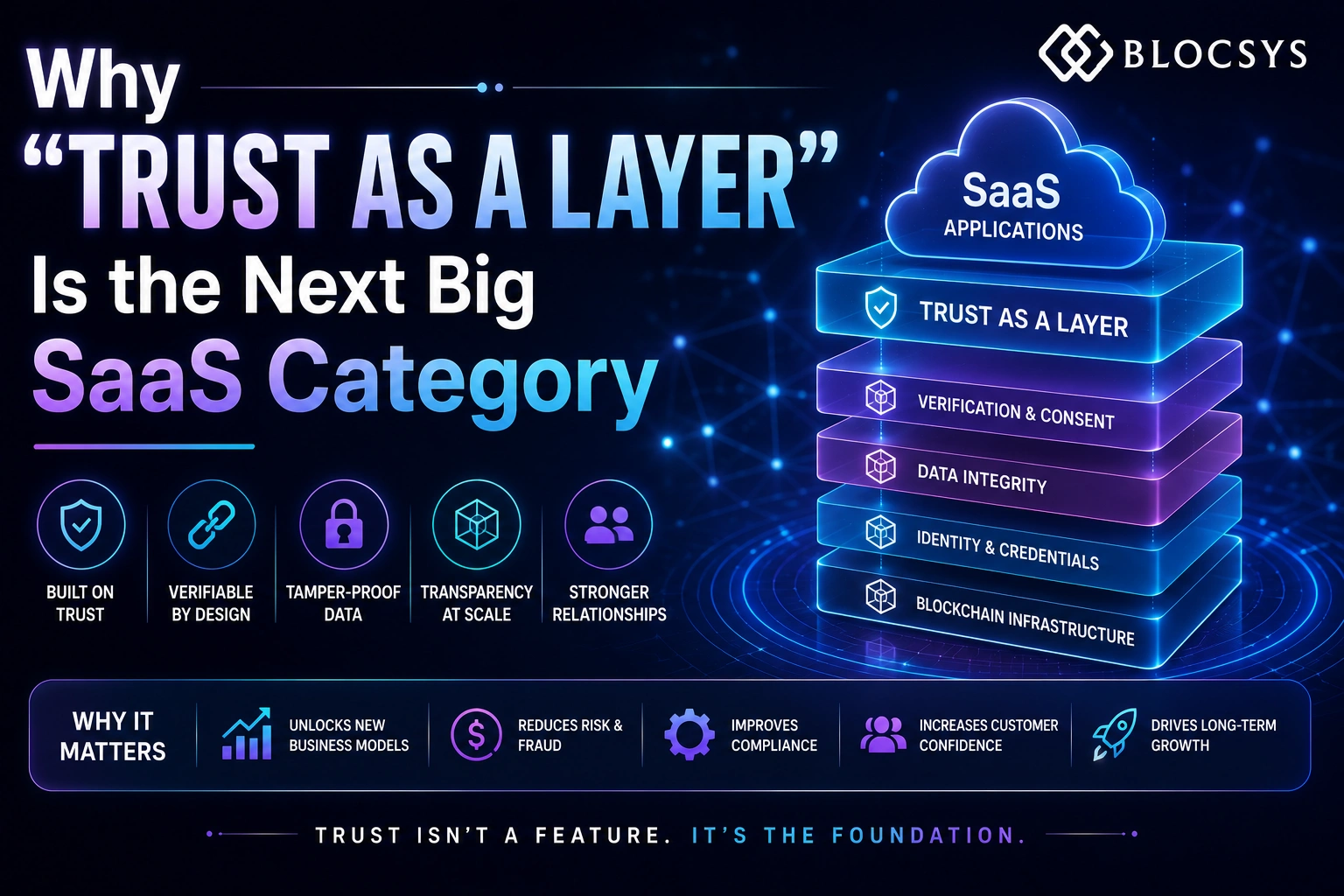
A routine upgrade should feel boring. In a trading platform, though, boring is the difference between a clean market session and a support room full of people trying to explain why orders stalled, balances lagged, or audit trails went missing. That’s why Trust as a Layer is moving from a brand idea to an operating model, especially in SaaS systems where reliability, identity, logging, and governance now shape product value as much as feature lists do.
For teams building exchanges, tokenisation rails, AI-driven compliance tools, or enterprise workflow software, the question isn’t whether to add trust later. It’s whether trust is built into the deployment path, the state model, and the rollback plan from day one. India’s SaaS revenue is projected to grow from $13 billion in 2023 to $50 billion by 2030 OpenView Partners, and that scale makes built-in trust features harder to treat as optional. For engineers looking at API-first trust design, an API-first trust infrastructure approach is one practical reference point.
Table of Contents
- Introduction to Trust as a Layer and Zero Downtime
- Understanding Core Zero Downtime Patterns
- Database and State Migration Strategies
- Designing CI/CD Pipelines with Observability
- Implementing Rollback Mechanisms and Safety Nets
- Smart Contract Upgrade Approaches
- Security Compliance and Practical Implementation Checklist
- Conclusion and Why Blocsys Can Help
Introduction to Trust as a Layer and Zero Downtime
A crypto exchange can survive a slow Tuesday. It usually cannot survive a failed release during a volatile market window. In that moment, the outage is not just a technical incident, it becomes a trust failure, because traders, compliance teams, and partners all see the same thing, a platform that could not preserve continuity when it mattered most.
That is the core shift behind Trust as a Layer. Security, auditability, and uptime stop being separate checkboxes and become part of the product architecture itself. Buyers in SaaS now expect reliability and auditable controls inside the workflow, not bolted on afterwards, as OpenView Partners notes.
Zero-downtime deployment is the operational expression of that idea. It means shipping changes without interrupting active users, while preserving sessions, ledger integrity, and external integrations as the system evolves. For blockchain trading systems, this is closer to changing the track under a moving train than updating a brochure site, because traffic shifts, schema changes, contract upgrades, and rollback readiness all have to stay aligned.
The architectural stakes are different from stateless web apps. A trading engine, an order book, or an on-chain workflow keeps state that cannot be recreated on demand. Live positions, pending transactions, and audit trails all carry forward from one release to the next, so each deployment has to respect what is already in motion. That is why this topic matters to CTOs, platform engineers, and security leads who want reliability to behave like a product feature, not a postmortem promise.
For teams building trust infrastructure, the same requirement appears in a different form. An API-first platform still has to keep identity, permissions, and workflow history intact while code changes roll out. The practical patterns behind that approach are laid out in this guide to API-first trust infrastructure for developers, and they become even more important once money movement and execution state are involved.
Understanding Core Zero Downtime Patterns
Blue Green, Canary, Rolling, and Feature Flags
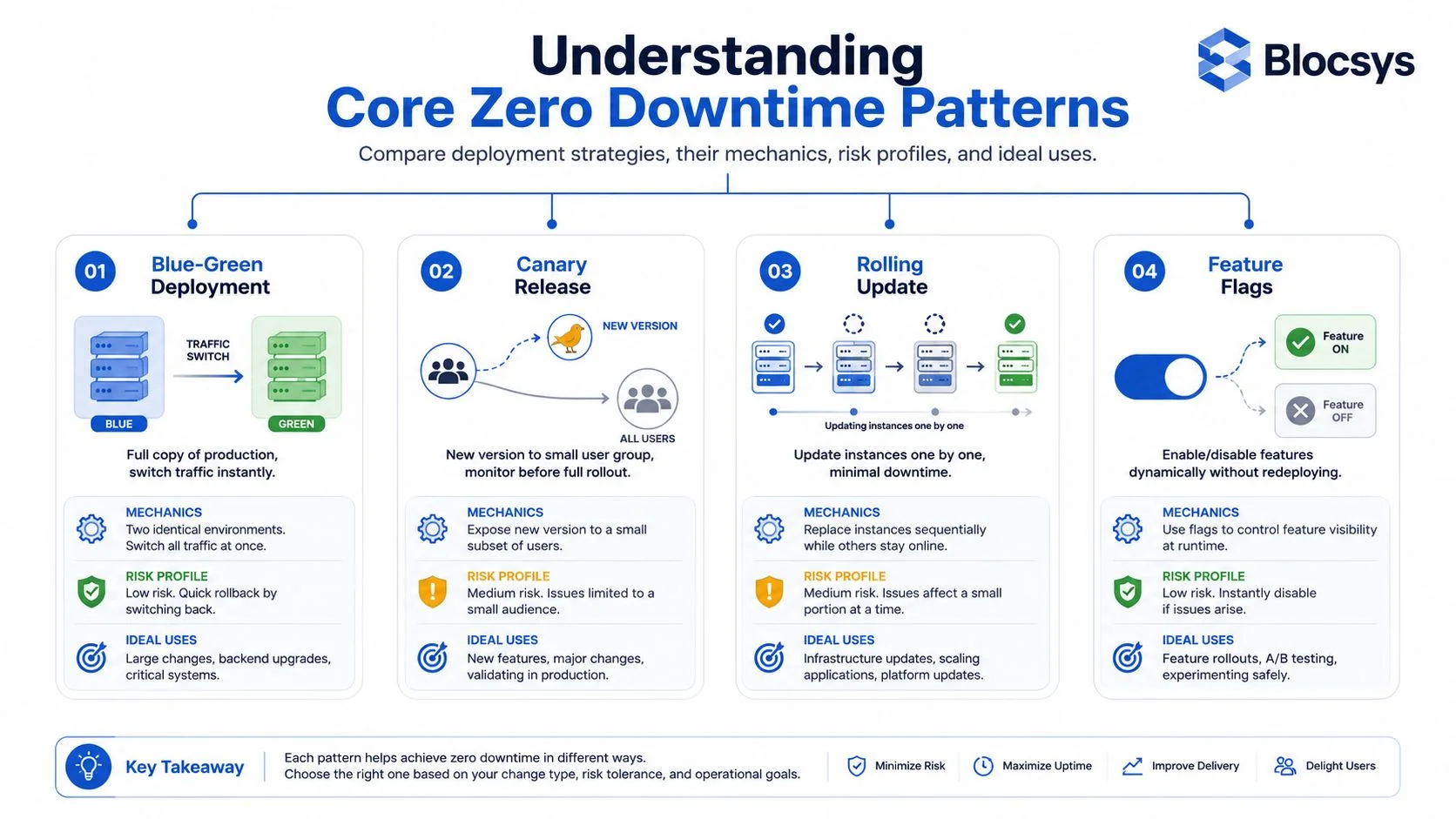
Each deployment pattern solves a different risk problem. Blue-green deployment is the cleanest handoff, you keep two production environments, validate the new one, then switch traffic over in one move. It’s the closest thing to replacing a racing engine while the car is still in the pit lane. That makes it attractive when you need a full safety net and can afford duplicate capacity.
Canary releases work differently. A small user group gets the new version first, then the team watches behaviour before expanding rollout. This is a good fit when platform risk is uncertain, because it gives you live signal without exposing the entire customer base. In a trading context, that’s useful when a new pricing service, risk check, or wallet workflow could affect transaction flow.
Rolling updates update instances one by one. The system stays up, but you need tight orchestration so mixed versions don’t break session affinity or shared dependencies. This is often the most efficient path for large services, yet it becomes risky when stateful components assume all nodes speak the same protocol.
Feature flags separate deployment from release. You ship code, but turn capabilities on or off dynamically. That’s powerful for controlled exposure, emergency disablement, and A/B validation, but it can turn into flag debt if teams leave stale toggles everywhere.
| Strategy | Description | Use Case | Risk Level |
|---|---|---|---|
| Blue-green | Full copy of production, switch traffic instantly | Major releases needing hard fallback | Lower operational risk, higher infra cost |
| Canary | New version to a small user group first | Uncertain changes, live validation | Medium |
| Rolling update | Update instances one by one | Large fleets, continuous delivery | Medium to higher if dependencies are tightly coupled |
| Feature flags | Enable or disable features dynamically without redeploying | Gradual exposure and emergency switch-off | Lower release risk, but governance can get messy |
Practical rule: use the simplest pattern that protects the part of the system most likely to fail. Don’t choose a rollout method because it sounds sophisticated, choose it because it matches the failure mode you’re trying to contain.
For teams deciding between them, transaction sensitivity is the key consideration. A low-risk admin panel can tolerate a rolling change. A matching engine or collateral service usually can’t. In those systems, release control is less about convenience and more about preserving market confidence while the platform changes shape.
Database and State Migration Strategies
State is where zero-downtime plans usually break. Code can roll forward cleanly, but a schema change that collides with live writes can corrupt order books, duplicate settlement events, or strand users mid-flow. The safest migrations assume the old and new systems need to coexist until the team has proof that reads, writes, and reconciliation all match.
Dual Write and Controlled Cutover
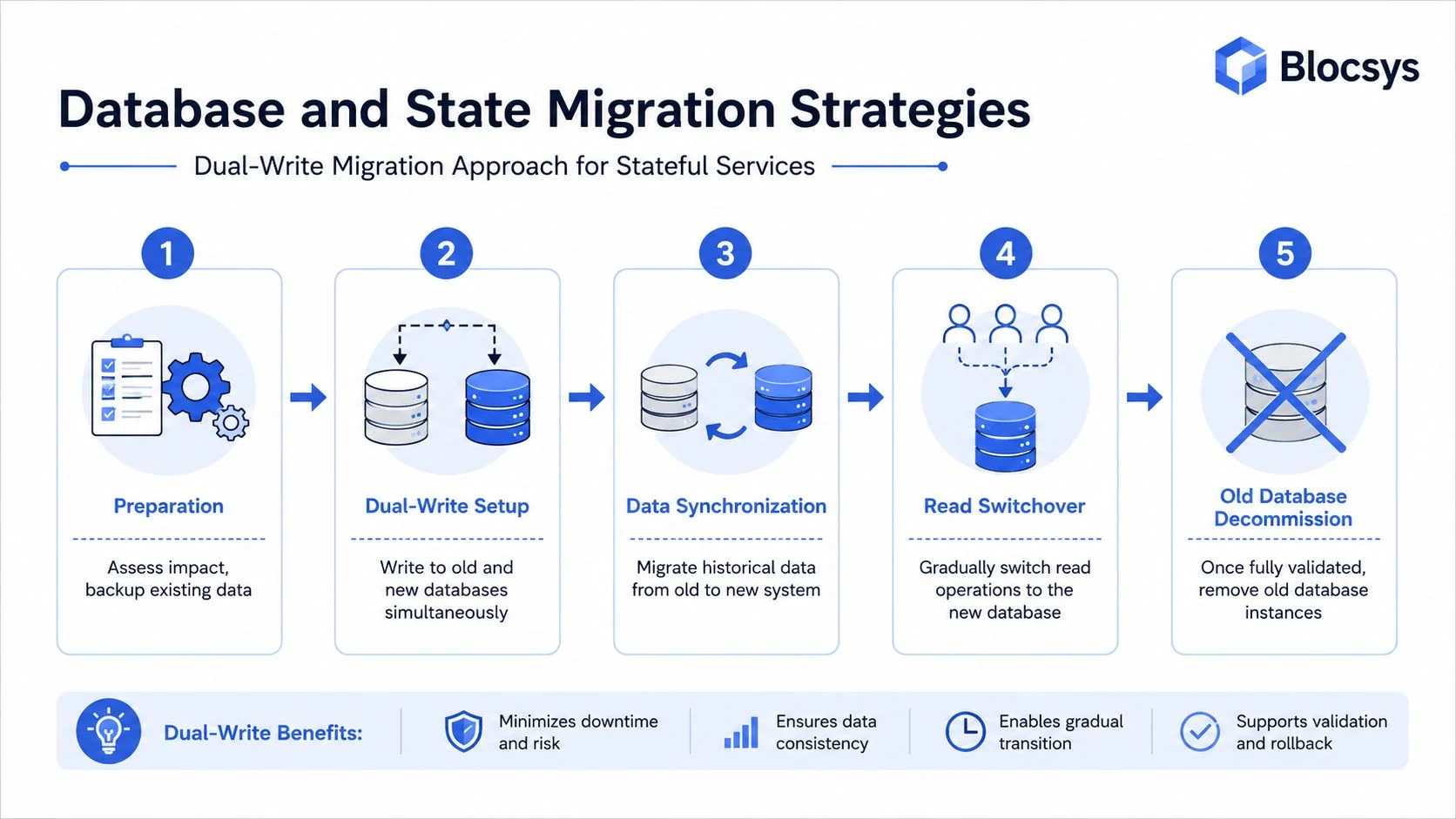
The first step is dual-write preparation. The application writes to both schemas or stores for a defined window, then the team compares results before turning off the old path. That gives engineers a way to validate behaviour under real traffic instead of hoping test data covered every edge case.
A useful pattern is to separate the migration into three checks. First, write compatibility, then historical backfill, then read switchover. Historical data can move through replication or backfill jobs, but the cutover only happens after consistency checks are clean. For blockchain or trading ledgers, that validation layer matters because one silent mismatch can become a reconciliation nightmare later.
Use migrations like settlement, not like copy-paste. Every stage needs a visible owner, a verification point, and a rollback path.
A second safeguard is schema versioning, where old and new application versions can read the same data shape during a transition. That keeps deploys from failing just because one pod is running ahead of another. It’s especially important for systems with long-lived sessions, asynchronous settlement, or delayed settlement instructions.
For teams handling audit-sensitive state, an internal reference on Merkle batching for one chain transaction and thousands of proofs is relevant because it shows how state-efficient approaches can reduce the strain of proving integrity while migrations are in flight. India’s privacy regime also raises the bar here, since the Digital Personal Data Protection Act, 2023 requires incident reporting within 6 hours and log retention for 180 days Valence Security, which makes auditable migration trails part of compliance, not an afterthought.
Designing CI/CD Pipelines with Observability
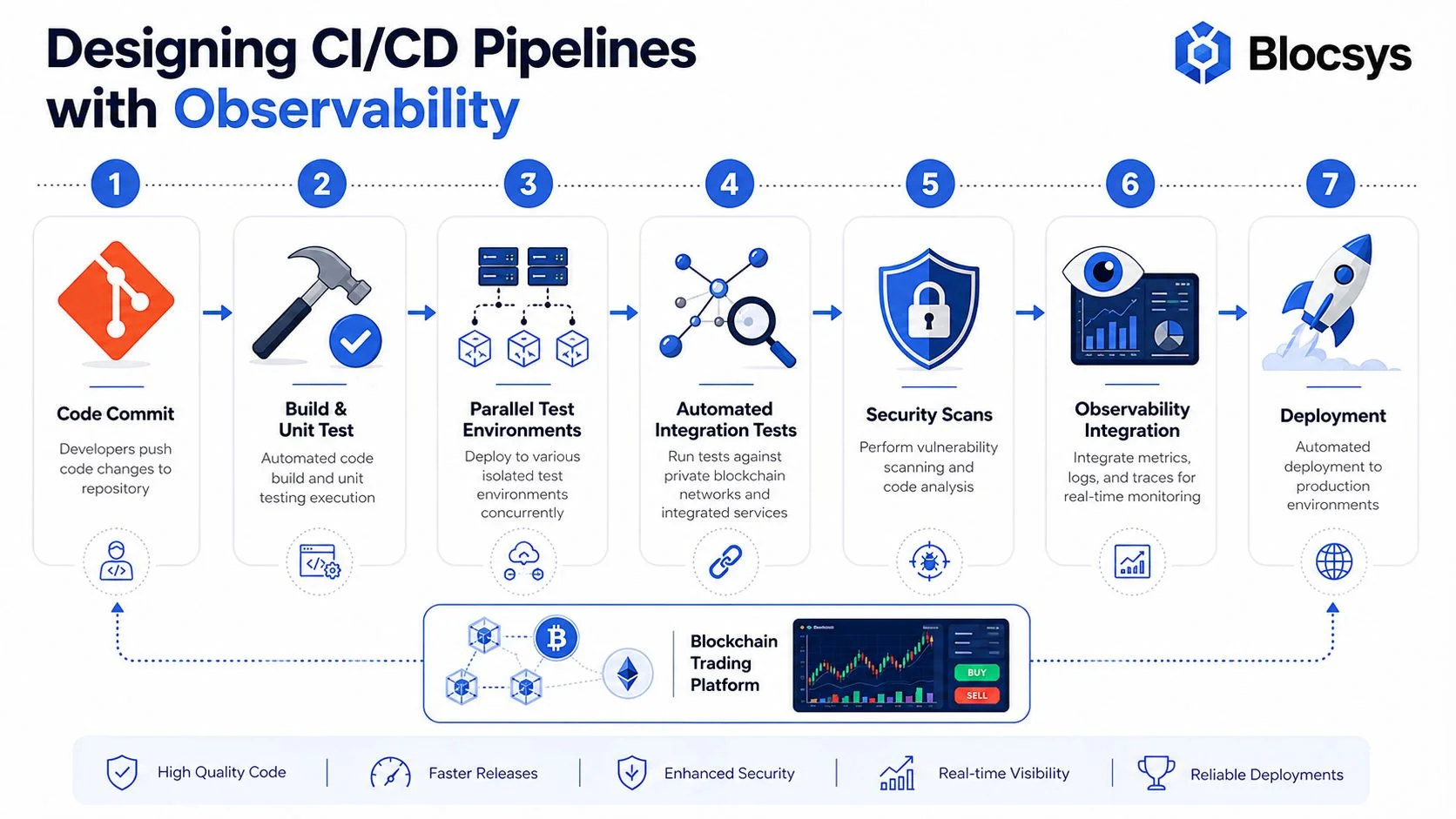
A good pipeline doesn’t just build software. It proves that the software can survive in production-like conditions before anyone routes real traffic to it. For blockchain trading services, that means isolated test environments, private network integration tests, security gating, and observability hooks that tell operators what changed the moment a release starts behaving differently.
Pipeline Stages That Catch Failures Early
A disciplined flow starts with code commit, then build and unit tests, then parallel test environments. After that come integration tests against private blockchain networks and connected services, followed by security scans and observability integration before deployment. Each stage filters a different class of error, which is why teams shouldn’t merge them into one vague “testing” step.
The observability layer is where trust becomes measurable. The pipeline should emit metrics, logs, and traces early enough that a canary can be judged on real signals, not gut feel. That matters because modern trust-layer models make per-request least-privilege decisions using identity, device, network, application, and data signals, which means every release can affect access behaviour as well as feature behaviour Armalo.
What Strong Operators Watch For
- Deployment health: track whether new pods, services, or nodes are behaving like the old ones before widening traffic.
- Release-specific logs: separate rollout logs from normal application logs so incidents don’t get buried.
- Correlation IDs: keep order, wallet, and identity events tied together across services.
- Security gates: block promotion when scans, attestations, or dependency checks fail.
- Human handoff points: make sure operators can pause or stop rollout without hunting through three dashboards.
Teams that want a platform view often pair development and operations with platform engineering discipline. A practical nexus IT group perspective on DevOps versus platform engineering helps clarify why ownership, guardrails, and reusable release patterns matter so much in release-heavy environments. For implementation support, Blocsys devops consulting is one route teams may use when they need these controls built into an actual delivery pipeline rather than discussed in theory.
Implementing Rollback Mechanisms and Safety Nets
No serious deployment plan assumes every release will behave. Rollback is the seatbelt, but the better analogy is an automatic safety rail that activates before the car leaves the track. In a trading or blockchain system, the goal is not just to undo code. It’s to preserve service continuity while the team figures out what failed.
Automated Triggers and Health-Based Reversion
Rollback should be tied to health, not emotion. If latency spikes, error rates rise, or a dependency stops responding correctly, the deployment controller should fail closed and revert or halt promotion. That works best when the same observability that approves a rollout also decides whether the rollout keeps going.
Feature flags give teams a faster escape hatch than a full redeploy, especially when a bad release affects only one workflow. Database version rollback is harder, so teams often use forward-compatible schemas to reduce the need for a physical revert. When state is too important to reverse safely, staged rollback can isolate the blast radius by switching only a subset of traffic back.
A rollback that depends on manual debate is already late.
The zero-trust mindset helps here too. Guidance on zero-trust SaaS access recommends continuous verification of each user and device before access, and the same logic applies to release health. The system should keep verifying that the new version still deserves traffic, then trigger a safe restore when evidence says it doesn’t.
For blockchain trading services, the hardest failures often aren’t obvious crashes. They’re partial failures, a chain reorg, a delayed settlement worker, or an order-routing bug that leaves the UI alive but the transaction path broken. Safety nets need to catch those cases through circuit breakers, alert thresholds tied to SLAs, and rollback conditions that can act before traders notice a broken state.
Smart Contract Upgrade Approaches
Smart contracts don’t patch like web servers. Once they’re deployed, the upgrade path usually depends on architecture choices made long before the first live transaction. That’s why proxy patterns, governance rules, and state migration tactics matter so much in blockchain systems that need continuity without sacrificing auditability.
Proxy Patterns and Governance Controls
Proxy-based upgrades let the contract address stay stable while logic changes behind it. That’s useful when wallets, integrations, or off-chain services already depend on the address. A guide to proxy contracts in Solidity is a sensible reference if your team is comparing deployment models for upgradeable systems.
The biggest operational discipline is permissions. Upgrade rights should be explicit, tightly governed, and reviewable through multisig or equivalent controls. If a team can upgrade logic too freely, trust collapses even if the code itself is technically sound.
Side by Side Releases and State Moves
Some teams prefer side-by-side deployment, where the new contract is released next to the old one and traffic moves gradually. That can simplify validation when the state shape changes materially. It also gives auditors a cleaner way to compare old and new behaviour before the switch.
A compact implementation pattern is often used for UUPS-style upgrades, where an initializer replaces constructor logic and the proxy delegates calls to implementation contracts. The exact mechanics matter less than the discipline around them, because the primary failure mode is usually governance drift, not syntax. If the team can’t prove who approved the upgrade and why, the upgrade path becomes a risk surface.
Security Compliance and Practical Implementation Checklist
Security and compliance don’t sit outside the trust layer. They are the trust layer. Buyers in regulated workflows want evidence that data, identity, logs, and access controls all line up, not just a promise that the platform “takes security seriously.”
What Enterprises Expect to See
SOC 2 is a useful benchmark because it maps to five Trust Services Criteria, Security, Availability, Processing Integrity, Confidentiality, and Privacy IS Partners. It’s not a law, but it is a common way for buyers to judge whether a vendor can support enterprise procurement. The right approach is to scope the controls first, assess gaps second, then implement and remediate before claiming readiness.
Data protection mechanics matter just as much. SaaS security guidance recommends classifying high-value assets, encrypting data in transit and at rest, and using Customer-Managed Encryption Keys where possible BetterCloud. Reassessments should happen at renewals or when the integration model changes, because a secure system last quarter can become a risky one after a platform connection expands.
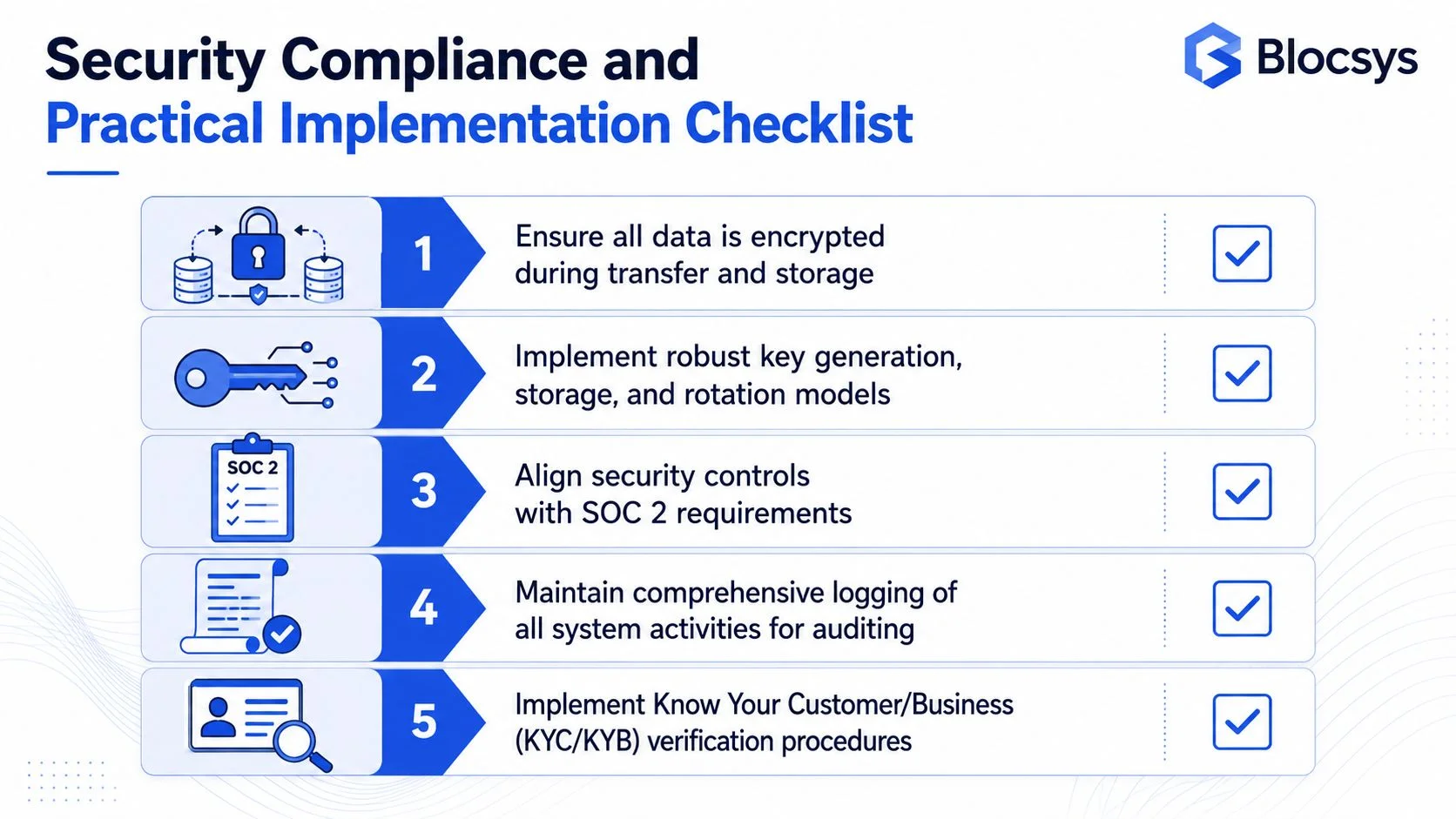
Practical Deployment Checklist
- Identity controls: confirm that every privileged action maps to a known operator, service account, or automated workflow.
- Access boundaries: review scopes before each release so old permissions don’t inadvertently cover new risk.
- Encryption coverage: verify that sensitive data remains protected in transit and at rest across all environments.
- Logging and evidence: keep audit logs complete enough to support incident review and customer assurance.
- KYC and KYB workflows: align identity verification with the business process so onboarding, monitoring, and exception handling are connected.
For teams that need a deeper security implementation reference, a guide for CTOs on big data security provides useful context on keeping large, sensitive data systems defensible under operational pressure. Internal audit trails also matter here, and compliance-ready audit trails with cryptographic evidence is relevant when the system needs provable, tamper-evident records rather than ordinary logs.
Conclusion and Why Blocsys Can Help
Trust as a Layer is becoming the default expectation for serious SaaS platforms because buyers no longer separate functionality from reliability, identity, and proof. In zero-downtime systems, that means deployment patterns, state migration, rollback logic, and smart contract upgrades all need to support continuity instead of threatening it.
That’s especially true for fintech, exchanges, and blockchain trading platforms, where a release isn’t just a software event. It’s a confidence event. Teams that design for continuous verification, auditable change, and safe recovery build systems that can keep trading while the architecture evolves.
Blocsys works across blockchain, AI, SaaS, and enterprise software delivery, including API-first trust infrastructure, trading platforms, smart contract development, and compliance automation. For organisations planning secure releases, trusted state migration, or zero-downtime product evolution, Blocsys can help shape the architecture and delivery path around those requirements.
Frequently Asked Questions
What is Trust as a Layer in SaaS?
Trust as a Layer in SaaS is an approach where security, identity, reliability, auditability, observability, and governance are built directly into the software architecture rather than added as separate controls later. For SaaS platforms handling financial transactions, sensitive data, or blockchain workflows, this approach makes trust an operational part of the product and deployment lifecycle.
Why is Trust as a Layer becoming important for SaaS platforms?
Trust as a Layer is becoming important because enterprise SaaS customers increasingly expect reliability, security, identity controls, auditability, and compliance evidence as part of the product experience. For platforms handling financial or sensitive workflows, a failure in availability or data integrity can become a business and trust issue rather than simply a technical outage.
How does zero-downtime deployment improve SaaS reliability?
Zero-downtime deployment improves SaaS reliability by allowing software updates to be released without interrupting active users or critical workflows. Deployment patterns such as blue-green releases, canary deployments, rolling updates, and feature flags allow teams to introduce changes gradually while monitoring system health and maintaining a controlled path for rollback.
What are the main zero-downtime deployment strategies?
The main zero-downtime deployment strategies are blue-green deployment, canary releases, rolling updates, and feature flags. Blue-green deployment maintains two production environments for controlled traffic switching, canary releases expose a new version to a limited user group, rolling updates replace instances gradually, and feature flags allow functionality to be enabled or disabled without redeploying the application.
How do database migrations affect zero-downtime SaaS deployments?
Database migrations can affect zero-downtime deployments because live systems may continue reading and writing data while the database structure changes. Techniques such as dual writes, historical backfills, schema versioning, compatibility layers, consistency checks, and controlled read cutovers allow old and new application versions to coexist while the migration is validated before full traffic is moved.
Why are observability and monitoring important for Trust as a Layer?
Observability and monitoring are important for Trust as a Layer because teams need measurable evidence that a new software release is behaving safely in production. Metrics, logs, traces, correlation IDs, deployment health signals, and security events help operators detect latency increases, errors, dependency failures, and abnormal transaction behaviour early enough to pause or roll back a release.
How does automated rollback protect SaaS platforms?
Automated rollback protects SaaS platforms by reverting or halting a deployment when predefined health conditions indicate that a release is unsafe. Triggers can include increased error rates, latency spikes, dependency failures, or transaction anomalies, allowing the system to reduce the impact of a faulty release without waiting for a manual decision after customers have already been affected.
How can smart contracts be upgraded safely?
Smart contracts can be upgraded safely by using controlled upgrade architectures such as proxy patterns, side-by-side contract releases, and governance mechanisms that restrict who can approve or execute upgrades. Multisig or equivalent approval controls, auditable upgrade decisions, state migration procedures, and staged validation are important because blockchain contract upgrades can affect persistent financial or transactional state.
What security controls should a Trust as a Layer SaaS platform include?
A Trust as a Layer SaaS platform should include strong identity controls, least-privilege access, encryption, audit logging, security testing, dependency checks, continuous monitoring, controlled deployment permissions, and clear incident-response procedures. For platforms handling financial or blockchain workflows, KYC and KYB processes, transaction monitoring, privileged-access controls, and cryptographic evidence may also be required.
What is the role of KYC and KYB in Trust as a Layer?
KYC and KYB provide identity and business verification controls that help SaaS platforms establish who is using a service and whether an organisation is legitimate. When integrated into the trust layer, these workflows can connect onboarding, permissions, monitoring, and exception handling so that identity verification becomes part of the operational system rather than a disconnected compliance process.
How can enterprises build a Trust as a Layer SaaS platform?
Enterprises can build a Trust as a Layer SaaS platform by integrating identity, access control, observability, auditability, security, compliance, zero-downtime deployment, state migration, rollback, and governance into the core architecture. The implementation should begin with the workflows where failure or unauthorised access creates the greatest business risk, then establish measurable controls and evidence that demonstrate reliability as the platform evolves.
A CTA for Blocsys Technologies.
