A private-company CFO in India can now sit with a treasury adviser and ask a serious question: should the business spend time and engineering budget preparing for a tokenised corporate bond, or wait until the market is fully operational? The answer isn't “issue immediately”. SEBI's initiative is still a controlled pilot, and private companies don't automatically receive permission to issue digital securities because blockchain is involved.
This guide is for CFOs, CTOs, compliance leaders, NBFCs, investment firms, asset managers and financial institutions evaluating SEBI corporate bond tokenisation. It separates confirmed developments from future possibilities, then turns the operational gap into a practical readiness plan covering issuance, wallets, ownership, smart contracts, settlement, servicing, security and reporting. For organisations assessing the technology layer, Blocsys works on enterprise blockchain and digital asset platforms, but technology remains only one part of the regulatory process.
Table of Contents
- What SEBI Corporate Bond Tokenization Actually Means
- Why Tokenized Debt Matters for India's Private Companies
- How Tokenized Bond Issuance and Lifecycle Management Works
- The Real Gaps Between Pilot Promise and Private Company Readiness
- How Private Companies Can Prepare for Tokenized Bond Issuance
- Infrastructure, Smart Contracts, and Scalability for Tokenized Debt
- Frequently Asked Questions for Private Companies and Issuers
- What does SEBI corporate bond tokenisation mean?
- Why is SEBI exploring tokenised corporate bonds?
- Can a private company issue tokenised corporate bonds now?
- Does the pilot specify a minimum ticket size for private issuers?
- Does RBI approval matter separately from SEBI approval?
- What infrastructure does an issuer need?
- How do blockchain-based issuance and settlement work?
- Can smart contracts automate coupons and redemption?
- What disclosure norms apply to tokenised bonds?
- Is secondary trading available automatically?
- Should the bond use a public or permissioned blockchain?
- How does Blocsys fit into a tokenisation project?
What SEBI Corporate Bond Tokenization Actually Means
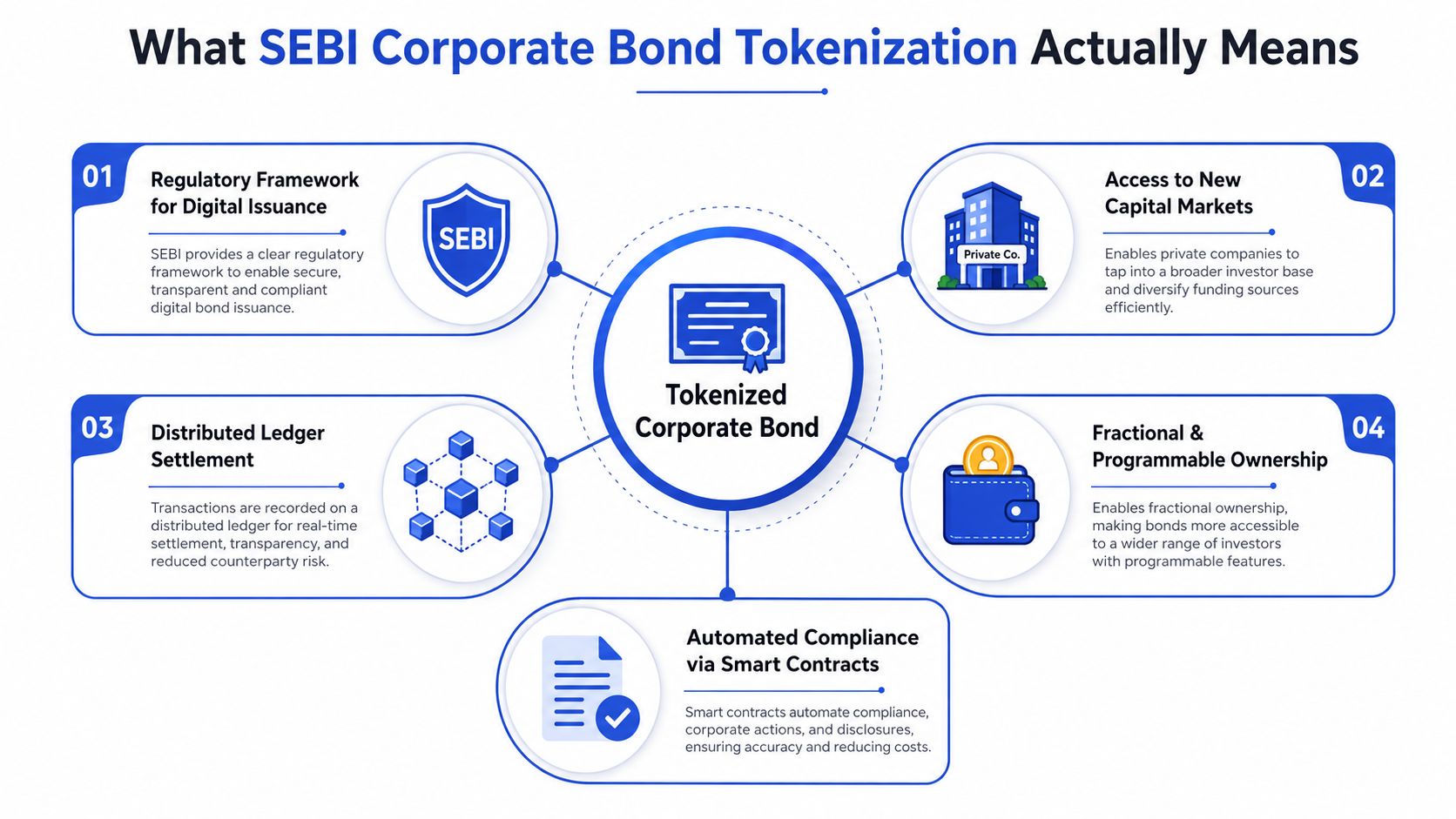
SEBI corporate bond tokenisation means representing a regulated corporate debt security as a digital token on distributed ledger technology, usually within a permissioned market environment. The token can carry or reference the bond's economic terms, including coupon obligations, principal repayment, transfer restrictions and ownership events. The legal instrument remains a security governed by applicable securities rules. Tokenisation changes the record-keeping and transaction plumbing, not the underlying legal obligations.
That distinction matters. A tokenised corporate bond isn't the same as a cryptocurrency, a stablecoin or an unregulated token offering. It isn't a licence to sell a freely transferable digital asset to anyone. Investor eligibility, disclosures, custody, transfer controls and settlement arrangements still need to work within the recognised market structure.
SEBI publicly confirmed in May 2026 that it would launch a pilot project for tokenisation of corporate bonds using distributed ledger technology, with implementation expected to take around 6 to 9 months and a limited-scale rollout before broader adoption, as reported by The Hindu's coverage of SEBI's pilot. The pilot is designed to test faster settlement, lower reconciliation costs and smarter servicing of debt instruments, subject to Reserve Bank of India approval.
The scope is therefore narrower than many headlines imply. The confirmed initiative concerns corporate bonds. It shouldn't be treated as a general approval covering government securities, commercial paper, every form of debenture or any private company that wants to create a bond token.
The working vocabulary for decision-makers
A CFO should think of tokenisation as a regulated digital representation of an existing debt obligation. A CTO should think of it as a permissioned system with identity, eligibility and settlement dependencies. A compliance head should ask whether every on-chain event can be reconciled with the legal register, regulatory reports and investor records.
The practical question isn't whether a token can be minted. It can. The question is whether the issuer can operate the entire bond lifecycle with authorised intermediaries, secure custody, RBI-aligned cash settlement and defensible audit evidence. The bond lifecycle management perspective is more useful than treating a token as a standalone crypto product.
Why Tokenized Debt Matters for India's Private Companies
India's corporate bond market is strategically significant because SEBI's 2026 reporting was cited as framing the opportunity around roughly ₹59 lakh crore in corporate bonds, as discussed in reporting on SEBI's tokenisation pilot. That scale explains why regulators are studying the infrastructure, while the pilot format explains why private issuers shouldn't assume immediate access to a new funding channel.
The potential value is operational. A shared ledger can give issuers, registrars, custodians and other authorised participants a more consistent view of ownership and transaction history. Smart contracts can encode routine servicing rules, while delivery-versus-payment design may reduce the need to reconcile separate asset and cash movements manually.
The strategic signal is stronger than the immediate commercial outcome. SEBI is evaluating tokenised corporate bonds inside India's regulated securities infrastructure, and the initiative is being designed with the RBI rather than as an isolated blockchain experiment. That should prompt private companies to review their data, controls and integrations now, even if no issuance is planned in the near term.
CFO question: Will tokenisation lower funding costs, or only modernise settlement? The pilot can test workflow efficiency, but it doesn't establish a cheaper pricing outcome for every private issuer.
Traditional and tokenized corporate bond mechanics
| Dimension | Traditional Bond | Tokenized Bond, Pilot |
|---|---|---|
| Ownership record | Maintained through established securities and depository processes | Represented through a controlled digital ledger, with legal and operational records still requiring alignment |
| Investor access | Governed by the issue structure and applicable eligibility rules | Controlled through identity, wallet and eligibility controls |
| Settlement | Uses existing market infrastructure and reconciliation processes | Intended to test more efficient settlement and reconciliation through DLT |
| Coupon servicing | Managed through issuer, registrar, trustee, custodian and payment workflows | May use smart-contract logic or controlled operator actions linked to verified records |
| Secondary trading | Depends on recognised venues, market participation and applicable rules | Not automatically created by tokenisation, particularly while pilot infrastructure is limited |
| Regulatory status | Established securities framework | Pilot activity remains subject to SEBI design choices and RBI approval sequencing |
The comparison in traditional versus tokenised corporate bonds is useful only if the technology is evaluated against the full operating model. A token may improve the asset record, but the issuer still needs investor servicing, tax handling, legal documentation, exception management and accountable intermediaries.
How Tokenized Bond Issuance and Lifecycle Management Works
A workable tokenised bond process begins with legal and regulatory structuring, not smart-contract deployment. The issuer works through the relevant SEBI-registered intermediaries, confirms the issue structure, prepares disclosures and coordinates with the debenture trustee, registrar and transfer agent, custodian and settlement participants.
From issue approval to ownership record
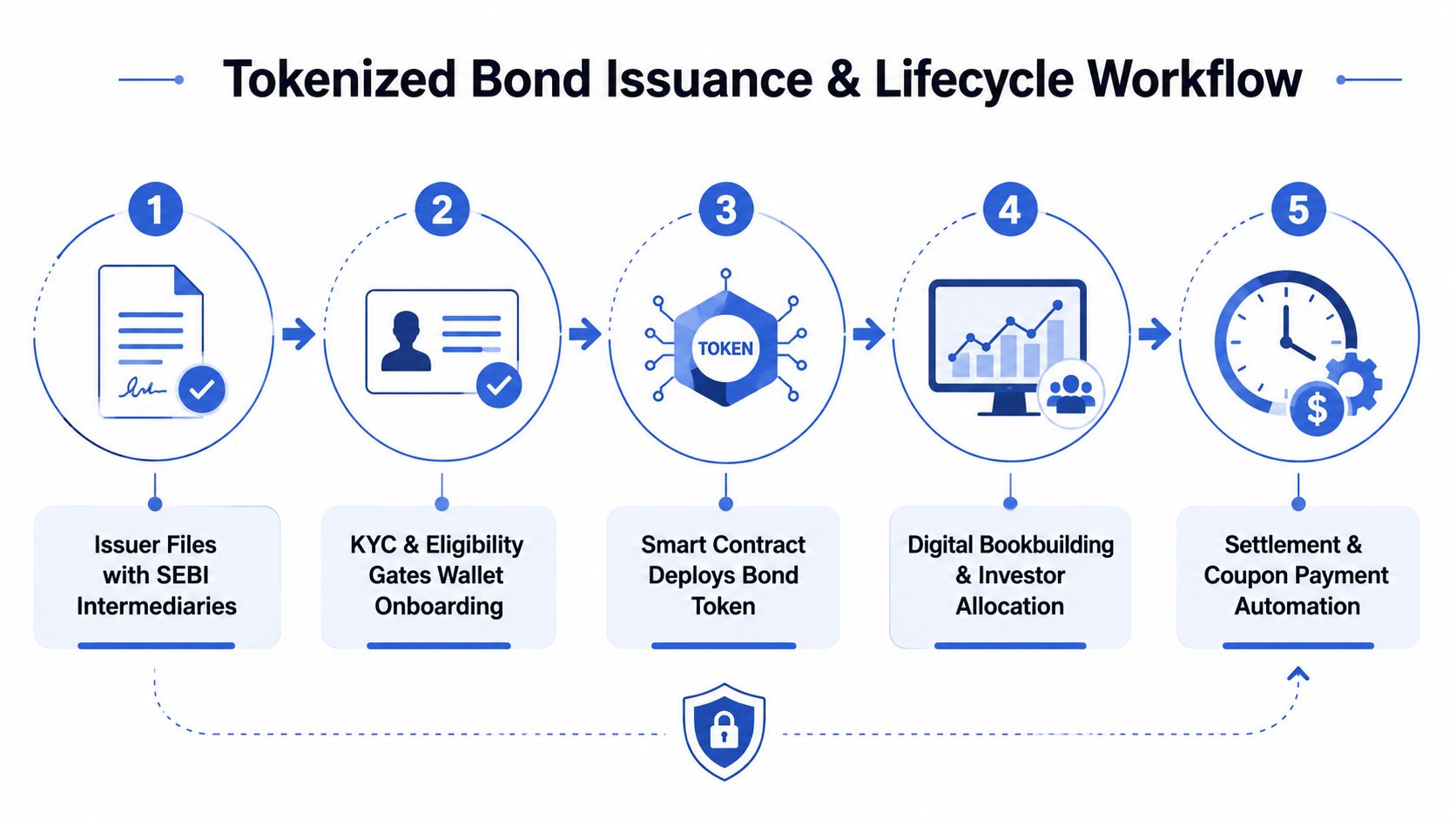
The operating sequence generally looks like this:
- Issue preparation: The issuer defines the bond's terms, investor eligibility, covenants, coupon schedule, maturity and redemption conditions within the applicable legal framework.
- Investor onboarding: Each investor passes KYC, beneficial-owner and eligibility checks before receiving access to the relevant wallet or account structure.
- Token creation: A permissioned ledger records the digital representation of the bond, with transfer restrictions and issue parameters enforced by the platform.
- Allocation and settlement: Investors subscribe through an approved process. The cash leg and asset leg need to settle in a coordinated way, rather than assuming that a blockchain transfer alone completes the transaction.
- Servicing and redemption: Coupon payments, corporate actions, early redemption, restructuring or default events are processed according to the legal documents, with the digital record updated to reflect the outcome.
The token ledger may provide the transaction history, but the legal register of holders, trustee instructions and regulatory reporting cannot be ignored. The platform must define which record is authoritative for each event and how discrepancies are resolved.
The step-by-step corporate bond tokenisation process should therefore be treated as an operating model, not a promise that every company can launch a digital issue immediately. A corporate bond tokenization platform can support digital issuance, smart-contract automation, settlement workflows and investor management, but authorised market participants still control regulatory access.
Smart contracts need exception paths
Routine coupon calculations can be automated when the payment schedule, record date, eligible holders and cash instructions are unambiguous. A production platform also needs controlled procedures for freezes, corrected records, failed payments, disputed ownership, sanctions screening results and legal holds.
Watch the workflow in context:
Tokenisation doesn't bypass disclosure norms, debenture trustee responsibilities or RBI settlement rules. It changes how the parties coordinate issuance, ownership and servicing.
The Real Gaps Between Pilot Promise and Private Company Readiness
The first practical warning is scale. Reuters reported that India's first tokenised corporate bond issue was expected for September 2026, with state-owned REC expected to issue roughly under ₹500 crore, or about $57 million, as a pilot, according to coverage of the planned issue. That is materially different from a broad private-debt marketplace with open retail distribution and continuous secondary liquidity.
The reported onboarding design is also operationally specific. The issue is expected to use two separate digital accounts, a wholesale CBDC wallet and a new electronic securities wallet. The cash and securities legs therefore depend on coordinated wallet, banking and custody infrastructure, not on an issuer deploying a token contract.
What the pilot does not prove
It doesn't prove that private companies can tokenise and market bonds without the normal securities process. It doesn't prove that retail access will be immediate. It doesn't prove that secondary trading will be deep enough to improve pricing or exits. Reuters reporting indicates that secondary-market development is expected later, which means the first rollout is focused more on controlled issuance and settlement than on a fully mature trading ecosystem.
The contradiction is important. India has a large corporate bond market, but the initial tokenised issue is deliberately constrained. That approach is sensible for a regulator testing settlement, reconciliation, servicing and control design. It also means private issuers should avoid budgeting on assumed liquidity or funding-cost improvements.
The unresolved operating questions
Private companies should obtain written answers from their intermediaries on:
- Cash settlement: Which RBI-aligned rail handles subscription, coupon and redemption funds?
- Wallet control: Who creates, approves, monitors and recovers investor wallets?
- Tax processing: How are withholding, statements and payment exceptions handled?
- Investor protection: Which party manages complaints, corrections and disputed transfers?
- Secondary activity: Which recognised venue and rulebook would govern later transfers?
- Record authority: How is the token ledger reconciled with the legal holder register?
A tokenisation project that answers only “which blockchain?” is incomplete. The actual readiness gap sits across banking, custody, investor operations, legal records and compliance reporting.
How Private Companies Can Prepare for Tokenized Bond Issuance
Preparation should start with governance and issue eligibility, then move into architecture. The board, CFO, treasury team and compliance function need a shared view of what the company is preparing for, because a tokenised bond remains a regulated financing transaction rather than a software launch.
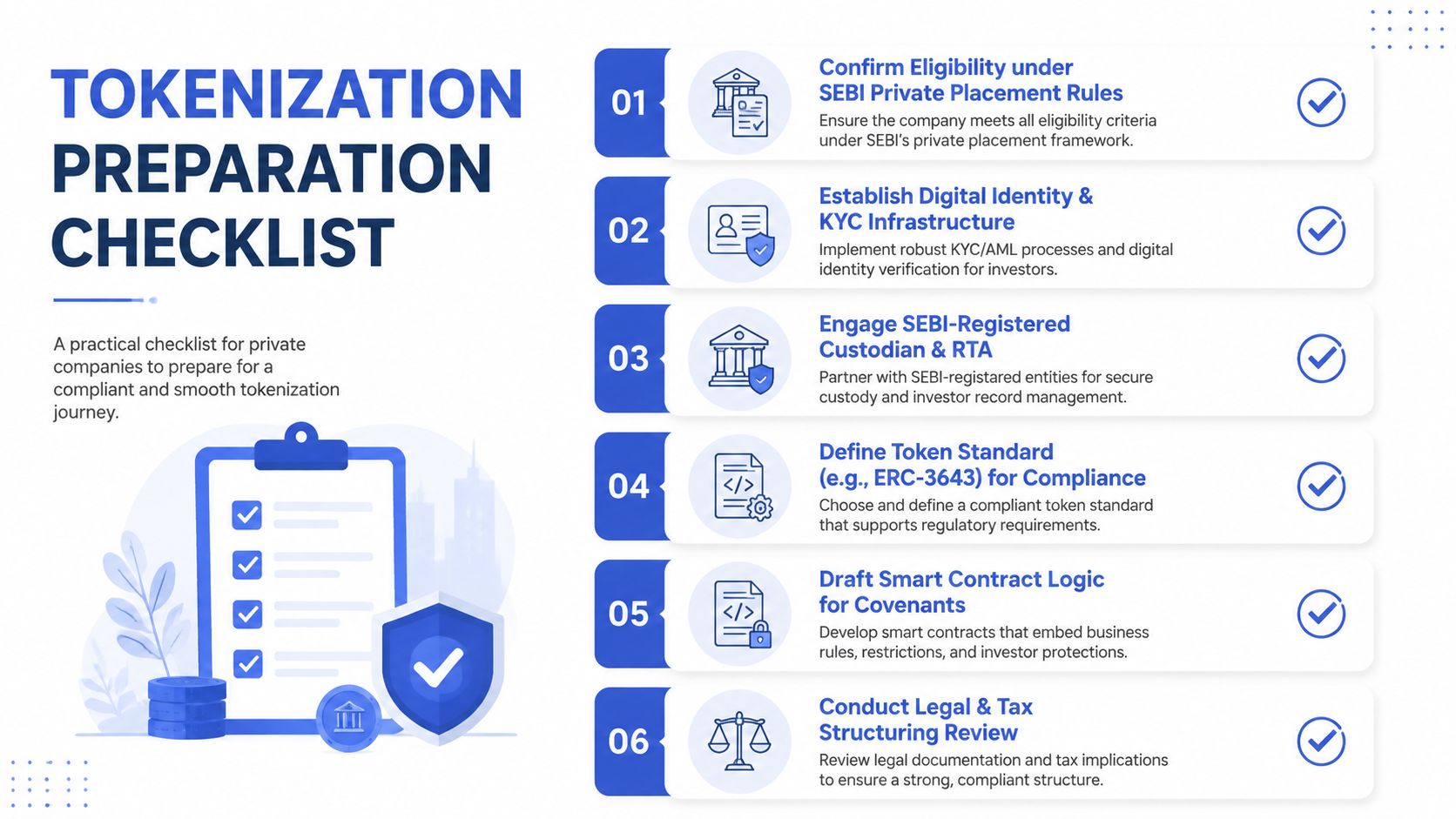
A readiness checklist
- Confirm the issue route: Review the proposed private placement or listed-debt structure with qualified advisers and the relevant SEBI-registered intermediaries. Don't assume the pilot creates an automatic route for an unapproved issuer.
- Map investor identity: Define how KYC, beneficial ownership, sanctions screening, investor eligibility and wallet ownership will be linked without exposing unnecessary personal data on a public ledger.
- Align settlement sequencing: Confirm the RBI approval and wholesale CBDC or other cash-leg dependencies before selecting the asset-ledger design. The token cannot settle independently of the money movement.
- Coordinate the control parties: Bring the debenture trustee, registrar and transfer agent, custodian, paying agent, technology vendor and internal audit team into the design process early.
- Prepare disclosures: Ensure issue documentation, financial information, risk factors, covenants and continuing reporting can be represented consistently across legal, operational and digital records.
- Approve an exception runbook: Document what happens when an investor fails eligibility checks, a payment fails, a key is lost, a transfer is blocked or a corporate action changes the bond terms.
A technical vendor should receive the operating requirements after these decisions are documented. Otherwise, the project can become a visually impressive token demo that can't pass custody review or reconcile with the registrar's records.
The guidance on corporate bond tokenisation platform development can help structure the technology conversation, but it shouldn't replace legal, tax or regulatory advice. The strongest preparation work is usually unglamorous: data dictionaries, approval matrices, reconciliation rules, access reviews and incident procedures.
Practical rule: Design the manual fallback before automating the routine path. Bond servicing needs a controlled answer for exceptions, not just a successful demo for normal coupon payments.
Infrastructure, Smart Contracts, and Scalability for Tokenized Debt
A production-ready bond tokenisation platform is a stack of coordinated services. The ledger is only the core record layer. Around it sit identity, compliance, custody, settlement, payment orchestration, reporting, observability and integration services.
The technical layers that matter
At the protocol layer, the issuer needs a token model that supports restricted transfers, verified identities, lifecycle states and controlled administrative actions. A public, unrestricted token standard is usually a poor fit for regulated debt because it doesn't enforce investor eligibility or transfer rules.
The ERC-3643 token standard is one example of a framework teams may evaluate for identity-aware digital securities. The correct choice depends on the final market design, intermediary requirements and integration constraints. A company shouldn't select a standard because it is popular in crypto. It should select one that can support the legal and operational control model.
Smart contracts should cover:
- Issuance: Supply creation, allocation, issue closure and authorised minting.
- Transfers: Whitelisting, holding limits, lockups, freezes and approved wallet checks.
- Servicing: Coupon schedules, record dates, payment status and redemption.
- Corporate actions: Calls, restructurings, consent events and amendments.
- Administration: Role separation, emergency pauses, upgrades and audit evidence.
Security and interoperability
Institutional custody requires disciplined key management. HSM-backed controls, role-based approvals, transaction limits, dual authorisation and recovery procedures should be designed before production deployment. Smart-contract testing and independent review are also essential, especially where a coding error could affect ownership, payment or redemption logic.
The platform must exchange data with banking rails, custodians, registrars, compliance systems and any recognised market infrastructure. APIs should expose clear event states, while an audit layer should preserve who approved an action, which data supported it and when the ledger changed.
Scalability isn't just transaction throughput. It includes the ability to support multiple issuers, separate permission domains, concurrent investor checks, reporting workloads, reconciliation cycles and regulatory changes without rewriting the entire platform.
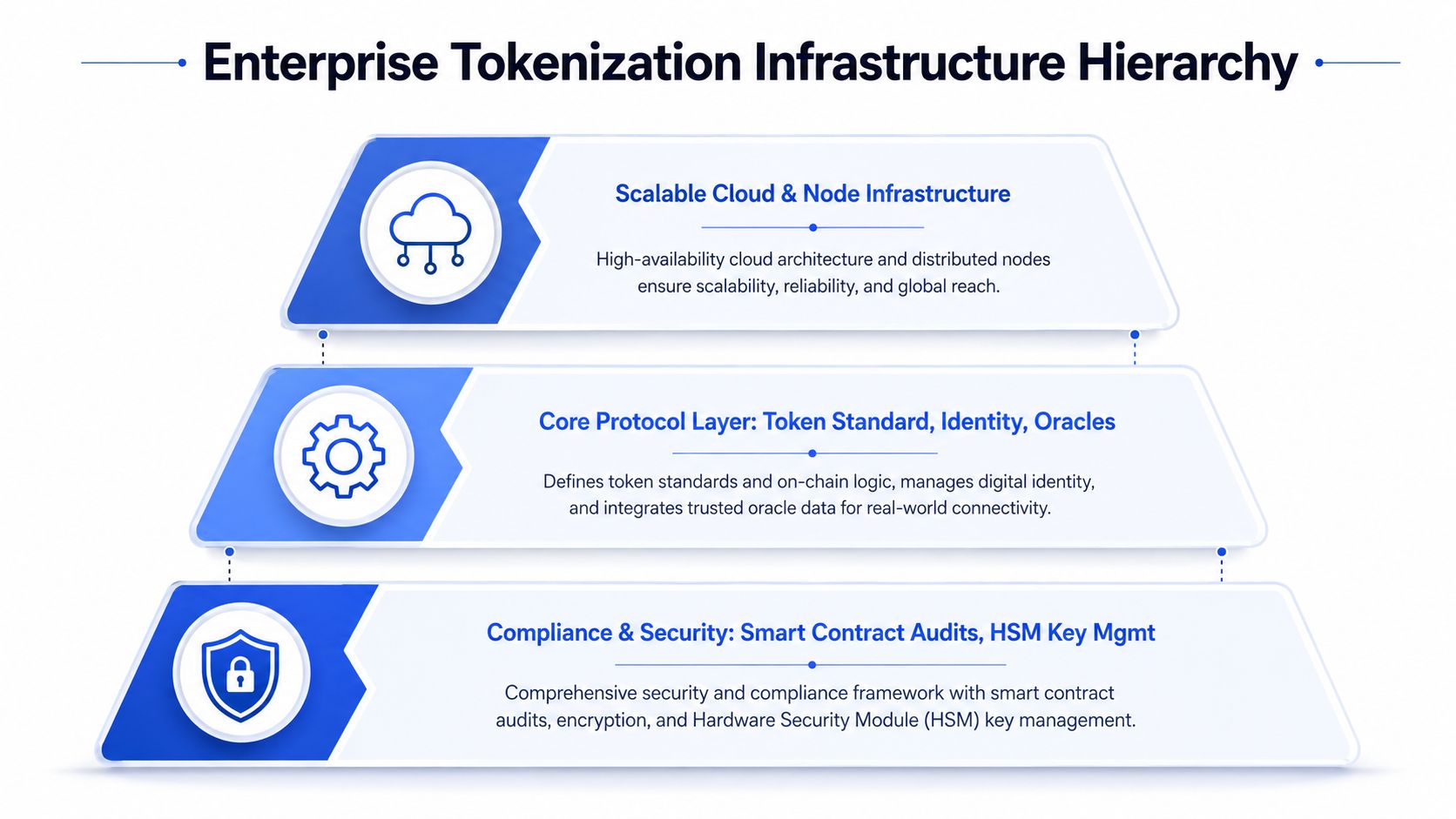
Blocsys Technologies develops secure and compliant corporate bond tokenisation platforms that enable digital bond issuance, smart-contract automation, faster settlements and efficient investor management for banks, financial institutions and capital markets worldwide. As a technology implementation partner, Blocsys doesn't provide SEBI approval or replace registered intermediaries. Regulatory authorisation remains with the relevant authorities and market institutions.
Frequently Asked Questions for Private Companies and Issuers
What does SEBI corporate bond tokenisation mean?
It refers to SEBI's exploration of distributed ledger technology for representing corporate bonds as digital tokens within regulated market infrastructure. The initiative is a pilot, not a blanket permission for private companies to issue crypto-like securities. The immediate action is to assess the proposed issue route, intermediary responsibilities, settlement design and technology controls with qualified advisers.
Why is SEBI exploring tokenised corporate bonds?
SEBI is testing whether DLT can support faster settlement, lower reconciliation costs and smarter servicing of debt instruments. The regulator is also coordinating the pilot with the RBI, so the exploration covers both the securities record and the cash settlement environment. Companies should treat this as a market-structure signal, not as proof that tokenisation automatically improves funding terms.
Can a private company issue tokenised corporate bonds now?
A private company can't assume that it can issue a tokenised bond by hiring a blockchain developer. The issue must fit the applicable securities framework and use the required recognised intermediaries, disclosures, custody arrangements and settlement rails. Companies should seek a transaction-specific legal and regulatory assessment before making any investor or fundraising commitment.
Does the pilot specify a minimum ticket size for private issuers?
The verified public information available here doesn't establish a general minimum ticket size for private-company participation. A company should not infer a threshold from the initial pilot issue. Its CFO should ask the proposed intermediary how investor eligibility, allocation, denomination and wallet controls would apply to the specific transaction.
Does RBI approval matter separately from SEBI approval?
Yes. SEBI governs the securities-market design, while the cash and settlement arrangement may depend on RBI approval and RBI-aligned rails. The pilot's reported use of a wholesale CBDC wallet and an electronic securities wallet shows why asset settlement and cash settlement need to be designed together.
What infrastructure does an issuer need?
The minimum design should cover issue management, permissioned ledger infrastructure, investor KYC, beneficial-owner mapping, wallet controls, custody, smart contracts, settlement integration, coupon payments, redemption, reporting and audit trails. It should also include exception handling for blocked transfers, failed payments, disputed records and corporate actions.
How do blockchain-based issuance and settlement work?
The bond terms are represented digitally, eligible investors receive controlled access, and the asset and cash legs are coordinated through approved settlement arrangements. A blockchain transfer alone doesn't complete a regulated settlement. The platform must reconcile the on-chain event with the authorised intermediary, custody records and legal holder information.
Can smart contracts automate coupons and redemption?
They can automate defined steps such as calculating scheduled obligations, identifying eligible holders and initiating payment instructions. They can't eliminate the need for payment accounts, tax processing, exception approval or human oversight. The contract should include controlled procedures for corrections, disputes, freezes, restructurings and default-related events.
What disclosure norms apply to tokenised bonds?
Tokenisation doesn't remove securities disclosures. The issuer and its advisers must determine the applicable documentation, continuing reporting, risk disclosures and issue requirements for the chosen structure. Because SEBI is also examining whether listed debt should face disclosure norms comparable to equities, companies should avoid hard-coding assumptions into a platform before the framework is settled, as reported in Reuters' account of the regulatory review.
Is secondary trading available automatically?
No. Creating a token doesn't create buyers, sellers, a recognised venue or a complete market rulebook. Reporting on the first issue indicates that secondary-market development is expected later. A private company should plan for controlled transfer records first and treat wider liquidity as a future possibility subject to regulatory and market-infrastructure decisions.
Should the bond use a public or permissioned blockchain?
A permissioned or hybrid architecture is generally more compatible with identity controls, approved participants, confidentiality and restricted transfers, but the final choice depends on the regulatory and institutional design. A public chain may create complications around privacy, unrestricted transfers, transaction screening and operational control. The decision should follow the compliance model, not precede it.
How does Blocsys fit into a tokenisation project?
Blocsys can act as a technology implementation partner for corporate bond tokenisation platforms, digital securities infrastructure, smart contracts, investor onboarding, ownership management, settlement workflows, compliance controls, asset servicing and integrations. It doesn't act as a SEBI market intermediary, provide regulatory approval or guarantee compliance. Companies evaluating scope and cost can also use the Blocsys software development cost estimator as an early planning tool.
Blocsys Technologies offers enterprise blockchain development for digital securities, corporate bond tokenisation, smart-contract workflows, investor management, settlement integrations and compliance-oriented infrastructure. Visit Blocsys Technologies to discuss your tokenised debt roadmap, define the required architecture and prepare for India's evolving regulated market environment.