A fintech team can deploy on Ethereum for settlement, Solana for high-throughput activity, and a Layer 2 for lower-cost execution, then discover that its users, assets, compliance records, and smart contracts still operate in separate silos. A token that exists on one network may be unavailable where the liquidity sits, while an enterprise workflow may depend on data that another chain can't verify.
That is the practical problem behind Blockchain Interoperability in 2026. This guide is for CTOs, developers, financial institutions, Web3 companies, and product teams evaluating cross-chain communication, bridges, messaging protocols, and multi-chain infrastructure. It focuses on the decisions that matter in production: trust assumptions, verification, finality, security, compliance, governance, and the difference between a quick bridge integration and a durable interoperability architecture.
Table of Contents
- The Shift from Isolated Chains to Multi-Chain Ecosystems
- Bridges Versus Interoperability Protocols
- How Cross-Chain Messaging and Asset Transfers Work
- Navigating Bridge Security and Regulatory Compliance
- Choosing the Right Interoperability Architecture
- Building Scalable Multi-Chain Solutions with Blocsys
The Shift from Isolated Chains to Multi-Chain Ecosystems
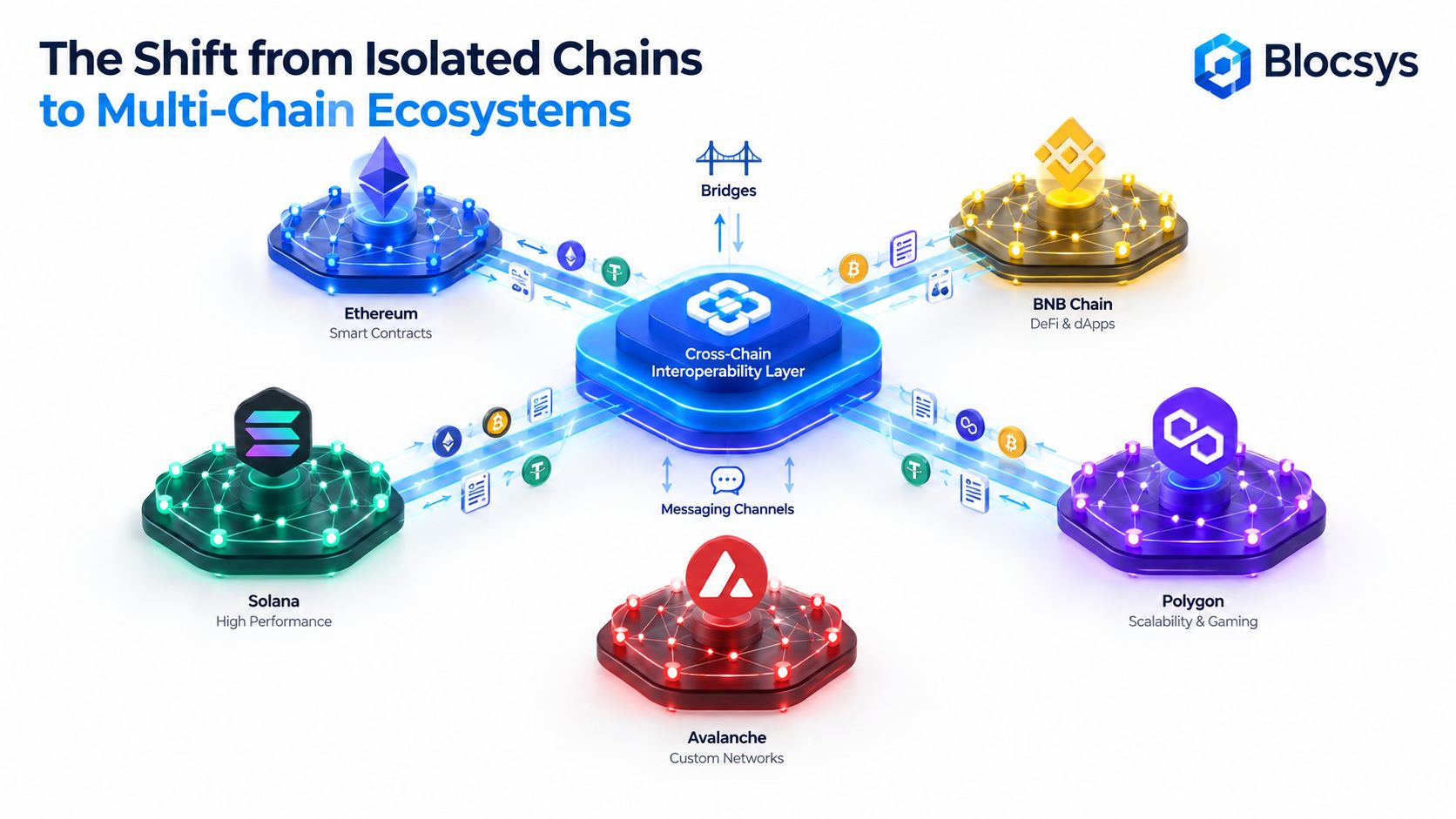
A production application can depend on Ethereum for assets, Solana for execution, Bitcoin for settlement, and Layer 2 networks for activity away from Ethereum mainnet. Each environment has its own execution model, consensus mechanism, fee structure, privacy requirements, and developer tooling. Without a communication layer, the application operates across separate financial and data systems, even when users experience them as one product.
Blockchain interoperability enables independent blockchain networks to exchange information, assets, and function calls with security, scale, and decentralised control. The definition of blockchain interoperability describes the core capabilities as cross-chain communication, asset transfer, and calls between blockchain functions. In production, that means an application on one network can trigger an action, verify an event, or represent an asset on another without depending entirely on manual exchange operations.
Why fragmentation affects production systems
A multi-chain product encounters several forms of isolation:
- Liquidity fragmentation: Capital is distributed across networks. Users may hold an asset on one chain while the relevant market or application runs on another.
- Data fragmentation: Identity, ownership, compliance, and transaction records may sit on separate ledgers that cannot natively validate one another.
- Execution fragmentation: A contract on one chain requires an intermediary protocol, proof system, or message route to call a contract on another.
- Governance fragmentation: Networks can apply different upgrade, validator, and dispute rules.
India shows why these infrastructure decisions now involve governance and compliance, alongside technical connectivity. Hashed Emergent's India Web3 Report states that India remained the world's number one blockchain adoption market in 2026, with on-chain value received doubling to $338 billion as of March 2026. It also records more than 1,000 Web3 startups and says the National Blockchain Framework had processed more than 396 million verifications across 105 million records.
These figures indicate an infrastructure requirement beyond retail trading. Public-sector, enterprise, and consumer systems need shared standards, verifiable state transfer, and message routing that can be audited across networks. The governance question is equally practical: who can validate a message, change the verification rules, resolve a dispute, or respond when a connected chain changes its assumptions?
India's developer base adds pressure for interoperable systems. A 2024 industry report on India's Web3 ecosystem says India's share of the global Web3 developer pool rose from 3% in 2018 to 12% in 2023, while more than 1,000 Web3 startups operated in the country and top Indian exchanges had more than 35 million trading accounts.
Architectural rule: Treat interoperability as shared infrastructure for messages, assets, and verification. Do not add a single bridge contract after the application has already been designed.
The strategic question is how an application preserves security and compliance across networks with different assumptions. Blocsys' discussion of cross-chain and omnichain blockchain systems is relevant because the design problem covers application coordination, governance, and auditable state transfer as well as token movement.
Bridges Versus Interoperability Protocols
A blockchain bridge usually connects two networks for a defined transfer or message path. A user deposits an asset into a contract on the source chain, an intermediary verifies the event, and the destination system releases or creates a corresponding representation. That model can work for a focused use case, but it concentrates risk around custody, minting authority, validator operations, and contract logic.
An interoperability protocol is broader. It can provide cross-chain messaging, arbitrary function calls, application-specific verification, and support for multiple asset models. Instead of asking only how to move a token, architects ask how a source-chain event becomes an authenticated instruction on the destination chain.
The trust model determines the real product
Different systems make different security compromises:
- External validator networks rely on a separate group of signers or guardians to observe and attest to events. They can support networks with different technical designs, but the validator set becomes a critical trust boundary.
- Relayer and oracle models separate message delivery from verification. Relayers transport information, while an oracle or verifier set confirms whether the source event is valid.
- Light-client verification uses a destination-side contract or client to verify source-chain consensus proofs. This can reduce reliance on external signers, although proof size, computation, and support for different chains create engineering constraints.
- Optimistic verification accepts a message provisionally and allows a challenge period. It may reduce verification overhead, but the application must handle disputes, delays, and the consequences of an incorrect assumption.
- Threshold networks and multi-party computation distribute control of keys or signing actions so that one operator can't authorise a transfer alone.
The phrase “trustless bridge” deserves scrutiny. Every live system has trust assumptions, whether they sit in cryptographic proofs, validator independence, smart contract correctness, governance, key management, or the ability to pause a route during an incident.
Architecture comparison
| Architecture Type | Trust Model | Primary Use Case | Latency Profile |
|---|---|---|---|
| Lock and mint bridge | Custody contracts plus validators or signers | Wrapped asset transfers | Depends on source finality and attestations |
| Burn and mint token standard | Token issuer and cross-chain verification | Native-style token representation across supported networks | Usually route and finality dependent |
| Messaging protocol | Verifiers, oracles, relayers, or proofs | Cross-chain data and function calls | Varies by verification model |
| Light-client bridge | Cryptographic verification of source state | Trust-minimised asset and message transfer | Proof generation and verification can add delay |
| Optimistic bridge | Economic challenge and dispute mechanism | Lower-cost or flexible message verification | Includes challenge and finality windows |
| Interoperability network | Dedicated validator or consensus layer | Multi-chain application coordination | Depends on network consensus and route design |
The distinction matters when connecting Ethereum, Solana, Avalanche, Polygon, Bitcoin, and Layer 2 ecosystems. EVM-compatible chains may share contract patterns, but that doesn't make their finality, gas behaviour, or security identical. Solana and Bitcoin introduce different execution and state-verification requirements, so a protocol that supports one route may not provide equivalent guarantees on another.
Teams building modular blockchain architecture should define the interoperability boundary early. Otherwise, a product may end up with a bridge for assets, a separate oracle for data, and custom middleware for application calls, creating overlapping trust models that auditors and operators must understand independently.
How Cross-Chain Messaging and Asset Transfers Work
A cross-chain transaction begins on one network and completes on another, but the destination chain can't trust a wallet message saying that the source event happened. It needs evidence. That evidence may come from validator signatures, an oracle network, a light-client proof, a zero-knowledge proof, or a threshold-controlled verification process.
The five operating stages
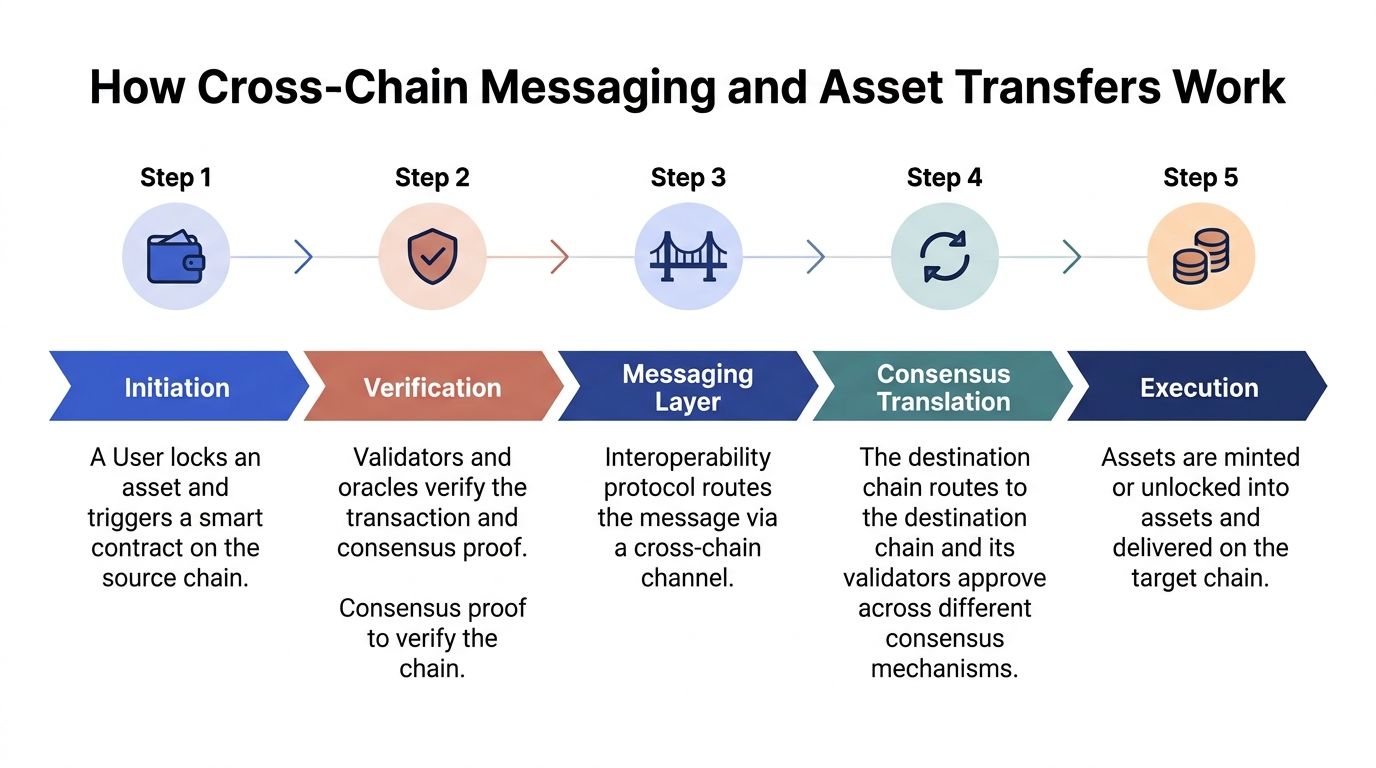
- Initiation: A user or application submits a transaction on the source chain. The transaction may lock an asset, burn a representation, or emit a message from a smart contract.
- Source confirmation: The system waits for the source chain to reach the required finality condition. “Confirmed” doesn't mean the same thing on every network, so route configuration must account for probabilistic and deterministic finality.
- Observation and verification: Relayers transport the event, while validators, oracles, light clients, or proof systems assess whether it belongs to the correct chain state and satisfies the application rules.
- Message delivery: The interoperability layer sends an authenticated payload to the destination chain. The payload can instruct a contract to mint, update a record, execute a function, or reject the request.
- Destination execution: A destination contract validates the proof or attestation, checks replay protection and nonce rules, then completes the action.
For a wrapped asset transfer, the source token may be held in custody while a representation is created on the destination network. For a burn and mint design, the source representation is destroyed and the destination contract creates an equivalent supply. For a message-only workflow, no asset needs to move at all. A source-chain compliance event could instead trigger an update to a permissioned contract on another network.
Modern systems also need to manage nonces, replay protection, message ordering, failed execution, refunds, gas payment, and route-level limits. A message can be valid but still fail on the destination chain because the target contract reverted, gas conditions changed, or the destination account lacks permission. Production systems should record each state transition and provide operators with a recoverable failure path.
The 2026 peer-reviewed study on privacy-preserving cross-chain compatibility reports benchmark performance above 1,250 transactions per second with latency below 400 milliseconds. Its architecture uses distributed threshold networks, multi-party computation, and key-shared supervision to reduce dependence on a single authority while preserving confidentiality. That benchmark is relevant to regulated enterprise systems, but it shouldn't be treated as a universal production guarantee. Performance depends on chain conditions, proof verification, payload size, route congestion, and the destination application's own execution limits.
Practical rule: Measure end-to-end completion, not only message delivery. A fast attestation has little operational value if destination execution, reconciliation, or compliance checks remain slow.
A peer-reviewed Twin-Token Protocol design, published in 2025, proposes synchronising tokens across blockchains through smart canisters on the Internet Computer Protocol. The approach focuses on maintaining cross-chain asset consistency, showing how emerging designs are moving beyond basic lock-and-mint flows.
Technical teams evaluating blockchain interoperability and cross-chain dApps should test message ordering, chain reorganisation handling, partial failure, duplicate delivery, validator outages, and emergency pauses. These behaviours matter more than a dashboard showing successful transfers under ideal conditions.
The following video provides additional context on cross-chain infrastructure and application coordination:
For teams that need a wider engineering scope, Blockchain Development can include custom blockchain applications for enterprises, startups, and governments across public, private, and hybrid networks.
Navigating Bridge Security and Regulatory Compliance
Cross-chain infrastructure creates a concentrated attack surface because one failure can affect multiple ledgers, custody contracts, token supplies, and application routes. The risk isn't limited to a flawed smart contract. Attackers may target operational wallets, signer coordination, upgrade authority, relayer infrastructure, governance controls, or the monitoring systems that should detect abnormal transfers.
An India-relevant incident demonstrates the operational dimension. CoinDCX reportedly suffered a $44.2 million breach connected to cross-chain bridge movement between Solana and Ethereum, as reported in Hashed Emergent's incident commentary. The lesson for exchanges and fintechs is direct: bridge-flow risk includes custody and treasury operations, not only code vulnerabilities.
Security controls that belong in the design
A production architecture should make every trust boundary visible:
- Key management: Use distributed signing, hardware-backed controls, role separation, and carefully limited hot-wallet exposure.
- Message limits: Set route-level caps, velocity controls, and asset-specific thresholds so an abnormal event can't drain an entire reserve immediately.
- Independent monitoring: Watch supply changes, signer behaviour, nonce gaps, unusual destination patterns, and contract upgrades.
- Circuit breakers: Give authorised responders a narrowly scoped ability to pause a route while preserving audit trails and recovery procedures.
- Upgrade governance: Document who can change verifier sets, token mappings, contract logic, and emergency parameters.
- Reconciliation: Compare source burns or locks with destination mints or releases, and investigate any mismatch before settlement continues.
The regulatory layer adds another constraint. India has no crypto law. Crypto is legal to hold and trade but isn't legal tender, while the framework remains centred on AML and counter-terrorist-financing obligations under the Prevention of Money Laundering Act rather than a dedicated blockchain or crypto statute, according to an India-focused legal analysis.
India's reporting requirements also became stricter in 2026. From April 1, 2026, exchanges were required to share transaction data directly with the Income Tax Department, Schedule VDA reporting became mandatory for FY2025-26, and cited non-compliance penalties included ₹200 per day for filing delays and ₹50,000 for inaccuracies, as described in India's crypto reporting coverage.
Governance is part of interoperability
A chain may verify that an event occurred without proving that the transaction is legally permissible. Cross-chain systems moving tokenised securities, stablecoins, or customer-linked assets need identity, jurisdiction, sanctions, reporting, privacy, and transfer restrictions to travel with the asset or remain enforceable at the destination.
The National Blockchain Strategy treats cross-border interoperability as a long-term goal, while India's policy direction calls for interoperability across application and core layers. India Science's IoBC project also frames an end-to-end standard for cross-chain asset and data transfer across permissioned and permissionless systems.
That makes standards and governance more important than a race to find the fastest route. The digital asset custody and compliance architecture around a product should define how custody, monitoring, authorisation, and reporting work before the first cross-chain transaction is released.
For capital-markets use cases, a corporate bond tokenization platform can combine digital bond issuance, smart contract automation, settlement workflows, and investor management. Cross-chain connectivity must then respect the asset's transfer rules and the institution's compliance obligations, not merely create a transferable token.
Choosing the Right Interoperability Architecture
The right architecture depends on the application's risk profile, not on the number of networks a protocol claims to support. A high-frequency DeFi application, a regulated asset issuer, and a public-sector data system need different guarantees around latency, privacy, recovery, and authority.
Start with the asset and message map
Document what must cross the boundary:
- Value: Native tokens, stablecoins, wrapped assets, tokenised securities, or settlement funds.
- Data: Ownership records, identity attestations, compliance status, oracle data, or enterprise events.
- Function calls: A source action that must execute a destination contract.
- Permissions: Rules determining who can transfer, redeem, freeze, or inspect the asset.
Then classify the consequence of failure. A delayed gaming item and an incorrectly minted financial instrument don't belong on the same route design.
Compare the architecture against five criteria
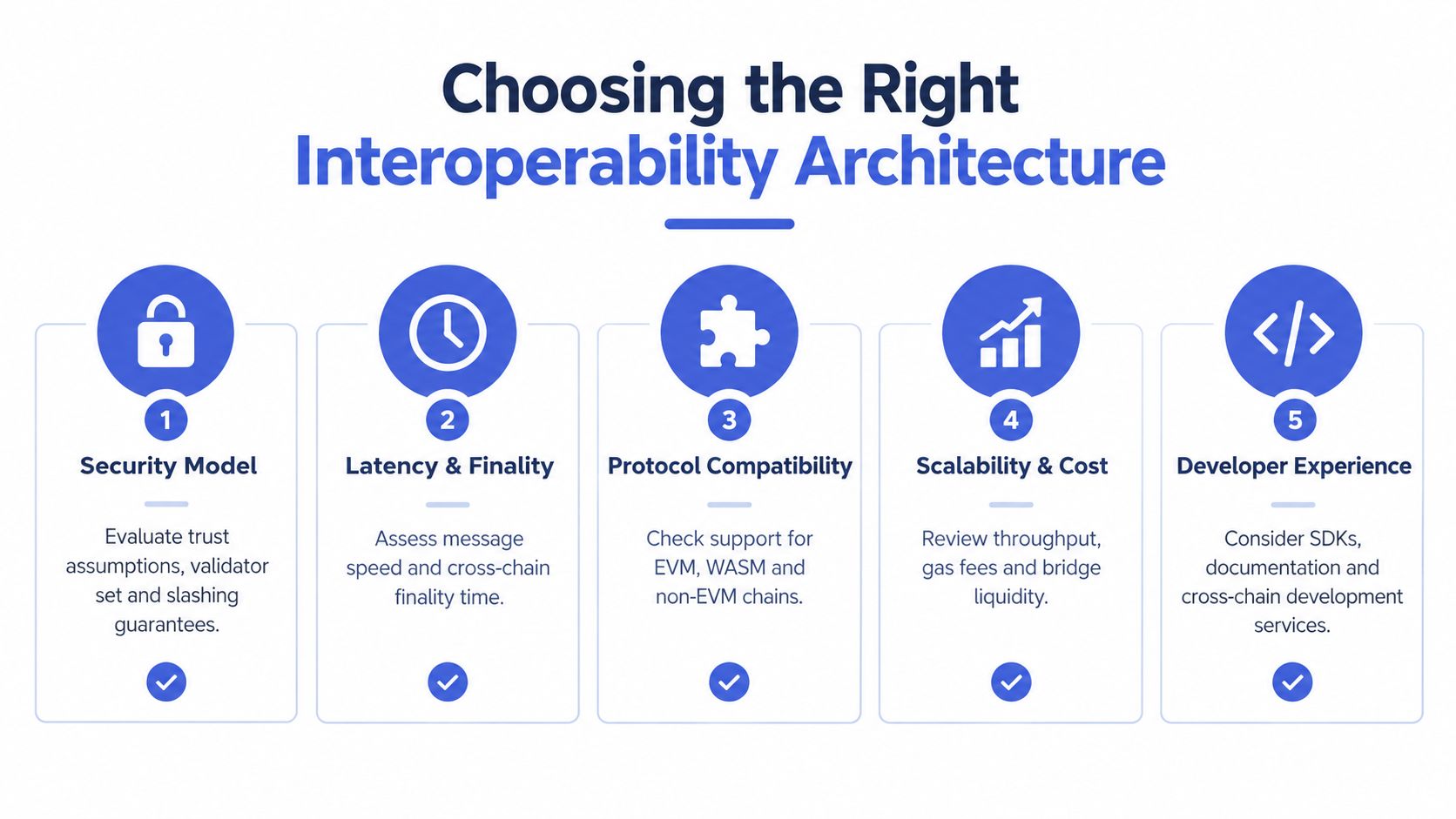
- Security model: Identify the validators, relayers, or proof systems. Ask what happens if a signer is compromised, a verifier goes offline, or governance changes the configuration.
- Finality and latency: Define when the source event is irreversible and how long destination execution takes. Don't promise instant settlement when the route relies on probabilistic confirmation or challenge windows.
- Protocol compatibility: Confirm support for EVM chains, WASM environments, non-EVM networks, permissioned ledgers, and the exact asset standard you need.
- Scalability and cost: Model gas, proof verification, liquidity, message volume, retries, and route congestion under realistic demand.
- Developer and operator experience: Review SDKs, documentation, observability, incident controls, testnet support, auditability, and rollback procedures.
Design for standards, not only routes
India's interoperability direction raises a broader question for every regulated market: will your application still work if the asset moves between a permissioned ledger, a public chain, and a different jurisdiction? The Canton Network and public blockchain interoperability discussion is relevant because enterprise systems often require privacy and controlled access alongside public-chain connectivity.
A sensible selection process includes a proof of concept with adversarial tests, a written trust model, a compliance review, and a migration plan. For a custom build, estimate engineering scope by mapping contract work, middleware, monitoring, custody, audits, network integrations, and support requirements. The software development cost estimator can help frame that discovery conversation, but the final budget depends on the architecture and required controls.
Building Scalable Multi-Chain Solutions with Blocsys
Cross-chain projects fail when teams treat interoperability as a plug-in rather than as an operating model. The application, bridge or messaging layer, custody system, compliance workflow, observability stack, and incident process must agree on what constitutes a valid transfer.
Blocsys Technologies works with fintechs, exchanges, and digital asset businesses on production-ready blockchain and AI-powered platforms. Its scope can include smart contracts, blockchain integrations, multi-chain applications, tokenisation systems, trading infrastructure, and compliance workflows designed around the client's technical and operational requirements.
For real-world assets, Tokenization Platform Development covers secure and compliant platforms for RWAs, securities, real estate, commodities, and digital assets using enterprise blockchain technology. That type of system benefits from an interoperability design that treats transfer restrictions, investor permissions, settlement records, and audit evidence as first-class requirements.
A practical engagement should begin with a route and risk assessment. The technical team can then choose between a messaging protocol, bridge model, light-client approach, threshold network, or a hybrid architecture, followed by proof-of-concept testing and production hardening.
Blocsys Technologies offers cross-chain infrastructure, smart contract, blockchain integration, and multi-chain application development for teams building secure Web3 and enterprise systems. Visit Blocsys Technologies to discuss your interoperability requirements, review the right architecture, and plan the next stage of your cross-chain roadmap.