Vietnam's digital asset opportunity in 2026 is less a retail crypto boom than a test of institutional execution. The country has formalised digital assets as a legal category, but licensed market access remains capital intensive and operationally demanding. This guide is for exchanges, fintechs, banks, custodians, investment firms, and technology companies evaluating the Vietnam Digital Asset Market 2026. It focuses on the practical outcome founders need, a defensible plan for licensing preparation, compliant crypto infrastructure, custody, trading, reporting, and staged investment.
The core recommendation is direct: design compliance architecture before product-market fit, but don't build every enterprise feature before you know which licensed operating model you're pursuing. Vietnam's pilot regime favours serious institutional operators, while offshore liquidity creates a difficult onboarding, execution, and surveillance problem for any domestic platform.
Table of Contents
- Why Vietnam 2026 Is an Institutional Gatekeeping Market, Not a Retail Boom
- Law 71, the Pilot Regime, and Decree 284 Explained for Builders
- Build, White-Label, or License the Right Way In
- Components of a Compliant Crypto Exchange Stack
- Regional Dev Rates and Realistic MVP, Growth, and Enterprise Budgets
- Phased Roadmap, ROI, and Cost-Saving Strategies for Compliant Infrastructure
- How Blocsys Builds Compliant Digital Asset Infrastructure for Vietnam
- The build capabilities that matter
- What is the Vietnam Digital Asset Market 2026 opportunity?
- How can a foreign business enter Vietnam's digital asset market?
- Does Vietnam require a licence for crypto exchanges and custodians?
- What KYC and AML capabilities does a Vietnam crypto platform need?
- How should custody and asset segregation be designed?
- What trading infrastructure does a compliant exchange require?
- What should a Vietnam digital wallet include?
- Can compliance technology guarantee licensing?
- How should a founder approach Vietnam crypto platform development?
- What does compliant crypto infrastructure cost in Vietnam?
Why Vietnam 2026 Is an Institutional Gatekeeping Market, Not a Retail Boom
The popular Vietnam crypto narrative starts with user demand. The more important question for a founder is whether the market can support a licensed, locally controlled operating model. Regional reporting has cited estimates of 17–20 million Vietnamese crypto owners and approximately $100–120 billion in annual crypto flows into Vietnam, much of it through offshore channels, but these figures describe latent demand, not accessible domestic liquidity or licensed revenue. Regional reporting on Vietnam's offshore crypto usage highlights the gap between ownership and regulated market infrastructure.
The pilot regime also imposes a substantial institutional filter. Reported requirements include VND10,000 billion in charter capital, at least 65% institutional ownership, at least two qualifying institutions jointly holding 35% or more, and a 49% foreign ownership cap. A custody and data-sovereignty guide for Vietnam describes the resulting model as one that favours bank-grade control, locally inspectable infrastructure, and institutional governance.
From a founder's perspective, this changes the investment thesis. You're not launching a retail exchange, buying traffic, and adding wallets later. You're deciding whether to become, partner with, or supply a technology layer to a narrowly licensed market participant.
The market structure founders should plan for
Vietnam's digital asset market has two conflicting features. Demand exists at scale, but domestic liquidity has historically leaked offshore. One 2026 industry summary cited FY25 trading volume of ₹51,252 crore, with 72.66% occurring offshore, connecting tax friction and compliance uncertainty to the location of trading activity. The 2026 India and regional digital asset compliance summary provides useful regional context, although India's rules shouldn't be transplanted into Vietnam's legal analysis.
The Vietnamese opportunity is therefore infrastructure-led. A domestic venue needs to absorb users without creating onboarding queues, weak transaction monitoring, custody bottlenecks, or fragmented reporting. That requires capital, governance, and technology before customer acquisition becomes the central problem.
| Indicator | Retail Narrative | Institutional Reality 2026 |
|---|---|---|
| User demand | Large crypto ownership creates immediate exchange opportunity | Ownership doesn't equal licensed, onshore liquidity |
| Market entry | Launch quickly with a standard exchange stack | Access depends on licensing, ownership, capital, and governance |
| Custody | Add wallets after the trading product works | Key management, segregation, reconciliation, and recovery shape the product |
| Compliance | Treat KYC and AML as onboarding features | Build monitoring, audit trails, reporting, and controls into core services |
| Growth strategy | Maximise retail acquisition | Secure institutional partners and a defensible operating model |
Practical rule: If the licensing structure requires institutional capital, your first customer may be a bank, fund, or licensed service provider rather than a retail trader.
Founders assessing institutional blockchain adoption in 2026 should apply that lens to Vietnam. The strongest entry strategy may be supplying custody, compliance, tokenisation, or trading infrastructure to licensed operators instead of trying to own the entire exchange.
Law 71, the Pilot Regime, and Decree 284 Explained for Builders
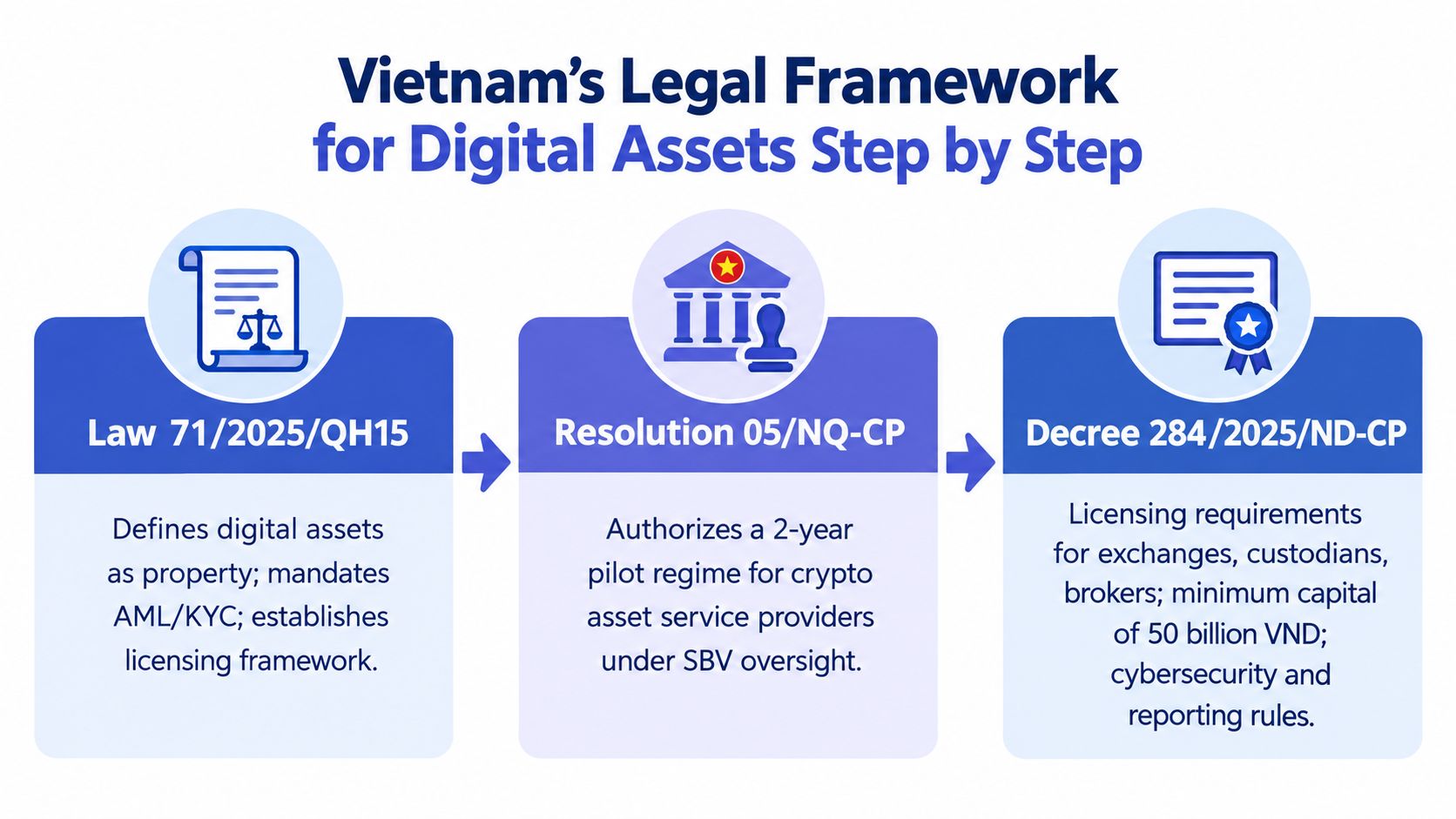
Vietnam's framework matters because it turns digital asset infrastructure from an offshore technology problem into a local operating-control problem. Law No. 71/2025/QH15, the Law on Digital Technology Industry, entered into force on 1 January 2026 and gives digital assets formal legal status as assets under the Civil Code, while excluding securities, digital currencies, cryptocurrencies, and other financial assets from that category. The legal analysis of Vietnam's Law on Digital Technology Industry explains why asset classification now needs to happen at the ledger, custody, and AML-rule layers.
The framework should be translated into technology in three steps.
Step one, classify the asset correctly
Law 71 means a platform can't treat every blockchain-based instrument as interchangeable. A token representing an asset, a cryptocurrency, a security, and a digital currency may require different admission rules, custody controls, transfer restrictions, and monitoring logic.
Build an asset registry that records:
- Asset category: Store the legal and operational classification attached to each instrument.
- Eligibility rules: Define who may hold, transfer, or trade the asset under the approved product model.
- Contract identity: Link smart-contract addresses, issuer records, custody accounts, and supported networks.
- Rule versioning: Preserve the rule set applied when a transaction was approved.
This registry should feed the exchange, wallet, settlement, and reporting layers. It shouldn't sit in a disconnected compliance spreadsheet.
Step two, treat Resolution 05 as an operating boundary
Resolution 05/NQ-CP authorises a pilot crypto-asset market regime. It doesn't make an unlicensed exchange compliant, and no software vendor can substitute for the applicant's legal entity, capital, ownership, governance, or approval process.
For builders, the resolution creates a clear architecture question. The platform must support a controlled operating environment in which investor onboarding, custody, trading, settlement, and reporting can be reviewed and governed by the licensed participant and relevant authorities.
That means permissions should be explicit. Separate applicant, operator, compliance, treasury, custody, and support roles. Record every privileged action. Make approval workflows configurable rather than hard-coding assumptions that become expensive to change during licensing review.
Step three, map Decree 284 to control evidence
Decree 284/2025/ND-CP is associated with the licensing requirements and penalties that take effect from 1 September 2026, including VND30 million to VND50 million fines for domestic investors trading on unlicensed platforms. Coverage of Vietnam's Decree 284 and digital asset market structure frames the key issue correctly, licensed onshore infrastructure must be ready to capture demand currently served offshore.
Your stack should produce evidence for:
- Identity and suitability: Who was onboarded, under which policy, and with what verification result.
- Wallet and custody events: Which account controlled an asset, when ownership changed, and who approved movement.
- Trade and settlement records: The order, execution, fees, settlement status, and exceptions.
- Monitoring decisions: Which rule triggered, who reviewed it, and what action followed.
- Regulatory reporting: What was filed, when it was filed, and whether the underlying records remain immutable.
A Web3 regulatory compliance framework can help organise these controls, but the licensed entity remains accountable for legal interpretation and regulatory engagement.
Build, White-Label, or License the Right Way In
Vietnam entry is an ownership decision before it is a software decision. Compare each route by licensing responsibility, local infrastructure and inspection requirements, source-code access, auditability, data control, and the cost of changing workflows during the pilot.
A bespoke build gives the operator the highest control over architecture and operating procedures. It also creates the longest route to launch and assigns responsibility for every design choice, including matching-engine resilience, wallet recovery, monitoring, and reporting. Choose this route when the business needs differentiated controls or expects frequent changes to the operating model.
A white-label crypto exchange can shorten delivery, but speed is useful only when the operator can inspect and control the underlying system. Review code ownership, deployment options, data flows, tenant separation, reporting depth, and the process for implementing policy changes. A fast launch that produces weak evidence or limits local control creates licensing risk later.
Licensing a foreign platform's brand and technology may provide a tested product model. It can also bind the operator to offshore infrastructure, vendor release cycles, and compliance assumptions built for another jurisdiction. Use this route only when the local operator controls user data, key management, audit records, and decisions affecting regulated operations.
| Path | Upfront Cost (USD) | Time-to-Market | Control | Compliance Readiness |
|---|---|---|---|---|
| Bespoke build | Varies by scope and control requirements | Longer | Highest | Can be designed around the pilot |
| White-label exchange | Varies by vendor, integrations, and customisation | Shorter | Moderate | Depends heavily on deployment and reporting depth |
| Foreign platform licence | Varies by licence, integration, and localisation | Potentially shorter | Lower to moderate | Must be tested against Vietnamese operating requirements |
The table avoids artificial price bands. Licensing conditions, infrastructure location, custody design, security controls, and integration scope can affect the economics more than the initial software quote.
Where founders usually under-resource the stack
Founders often budget for the customer-facing exchange and underfund the operating core. Reconciliation, exception handling, approvals, surveillance tuning, evidence retention, incident response, and external assurance continue after launch and may require more work than the first trading interface.
Approve a white-label exchange only after the vendor answers operational questions in writing. Confirm who owns data, who can access keys, where logs are stored, how records are exported, and whether the operator can keep running if the vendor changes its product or commercial direction. Test these controls before signing, not during a licensing review.
For firms exploring Tokenization Platform Development, apply the same ownership standard. Real-world assets, securities, real estate, commodities, and digital assets require asset-specific permissions and investor records. A generic token ledger does not replace those controls.
Components of a Compliant Crypto Exchange Stack
A compliant exchange is not a matching engine with a KYC plug-in. It's a controlled system that connects identity, eligibility, custody, execution, settlement, surveillance, reporting, and security evidence. Resolution 05 and Decree 284 make those operating controls central to the market-entry discussion, even though the exact implementation must be validated with Vietnamese counsel and the relevant authorities.
The trading core
The matching engine should support deterministic order handling, replayable event logs, cancellation controls, and clear separation between accepted, matched, settled, rejected, and reversed states. An in-memory engine can deliver low-latency execution, but a production platform still needs durable event persistence and recovery procedures. A distributed design can improve resilience and scale, but it adds complexity around ordering, consistency, and reconciliation.
The order book also needs market-specific controls. Define supported order types, price bands, self-trade prevention, market halts, privileged intervention, and surveillance triggers before connecting liquidity providers.
Custody and wallet controls
Use separate balances for customer assets, operating funds, fees, collateral, and unsettled transactions. The ledger should be the authoritative record of ownership, while blockchain balances and custody-provider balances are reconciled continuously.
Hot wallets should have tightly limited balances and policy-controlled withdrawals. Cold or offline arrangements can reduce exposure but may slow operational recovery. Multi-signature and MPC approaches can distribute signing authority, but the design must account for availability, approval friction, key-share governance, recovery, and local infrastructure control.
The custody architecture deserves its own design review. Digital asset custody and compliance architecture should be treated as a primary market-entry decision, not a wallet implementation detail.
Compliance services
A practical stack usually includes:
- KYC and AML: Identity verification, liveness, sanctions screening, risk scoring, source-of-funds workflows, and case management.
- Transaction monitoring: Rules for velocity, unusual counterparties, rapid movement, layering patterns, and wallet-risk indicators.
- Market surveillance: Detection of wash trading, spoofing, manipulation, coordinated activity, and abnormal order behaviour.
- Reporting: Exportable records for trades, transfers, customer accounts, suspicious activity reviews, and operational incidents.
- Audit trails: Immutable or tamper-evident records for configuration changes, privileged actions, approvals, and data corrections.
Vietnam-linked guidance cited in the brief describes stronger onboarding expectations, including selfie liveness, geolocation capture, and bank-account verification. Those controls should be implemented as policy-driven services, not scattered across front-end screens.
| Component | One-Time Build Cost (USD) | Ongoing Monthly Cost (USD) |
|---|---|---|
| Matching engine and order book | Scope-dependent | Infrastructure and support dependent |
| Wallet orchestration and custody integration | Scope-dependent | Custody, key-management, and support dependent |
| KYC and AML workflows | Scope-dependent | Vendor checks and case operations |
| Transaction monitoring | Scope-dependent | Screening, analytics, and investigations |
| Market surveillance | Scope-dependent | Rule tuning and review operations |
| Ledger and reconciliation | Scope-dependent | Continuous operations and exception handling |
| Reporting and audit trails | Scope-dependent | Storage, review, and regulatory support |
| Security operations and observability | Scope-dependent | Monitoring, incident response, and assurance |
| UI and administrative console | Scope-dependent | Product support and change management |
Real cost depends on deployment location, supported chains, banking integrations, custody model, assurance requirements, and the number of markets. Any vendor presenting a single fixed cost without clarifying those variables is selling a sales shortcut, not a reliable budget.
Regional Dev Rates and Realistic MVP, Growth, and Enterprise Budgets
Regional engineering rates can influence delivery economics, but they shouldn't determine architecture on their own. Vietnam-based teams may offer strong local context and competitive delivery, while Eastern European, Indian, and Latin American teams can contribute specialised engineering, security, product, or platform experience. The operator still needs one accountable architecture owner and a single control model across all locations.
Use regional rate comparisons as a procurement input, not as a substitute for a work breakdown. A lower hourly rate can become expensive when requirements are unclear, code ownership is weak, testing is incomplete, or compliance evidence must be rebuilt.
Budget by operating ambition
An MVP should be narrowly defined. It might include spot trading, basic onboarding, one custody integration, a controlled wallet workflow, a core ledger, and initial reporting exports. It shouldn't pretend to be an enterprise venue with every chain, fiat rail, asset class, and surveillance capability.
A growth build adds banking and fiat connectivity, deeper monitoring, multi-chain support, stronger reconciliation, liquidity integrations, and operational dashboards. An enterprise programme adds dedicated reliability engineering, advanced reporting, formal security assurance, redundancy, broader custody controls, and institutional account management.
The following budget table uses no invented dollar figures. The source brief provides no verified rates, team counts, timelines, or cost ranges, so a responsible estimate must remain scope-led.
| Tier | One-Time Build Cost (USD) | Monthly Opex (USD) | Team Size | Timeline (Months) |
|---|---|---|---|---|
| MVP | Scope-dependent | Vendor and operations dependent | Defined by control scope | Determined after discovery |
| Growth | Scope-dependent | Higher due to rails, monitoring, and support | Larger cross-functional team | Longer than MVP |
| Enterprise | Scope-dependent | Includes dedicated operations and assurance | Multi-disciplinary delivery and SRE | Longest delivery path |
Hidden costs to model before approval
Budget separately for identity and screening vendors, chain analytics, custody services, cloud or domestic infrastructure, penetration testing, smart-contract audits, legal advice, insurance, customer support, incident response, data retention, and reconciliation operations. These aren't optional line items for a platform seeking institutional credibility.
Teams also need to decide what stays internal. Keep risk policy, treasury authority, compliance ownership, product decisions, and incident command close to the licensed operator. Outsource commodity engineering or selected integrations only when the operator can inspect the work and retain control of deployment and records.
For firms that need a broader Blockchain Development capability, the relevant question is whether the delivery team can build across public, private, and hybrid networks while preserving the controls required by the operating model.
Phased Roadmap, ROI, and Cost-Saving Strategies for Compliant Infrastructure
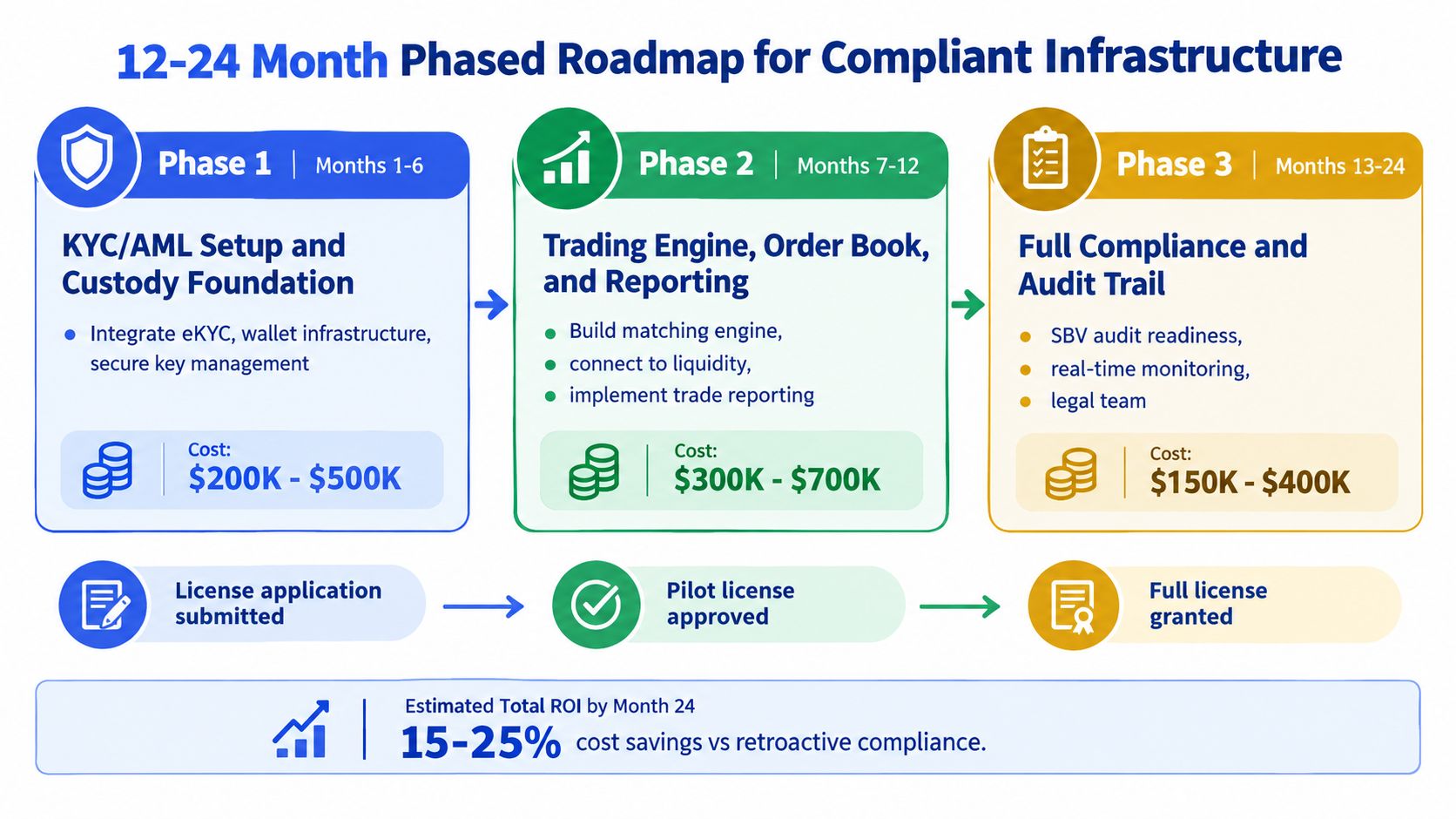
A 12 to 24 month plan should align technology spend with licensing preparation and institutional onboarding, not with a speculative retail launch. The first release should prove that identity, asset eligibility, custody, ledger controls, and reporting work together. Trading depth comes after the control plane is credible.
A practical sequence
Phase one establishes the foundation. Configure KYC and AML workflows, risk tiers, bank-account verification, wallet provisioning, key-management policies, asset segregation, and the internal ledger. The ROI trigger is readiness for a controlled licensing application and early institutional design-partner validation.
Phase two adds execution. Build or integrate the matching engine, order book, liquidity connections, settlement workflows, fee logic, reconciliation, and trade reporting. The ROI trigger is a functioning pilot environment with controlled users and measurable operational evidence.
Phase three hardens the platform. Add real-time monitoring, formal incident response, advanced reporting, security testing, disaster recovery, and audit support. The ROI trigger is institutional onboarding and repeatable operations, not vanity user growth.
Cost control comes from sequencing, not from deleting controls. Use shared KYC and screening integrations where appropriate, standardise surveillance rules, adopt proven ledger and custody components, and stage assurance reviews around actual release boundaries. Don't pay for every supported chain before the licensing and liquidity model identifies which assets matter.
Budget discipline: Build the control plane first, then expand the trading surface. Retrofitting ownership records and custody segregation costs more than designing them into the ledger.
The roadmap visual contains illustrative cost and savings figures. Those figures aren't verified by the provided data and shouldn't be treated as a commercial quote or expected return. A founder should commission a discovery-led estimate based on supported assets, integrations, deployment model, security requirements, and operating responsibilities.
How Blocsys Builds Compliant Digital Asset Infrastructure for Vietnam
Blocsys Technologies can act as a technology development partner for a licensed operator, pilot applicant, financial institution, or fintech that needs a configurable digital asset platform. Its role is to design and build software. It doesn't provide regulatory licences or legal approvals, and the operator remains responsible for licensing, policies, governance, and regulatory engagement.
The architecture should be modular because Vietnam's pilot environment may evolve while the product is being built. A founder shouldn't have to replace the trading core to change an onboarding rule or add a reporting field.
The build capabilities that matter
Blocsys can support a platform architecture covering:
- Trading infrastructure: Matching-engine integration, order-book services, liquidity connections, fee calculation, and settlement states.
- Custody controls: Multi-signature cold and hot wallet architecture, policy-controlled withdrawals, key-management workflows, and reconciliation.
- Compliance pipelines: KYC and AML integrations aligned to the operator's interpretation of Law 71 and applicable guidance.
- Monitoring: Transaction monitoring, wallet-risk signals, case management, market surveillance, and escalation workflows.
- Reporting: Configurable reporting modules, evidence retention, audit trails, and operational dashboards for reviews associated with Decree 284.
- Product interfaces: Modular customer, institutional, compliance, treasury, and administrator experiences.
The key technical trade-off is flexibility versus speed. A fully bespoke platform offers control, but it needs more product definition and testing. A configurable foundation can accelerate delivery, provided the operator can inspect the deployment model, data flows, access controls, and source-code arrangements.
Blocsys's dedicated blockchain development team model is relevant when the programme needs sustained engineering ownership rather than a short implementation sprint. The engagement should begin with a regulatory and operating-model workshop, followed by an architecture map, control matrix, delivery backlog, testing plan, and staged budget.
The Software Development Cost Estimator can help structure an early scope discussion, but it shouldn't replace technical discovery. Cost depends on chain coverage, custody, fiat rails, reporting, security, data residency, institutional workflows, and the degree of customisation.
Frequently Asked Questions
What is the Vietnam Digital Asset Market 2026 opportunity?
Vietnam's 2026 opportunity is an institutionally controlled digital asset market rather than a simple retail acquisition opportunity. Digital assets have formal legal status as assets under Law 71, while the pilot regime requires licensed service providers and significant capital, ownership, governance, custody, monitoring, and reporting capabilities.
How can a foreign business enter Vietnam's digital asset market?
A foreign business should first choose between becoming part of an eligible local operator, partnering with an institution, supplying technology, or pursuing a structure that satisfies Vietnamese licensing and ownership rules. It shouldn't launch an unlicensed domestic exchange and assume that an offshore platform or foreign software licence transfers regulatory permission.
Does Vietnam require a licence for crypto exchanges and custodians?
The pilot regime requires licensed crypto-asset service providers for covered domestic market activities. Software can support the application and operating controls, but it can't replace the applicant's legal entity, capital, ownership, governance, licensing submission, or regulatory approval.
What KYC and AML capabilities does a Vietnam crypto platform need?
A Vietnam crypto platform should support identity verification, selfie liveness, geolocation capture, bank-account verification, sanctions screening, customer risk scoring, source-of-funds workflows, suspicious-activity review, transaction monitoring, case management, and reporting. The exact control set should be validated against current Vietnamese requirements and the licensed operator's risk policy.
How should custody and asset segregation be designed?
Custody should separate customer assets from operating funds and maintain an authoritative internal ledger linked to blockchain and custody balances. Use controlled hot-wallet limits, secure cold or offline procedures where appropriate, multi-party approval, recovery plans, continuous reconciliation, and clear records showing who controlled each asset and when.
What trading infrastructure does a compliant exchange require?
A compliant exchange needs an order-management layer, matching engine, order book, durable event logs, market controls, settlement workflows, fee logic, liquidity integrations, reconciliation, customer ledgers, market surveillance, and reporting. The trading engine should connect to identity, eligibility, custody, and monitoring services rather than operate as an isolated technical component.
What should a Vietnam digital wallet include?
A Vietnam digital wallet should include controlled wallet creation, address management, transaction policy checks, withdrawal approvals, key-management governance, blockchain confirmation handling, risk screening, reconciliation, recovery procedures, and an audit trail for administrative actions. The wallet should also respect the operator's custody, asset-segregation, security, and data-control model.
Can compliance technology guarantee licensing?
No. Compliance technology can produce controls, workflows, records, alerts, and evidence, but it doesn't guarantee a licence or legal compliance. The operator needs qualified Vietnamese legal advice, appropriate governance, eligible ownership and capital, documented policies, security controls, and engagement with the relevant authorities.
How should a founder approach Vietnam crypto platform development?
Start with a market-entry decision and control matrix, then define the asset classes, users, custody model, supported chains, trading scope, reporting obligations, deployment location, and institutional partners. Build an MVP around onboarding, custody, ledger integrity, controlled trading, monitoring, and reporting before expanding to broader assets or retail features.
What does compliant crypto infrastructure cost in Vietnam?
There's no responsible universal cost figure because the brief provides no verified regional rates or cost ranges, and scope changes the budget substantially. Obtain a work-breakdown estimate covering engineering, custody, KYC and AML vendors, monitoring, infrastructure, security assurance, legal support, insurance, support, and ongoing reconciliation, then model separate MVP, growth, and enterprise scenarios.
A successful Vietnam entry won't be won by the loudest retail launch. It will be won by the operator that can prove controlled onboarding, protected customer assets, reliable execution, defensible records, and rapid response when a transaction or security event requires investigation.
Blocsys Technologies offers custom blockchain, digital asset, wallet, trading, smart contract, and compliance-integration development for businesses planning a Vietnam market entry. Visit Blocsys Technologies to discuss your operating model, architecture, and MVP-to-scale development roadmap with a technology team.