
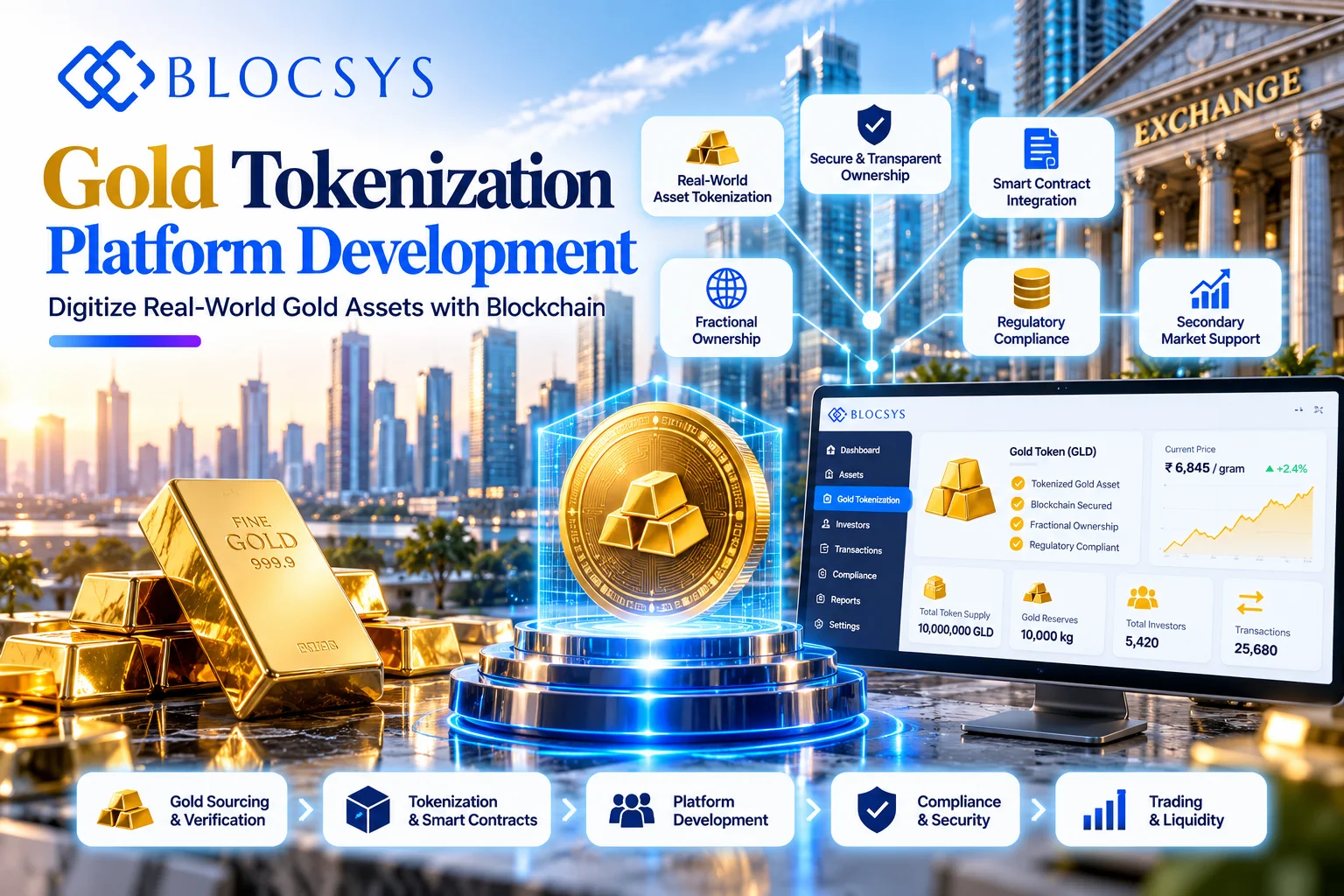
A vault operator has confirmed that a new allocation of gold is ready. The product team has prepared the token contract. Compliance has approved the customer journey in principle. Yet the launch remains blocked because nobody can answer a basic institutional question with enough precision: which physical gold supports each token, who controls it, and how can an auditor verify the relationship?
That is the difference between a consumer-facing digital gold app and gold tokenization platform development for a bank, fintech, asset manager, gold business, or digital asset platform. This guide explains how to connect physical gold with digital tokens through custody integrations, issuance controls, smart contracts, reconciliation, wallets, redemption workflows, and audit-ready compliance infrastructure. It also addresses the difficult part that many tokenization plans understate, the legal and operational accountability that blockchain technology cannot provide by itself.
Table of Contents
- The Reality of Gold Tokenization Platform Development
- How Gold Tokenization Works in Practice
- Core Components of a Gold Tokenization Platform
- Physical Gold Custody and Vault Integration
- Compliance, Proof of Reserves, and Reconciliation
- Gold Tokenization Platform Development Process
- Partnering for Enterprise Digital Gold Infrastructure
The Reality of Gold Tokenization Platform Development
A customer sees a simple balance, a buy button, and perhaps a redemption option. Behind that interface, an enterprise gold tokenization platform must coordinate a vault, issuer, compliance team, blockchain network, payment system, wallet infrastructure, auditors, and customer support operations. Each party has a different responsibility, and a production system must preserve those boundaries rather than hide them behind a single smart contract.
India illustrates why the opportunity deserves serious architectural planning. The World Gold Council’s India market update reports that digital gold purchases through UPI rose from INR 8 billion, or US$88 million, in January 2025, to INR 21 billion, or US$231 million, in December 2025, a near three-fold increase over the year. The same source estimates 13.5 tonnes purchased in 2025. That demand points to sustained interest in small-ticket, digitally distributed gold exposure, particularly through mobile payment rails that can support tokenized ownership and settlement.
The historical progression matters too. The World Gold Council’s India gold investment research states that the first digital gold product appeared in 2012, fintech participation accelerated from 2016, and by 2022 about 16 companies offered digital gold products with estimated trading volume of 4 to 5 tonnes, compared with less than 0.5 tonne in 2016. The market has moved beyond a purely experimental concept, but operational scale makes weak controls more consequential.
The gap between a token and an enforceable claim
A token can record a balance. It can’t, on its own, prove that a custodian holds the right bars, that the issuer has authority to mint, or that a customer has a legally enforceable claim to redemption. Those questions depend on contracts, custody arrangements, disclosures, jurisdictional rules, insurance, audit procedures, and operational controls.
Practical rule: Design the platform so an auditor can trace a token event back to a custody event without relying on an administrator’s spreadsheet.
The most resilient projects begin with an asset model, not a blockchain selection. They define whether gold is allocated or pooled, how ownership is represented, who may mint and burn, what redemption means, and which events require human approval. The technology layer then enforces those decisions through permissioning, state transitions, APIs, and immutable records.
For businesses evaluating real-world asset tokenization, gold is a demanding use case because the physical asset remains central. A credible solution must connect digital convenience with custody accountability, rather than treating token issuance as the product itself.
How Gold Tokenization Works in Practice
Gold tokenization converts a custody relationship into a digital asset lifecycle. The exact legal effect differs by jurisdiction and contract, but the operating model usually follows a controlled sequence from physical allocation to token creation, transfer, and redemption.
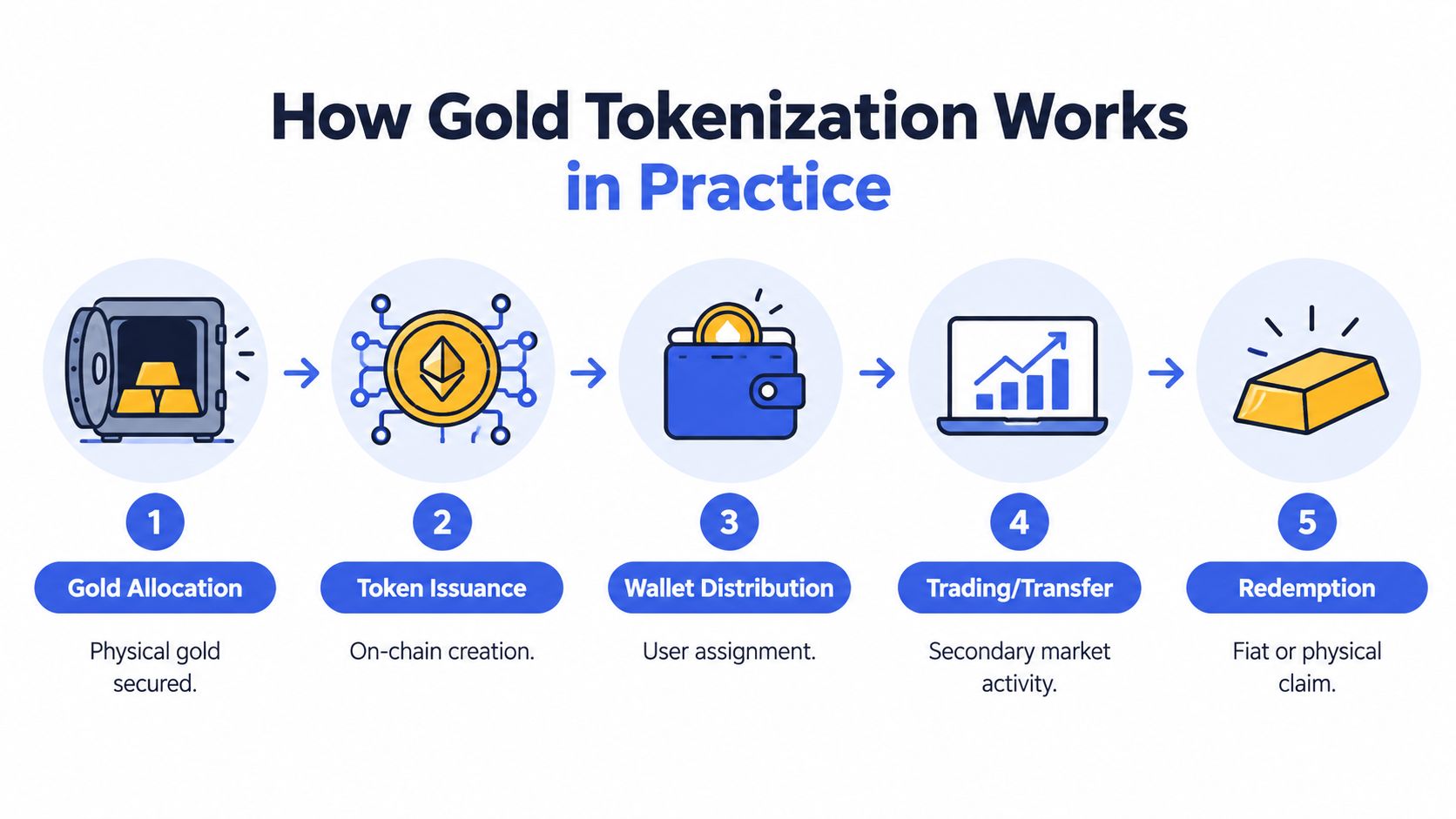
A five-stage operating lifecycle
Gold allocation begins when an issuer or approved custodian accepts eligible metal into a controlled vault account. The system should capture bar identity, weight, purity, location, status, and relevant custody documentation. The token shouldn’t be minted merely because a purchase order exists.
Token issuance follows an approved custody event. An issuance engine validates the reserve record, checks minting authority, creates the appropriate quantity of tokens, and records the relationship between the supply and the underlying asset pool. Smart contracts should reject unauthorised minting and preserve a clear event history.
Wallet distribution assigns tokens to a customer wallet, omnibus account, or institutional custody account. The platform must distinguish between a blockchain address, the verified legal customer, and the beneficial owner recorded in the platform’s books.
Trading and transfer changes the on-chain holder, but the platform still needs eligibility rules, sanctions screening, transfer restrictions, transaction monitoring, and reconciliation. A technically valid blockchain transfer may still be commercially or legally unacceptable.
Redemption reverses the process. The holder submits a request, the platform validates eligibility and available balance, tokens are locked or burned, and the custodian either prepares physical delivery or processes a cash settlement under the published terms.
The burn event is important, but it isn’t enough by itself. The platform must also create a settlement record showing what happened to the corresponding reserve, including delivery, sale, allocation changes, or release from custody.
A corporate bond tokenization platform follows a different asset model, but the same architectural principle applies. Issuance, ownership, lifecycle events, and investor records need explicit controls rather than being left to an unstructured token contract.
A useful design test is to ask what happens when a redemption request arrives during a custody data delay, a blockchain outage, a compliance hold, or a price discrepancy. Production-ready digital gold infrastructure makes those exception states visible and recoverable.
Core Components of a Gold Tokenization Platform
A commercial gold tokenization platform should be modular. The issuer may change its vault provider, blockchain network, payment partner, or compliance vendor over time. Coupling every function to one provider creates operational fragility and makes regulatory changes expensive to implement.
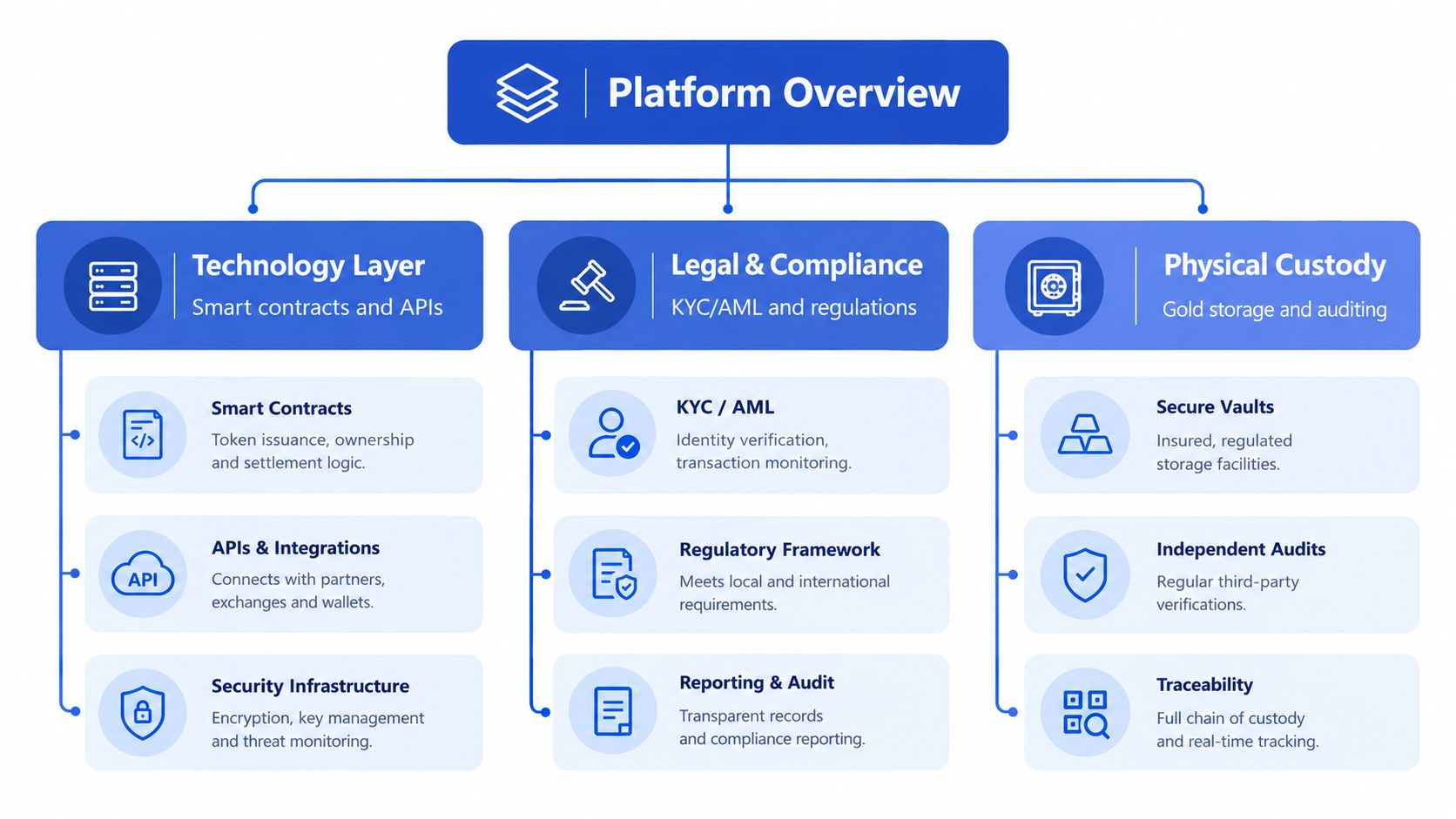
The technology layer
The technology layer contains the systems that create, manage, and expose digital ownership records.
- Blockchain network: A public, private, or hybrid network records token movements and contract events. The choice affects transaction costs, privacy, interoperability, governance, and operational control.
- Token engine: Issuance, burning, pausing, freezing, recovery, and supply controls should run through explicit workflows with role separation.
- Smart contracts: Contracts enforce transfer rules and lifecycle states. They should be independently reviewed and designed for upgrade governance, emergency controls, and transparent event logging.
- Wallet services: The platform may support hosted wallets, external wallets, institutional custody, or a combination. Each model changes the security and compliance burden.
- API gateway: APIs connect the platform to banks, payment providers, vault systems, accounting tools, customer applications, market data, and reporting environments.
The administrative console is equally important. Operations teams need views for reserve status, pending mint requests, redemption queues, failed integrations, suspicious transfers, user restrictions, and contract permissions. A token lifecycle management platform can help organise these events, but the gold-specific custody and legal model still requires dedicated controls.
Compliance and custody layers
The compliance layer handles identity verification, sanctions screening, transaction monitoring, jurisdiction rules, disclosures, investor eligibility, complaints, and audit exports. It shouldn’t be embedded solely in the front end. Transfer permissions and issuance authority need enforcement at the service and smart contract layers as well.
The physical custody layer records the asset that the token references. It includes vault connectivity, bar-level records where applicable, inspection evidence, reserve attestations, insurance information, allocation status, and redemption instructions. Technology teams can integrate this information, but they don’t become the custodian by doing so.
Blockchain Development can cover the underlying public, private, or hybrid network and application infrastructure. The platform owner must still define the legal claim, appoint responsible counterparties, and establish controls for the physical metal.
| Platform concern | Technology responsibility | Non-technology responsibility |
|---|---|---|
| Token supply | Enforce mint and burn rules | Confirm valid underlying allocation |
| Ownership record | Store and expose transaction history | Define the legal effect of ownership |
| Reserve status | Ingest and reconcile custody data | Hold, insure, inspect, and attest to gold |
| Redemption | Orchestrate requests and settlement states | Deliver metal or process the agreed settlement |
| Compliance | Apply configurable controls | Interpret and approve the applicable legal framework |
This separation is not bureaucracy. It prevents an immutable ledger from creating false confidence about obligations that only contracts, custodians, issuers, and regulators can establish.
Physical Gold Custody and Vault Integration
The most important integration in a gold-backed token system is not the exchange connection. It is the bridge between the digital supply and the physical reserve. If that bridge is weak, a polished wallet and audited contract won’t repair the trust problem.
Comparing custody connectivity models
An API-driven model can send allocation, release, inspection, and redemption status directly from a vault or custody system into the platform. It supports faster operational updates and reduces manual data entry, but it introduces dependency on authentication, data quality, uptime, schema changes, and the custodian’s ability to expose trustworthy events.
A batch model imports signed files or periodic statements. It may be easier to implement with established vaults that lack modern APIs, and it can preserve a clear approval process. The trade-off is stale reserve information, slower exception handling, and greater reliance on controlled human reconciliation.
| Integration model | Strength | Risk | Suitable control |
|---|---|---|---|
| Real-time API | Faster status updates and automation | Integration or source-data failure | Signed messages, schema validation, replay protection |
| Scheduled batch | Practical for legacy custodians | Reserve data can become stale | Dual approval, file hashes, exception queues |
| Manual attestation | Flexible during early pilots | High operational and fraud risk | Segregated duties and documented evidence |
| Hybrid model | Combines automation with oversight | More complex operating procedures | Automated matching plus human approval for exceptions |
Allocated and unallocated gold
The platform must state whether tokens reference specific allocated bars or a claim on a broader pool. Allocated custody can support bar-level traceability, while pooled or unallocated arrangements may simplify operations but create a different legal and counterparty profile. Neither label should be used as a marketing substitute for clear contracts and disclosures.
Bar records may include serial number, refiner, weight, purity, location, encumbrance status, and movement history. The platform should protect sensitive custody data while making enough evidence available for authorised auditors, regulators, and customers.
Custody principle: The ledger should report what the custodian has verified. It should never manufacture reserve certainty from an unverified database field.
The digital asset custody and compliance framework should therefore cover key management, role separation, access logs, custody messages, asset movements, and incident procedures. The issuer also needs a documented process for vault changes, insurance events, bar substitutions, liens, and discrepancies.
Compliance, Proof of Reserves, and Reconciliation
Blockchain immutability proves that a transaction was recorded according to the network’s rules. It doesn’t prove that the issuer had authority to mint, that the custodian held sufficient gold, or that a token holder can enforce a redemption claim. Proof of reserves is an operating control, not an automatic property of tokenization.
India’s current position demonstrates the uncertainty. Market coverage states that India lacks a dedicated regulatory framework for tokenised gold, while blockchain-based gold tokens are treated as virtual digital assets with a flat 30% tax on gains and 1% TDS on transfer consideration. The same market report on tokenised gold notes that SEBI has clarified digital gold products are neither notified securities nor regulated commodity derivatives.
A separate regulatory overview of digital gold in India says SEBI has described digital gold products as unregulated, while industry reporting discusses possible tighter oversight and physical-gold backing requirements. The appropriate response isn’t to predict the final rules. It is to build configurable controls before the rules are finalised.
A defensible reserve control
A reserve workflow should compare at least three records:
- The authorised token supply and every mint or burn event.
- The custodian’s reserve statement, allocation record, or attestation.
- The issuer’s internal accounting and customer liability ledger.
The reconciliation engine should match units, asset status, account ownership, encumbrances, and effective timestamps. Exceptions need severity levels, investigation ownership, resolution evidence, and escalation rules. An oracle can transmit signed data on-chain, but it can’t independently guarantee that the source statement is accurate.
Compliance as a transaction decision
KYC and AML checks should operate before onboarding and throughout the customer relationship. Transfer controls may need jurisdiction filters, wallet allowlists, sanctions screening, velocity monitoring, suspicious activity review, and manual holds. Permissioned token contracts can support these controls, but they must be aligned with the legal model and customer disclosures.
The audit trail framework with cryptographic evidence should preserve who approved an action, which evidence supported it, what data changed, and when the resulting transaction settled. That record helps institutions investigate disputes without claiming that cryptography replaces legal accountability.
Gold Tokenization Platform Development Process
A credible development programme joins commercial, legal, custody, and technical milestones. Teams that start by coding the token often discover late that their redemption terms, customer ownership model, or vault data cannot support the intended product.
Phase one, concept and feasibility
Define the customer, distribution model, supported jurisdictions, gold standard, custody structure, token denomination, wallet model, settlement currency, redemption path, and operating entity. Test the business model against the actual costs and responsibilities of vaulting, insurance, audits, payments, support, and compliance.
Phase two, legal and operating design
Legal counsel should map the token’s classification, customer rights, transfer restrictions, tax treatment, disclosures, insolvency position, and redemption obligations. The issuer and custodian should document who owns the metal, who may move it, who may mint, and who bears loss in each operational scenario.
Phase three, technical architecture and contracts
Select the blockchain based on privacy, performance, interoperability, governance, and operational requirements. Build the issuance engine, custody adapter, reconciliation service, wallet layer, compliance orchestration, reporting tools, and smart contracts as separate components with clear interfaces.
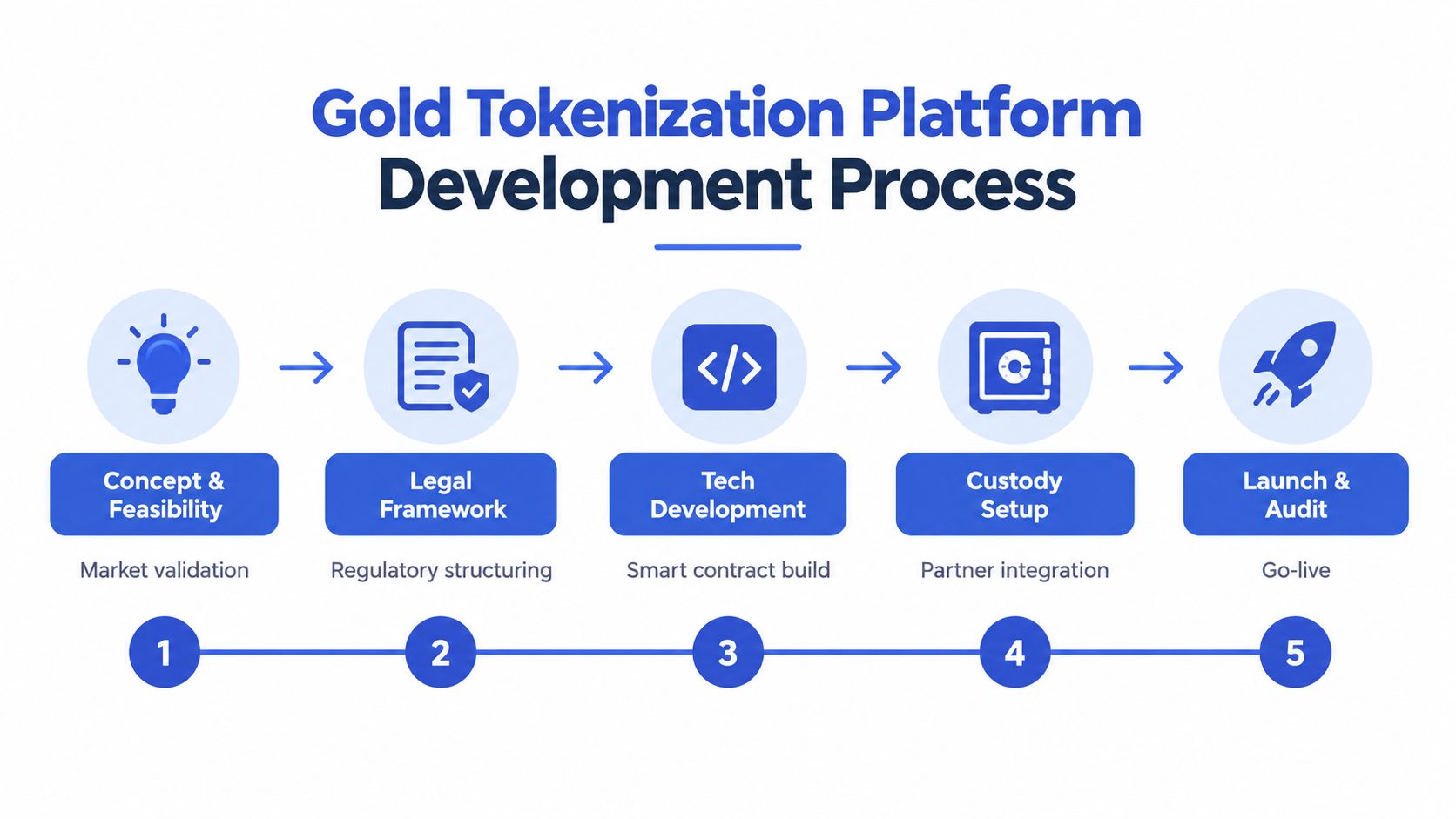
Phase four, integration and testing
Connect the vault, payment rails, identity provider, market data, accounting system, and custody or wallet provider. Test normal and adverse flows, including duplicate messages, delayed attestations, failed burns, rejected transfers, chain reorganisation, lost access, partial redemption, and an unavailable vault endpoint.
Phase five, audit and controlled launch
Commission smart contract review, application security testing, penetration testing, key-management review, access-control testing, data protection checks, and operational rehearsals. Launch with monitored limits and a defined incident process rather than treating mainnet deployment as the end of the project.
Delivery standard: A launch decision should depend on evidence from the custody, reconciliation, redemption, and incident workflows, not just on whether the contract passed compilation.
Partnering for Enterprise Digital Gold Infrastructure
Banks and asset managers usually don’t need another isolated token demo. They need infrastructure that fits existing governance, connects to financial systems, supports controlled digital asset operations, and gives risk teams evidence they can review. Startups need the same foundations, but often require a more modular rollout that keeps the initial operating surface manageable.
The right gold tokenization development services partner should be comfortable at both edges of the system. That means smart contract engineering and blockchain infrastructure on one side, and vault interfaces, accounting, compliance operations, customer entitlements, and settlement on the other. The partner should also be willing to identify what it cannot provide. A software firm isn’t a vault, regulator, insurer, or legal adviser.
What to evaluate before selecting a provider
- Architecture ownership: Can the team explain the boundary between token logic, custody records, legal rights, and operational approval?
- Integration discipline: Can it support APIs, batch files, signed attestations, reconciliation, retries, and exception handling?
- Security depth: Does the delivery plan cover key management, privileged access, contract controls, monitoring, and incident response?
- Regulatory adaptability: Can compliance rules, jurisdictions, transfer permissions, and disclosures change without rebuilding the entire platform?
- Operational readiness: Are redemption, reserve discrepancies, failed transactions, customer complaints, and audit exports designed before launch?
Blocsys Technologies operates as an enterprise blockchain, Web3, and tokenization technology partner, with capabilities across blockchain infrastructure, smart contracts, digital assets, and tokenization platforms. Its SaaS tokenization platform development work is relevant where an organisation needs configurable infrastructure for issuing and managing digital assets, subject to its own legal, custody, and compliance arrangements.
Over the next 12 to 24 months, the strongest projects are likely to be those that treat regulatory change as an architectural requirement rather than a launch obstacle. In India, industry commentary on RBI’s exploration of gold tokenization says gold tokenization is being explored for the Unified Markets Interface, although eligible issuers have not yet been identified. The same discussion highlights unresolved questions around issuer eligibility, gold quality, custody verification, and token-holder protection.
Within India’s GIFT City ecosystem, coverage of tokenised commodities describes a sandbox-style regulated perimeter built around a clear legal link between token and asset, credible custody, defined redemption rights, and separation between issuer, custodian, and trading platform. That model is limited to international financial centres rather than the broader domestic market, but its design principles are useful globally.
Frequently asked questions
What is a gold tokenization platform?
A gold tokenization platform is software and operational infrastructure that links physical gold held through a custody arrangement with digital tokens recorded on a blockchain. It typically includes issuance, smart contracts, wallets, compliance controls, custody connectivity, reconciliation, reporting, transfers, and redemption orchestration. The platform itself doesn’t automatically create legal ownership or prove that reserves exist.
What is a gold-backed token?
A gold-backed token is a digital token that refers to an agreed quantity or interest in physical gold under a defined custody and legal structure. The backing can involve allocated bars or a pooled claim, depending on the product design. Buyers should review the issuer’s terms, redemption rights, custody arrangements, reserve evidence, restrictions, and applicable regulation before treating the token as equivalent to direct physical ownership.
How does custody work in gold tokenization?
A custodian stores the physical gold, maintains asset records, and supports allocation, inspection, release, and redemption processes. The platform connects to the custodian through APIs, signed files, or controlled attestations, then uses that information for issuance and reconciliation. Software teams integrate custody data, but the custodian remains responsible for the physical storage and related obligations defined in the contract.
How are gold tokens issued?
The issuer first establishes that eligible gold has been allocated or otherwise qualifies under the product’s asset model. An authorised issuance workflow validates the custody evidence, checks permissions and compliance conditions, and calls the smart contract to mint the corresponding token supply. The platform should record the approval, source evidence, transaction hash, and resulting reserve relationship for later audit.
What role do smart contracts play in tokenized gold?
Smart contracts enforce rules for minting, burning, transfers, pausing, freezing, and other token lifecycle events. They can create consistent on-chain records and support automated settlement logic, but they can’t verify physical gold without trusted off-chain inputs. Contract design therefore needs governance, access controls, emergency procedures, upgrade policy, and independent security review.
How does proof of reserves work?
Proof of reserves compares the token supply with evidence from a custodian, auditor, or other authorised source confirming the relevant gold position. A reliable process also checks internal liabilities, asset status, encumbrances, timestamps, and unresolved exceptions. An on-chain record can make the supply visible, but it doesn’t independently establish that an off-chain reserve statement is accurate.
What is reconciliation in a gold tokenization platform?
Reconciliation is the controlled process of matching blockchain token supply and lifecycle events with custody records and the issuer’s internal books. The engine should identify missing, duplicated, delayed, or conflicting records and route them to named operators. No new tokens or redemption releases should proceed automatically when a material reserve mismatch remains unresolved.
Which wallets can support gold-backed tokens?
A platform can support hosted wallets managed by the operator, external self-custody wallets, institutional custody accounts, or a hybrid model. Hosted wallets simplify onboarding but increase the operator’s security and safeguarding responsibilities. External wallets offer user control but require stronger address screening, transfer permissions, recovery procedures, and customer education.
How does token redemption work?
A holder submits a redemption request under the product’s eligibility, location, minimum, fee, and delivery terms. The platform verifies the holder, locks or burns the required tokens, instructs the custodian, and records either physical delivery or an agreed cash settlement. Redemption needs exception handling for compliance holds, incomplete documentation, insufficient reserve availability, and failed delivery.
What makes gold tokenization platform development secure?
Security depends on more than an audited token contract. A secure platform uses separated privileges, strong key management, multi-party approval for sensitive actions, encrypted integrations, wallet protection, monitoring, rate controls, dependency management, penetration testing, incident response, and tested recovery procedures. It also limits what each operator, service account, custodian, and administrator can do.
Blocsys Technologies offers blockchain infrastructure, smart contract engineering, digital asset systems, and tokenization platform development for organisations building gold-backed products with custody, compliance, wallet, and redemption requirements. Visit Blocsys Technologies to discuss your gold tokenization architecture, integration plan, and next production milestone.
