
India’s blockchain market reached USD 1,088.0 million in 2025 and is projected to reach USD 85,107.3 million by 2034, with a forecast 60.45% CAGR from 2026 to 2034, according to IMARC’s India blockchain market analysis. That signal matters to CTOs because the commercial question has moved beyond whether blockchain works. The question is which operating model can deliver shared trust, controlled access, regulatory evidence, and reliable integrations without forcing the enterprise to run every node and protocol component itself.
This guide is for enterprise technology leaders, fintechs, financial institutions, Web3 companies, digital asset platforms, and product teams evaluating blockchain SaaS development services. It focuses on the decisions that affect production outcomes, including platform architecture, multi-tenancy, smart contracts, security, compliance, integrations, scalability, governance, and partner selection.
Table of Contents
- Why Enterprises Are Shifting to Blockchain SaaS
- Blockchain SaaS Versus Traditional SaaS and Custom Development
- Core Architecture and Multi-Tenancy Strategies
- Security, Compliance, and Regulatory Considerations
- Key Features of Enterprise Blockchain SaaS Platforms
- Building Your Blockchain SaaS Platform with Blocsys
Why Enterprises Are Shifting to Blockchain SaaS
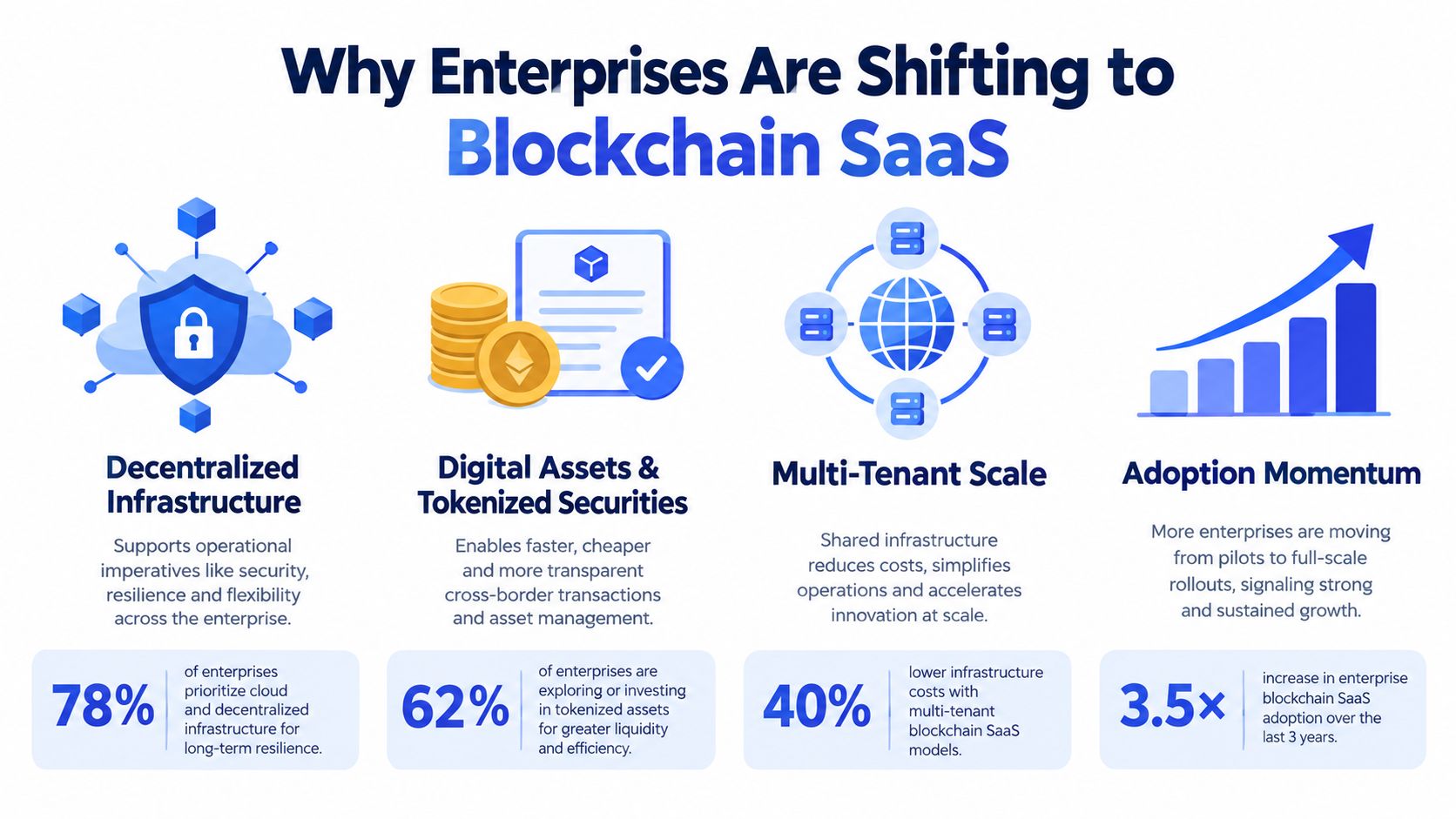
Enterprise blockchain adoption is becoming more practical because organisations need shared records across parties that don’t fully trust one another. Digital asset businesses, financial institutions, logistics networks, and public-sector programmes often need a consistent audit trail while retaining control over identity, permissions, and sensitive data.
The market signal is strong, but market growth alone doesn’t justify a blockchain project. The business case usually appears where several organisations must coordinate ownership, provenance, settlement, approvals, or compliance evidence. A conventional database may remain the right choice when one organisation owns the workflow and controls the source of truth.
India provides a useful example of how blockchain infrastructure can move from experimentation into public and enterprise-grade operations. The National Blockchain Framework began in March 2021 with a budget outlay of ₹64.76 crore and was officially launched on 4 September 2024. By 21 October 2025, it had securely verified more than 34 crore documents, including over 48,000 Document Chain records and 665 judiciary documents, according to the Government of India’s Press Information Bureau release.
The business case goes beyond decentralisation
Blockchain SaaS lets a provider manage network connectivity, deployment tooling, observability, upgrades, and infrastructure operations while the customer concentrates on its product and commercial workflow. That doesn’t remove technical responsibility. It changes where responsibility sits and makes service boundaries, data ownership, incident response, and vendor exit plans essential design questions.
India’s SaaS market is projected to reach ₹8,57,700 crore, or US$100 billion, by 2035, from ₹1,71,540 crore, or US$20 billion, currently, according to a SaaSBoomi report cited by IBEF. The same source attributes ₹3,00,195 crore, or US$35 billion, of expansion to enterprise AI and cloud adoption. For blockchain SaaS providers, the implication is clear. Buyers increasingly expect blockchain functionality to fit established enterprise SaaS patterns, including tenant administration, APIs, billing, auditability, and service-level operations.
A decision-maker also needs commercial and operational talent around the technology. Teams hiring for growth roles can review specialist opportunities such as senior sales jobs in blockchain to understand how enterprise blockchain products are being positioned in the market.
For a broader view of the market context, enterprise blockchain adoption and business innovation shows why platform strategy must connect technical architecture with a specific operating problem. The strongest projects don’t start with a chain. They start with a multi-party process that conventional software handles poorly.
Blockchain SaaS Versus Traditional SaaS and Custom Development
Blockchain SaaS is a managed cloud software model in which a provider operates the blockchain-connected infrastructure and exposes application capabilities through interfaces such as dashboards, APIs, wallets, identity services, and smart-contract workflows. The customer uses the platform without owning every infrastructure component, but still controls its business rules, users, data policies, and operational decisions.
Traditional SaaS normally centralises application data under the provider’s control. Blockchain SaaS adds a distributed ledger, cryptographic signing, consensus, and potentially smart contracts to selected parts of the workflow. Custom blockchain development gives the enterprise greater control over network topology, protocol configuration, code ownership, and deployment, but also transfers more operational and governance work to the enterprise.
| Model | Cost Structure | Control Level | Scalability |
|---|---|---|---|
| Traditional SaaS | Subscription and configuration costs, with infrastructure managed by the provider | High application-level control, limited control over underlying infrastructure | Usually straightforward for centralised workloads, subject to provider and integration limits |
| Blockchain SaaS | Service, usage, integration, and governance costs, with blockchain operations managed partly or fully by a provider | Control is divided between the customer, provider, and network participants | Scales through managed infrastructure, but ledger throughput and consensus remain workload constraints |
| Custom blockchain development | Higher internal responsibility for engineering, infrastructure, audits, operations, and upgrades | Broad control over architecture, network, contracts, and deployment | Can be tuned to a defined workload, but scaling requires in-house operational maturity |
Choose the model by the trust problem
Traditional SaaS is usually preferable when a single organisation owns the data, can change records under a controlled audit process, and doesn’t need independent participants to validate shared state. Blockchain SaaS becomes more compelling when several parties need a common record, selective write permissions, durable evidence, or programmable settlement rules.
Custom development fits cases where the network itself is a strategic asset or where protocol-level requirements cannot be expressed through a managed platform. It also creates exposure to governance disputes, key management, upgrade coordination, data localisation, disaster recovery, and vendor or consortium dependencies. Those obligations remain even with a permissioned network.
Practical rule: Don’t select blockchain SaaS because it sounds more modern. Select it when independent verification or programmable multi-party coordination has a measurable business role.
A tokenisation initiative may require a separate evaluation from general enterprise blockchain SaaS. SaaS tokenisation platform development is relevant when the core product involves issuance, ownership logic, or asset workflows rather than using a ledger as an audit component.
Custom blockchain development can be appropriate for enterprises, startups, and governments that need secure applications across public, private, or hybrid blockchain networks. The Blockchain Development catalogue description frames that work around network choice, application performance, and enterprise requirements rather than a one-size-fits-all deployment.
The most useful evaluation compares total operating responsibility, not only build cost. Ask who owns smart-contract upgrades, who can pause a workflow, how tenants leave the platform, where personal data resides, how evidence is exported, and which party answers a regulator after an incident. Those answers often determine the right model more decisively than feature lists.
Core Architecture and Multi-Tenancy Strategies
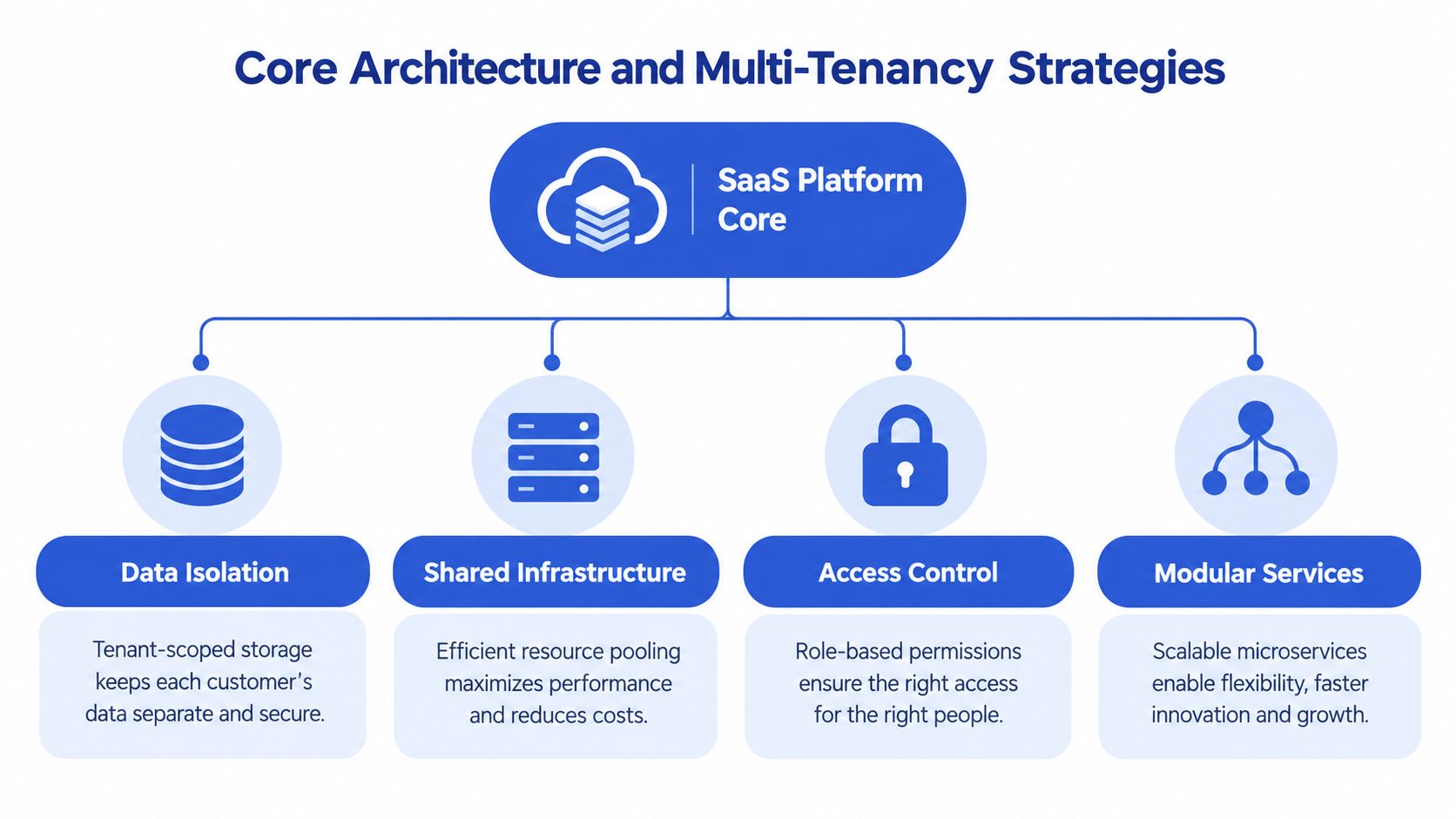
A production blockchain SaaS platform needs two architecture layers. The first is the application control plane, which handles tenants, users, plans, permissions, billing, configuration, and observability. The second is the transaction and ledger plane, which manages blockchain connectivity, smart-contract execution, signing, confirmations, indexing, and evidence.
Multi-tenancy doesn’t mean placing every customer’s records into one undifferentiated database. A safer design assigns each tenant an explicit identity boundary, tenant-scoped storage, policy context, encryption strategy, and audit namespace. Depending on risk, tenants may share application services while using separate schemas, separate databases, dedicated channels, isolated contract instances, or distinct network resources.
Design the ledger boundary deliberately
Don’t put every field on-chain. Store sensitive or frequently changing information in controlled off-chain systems, then record hashes, references, approvals, or state transitions on-chain where durable verification adds value. This hybrid pattern reduces unnecessary ledger load and gives the enterprise more control over retention, privacy, and data localisation.
Smart contracts should be treated as versioned domain modules, not as an uncontrolled collection of scripts. A tenant may need configurable approval thresholds, asset rules, settlement conditions, or reporting policies, but those variations should run within a governed contract lifecycle. Versioning, testing, audit review, deployment approvals, and rollback or pause procedures need to be designed before production release.
Set performance targets by workload
India’s telecom DLT deployments offer a useful architecture benchmark. One large production network is reported to process more than 1 billion daily transactions across about 1.2 billion subscribers, while an optimised Hyperledger Fabric-style stack is cited at 1,200 to 3,000 TPS with typical confirmation latency of 0.5 to 3 seconds, according to technical coverage of India’s telecom DLT infrastructure. These figures describe different environments and shouldn’t be copied into a product specification without workload testing.
A messaging ledger, identity registry, settlement workflow, and compliance evidence store have different performance profiles. Consensus overhead, endorsement policy, payload size, topology, indexing, and external integrations all affect finality. A platform should therefore define service objectives per transaction class instead of advertising one platform-wide throughput number.
The shared architecture should include an API gateway, event bus, blockchain adapters, indexers, policy services, and monitoring. This arrangement lets the customer replace or add networks without rewriting the tenant and billing layers. It also reduces lock-in when a permissioned chain, public network, or hybrid deployment becomes more appropriate for a new jurisdiction or use case.
For teams working on asset infrastructure, enterprise tokenisation infrastructure provides a related architectural reference. The design principle remains the same. Keep tenant configuration, business workflows, and network-specific implementation separate enough to evolve independently.
Security, Compliance, and Regulatory Considerations
Enterprise blockchain SaaS must treat compliance as an operating capability, not a document produced after deployment. The platform should capture who performed an action, which policy permitted it, what data was presented, what contract or service executed, and which evidence a compliance team can retrieve later.
India illustrates why this matters. The country doesn’t have one complete crypto law or a single lead regulator covering every digital asset activity. At the same time, FIU-IND has moved virtual digital asset platforms into a stricter AML and CFT environment involving PAN or Aadhaar-linked KYC, Travel Rule-style disclosures, suspicious transaction reporting, and registration obligations for platforms serving Indian users regardless of location, as outlined in the India cryptoassets legal guide.
Build compliance into the control plane
A compliance-ready platform should separate identity, transaction, and reporting services so a policy change doesn’t require a rewrite of the ledger layer. Core controls include:
- Identity orchestration: Connect KYC, sanctions screening, wallet screening, beneficial ownership, and jurisdiction rules through replaceable provider adapters.
- Role-based authorisation: Apply permissions to tenants, portfolios, contracts, wallets, approval queues, and reporting actions. Administrative access should require stronger authentication and review.
- Evidence capture: Store immutable references to decisions, documents, approvals, and system events while keeping personal or confidential payloads in appropriate controlled storage.
- Reporting workflows: Support case management, review queues, suspicious transaction escalation, regulatory exports, and retention policies rather than assuming a dashboard equals compliance.
- Policy versioning: Record which rule set applied at the time of onboarding, transfer, issuance, redemption, or settlement.
The Reserve Bank of India’s discussion of DLT constraints states that DLT introduces additional consensus overhead and isn’t suitable for high-volume CBDC-like systems except in very small jurisdictions. That guidance supports a cautious architecture using permissioned networks, hybrid storage, selective on-chain records, and workload-specific processing.
Protect keys, contracts, and tenant boundaries
Smart-contract security requires independent review, controlled deployment, test environments, and explicit emergency procedures. Key management should use strong separation of duties, approval policies, secure custody mechanisms, and auditable signing flows. A platform that protects the ledger but exposes administrative APIs or tenant data still has a serious security weakness.
Data localisation also affects architecture. Map where identity data, transaction payloads, logs, backups, analytics, and support exports are stored and processed. Global enterprises operating across the USA, UK, UAE, Europe, Singapore, Canada, Australia, and India may need regional controls instead of one global data plane.
For digital asset teams, regulatory-ready blockchain platform design places custody, compliance, and operational evidence in the same architectural conversation. That integration is more durable than adding compliance screens after the core workflow has already been built.
Key Features of Enterprise Blockchain SaaS Platforms
Scalability is only one part of production readiness. A platform that processes transactions efficiently but can’t isolate tenants, explain decisions, export evidence, or integrate with an enterprise resource planning system won’t satisfy a serious buyer.
The feature set should support both the customer-facing product and the provider’s operating model. Customers need workflows and reporting. Providers need provisioning, metering, observability, incident response, and controlled releases.
Product capabilities that earn enterprise trust
A practical evaluation checklist includes:
- Tenant and user administration: Provision organisations, teams, environments, wallets, policies, and data boundaries without manual database intervention.
- Role-based controls: Support roles such as platform administrator, tenant administrator, compliance reviewer, operator, auditor, and read-only analyst.
- Blockchain connectivity: Provide adapters for selected public, private, and hybrid networks, with confirmation tracking and failure handling.
- Smart-contract operations: Manage templates, parameters, versions, approvals, deployment status, events, and pause procedures.
- API-first integration: Expose documented REST, GraphQL, webhooks, and event interfaces where appropriate. Enterprise buyers should be able to connect ERPs, CRMs, custody systems, payment providers, identity vendors, and legacy databases.
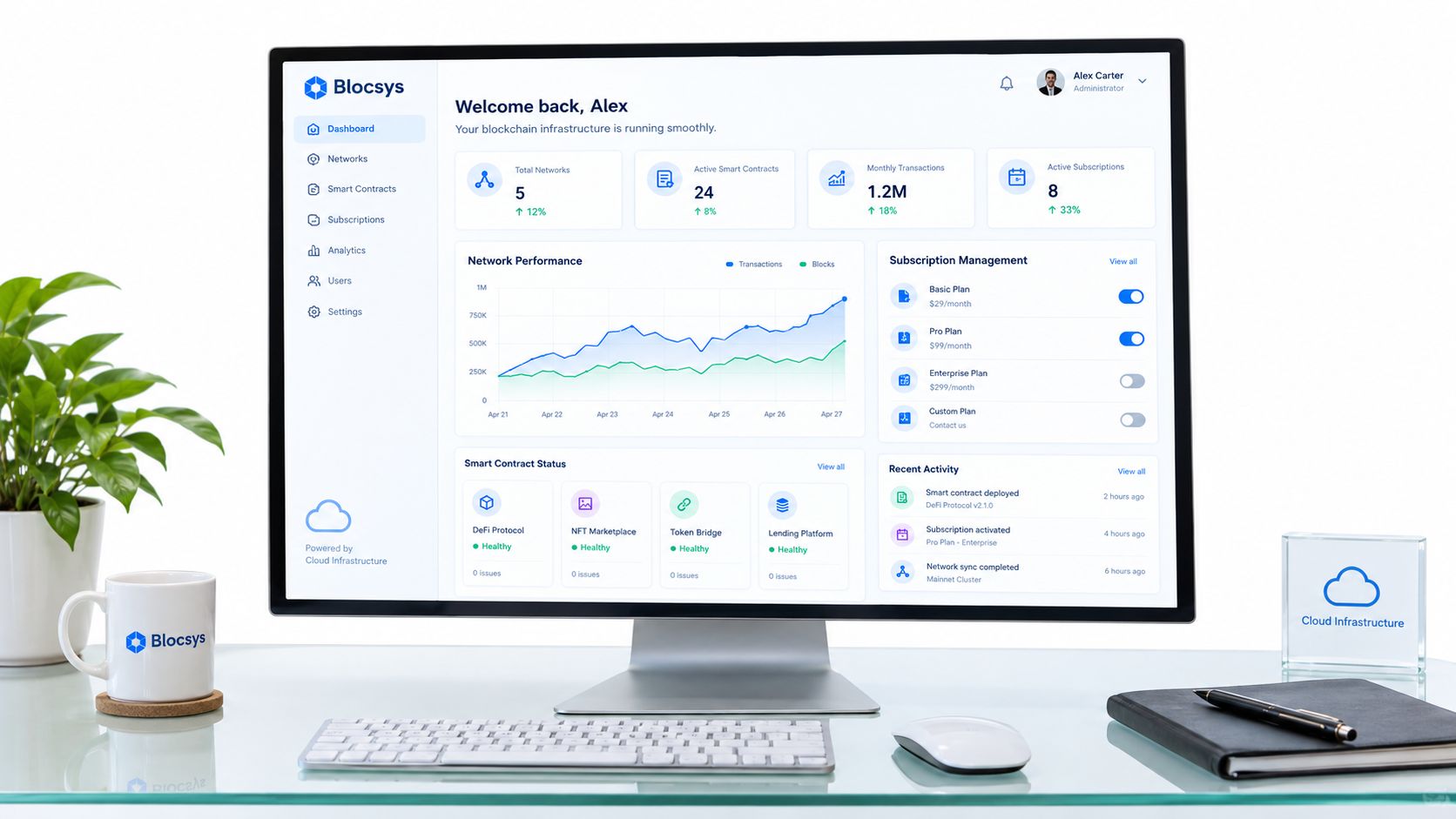
- Dashboards and analytics: Show transaction states, exceptions, wallet activity, contract events, tenant usage, reconciliation status, and compliance cases.
- Subscription and billing: Support plans, entitlements, usage metering, invoices, payment status, credits, and account-level controls without mixing billing logic into smart contracts.
- Monitoring and support: Track node health, API latency, queue depth, failed jobs, confirmation delays, contract errors, and suspicious administrative activity.
The provider should also make export and migration practical. Customers need access to their configuration, audit records, transaction references, and business data in formats they can use independently. A platform that makes exit difficult creates procurement resistance, especially for banks and regulated digital asset firms.
A useful product review asks for failure demonstrations, not only successful workflow demos. Ask what happens when a node is unavailable, an oracle returns stale data, a contract call fails, a tenant exceeds a service limit, a regulator requests historical evidence, or a user must be suspended immediately. The answers reveal more than a polished dashboard.
Building Your Blockchain SaaS Platform with Blocsys
The right blockchain SaaS development partner should begin with a decision model, not a preferred framework. The first workshop should define the trust problem, participants, transaction classes, data boundaries, regulatory jurisdictions, integration dependencies, and measurable business outcome.
A sensible delivery sequence starts with architecture discovery, followed by a proof of concept for the highest-risk assumption. That assumption might be contract behaviour, identity interoperability, custody integration, cross-chain messaging, data residency, or transaction finality. The team can then define the minimum viable platform, establish security controls, and expand functionality without committing the enterprise to an untested network design.
What to assess in a development partner
Look for evidence that the provider can work across application engineering and blockchain operations. The team should be able to define tenant boundaries, design APIs, implement smart contracts, integrate identity and custody services, build administrative workflows, test failure modes, and document deployment and support responsibilities.
Blocsys Technologies Pvt Ltd is described as a blockchain technology and development company focused on blockchain development, smart contracts, Web3 solutions, digital asset platforms, and enterprise technology capabilities. Its work can be assessed against a project’s specific architecture, integration, security, and delivery requirements rather than accepted through broad claims.
The delivery model matters as much as the technical stack. Clarify who owns product decisions, architecture records, code review, contract audits, release approval, infrastructure access, incident response, and post-launch maintenance. A dedicated blockchain development team approach can be useful when the platform requires sustained domain knowledge and iterative compliance changes.
Teams comparing external engineering options can also review Hire Developers as a resource for understanding developer hiring and team composition. The choice should still be based on technical accountability, communication, security practice, and long-term ownership.
After the architecture has been validated, implementation normally proceeds through domain services, tenant management, identity and access control, blockchain adapters, contract modules, integrations, observability, and operational runbooks. Each release should include automated tests, security review, migration planning, and clear rollback or pause procedures.
The platform’s future roadmap should allow for new networks, changing reporting obligations, additional jurisdictions, and evolving enterprise integrations. That doesn’t mean building every capability on day one. It means creating boundaries that make change controlled instead of disruptive.
The strongest partner conversations end with a written architecture decision record and a delivery plan tied to business risk. If a vendor can discuss only chain selection and interface design, it hasn’t addressed the full enterprise problem. Governance, data localisation, operational evidence, and exit planning belong in the initial scope.
Frequently asked questions
What is blockchain SaaS development?
Blockchain SaaS development creates a cloud software platform that exposes blockchain-connected capabilities as a managed service. The provider may operate nodes, network connectivity, indexing, smart-contract tooling, monitoring, and deployment services, while the enterprise manages its application workflows, users, policies, and business data.
How does enterprise blockchain SaaS differ from traditional SaaS?
Traditional SaaS generally relies on a centralised database controlled by one provider. Enterprise blockchain SaaS adds distributed ledger connectivity, cryptographic signing, consensus, smart contracts, or shared verification for selected workflows. It still needs familiar SaaS functions such as tenant management, APIs, dashboards, billing, support, and access control.
When should an enterprise choose blockchain SaaS?
An enterprise should consider blockchain SaaS when multiple parties need a shared, verifiable record and no single participant should control every update. Traditional SaaS is often more suitable when one organisation owns the data and can govern changes through an internal audit process. The decision should follow the trust, integration, privacy, and governance problem.
What does a multi-tenant blockchain SaaS architecture include?
A multi-tenant architecture typically includes tenant-scoped identity, storage, permissions, configuration, billing, audit records, and service limits. The blockchain layer may use shared infrastructure, separate contract instances, channels, or dedicated network resources depending on risk and workload. Isolation must be enforced at application, data, key, and operational levels.
How are blockchain networks integrated into a SaaS platform?
Integration usually uses blockchain adapters, API gateways, transaction queues, indexers, event processing, signing services, and confirmation tracking. This design keeps network-specific logic separate from tenant and application services. It also allows the platform to handle retries, failures, asynchronous confirmations, and changes in supported networks more safely.
What role do smart contracts play in blockchain SaaS?
Smart contracts encode selected business rules and state transitions on a blockchain network. They can support approvals, issuance, settlement, access conditions, or audit events, but they shouldn’t contain every application function. Version control, testing, independent review, deployment approval, monitoring, and emergency procedures are essential for production contracts.
How should enterprises secure a blockchain SaaS platform?
Security should cover identity, role-based permissions, authentication, key custody, smart-contract code, APIs, tenant boundaries, cloud infrastructure, logs, backups, and incident response. Personal or confidential information should be handled according to the relevant privacy and localisation requirements rather than placed indiscriminately on a ledger.
How can a blockchain SaaS platform scale?
Scaling requires workload classification, efficient consensus and endorsement policies, asynchronous processing, indexing, queue management, horizontal application scaling, and careful separation of on-chain and off-chain data. Enterprises should test confirmation latency, failure recovery, integration load, and tenant isolation under realistic transaction mixes rather than rely on a single throughput claim.
What affects blockchain SaaS development costs and timelines?
Costs and timelines depend on network choice, contract complexity, custody and identity integrations, tenant isolation, compliance workflows, regional deployment, security testing, analytics, support requirements, and migration needs. A narrowly scoped proof of concept can expose major risks before full implementation, but a production platform requires operational tooling and governance beyond the initial application build.
How should an enterprise choose a blockchain SaaS development partner?
Evaluate architecture experience, smart-contract engineering, API and enterprise integration capability, security processes, compliance awareness, documentation, testing discipline, communication, ownership model, and post-launch support. Ask the partner to explain failure handling, data export, network changes, key management, audit evidence, and regulatory updates, not only the product demo.
Blocsys Technologies offers blockchain development, smart-contract engineering, Web3 solutions, digital asset platforms, and enterprise integrations for organisations building production-ready SaaS infrastructure. Visit Blocsys Technologies to discuss your blockchain SaaS architecture, platform development requirements, and next technical step.
