
A CTO at a regulated financial institution has two platforms left on the shortlist. Both vendors mention EY in their pitch decks. One says it underwent an EY audit. The other refers to an EY assessment covering selected controls. The procurement committee meets on Friday, yet the commercial language makes the two claims sound almost identical.
They aren’t identical. “EY audited” is a scoped assurance signal, not a blanket endorsement of a technology platform. The value depends on the engagement type, control objectives, audit period, evidence examined, and exclusions stated in the underlying report.
This guide is for CTOs, CIOs, CISOs, procurement leaders, compliance teams, financial institutions, fintechs, asset managers, healthcare organisations, and Web3 companies evaluating an enterprise technology platform. It gives you the vocabulary and verification framework needed to distinguish an EY audit from an EY assessment, security review, attestation, certification, or regulatory approval, then apply that distinction to fintech onboarding, custody-adjacent workflows, tokenisation infrastructure, and regulated digital platforms.
Table of Contents
- The Procurement Moment Every Enterprise Buyer Faces
- What EY Audited Means for a Technology Platform
- EY Audit Versus EY Assessment and Other Assurance Labels
- What an Independent Technology Assessment Typically Examines
- Why Independent Assurance Matters for Enterprise Buyers
- How to Read and Verify an EY Claim Correctly
- What Enterprise Buyers Should Evaluate Across Jurisdictions
- How Independent Assurance Supports Adoption and How Blocsys Builds for It
- Frequently Asked Questions
- What does EY audited mean for an enterprise technology platform?
- What does EY assessed mean?
- What is the difference between an EY audit and an EY assessment?
- What does an independent technology assessment evaluate?
- Why does third-party assurance matter to enterprise buyers?
- How can a buyer verify an EY claim?
- Does an EY assessment mean the platform is legally compliant?
- Does EY assurance guarantee cybersecurity?
- What should an enterprise buyer evaluate beyond an EY credential?
- Can an EY audited platform support fintech or blockchain onboarding?
- What should enterprises consider when commissioning enterprise platform development?
- How much does enterprise platform development cost?
- Why choose Blocsys for enterprise technology development?
The Procurement Moment Every Enterprise Buyer Faces
The CTO asks both vendors for the same thing: “Send me the report, not the slide.”
The first vendor provides an EY report describing a defined assurance engagement, a stated period, control criteria, and an opinion or conclusion. The second sends a presentation describing an EY assessment of selected security and governance controls. Both documents may be useful, but they answer different risk questions.
That difference matters because procurement teams don’t approve technology based on a firm’s name alone. They assess whether the evidence supports the intended use. A platform used for internal workflow automation may tolerate a narrower control review. A platform supporting payment operations, trading records, digital assets, investor data, or custody-adjacent processes requires a more exact match between the assurance scope and the proposed deployment.
Practical rule: Treat “EY audited” as the beginning of document review, not the end of vendor diligence.
The buyer’s task is to establish five facts:
- What was examined: Identify the platform, service, infrastructure, processes, and controls included in scope.
- When it was examined: Confirm the reporting period and whether the evidence reflects current operations.
- Against what criteria: Look for the control framework, contractual criteria, or reporting standard used.
- What EY concluded: Distinguish an opinion, attestation, findings report, agreed-upon procedures, or advisory output.
- What was excluded: Review dependencies, sub-processors, regions, products, and controls outside the report.
This is why trust architecture deserves as much attention as product functionality. The same procurement discipline applies to trust as a layer in SaaS, particularly when a vendor’s assurance language becomes part of a board paper or risk acceptance decision.
An EY audited platform can provide meaningful independent evidence. An EY assessed platform can also reveal useful control strengths and weaknesses. Neither label removes the buyer’s responsibility to determine whether the evidence fits the actual enterprise risk.
What EY Audited Means for a Technology Platform
An audit is a structured examination against defined criteria. In financial reporting, an EY audit generally considers whether financial statements are fairly presented under an applicable reporting framework. In technology, the term can describe an engagement covering systems, controls, data flows, or services that affect financial reporting or operational assurance.
The decisive issue is scope. An EY-audited enterprise platform has not automatically had every line of code, endpoint, integration, employee, or business process reviewed. EY describes its audit technology platform as a global Assurance system that processes more than 1.4 trillion lines of journal-entry data per year, supports the daily workflows of about 130,000 Assurance professionals, and covers roughly 160,000 audit engagements across more than 150 countries and territories as of April 2026. (EY audit technology) That description shows how connected workflows, analytics, and AI-enabled review operate across EY’s assurance work. It does not show that every platform associated with EY receives the same examination.
Read the engagement boundary first
Start with the report, not the vendor headline. Confirm the system or service examined, the legal entity, locations, control objectives, testing approach, and reporting period.
Identify the output as well. A formal report may contain an opinion, management’s assertion, tests performed, results, exceptions, and complementary controls expected from the customer. A consulting deliverable may provide observations and recommendations without expressing the same assurance conclusion.
The audit supports confidence in controls or information within its stated boundaries. It does not prove that a platform is secure in every circumstance, legally compliant in every jurisdiction, or approved by a regulator. It also does not establish that every outsourced dependency meets the same standard.
EY describes a future direction in which enterprise-scale agentic AI supports end-to-end audit activities by 2028, as stated on its technology page. That projection does not change the scope of an individual vendor report. Buyers should still ask how AI-enabled review, data integrity, access controls, and evidence management are handled in the engagement.
For teams designing compliance-ready audit trails with cryptographic evidence, the procurement test is direct: can the assurance document map to the controls that legal, security, and risk teams must approve for fintech onboarding, custody-adjacent workflows, or regulated digital platforms?
EY Audit Versus EY Assessment and Other Assurance Labels
Procurement decisions become unreliable when vendors use audit, assessment, attestation, security review, and approval as interchangeable terms. They describe different activities and carry different evidentiary weight.
| Engagement Type | Scope | Output | Legal Weight |
|---|---|---|---|
| EY audit | Defined systems, controls, transactions, or reporting assertions examined against stated criteria | Audit report, opinion, findings, or other specified conclusion | Meaningful within the stated scope, but not a universal product endorsement |
| EY assessment | Selected controls, processes, risks, or readiness conditions reviewed | Findings, maturity observations, recommendations, or assessment report | Useful decision evidence, but usually not the same as a formal audit opinion |
| Attestation | Management assertion or service controls evaluated against a recognised reporting framework | Formal attestation report with assurance language | Strong evidence within the report’s framework and boundaries |
| Security review | Security architecture, vulnerabilities, access, testing, or operational safeguards examined | Technical findings, risk ratings, remediation advice, or test report | Technical evidence, not regulatory approval or a universal security guarantee |
| Regulatory approval | A regulator determines that a licensed entity, product, or activity meets applicable requirements | Licence, authorisation, registration, or supervisory decision | Jurisdiction-specific legal or supervisory status |
An EY compliance assessment may help a buyer understand whether a platform’s control design aligns with a target requirement. It doesn’t automatically establish that the customer, vendor, or service is legally compliant. Likewise, an EY security assessment platform is not a recognised category that grants certification merely because EY participated in a review.
The report’s wording matters. An attestation may express a conclusion over controls during a defined period. An assessment may identify gaps without providing an opinion. A security review may test technical safeguards while excluding governance, privacy, or financial reporting controls. A regulator may approve an entity or activity without auditing the vendor’s entire technology stack.
For an organisation commissioning Blockchain Development, this distinction is practical. Custom blockchain development services for enterprises, startups, and governments can involve public, private, or hybrid networks, and each architecture introduces a different control boundary. The assurance label should match the deployed system and its operating model, not merely the service category.
What an Independent Technology Assessment Typically Examines
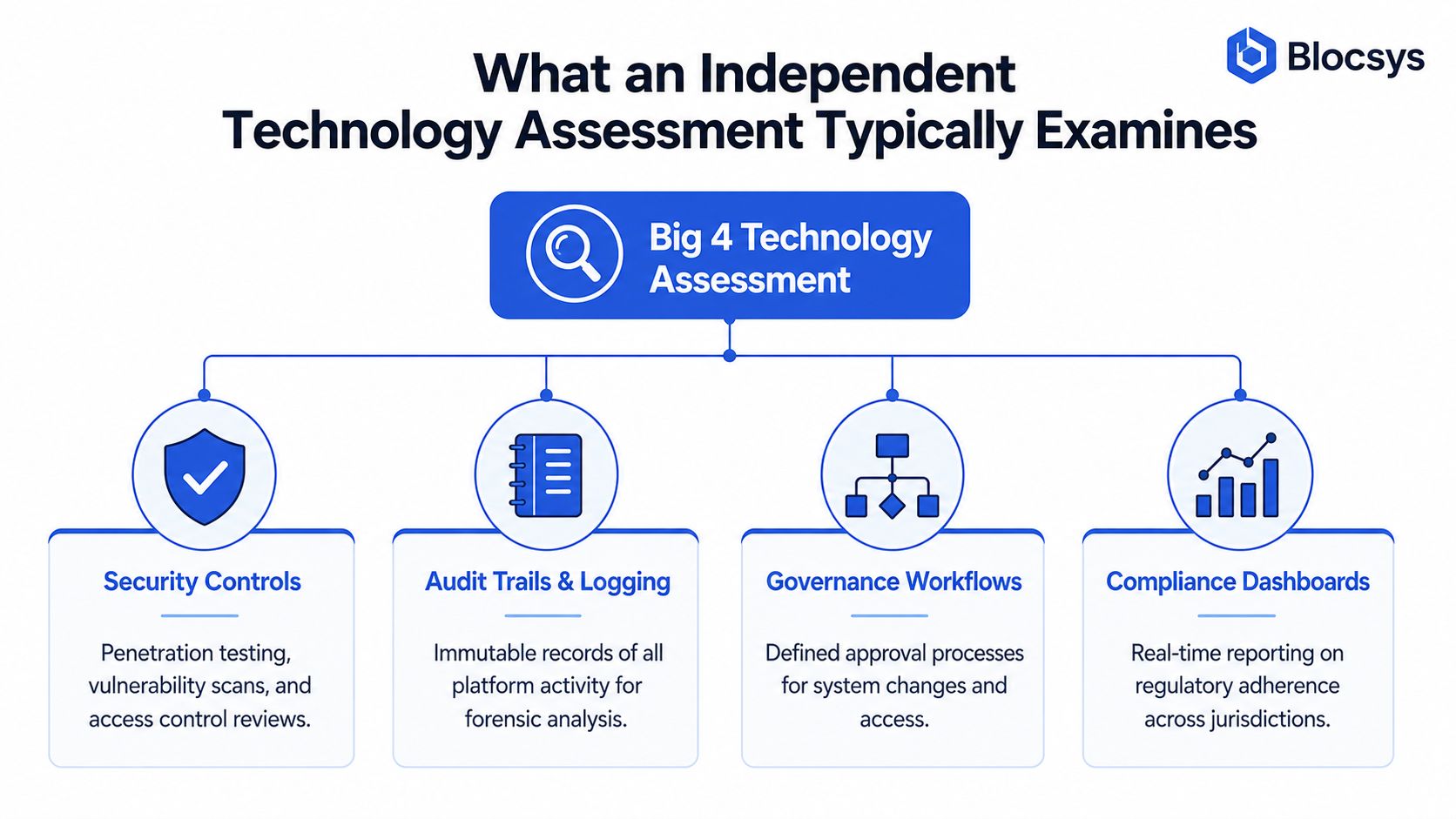
A technology assessment earns attention through the evidence it examines. The assessor may review how people receive access, how engineers change production systems, how the platform protects data, how incidents are handled, and how the organisation proves that controls operated over time.
The control domains that deserve close attention
Identity and access includes authentication, privileged access, least privilege, joiner-mover-leaver processes, and segregation of duties. For a digital asset platform, the buyer should understand who can initiate transactions, approve changes, access sensitive records, or manage cryptographic material.
Change management covers code review, approval workflows, testing, release controls, rollback procedures, and emergency changes. A platform may have strong access controls yet remain exposed if one person can develop, approve, and deploy a material change without independent review.
Data protection and key handling concern encryption, data classification, secrets management, key custody, backup protection, and recovery access. The report should clarify whether these controls cover the platform provider, cloud infrastructure, customer-managed keys, or a combination.
Logging and incident response involve event capture, retention, monitoring, alert escalation, investigation, and evidence preservation. An immutable audit trail can support forensic review, but buyers still need to know who monitors it, how alerts are triaged, and whether logs cover administrator activity.
Vendor management and resilience extend beyond the application. Assessors may examine cloud providers, sub-processors, continuity planning, recovery procedures, capacity management, and incident communications. A report can exclude a dependency that remains critical to the buyer’s risk posture.
The assessment may test both control design and operating effectiveness over a defined period. Screenshots taken on one day don’t demonstrate sustained performance. Exclusions, exceptions, and complementary customer controls are material, especially when a pilot is moving into regulated production.
For legal and security teams preparing enterprise buyer security readiness, the report should be mapped to the buyer’s deployment architecture. A corporate bond tokenization platform may involve digital issuance, smart contract automation, settlement workflows, and investor management, so the assurance boundary should cover the controls relevant to each operating layer.
Why Independent Assurance Matters for Enterprise Buyers
Vendor self-attestation is useful for discovery, but it rarely closes enterprise risk review. The vendor defines the narrative, selects the supporting materials, and has a commercial interest in presenting its controls favourably. Procurement teams therefore discount unsupported claims and give more weight to evidence tested by an independent party.
That doesn’t make an independently audited platform automatically safer. It changes the quality of the evidence available to the decision-maker. An external assurance provider has its own professional reputation and reporting obligations, which gives risk committees a different basis for evaluating control claims than a sales presentation or product white paper.
Evidence reduces repeated diligence
Independent assurance can reduce duplicated questioning across procurement, security, legal, compliance, and operational teams. A well-scoped report gives each function a common reference point, although it won’t eliminate follow-up questions about customer responsibilities, integrations, data residency, or use-case-specific risks.
Evidence management also matters after onboarding. Teams can use a structured approach such as DPP Grid’s compliance evidence management resource to organise reports, control mappings, exceptions, remediation records, and renewal dates. The tool or process is less important than preserving an auditable chain from requirement to evidence to owner.
This is particularly relevant to fintech onboarding, custody-adjacent workflows, regulated digital asset infrastructure, and data-processing arrangements. A bank or institutional partner may need to show why a vendor was accepted, which controls were relied upon, and which risks remained with the customer.
Independent assurance doesn’t transfer accountability from the buyer to EY. It gives the buyer stronger evidence for exercising its own accountability.
The commercial benefit is defensibility. A procurement lead can explain the basis for selection, a CISO can identify residual gaps, and a compliance officer can distinguish vendor controls from customer obligations. That clarity supports adoption without pretending that an audit replaces governance.
For platforms built around tamper-resistant records, tamper-proof verification platforms illustrate the same principle: trust depends on verifiable evidence and control ownership, not a label presented without context.
How to Read and Verify an EY Claim Correctly
Treat “EY audited” as an invitation to verify scope, not as a procurement approval. Ask for the underlying report before accepting the vendor’s description. If the vendor cannot provide the document, an authorised extract, or a clear explanation of confidentiality limits, the claim is not ready for security, legal, or compliance review.
Make the vendor answer in operational terms
Use a written request that forces the vendor to connect the report to your intended deployment:
- Which EY legal entity performed the engagement, and for which organisation?
- What exact platform components, environments, data flows, regions, and legal entities were reviewed?
- Which deliverable did EY issue: an audit, attestation, review, agreed-upon procedures engagement, assessment, or consulting report?
- What customer responsibilities remain, particularly for access, configuration, incident response, and data handling?
- Can our legal, security, and compliance advisers review the report under an appropriate confidentiality agreement?
- Which parts of our proposed use case fall outside the engagement?
Ask the vendor to map its answers to the workflows you plan to approve. A fintech onboarding process may rely on different controls from a custody-adjacent workflow or a regulated digital platform. A report covering the core service may not cover the tenant configuration, integration layer, local entity, or supporting sub-processor your use case depends on.
Require the vendor to state whether EY tested control operation over time or examined design and documentation only. Ask for open findings, management responses, remediation status, and any customer-side controls. These answers determine whether the report supports approval, conditional approval, or further testing.
Recognise marketing language early
A readiness assessment is not an audit. “EY validated” may describe a consulting deliverable or a vendor’s internal mapping exercise. “EY aligned” is less precise still. Require the report’s formal title, issuing entity, scope statement, conclusion, and permitted users before treating any phrase as independent assurance.
Escalate the review if the vendor withholds the report without identifying a workable review process, cannot name the applicable framework, gives vague answers about exclusions, or refuses to distinguish assessment from audit. Procurement should pause rather than fill those gaps with assumptions.
For blockchain systems, evidence integrity also depends on file handling. Teams exchanging signed reports and control artefacts should review metadata canonicalisation and hash consistency so identical files are not treated as different evidence because their metadata changed.
What Enterprise Buyers Should Evaluate Across Jurisdictions
An EY report supports technology assurance. It doesn’t replace a licence, regulator decision, statutory compliance analysis, or jurisdiction-specific accreditation. The buyer must map the platform’s evidence to the rules governing its entity, customers, data, and activities.
In the US, ask whether the service supports the organisation’s SOC 2, financial reporting, privacy, or sector-specific requirements. Where a federal cloud authorisation is required, a private assurance report doesn’t substitute for FedRAMP status. For financial reporting, map access, change, logging, and data controls to the buyer’s own SOX responsibilities.
In the UK, review outsourcing governance, operational resilience, data protection, and any FCA expectations relevant to the regulated entity. An assurance report can support supplier due diligence, but it doesn’t replace the firm’s obligations under FCA supervision or the UK’s data protection regime.
In the EU, examine GDPR roles, processing instructions, transfer mechanisms, resilience, incident handling, and DORA-related contractual and operational requirements where applicable. Germany adds local supervisory expectations, including BaFin considerations, while international data transfers require careful attention to transfer safeguards and the Schrems II judgment. An EY report can inform the review, but the buyer still needs legal analysis of the data flow.
For the UAE, assess data protection, outsourcing, cyber controls, and any requirements connected to the relevant financial or virtual-asset regime, including VARA where applicable. Singapore buyers should connect platform controls to MAS technology-risk expectations and PDPA obligations. Switzerland requires attention to the regulated entity’s FINMA obligations and outsourcing governance.
Canadian buyers should assess privacy, security, breach response, and outsourcing against the organisation’s obligations, including PIPEDA where applicable. In India, EY India describes IT audit services supporting integrated audits, financial statement audits, and statutory audits. Its regulatory-reporting automation tool for banks, NBFCs, and insurers includes audit trails, validations, and data governance. In one cited India banking implementation, EY India reported zero critical findings after implementation, reclaimed 30% to 40% of business bandwidth, and reduced report-preparation time by 70% to 80%. (EY India technology risk)
A procurement handoff checklist
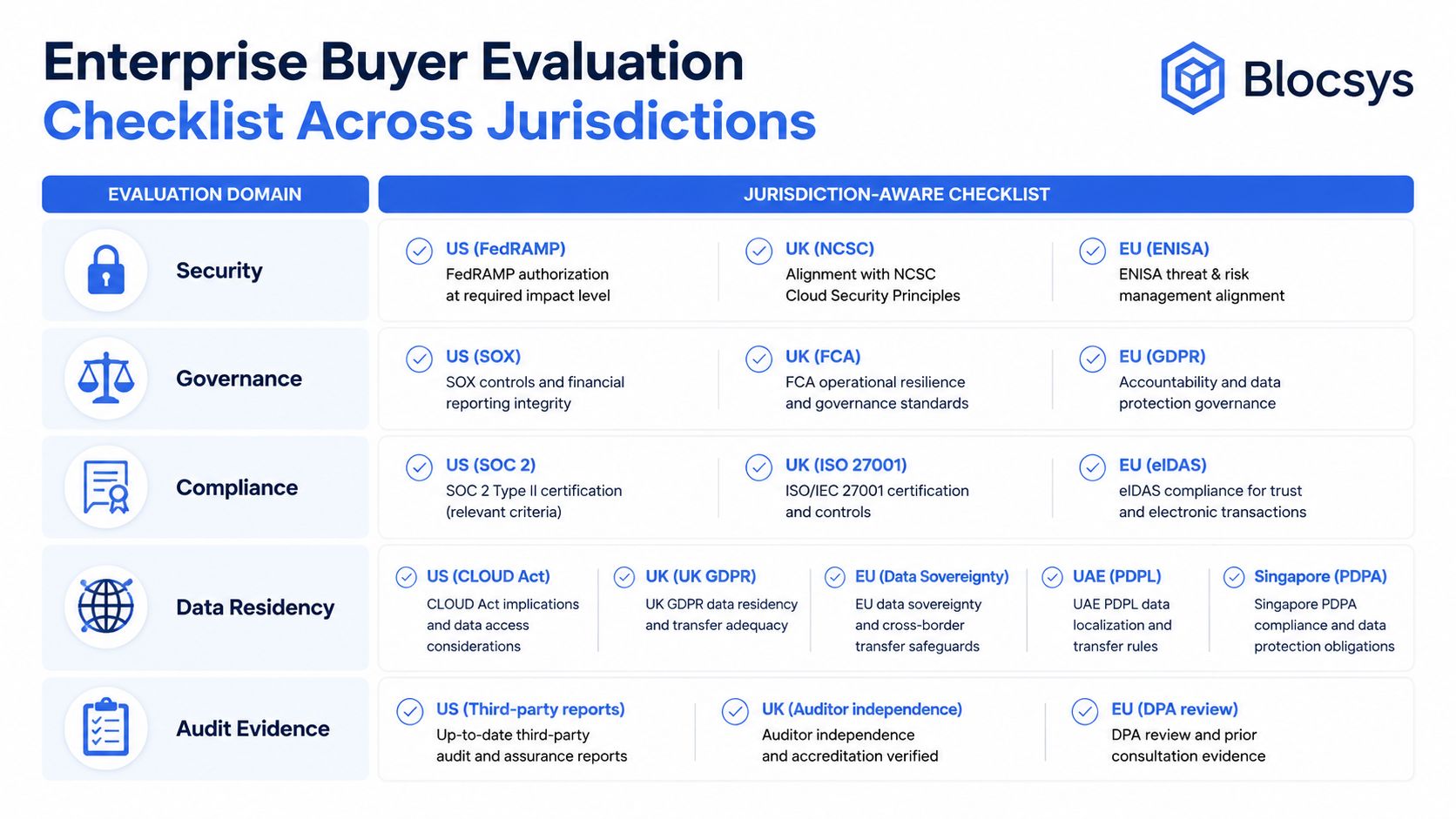
Before signing, ask legal and security teams to confirm:
- Security: Access, encryption, key management, logging, incident response, testing, and recovery controls.
- Governance: Ownership, approvals, segregation of duties, change management, subcontractor oversight, and accountability.
- Compliance: The exact laws, contractual duties, reporting standards, and sector rules that apply to the proposed service.
- Data residency: Storage locations, transfer routes, subprocessors, deletion controls, and customer access rights.
- Audit evidence: Report type, EY entity, period, scope, findings, complementary controls, and permitted reliance.
EY India also says its ERP-agnostic GST platform has processed more than 2.6 billion invoices, demonstrating why traceability, automated validation, and governance matter in India’s regulated enterprise software environment. (EY India technology risk) The figure describes the platform’s processing scale, not a universal compliance conclusion for every customer or deployment.
How Independent Assurance Supports Adoption and How Blocsys Builds for It
A third-party report can move a platform from a self-declared control posture to an evidence-backed one. That shift helps procurement teams ask narrower questions, helps security teams focus on residual risk, and gives business sponsors a stronger basis for partner onboarding.
The result isn’t automatic approval. It is a cleaner decision record. A bank can see which controls it may rely on, a fintech can identify integration obligations, and a digital asset business can separate platform safeguards from custody, governance, and regulatory responsibilities that remain its own.
Design for reviewability from the start
Blocsys Technologies develops enterprise blockchain and technology solutions for organisations building blockchain infrastructure, digital asset platforms, tokenisation systems, smart contracts, AI platforms, and financial technology products. The relevant engineering objective is not to “build for an audit” at the end. It is to make the system reviewable throughout its lifecycle.
That means documenting the software development lifecycle, separating environments, enforcing least-privilege access, recording administrative and transactional events, protecting data, managing cryptographic keys carefully, monitoring operations, and preserving evidence trails that reviewers can understand. It also means documenting integrations and outsourced dependencies, because an assessor can’t evaluate a control boundary that the engineering team hasn’t defined.
How Blocsys builds dedicated blockchain development teams for enterprise projects reflects the delivery discipline required when architecture, controls, integrations, and operational ownership must work together. The same approach applies to enterprise blockchain development for regulated workflows, private networks, tokenisation, and institutional systems.
Blocsys doesn’t act as an auditor, regulator, or certification authority, and this article doesn’t claim that Blocsys is EY audited or assessed. Its role is to engineer systems with clear control ownership, testable workflows, reliable audit trails, and scalable infrastructure so an independent assurance process has something coherent to review.
Independent assurance is strongest when it confirms disciplined engineering rather than compensating for an undocumented retrofit.
Blocsys Technologies helps enterprises build secure, scalable, auditable infrastructure across Enterprise Blockchain Development, digital asset platforms, smart contracts, tokenisation, AI systems, integrations, and financial technology workflows. Visit Blocsys Technologies to discuss your platform architecture, control requirements, and next step towards an enterprise-ready build.
Frequently Asked Questions
What does EY audited mean for an enterprise technology platform?
It means EY performed a defined engagement involving specified systems, controls, data flows, or reporting assertions under stated criteria. The phrase doesn’t mean EY reviewed every component of the platform or endorsed its security, legal compliance, regulatory status, or business suitability. Buyers must read the report scope, period, conclusion, exceptions, and exclusions.
What does EY assessed mean?
“EY assessed” generally indicates that EY reviewed selected controls, processes, risks, readiness conditions, or other defined areas. An assessment may produce findings, observations, recommendations, or a maturity view rather than a formal audit opinion or attestation conclusion. The precise meaning depends on the engagement document, not the phrase used in a pitch deck.
What is the difference between an EY audit and an EY assessment?
An EY audit normally follows a defined audit methodology and produces a specified conclusion or opinion within a documented scope. An EY assessment may examine controls or readiness without providing the same assurance language. Neither label should be interpreted without checking the report, criteria, testing period, exclusions, and intended users.
What does an independent technology assessment evaluate?
It can evaluate identity and access management, segregation of duties, change management, data protection, key handling, incident response, logging, vendor management, continuity, and operational resilience. The exact domains vary by engagement. Buyers should confirm whether the assessor tested control design, operating effectiveness over time, or only selected conditions at a point in time.
Why does third-party assurance matter to enterprise buyers?
An independent report gives procurement, security, legal, and compliance teams evidence that doesn’t originate solely from the vendor’s marketing function. It can support supplier due diligence, risk committee review, partner onboarding, and documented residual-risk decisions. It doesn’t transfer accountability from the buyer or eliminate the need for use-case-specific review.
How can a buyer verify an EY claim?
Request the underlying report or an approved extract. Confirm the EY legal entity, engagement type, reporting period, criteria, scope, addressees, conclusion, qualifications, exclusions, complementary customer controls, and permitted reliance. Ask the vendor to explain any difference between the report’s language and the wording used in its sales material.
Does an EY assessment mean the platform is legally compliant?
No. An EY assessment may provide evidence about selected controls or processes, but legal compliance depends on the applicable jurisdiction, entity, activity, contracts, data flows, and implementation. A buyer still needs legal and compliance analysis for requirements in the US, UK, Europe, UAE, Singapore, India, Canada, Australia, and other relevant markets.
Does EY assurance guarantee cybersecurity?
No. An audit or assessment doesn’t guarantee that a platform will resist every attack or that every component has been reviewed. It provides evidence about specified controls and procedures within a defined scope and period. Buyers must still evaluate architecture, threat exposure, dependencies, incident response, vulnerability management, and their own customer-side controls.
What should an enterprise buyer evaluate beyond an EY credential?
Evaluate the intended use case, architecture, identity model, data handling, encryption, key management, logging, change control, resilience, sub-processors, contractual commitments, incident obligations, data residency, regulatory duties, and exit arrangements. Then map those requirements to the assurance report and identify gaps that require compensating controls or contractual protection.
Can an EY audited platform support fintech or blockchain onboarding?
It can support the evidence portion of onboarding when the report covers the relevant service and controls. It doesn’t automatically approve a fintech, exchange, custody-adjacent workflow, tokenisation system, or blockchain application. The onboarding team must assess licensing, operational responsibility, transaction controls, data protection, customer obligations, and jurisdiction-specific requirements separately.
What should enterprises consider when commissioning enterprise platform development?
Start with the operating model and control boundary, then define identity, approvals, audit trails, data protection, key management, monitoring, incident response, integrations, resilience, and evidence retention. Build these requirements into architecture and delivery documents rather than adding them before an assessment. A clear control design makes later independent review more practical.
How much does enterprise platform development cost?
The cost depends on the architecture, integrations, security requirements, regulatory scope, platform functions, delivery model, and ongoing operational needs. A responsible estimate requires discovery rather than an invented fixed figure. Teams can begin by using the Blocsys software development cost estimator and then validate the assumptions with a technical consultation.
Why choose Blocsys for enterprise technology development?
Blocsys Technologies works on enterprise blockchain and technology solutions involving blockchain infrastructure, digital assets, tokenisation, smart contracts, AI-powered platforms, integrations, and financial technology workflows. It isn’t an auditor, regulator, or certification authority. Its relevance is in engineering secure, scalable, reviewable systems with clear control ownership and evidence trails.
