A patient arrives for an appointment, but registration still depends on repeated data entry. A physician waits for a laboratory result that another department has already received. A nurse calls the pharmacy, billing calls insurance, and discharge staff chase approvals across disconnected systems. Everyone is working, yet the patient journey keeps slowing down.
Hospital workflow automation addresses that coordination problem. It converts manual, repetitive processes into structured digital workflows that route tasks, trigger notifications, manage approvals, record audit trails, and connect clinical and administrative systems. This guide is for hospital leaders, CIOs, CTOs, administrators, clinical teams, and healthcare technology providers evaluating healthcare workflow automation development. It focuses on India while recognising the different operational and compliance environments across the US, UK, UAE, Singapore, Germany, Canada, and Australia.
India has already moved beyond isolated digitisation. The government reported that 631+ hospitals had been onboarded onto e-Hospital, with 441 hospitals reporting live, 22.87 crore transactions generated since September 2015, and more than 4.50 lakh transactions per day. ORS online registration had also been adopted by 417+ hospitals, according to the Ministry of Electronics and Information Technology update. The next challenge is not just installing another HIS or EMR. It's connecting departments, redesigning handoffs, and making digital work visible from registration through discharge.
Table of Contents
- The Reality of Manual Hospital Workflows
- What Hospital Workflow Automation Actually Means
- Measurable Impact of Workflow Automation in Hospitals
- Clinical Workflow Automation from Registration to Discharge
- Administrative Workflow Automation for Hospital Operations
- Prioritizing Which Workflows to Automate First
- How Blocsys Automates Hospital Workflows
- Frequently Asked Questions
- What does hospital workflow automation mean?
- Which clinical processes can hospitals automate?
- Which administrative processes can hospitals automate?
- How does appointment and registration automation work?
- Can laboratory and pharmacy workflows be automated?
- How does automation support billing and insurance workflows?
- What does discharge automation include?
- How do task routing and notifications work in hospitals?
- How do security and audit trails support hospital workflows?
- How do healthcare integrations support workflow automation?
- What affects the cost of healthcare workflow automation?
- Why should hospitals choose Blocsys for workflow automation?
- Conclusion
The Reality of Manual Hospital Workflows
At 8:30 in the morning, a hospital's outpatient desk is already under pressure. A receptionist enters a patient's demographic information into one system, copies insurance details into another, and prints a form for a clinical department that still works from paper. The patient repeats information that the hospital already holds, while the front desk manages queues through phone calls, spreadsheets, or informal messages.
The delay rarely stops at registration. A physician places a laboratory request, but the lab team doesn't see it until someone checks a queue or makes a call. The result is uploaded, yet the nurse doesn't receive a clear task to review it. A pharmacy request waits for approval, a ward clerk searches for a missing document, and a billing coordinator starts a separate approval chain before discharge can proceed.
Practical observation: A digital screen at one desk doesn't create an automated hospital workflow if the next handoff still depends on a phone call.
Where partial digitisation breaks down
The most common friction points are familiar to hospital teams:
- Duplicate data entry: Staff retype patient, payer, order, and admission information because systems don't share the same record or data structure.
- Departmental phone tag: Registration, nursing, laboratory, pharmacy, billing, and insurance teams call one another to confirm status.
- Lost or delayed paperwork: Forms sit in trays, email inboxes, shared folders, or scanned-document queues without a clear owner.
- Manual approval chains: A request moves from a clinician to a supervisor, then to finance or insurance, with no automatic escalation when someone is unavailable.
- Invisible bottlenecks: Administrators see that discharge is delayed, but not whether the cause is medication reconciliation, a pending result, bed allocation, or payer approval.
India's public hospital digitisation demonstrates the scale of basic digital infrastructure, but the operational gap remains. The government's NextGen eHospital is designed as an HMIS for internal hospital workflows and processes, not merely as a patient-facing portal, as described in the Government of India overview. Hospitals therefore need to assess whether their existing systems support end-to-end coordination or only digitise individual departments.
A useful starting point is a process map that follows one patient rather than one application. The hospital information management system context for India is broader than workflow automation alone, but it highlights the same operational reality. Hospitals need connected information, accountable task ownership, and reliable movement of work between teams.
What Hospital Workflow Automation Actually Means
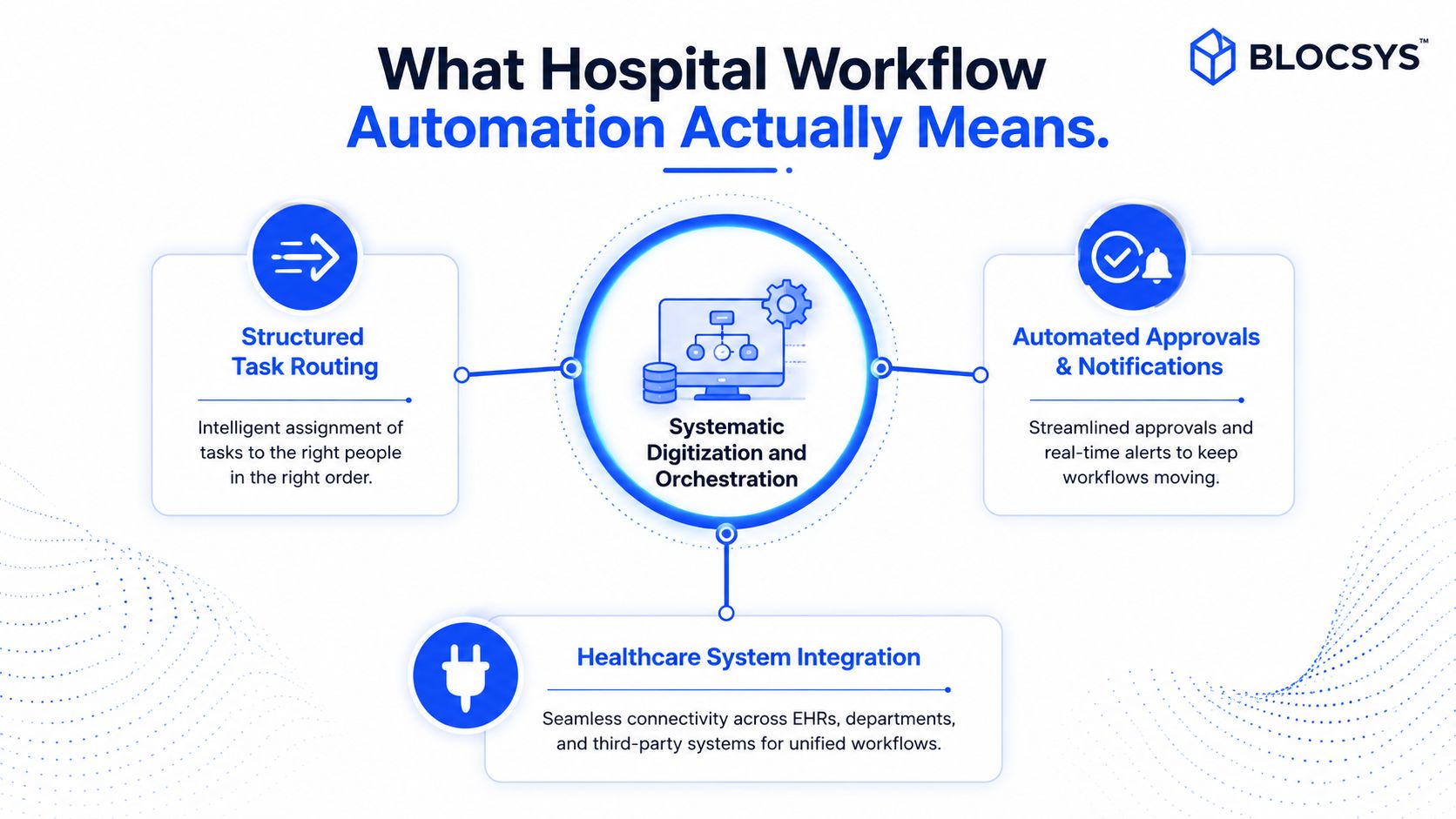
Hospital workflow automation is the systematic digitisation and orchestration of clinical and administrative processes through software rules. A workflow defines the trigger, the responsible role, the required information, the next action, the approval conditions, and the evidence that must be retained.
That makes it different from installing an HIS, EMR, billing application, or laboratory information system. Those systems may store information and support individual transactions. Healthcare workflow automation connects the steps between them so that a completed action automatically creates the next appropriate task.
The mechanics behind automated hospital workflows
A production workflow usually combines several components:
- Workflow engine: Defines states, transitions, conditions, timers, and exceptions. A discharge workflow might remain pending until clinical clearance, medication reconciliation, billing approval, and patient instructions are complete.
- Structured task routing: Assigns work to a role, department, queue, or named individual based on patient context and operating rules.
- Approvals and notifications: Sends a request to the right approver, confirms completion, and notifies the next team without requiring manual follow-up.
- Escalation rules: Redirects overdue work to a supervisor or alternate queue when a service-level threshold is at risk.
- Role-based access: Shows each user the information and actions required for their job, while restricting unrelated patient data.
- Integration APIs: Connects the HIS, EMR, LIS, pharmacy, billing, payer, identity, and analytics systems.
- Audit trails and monitoring: Records who performed an action, when it happened, what changed, and where work is accumulating.
The design principle is coordination, not autonomous medicine. Automation can route a laboratory order, remind a nurse to review a result, or request billing clearance. It shouldn't replace clinical judgement, and it can't guarantee better patient outcomes. High-risk decisions still require qualified human oversight.
Hospitals exploring broader automation patterns can also review how organisations automate clinical workflows with Ekipa AI, particularly where human review and exception handling remain part of the process. The same discipline applies to privacy and data-sharing design. In India, organisations should align workflows with their consent and data-governance responsibilities, including considerations described in this patient consent, EHR data sharing, and DPDP compliance guide.
The concept is not limited to healthcare. In financial services, for example, a corporate bond tokenization platform may use smart contract automation and digital issuance workflows. In a hospital, the governed objects are different, but the engineering requirements still include permissions, integration, traceability, and exception management.
Measurable Impact of Workflow Automation in Hospitals
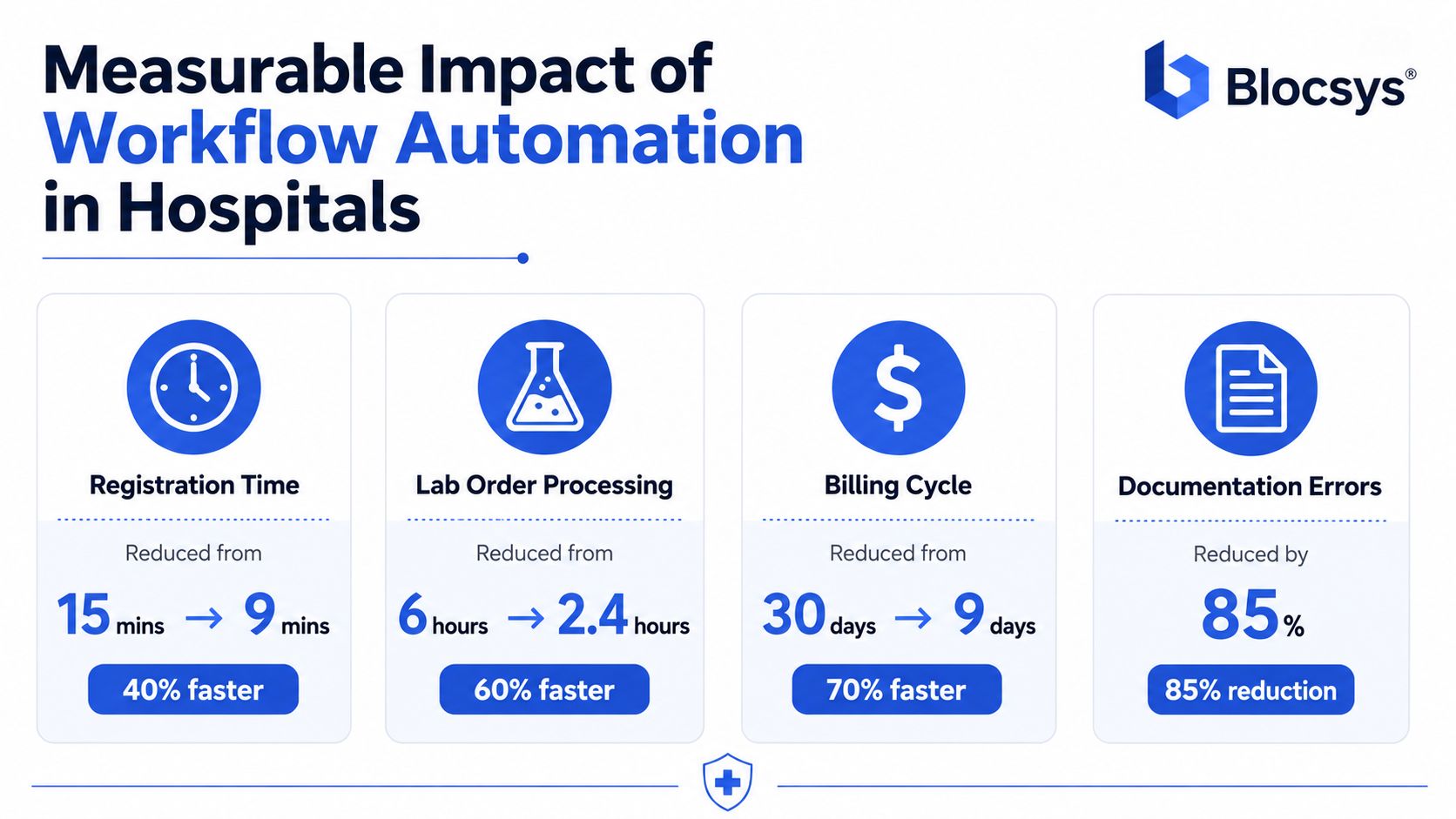
Workflow automation needs an evidence-based business case. The strongest case doesn't begin with a promise that every department will become faster. It begins with a baseline, identifies one bottleneck, changes the process, and measures the same operation again.
A dissertation from an Indian healthcare institute reported that OPD registration and billing fell from 9 minutes to 5 minutes per patient, while IP admission time dropped from 57 minutes to 15 minutes, saving 42 minutes per patient, according to the PubMed record. These figures are useful because they show where gains can come from: not from a dashboard alone, but from removing avoidable steps across a defined workflow.
What administrators should measure
A credible measurement plan should separate activity from impact:
- Patient-facing time: Registration duration, admission completion, appointment confirmation, and discharge readiness.
- Handoff time: Time between an order and collection, result and acknowledgement, or clearance request and approval.
- Manual effort: Number of re-entries, calls, emails, paper forms, and reconciliation steps.
- Exception volume: Tasks requiring correction, escalation, or human review.
- Operational visibility: Whether managers can identify the queue, owner, age, and next action for pending work.
- Revenue-cycle movement: The time taken for coding, approval, claim preparation, and exception resolution.
A 2026 industry report said fewer than 25% of hospitals use technologies such as robotic process automation, while only about 34% operate real-time enterprise dashboards, as reported by the Times of India. That gap matters because an organisation can have a functioning HIS or EMR while still relying on manual coordination downstream.
The labour question deserves equal attention. India-relevant guidance notes that automation can free about 15% of staff capacity for patient-facing work, particularly across coding, billing, and revenue-cycle activities, while also recommending 20 to 40 hours of training, internal champions, quarterly KPI reviews, and baseline cybersecurity and DPDP planning. Those figures and recommendations appear in this India-focused healthcare automation analysis. Capacity isn't automatically converted into better service. Managers need to decide whether freed time will support patient communication, exception handling, quality work, or additional throughput.
A realistic ROI model includes process discovery, integration, testing, training, adoption monitoring, and ongoing governance. Automation that accelerates registration while leaving bed allocation, sample collection, or discharge approvals untouched may improve one metric without improving the patient journey.
Clinical Workflow Automation from Registration to Discharge
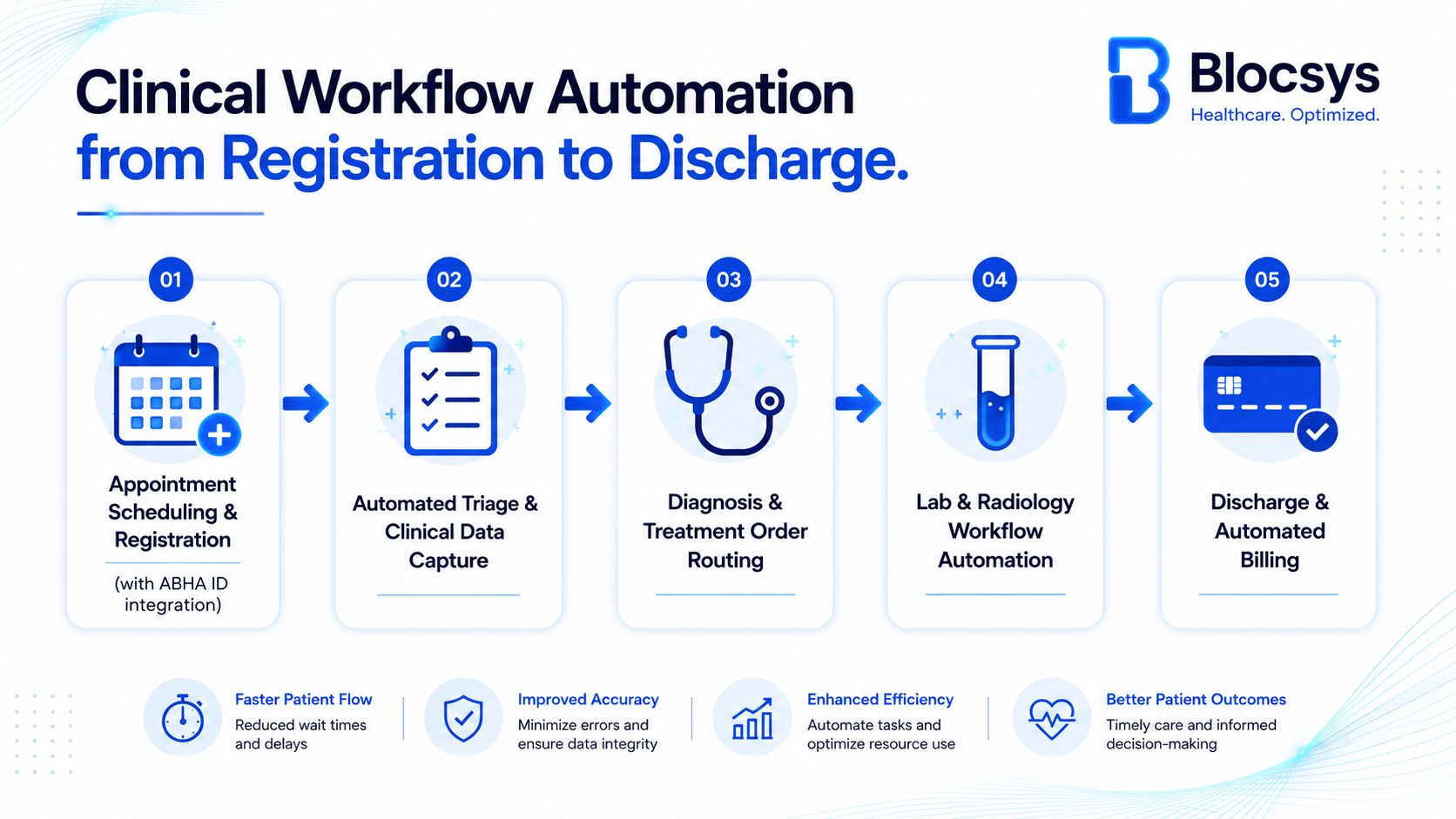
Clinical workflow automation follows the patient journey and makes each handoff explicit. It begins before the consultation, continues through orders and care tasks, and ends only when discharge and follow-up responsibilities have been assigned.
Registration and appointment intake
An appointment workflow can check clinician availability, create the booking, send confirmation, collect required information, and identify missing documents before arrival. Registration can then verify identity, payer information, consent status, and the relevant health identifier without asking staff to copy the same data repeatedly.
India's ABDM roadmap calls for ABHA numbers to be used for treatments, health records to be created and shared digitally through ABDM architecture, booking services and discoverability through UHI, and digital claims processing through HCX, as set out in the ABDM digitisation roadmap. Implementation still requires careful consent, identity matching, and human review for exceptions.
Clinical tasks and diagnostic requests
After triage, a clinician's order should create the appropriate task for nursing, laboratory, radiology, or pharmacy teams. The system can validate required fields, route the request to the correct queue, notify the responsible role, and record completion. A critical result can generate an acknowledgement task rather than relying on an individual to notice it in a separate inbox.
Role-based access prevents overexposure of patient information. A laboratory user sees the order and relevant specimen details, a pharmacist sees medication-related work, and a nurse sees the tasks assigned to the ward. The system should also show exceptions, such as an order awaiting clarification or a specimen that cannot be processed.
A practical integration pattern is described in this guide to connecting patient, billing, pharmacy, and lab systems. The objective isn't to force every department onto one application. It's to make the handoff reliable across existing systems.
The clinical workflow continues into discharge. A rule can create a discharge coordination task when the responsible clinician initiates the process, then track medication reconciliation, patient education, billing clearance, transport, and follow-up booking. Each role receives only the work it owns, while supervisors see unresolved dependencies.
For organisations working beyond healthcare, the same orchestration principles can support Tokenization Platform Development for real-world assets, securities, real estate, commodities, and digital assets. The domain changes, but structured states, permissions, integrations, and auditability remain central engineering concerns.
The following video offers a visual introduction to workflow concepts and healthcare process coordination:
Administrative Workflow Automation for Hospital Operations
Hospital administrative automation keeps clinical operations supplied, authorised, documented, and financially viable. It should reduce coordination effort without weakening controls.
Billing is a strong example. A workflow can collect charge information, validate required documentation, route unusual items for review, and send multi-level approvals to the right finance or clinical authority. The approval path should depend on the transaction type and organisational policy, not on whoever happens to receive an email.
Insurance workflows benefit from the same structure. The system can assemble required documents, check whether fields are complete, identify missing clinical or billing evidence, and route an exception to a named owner. It shouldn't make unsupported coverage decisions. Payer rules differ by country and contract, so hospitals need configurable rules and a review step.
Operating controls that scale
Useful administrative workflows include:
- Vendor approvals: Route purchase requests through department, finance, and procurement review, with a record of each decision.
- Inventory monitoring: Create replenishment tasks for pharmacy and medical supplies, then escalate unresolved shortages to operations.
- Staff assignments: Allocate tasks by department, role, shift, and workload, with a visible queue for unassigned work.
- Revenue-cycle exceptions: Separate clean transactions from cases requiring coding, documentation, or payer clarification.
- Facilities requests: Assign maintenance or transport work, track status, and escalate tasks that threaten service continuity.
An audit trail should capture the actor, timestamp, action, previous value, new value, approval state, and related record. That evidence supports internal review and can help organisations demonstrate controlled operations, although the exact requirements depend on jurisdiction and service type.
India's DPDP framework, ABDM ecosystem, and hospital policies need to be considered together. In the EU and Germany, GDPR and local health-data rules affect lawful processing, minimisation, access, and retention. The UK requires attention to UK GDPR and NHS-specific governance where applicable. HIPAA applies to covered entities and business associates in the US. The UAE, Singapore, Canada, and Australia each have their own privacy, health-data, hosting, and sector requirements. A workflow platform should therefore support configurable retention, access, consent, logging, and data-location policies rather than assuming one global configuration fits every hospital.
Hospitals looking at broader operational architecture can also review this guide to AI-powered hospital ERP development. ERP functionality may support procurement, finance, and workforce operations, but it doesn't remove the need to design the actual handoffs.
Prioritizing Which Workflows to Automate First
The best first workflow is usually not the most advanced one. It's the process with high volume, repeated manual effort, visible ownership, available data, and a measurable operational consequence.
Registration, appointment management, billing, and discharge coordination often make practical starting points because they contain structured steps and involve multiple teams. Complex clinical workflows may be strategically important, but they require stronger governance, richer data, and deeper clinician involvement.
A practical scoring method
Score candidate workflows against four questions:
- How often does the process run? Repeated transactions create more opportunities to remove manual work.
- How much coordination does it require? Phone calls, email chains, paper forms, and re-entry signal automation potential.
- What happens when it fails? Patient delays, claim rework, missed approvals, and blocked beds deserve attention.
- Can the hospital measure the baseline? If leaders can't define the current time, queue, error, or handoff, they won't know whether the change worked.
| Workflow Type | Volume | Complexity | Priority | Expected Timeline |
|---|---|---|---|---|
| Appointment and registration | High | Low to medium | High | Short |
| Billing and approval routing | High | Medium | High | Short to medium |
| Laboratory and pharmacy requests | High | Medium | High | Medium |
| Discharge coordination | Medium to high | Medium | High | Medium |
| Complex clinical pathways | Variable | High | Phased | Longer |
| Predictive or AI-assisted orchestration | Variable | High | After foundations | Longer |
The timeline categories are intentionally qualitative. A hospital's interfaces, data quality, procurement process, and change capacity matter more than a generic delivery promise.
Readiness before build
Check whether the required systems expose usable APIs or standards-based interfaces. Confirm that master data, patient identity, role definitions, and escalation ownership are consistent. Identify a clinical sponsor, an operational owner, an IT integration lead, and a measurement owner before development begins.
The main pitfall is treating HIS or EMR installation as automation completion. A 2026 India-focused implementation guide recommends readiness checks, open APIs, HL7 or FHIR support, and one measurable pilot such as registration or billing. It also identifies interoperability and change management as the harder implementation problem, as explained in this guidance for Indian hospitals.
Start with one workflow lane, remeasure it, fix the handoffs, and then expand. That sequence is safer than launching a large catalogue of automated processes that staff haven't validated.
How Blocsys Automates Hospital Workflows
Blocsys builds enterprise healthcare software around the operational layer that basic digitisation often leaves unresolved. Its work can include workflow engines, structured task automation, role-based access, approval routing, notifications, escalations, audit trails, API development, dashboards, and integrations across hospital systems.
For a hospital, that can mean a configurable workflow for registration, a clinical task queue for laboratory and pharmacy requests, a discharge orchestration layer, or an administrative approval process connected to billing and insurance. The design should preserve human review for exceptions and clinical decisions while giving administrators visibility into pending work.
Blocsys can also support interoperability with ABDM-enabled infrastructure and other national or enterprise systems, subject to the hospital's technical and governance requirements. Security design, access control, auditability, data handling, monitoring, and change management should be defined before production deployment. The company also works across healthcare technology, AI, blockchain, integrations, and enterprise software, with its healthcare capabilities described through its healthcare software development services.
If you're planning a workflow pilot, begin with a process map and baseline rather than a feature list. For early budget planning, use the software development cost estimator and then discuss scope, integration complexity, security controls, training, and support with a delivery team.
Blocsys Technologies develops secure healthcare software, workflow engines, integrations, dashboards, and enterprise platforms for organisations digitising clinical and administrative operations. Visit Blocsys Technologies to discuss your workflow roadmap, identify a practical pilot, and plan the next implementation step.
Frequently Asked Questions
What does hospital workflow automation mean?
Hospital workflow automation uses software to structure and coordinate clinical, administrative, and operational tasks. It routes work to the right role, triggers notifications and approvals, escalates overdue actions, connects systems through APIs, and preserves an audit trail. It supports human decision-makers rather than replacing clinical judgement.
Which clinical processes can hospitals automate?
Hospitals can automate appointment intake, registration, triage data capture, laboratory and radiology orders, pharmacy requests, nursing assignments, result acknowledgements, discharge coordination, medication reconciliation tasks, and follow-up scheduling. Automation should manage routing and coordination, while clinicians retain responsibility for diagnosis, treatment, and other clinical decisions.
Which administrative processes can hospitals automate?
Administrative automation can support billing approvals, coding queues, insurance documentation checks, vendor payments, inventory replenishment, staff assignments, shift-related tasks, facilities requests, and revenue-cycle exceptions. Each workflow should include role permissions, approval rules, exception handling, and a record of completed actions.
How does appointment and registration automation work?
An automated appointment workflow checks availability, records the booking, sends confirmations, collects required information, and creates follow-up tasks for missing documents. Registration can use available identity and health-record integrations to reduce repeated entry, while still applying consent, identity matching, and human review rules required by the hospital.
Can laboratory and pharmacy workflows be automated?
Yes. A clinician's order can create a laboratory or pharmacy task, route it to the appropriate queue, notify the responsible team, and record collection, processing, dispensing, or exception status. The workflow can also escalate overdue work, but it shouldn't independently make clinical decisions or bypass required verification.
How does automation support billing and insurance workflows?
Automation can validate required fields, assemble supporting documents, route approvals, identify incomplete records, and assign payer-related exceptions to a responsible team. It can reduce manual coordination, but coverage interpretation and unusual claims still require authorised review because payer policies and national rules differ.
What does discharge automation include?
Discharge automation can coordinate clinical clearance, medication reconciliation, patient instructions, billing approval, transport, documentation, and follow-up appointments. Instead of treating discharge as one final form, the workflow tracks the dependencies that must be completed and shows staff which item is delaying readiness.
How do task routing and notifications work in hospitals?
A workflow engine assigns tasks according to role, department, patient context, priority, and operating rules. Notifications can confirm new work or changes, while escalation rules send overdue tasks to supervisors or alternate queues. Effective designs avoid excessive alerts by defining which events require action and which can remain in a dashboard.
How do security and audit trails support hospital workflows?
Role-based access limits what each user can view or change. Audit trails record actions, timestamps, approvals, status changes, and relevant record history, helping hospitals review activity and investigate exceptions. Security configuration, retention, consent, hosting, and privacy controls must be aligned with the applicable requirements in each operating country.
How do healthcare integrations support workflow automation?
Integrations connect systems such as HIS, EMR, LIS, pharmacy, billing, insurance, identity, analytics, and national digital-health infrastructure. APIs and standards such as HL7 or FHIR can reduce duplicate entry and make handoffs more reliable, but interface quality, data mapping, patient identity, and exception handling need to be tested before launch.
What affects the cost of healthcare workflow automation?
Cost depends on workflow scope, number of departments, existing systems, integration availability, data quality, security requirements, user roles, reporting, migration, testing, training, and support. A focused pilot is easier to estimate than a hospital-wide programme. Leaders should define the baseline, target workflow, interfaces, controls, and adoption plan before requesting a final proposal.
Why should hospitals choose Blocsys for workflow automation?
Blocsys can support healthcare workflow automation development across workflow engines, task routing, approvals, notifications, role-based access, audit trails, APIs, healthcare integrations, dashboards, and scalable enterprise platforms. Hospitals should evaluate Blocsys against their own interoperability, security, clinical governance, implementation, and support requirements before selecting a delivery partner.
Conclusion
Hospital workflow automation is not a synonym for installing an HIS or EMR. It is the disciplined redesign of how people, systems, approvals, notifications, records, and exceptions move through the hospital.
India's digital-health infrastructure creates a strong foundation, but hospitals still need interoperability, measurable pilots, accountable ownership, staff training, and ongoing governance. The organisations that gain lasting value will start with a visible bottleneck, connect the downstream handoffs, protect human oversight, and expand only after the workflow works in practice.