Your legal team has approved a new equity structure, but the cap table still lives in one system, investor verification in another, and shareholder records in a spreadsheet or statutory register. The product team wants blockchain settlement, while compliance wants every transfer controlled and auditable. That tension is where share tokenization becomes a serious infrastructure project rather than a token-minting exercise.
Share tokenization represents company equity as blockchain-based digital tokens, while preserving the legal rights, restrictions, records, and corporate processes attached to the underlying shares. This guide is for founders, private companies, financial institutions, investment firms, fintech teams, and enterprise decision-makers evaluating tokenized shares. It focuses on the work that determines whether a platform can operate in production, including smart contracts, identity, custody, depository reconciliation, statutory registers, corporate actions, and regulatory design.
Table of Contents
- Defining Share Tokenization for Modern Enterprises
- Tokenized Shares vs Traditional Electronic Ownership
- Architecting the Blockchain Infrastructure for Equity
- Embedding Compliance and Transfer Controls in Smart Contracts
- Navigating the Regulatory Landscape and Market Pilots
- Choosing the Right Technology Partner for Tokenization
- Frequently Asked Questions About Share Tokenization
- What is share tokenization?
- How do companies tokenize shares?
- Are tokenized shares real shares?
- Do tokenized shareholders retain voting rights?
- What does a smart contract do for tokenized equity?
- How are investors onboarded?
- Where is ownership recorded?
- Can tokenized shares be transferred freely?
- How are tokenized shares secured?
- How should a company choose a tokenization provider?
Defining Share Tokenization for Modern Enterprises
A company already has electronic ownership records, so why tokenize shares? The difference is architectural. Traditional electronic ownership usually updates a controlled database operated by a registrar, transfer agent, broker, custodian, or depository. Share tokenization adds a programmable ownership layer on a distributed ledger, with token movements governed by smart contracts and reconciled against the legally authoritative company records.
A token can represent a direct share, a beneficial interest, or another regulated instrument, depending on the legal structure. The technology doesn't decide that status. Corporate law, securities legislation, offering documents, constitutional documents, transfer-agent arrangements, and local regulatory requirements determine what the token legally represents.
Tokenization is a reconciliation problem
The practical model has two connected records:
- The legal record: The company's statutory registers, articles, shareholder resolutions, transfer-agent records, and other documents that establish ownership and rights.
- The blockchain record: Wallet balances, token transfers, smart-contract events, permissions, and transaction history.
A production platform must keep those records aligned. If an investor transfers a token but the statutory register doesn't recognise the transfer, the company has created a reconciliation failure. If the legal register changes but the blockchain balance doesn't, the platform has created a second failure.
That makes a tokenized equity platform a reconciliation layer between corporate law and blockchain infrastructure. It must support minting, burning, approved transfers, wallet recovery, corporate actions, reporting, and an auditable history of changes.
Practical rule: Don't ask only whether a token can represent one share. Ask which record is legally authoritative, who can update it, and how every on-chain event is reconciled.
Why enterprises explore blockchain-based equity
Private companies often manage ownership through fragmented workflows. Investors may sit in different jurisdictions, transfer approvals may require manual review, and corporate actions can involve several intermediaries. A distributed ledger can provide a shared transaction history, programmable restrictions, and a common operational view for authorised participants.
That doesn't remove governance or legal work. It changes where some controls are executed and how evidence is produced. Teams considering a guide to tokenized equity and digital share ownership should treat tokenization as a redesign of ownership operations, not as a replacement for corporate law.
Tokenized Shares vs Traditional Electronic Ownership
Traditional electronic shares and tokenized shares both remove paper certificates, but they don't use the same operating model. A conventional registry relies on controlled database writes and institutional reconciliation. Blockchain-based equity can use a shared ledger, programmable permissions, and smart-contract execution, provided the network and legal structure support those functions.
The distinction matters because many projects promise blockchain benefits while keeping every meaningful ownership decision off-chain. That may still be a valid digitisation project, but it isn't necessarily direct share tokenization.
| Feature | Traditional Electronic Shares | Tokenized Shares on Blockchain |
|---|---|---|
| Ownership record | Controlled registry or depository database | Blockchain ledger connected to the legal ownership record |
| Transfer process | Broker, registrar, custodian, or depository workflow | Smart-contract transfer between approved participants |
| Compliance | Institutional procedures and manual or system-based checks | Identity and eligibility rules can be embedded into transfer logic |
| Audit trail | Records distributed across authorised systems | Shared, timestamped ledger history, subject to governance and reconciliation |
| Corporate actions | Separate registrar, issuer, broker, and custodian processes | Smart contracts can coordinate eligible holders and event processing |
| Fractionalisation | Depends on the legal and market structure | Can be technically supported, but legal and market treatment still applies |
| Settlement | Existing market infrastructure and its operating cycles | Near-instant technical settlement may be possible, but legal finality and integration remain essential |
What tokenization adds
A tokenized share can carry rules that ordinary database entries don't natively express. A transfer may require a verified wallet, an eligible jurisdiction, an investor classification, a satisfied holding period, and an approved transaction route. The contract can reject a transfer that fails those conditions.
Tokenization can also expose a consistent event history to authorised systems. That helps operations teams investigate ownership changes, reconcile balances, and generate reports. It doesn't make the history correct automatically. Poor oracle design, weak access controls, or an incorrect off-chain record can still produce a clean-looking but unreliable ledger.
What tokenization doesn't solve
Tokenization doesn't create liquidity. A private tokenized share still needs eligible buyers, an authorised transfer mechanism, appropriate disclosures, and a functioning market design. It also doesn't turn a shareholder into a legal owner merely because a wallet holds a token.
A comparison of equity tokenization and stock tokenization helps clarify another important distinction. A token may represent the underlying equity, a receipt for an asset held by a custodian, or an economic exposure through a wrapper. Those structures have different rights, risks, and operational obligations. A Tokenization Platform Development project therefore needs the asset model defined before the smart contract is selected.
Architecting the Blockchain Infrastructure for Equity
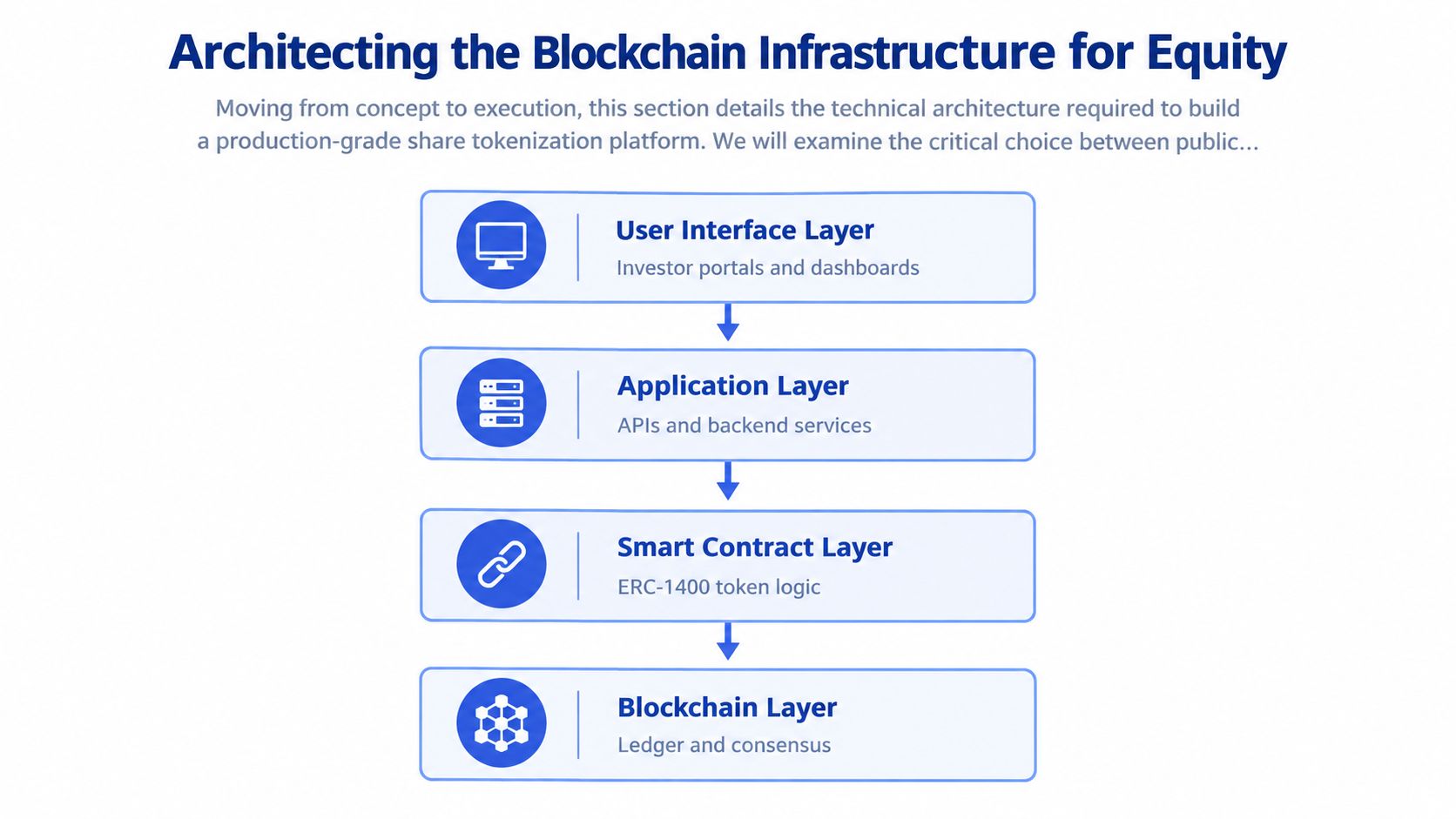
A production-grade share tokenization platform needs more than a blockchain network and a token contract. It needs a controlled system that connects investor interfaces, identity services, compliance decisions, transfer logic, ownership records, custody, and legacy financial infrastructure.
Four layers support the operating model
The user interface layer includes issuer dashboards, investor portals, subscription screens, transfer requests, corporate-action notices, and reporting views. Users shouldn't need to understand gas, contract calls, or ledger synchronisation to complete an approved equity transaction.
The application layer handles APIs, workflow orchestration, identity integrations, event processing, document management, notifications, and permissions. This layer coordinates actions that don't belong inside a smart contract, such as reviewing an investor file or generating a board report.
The smart-contract layer represents the token's rules. A security-token standard such as ERC-1400 may provide a useful design reference, but the implementation must reflect the instrument's rights, restrictions, issuance model, and recovery requirements. The contract should define who can mint, burn, transfer, pause, recover, or administer tokens.
The blockchain layer provides the ledger, consensus mechanism, node governance, transaction ordering, and event history. Public, private, and permissioned networks each offer different trade-offs around accessibility, privacy, control, resilience, and integration.
Permissioned rails versus public networks
Enterprise issuers commonly prefer permissioned infrastructure when they need controlled participation, known validators, confidential information handling, and predictable governance. A public network can offer broad visibility and composability, but the platform still needs allowlists, identity controls, wallet screening, and a way to correct operational errors without undermining the ownership record.
The most important design decision isn't whether a chain is fashionable. It is whether the network can support the issuer's legal obligations, service levels, key-management model, recovery process, reporting requirements, and integration with registrars or depositories.
A token transfer is only complete when the legal record, operational systems, and investor-facing balance agree.
That principle makes integration work central. The platform may need adapters for statutory registers, transfer agents, registrars, broker applications, custody systems, payment rails, accounting software, tax workflows, and corporate-action systems. India's emerging market infrastructure illustrates this requirement, with reporting describing depository-linked pilots rather than unrestricted public-chain issuance.
Teams planning the build can use a practical guide to equity tokenization platform architecture to map these components. A Blockchain Development engagement may include custom applications on public, private, or hybrid networks, but the architecture should be selected around the securities workflow rather than around blockchain capability alone.
Embedding Compliance and Transfer Controls in Smart Contracts
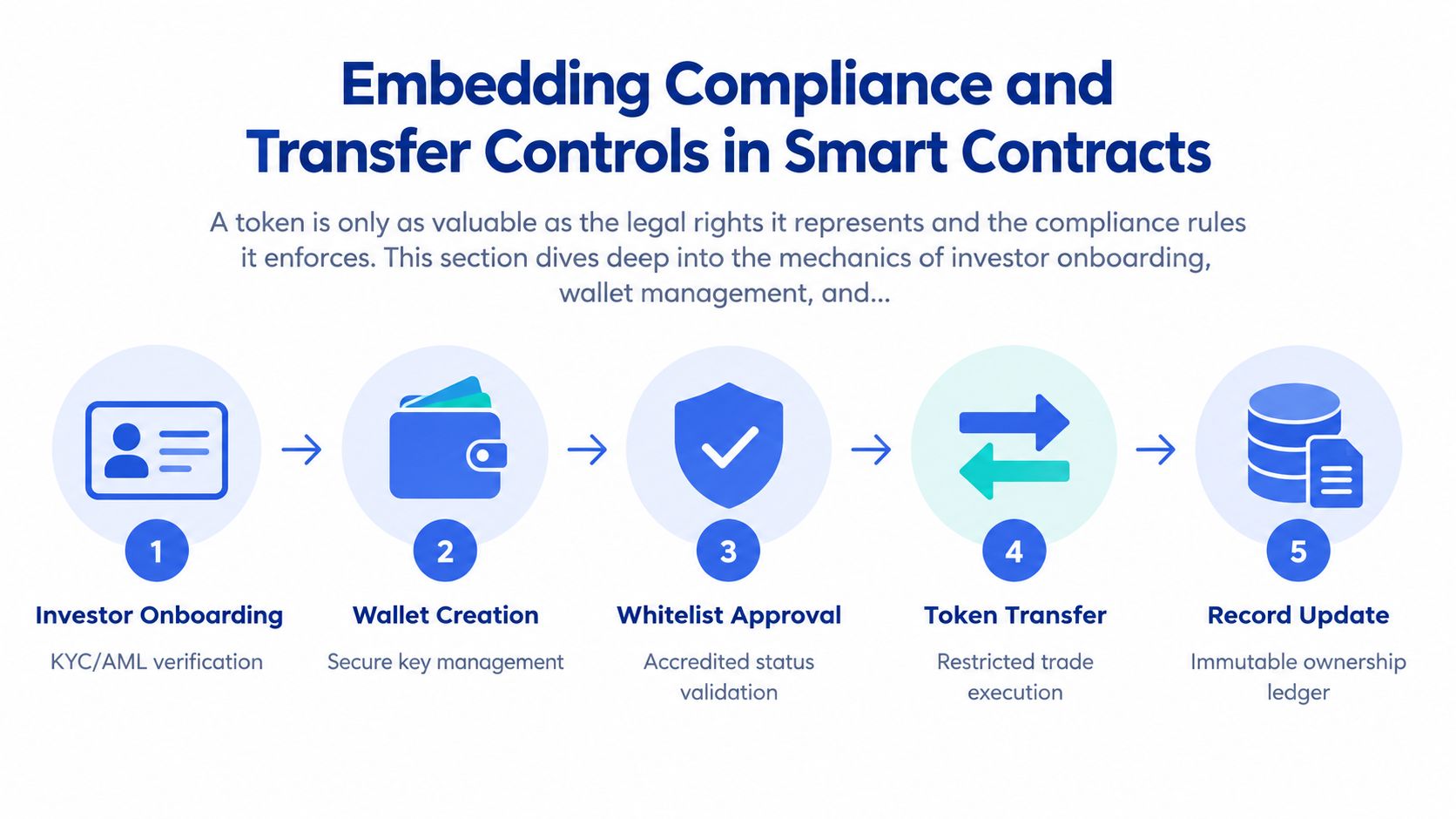
A token has no useful financial meaning unless the rights and restrictions behind it are explicit. For tokenized equity, compliance must operate across the investor lifecycle, from onboarding and wallet creation to transfers, corporate actions, redemptions, and account recovery.
The controlled investor journey
Investor onboarding begins with identity, entity, beneficial-owner, sanctions, and eligibility checks appropriate to the offering and jurisdiction. The result shouldn't be a simple “verified” flag. The platform needs a durable compliance decision with status, scope, expiry, evidence, and an audit trail.
Wallet creation links an approved investor to a wallet or custody account. Self-custody can provide direct control, while institutional custody can support governance, recovery, and operational segregation. In both models, the platform needs a reliable mapping between the legal investor and the blockchain address.
Whitelist approval determines whether the wallet can hold or receive a particular token. A single global allowlist is often too crude. Rules may depend on the instrument, investor type, jurisdiction, holding period, transfer route, or offering terms.
Restricted transfer execution occurs when the smart contract checks the sender, recipient, token status, and transaction conditions. A failed check should reject the transfer before ownership is changed, rather than allowing a transfer that an operations team must later unwind.
Record update synchronises token events with the issuer's ownership system. The platform should retain the transaction identifier, prior balance, new balance, approval evidence, and any associated documents needed for reporting or review.
Rights need explicit implementation
Voting requires a snapshot policy, eligibility date, proposal identity, vote weighting, delegation rules, and an outcome process. Dividend or distribution workflows need a payment source, holder calculation, claim handling, tax treatment, and reconciliation. Lock-ups and vesting require time-based logic that can be tested and independently reviewed.
The contract shouldn't contain every business process. Sensitive compliance decisions may belong in an authorised policy service, with the smart contract receiving signed instructions or verified status updates. That separation can make changes more manageable, but it introduces trust and key-management considerations.
A compliance and regulatory requirements guide for equity tokenization can support planning, but it isn't a substitute for jurisdiction-specific legal advice. The issuer, counsel, transfer agent, and compliance team must agree which controls are legally required and which are operational safeguards.
Navigating the Regulatory Landscape and Market Pilots
Blockchain technology doesn't determine whether a token is a share, security, receipt, derivative, or another financial instrument. The legal analysis starts with the rights attached to the instrument, the issuer's structure, the offering, the investor population, the transfer model, and the relevant jurisdiction.
In the United States, the UK, UAE, Germany, Singapore, Canada, Australia, and India, the details differ. A platform designed for global use therefore needs a jurisdiction matrix, offering-specific permissions, disclosure workflows, restricted transfer routes, and a process for updating controls as rules change. This article isn't legal advice, and no technical design guarantees regulatory compliance.
India's direction is instructive
India's policy framework is moving from legal ambiguity toward formal recognition. In February 2025, the IFSCA Expert Committee on Asset Tokenization proposed a regulated approach for digital tokens representing ownership or beneficial interests in real-world assets. The proposal addressed legal recognition, issuance, trading, custody, clearing, settlement, AML/KYC, governance, technology, and cyber-risk controls, as described in the IFSCA consultation paper on tokenization.
By September 2026, SEBI's Demat 2.0 pilot FAQs stated that a tokenised corporate bond remains a security under the Securities Contracts (Regulation) Act, 1956. It keeps the same ISIN, issuer obligations, coupon, maturity, covenants, rating, security, and investor rights. The FAQ position was that tokenisation changes the technology used to maintain the ownership record, not the underlying legal character of the instrument.
That principle matters for equity. If tokenized instruments are treated as securities rather than a wholly new asset class, a company still needs to preserve issuer obligations, investor rights, disclosures, custody, transfer controls, and market supervision. A 2026 bill introduced in Parliament also sought statutory recognition and supervision for asset tokenisation across issuance, trading, custody, and settlement, signalling movement toward formal market structure.
Market plumbing matters more than minting
India's first tokenised corporate bond pilot used a regulated, permissioned structure rather than an open public blockchain. The instrument could remain within existing Demat arrangements and investor-protection processes, reinforcing the practical lesson that tokenization succeeds when it connects to established rails.
For teams operating in the United States, a resource such as South Florida SEC compliance tips can provide useful general context, but it shouldn't be treated as a substitute for counsel reviewing the actual offering. The right sequence is legal classification, ownership model, market permissions, investor safeguards, then technical implementation.
Choosing the Right Technology Partner for Tokenization
A standard token contract is not a share tokenization solution. The technology partner must understand ownership records, investor eligibility, custody, transfer restrictions, corporate actions, key recovery, reporting, and the interfaces that connect blockchain infrastructure with financial-market systems.
Use a practical evaluation filter
Ask prospective providers to demonstrate how they would handle:
- Legal-record reconciliation: How does a blockchain event update, or receive confirmation from, the statutory register, transfer agent, or depository?
- Policy enforcement: Can the platform apply instrument-specific allowlists, lock-ups, jurisdictional restrictions, investor classifications, and approval workflows?
- Corporate actions: Can the system manage voting, distributions, vesting, redemptions, and issuer notices without creating a second incompatible cap table?
- Custody and recovery: How are keys protected, wallets approved, lost access handled, and administrative actions authorised?
- Operational resilience: What happens during chain outages, failed transactions, contract pauses, incorrect transfers, data mismatches, or service disruption?
- Evidence and reporting: Can compliance officers reconstruct who owned what, when, under which approval, and through which transfer path?
The partner should also explain what belongs on-chain, what remains off-chain, and which parties can change each record. If those answers are vague, the project is still at the concept stage.
Where Blocsys fits
Blocsys Technologies Pvt Ltd provides blockchain technology and tokenization solutions for organisations building digital-asset infrastructure. For this use case, its relevant work can include equity tokenization platform development, blockchain applications, smart contracts, compliance workflows, investor management, and integrations around tokenized ownership.
The company should be evaluated like any other technology partner. Require an architecture workshop, threat model, data-flow diagrams, contract specifications, test strategy, deployment plan, and support responsibilities. A private-company and startup equity tokenization platform perspective can help founders frame requirements, but the final design still needs input from legal, compliance, custody, registry, and financial-market stakeholders.
Frequently Asked Questions About Share Tokenization
What is share tokenization?
Share tokenization is the representation of company equity as blockchain-based digital tokens, with the token linked to defined legal and economic rights. The system must reconcile blockchain balances with the issuer's authoritative ownership records and enforce applicable transfer, investor, and custody controls.
How do companies tokenize shares?
A company first defines the equity instrument, rights, restrictions, investor eligibility, and legal record. It then designs the token, deploys and tests smart contracts, connects identity and compliance services, onboards investors, approves wallets, issues tokens, and establishes ongoing reconciliation with statutory registers or authorised market infrastructure.
Are tokenized shares real shares?
They can represent real shares, but not every stock-related token does. Some tokens represent direct equity, while others represent receipts, fund interests, derivatives, or economic exposure. The legal documents and ownership architecture must state exactly what the token represents.
Do tokenized shareholders retain voting rights?
They may retain voting rights when the token represents equity with those rights and the issuer implements a valid voting process. The platform needs clear eligibility dates, vote weighting, proposal records, delegation rules, and a method for recording and executing outcomes.
What does a smart contract do for tokenized equity?
A smart contract can control issuance, burning, transfers, wallet permissions, lock-ups, investor restrictions, voting logic, and selected corporate actions. It doesn't replace the issuer, legal register, transfer agent, compliance function, or governance process.
How are investors onboarded?
Investors generally complete identity, entity, beneficial-owner, sanctions, AML, suitability, and offering-specific checks required by the structure. Approved investors are linked to approved wallets or custody accounts before they can receive or transfer restricted tokens.
Where is ownership recorded?
Ownership may be recorded across a blockchain ledger and an authorised legal or operational register. The platform must define which record is legally authoritative and how token events, corrections, redemptions, and corporate actions are synchronised.
Can tokenized shares be transferred freely?
Not necessarily. Smart contracts can restrict transfers by wallet approval, jurisdiction, investor status, holding period, offering terms, or transaction route. A token's technical transferability doesn't override securities law or the issuer's contractual restrictions.
How are tokenized shares secured?
Security requires audited smart contracts, controlled administration, strong key management, wallet screening, role separation, monitoring, incident response, tested recovery, and secure integrations. Self-custody also creates personal key-management responsibility for investors.
How should a company choose a tokenization provider?
Choose a provider that can connect blockchain infrastructure with statutory records, identity services, custody, compliance workflows, corporate actions, reporting, and existing financial systems. Assess its architecture, security process, integration experience, testing discipline, documentation, and ability to work with legal and regulated-market stakeholders.
Blocsys Technologies develops blockchain infrastructure, smart contracts, digital-asset systems, and equity tokenization platforms for companies designing controlled on-chain ownership workflows. Visit Blocsys Technologies to discuss your share tokenization requirements, architecture, compliance workflow, and implementation roadmap.