
A Dubai investment desk is ready to issue a bond, fund interest, equity claim, or sukuk on-chain. The commercial case is clear, but the production questions are harder: who can see the position, which ledger proves ownership, how does cash settle against the asset, and which regulator accepts the resulting record? Retail-style token issuance doesn’t answer those questions.
This guide is for UAE banks, asset managers, issuers, fintechs, family offices, enterprise technology leaders, and institutional investors evaluating Tokenized Securities in Dubai. It focuses on the practical role Canton Network could play in moving from isolated pilots to privacy-preserving, interoperable capital-markets infrastructure, while separating what the technology can solve from what still requires legal, custody, market, and regulatory design. Teams assessing an implementation can also review Blocsys Technologies for enterprise blockchain and digital-asset development context.
Table of Contents
- Why Tokenized Securities Matter for Dubai Capital Markets
- What Tokenized Securities Actually Are
- How Security Tokenization Works End to End
- What Canton Network Brings to Institutional Finance
- How Canton Compares to Traditional Blockchain Infrastructure
- Tokenized Bonds, Equities, Funds, and Sukuk on Canton
- Regulatory and Compliance Design for Dubai Issuers
- Institutional Implementation Roadmap for Tokenized Securities
- The Future of Tokenized Finance in Dubai
- Why Blocsys Aligns with These Needs
- Frequently Asked Questions
- What are tokenized securities in Dubai?
- How does security tokenization work in Dubai?
- What is Canton Network?
- Why is Canton relevant to institutional finance?
- How can Canton support tokenized securities?
- Is tokenization regulated in Dubai?
- Can bonds and equities be tokenized in Dubai?
- What is the difference between tokenized securities and cryptocurrencies?
- What are the benefits for institutional investors?
- What are the main risks of tokenized securities?
- Can tokenized securities move between Dubai and India?
- How should an institution start a tokenization project?
Why Tokenized Securities Matter for Dubai Capital Markets
Dubai’s opportunity isn’t just to put more assets on a blockchain. The strategic question is whether the city can turn tokenization into production-grade market infrastructure that banks, exchanges, custodians, issuers, and regulators can use without weakening existing controls.
A tokenized security can support programmable compliance, controlled transfer, faster settlement, and continuous market operations. Those advantages disappear if every participant operates on a separate ledger, if investor data becomes visible to the wrong parties, or if the legal ownership record remains disconnected from the token. A public-chain issuance may look efficient at the transaction layer while creating new exposure in custody, privacy, reconciliation, and reporting.
The production gap
Institutional desks need more than a minting function. They need a complete operating model covering:
- Issuance: A legally valid instrument, offering documentation, investor eligibility, and a controlled creation process.
- Trading: Order handling, transfer restrictions, market surveillance, and venue connectivity.
- Settlement: Delivery-versus-payment, collateral movement, cash integration, and finality.
- Asset servicing: Coupons, redemptions, voting, corporate actions, distributions, and reporting.
- Custody: Segregated holdings, key management, recovery procedures, and an authoritative ownership trail.
That is why the difference between retail-style token issuance and institutional tokenization matters. Retail infrastructure often prioritises open access and composability. A Dubai capital-markets product needs permissioned participation with selective transparency.
Practical rule: Treat tokenization as a regulated operating model, not as a smart-contract deployment.
The same readiness question appears in adjacent banking infrastructure. A useful resource on tokenized deposits bank readiness helps frame why payment, treasury, and deposit workflows must evolve alongside securities infrastructure. For institutions evaluating enterprise blockchain adoption in UAE financial institutions, the decisive test is whether the network supports controlled coordination across existing financial functions.
Canton Network is relevant because its institutional tokenization stack combines a privacy-enabled public L1 with Daml-based workflows. Its design aims to let institutions move tokenized assets without exposing proprietary positions, while supporting atomic settlement and continuous intraday financing. The network’s RWA mobility materials describe “instant liquidity” and “24/7 onchain financing”, while its 2024 pilot data reported atomic transactions at scale across 22 permissioned blockchains according to Canton Network materials. The implication is important for Dubai: the difficult problem is less creating a token than coordinating asset, collateral, cash, and financing legs across controlled systems.
What Tokenized Securities Actually Are
Tokenized securities are blockchain-based representations of legally enforceable financial claims. A token may represent a bond, equity share, fund unit, or sukuk interest, but the token isn’t automatically the legal asset itself. The legal wrapper, offering documents, shareholder arrangements, trustee structure, and applicable securities rules still determine what the investor owns and what rights that ownership creates.
Three properties distinguish a tokenized security from a cryptocurrency or a payment token:
- A defined legal claim. The holder has rights connected to an underlying instrument, issuer, vehicle, or contractual arrangement.
- A responsible issuer or intermediary. The product has an entity accountable for issuance, disclosures, servicing, and compliance.
- Controlled transferability. Smart contracts can enforce KYC status, investor eligibility, whitelists, holding limits, lock-ups, and jurisdictional restrictions.
The token is best understood as a digital twin of an ownership or entitlement record. Smart contracts can automate coupon calculations, maturity events, voting rights, distributions, and transfer checks. They can’t independently establish legal title where the relevant statute, register, depository, or court doesn’t recognise the blockchain record. A solid design therefore maps on-chain balances to an authoritative legal record, whether that record sits with a registrar, custodian, trustee, depository, or special-purpose vehicle.
Tokenisation is not cryptocurrency issuance
A cryptocurrency generally seeks broad transferability and network-level utility. A stablecoin is designed to represent a monetary or settlement claim under its own reserve and redemption model. A tokenized security represents an investment instrument with restricted ownership and issuer obligations.
| Attribute | Cryptocurrency | Stablecoin | Tokenized security |
|---|---|---|---|
| Primary function | Network utility, exchange, or investment | Payment or settlement representation | Ownership or entitlement in a financial instrument |
| Legal relationship | May not represent an issuer obligation | Usually linked to a redemption or reserve framework | Linked to a defined security, contract, or vehicle |
| Transfer rules | Often open or broadly accessible | May include issuer controls | KYC, eligibility, jurisdiction, and instrument restrictions |
| Corporate actions | Usually absent or protocol-based | Based on the token’s terms | Coupons, voting, distributions, maturity, and redemptions |
| Institutional design priority | Liquidity and network access | Stability and redemption | Privacy, custody, compliance, settlement, and auditability |
Dubai issuers need to avoid a common design error: treating the token as the whole asset. A legally strong structure starts with the financial product and then determines how the ledger records ownership, restrictions, servicing, and settlement. The RWA tokenization guide is useful background for separating the underlying asset, legal wrapper, token standard, and operational services.
Why Dubai attracts institutional tokenisation
Dubai and the wider UAE offer a layered environment involving securities, virtual assets, and property or title rules. Depending on the token’s economic and legal characteristics, relevant authorities can include VARA in Dubai, SCA or CMA at federal level, and DFSA or ADGM regulators in free zones Clyde & Co explains the UAE’s layered real-estate tokenisation regime. DIFC and ADGM also provide legal environments familiar to international institutions.
The attraction isn’t regulatory permission in the abstract. It is the combination of capital, issuers, family offices, banks, asset managers, and real-world assets that could benefit from controlled digital distribution. Real estate, private credit, funds, bonds, and sukuk all have administrative processes that can be represented through permissioned workflows.
That opportunity still depends on infrastructure. Dubai can become a tokenisation hub only if its digital securities stack preserves institutional confidentiality while connecting multiple market participants and legal systems.
How Security Tokenization Works End to End
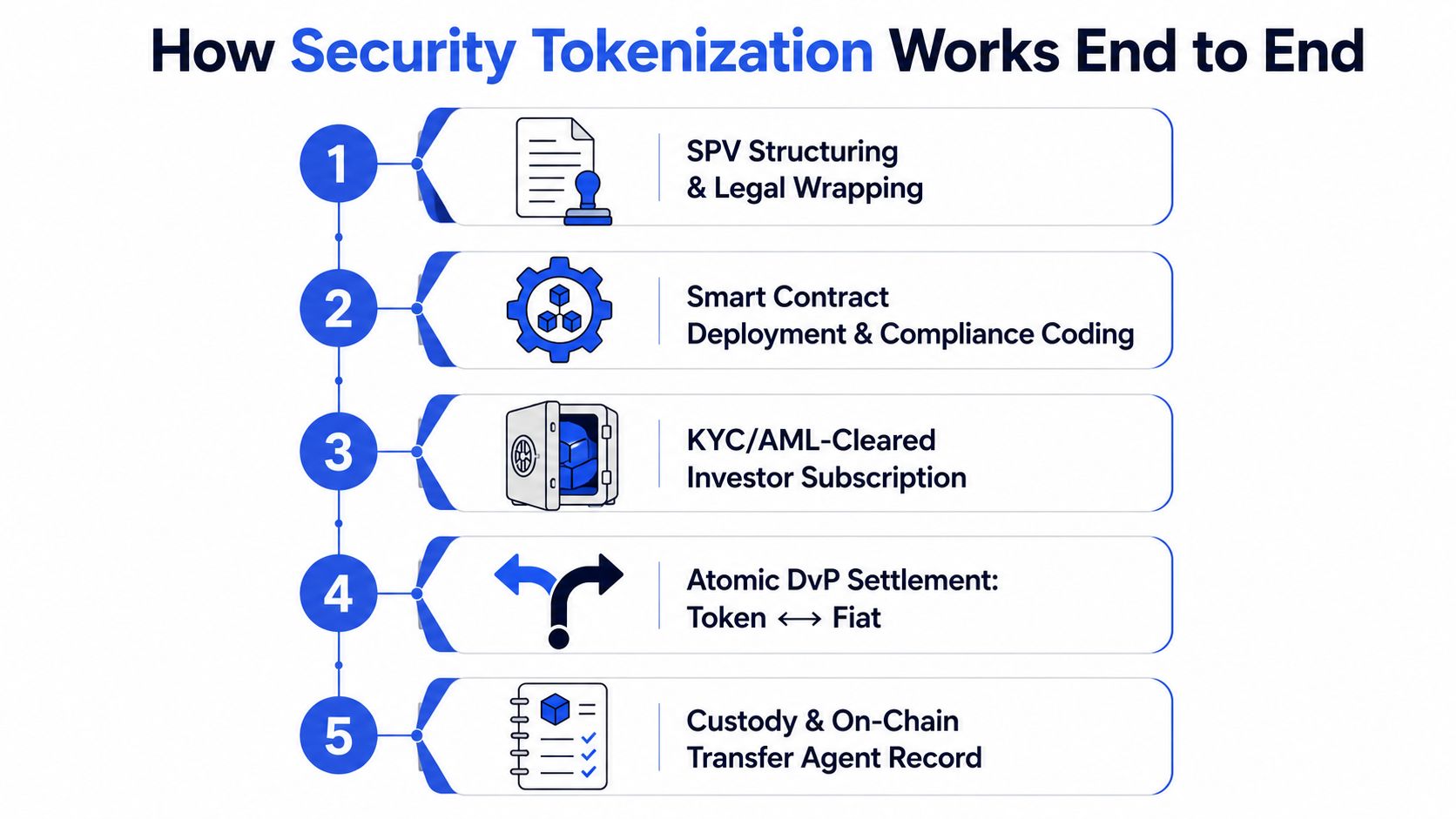
A Dubai desk should structure tokenization as a controlled chain of legal, technical, and operational decisions.
The operating sequence
- Create the legal wrapper. The issuer establishes the SPV or other issuing structure under the chosen DIFC, ADGM, or onshore framework. Counsel defines the investor’s legal claim, transfer rules, disclosure duties, and servicing arrangements.
- Deploy the instrument logic. The security token is created on the selected DLT. Smart contracts encode eligibility checks, transfer restrictions, supply controls, corporate actions, and permissions.
- Onboard investors. KYC, AML, suitability, accreditation, and jurisdictional checks occur before subscription. The resulting permission should be reusable without exposing unnecessary personal data.
- Distribute and settle. Primary distribution can occur through private placement or a regulated venue. For secondary transactions, atomic delivery-versus-payment exchanges the token and cash in one coordinated transaction where the architecture supports it.
- Maintain custody and records. Custodians, trustees, registrars, and paying agents remain essential. The ledger records transfers and servicing events, while off-chain systems preserve legal documents, identity evidence, recovery processes, and institutional controls.
A tokenization and asset-servicing architecture should therefore connect the DLT to custody wallets, investor registries, payment rails, corporate-action engines, compliance systems, and reconciliation feeds. For a bank issuing debt, a corporate bond tokenization platform can provide a product-specific implementation context for digital issuance, smart-contract automation, settlement, and investor management.
The following video offers supplementary context for teams comparing blockchain settlement and institutional finance workflows.
What Canton Network Brings to Institutional Finance
A Dubai issuer can create a token on a public chain in days. The harder task is supporting confidential pricing, controlled participant access, interoperable applications, and delivery-versus-payment without forcing every party to share the same transaction history. Canton Network is a privacy-enabled, interoperable DLT designed for regulated institutional workflows. Its value lies in coordinating applications that exchange securities, cash, collateral, and obligations while limiting data exposure to the parties that need it.
Daml, the Digital Asset Modeling Language used in Canton-based workflows, lets institutions define financial agreements, rights, and obligations in executable form. Each participant receives the information required for its role. A custodian need not see a lender’s unrelated positions, and a competing institution need not receive proprietary order information. That selective visibility addresses a central gap between retail-style token issuance and institutional market operations.
Privacy with coordinated settlement
The practical distinction is transaction-level privacy rather than broad ledger visibility. An issuer may need evidence that a transfer occurred, while the investor, custodian, financing provider, and other parties receive only the records relevant to their responsibilities.
Canton’s Global Synchronizer coordinates atomic transactions across independent applications and asset types. A securities workflow could settle a tokenized bond, tokenized cash, and collateral instruction together. This reduces disconnected state changes and the reconciliation work created when asset and cash legs settle in separate systems.
Canton’s institutional examples describe synchronized settlement across permissioned environments Canton Network describes the relevant settlement architecture. Canton has also publicised a 2025 on-chain U.S. Treasury financing transaction and 2026 real-time settlement with tokenized Treasuries against tokenized cash Canton Network outlines the Treasury financing example. These examples show the workflow Canton targets. They do not establish secondary liquidity or regulatory acceptance for every Dubai instrument.
For an implementation team, Daml and Canton Network for digital assets offers an architecture reference. A provider offering Blockchain Development may build public, private, or hybrid applications. The instrument’s privacy, governance, and interoperability requirements should determine that choice.
How Canton Compares to Traditional Blockchain Infrastructure
The right question isn’t whether Canton is universally better than Ethereum, Besu, Quorum, or a CBDC platform. The question is which operating conditions the issuer needs.
| Dimension | Public L1 | Permissioned ledger | Canton Network |
|---|---|---|---|
| Data visibility | Broad ledger transparency is common | Access is controlled within one network | Privacy is applied to participant workflows and transaction data |
| Interoperability | Often depends on bridges and external protocols | Usually strongest inside one ledger | Designed to coordinate independent applications and networks |
| Settlement | Cross-asset DvP may require additional contracts or bridges | Efficient within the same environment | Supports synchronized multi-party settlement across applications |
| Governance | Public protocol governance and validator ecosystem | Operator or consortium governance | Participant, application, and synchronizer governance |
| Composability | Broad, open composability | Controlled, often siloed composability | Permissioned interoperability between institutional workflows |
| Main trade-off | Privacy, compliance, and transaction confidentiality | Data silos and limited external connectivity | More structured participation and less open retail composability |
A public chain may suit an instrument designed for broad investor access, but visible order flow can conflict with bilateral pricing, institutional confidentiality, and data-minimisation obligations. A single permissioned ledger improves access control, yet it can leave banks, custodians, venues, and issuers maintaining separate silos.
Canton addresses the latter problem with application interoperability and synchronized settlement. It still introduces trade-offs. Institutions must assess governance, participant admission, integration complexity, operational responsibility, and the extent of network-level decentralisation they require. Canton also doesn’t create a liquid market because transactions settle atomically.
For a concise view of how Canton approaches interoperability beyond isolated ledgers, see Daml blockchain interoperability and Canton. Broader fintech comparisons, including the relationship between digital finance and traditional banking, are explained by Smart Classic Business Hub.
Tokenized Bonds, Equities, Funds, and Sukuk on Canton
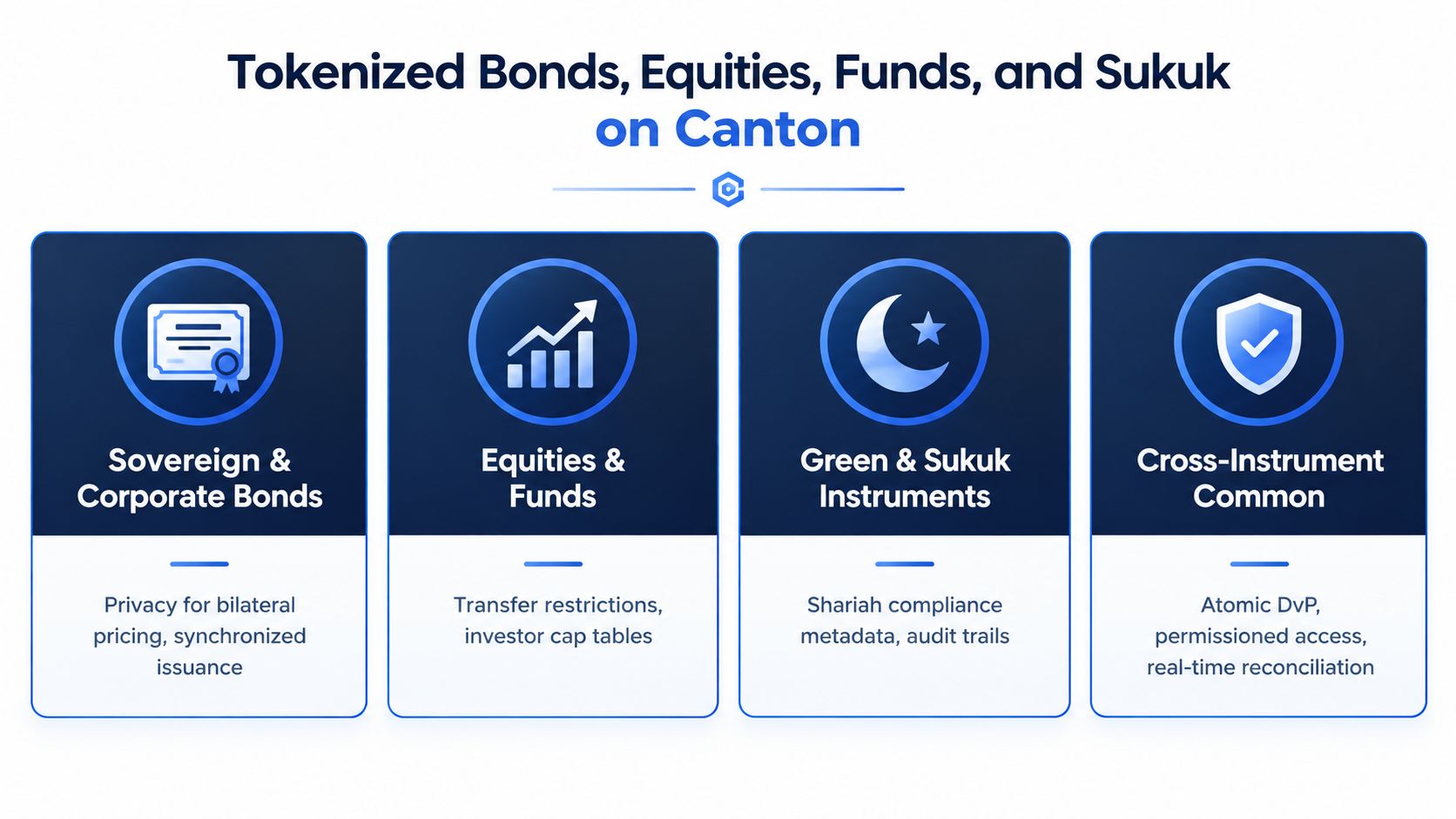
The strongest Dubai use cases are those where privacy, controlled transfer, and coordinated settlement solve a specific operational problem.
Debt instruments
For corporate and sovereign bonds, Canton can coordinate delivery of the tokenized bond against tokenized cash or another approved settlement asset. Bilateral pricing and investor positions can remain private, while the transaction itself reaches a coordinated final state. The model is useful where settlement breaks, duplicated instructions, and separate collateral records create operational friction.
Equities and private-market interests
Private equity, venture tranches, and closely held shares need strict transfer controls. A Canton workflow can make investor eligibility, whitelist status, lock-ups, and cap-table permissions part of the transaction logic. It can also give each participant only the ownership information required for its role, rather than exposing the entire register.
Funds and sukuk
A fund register may need to connect subscriptions, redemptions, NAV updates, transfer approvals, and investor servicing across separate applications. Canton can coordinate those workflows without forcing every sub-network to reveal its LP identities.
Sukuk requires an even more careful design. Profit-distribution logic, asset-backed ringfencing, ownership records, and Shariah board review need to remain traceable. Smart contracts can preserve relevant metadata and automate approved events, but they don’t replace legal structuring or Shariah governance.
What Canton doesn’t solve
Canton doesn’t independently create primary-market demand, provide FX, determine valuation, appoint a custodian, or guarantee a functioning secondary market. It also doesn’t eliminate fragmented liquidity. A Dubai issuer still needs venues, market makers where appropriate, investor distribution, cash connectivity, custody, and regulator-aligned reporting.
The central distinction is settlement capability versus market depth. Atomic settlement can reduce post-trade uncertainty, but institutions still need enough eligible counterparties and usable collateral pathways for tokenized securities to become working capital rather than digitised ownership.
Regulatory and Compliance Design for Dubai Issuers
Tokenization doesn’t remove securities-law obligations. The U.S. SEC has stated that tokenized securities remain securities, represented as crypto assets with ownership recorded on or through crypto networks, so the relevant federal securities obligations continue to apply SEC statement on tokenized securities. Dubai issuers should apply the same principle to local classification and licensing analysis.
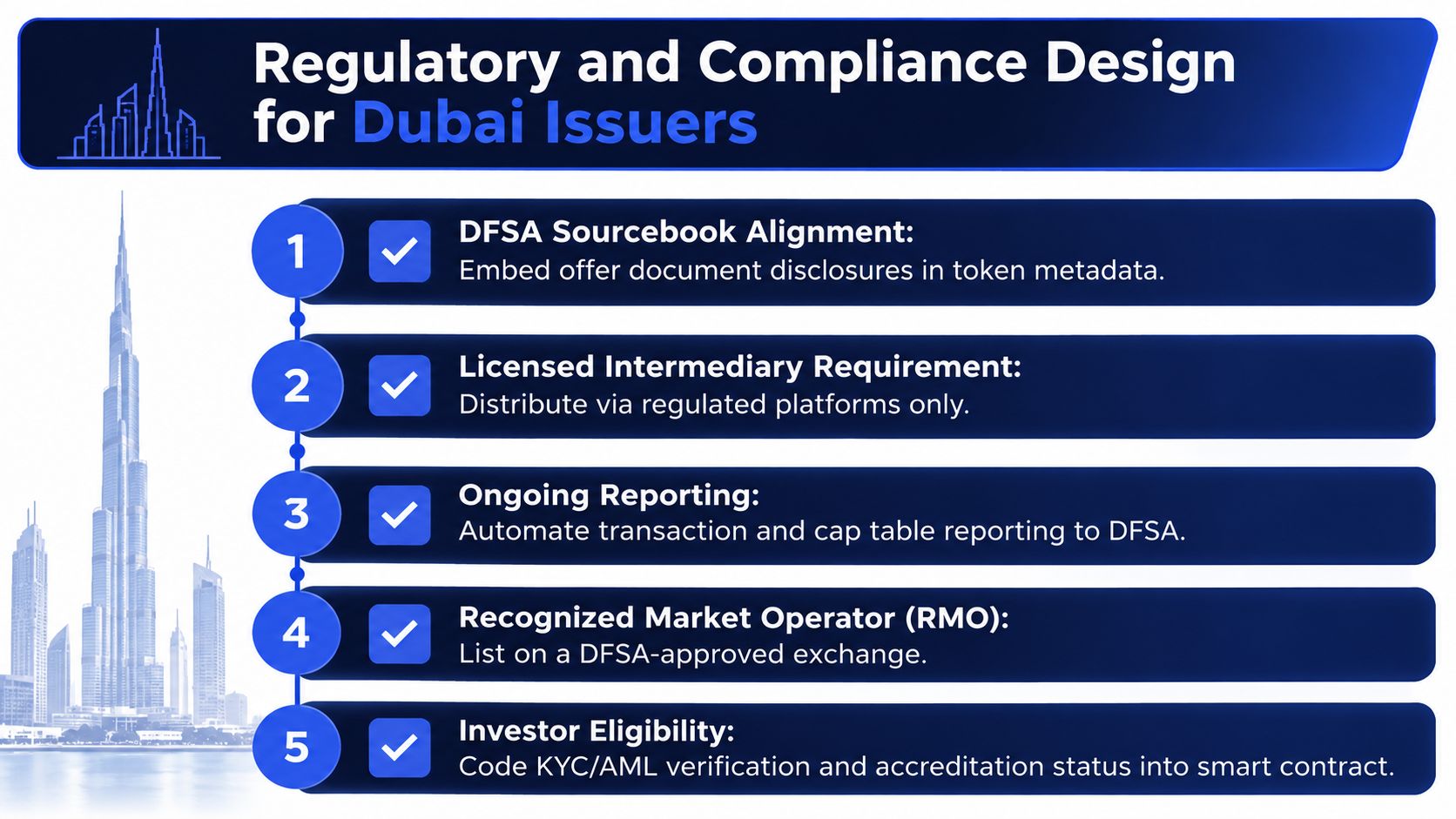
Build compliance into the instrument
A Dubai implementation should begin with the token’s legal and economic characteristics. The issuer then maps the product to the relevant perimeter, which may involve DFSA, VARA, SCA, ADGM, or another applicable authority, depending on the entity, venue, asset, and activity.
The system design should address:
- Offering documents: Link investor rights, disclosures, restrictions, and servicing terms to the token’s authoritative records.
- Identity controls: Use permissioned identities and attestations rather than placing unnecessary personal information on-chain.
- Transfer rules: Encode KYC, AML, suitability, accreditation, jurisdiction, holding, and lock-up checks.
- Privacy controls: Separate transaction visibility from compliance access, using hashed references or privacy-preserving proofs where appropriate.
- Auditability: Maintain immutable event records while preserving the ability to manage sensitive off-chain evidence correctly.
For India-facing products, the legal mapping is especially important. Indian analysis notes that there is no exclusive law for tokenized securities, while the SCRA, Companies Act, Depositories Act, and IT Act may apply without expressly recognising blockchain or decentralised registers Indian tokenized securities analysis. The same analysis recommends sequenced sandbox testing across issuance, custody, interoperability, and smart-contract audits.
That approach translates well to a Dubai and India corridor. Keep the on-chain settlement layer modular, but map authoritative ownership and legal finality to the securities-law concepts that each jurisdiction recognises.
Institutional Implementation Roadmap for Tokenized Securities
A serious implementation should use staged gates rather than a single production launch. The sequence below gives a Dubai issuer a defensible way to test legal, operational, and technical assumptions before opening secondary trading.
Phase one focuses on product and legal fit
Select an instrument with a clear ownership model, defined investor base, and manageable servicing requirements. Complete the legal wrapper, determine the relevant regulatory perimeter, identify the proposed custodian and registrar, and agree on how the off-chain legal record will map to the Canton instrument.
The go/no-go gate is not transaction speed. It is whether counsel, compliance, operations, and the relevant regulator or innovation-testing process agree on the product’s structure and responsibilities.
Phase two establishes the controlled pilot
Create the Canton application or sub-network, configure participant identities, integrate KYC and AML systems, and connect the cap-table or asset register. Issue a closed pilot to a qualified participant or tightly controlled investor group.
Test failed transfers, revoked permissions, key recovery, corporate actions, data visibility, and reconciliation. A pilot that only tests successful issuance isn’t evidence of production readiness.
Phase three connects cash and operations
Add the cash leg for atomic DvP where the chosen settlement asset and counterparties support it. Run the tokenized process in parallel with conventional custody or central securities infrastructure, then compare records, exception handling, reporting, and operational hand-offs.
The board should receive evidence on:
- Reconciliation: Which events require manual intervention?
- Controls: Can compliance stop or reverse an unauthorised workflow under the legal model?
- Resilience: What happens if a participant, custodian, or integration endpoint is unavailable?
- Servicing: Can the system process redemptions, coupons, distributions, and amendments?
- Audit: Can internal and external reviewers reconstruct the complete transaction history?
Phase four tests the market, not just the ledger
Open secondary trading only after a regulated venue, custody model, investor eligibility process, and market-operating rules are ready. Add additional issuers or instruments gradually, and test portability across approved sub-networks without weakening privacy or transfer restrictions.
An integration partner should cover four connected workstreams:
- Issuance architecture: Legal-asset mapping, token models, supply controls, and corporate actions.
- Canton connectivity: Participant onboarding, Daml workflows, synchronizer integration, and environment operations.
- Compliance engineering: Identity attestations, KYC and AML integrations, eligibility logic, audit trails, and reporting.
- Post-deployment operations: Monitoring, smart-contract audits, custody integrations, incident handling, and venue connectivity.
Budgeting should include product discovery, legal analysis, security review, integrations, infrastructure, compliance operations, and ongoing support. Teams can use the Blocsys Software Development Cost Estimator to frame an initial development conversation, then validate the estimate against the instrument’s regulatory and integration scope.
For Indian institutions connecting to Dubai infrastructure, a sequenced sandbox is preferable to a broad public-market launch. The unresolved issues include registry recognition, depository roles, custody logic, cross-border reporting, data localisation, and duplicated compliance stacks. IFSCA’s 2025 framework in GIFT City is described as requiring registration, fit-and-proper governance, and a sandboxed approach for tokenization and DLT-based services regional coverage of the IFSCA framework. That supports a corridor architecture combining on-chain settlement with jurisdiction-specific legal finality.
Blocsys Technologies develops security tokenization, RWA tokenization, digital securities platforms, smart contracts, and enterprise blockchain infrastructure for financial institutions and issuers assessing Canton-based capital-markets workflows. Visit Blocsys Technologies to discuss the legal, technical, compliance, custody, and settlement requirements for a Dubai tokenized securities pilot.
The Future of Tokenized Finance in Dubai
Over the next 12 to 24 months, the practical market will likely be shaped less by headline issuance volume and more by whether institutions can make tokenized assets usable across financing, collateral, custody, and regulated trading workflows. Canton is positioned for regulated institutional finance through privacy-preserving coordination and synchronised multi-party workflows, with a roadmap that includes DTCC tokenizing a subset of DTC-custodied U.S. Treasuries on Canton targeted for 2026 Canton’s institutional roadmap. That is a concrete signal of institutional direction, not proof that every local asset class is ready.
Dubai’s next challenge is interoperability across legal and market structures. A Dubai issuer may need to connect a DIFC or UAE vehicle to custodians, banks, venues, investors, and counterparties in Singapore, Hong Kong, Switzerland, the UK, the EU, the US, or India. Each connection introduces questions about investor eligibility, title, reporting, privacy, settlement assets, and custody.
The strategic test
Canton can help close the gap between isolated ledgers by coordinating approved applications and preserving transaction confidentiality. It can’t make an ill-defined security compliant, create liquidity, replace a custodian, or resolve jurisdictional conflicts.
The strongest strategy is therefore selective:
- Use Canton where privacy and multi-party synchronisation are essential.
- Keep legal ownership, identity evidence, and regulatory reporting mapped to recognised institutional records.
- Start with instruments such as bonds, collateral, funds, or controlled private-market interests where operational pain is clear.
- Measure market usefulness through settlement reliability, servicing quality, custody integration, and participant adoption, not token issuance alone.
For a Dubai institution, the winning architecture won’t be the one with the most visible tokens. It will be the one that lets authorised participants transfer real financial rights with controlled disclosure, clear legal accountability, and dependable settlement across the systems they already use.
Why Blocsys Aligns with These Needs
Blocsys fits the implementation problem when an institution needs more than a token contract. The relevant work spans security tokenization, RWA tokenization, digital securities platform development, smart-contract engineering, custody integration, compliance workflows, and enterprise blockchain operations.
A practical engagement should begin with instrument selection and legal-technical mapping. From there, the delivery scope can include token and permission models, Canton connectivity where appropriate, KYC and AML integrations, investor portals, issuance workflows, corporate actions, custody interfaces, reconciliation, reporting, testing, and post-launch support.
Blocsys should be evaluated as a development and integration option, not as a substitute for regulated counsel, a licensed intermediary, a custodian, an exchange, or a regulator. The value of an engineering partner is its ability to connect those responsibilities into one coherent product architecture.
For Dubai institutions, that means designing the full path from traditional asset to tokenization, blockchain infrastructure, institutional trading, and settlement. The technology choice matters, but the operating model determines whether the product can survive production scrutiny.
Frequently Asked Questions
What are tokenized securities in Dubai?
Tokenized securities in Dubai are digital representations of financial instruments such as bonds, equities, fund interests, or sukuk, recorded through blockchain infrastructure. Their legal status depends on the underlying rights, issuer structure, offering terms, applicable regulator, custody model, and recognition of the ownership record.
How does security tokenization work in Dubai?
The issuer defines the legal instrument, establishes the appropriate vehicle, deploys smart-contract logic, completes investor onboarding, distributes the security through an approved process, and maintains custody and ownership records. The DLT manages permissions and transfers, while legal documents, custodians, registrars, and trustees remain part of the structure.
What is Canton Network?
Canton Network is a privacy-enabled, interoperable DLT for institutional workflows. It uses Daml-based applications and synchronised transactions so approved participants can coordinate assets, cash, collateral, and financial obligations without exposing every transaction detail to every network participant.
Why is Canton relevant to institutional finance?
Institutional finance requires confidentiality, controlled access, interoperability, auditability, and dependable settlement. Canton is relevant because it is designed to coordinate independent applications and multi-party workflows while applying privacy to the data each participant can see.
How can Canton support tokenized securities?
Canton can support issuance and transfer workflows, investor permissions, asset servicing, and atomic settlement between tokenized securities and compatible cash or collateral assets. It doesn’t independently provide legal recognition, custody, primary distribution, foreign-exchange liquidity, or secondary-market depth.
Is tokenization regulated in Dubai?
Tokenization may fall under securities, virtual-asset, property, or title rules depending on the token’s legal and economic characteristics. Dubai and UAE implementations may involve VARA, DFSA, SCA or federal authorities, ADGM, or other relevant regimes. Issuers need a product-specific legal and regulatory assessment.
Can bonds and equities be tokenized in Dubai?
Bonds and equities can be considered for tokenization when the legal structure, issuer obligations, investor restrictions, custody, transfer record, and regulatory perimeter are properly addressed. The blockchain representation doesn’t remove securities-law duties.
What is the difference between tokenized securities and cryptocurrencies?
A tokenized security represents a defined financial claim and normally includes issuer, disclosure, transfer, and servicing obligations. A cryptocurrency generally represents network utility, exchange value, or a digital asset position rather than ownership in a bond, share, fund, or sukuk.
What are the benefits for institutional investors?
Potential benefits include controlled transferability, programmable compliance, coordinated settlement, reduced reconciliation between connected systems, continuous operating windows, and improved visibility into permitted ownership and servicing events. The benefits depend on integrations, legal recognition, custody, and market participation.
What are the main risks of tokenized securities?
Key risks include unclear legal title, regulatory classification, privacy leakage, smart-contract defects, key loss, custody failure, fragmented liquidity, limited venue connectivity, data-localisation constraints, and dependence on off-chain records. Atomic settlement addresses a settlement condition, not every market or legal risk.
Can tokenized securities move between Dubai and India?
They may be designed for cross-border workflows, but transferability depends on both jurisdictions’ securities, custody, registry, investor, reporting, and data requirements. India-facing products should use modular legal controls and a sequenced sandbox approach until DLT ownership records receive the necessary recognition.
How should an institution start a tokenization project?
Start with one instrument and a closed workflow. Define the legal claim, target investors, regulator perimeter, custody model, authoritative ownership record, settlement asset, privacy requirements, and success gates before selecting the DLT. Then test issuance, failed transfers, servicing, reconciliation, reporting, and custody recovery before considering secondary trading.
