
You’re in the middle of a document review, and one file keeps raising the same uncomfortable question. Was that contract really signed on that date, was that certificate altered after issue, or did someone swap a record in a system that looks fine on the surface? For US teams handling property files, HR paperwork, clinical records, lending documents, or compliance evidence, that uncertainty is where fraud slips in and trust breaks down. Immutable blockchain records turn that uncertainty into a verifiable trail, so a document’s history can be checked against a tamper-evident record instead of a system that someone can edit after the fact. For a deeper product view, see Blocsys’s blockchain-based document verification approach.
Table of Contents
- Introduction to Document Fraud and Blockchain Solutions
- Understanding Document Fraud in US Organizations
- What Are Immutable Blockchain Records
- Key Cryptographic Features for Tamper Proof Documents
- Integrating AI and Blockchain for Advanced Verification
- Compliance and Legal Requirements for Blockchain Evidence
- US Use Cases and Implementation Considerations
- Why Choose Blocsys and Next Steps
Introduction to Document Fraud and Blockchain Solutions
A fraud incident rarely starts with a dramatic breach. More often, someone changes a file, a signature gets reused, or a record is backdated inside a workflow that was trusted too much. By the time a legal team, auditor, or regulator spots the mismatch, the organisation is already dealing with disputed evidence, extra review work, and a damaged chain of trust.
That’s why immutable blockchain records matter. They do not replace every system you already use, they add a tamper-evident layer that makes later edits obvious by anchoring a document’s proof state to a ledger that is designed to resist silent change. In enterprise terms, the value is not “put everything on-chain”, it’s “make the document’s integrity independently verifiable”.
This guide is for CIOs, compliance officers, legal teams, government record owners, and implementation leads who need a practical answer, not just a slogan. You’ll get a plain-language explanation of how blockchain document verification works, what cryptographic pieces do the heavy lifting, where AI fits, and what still has to be proven off-chain in the US if the record is ever challenged. For teams planning architecture and budgeting, the Blocsys software development cost estimator is a useful starting point for scoping a verification platform.
Practical rule: If a document can be edited without creating a visible integrity break, it is not secure enough for high-stakes evidence workflows.
Understanding Document Fraud in US Organizations
Document fraud in US organizations usually starts as a workflow problem before it becomes a legal dispute. A contract version is swapped after approval, a certification date is changed, or a supporting file is uploaded into a records system with no reliable way to prove whether it still matches the original submission. In regulated environments, that uncertainty is expensive because teams must spend time reconstructing what happened instead of acting on the record itself.
A hiring team can run into the same issue with background checks and credentials. For a deeper look at that use case, see Blocsys’s guide on blockchain verification for hiring.
Where traditional controls break down
Centralised databases, shared drives, and manual review steps all depend on trust in an administrator, an application, or a workflow that can be changed. That leaves room for forged signatures, unauthorised edits, duplicate files, and retrospective corrections. The fraud is only part of the problem. The longer delay between the edit and the moment anyone can prove the edit happened makes the evidence harder to rely on.
India’s land-record modernisation programme shows the scale of the challenge once records move online. As reported in the DILRMP-related reference, computerisation of Record of Rights reached 99.99% of villages, digitisation of cadastral maps reached 92.37%, and integration of registration with land records reached 92.11% of targeted states and UTs. That matters for the US conversation because it shows that scanning records is only the first step, while immutability and cross-system verification become the critical test after digitisation.
A digital file that can be overwritten is still a soft target, even if it lives inside a modern platform.
High-risk document types
In US organizations, the records most exposed to fraud are usually the ones that carry legal or financial consequences. Property deeds, wills, trust instruments, transaction authorisations, academic credentials, medical records, and employment verification documents all depend on being able to prove origin and history. If a bad actor can alter one of those records without leaving a clear trace, the business inherits the dispute.
The pattern is familiar across sectors. People want a simple answer to whether a file is the same one that was issued, and traditional systems often answer with policy instead of proof. Blockchain document authentication changes that by giving teams a cryptographic way to check whether the file still matches the version that was originally anchored.
What Are Immutable Blockchain Records
An immutable blockchain record is a proof trail that can’t be rewritten the way a normal database entry can. Instead of storing every document in full on-chain, the system stores a cryptographic fingerprint, a timestamp, and the ledger history needed to prove whether the file still matches the version that was originally recorded. That distinction matters, because the blockchain is not acting like a file cabinet, it’s acting like a notarised integrity layer.
How the record stays tamper-evident
The core idea is straightforward. A document is turned into a unique hash, that hash is anchored to a block, and the block is linked to the rest of the chain. If anyone changes even one character in the underlying file, the hash changes too, which means the current version no longer matches the proof stored on-chain. A practical comparison workflow follows exactly that logic, the original document becomes a digital fingerprint, the fingerprint is stored on-chain, and a later re-hash reveals whether the file has been altered as described in the hash comparison workflow reference.
Why this is different from a normal archive
Traditional archives try to preserve the file. Immutable blockchain records preserve the evidence that the file was once in a known state. That’s a subtle but important shift, because it lets legal, compliance, and audit teams verify integrity without relying on the same system that might have been compromised. It also avoids the mistake of putting sensitive full documents directly on public chains, which is usually not the design goal for enterprise record security.
The best mental model is a sealed ledger page. You can inspect it, compare it, and prove whether a later page still matches the earlier one, but you can’t erase the earlier page without leaving traces everywhere. That is why immutable records blockchain architectures work so well for document verification.
What implementation teams need to understand
Teams often confuse anchoring with storage. Anchoring means the proof lives on-chain, while the actual document can remain in a secure off-chain repository. That lets organisations balance privacy, cost, and accessibility while still benefiting from tamper-evident verification. The important part is that the hash, timestamp, and transaction context are preserved in a way that can be checked later.
The same logic underpins digital proof of document integrity, which is the phrase many teams use once they move from theory into workflow design.
Key Cryptographic Features for Tamper Proof Documents
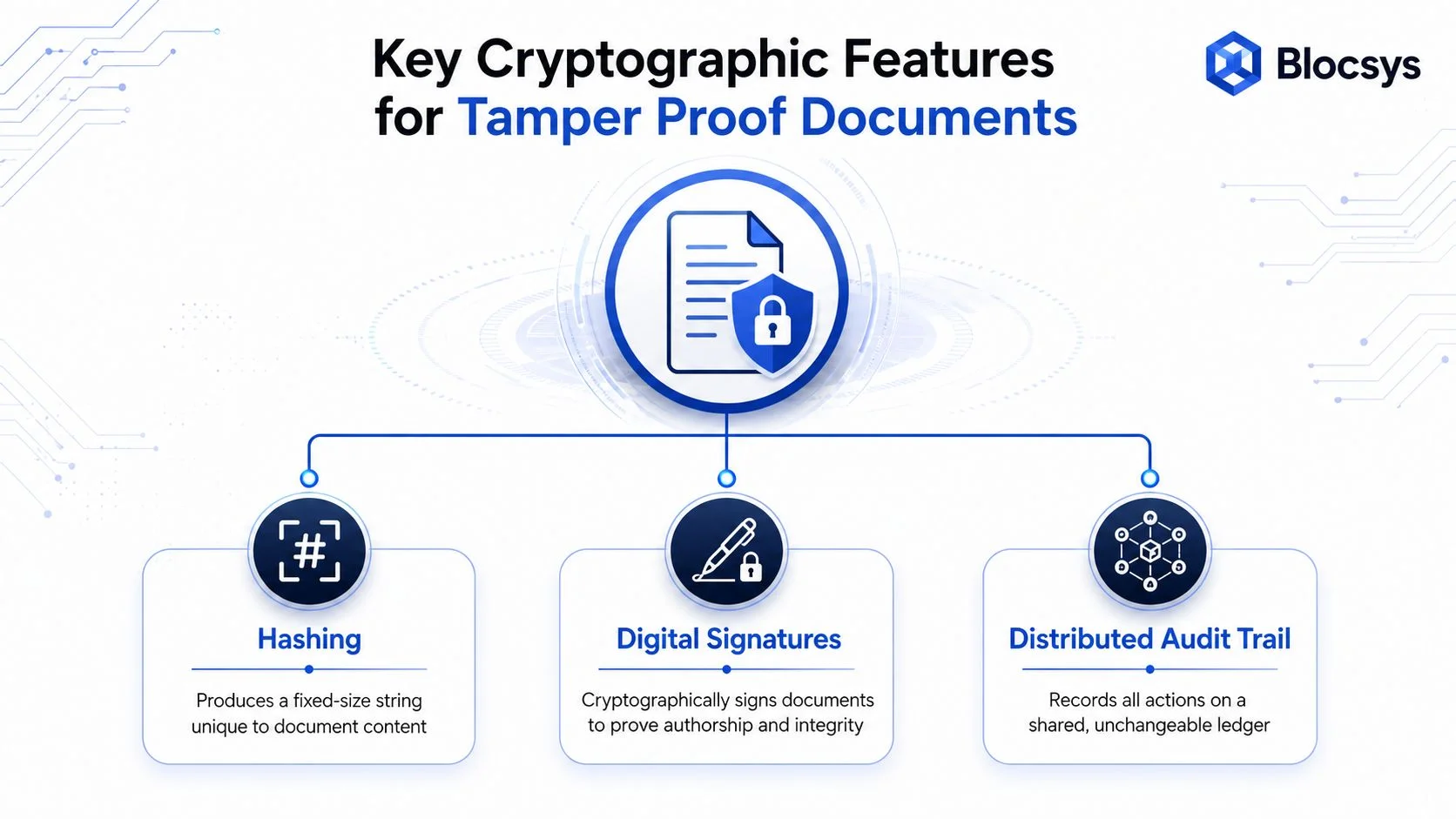
The reason blockchain document verification works is not magic, it’s the combination of three cryptographic layers that reinforce each other. Hashing proves whether the file changed. Digital signatures tie a record to an author or issuer. A distributed audit trail shows when actions happened and who interacted with the record. Together, they turn a document from something that can be edited in place into something that can be checked against an unchangeable history.
Hashing gives every file a fingerprint
Hashing converts a document into a fixed digital fingerprint. The useful property is not secrecy, it’s sensitivity. Even a tiny change, like a character edit or an altered metadata field, produces a different result. That’s why document verification systems can compare the current version with the on-chain reference and instantly flag a mismatch. In practice, that’s the simplest anti-fraud control in the stack, and the one implementation teams understand fastest.
Digital signatures prove authorship and intent
A signature is not just a name on a file, it’s a cryptographic assertion that connects a document to a specific identity or key. In enterprise workflows, that matters for authorisation, approval, and non-repudiation. If a contract, certificate, or internal approval record is signed digitally and then anchored to a blockchain proof, the organisation gets two layers of evidence, who issued it and whether it stayed unchanged.
Audit trails preserve the story
A document is rarely important in isolation. Teams need to know when it moved, who touched it, and which version was active at each step. That’s where a distributed audit trail helps. It records actions on a shared ledger instead of leaving them buried in one application log that could be edited or lost. For high-stakes workflows, that kind of traceability is what makes blockchain document authentication useful in an actual dispute, not just in a demo.
The general pattern is simple enough to repeat in a control checklist:
- Hash the document state: Create the fingerprint from the exact file content.
- Sign the transaction or issuance event: Bind the record to an authorised identity.
- Anchor the proof on-chain: Store the hash and timestamp in an append-only ledger.
- Verify later by re-hashing: Compare the new file against the stored proof.
Implementation advice: Treat the blockchain as your proof layer, not your document warehouse. That keeps privacy controls cleaner and reduces unnecessary exposure.
The metadata canonicalisation issue matters here because two files that look identical to users can still hash differently if their underlying metadata changes. That’s one of the first issues a serious implementation team should test before rollout.
Integrating AI and Blockchain for Advanced Verification
AI makes document security more proactive, while blockchain makes it more defensible. Used together, they cover different failure modes. AI can flag suspicious patterns before a human ever opens the file, while blockchain can prove whether the current file still matches the record that was originally anchored.
Where AI adds value
Machine learning is useful when the fraud is subtle. It can inspect formatting anomalies, inconsistent metadata, unusual submission patterns, or signs that a file was reconstructed from multiple sources. That matters in workflows where fraud isn’t obvious from a single visual inspection, especially when reviewers are handling large volumes of documents under time pressure. AI doesn’t replace cryptographic proof, it reduces the number of files that need manual escalation.
The design gain comes from pairing that detection with a ledger check. A flagged document can be compared against the immutable record, so the team is not just asking “does this look odd?”, it’s asking “does this file still match what was originally issued?”.
Where blockchain adds legal weight
Blockchain doesn’t automatically make a document admissible or fraud-proof in court. That point is easy to miss and it causes a lot of bad architecture decisions. U.S. legal standards still require authentication, chain of custody, and preservation of off-chain evidence such as wallet addresses, transaction hashes, communications, and timestamps to prove fraud or breach as noted in the legal guidance on blockchain action in NYC.
The right workflow therefore combines AI triage with evidence preservation. The AI system highlights anomalies, the blockchain anchor proves integrity, and the legal team keeps the off-chain materials that show how the record was created and handled.
A practical operational pattern
A clean enterprise workflow usually looks like this:
- A document enters the pipeline.
- AI screens it for anomalies or inconsistent attributes.
- The approved version is hashed and anchored to the ledger.
- Later submissions are re-hashed and checked against the record.
- Any mismatch triggers an investigation with preserved metadata and communications.
The Blocsys AI and blockchain verification concept aligns with that combined model, especially for organisations that want verification, fraud detection, and workflow automation in one system.
Compliance and Legal Requirements for Blockchain Evidence
US legal teams should be careful with one common assumption, that a blockchain timestamp alone is enough. It isn’t. Federal Rule of Evidence 901 still requires the proponent to show the record is what it claims to be by proving how the data was collected, preserving hash consistency, and documenting a chain of custody from acquisition to courtroom presentation as stated in the evidence standards reference.
What needs to travel with the on-chain proof
The blockchain record is only one piece of the evidentiary package. Legal, compliance, and forensic teams still need off-chain documentation that explains where the file came from, who handled it, and how it was preserved. That usually means keeping transaction hashes, wallet or account identifiers where relevant, timestamps, communications, and logs that show the file’s path through the workflow.
A few points deserve attention:
- Collection method: Keep a clear record of how the document was acquired.
- Hash consistency: Verify that the hash used in evidence matches the one originally anchored.
- Chain of custody: Record each handoff, system, or person involved.
- Supporting metadata: Preserve the context that proves the document’s origin and handling.
- Qualified declarations: Use formal attestations where the relevant statute or procedure expects them.
Why immutability is not the same as admissibility
Immutability answers one question, whether the proof changed after anchoring. Admissibility answers a broader one, whether the court or regulator can trust the evidence package as presented. Those are related, but they are not interchangeable. Vermont’s 12 V.S.A. §1913 treats a blockchain record as admissible and authentic when supported by a qualified written declaration, while federal practice still expects chain-of-custody proof and hash verification as summarised in the admissibility coverage.
That distinction matters for procurement conversations too. If a vendor promises that blockchain will “solve” legal admissibility on its own, the claim is too broad. The stronger promise is narrower and more useful, blockchain can provide a verifiable integrity layer, while the organisation maintains the off-chain evidence required by legal procedure.
A ledger can prove a record did not quietly change, but your legal file still has to prove how that record was created, moved, and preserved.
US Use Cases and Implementation Considerations
The strongest US use cases appear where several parties need to rely on the same record without depending on one party’s database. Finance teams want clean transaction authorisations. Healthcare teams need auditable document handling. Educational institutions need credential verification. Government agencies need records that can withstand challenge.
A simple way to understand the fit is to separate the document itself from the proof around it. The document can remain in the system that must handle privacy, permissions, or workflow control. The blockchain layer anchors evidence about that document, so later reviewers can confirm whether the file they see is the same one that was originally approved, signed, or issued.
Where the pattern fits best
For property and public-record workflows, blockchain document verification helps anchor title-related proofs without replacing the full land administration stack. In healthcare, it can support integrity checks for records and authorisations while sensitive data stays in compliant systems. In education, it can support credential authenticity checks. In legal and insurance environments, it helps verify signed forms, settlement records, and claims documents where version disputes can become expensive quickly.
The Bloomberg Law guidance is useful for implementation teams because it focuses on reproducibility, not only immutability. For US litigation and compliance, blockchain evidence should capture the full transaction context, including block number, transaction hash, timestamps, sender or receiver identifiers, and related metadata, then preserve hash consistency from acquisition through courtroom presentation as noted in the Bloomberg Law insight. That is the level of traceability teams should design for.
Startup and enterprise approaches differ
Startups usually need a narrow, high-value workflow first. Enterprises usually need integration across document management systems, identity systems, and audit processes. The technical core is similar, but the rollout strategy is not. A startup can launch with a single verification path. An enterprise often needs governance, permissions, logs, and legal review before the first pilot goes live.
| Phase | Startup Approach | Enterprise Approach |
|---|---|---|
| Discovery | Pick one document type with recurring fraud risk | Map document classes, owners, and legal controls |
| Design | Build a narrow hash and verify flow | Define governance, identity, logging, and retention rules |
| Pilot | Test with one workflow and one team | Test across departments and evidence requirements |
| Integration | Connect to a single document system | Integrate with DMS, ERP, IAM, and audit tooling |
| Rollout | Expand only after manual validation | Expand by business unit with compliance sign-off |
A useful implementation habit is to start with one control question, not a platform question. If the team cannot clearly answer what problem it needs to solve, the architecture can drift into feature sprawl.
For teams building a broader product strategy, Blocsys’s home page shows the company’s blockchain and AI development focus, and it can be one reference point among several vendors when you are comparing solution partners. If you need a narrower scoping exercise, the project team can use a cost estimator to frame the conversation before engineering begins.
Why Choose Blocsys and Next Steps
The core case for immutable blockchain records is simple. They make document tampering detectable, they preserve a verifiable history, and they give legal and compliance teams a proof layer that is stronger than editable databases alone. The bigger lesson is that blockchain works best when it is treated as part of a document integrity system, not as a standalone promise. AI can flag suspicious files, the ledger can anchor proof, and the legal team can retain the off-chain evidence needed for admissibility.
That is where implementation quality starts to matter more than the headline concept. Teams need a design that respects data privacy, preserves hash consistency, keeps chain-of-custody records intact, and fits the actual evidence requirements of US organisations. They also need a build partner that understands enterprise software, not just blockchain terminology. Blocsys builds blockchain and AI-powered systems that can support document verification workflows, digital identity components, smart contract logic, and compliance-oriented platforms, which makes it relevant for teams planning a serious rollout rather than a one-off demo.
A practical next step is to assess one high-risk document flow and map three things, where the file is created, where the proof is anchored, and what off-chain evidence must be preserved. After that, the team can define a pilot, choose its verification rules, and set the KPIs that matter to legal, audit, and operations. That sequence keeps the project grounded in actual risk reduction instead of abstract technology buying.
If your organisation is evaluating blockchain document verification platforms, AI-powered verification systems, or an enterprise architecture for tamper-evident records, contact Blocsys for an implementation discussion and a solution fit review.
Frequently Asked Questions
What are immutable blockchain records?
Immutable blockchain records are tamper-evident digital records whose integrity can be independently verified against information anchored to a blockchain. For document verification, organisations typically store a cryptographic hash, timestamp, and transaction information on-chain while keeping the original document in a secure off-chain repository.
How does blockchain prevent document fraud?
Blockchain helps prevent document fraud by creating a verifiable record of a document’s original state. A document is hashed before its proof is anchored to the blockchain, and if the document is later modified, its new hash will no longer match the original blockchain record, making the alteration detectable.
How does blockchain document verification work?
Blockchain document verification works by hashing a document, anchoring the resulting fingerprint to a blockchain, and later re-hashing the document to compare it with the original proof. Digital signatures can establish who issued or approved the document, while the blockchain provides a tamper-evident record that helps verify whether the document has changed.
Does blockchain store the entire document?
No, blockchain document verification does not require storing the entire document on-chain. A more privacy-conscious architecture stores the original document in a secure off-chain system and places only its cryptographic hash, timestamp, and relevant transaction context on the blockchain. This approach reduces unnecessary exposure of sensitive information while preserving verifiable document integrity.
What types of documents can be verified using blockchain?
Blockchain document verification can be used for documents such as contracts, property records, academic credentials, employment records, medical documents, insurance claims, transaction authorisations, certificates, and compliance evidence. The strongest use cases are documents where authenticity, version history, and proof of issuance are important for legal, financial, regulatory, or operational decisions.
How do AI and blockchain work together for document verification?
AI and blockchain address different parts of document verification: AI can identify suspicious patterns or anomalies, while blockchain can provide cryptographic proof of whether an approved document has changed. A combined workflow can use AI to flag unusual formatting, metadata, or submission behaviour and then compare the document against its blockchain-anchored proof to determine whether its integrity has been compromised.
Are blockchain records legally admissible in US courts?
Blockchain records are not automatically admissible in US courts simply because they are stored on a blockchain. Legal teams may still need to establish authenticity, preserve chain-of-custody information, demonstrate hash consistency, and retain supporting evidence such as transaction records, timestamps, communications, and relevant metadata. Immutability provides an integrity layer, but admissibility depends on the broader evidence package.
What is the difference between blockchain immutability and document authenticity?
Blockchain immutability means that a previously recorded blockchain entry is designed to resist unauthorised alteration, while document authenticity concerns whether a particular document is genuinely what it claims to be and came from the claimed source. A strong document verification system combines blockchain integrity with digital signatures, identity controls, chain-of-custody records, and evidence about how the document was created and handled.
Can blockchain document verification protect sensitive US records?
Yes, blockchain document verification can help protect sensitive records when the architecture keeps the actual documents off-chain and stores only the minimum required proof on the blockchain. Organisations can combine secure document repositories with encryption, access controls, identity management, and blockchain-based integrity proofs to reduce the risk of exposing confidential information while maintaining verifiability.
What are the benefits of blockchain-based document authentication for enterprises?
The main benefits of blockchain-based document authentication for enterprises include tamper detection, independent verification, traceable document history, stronger auditability, reduced reliance on a single database, and faster investigation of disputed records. These benefits are particularly valuable for legal, healthcare, education, finance, insurance, government, and compliance workflows where document integrity has significant operational or legal consequences.
How much does it cost to build a blockchain document verification platform?
The cost of building a blockchain document verification platform depends on factors such as blockchain architecture, document storage, hashing and verification workflows, digital signatures, identity management, AI-based fraud detection, API integrations, access controls, audit trails, security requirements, and compliance needs. A focused verification system for one document type generally costs less than an enterprise platform integrated with document management, identity, ERP, audit, and legal workflows.
A CTA for Blocsys Technologies.
